
A European buyer’s guide to five-job equipment planning, PTO and hitch compatibility, whole-life cost and selecting a suitable OXPLO tractor.
A 50 HP tractor can power a mower in the morning, cultivate a plot after lunch and tow feed to a livestock yard before the day ends. That sounds efficient—until a tiller needs more PTO power than expected, a loader kit lacks the correct hydraulic arrangement or a tractor cannot pass through an old farm gate.
The real buying decision is not “How many attachments are included?” It is which configuration can complete the farm’s recurring jobs, safely and economically, through the full season. A well specified tractor and implement package has to work as a system: tractor, implement, driveline, hydraulics, tyres, ballast, operating space and paperwork.
This technical guide is written for European farmers, agricultural contractors, dealers and purchasing teams. It examines five common jobs, the failure points that increase ownership cost, and a practical way to compare 40, 50 and 60 HP tractors without treating horsepower as the only deciding factor.
I. Why Multi-Implement Purchases Fail in Real Farm Work
The hidden problem: machines are bought as separate line items
Mixed farms rarely have a single repeatable operation. A pasture may need topping every few weeks, a field needs cultivation in a short weather window, and a farmyard needs transport and materials handling almost every day. Buying the tractor, mower, tiller and trailer from separate quotations can leave nobody responsible for verifying the assembled package.
Three avoidable failures are particularly expensive. A PTO-driven implement may need more verified PTO horsepower, not merely the advertised engine rating. A mounted attachment may fit the linkage pins but exceed the approved lift or stability limits. And a front loader may be quoted without the proper mounting arrangement, control valves, bucket specification or ballast.
Why these mistakes affect the whole business
For an owner-operator, the immediate consequence is extra hours or having to replace an unsuitable implement. For a European dealer, it can mean delayed handover, unresolved warranty responsibilities and equipment occupying stock space. The cheapest initial package becomes costly when installation and troubleshooting are added after delivery.
A stronger purchasing method is to define the expected work first, then request one written configuration that lists all tractor and attachment interfaces. Buyers seeking background on size selection can also review this guide to choosing farm tractor horsepower.
II. Define the Farm Workload Before Comparing 40, 50 and 60 HP
Map task frequency, terrain and the limiting operation
Consider an illustrative 14-hectare Central European mixed farm with pasture, cultivated plots, a small orchard and farm buildings. Its five recurring activities are mowing, tillage, transport, loader work and fertilizer spreading. A useful procurement brief records not only the hectares but also the number of seasonal passes, peak-period deadlines, soil type, trailer route and gateway dimensions.
Workstream | What to record | Likely limiting factor |
Pasture mowing | Area, vegetation density, cutting window | PTO output and working width |
Rotary tillage | Soil, target depth, seasonal hectares | PTO load, gearbox and traction |
Transport | Loads, trip length, grades, road use | Tow limits and braking |
Yard loading | Material, lift height, frequency | Loader rating and stability |
Spreading | Fertilizer mass, width and target rate | Linkage load and calibration |
Define the most demanding frequent job rather than the most impressive occasional job. A rare heavy task may justify equipment hire; a weekly task should influence the tractor configuration. If implements must be changed often, include the time required for safe removal, alignment and connection in the schedule.
Engine HP is not PTO HP—and neither is lift capacity
A 50 HP engine rating is not a 50 HP PTO rating. Transmission losses and the tractor’s configuration affect output at the PTO shaft. Similarly, a published three-point lift figure is meaningful only when the measurement position is specified. The correct method is to compare the implement maker’s minimum requirements with the actual tractor configuration proposed for the order.
A quick choice between 40, 50 and 60 HP
A compact 40 HP model deserves consideration when access, routine mowing and light-to-moderate compatible implements dominate. A 50 HP compact model may add useful engine reserve without a larger footprint. A 60 HP utility platform becomes relevant when recurring work calls for a different hitch category, longer wheelbase or broader gear choice—not just another 10 HP.
On restricted sites, dimensions can outrank power. An illustrative 1.70 m-wide gate admits neither a listed 1.76 m-wide machine nor any wider configuration; even a tractor listed at 1.56 m leaves only 140 mm of nominal total clearance before allowing for tyre variation, obstacles and safe manoeuvring. Confirm the complete installed width and height, including loader and tyres, before ordering.
III. One Tractor, Five Daily Farm Jobs: A Practical Attachment Plan
A practical tractor and implement package for a small farm starts with the jobs performed most often, not the number of implements included in a promotional bundle. Each tool below should earn its place through regular use, confirmed compatibility and realistic operating cost.
Job 1 — Mow pasture without oversizing the cutting equipment
Typical implement: a compatible rotary mower or flail mower. Pasture management, orchard-floor mowing and estate upkeep sound similar, but the vegetation, soil and finish required are different. A flail mower may suit uneven or mixed vegetation where mulching is useful; a rotary mower may be more appropriate for open cutting conditions. Neither is automatically the right choice for every property.
Check the mower’s mass, working width, required PTO speed, minimum PTO horsepower, guarding, local obstacles and turning width. Dense grass can force a wider mower to travel more slowly, eliminating its theoretical productivity gain. For horse properties, check for stones, wire and potentially harmful plants before mowing; this horse-property tractor guide discusses those operational differences.
Failure to avoid: selecting a 1.8 m mower simply because it is wider than a 1.6 m option. Only compare coverage after confirming the tractor can sustain the required cutting speed and quality.
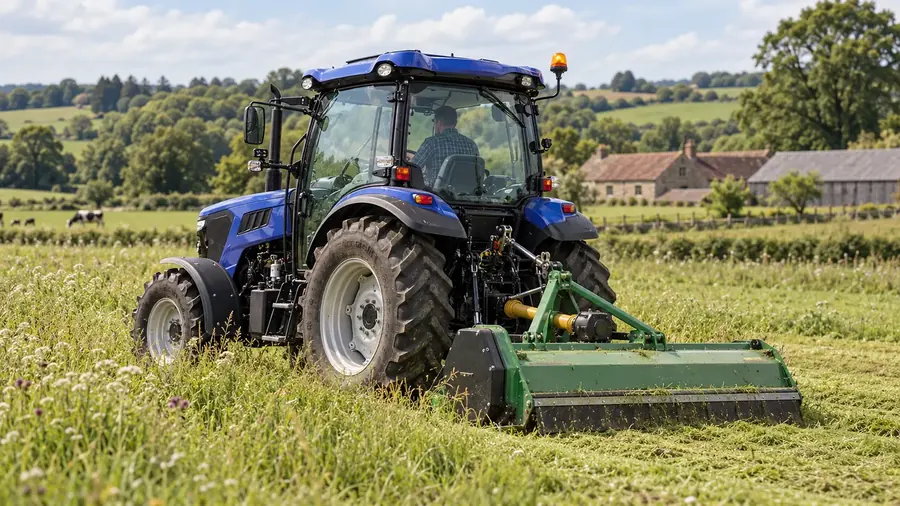
Figure 1. Pasture Mowing — Blue OXPLO-style 4WD cab tractor operating a rear flail mower.
Job 2 — Prepare soil without overstressing the PTO driveline
Typical implement: a rotary tiller. Soil texture, moisture, crop residue, forward speed and working depth determine the load placed on its rotor and driveline. A tiller that works comfortably in prepared light soil can overload a compact tractor in wet clay or compacted ground.
A suitable tractor with rotary tiller and trailer should be specified for two distinct modes: stationary-power-transfer demands during tillage and drawbar/braking demands during haulage. For the tiller, confirm PTO power and rated speed, spline and shaft geometry, gearbox protection, working width, depth and rear-linkage capacity. If resistance increases, reducing tilling depth or making staged passes may be more effective than continually loading the engine.
Failure to avoid: assuming a different PTO speed can be used to obtain more cutting capacity. The implement must run at its specified speed with appropriate guarding and driveline overlap. For additional ground-engaging implement selection, see the tractor and disc-harrow matching guide.
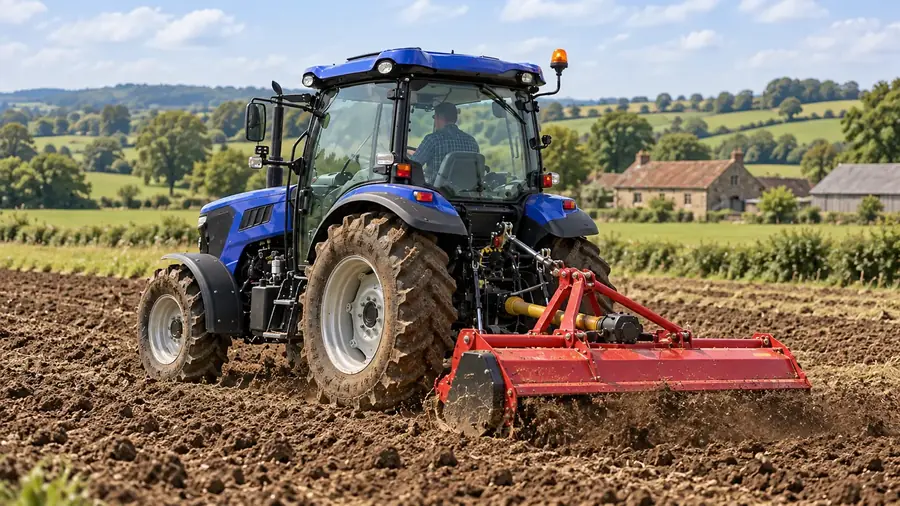
Figure 2. Soil Preparation — Blue OXPLO-style 4WD cab tractor with a PTO-driven rotary tiller.
Job 3 — Transport farm materials safely between work areas
Typical implement: an agricultural trailer. Feed, harvested produce, fencing supplies and fertilizer often travel between dispersed plots, storage yards and barns. A trailer can cut repeated small-load trips, but rated trailer payload is not the same as a tractor’s permitted towing capacity.
Verify approved tow mass, drawbar connection and vertical load, trailer brakes, combined mass, tyres, ground slope and any public-road requirements. Never attach a heavy towed load to an improvised elevated point: the hitch geometry affects overturn risk. For public-road journeys, the vehicle and trailer must satisfy the applicable registration and equipment rules.
Failure to avoid: comparing “3-tonne trailers” without knowing whether the tractor–trailer combination can brake, turn and climb safely with its actual load.
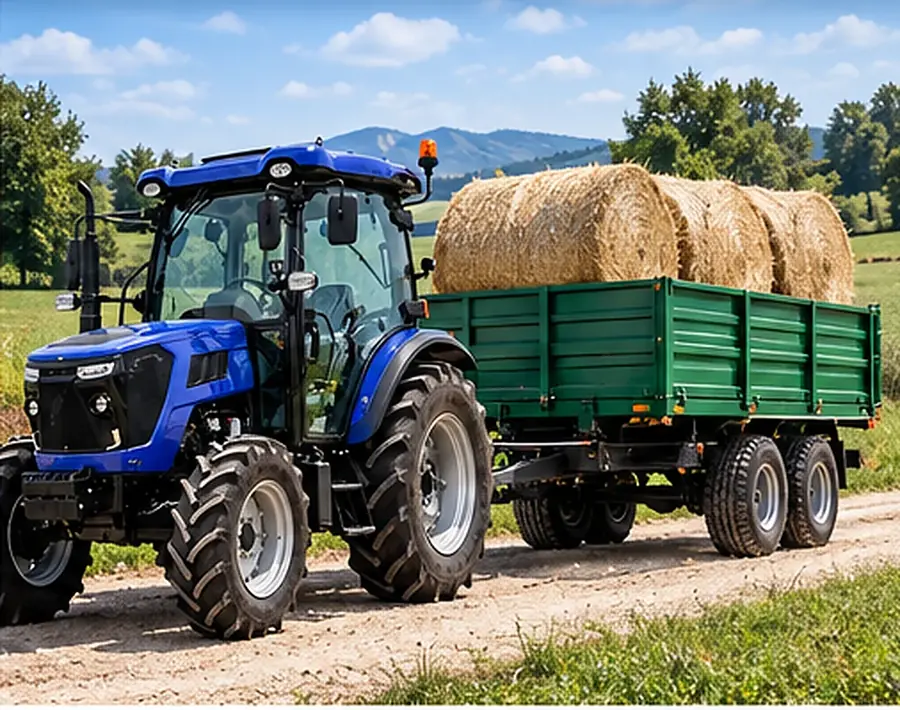
Figure 3. Farm Transport — Blue OXPLO-style tractor towing a hay trailer along a farm track.
Job 4 — Move materials without treating hydraulic power as safe payload
Typical implement: an approved front loader and suitable bucket or handling tool. Loader work is often the deciding job for livestock farms: daily movement of feed, manure, soil or bagged material puts repetitive demands on the machine. A 4WD tractor with mower and loader may cover both field and yard work, but only when the full configuration is approved.
A quoted loader lift figure may be measured at a specified pivot point or height and may not equal usable bucket payload. Attachment weight, load centre, front-axle rating, tyre capacity, hydraulic connections and the need for rear ballast must all be reviewed. Transport loads close to the ground and avoid raising loaded equipment on uneven terrain.
Trade-off: for intermittent light loading, an integrated loader may be economical; for continuous heavy handling, a dedicated forklift or loader may be better suited than overworking a farm tractor. The agricultural handling workflow explains how field transport and storage handling can be divided between machines.
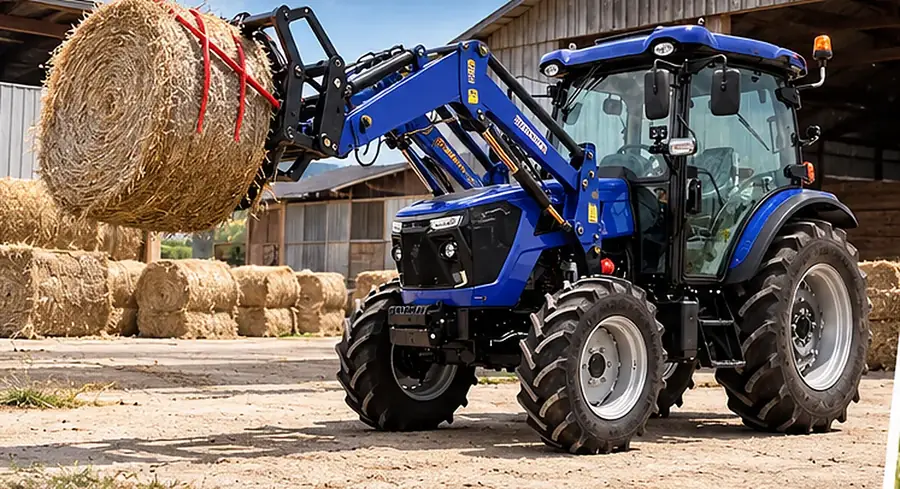
Figure 4. Material Loading — Blue OXPLO-style tractor using a front-loader bale-handling attachment.
Job 5 — Spread fertilizer accurately and within hitch limits
Typical implement: a mounted fertilizer spreader. The filled mass—not merely the hopper’s nominal capacity—determines rear-linkage loading and affects balance. Check the empty weight, fertilizer bulk density, load centre, PTO or hydraulic drive, and the required spreading width.
Application accuracy depends on calibration for the actual material and on ground speed. A spreader bought cheaply but used without correct calibration can waste fertilizer and produce uneven growth. On farms where spreading is rare but access-track maintenance is frequent, an approved grader blade may be a better fifth attachment.
This is the central lesson for mixed farm tractor equipment: the package should reflect the jobs that recur, not a fixed list of “free” implements. For farms combining crops and spraying, OXPLO’s tractor spraying selection guide is a related reference.

Figure 5. Fertilizer Spreading — Blue OXPLO-style 4WD cab tractor with a rear-mounted spreader.
Image note: Illustrative AI-generated scenes based on supplied OXPLO tractor reference photos; actual tractor/attachment compatibility must be confirmed.
IV. Six Compatibility Checks to Complete Before Paying a Deposit
Power and connection: PTO output, speed, splines and protection
Obtain the tractor’s verified PTO output, available PTO speed(s), shaft specification, the implement’s minimum power requirement and overload-protection arrangement. Engine HP alone cannot approve a powered implement. The delivered PTO speed combination should appear on the confirmed quotation, especially where a manufacturer lists alternative configurations.
Rear hitch: category, geometry and real lift position
Confirm Category I or II, pin diameters, lower-arm spacing, top-link geometry and operating clearance. Ask whether the quoted lift capacity is measured at the ball ends or at a distance behind them. Category adapters do not overcome excess attachment weight or unsuitable geometry.
Hydraulics: pressure and usable flow, not just outlet count
Front loaders and tipping trailers may have different valve and coupling requirements. Confirm pump delivery under the stated operating conditions, hydraulic pressure, available remote valves, return connections and whether any loader installation requires additional hardware.
Stability: tyres, ballast, axle ratings and gradients
4WD improves traction in many conditions but does not cancel rollover risk or prevent compaction. The combined tractor, ballast and attachment must stay within axle and tyre ratings. Review slopes, turning areas and soil conditions using the operator’s manual and the approved equipment configuration.
Access: actual envelope with attachments installed
Measure entrances, tree rows, barn clearance and turning space. Listed chassis width is not always the maximum width with the chosen tyres, loader and other equipment installed. A compact tractor cannot solve a clearance problem that was never measured.
Responsibilities: obtain one configuration sign-off
Before dispatch, ask for a consolidated specification with tractor serial/model identification, selected implements, hitch/PTO/hydraulic arrangement, ballast recommendations, safety equipment and the person responsible for confirming fit. OXPLO lists attachments and parts support as part of its equipment offering; each buyer should still confirm the exact supplied attachment models and support conditions.
V. European Procurement: Compliance, Documents and Serviceability
For an importer or dealer, the tractor and implement package is also a documentation, delivery and service project. A mechanically suitable machine can still become an expensive problem if road eligibility or support obligations are unclear.
Mechanical compatibility is not the same as EU road eligibility
Regulation (EU) No 167/2013 provides the EU type-approval framework for agricultural and forestry vehicles within its scope. Engine-emission obligations and national registration or road-use rules also matter. A tractor can work on private land yet lack the documentation required for its planned use on public roads in a particular destination country.
Ask for evidence covering the specific vehicle type and as-built configuration: relevant vehicle approval, Certificate of Conformity where required, engine/emissions documentation, lighting and braking equipment, tyres, operator protection and identification. A generic “CE certificate” image is not a substitute for the correct vehicle approval documents. See the EU tractor COC and road-registration checklist for additional questions.
What changes by farm and destination
A Polish agricultural dealer supplying farms with separated plots may need to prioritize trailer braking and road-registration questions. An Italian orchard purchaser may place greater weight on overall width, headland turns and canopy clearance. A wet-ground grassland buyer may prioritize tyre choice and traction. These are scenario examples—not assumptions that every farm in one country has the same needs.
After-sales availability is part of total cost
Buyers should request the identification process for consumables and spare parts, the supplied maintenance documents, service responsibilities, lead-time estimates and any exclusions from warranty coverage. Dealers in particular need clarity on how support requests are handled. OXPLO describes its equipment and after-sales approach, but the purchase agreement should specify the actual conditions for the order.
VI. Estimate Real Productivity and Total Cost of Ownership
Field capacity: why a wider mower can finish later
A planning estimate for effective field capacity is ha/hour = working width (m) × working speed (km/hour) × field efficiency ÷ 10. This is a calculation method, not a guaranteed result. Field shape, turns, downtime, grass density and operator behaviour affect the result.
Illustrative scenario | 1.6 m mower | 1.8 m mower |
Actual working speed | 5.0 km/h | 4.4 km/h |
Assumed field efficiency | 70% | 70% |
Effective capacity | 0.560 ha/h | 0.554 ha/h |
Estimated 6 ha mowing time | 10.7 hours | 10.8 hours |
The wider machine saves no meaningful time in this example because operating speed falls. Buyers should estimate realistic speed under their own vegetation and terrain rather than using only catalogue width.
Implement-change time and ownership cost
Small amounts of nonproductive time accumulate. Illustrative example: four attachment changes per week at 15 minutes each over 30 working weeks equal 30 hours a season. A quick, consistent changeover arrangement may have commercial value, but only if the actual equipment allows safe and correct connections.
For price comparisons, calculate total cost of ownership (TCO) = purchase and setup + finance + fuel + labour + maintenance + repairs + downtime cost − residual value. Include freight and any compliance-related configuration costs. A farm tractor package price is only useful if the quotation specifies what is included.
Illustrative additional-package economics | Annual effect |
70 labour hours avoided × €22/hour | €1,540 benefit |
Avoided equipment hire | €1,300 benefit |
Additional servicing and consumables | −€440 cost |
Net annual operating benefit | €2,400 |
If incremental package cost is €8,400 | 3.5-year simple payback |
All figures are hypothetical; they are not OXPLO customer results or product quotations. The example excludes financing timing, tax effects and discounting. Replace the inputs with local wages, utilisation, dealer prices and documented downtime before making a capital decision.
VII. Which OXPLO 40–60 HP Tractor Matches the Workload?
OXPLO OXT404 — 40 HP when manageable access is essential
The OXPLO OXT404 40 HP 4WD tractor is listed with an 8F+8R gearbox, Category I rear linkage, 540/1000 rpm PTO and 1,560 mm overall width. It is an appropriate starting point to evaluate where frequent work involves suitable mowing, lighter cultivation and seasonal transport with compact Category I equipment.
The buying advantage is not a promise of unlimited implement choice: it is the ability to compare a 40 HP 4WD platform without automatically moving to a wider utility chassis. PTO output, lift capacity and any loader arrangement still need model-specific confirmation.
OXPLO OXT504 — 50 HP on the listed compact 1,560 mm platform
The OXPLO OXT504 50 HP tractor is the key option for a 50 HP tractor attachment package where access remains restricted. OXPLO lists 50 HP engine output, 4WD, 8F+8R gears, Category I linkage, a 1,800 mm wheelbase and 1,560 mm overall width. Its product specification lists a 540/720 rpm PTO combination; because published specifications may differ across pages or options, the supplied PTO arrangement must be confirmed in writing.
For buyers whose workload has grown beyond occasional field maintenance, OXPLO OXT504 adds engine-power reserve compared with OXT404 while retaining the published compact width. The boundary is the Category I platform: the extra horsepower does not itself authorize heavier Category II attachments or a particular front-loader payload.
OXPLO OXT604 — 60 HP and the step to Category II
The OXPLO OXT604 60 HP utility tractor moves to a different platform. OXPLO lists 12F+12R gears, Category II linkage, 540/760 rpm PTO, a 2,010 mm wheelbase and 1,760 mm overall width. This difference affects implement selection and site access—not merely rated engine power.
OXPLO OXT604 is worth comparing for recurring mixed-farm operations that may benefit from a larger utility chassis and appropriately matched Category II implements. However, buyers with narrow entrances or an existing inventory of Category I attachments must check compatibility, machine envelope, towing arrangements and loader approval before selecting it.
A buyer-oriented summary
Operating priority | OXPLO model to evaluate | Non-negotiable question |
Narrow access, routine mowing and light cultivation | OXT404 | Do PTO and Category I limits fit the implements? |
More frequent PTO work without wider compact chassis | OXT504 | Is the final PTO arrangement and lift capacity suitable? |
Larger utility jobs and Category II requirements | OXT604 | Will the wider chassis fit, and is the loader approved? |
These are selection starting points, not capacity guarantees. Explore the full OXPLO tractor range and the OXPLO implement catalogue when building an equipment shortlist.
VIII. A Procurement Checklist for an OXPLO Tractor Package
A properly quoted tractor and implement package should identify the complete installed system and the documents the buyer will actually receive. The same checklist helps farmers compare quotations and helps distributors reduce specification disputes.
Send a short, complete technical brief—not just “quote 50 HP”
A productive inquiry includes the following information so the supplier can review the complete configuration rather than guessing from horsepower:
- Destination country and intended private-land or public-road use.
- Farm size, crops/livestock, soil type and most frequent tasks.
- Minimum gateway/row width, building height and typical slopes.
- Required mower, tiller, trailer, loader and spreader specifications—or existing implement model numbers.
- Expected seasonal workload, preferred operator station and tyre arrangement.
- Required conformity documents, delivery location, spare-parts needs and target purchasing window.
Ask for written confirmation of the complete system
OXPLO’s tractor configuration and quotation page describes assistance with model selection, attachment matching, market documents, shipping plans and after-sales information. Ask OXPLO to itemise tractor specification, attachment part/model numbers, included PTO and hydraulic connections, approved loader and ballast configuration, freight terms and the documents supplied for the destination.
Before shipment, request the agreed pre-dispatch checks and photo/video evidence where available. This helps a dealer or end user identify configuration differences before the machine is handed over. For a tailored review, contact OXPLO’s European sales team with the workload map and implement list.
IX. Frequently Asked Questions
Q1. Is a 50 HP tractor enough for a small mixed farm?
A1. Often, but only where the frequent jobs and selected implements remain within the tractor’s actual PTO, hydraulic, hitch, towing and stability limits. For restricted access, the OXPLO OXT504 is a compact option worth evaluating; the final attachment list still requires approval.
Q2. Can one tractor run a mower, rotary tiller, trailer, loader and spreader?
A2. One tractor may be configured for all five tasks at different times, but it does not follow that any five attachments will fit. Check implement changeover, rear linkage, PTO output, loader hydraulics, axle loading and safe ballasting. Some farms may find hired equipment more economical for rare heavy jobs.
Q3. Is a 60 HP machine automatically better than a 50 HP model?
A3. No. The OXPLO OXT604 offers a larger Category II working platform, whereas the OXPLO OXT504 retains a 1,560 mm listed width and Category I linkage. Site access, existing implements and expected hours can matter more than the 10 HP difference.
Q4. What should be included in an OXPLO tractor and implement package quotation?
A4. Request the specific tractor and implement models, tyres, operator station, PTO speed and spline, hydraulic valves, hitch category, required loader/ballast kit, shipment terms, warranty conditions, market documents and spare-parts process. Avoid accepting a price that omits essential installation parts.
Q5. What affects the farm tractor package price most?
A5. The model and power class, loader and implement selection, tyre/hydraulic options, documentation, shipping conditions and after-sales requirements all change the quote. Compare equivalent, fully specified configurations and model expected operating cost—not the headline price alone.
Q6. Can my existing Category I implements be used on an OXPLO OXT604?
A6. Some attachments may be adaptable, but a connection adapter does not guarantee safe operation. Provide pin dimensions, implement mass and centre of gravity, PTO specifications and working geometry. Confirm the mounting and operating arrangement before buying.
Q7. Does every OXPLO tractor arrive with EU road-registration documentation?
A7. Do not assume this. Confirm applicable EU type approval, Certificate of Conformity and engine/emissions documentation for the exact vehicle and destination. The required paperwork can depend on model, version and intended use, and must be checked before order confirmation.
X. Conclusion: Buy a Working System, Not Five Separate Attachments
A 40–60 HP tractor earns its place on a mixed farm by completing repeated jobs with manageable downtime and ownership cost. Mowing, tillage, towing, loading and spreading impose different demands; a well-designed tractor and implement package accounts for all five before equipment is ordered.
For narrow-access properties, the OXPLO OXT404 and OXT504 provide compact Category I options at different engine ratings. The OXPLO OXT604 offers a larger Category II platform for buyers whose workload and site conditions justify it. The correct choice depends on verified implement requirements, actual dimensions, approved loading and towing configurations, and the destination-market documents.
Next step: Share your farm size, five priority jobs, planned attachments and destination country with OXPLO. Request a written model-and-implement match, a fully itemised quotation and confirmation of the documentation needed for your application. That is how a multi-purpose tractor becomes a reliable working asset rather than an expensive collection of compromises.