
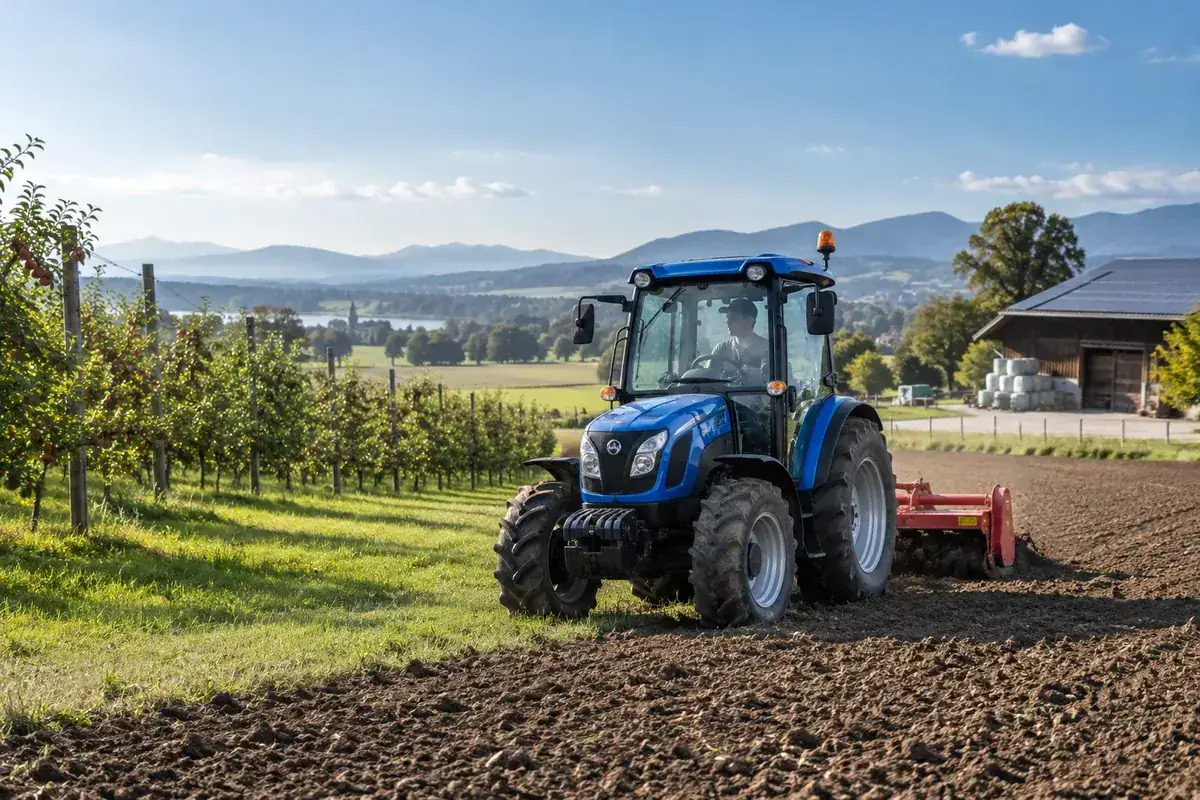
How Much Horsepower Does Your Farm Really Need? OXPLO Tractor Guide
A practical way to choose tractor horsepower from acreage, implements, field conditions, access limits, and the time available to finish the work.
Key Takeaways
- Acreage is a screening input, not a horsepower rule.
- The limiting implement usually sets the minimum useful tractor configuration.
- Engine horsepower, PTO horsepower, drawbar performance, and hydraulic capacity answer different questions.
- Weight, tyres, ballast, hitch category, and dimensions can matter as much as the number on the bonnet.
- A wider implement improves productivity only when the tractor can run it safely at the required speed.
- OXPLO’s current tractor category spans 25 to 70 HP; select the final configuration for the destination market.
Why acreage alone cannot size a farm tractor
Choosing the right farm tractor starts with acreage, but acreage alone does not determine the answer. The same 10-acre property might need a compact machine for mowing and orchard work, or a heavier platform for repeated tillage, loaded trailer work, and short weather windows. The dependable method is to start with the hardest regular job, match the implement requirements, and then check traction, hydraulics, access, and total annual use.
Acreage tells you how much land exists. It does not tell you how much draft, PTO work, lifting, transport, or time pressure the work creates. Crop type, soil resistance, slope, row spacing, field shape, implement width, and the number of working days can change the required tractor size.
Consider two farms with the same area. One may mow a grass field a few times each year and move light materials around a yard. The other may cultivate heavy soil, pull a loaded trailer uphill, and complete several operations between rain events. Their tractor-size decisions should be different even before brands or model names enter the discussion.
For that reason, avoid a fixed “horsepower per acre” formula. Use acreage to estimate workload, then identify the implement and operating condition that will limit the system. A tractor that can technically operate an attachment in dry, level conditions may still be too small to maintain useful speed when the soil is wet or the crop is dense.
The five inputs behind tractor horsepower
1. The implement with the highest regular demand
List every attachment you expect to use over the next three to five years: mower, rotary tiller, plough, disc, planter, spreader, sprayer, baler, trailer, front loader, or pump. For each item, record the manufacturer’s minimum and recommended engine or PTO horsepower, operating weight, working width, hitch category, PTO speed, hydraulic demand, and recommended travel speed.
The limiting implement is not always the widest one. A narrow soil-engaging tool can create more draft than a wider finishing mower. A loader can reach its practical limit through hydraulic flow, lift geometry, front-axle load, or ballast before engine output is the constraint.
2. PTO horsepower versus engine horsepower
Engine horsepower is the rated output at the engine. PTO horsepower is the power available at a PTO-driven implement after driveline losses. Mowers, tillers, balers, chippers, pumps, and spreaders must be matched to the implement maker’s PTO requirement and the tractor’s rated PTO output, not to the engine label alone.
For pulling work, drawbar performance is the relevant question. Tyres, ballast, drive configuration, gearing, soil moisture, slope, and wheel slip determine how much power becomes useful pull. A higher engine rating cannot correct a poor tyre or ballast setup.
3. Field capacity and the available work window
The tractor must complete time-critical work before soil or weather conditions change. A useful planning estimate is:
Effective field capacity (ha/h) = implement width (m) x travel speed (km/h) x field efficiency / 10
Field efficiency allows for turns, overlap, refilling, adjustments, and short stops. Iowa State University Extension uses the same width, speed, draft, and soil-condition logic when matching tractor power to an implement. Its machinery-selection material also shows why required PTO power changes with implement width, travel speed, draft, and soil factor: Farm Machinery Selection.
For an illustrative calculation, a 2.0 m implement travelling at 7 km/h with 75% field efficiency has an effective capacity of 1.05 ha/h. Covering 40 ha would take about 38 working hours. If the reliable operating window is only four eight-hour days, the combination does not meet the schedule even if the tractor can pull the implement.
4. Traction, weight, and ground conditions
Ploughing, discing, trailer work, and loader operations depend on the complete tractor system. Four-wheel drive can help on loose soil, wet grassland, and slopes, but it does not replace correct ballast, tyre selection, or tyre pressure. Too little traction creates wheel slip and lost field capacity. Too much ballast increases rolling resistance, soil compaction, and axle loading.
Evaluate the wettest soil you regularly work, the steepest route you regularly travel, and the heaviest normal transport load. Occasional extreme work may be better hired out than used to justify a much larger tractor that is underutilized for the rest of the year.
5. Access, stability, and the implement ecosystem
Measure the narrowest gateway, orchard row, building entrance, low canopy, headland, and storage bay. Use the tractor’s complete working dimensions with tyres, cab or ROPS, ballast, loader, and implement attached. A 70 HP tractor has no practical value in a row it cannot enter safely.
Three-point hitch category also changes the implement ecosystem. Category I and Category II equipment differ in pin dimensions, lift capacity, geometry, and typical implement mass. An adapter may create a physical connection, but it does not prove that the tractor can lift, steer, brake, and transport the implement safely.
A practical tractor size for acreage guide
The table below is a first-pass screen for a tractor size for acreage decision. It is not an OXPLO acreage guarantee or a substitute for the implement manufacturer’s minimum requirements. The work profile and the limiting implement should move the decision up or down.
| Work profile and acreage context | Initial horsepower class | Typical work profile | Check before selecting |
|---|---|---|---|
| Small acreage with light maintenance | 25 HP class | Mowing, estate or paddock care, light spreading, short transport, light cultivation | PTO requirement, loader use, slopes, and whether the implement fleet is Category I |
| Small or mixed farm with recurring PTO work | 40 HP class | Regular mowing, spreading, light tillage, orchard-floor work, and general transport | Rated PTO output, implement weight, access width, and weather-window hours |
| Mixed farm with more reserve or frequent field work | 50 HP class | More frequent cultivation, grassland work, transport, and PTO applications | Whether additional power solves the bottleneck, or whether weight, hydraulics, or hitch category is limiting |
| Larger or multi-purpose acreage with heavier implements | 70 HP class | Heavier tillage, livestock work, wider implements, loaded transport, and contracting-type utilization | Category II equipment, axle and brake loads, turning space, soil compaction, and annual utilization |
This screen should answer “which class should I investigate?” rather than “which exact tractor will work?” For a 10-acre orchard, row width and canopy clearance may matter more than the acreage. For a 10-acre field with deep tillage and a narrow planting window, implement draft and field capacity may point to a different class.
What changes between 25, 40, 50, and 70 HP?
Horsepower classes often represent different tractor platforms, not only different engines. A useful comparison includes the following:
| Decision factor | Compact 25-50 HP platform | Utility 70 HP platform |
|---|---|---|
| Access | Usually easier around narrow lanes, buildings, and orchard rows | Needs more clearance and turning space |
| Implement system | Often centred on Category I equipment, subject to the exact model | Often configured for heavier Category II equipment, subject to the exact model |
| PTO and draft reserve | Suits lighter or moderate regular loads when the implement matches | Provides more reserve for heavier or wider work when the complete configuration matches |
| Loader and transport work | Confirm hydraulic flow, lift, ballast, and braking carefully | Heavier chassis may support larger work, but loader ratings and axle loads still require confirmation |
| Ownership and utilization | Can be easier to keep productive on small or fragmented acreage | Makes more sense when higher capacity is used frequently or deadlines are tight |
| Main boundary | Heavy implements, steep loaded transport, or repeated full-load work may exceed the platform | Low annual utilization, compaction, storage, and access costs may outweigh unused capacity |
The correct choice is the smallest reasonable platform that completes the farm’s core work with operating margin. “Smallest” does not mean a machine that only works in ideal conditions, and “margin” does not mean buying the largest tractor available.
How to calculate the work requirement before you buy
Use this six-step worksheet with your own implement data:
- List annual operations. Record mowing, tillage, planting, spraying, spreading, hauling, loading, snow work, and any non-farm use.
- Mark the limiting job. Identify the operation with the highest recurring PTO, draft, hydraulic, lift, or transport demand.
- Record the implement requirements. Capture minimum and recommended PTO HP, hitch category, PTO speed and spline, implement weight, hydraulic flow and valves, width, and recommended speed.
- Test field capacity. Multiply width, practical speed, and realistic field efficiency. Compare the resulting hours with the available weather window.
- Check complete dimensions and stability. Measure the narrowest access point and verify steering, braking, axle loading, ballast, and raised-implement stability.
- Compare cost per productive hour. Include depreciation or finance, fuel, maintenance, tyres, labour, implement adaptation, transport, and downtime.
Mississippi State University Extension separates machinery costs into ownership costs, such as depreciation and interest, and operating costs, such as repairs, fuel, lubrication, and labour. It also recommends comparing cost per hour and cost per acre with farm records where possible: Farm Machinery Cost Calculations.
If the largest job occurs only for a few days each year, compare the cost of hiring a contractor or renting a suitable machine with the fixed cost of owning a larger tractor. If the same high-load work appears across several seasons, additional capacity may be easier to justify.
How OXPLO’s 25-70 HP range fits the decision
OXPLO’s current tractor category lists OXT254, OXT304, OXT404, OXT504, OXT604, and OXT704 within a 25-70 HP range. The model name is a starting point for a configuration discussion, not a replacement for the implement matrix above. Review the OXPLO tractor range after you have identified your limiting job and required implement interface.
For a first comparison, buyers can use these model classes:
| OXPLO model class | Publicly listed rating | Use the class as a starting point for |
|---|---|---|
| OXT254 | 25 HP | Light maintenance, mowing, estate or paddock work, and compatible light attachments |
| OXT404 | 40 HP | Compact mixed-farm work with more reserve for recurring mowing, spreading, light tillage, or transport |
| OXT504 | 50 HP | More reserve for regular PTO, grassland, moderate cultivation, and transport work within a compact platform |
| OXT704 | 70 HP | Heavier mixed-farm work, wider or heavier implements, transport, and workloads that justify a utility platform |
Before a quotation is compared, ask OXPLO to confirm the exact engine and PTO output, PTO speed and spline, three-point category and lift capacity, hydraulic flow and valves, tyre and ballast package, dimensions, operating weight, loader or trailer requirements, braking and road-use equipment, and destination-country documentation. These items can change the suitability of a tractor even when the headline horsepower is the same.
What to send OXPLO for a matched recommendation
Use the following information in your enquiry through the OXPLO contact page:
- Destination country and operating location.
- Total acreage, crop or livestock activity, and the share of land actually worked.
- Soil type, steepest regular slope, and typical wet or dry conditions.
- Narrowest gateway, row spacing, lowest overhead clearance, and turning space.
- The main operations and how often each occurs.
- Existing or planned implements, including minimum and recommended PTO HP.
- Implement width, weight, hitch category, PTO speed and spline, and hydraulic requirements.
- Maximum trailer weight, loader lift target, ballast needs, and road-use requirements.
- Expected annual operating hours and the shortest seasonal work window.
- Required cab, ROPS, lighting, braking, emissions, conformity, and documentation for the destination market.
This information gives the supplier enough context to compare a compact OXPLO model with a larger utility platform on actual workload and compatibility. It also helps identify a mismatch before an order is placed.
Frequently Asked Questions
How many horsepower do I need per acre?
There is no reliable fixed horsepower-per-acre rule. Acreage measures land area, while tractor demand comes from implement draft or PTO load, soil, terrain, working speed, access, and the time available to complete the work. Use acreage as a workload input, then size the tractor around the hardest regular operation.
What size tractor do I need for 10, 20, or 50 acres?
The answer depends on what the acreage requires. Ten acres of orchard mowing may favour a compact tractor with the right width and PTO output. Twenty acres of repeated tillage or hay work may require more reserve. Fifty acres with heavy transport or tight planting windows may justify a larger platform. Confirm the limiting implement, field capacity, and complete dimensions before choosing a horsepower class.
Is a 40 HP tractor enough for a small farm?
A 40 HP class tractor can suit regular mowing, spreading, light cultivation, orchard-floor work, and transport when the implements, terrain, hydraulics, and access dimensions match. Heavy soil engagement, loaded uphill transport, large bales, or a short weather window can move the decision to a higher class.
Should I compare engine horsepower or PTO horsepower?
Use engine horsepower to understand the tractor class, but use rated PTO horsepower for PTO-driven implements. For ploughs, discs, and loaded trailers, also evaluate drawbar performance, tyres, ballast, gearing, drive configuration, and soil conditions. Loader work adds hydraulic flow, lift capacity, axle loading, and stability checks.
Is 50 HP or 70 HP better for a mixed farm?
Choose 50 HP when compact access, Category I implements, and moderate annual workload are the main requirements. Consider 70 HP when heavier or Category II implements, higher drawbar loads, more working-speed options, or a tighter work window are recurring needs. The larger platform can be a poor fit if it is underused or cannot access the farm’s narrowest areas.
What information should I send before requesting a quote?
Send OXPLO your destination country, acreage, crop or livestock activity, task list, implement specifications, soil and slope, annual hours, narrowest access point, loader or trailer needs, and road-use requirements. Ask for the final configuration and compatibility details in the quotation.
Choose the tractor around the job
Write down the one operation that is both demanding and time-sensitive, then collect the implement’s minimum and recommended PTO or drawbar requirement. Add the narrowest access dimension and annual working hours. With that information, you can compare the OXPLO OXT254, OXT404, OXT504, or OXT704 classes on a complete job system rather than on a horsepower number alone.
Review the OXPLO tractor range or send OXPLO your work profile for a matched configuration discussion.