
An application-led buying guide for European equestrian centres, livery yards, horse-property owners and agricultural equipment dealers.
The first job in a horse yard may begin before the morning riding lessons: remove soiled bedding, deliver hay to the stable block, transport manure to the storage area, and check the paddocks before turnout. Mowing and field repairs follow later in the week. The tasks sound modest, but they place very different demands on a machine.
A tractor that cuts a large field efficiently may be too tall for an older stable entrance. A small machine that negotiates every gateway may struggle with heavy round bales. Even a powerful tractor can damage wet grazing land if the operator chooses the wrong tyres or working day.
The right tractor for horse farm operations is therefore not necessarily the highest-HP model. It is the smallest properly configured working system that can complete the property’s recurring tasks safely, within the available access and labour budget. This guide shows how to define that system before requesting a quote.
I. Why Horse Properties Need a Different Tractor Strategy
One property, several incompatible workloads
A horse property is neither a conventional arable farm nor a simple landscaped estate. Mowing demands power through the PTO. Bale handling demands verified hydraulic and structural capability. Stable-yard loading demands controlled low-speed manoeuvring. Paddock maintenance demands suitable timing and low ground damage. A single machine must often switch between those jobs without becoming expensive to operate.
For a commercial livery yard, recurring material movement may matter more financially than annual mowing. For a private horse owner with a few small paddocks, the opposite may be true. Treating every equestrian site as a small farm leads to predictable procurement errors: overspecifying horsepower, underspecifying the loader, or buying attachments that the tractor cannot use.
The real bottleneck is the full job cycle
Consider daily bedding removal. Travel time, bucket filling, reversing, access through gates, dumping and returning all contribute to the cycle. A large bucket is not useful if it prevents the machine from turning safely. Likewise, a wider mower loses its theoretical advantage when the operator must repeatedly reverse around fencing, troughs and trees.
Start with two lists: daily/weekly work and seasonal work. Then rank tasks by hours spent, physical risk and cost of delay. This establishes the purchasing priorities before horsepower enters the discussion.
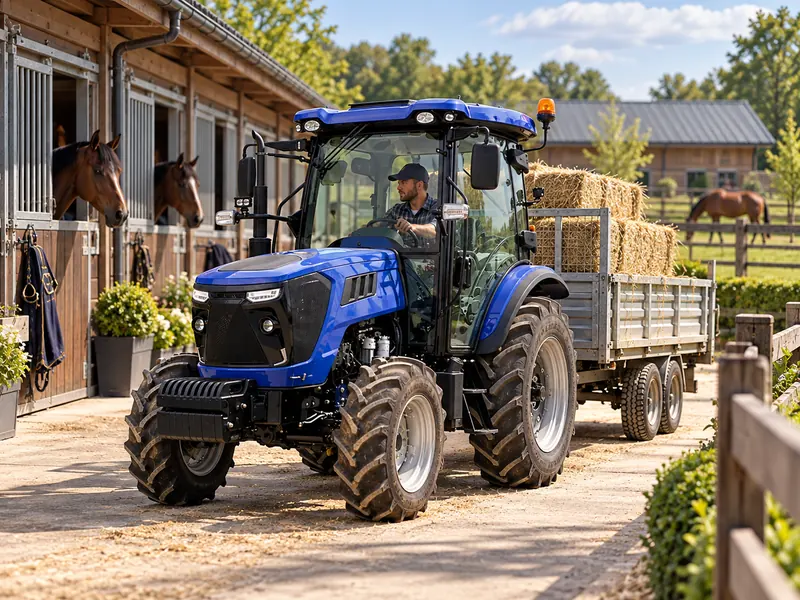
Figure 1. Daily hay and supply transport through a stable yard (illustrative scene).
II. Start With the Workload, Not the Horsepower
Map your yard before choosing the tractor class
Measure the narrowest gate, usable doorway width, overhead clearance, turn into the manure area, yard slope and the route to the hay store. Include protruding door hardware, uneven ground, low branches and the space required by a front loader or bale spear. A machine may fit through a straight doorway but have no room to turn with a mounted attachment.
Worked access example: a 1,560 mm-wide tractor approaching a 1,800 mm-clear gateway leaves only 240 mm total nominal lateral clearance, or 120 mm per side when perfectly centred. That is not an approved safety margin; tyres, attachments, pillars, operator error and ground camber can consume it. The correct test uses the complete, as-delivered machine and its intended working envelope.
Record the jobs and the variables that drive machine selection
Yard task | What must be measured | Common buying mistake |
Paddock mowing | Area, vegetation, obstacles, mower width, PTO demand | Selecting by hectares alone |
Round-bale handling | Maximum bale mass, spear/grab weight, lift height, load centre | Using engine HP as loader capacity |
Manure and bedding | Volume per shift, transfer distance, bucket size, access | Buying an oversized bucket for a small yard |
Feed and trailer work | Trailer loaded mass, hitch rating, braking, routes | Ignoring slopes and road-use rules |
Wet-season repairs | Ground firmness, tyre choice, drain locations | Assuming 4WD prevents soil damage |
Use power classes as a shortlist—not a verdict
As a preliminary screen, 25–30 HP tractors may suit relatively light mowing and routine upkeep, 40–50 HP machines can be worth evaluating when the property has more regular PTO work, and 60–70 HP utility platforms may be more appropriate where broader rear implements and sustained material handling matter. None of these bands establishes safe bale weight or towing capacity. For the distinction between engine power, PTO output and usable productivity, see the tractor horsepower selection guide.
III. Mowing and Paddock Care Without Damaging Grazing Land
Mowing decisions start with the horses and the sward
Good paddock management is not a competition to cut grass as short as possible. The mowing or topping schedule should fit the local forage species, grazing pressure, seasonal growth and any veterinary restrictions. Cutting too low can weaken regrowth and expose bare soil; leaving paddocks unmanaged can allow rough patches and certain weeds to spread.
A rotary mower can be efficient on relatively open, reasonably even pasture. A flail mower may offer advantages in mixed vegetation and more irregular cutting conditions. Either can be wrong if its width, mass, PTO requirement or debris risk exceeds what the tractor and field can tolerate. Before topping, inspect fencing wire, stones, trough surroundings and other foreign objects.
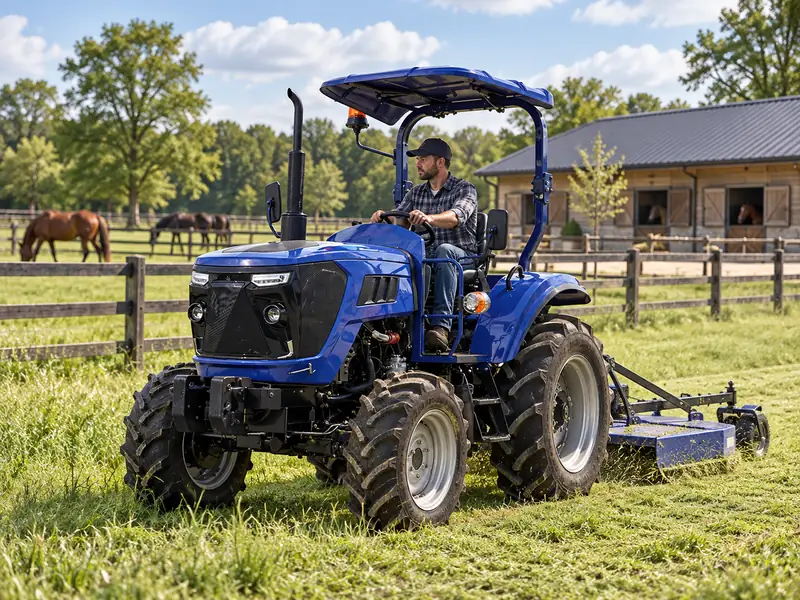
Figure 2. Pasture topping with a rear mower on a fenced horse property (illustrative scene).
Do not turn poisonous plants into chopped forage
European horse owners—particularly in the UK—must pay close attention to ragwort and other toxic pasture plants. The British Horse Society advises against mowing or cutting ragwort: cut or dried material can remain dangerous to horses, while cutting may encourage further growth. Identify and remove poisonous plants using locally appropriate methods, and keep horses away from affected material. See the British Horse Society ragwort guidance for management precautions.
Wet ground: traction is not the same as protection
A 4WD tractor can offer useful grip on grass, tracks and uneven approaches. It does not remove the risk of poaching, rutting or soil compaction. In regions with prolonged autumn and winter rainfall, driving through a saturated gateway may create repeated ground-repair costs and an unsafe surface for horses.
Use designated traffic routes, preserve drainage, choose tyres for the actual surface and postpone non-essential field work when the soil is too wet. The British Horse Society’s pasture guidance specifically advises using machinery only when the ground is sufficiently dry to avoid damage and compaction.
A practical paddock-work sequence
First remove horses from the work zone. Walk the paddock and mark hazards or toxic plants. Choose mowing height and equipment from the forage condition, not only the visual result. Carry out the job with guards in place and a safe exclusion area. Afterwards check for exposed debris, deep wheel marks, damaged fences and any material that must be removed before turnout.
Harrowing is not an automatic substitute for poo-picking. Whether to spread droppings depends on the parasite-control programme, weather, pasture resting time and veterinary advice. In smaller, heavily used equestrian fields, collection may be the more appropriate routine.
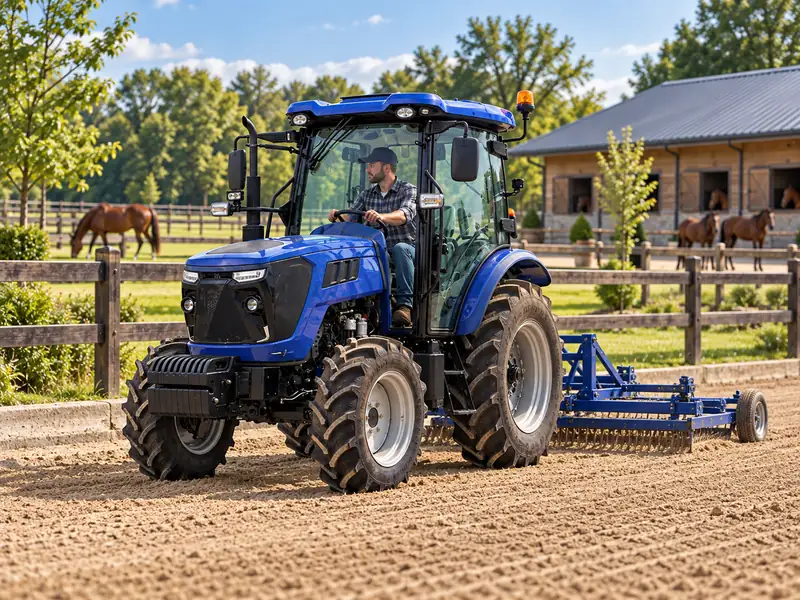
Figure 3. Levelling and surface maintenance around an equestrian arena (illustrative scene).
IV. Bale Handling and Stable Yard Loading: Work Safely Before Working Faster
Bale weight is a system problem, not a horsepower number
A tractor for hay bale handling must be specified from the heaviest real bale, its dimensions, the attachment, the load centre and the height to which it must be placed. Loader capacity measured at the pivot is not equivalent to the capacity at the tip of a bale spear or farther forward on forks. An advertised maximum also may not apply at full lift height.
For illustration only, a 450 kg bale plus an 80 kg bale-handling attachment produces 530 kg of suspended payload and attachment mass before considering leverage, loader geometry, dynamic forces or the tractor’s permissible axle loads. This is a calculation example, not a claimed capacity for any particular machine. Buyers need a loader specification showing measurement point, usable capacity at the relevant height, approved ballast and tyre/front-axle limits.
A stable yard tractor with loader should use a purpose-matched bale spear or grab, keep carried bales low, travel slowly, and avoid slopes or abrupt turns. High-stacking frequent heavy round bales may justify a dedicated telehandler or hired equipment rather than pushing a compact tractor close to its operating limits. For a more detailed procurement method, consult the front-loader selection and load-centre guide.
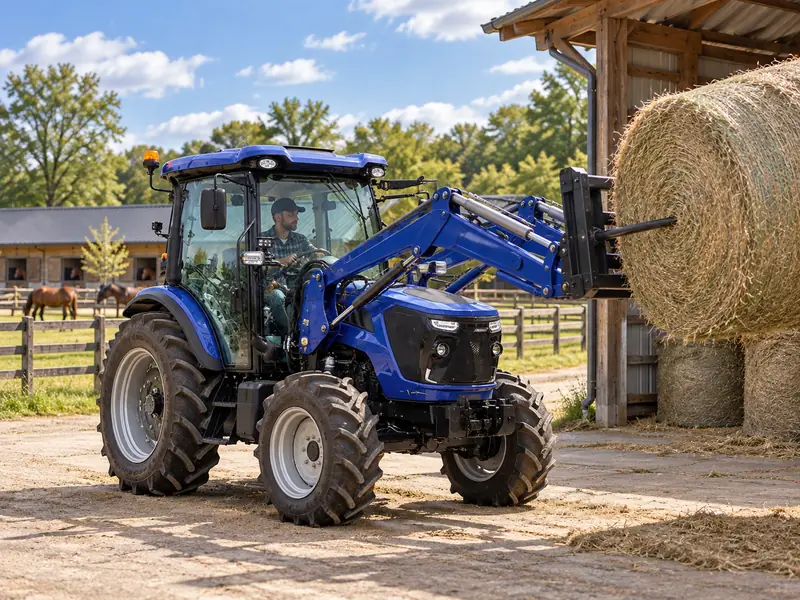
Figure 4. Round-bale handling with a dedicated front-loader attachment (illustrative scene).
Why manual stable work does not disappear completely
Even a well-specified loader should not be driven into every horse box or narrow passage. The safer, more productive arrangement is often manual cleaning in the stalls, a designated collection point, and mechanical bulk transfer to an appropriate manure store or composting area. Keep horses, riders and bystanders separated from machinery routes. Never use a diesel tractor in a poorly ventilated enclosed stable where exhaust can accumulate.
Specify repeated loading by cycles per hour
For a commercial yard, compare proposed equipment using actual payload per cycle × completed cycles per hour, then check the operator’s time and turning space. A machine with a larger headline lift number can be less productive if every cycle requires multiple manoeuvres or long waits for the hydraulics.
This is also where transmission selection matters. Loading repeatedly involves approach, fill, reverse, turn, unload and repeat. The number and practicality of forward/reverse ratios, visibility and attachment control may matter more than a small difference in rated horsepower.
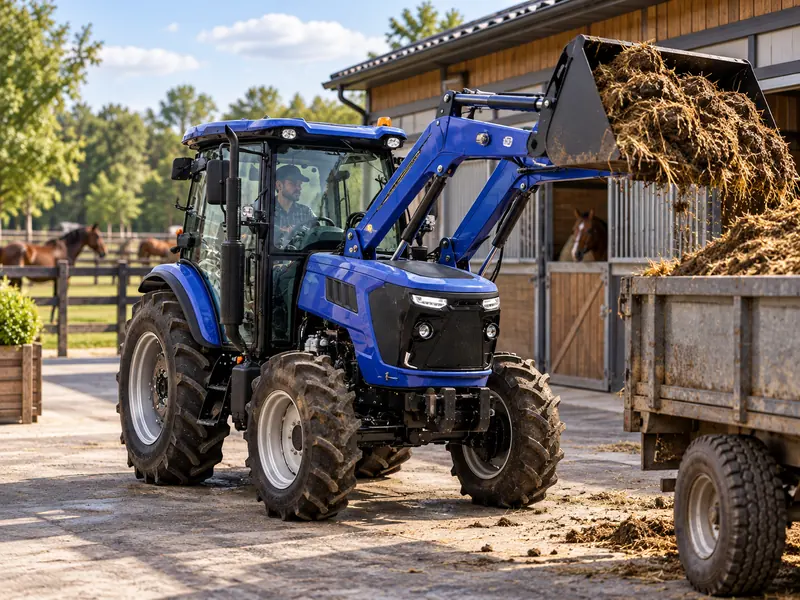
Figure 5. Concentrated yard loading of used bedding into a trailer (illustrative scene).
V. Size, PTO and Attachments: The Engineering Checks That Prevent Wrong Orders
Confirm PTO horsepower, speed and driveline requirements
Engine output is not the same as available PTO output. A mower’s minimum PTO horsepower, shaft speed, hitch category, driveline length, weight and guarding must be compatible with the specific tractor. Selecting a wider mower solely because the engine advertises more HP can produce poor cutting, excessive slip or overloaded driveline components.
Ask for the exact implement model and its manufacturer’s power and attachment requirements. A 540 rpm implement should not be assumed compatible with another PTO speed unless the implement manufacturer explicitly permits it. An approved rear implement weight matters as much as the speed setting.
Confirm dimensions in the delivered configuration
The nominal tractor body width is only one dimension. Cab or ROPS height, tyres, mirrors, loader arms, bale attachments and transport positioning can all affect access. The full machine also needs room to turn, attach implements and reverse without putting people against walls, gates or fences.
Tyre choice creates a genuine trade-off
More aggressive agricultural tread can improve traction in suitable field conditions but may create more surface disturbance on delicate grazing land. Turf-oriented options may reduce some disturbance but can have different traction, load and wear characteristics. Selection must account for loader axle loads, gradients, hard-surface travel and the exact approved tyre specification. There is no universal horse-property tyre.
Avoid the “one machine does everything” trap
A tractor may rationally cover mowing, light trailer work, yard loading and paddock repairs. It should not be forced into jobs beyond approved loader reach or lift limits, unsafe gradients, or extremely soft surfaces merely to avoid renting a specialist machine. This distinction protects both operating margin and total ownership cost.
VI. Running Cost, European Compliance and the Pre-Order Decision
Calculate labour value from measured time—not marketing percentages
Suppose a yard spends 60 minutes per day on a defined material-transfer task. A reorganised workflow and suitable tractor-loader system reduce it to 35 minutes. Across 300 working days, the recovered time would be 25 minutes × 300 / 60 = 125 hours annually. At an illustrative fully loaded labour rate of €20 per hour, that represents €2,500 of redeployable labour capacity—not guaranteed net savings.
Net financial impact must then account for equipment depreciation or finance, fuel, tyres, servicing, insurance, operator hours, repairs and resale value. For an honest comparison, calculate cost per productive operating hour and avoid counting the same labour saving twice. A cheaper tractor that needs twice as many handling cycles may cost more over its working life; an oversized model that sits idle can be just as uneconomic.
European documents are an order-level decision
Horse-property buyers may need to travel between sites or use public roads. Agricultural and forestry vehicle approval is governed in the EU by a dedicated framework, including Regulation (EU) No 167/2013. Applicable type approval, Certificate of Conformity (CoC), national registration, engine-emissions and road-equipment requirements depend on the vehicle and destination country. CE-related machinery documentation is not interchangeable with tractor whole-vehicle type approval or a CoC.
Before paying a deposit, request written confirmation of the exact ordered model, emission/engine configuration, operator protection, brakes and lights, road-use intent, manual language and the documents available for the destination market. Do not assume that documentation for one tractor variant covers an entire model range.
Send a quotation request that answers the engineering questions
An effective request names the country; minimum gate height and width; the area and frequency of mowing; mower model and PTO requirement; maximum bale weight and handling height; estimated loader cycles; surfaces and slopes; and any intended public-road travel. Include the required parts and maintenance support. A technically complete enquiry is more useful than asking only, “How much is a 50 HP tractor?”
VII. Matching OXPLO Tractors to European Equestrian Work
Once the work is defined, OXPLO can be evaluated on real platform differences instead of vague horsepower claims. The current OXPLO range spans 25–70 HP 4WD tractors. For horse properties, the key choice is often between the compact Category I models and the larger Category II utility platform—not simply between two neighbouring power ratings.
Small private yards: OXPLO OXT254 and OXT304
The OXPLO OXT254 25 HP tractor and OXPLO OXT304 30 HP tractor are starting points for light mowing, basic paddock care and modest trailer/yard tasks where access matters. Published specifications list 4WD, Category I rear linkage, 8F+8R transmissions and a body width of 1,560 mm. Both list a 2,600 mm overall height, so buyers with traditional low-roof stables must check overhead clearance carefully.
For the compact tractor for horse owners segment, the practical OXPLO benefit is a smaller access envelope for compatible light-duty applications. It is not a promise that a 25 or 30 HP model can lift every round bale. Bale load and attachment checks remain separate.
Busy livery yards: OXPLO OXT404 and OXT504
A yard with several paddocks, routine mowing, manure transfer and frequent seasonal work may need additional engine reserve while still keeping access manageable. The OXPLO OXT404 40 HP tractor and OXPLO OXT504 50 HP tractor retain the published compact-series 1,560 mm width and 1,800 mm wheelbase. The OXT504 offers 50 HP within that compact footprint.
This is a defensible OXPLO selection advantage for European properties that need more engine power for compatible mowing tasks without automatically moving to a wider chassis. However, 1,560 mm width is not the complete loader envelope, and the OXT504’s published 2,600 mm height may still rule out certain barn entrances. Ask OXPLO to confirm the intended mower and loader as one package.
Larger equestrian centres: OXPLO OXT604 and OXT704
Where daily material handling, frequent reversing, broader implements or longer annual operating hours dominate, the OXPLO OXT604 60 HP utility tractor and OXPLO OXT704 70 HP tractor offer a larger platform. Their published specifications include a 2,010 mm wheelbase, 1,760 mm width, 2,800 mm height, 12F+12R transmission and Category II rear linkage.
The OXT604/704 platform gives OXPLO a different answer for buyers who have outgrown the compact category: broader rear-implement compatibility, more speed selections for mixed work and a more substantial chassis. That still does not establish a safe bale-lifting rating. OXPLO should confirm the specific front loader, load-centre chart, attachment, hydraulic package, tyres and approved ballast before describing a large-bale application as suitable.
Horse-property profile | OXPLO shortlist | Buying boundary |
Small yard; low annual hours; light mowing | OXT254 / OXT304 | Confirm PTO/mower and low-building access |
Multiple paddocks; regular mowing and yard work | OXT404 / OXT504 | Compact width helps only if the complete loader/roof envelope fits |
Frequent handling; larger implements; high annual hours | OXT604 / OXT704 | Verify load chart, axle loads, stability and Cat. II implements |
How to request the right OXPLO configuration
Instead of requesting only an HP quotation, send OXPLO the intended operating country, access dimensions, bale weights, lifting height, mower model, annual working hours and road-use requirements. Use the OXPLO tractor configuration page to specify a complete package.
The OXPLO attachment and support overview is also useful when confirming mower, trailer, loader-related requirements, spare parts and ongoing service planning.
Ask for a final written quotation with the exact tractor specification, confirmed compatible attachments, transport scope and market documents. That is more valuable than a general assertion that a machine is suitable for horse properties.
VIII. Frequently Asked Questions
What is the best tractor size for a small horse property?
For light mowing and modest daily chores, 25–30 HP is a reasonable initial comparison—not a universal recommendation. OXPLO OXT254/OXT304 models may fit that shortlist where their dimensions and compatible implements match the job. Heavy bale lifting or intensive loader work can change the answer completely.
Is a 50 HP tractor enough for a livery yard?
It can be appropriate for regular mowing and mixed light-to-moderate work when implements and site access are matched correctly. The OXPLO OXT504 offers 50 HP in the listed compact 1,560 mm-wide platform; any front-loader work still requires separate load and stability verification.
Can a compact tractor carry a large round bale?
Only if the complete approved tractor-loader-attachment system is rated for the real bale mass, load centre and working height, with the prescribed ballast and axle/tyre limits. Engine horsepower alone provides no safe answer. If the job involves frequent high stacking, a dedicated handling machine may be preferable.
Which attachments matter most for equestrian properties?
Usually a correctly sized mower, approved front-loader attachment or small trailer, and selected maintenance implements. The correct package depends on whether the property spends more hours mowing, moving bales, transferring bedding or repairing tracks. OXPLO can discuss compatible options by model, but compatibility must be documented before ordering.
Does 4WD make it safe to drive on wet horse paddocks?
No. Four-wheel drive can improve traction, but rutting, compaction, side-slope stability and horse-surface damage remain concerns. Delay fieldwork on saturated ground and use a defined access route where practical.
Do European buyers need a CoC for every tractor?
Requirements depend on the vehicle category, approval route, market, intended use and local registration rules. OXPLO customers should confirm whether the exact supplied unit has the documentation necessary for the destination and any public-road use before committing to the order.
IX. Conclusion: Choose a Working System, Not an HP Number
A suitable tractor for horse farm work must solve the property’s everyday constraints first: access through existing buildings, safe hay and material handling, dependable mowing with correct PTO matching, and paddock maintenance that does not damage grazing land. Horsepower belongs in that decision, but it cannot replace measurements of load, space, surface and annual duty cycle.
For smaller yards, a compact machine may protect access and capital efficiency. For busy livery operations, the right loader package and predictable work cycles may deliver greater value than extra mowing power. For larger equestrian centres, a heavier utility platform may be justified—provided its size does not create new bottlenecks.
OXPLO offers compact 25–50 HP and larger 60–70 HP tractor platforms that can be compared using these conditions. Share your country, gate and roof clearances, paddock workload, maximum bale weight, required lift height and attachment list with OXPLO. Start at the OXPLO website to request a configuration based on the actual work—not just a brochure horsepower figure.