
A Practical Technical and Commercial Buying Guide for Polish Tractor Dealers
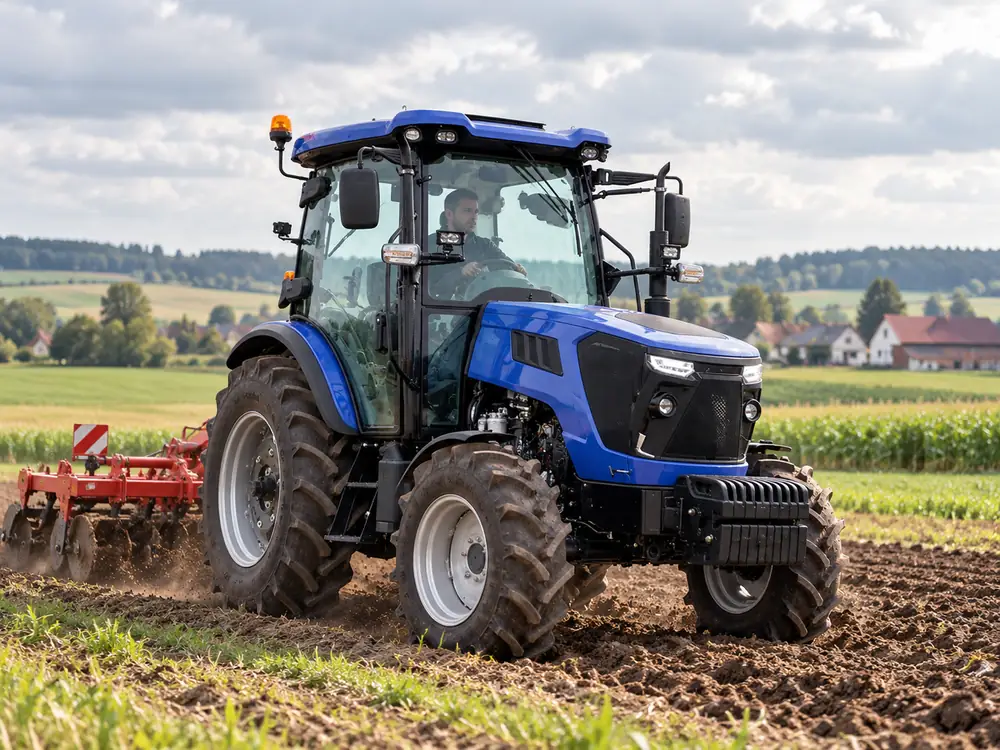
Polish mixed-farm cultivation with a 4WD cab tractor (illustrative scene).
A Polish dealer receives three offers for a 60 HP cab tractor. One has an attractive ex-factory price but no confirmed heating specification. Another includes a front loader without stating where its lifting capacity was measured. The third looks more expensive, but the supplier can identify the exact tractor configuration, hydraulic interfaces, documentation and service responsibilities.
Which offer is cheaper once the tractor is ready to sell and the first customer needs support? That question matters more than the number on the first quotation. A cab tractor for Poland has to fit the farm, work with the buyer’s implements, meet applicable market requirements and leave the reseller enough margin after delivery and warranty costs. A low price cannot compensate for a tractor that cannot be registered through the intended route or cannot perform the customer’s daily work.
This guide explains how to qualify farm applications, compare 50–70 HP platforms and turn an incomplete supplier offer into a defensible purchasing decision. It is written for dealers who need to protect customer relationships as well as initial purchase margins.
I. Why Incomplete Tractor Quotes Cost Polish Resellers Money
The real buyer is purchasing a working system
A mixed farm may want one tractor for spring cultivation, summer grassland work, autumn trailer transport and winter yard maintenance. A dairy farm may care more about bale handling, feed movement and narrow barn access. An agricultural contractor needs several implements, repeatable working speeds and predictable servicing during seasonal peaks. The headline horsepower does not tell a dealer whether a machine suits any of these operating patterns.
This explains a common failure: a reseller orders stock based on the lowest purchase price, then discovers that the local customer’s PTO speed, three-point hitch, loader forks or building dimensions do not match. The result can be retrofitting, lost sales time and an argument over who pays for the correction. To avoid it, compare a tractor dealer quote Poland against a customer-use specification, not against another advertisement alone.
Separate three kinds of cost before comparing suppliers
The first cost is technical mismatch: adapters, hydraulic changes, different tyres or an unsuitable loader. The second is compliance risk: a missing or inappropriate approval document can interrupt the intended sale or registration process. The third is lifetime support: filters, glass, seals, wear parts and warranty labour still cost money after the machine leaves the dealer’s yard.
An early quoting conversation should therefore establish the same five facts for every supplier: exact model and variant; intended jobs and implements; permitted attachments and loads; documents applicable to the destination; and a comparable delivery basis. For additional pricing context, a useful reference is the Poland tractor price breakdown, which explains why listed prices cannot be compared without aligning equipment and delivery terms.
Do not confuse a requested feature with a verified specification
“Cab”, “4WD” and “front loader available” are requests, not engineering evidence. A quote must distinguish included equipment from optional equipment, provide operating limits and identify what will be supplied. When the final tractor has a different tyre or cab combination, published dimensions and weight may no longer describe the delivered vehicle. Put configuration revisions into a signed specification schedule before an order is placed.
II. Start with Farm Work, Not the Horsepower Label
A mixed-farm scenario: protect compatibility with existing implements
Before recommending a 50 HP cab tractor Poland buyer might ask for, document the farm’s existing mower, rotary tiller, spreader, trailer and hitch equipment. Collect the implement make and model, working width, PTO speed and spline, rated power requirement, hitch category, mass and hydraulic needs. A tractor with enough engine power may still be unable to lift or drive the attachment correctly.
Category I and Category II are not simply interchangeable descriptions of rear-linkage strength. They designate different hitch geometries and dimensions. An adapter may solve a particular connection issue, but it does not increase the tractor’s permissible lift load, stability or PTO capacity. Confirm each implement rather than assuming an entire collection will fit because one hitch pin can be adapted.
A livestock scenario: the front loader changes the decision
Suppose a farm moves feed in the morning, transports round bales after lunch and uses a mower later in the week. The chosen cab tractor with front loader must be assessed as a tractor–loader–attachment system. The actual payload and its centre of gravity, stacking height, operating surface, visibility and required ballast can be more restrictive than engine power.
A bucket quoted by volume may be unsuitable for dense wet material. A pallet fork introduces its own mass and moves the load centre forward; a round bale can move that centre even farther out. Ask for an approved loader configuration and capacity at the real load centre and height. The front-loader selection guide is useful when collecting those job details.
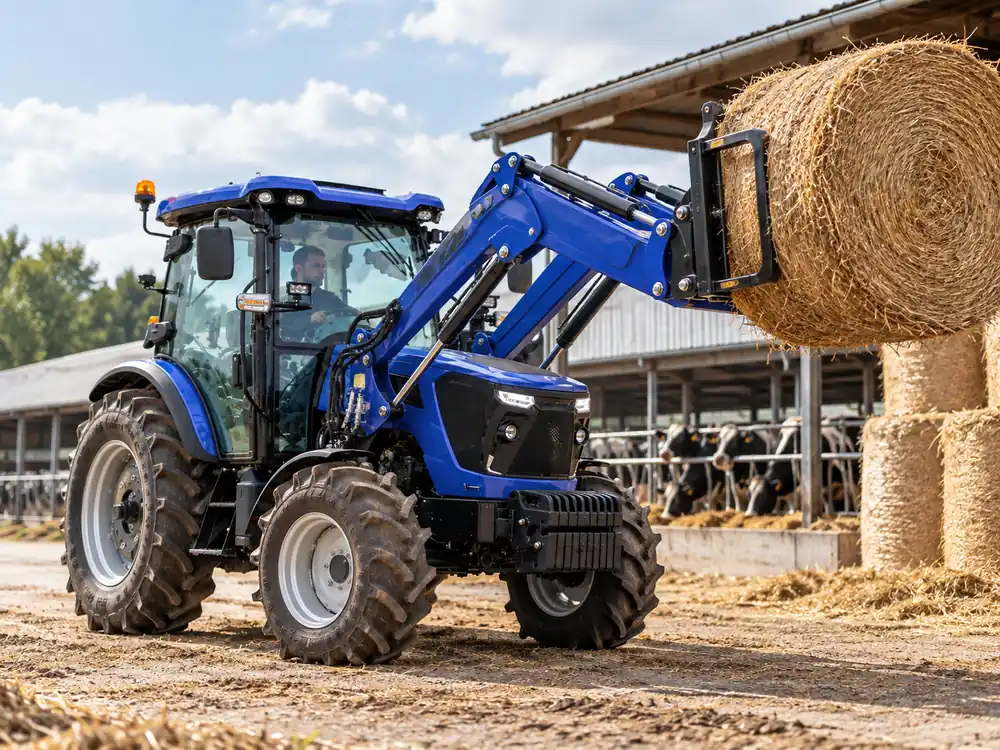
Front loader and bale handling: confirm lifting capacity, load centre and ballast (illustrative).
A contractor scenario: measure capacity in completed work
Contractors often compare horsepower because it is easy to print on a brochure. Their revenue, however, depends on hectares completed, handling cycles and hours of usable machine availability. The effective field-capacity estimate is:
Effective field capacity (ha/h) = working width (m) × speed (km/h) × field efficiency ÷ 10.
For example, a 2.0 m implement at 6 km/h with a 75% field-efficiency assumption yields 0.90 ha/h. An otherwise comparable 1.8 m setup at 5.5 km/h and 70% efficiency yields about 0.69 ha/h. These are illustrative inputs, not measured results for any tractor. They show why implement size, soil conditions and operating speed are needed before attributing a productivity gain to higher HP alone. See this tractor horsepower selection framework for a broader decision process.
The one-page farm profile every dealer should collect
- Main operations by month, annual tractor hours and the shortest seasonal work window.
- Existing implements: model, hitch category, weight, PTO input speed and hydraulic demand.
- Soil and terrain: wet clay, grass, slopes, paved yard or mixed ground surfaces.
- Access dimensions: narrowest gate, barn height, headland and turning area.
- Loader duty: heaviest material, load centre, required lifting height and daily cycles.
- Road and trailer use: planned travel, trailer braking interface and local registration expectations.
III. 50 vs 60 vs 70 HP: Chassis, Implements and Trade-offs
When a compact 50 HP tractor is the better business choice
A 50 HP tractor can be appropriate for grassland maintenance, lighter soil work, PTO-driven tasks and general farm transport when implement requirements are matched correctly. The more decisive benefit may be a compact chassis that passes through older gates and fits existing storage buildings. A dealer should not push a larger tractor if the farmer’s current implements are Category I, the workload is moderate and access is the principal limitation.
The trade-off is clear: keeping a compact working envelope may also limit the size and weight of some compatible implements. Verify hitch lift ratings at the specified measurement point, PTO requirements, axle loads and tyre options before promising heavier equipment.
Why 60 HP can mean a platform change, not a 10 HP upgrade
Moving from a compact Category I tractor to a larger Category II utility platform can change the entire equipment decision. A longer wheelbase, larger tyres and a broader gearbox ratio selection may be attractive for repeated field, yard and transport work. But a wider vehicle can be harder to store or manoeuvre, and older Category I implements may need a separate compatibility review.
A 12-forward/12-reverse gearbox gives more nominal ratios than an 8-forward/8-reverse unit; it does not by itself prove a power-shuttle or clutchless reversing function. For frequent loader work, ask what the actual reversing mechanism is and how it operates. This compact-versus-utility tractor comparison explains the difference from a practical farm perspective.
When 70 HP earns its extra purchase cost
A 70 HP tractor is easier to justify where an implement requires more sustained engine output or where the farm’s short weather window makes available power valuable. It is harder to justify when the real bottleneck is slipping tyres, an undersized hydraulic circuit, limited loader geometry or narrow field access. Extra engine horsepower cannot remedy a mechanically incompatible implement.
For each prospect, ask which constraint dominates: engine-power limited, traction limited, hydraulic limited, or implement limited. The answer guides whether to increase HP, improve tyres and ballast, choose another implement or change the work plan. That is more credible than claiming that a 70 HP tractor must be 40% more productive than a 50 HP model.
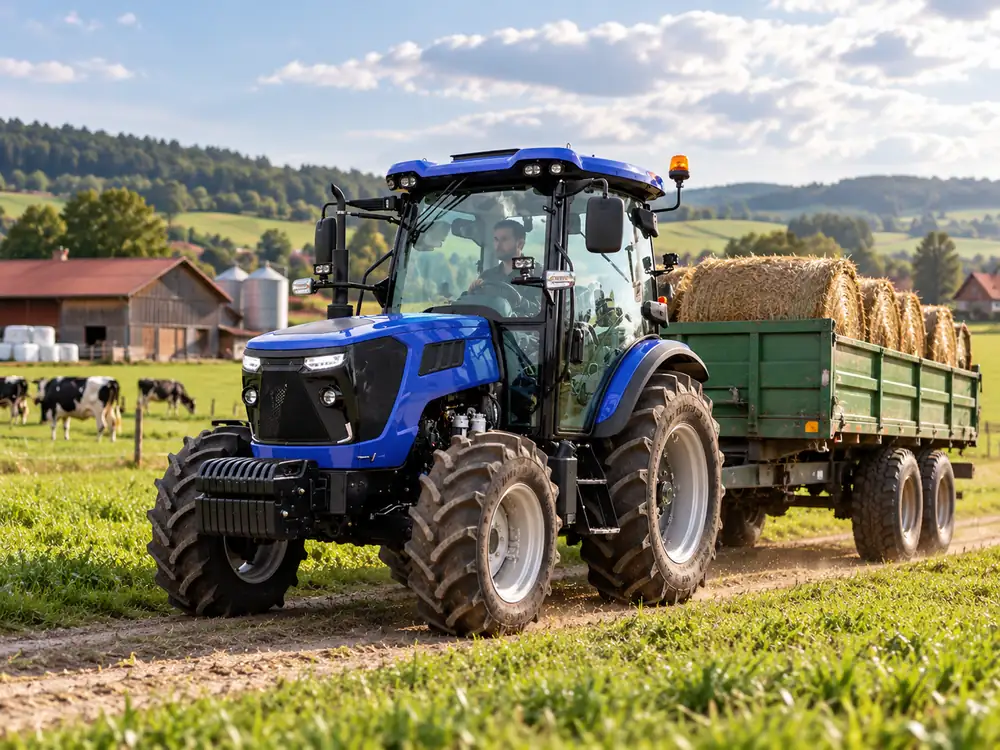
Mixed-farm trailer work: check hitch, trailer braking and axle-load compatibility (illustrative).
IV. Cab, Loader and Implement Details That Prevent Expensive Returns
Treat cab equipment as an operating specification
For Polish conditions, a cab is not merely a cosmetic upgrade. Heating, demisting, ventilation, door sealing and all-round visibility can affect the operator’s ability to work during cold and wet periods. The quotation should state whether heating and air-conditioning are included, describe glass and door serviceability, and identify the exact operator-station variant.
A fully enclosed cab should not automatically be presented as a certified roll-over protective structure. Confirm the applicable ROPS documentation for the delivered variant and any other protective requirements relevant to its actual use. A comparison of cab and ROPS configurations helps dealers explain the distinction without overselling comfort or safety claims.
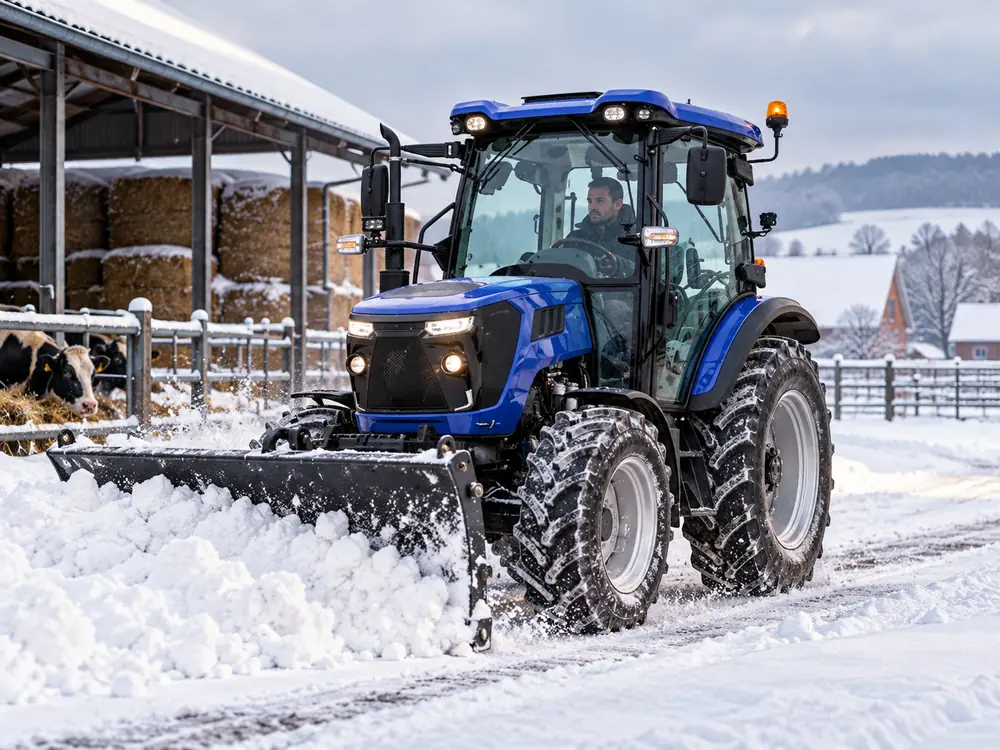
Cold-weather farm work: verify cab heating, demisting and attachment fit (illustrative).
Verify the loader at the working position
The most misleading figure on some loader offers is a single maximum lifting number without the measurement point. Capacity at a pivot pin is not equivalent to capacity on pallet forks at a forward load centre, nor to capacity at the top of the lifting range. Ask the supplier to specify the boom position, load reference point, actual attachment, hydraulic conditions and approved ballast configuration.
Consider an illustrative job: a 620 kg pallet is moved using a fork carriage weighing 110 kg, and the farm needs to place it 2.2 m above ground. The supplier must assess the correct geometry and separate load moments, not merely compare 730 kg with a headline “1,000 kg” loader rating. Front axle, tyres, loader structure, attachment ratings and stability can each be the controlling limitation. The loader capacity and safe-payload guide sets out those distinctions in detail.
PTO, hitch and hydraulics: three compatibility checks
A buyer needs the precise PTO speeds and shaft specification; a six-spline shaft alone does not confirm the correct input speed. The three-point linkage must match hitch geometry and the mounted implement’s mass, not just a Category I or Category II label. Hydraulic valves, pressure, flow and couplers must match the actual attachment, especially where the same tractor is expected to alternate between loader and rear hydraulic work.
For hay and livestock customers, the baling and hay-work checklist is a useful follow-on to these requirements. A dealer who confirms the entire working combination can explain to the customer what the tractor will do—and equally important, what it should not be asked to do.
Three supplier answers that should trigger a second question
Supplier statement | Dealer follow-up |
“Loader capacity: 1,000 kg” | At which load centre, boom height and attachment configuration? |
“Cab is included” | Heating, demisting, ROPS status, height and replacement parts? |
“Works with standard implements” | Which hitch category, PTO speed/spline, lift capacity and hydraulic outlets? |
V. Compliance and Polish Registration: Check the Exact Vehicle
EU vehicle approval is different from a generic CE claim
Regulation (EU) No 167/2013 sets the type-approval and market-surveillance framework for agricultural and forestry vehicles. For relevant new agricultural tractors, the dealer must identify the applicable approval route and ask whether a valid Certificate of Conformity (CoC) can accompany each actual delivered vehicle. A generic CE mark or certificate for another component is not, by itself, evidence of EU whole-vehicle type-approval. See the official EU Regulation 167/2013.
This must be checked against the configuration being quoted: engine, tyres, cab or operator protection, lighting, brakes and any approval-relevant option. A dealer should never promise Polish registration merely because a product photograph or an earlier model’s certificate is available.
Stage V and braking are order-level questions
Agricultural-tractor engine emissions and Stage V requirements are governed through the applicable EU framework, including Regulation (EU) 2016/1628 and related legislation. Do not treat “Euro 5” as an adequate substitute for identifying the specific approved engine family and emissions configuration. Some options depend on model and destination; request documentary confirmation before deposit.
Trailer braking deserves equally careful review. EU delegated braking rules restrict new tractors equipped only for single-line hydraulic trailer brake connections from 1 January 2025, and Poland’s TDT has published relevant approval notices. A farm’s old trailer being physically connectable does not prove the proposed new tractor-and-trailer arrangement is lawful. See the Polish TDT homologation notices.
A simple evidence gate before the purchase order
Review item | Evidence required or question to resolve |
Tractor identity | Exact model, variant, identification and as-built specification |
Market approval | Relevant approval route and CoC availability where applicable |
Emissions | Engine family and documentary proof for the intended market |
Cab and protection | Actual cab/ROPS variant and applicable supporting records |
Braking and road use | Tractor and trailer interfaces, lighting and local use rules |
Loader/attachments | Installation, manuals and documents relevant to the approved configuration |
If a critical document is unverified, leave the quotation conditional and seek specialist or authority confirmation. It is cheaper to resolve a paperwork question before production than to hold a shipment or stock that cannot be sold as planned.
VI. Price a Ready-to-Sell Tractor, Not Just an Ex-Factory Machine
Standardise all quotations to one delivery basis
A supplier’s EXW price, an FOB price and a delivered-to-Poland offer allocate different costs and responsibilities. Convert them into a single comparison showing tractor, selected cab, loader and attachments; freight and insurance; applicable customs costs; inland delivery; PDI; initial spare-parts provision; and warranty reserve. Treat VAT according to the dealer’s real tax position rather than adding or excluding it inconsistently.
The following example is purely illustrative, not an OXPLO offer or a current Polish market price:
Cost line | Illustrative amount |
Tractor and selected equipment | EUR 18,000 |
International freight and insurance | EUR 1,200 |
Clearance and local logistics | EUR 800 |
Inland delivery and PDI | EUR 650 |
Warranty reserve and parts provision | EUR 500 |
Selling and financing allocation | EUR 650 |
Total modelled cost | EUR 21,800 |
Assumed selling price | EUR 25,000 |
On those assumptions, the contribution is EUR 3,200, or 12.8% of selling price, before any omitted overhead or tax effects. A EUR 1,500 post-delivery modification would reduce that to EUR 1,700, or 6.8%. The example demonstrates the margin sensitivity of an incomplete specification; it is not a forecast of actual tractor profitability.
PDI and spare parts protect the dealer’s reputation
A first delivery should be inspected by machine identification number. Record fluids, leaks, steering, brakes, 4WD, differential lock, PTO operation, linkage movement, hydraulic performance, cab electrical systems and any fitted loader or attachment. Record any defects and the correction before handover.
Parts planning is part of the quotation. Ask about filters, belts, hydraulic hoses, cab glass, seals, electrical components and loader wear items. Agree on identification method, typical dispatch arrangements and warranty claim responsibilities instead of assuming that “parts available” describes a usable service system. The manufacturer’s parts and technical support information can be used as a starting point for this discussion.
Compare customer value, not only the dealer discount
A lower purchase price is useful only if the machine still meets the work and documentation requirements. Dealers can preserve margin by supplying the correctly rated loader rather than the cheapest attachment, confirming the appropriate cab from the start and ordering a focused first-service parts package. These measures reduce avoidable corrective visits and make the sales promise easier to honour.
VII. How to Build a Reseller-Ready OXPLO 50–70 HP Lineup
OXPLO platform comparison: published specifications
After the application and compliance questions are defined, OXPLO gives the reseller three relevant 4WD platforms to evaluate. The key distinction is not simply the 50/60/70 HP badge. OXPLO OXT504 uses the compact Category I chassis, while OXPLO OXT604 and OXPLO OXT704 use the larger Category II utility platform.
Published item | OXPLO OXT504 | OXPLO OXT604 | OXPLO OXT704 |
Rated power | 37 kW / 50 HP | 44.1 kW / 60 HP | 51.5 kW / 70 HP |
Drive | 4WD | 4WD | 4WD |
Gearbox | 8F + 8R | 12F + 12R | 12F + 12R |
Rear hitch | Category I | Category II | Category II |
Published PTO speeds | 540 / 720 rpm | 540 / 760 rpm | 540 / 760 rpm |
Wheelbase | 1,800 mm | 2,010 mm | 2,010 mm |
Listed width | 1,560 mm | 1,760 mm | 1,760 mm |
Listed weight | 2,200 kg | 2,500 kg | 2,500 kg |
These are the currently published base-model figures, not promises about every cab, tyre or loader variant. OXPLO’s OXT504 listing specifically notes a conflicting PTO value elsewhere on the site; the final OXPLO specification and purchase order must resolve the exact shaft and speed configuration before shipment.
OXPLO OXT504: sell the access and implement fit
An OXPLO OXT504 50 HP tractor quote is relevant to buyers who need 50 HP within a listed 1,560 mm-wide compact platform and mainly use suitable Category I implements. It can be positioned for grassland maintenance, mixed small-farm work and agricultural transport where an excessively wide tractor creates access problems. Its advantage is not a claim of universal loader capacity; it is a different package of footprint, 4WD and compact-implement compatibility.
OXPLO OXT604: sell the platform upgrade
The OXPLO OXT604 60 HP utility tractor has a 2,010 mm wheelbase, 12F+12R transmission and Category II linkage in the published specification. It is a better discussion candidate when the customer’s implement fleet or recurring workload has moved beyond the compact platform. OXPLO resellers should explain that this is a chassis and implement-system change, not only a 10 HP increase; the final loader and cab options still need approval and commercial confirmation.
OXPLO OXT704: sell power where it removes a real bottleneck
The OXPLO OXT704 70 HP tractor offers a higher engine power rating on the published utility platform. It is worth comparing for farms with sustained PTO demand, higher routine workload or heavier compatible implements. It is not automatically the right choice for a site with a narrow barn or a loader whose load-centre rating is inadequate. A credible OXPLO quote should state both the use case and the operating limits.
Turn a model request into three comparable OXPLO packages
Rather than quoting one loosely specified vehicle, an OXPLO reseller can request three written configurations: a farm-utility package with selected cab and field equipment; a livestock-loader package including the confirmed loader, attachment and ballast; and a dealer-ready package with agreed inspection, spare-parts provision and commercial terms. These are proposed RFQ categories, not fixed or pre-approved OXPLO bundles.
OXPLO’s tractor configuration and attachment programme describes an application-led process covering destination, farm type, PTO, hydraulics, tyres and attachments. The available OXPLO option and document set must still be established for the individual order, especially when the destination is Poland.
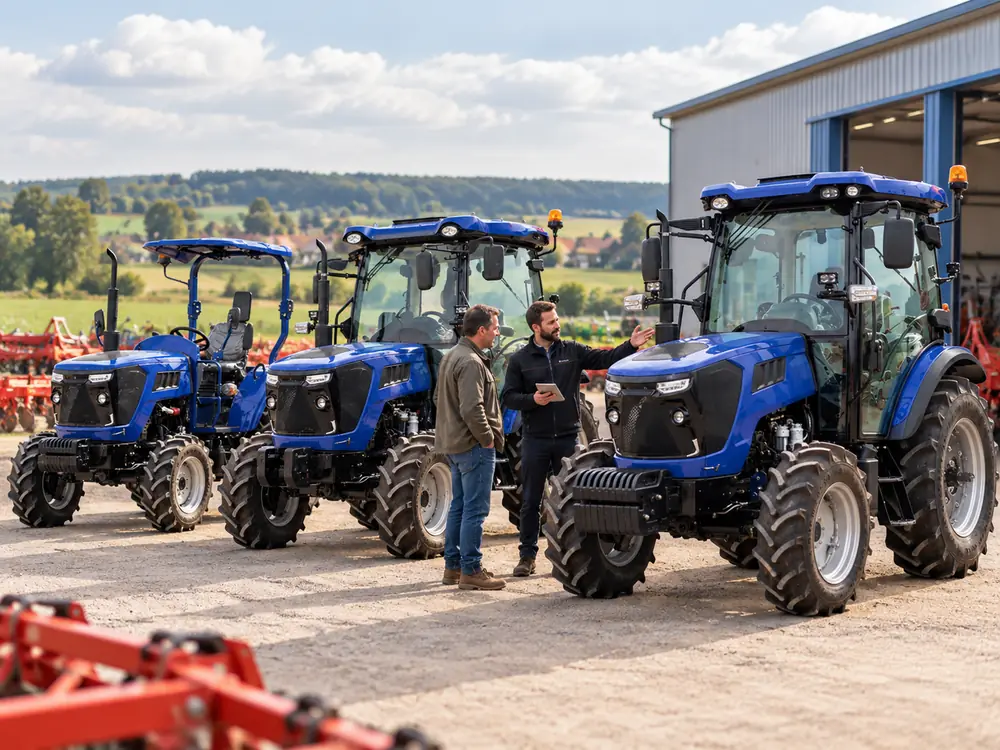
Comparing utility-tractor platforms and options before dealer stock orders (illustrative).
What a Polish reseller should send OXPLO
- Delivery country and location, dealer type and expected first-order quantity.
- End-customer applications, annual hours, ground conditions and seasonal deadlines.
- Existing implement list with hitch category, PTO speed, mass and hydraulic interfaces.
- Desired cab equipment, operator-protection requirements and size restrictions.
- Loader task: payload, load centre, placement height, fork/bucket/bale attachment and cycle count.
- Planned trailer, road-use and registration requirements in Poland.
- Required evidence for engine emissions, whole-vehicle approval/CoC where applicable, and manuals.
- Commercial basis, pre-shipment inspection evidence, warranty and replacement-parts expectations.
With this information, OXPLO can review whether OXT504, OXT604 or OXT704 is the better starting point and identify the configuration, quotation and documentation that still need validation. A reseller can then use the written OXPLO offer to qualify a genuine sales opportunity instead of collecting a number that cannot be compared or delivered reliably.
VIII. Frequently Asked Questions
1. Which cab tractor for Poland is suitable for smaller mixed farms?
Start with access dimensions, PTO tools and hitch category. OXPLO OXT504 can be evaluated when a 50 HP compact Category I platform fits the main jobs; OXPLO OXT604 merits attention where Category II implements, a larger chassis or a wider ratio selection are needed. Both require confirmation of the specific cab, tyres and market documents before ordering.
2. Is a 70 HP tractor with cab Poland buyers request always more productive than a 60 HP model?
No. OXPLO OXT704 provides more rated engine power than OXPLO OXT604, but actual output depends on implement size, traction, gearing, soil, operator and field layout. If the bottleneck is access, hydraulic capacity or implement matching, added HP may not improve the required task. Compare the working combination, not just the engine figures.
3. Can OXPLO quote a cab tractor with front loader for livestock work?
OXPLO can discuss loader options for eligible tractor configurations. The quotation must still specify the actual loader model, fork or bucket, load-centre conditions, height, hydraulic interfaces, tyres and ballast. Do not interpret “loader available” as a confirmed safe payload for a particular bale or pallet job.
4. Does an OXPLO tractor automatically include CoC documents for Polish registration?
No such blanket claim should be made. EU approval and CoC availability depend on the precise tractor variant, applicable route and supplied equipment. Ask OXPLO for the relevant model-specific evidence and check the intended Polish registration pathway before ordering inventory. The broader OXPLO support and documentation guidance explains that European configuration and paperwork vary by model and destination.
5. What should a dealer request beyond the OXPLO tractor price?
Request a signed configuration schedule, included cab and options, machine dimensions, PTO and hydraulic data, relevant certification evidence, the Incoterm and delivery point, PDI scope, warranty, initial service parts and a method for ordering replacements. A quote without those terms is only a preliminary price.
6. Can Polish tractor reseller models be mixed in one purchasing enquiry?
Yes. A dealer can ask OXPLO to compare OXT504, OXT604 and OXT704 around a proposed mix of end customers. The exact quantities, options, lead time, available documentation and shipping terms require a formal OXPLO response. A small, validated initial model range is usually easier to support than broad inventory selected without customer evidence.
IX. Conclusion: Quote the Working Configuration, Not a Horsepower Badge
The central lesson for a Polish reseller is straightforward: a tractor’s commercial value is determined before shipment, when the intended job is matched to a verified machine, operator station, loader, implement interfaces, documents and delivery responsibilities. The lowest first-page price is not necessarily the lowest ready-to-sell or lifetime cost.
OXPLO offers 50, 60 and 70 HP 4WD platforms with different chassis and hitch characteristics. The OXPLO compact-versus-utility distinction allows a reseller to match the machine to real access, implement and workload needs instead of defaulting to the highest-power model. For a cab tractor for Poland, the responsible next step is to verify the precise cab and loader version and the applicable Polish market documentation.
If you are comparing OXPLO tractors for resale, send the farm applications, existing implements, loader task, requested cab equipment, destination and estimated quantity. Review the OXPLO tractor range or contact OXPLO for a configuration-based quote that identifies the technical assumptions, available documents and commercial terms before you place an order.