
A practical buying guide for European livestock farms, hay producers and agricultural equipment dealers
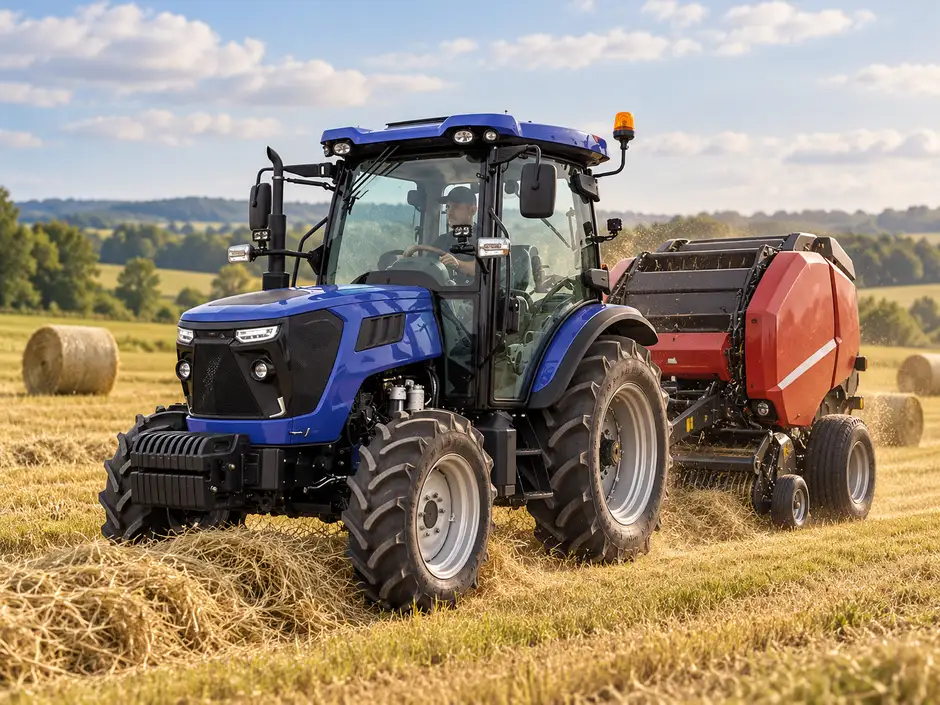
Figure 1. A tractor and round baler working through dry hay windrows. Application illustration; check the baler and tractor specifications separately.
A tractor can pull a baler across a field and still be the wrong tractor for baling. The difference becomes obvious when a heavy windrow reaches the pickup: PTO speed drops, the operator slows down, a chamber blocks, or the next field is still waiting when the forecast changes. What looked like a satisfactory horsepower match on a quotation becomes a missed harvest window.
For a livestock farm, haymaking is not one isolated machine operation. Mowing, tedding, raking, baling, bale handling and transport must happen in the correct order. The tractor may be required for several of these tasks while carrying different implements and working on wet gateways, uneven grassland and narrow rural roads. The most economical choice is therefore not automatically the cheapest tractor or the highest engine horsepower; it is the machine that can perform the complete workload safely and on schedule.
This guide explains how to evaluate a tractor for baling through actual PTO demand, hydraulic compatibility, implement geometry, traction, haulage and seasonal cost. It also shows which questions a European buyer should resolve before placing an order.
I. The Real Haymaking Problem: One Weak Link Can Delay the Whole Harvest
The weather window is a production deadline
Cut forage continues to change after mowing. Its moisture content, drying uniformity and exposure to rain affect storage quality and feeding value. The University of Minnesota Extension gives approximately 15–20% moisture (wet basis) as a general target for dry stored hay, while noting the role of bale size and storage practice. This is guidance, not a universal setting: particular crops, large dense packages and preservative systems require their own targets. See the hay storage guidance.
The operational consequence is simple. If a baler works more slowly than planned, the delay is not limited to a few extra machine hours. It can shift the final bales into a rain period, increase drying or handling losses and disrupt feeding or contractor schedules. A buyer should therefore ask, “How much hay must be completed inside the available working hours?” before asking, “How many horsepower should I buy?”
Why acceptable specifications still fail in the field
The load on a hay tractor is rarely constant. A thin windrow may require little torque; a thick or damp windrow raises feed demand. Cutter-equipped balers, higher bale density, slopes and repeated starts add further variation. Gear selection affects ground speed and crop intake rate, but slowing down does not correct inadequate hydraulic connections or an unsupported PTO speed.
Three common purchasing shortcuts cause expensive problems: comparing engine horsepower with a baler’s PTO horsepower requirement; assuming that one hydraulic coupler means all functions will work; and calculating transport needs from trailer capacity without checking allowable hitch loads and braking. Each shortcut confuses a headline figure with the specification that governs the job.
Define the work before selecting a model
Write down the actual operating envelope: forage species, annual cutting frequency, hectares per cut, likely yield, windrow variation, terrain, distance between fields, baler make and model, and whether the tractor will also mow, rake or move bales. Agricultural contractors should add the worst credible customer field, not just their easiest regular job. That single sheet of information prevents a sales discussion from turning into an unstructured argument about horsepower.
II. PTO Compatibility: The First Technical Gate for a Tractor for Baling
Engine HP is not delivered PTO HP
A tractor’s rated engine output is measured at the engine; the usable output at the rear power take-off is lower because of drivetrain and auxiliary losses. A baler’s published power requirement may specify minimum PTO power, recommended PTO power or a different reference. These cannot be treated as equivalent. A 60 HP engine rating does not prove that 60 HP is available continuously at the PTO.
Ask the baler manufacturer for its minimum and recommended PTO horsepower, the prescribed shaft speed and the operating conditions behind those figures. Then ask the tractor supplier for the confirmed PTO output at the specified speed. If the latter is unavailable, record compatibility as unverified, not “probably suitable.” A cautious purchaser should also ask how a cutter, dense crop or sustained duty changes the recommended power reserve.
Match the baler rather than the generic baler category
“Round baler” is not a useful power specification on its own. A basic compact fixed-chamber machine, a higher-output variable-chamber baler and a large square baler can have very different demands. The critical inputs are the exact model and options: pickup width, bale diameter, knives or rotor, density settings and the maker’s power recommendation. Never use a generic horsepower chart to guarantee compatibility.
A practical decision rule is to reject any tractor whose verified PTO rating is below the implement’s required rating, then compare acceptable options against the farm’s worst regular workload. Excessive oversizing also has a cost: a large machine may be harder to use in small fields and can carry additional ownership expense without reducing the baler’s own feed-capacity limit.
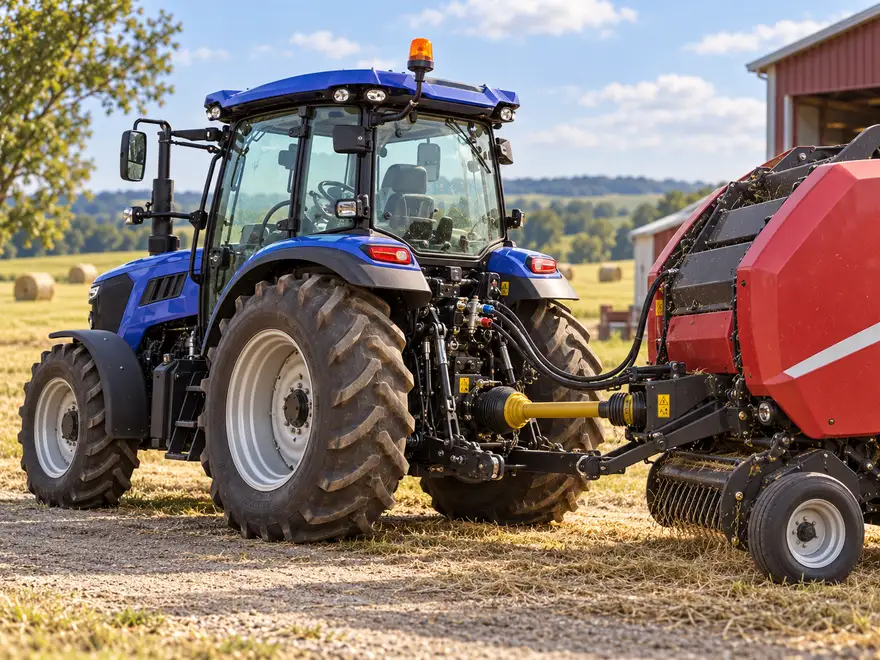
Figure 2. PTO driveline and hydraulic connections between tractor and baler. Illustrated equipment arrangement; verify every approved interface.
540 rpm is not the same as 760 or 1000 rpm
Many hay implements use a 540 rpm PTO; others use 1000 rpm or a specified alternative. Verify shaft speed, spline form, rotation, shaft length, driveline working angle, clutch protection and guarding. Do not assume a 540/760 rpm tractor can operate a baler specified for 1000 rpm just because both machines have rear PTO equipment. Unapproved speed changes can exceed implement design limits.
During commissioning, bring the machine to the manufacturer’s correct PTO speed and test it through representative windrows. Monitor actual engine and PTO behaviour, feed consistency, tractor temperature and the ability to sustain the required field speed. If performance deteriorates only in heavy crop, record the condition rather than dismissing the test as an operator issue.
The hidden trade-off: horsepower versus controllable feed rate
More engine power may maintain speed under load, but baler throughput depends on pickup capacity, crop condition and feed-mechanism design. A tractor with more gears can sometimes make it easier to select a travel speed that keeps the pickup supplied without repeated plugging. The correct choice balances verified PTO reserve against the implement’s permissible crop intake, rather than treating the engine rating as a productivity guarantee.
III. Hydraulics, Hitching and Controls: Prevent Expensive Delivery-Day Surprises
Build an implement-by-implement interface map
Before agreeing to a tractor for baler combination, list what each hydraulic circuit actually operates. Depending on the baler, functions can include tailgate opening, pickup lift, drop-floor clearing, bale-density controls or other accessories. One machine may require a single double-acting outlet; another may require additional circuits, an electric selector, continuous flow or a dedicated low-back-pressure return.
For every function, check number of rear remotes, single- or double-acting operation, required flow (L/min), pressure (bar), coupler type and return arrangement. Pressure controls the force a cylinder can develop; flow strongly affects its speed. Neither figure substitutes for the other. Inadequate hydraulic performance often emerges as sluggish tailgate cycles, heat generation or an inability to operate two functions as intended.
Keep three-point linkage and drawbar requirements separate
A mower or rake may mount on a Category I or Category II three-point linkage, while a conventional baler is often drawn behind a hitch or drawbar. These connections require different checks. For mounted tools, confirm linkage category, lift capacity at the specified reference point, implement centre of gravity and clearances. For drawn machinery, confirm hitch type and height, permissible static vertical load, pin size, safety-chain arrangement and driveline geometry.
An agricultural buyer expecting a single livestock farm tractor to mow, rake and bale should check every implement individually. Compatibility with a Category II mower does not establish the tractor’s ability to tow a particular baler, and a suitable drawbar does not confirm hydraulic compatibility.
Electronic controls are part of the specification
Modern balers may require a dedicated cab terminal, power supply, harness or ISOBUS compatibility. Ask whether the baler brings its own control box and whether the tractor needs a specific socket, voltage, electrical capacity or software interface. Do not list “electronic control compatible” on an order until the actual baler and tractor interface has been checked.
For dealer deliveries, a short pre-shipment test is valuable: couple the actual machine type where practical, verify valve functions, measure any required hydraulic supply and check cab controls. The cost of resolving an incorrect connector before shipment is usually lower than the cost of diagnosing it after a machine reaches a farm during harvest.
IV. Grassland, Bale Handling and European Transport: Safety Is a Design Constraint
4WD improves grip, not the legal towing limit
Wet gateways, sloping headlands and uneven yards explain why many buyers prefer a 4WD hay tractor. Four-wheel drive can help transmit available tractive effort, but it does not increase the tractor’s certified permissible trailer mass or remove downhill braking and overturn risks. Compare tyres, ballast, actual axle loads, drawbar loads, slope exposure and trailer brakes as a complete system.
Test the combination where it will operate: starting uphill, turning on a headland and negotiating a wet entrance are different tasks from pulling a baler on dry level ground. If the farm has steep side slopes, a longer wheelbase or greater mass cannot be treated as automatic proof of safe operation; manufacturer operating limits and a site-specific risk assessment still govern.
Treat bale transport and bale lifting as separate jobs
After baling, a farm may move wrapped or dry round bales by trailer and later lift them into storage. These require separate load calculations. For a trailer, use:
Actual trailer mass = unladen trailer mass + number of bales × measured average bale mass + other payload.
For illustration only, a 1,800 kg trailer carrying twelve 350 kg bales has a loaded mass of approximately 6,000 kg. This is not a recommendation or a safe towing limit for any particular tractor. The buyer must still confirm legal gross mass, tractor permitted train mass, braking system, road conditions and vertical hitch loading.
Bale handling adds another layer: bale spear or fork design, loader lift rating at the relevant height and load centre, rear counterweight, tyre capacity and visibility. Round bales can roll; safe containment and correct handling attachments matter. A rear linkage lifting rating must not be substituted for a front-loader’s lifting rating.
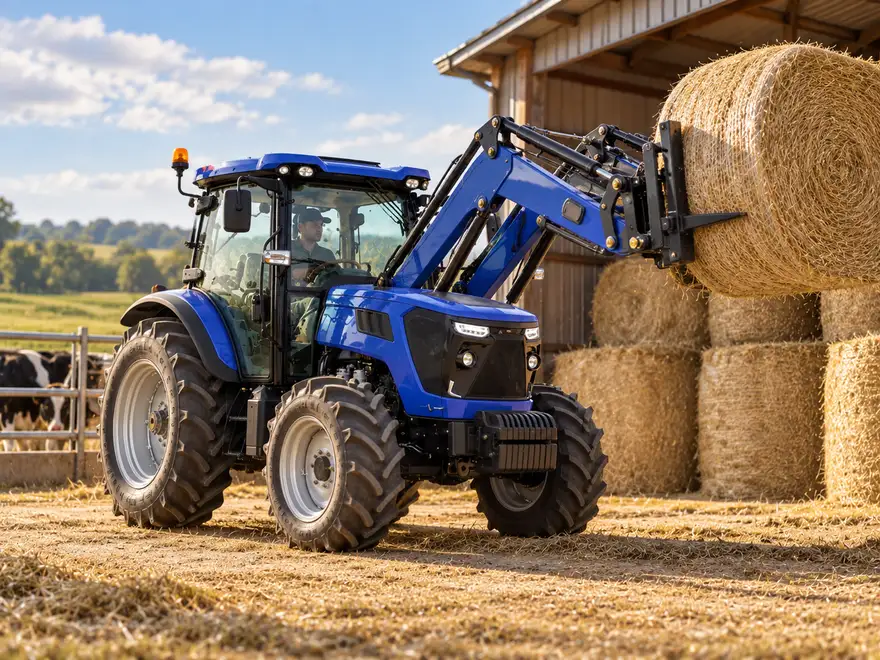
Figure 3. Bale handling involves loader lift capacity, attachment selection, load centre and ballast. Illustrated application, not a rated lifting claim.
What European importers must verify
For public-road use and market entry, check the exact configuration and destination country. Regulation (EU) No 167/2013 sets an EU framework for agricultural and forestry vehicle approval; individual road registration and use can involve national requirements. Engine emissions, operator protection, lighting, braking, tires, homologation and supporting documents should be confirmed for the ordered vehicle and trailer combination.
A generic claim of “CE certified” is not a substitute for checking the documentation actually needed for the tractor’s intended market and road use. For dealers, request a model- and market-specific document list before deposit, not after the shipment is ready. This reduces the risk of a technically workable machine becoming difficult to register or deliver.
V. Productivity and Total Cost: Calculate the Harvest, Not Just Fuel Use
Translate annual forage tonnage into required baling hours
Assume a livestock farm harvests 30 hectares, produces 3.5 tonnes of dry matter per hectare, and makes bales containing 0.30 tonnes of dry matter each. The illustrative quantity is 30 × 3.5 ÷ 0.30 = 350 bales per cutting. Actual bale count depends on forage yield, final moisture and bale density; record bale mass and moisture on the same basis to avoid calculation errors.
Now compare two hypothetical, technically suitable combinations. Option A forms 20 bales per active baling hour; Option B forms 30. If the proportion of total scheduled field time spent productively baling is 70% for both, the total time is:
Required time = target bales ÷ (active bales per hour × effective field-time fraction).
Illustrative calculation | Option A | Option B |
Active rate | 20 bales/h | 30 bales/h |
Effective field-time fraction | 70% | 70% |
Hours for 350 bales | 25.0 h | 16.7 h |
Difference per cutting | — | 8.3 h less |
Across three comparable cuttings, the modelled time difference is about 25 hours. These figures are arithmetic examples, not performance claims for a specific baler or an OXPLO tractor. The lesson is that lost capacity near a weather deadline can cost far more than the extra fuel burned by a correctly sized tractor.
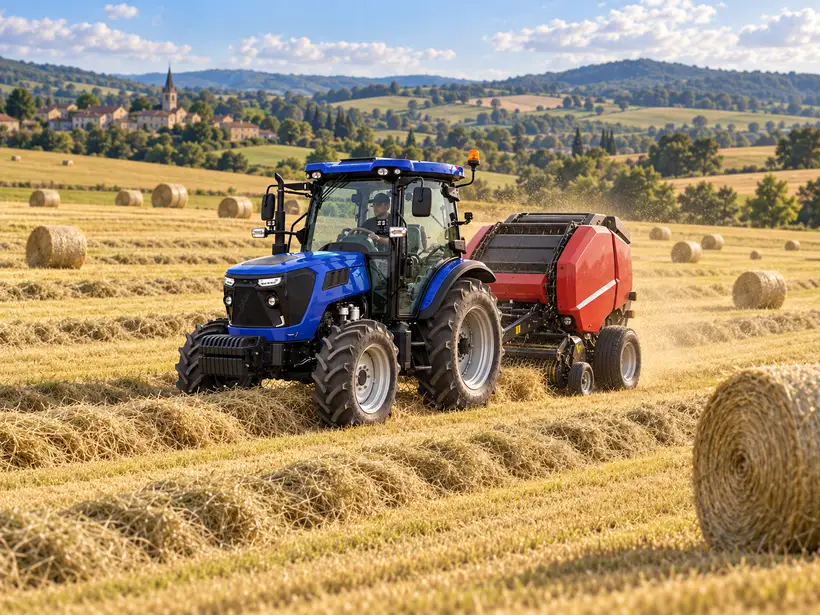
Figure 4. Windrow density and the available weather window affect the required hourly baling capacity. Illustrated field scene.
Calculate cost per tonne and the risk of under-capacity
A useful total-cost-of-ownership comparison includes annualised purchase and financing cost, fuel, lubricants, tyres, routine maintenance, replacement parts, repairs, operator labour, transport and any baler-hire or contractor expense. Then divide relevant annual cost by the tonnes of hay actually handled. Keep crop-quality losses and weather penalties as separate, clearly described scenarios to avoid double-counting.
One larger tractor is not necessarily the cheaper system: if its spare capacity is rarely used, capital cost per tonne may rise. But one undersized tractor is not necessarily economical either: extra stoppages, delayed harvest and hiring a second machine can overwhelm a small purchase-price saving. Buyers should compare a realistic base season and a difficult season, not only an average day.
Use a staged acceptance test before committing to a fleet purchase
First, verify documents and connections. Second, connect a representative baler and implement. Third, test both light and heavy windrows at the specified PTO speed. Fourth, evaluate headland turns, braking and routes between fields. Finally, record actual hourly output, fuel use, operating temperature, stoppages and operator feedback. A dealer can use the same checklist across customer demonstrations to make a technical quotation more credible.
VI. Where OXPLO Fits: Match a 50–70 HP Tractor to the Whole Farm Workload
Choose an OXPLO platform by field access and implement family
The value of an OXPLO tractor is best assessed across the whole operating calendar. A farm might mow in spring, prepare and rake windrows in summer, tow feed and small trailers later in the year, and occasionally handle materials with a suitably rated optional loader. That is why OXPLO’s mixed-farm range is relevant to buyers comparing a dedicated baling tractor with a more versatile utility machine. See the OXPLO farm tractor range and OXPLO tractor configurations.
OXPLO OXT504 is a 50 HP 4WD compact tractor listed with an 8F+8R gearbox, Category I rear linkage and approximately 1,560 mm overall width. Its published PTO option is 540/720 rpm, although the OXPLO product page flags conflicting data elsewhere; obtain the final PTO specification in writing. The OXT504 is worth evaluating for farms where gateway access and compatible light-to-medium grassland equipment matter. Read the OXPLO OXT504 specifications.
OXPLO OXT604 moves to a larger utility platform: 60 HP, 4WD, 12F+12R, Category II, a 2,010 mm wheelbase and a listed 540/760 rpm PTO. For farms that need Category II implements and more speed choices across mowing, cultivation and transport, the chassis transition matters as much as the ten-horsepower difference. Review the OXPLO OXT604 tractor.
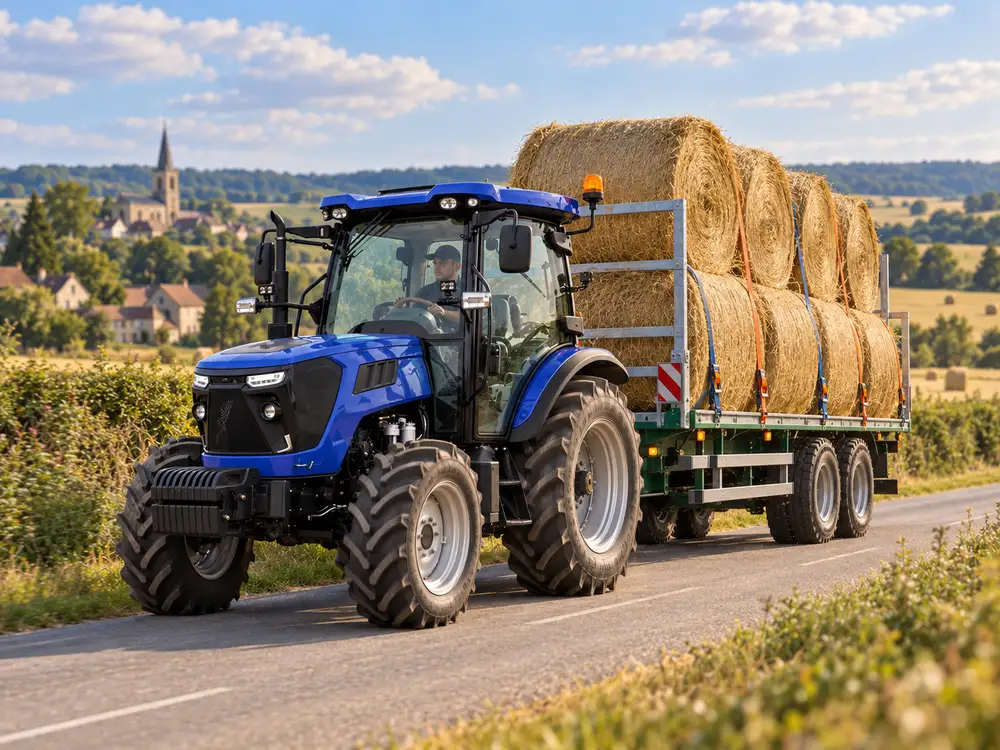
Figure 5. Moving bales between fields introduces separate towing, braking, load-securing and road-approval checks. Illustrated transport scene.
OXPLO OXT704 uses the larger platform with 70 HP, 4WD, 12F+12R, Category II and a listed 540/760 rpm PTO. The extra rated engine output may be relevant to buyers with higher general farm workloads, but it is not proof that a baler requiring 70 PTO HP can be driven by this tractor. Compare the OXPLO OXT704 tractor against the implement maker’s actual specification.
Published OXPLO model | Engine rating | Transmission | Rear linkage | Listed PTO speed |
OXT504 | 50 HP | 8F+8R | Category I | 540/720 rpm* |
OXT604 | 60 HP | 12F+12R | Category II | 540/760 rpm |
OXT704 | 70 HP | 12F+12R | Category II | 540/760 rpm |
Published product-page information only; OXT504 PTO information is not fully consistent across OXPLO pages. Confirm exact supplied configuration. None of these engine ratings establishes a verified PTO horsepower rating.
Which problem can OXPLO help solve—and which needs another tractor?
For a European dealer supplying a compact livestock farm, OXPLO can make sense where the customer needs one adaptable tractor for compatible mowing, raking, grassland maintenance and seasonal transport rather than a purpose-built high-output baler power unit. The larger OXPLO OXT604 and OXPLO OXT704 platforms add Category II linkage and more forward/reverse ratios; OXPLO OXT504 preserves compact access. The right trade-off depends on the customer’s implement inventory and operating hours.
Where a baler’s documented PTO demand, hydraulic specification or permitted towing requirement exceeds the chosen OXPLO configuration, the correct decision is to change the machine or tractor class. Selling an unsuitable combination transfers avoidable risk to the farm. OXPLO buyers should request a match review rather than assuming that any 50–70 HP tractor will power any round baler.
Verify attachment support and pre-shipment configuration
OXPLO also presents tractor attachments and spare-parts support, including grassland-related tools such as mowers and a hay rake. Availability and fitment are model-dependent. Ask OXPLO to confirm rear linkage class, hitch, PTO spline, hydraulic outlets, tyres, operator-protection configuration, optional loader requirements and destination-market paperwork on the final quotation. Where practical, request photographs or video of the exact configuration before shipment.
VII. Procurement Checklist and Frequently Asked Questions
The 10-point tractor-for-baler quotation checklist
- Exact baler identity:manufacturer, model, year and options (rotor, knives, chamber, pickup).
- PTO performance:minimum and recommended PTO HP; required rpm; verified tractor PTO output.
- PTO driveline:spline, guard, length, angle and appropriate protection clutch.
- Hydraulics:number and type of remotes, required pressure/flow, return requirements.
- Electrical interface:harness, controller, voltage, ISOBUS requirements, if any.
- Coupling:drawbar/hitch rating and height; separate three-point checks for other implements.
- Terrain:slope, soil, wet gateways, tyres, ballast, turning and access width.
- Bale movement:trailer gross mass, brakes, legal towing limits, bale-handling loader capacity.
- European delivery:destination-specific emissions, approval/registration and operating documents.
- Service and economics:annual hours, spare parts, maintenance, acceptance test and TCO.
Can a 50 HP tractor run a round baler?
Sometimes, but not on engine HP alone. Compare the specific baler’s minimum and recommended PTO requirements with the tractor’s verified PTO power and hydraulic setup. A nominal 50 HP farm tractor may be suitable for certain lighter tasks and not for a larger or cutter-equipped round baler. Ask OXPLO for the confirmed PTO data before evaluating the OXT504 against a baler.
Is 540 rpm PTO enough for hay equipment?
It is suitable only where the implement specifies 540 rpm and the shaft, guarding and drive arrangement also match. A listed 760 rpm alternative on an OXPLO tractor is not a 1000 rpm option. Never change the required operating speed without the implement manufacturer’s approval.
Do I need a different tractor for baling and moving bales?
Not necessarily. One livestock farm tractor can cover several jobs if each implement passes its own power, hitch, hydraulic and load checks. For bale lifting, verify the actual loader model and its safe capacity at the required reach and height. OXPLO can review candidate tractor and attachment configurations, but no loader capacity should be assumed from the tractor engine rating.
What should a European dealer request from the supplier?
At minimum: the final tractor specification, required market documentation, PTO information, hydraulic details, approved hitch and transport limits, warranty scope, parts procedure and inspection evidence. For an OXPLO order, submit the destination country and existing baler manual together so the technical review can identify unresolved items early.
VIII. Conclusion: Buy a Complete Haymaking System, Not a Horsepower Number
A reliable tractor for baling is the one that maintains the specified PTO operating conditions, powers the real hydraulic functions, couples correctly to every implement and moves safely between fields and storage. These checks protect the harvest window, reduce expensive surprises and provide a sounder basis for comparing lifecycle costs. The priority is compatibility under demanding conditions—not a persuasive engine HP headline.
For European livestock farms and dealers, OXPLO provides a 50–70 HP selection within its broader 25–70 HP tractor range. OXPLO OXT504, OXT604 and OXT704 represent different access, gearbox and linkage choices for mixed-farm work. The final match for any baler remains conditional on confirmed PTO output, hydraulic capacity, hitch and transport limits, and the destination-market configuration.
Request an application-based OXPLO quotation: send the baler brand/model, its PTO and hydraulic requirements, your field size and slope, other intended implements, expected annual use and European destination country. The OXPLO team can review the proposed configuration, clarify what needs technical confirmation and help you compare workable options. Explore OXPLO tractor products, parts and attachment support or contact OXPLO with your equipment list.