

A cab tractor and an open station tractor can share similar horsepower, transmission, PTO and hydraulic specifications, yet produce different results across a long working season. The deciding variables are operator exposure, task duration, overhead clearance, operating constraints and the value of productive time. The question is not which configuration looks more substantial: it is which one enables safe, repeatable work under the conditions the buyer actually faces.
This guide provides a field-oriented selection method, an illustrative total cost of ownership calculation, a procurement checklist and model-specific questions to raise with OXPLO. It also distinguishes typical configuration advantages from safety features that must be verified on the exact machine.
I. The Real Buying Problem: A Tractor That Works on Paper May Not Work on Site
Operator exposure can become an operational bottleneck
Buyers routinely compare engine power, four-wheel drive, transmission ratios, PTO speed and implement lift capacity. Those parameters determine whether a tractor can handle the intended equipment. They do not fully predict whether the operator can perform the job consistently in freezing temperatures, high dust, wind or prolonged solar exposure. When mowing and transport are concentrated into a short season, a few lost usable hours can have an outsized commercial effect.
Define the duty cycle before comparing prices
Document annual hours, typical uninterrupted shift length, operating months, high-priority tasks, weather during those tasks and access restrictions. A machine running 250 hours per year on a flexible estate maintenance schedule may justify a very different station from a tractor working daily on a livestock operation. Cab features should be valued only against a real operating constraint; a cab cannot make unsafe soil conditions or restricted visibility disappear.
II. Cab Tractor vs ROPS Tractor: What Changes Technically?
Enclosed cab: environmental separation with additional systems
An enclosed farm tractor cab can reduce direct exposure to wind, rain, dust and temperature extremes. Depending on the exact specification it may have heating, air conditioning, ventilation, filtration, defogging, wipers and ergonomic seating. Check each item separately. Cab glazing and seals create additional service requirements; window pillars can also create blind spots. A closed compartment is not automatically approved for pesticide spraying or certified as rollover protection.
Open station ROPS: rollover structure without an enclosed compartment
ROPS means Roll-Over Protective Structure. On a typical open station tractor it is a frame intended to maintain a protective space in a rollover when used with a properly fastened seat belt. ROPS is not a weather canopy, and a canopy by itself is not a substitute for certified rollover protection. Folding ROPS, where provided, must be operated in accordance with the manufacturer’s instructions, with the protective structure restored before normal work.
Decision factor | Enclosed cab | Open station ROPS |
Operator climate | Heating/AC may be specified | Direct exposure to ambient conditions |
Initial cost | Usually higher | Usually lower |
Maintenance | HVAC, seals, glazing, filters | Fewer cabin-related components |
Overhead clearance | Fixed height requires measurement | May suit tight spaces; verify ROPS height |
Rollover protection | Check certified structure | Check certified ROPS and seat belt |
Spray operations | Check EN 15695 category where applicable | Not equivalent to filtered protection |
III. Climate: Evaluate the Weather During Working Hours, Not the Annual Average
Cold and wet operations
A heated cab with suitable demisting can help when livestock feeding, material transport or winter maintenance cannot be deferred. The practical benefit is improved operator conditions and visibility, not a guarantee that towing, braking or ground traction remain safe in snow or on waterlogged soils. Confirm heater output, windshield clearing and cold-weather starting requirements for the actual model.
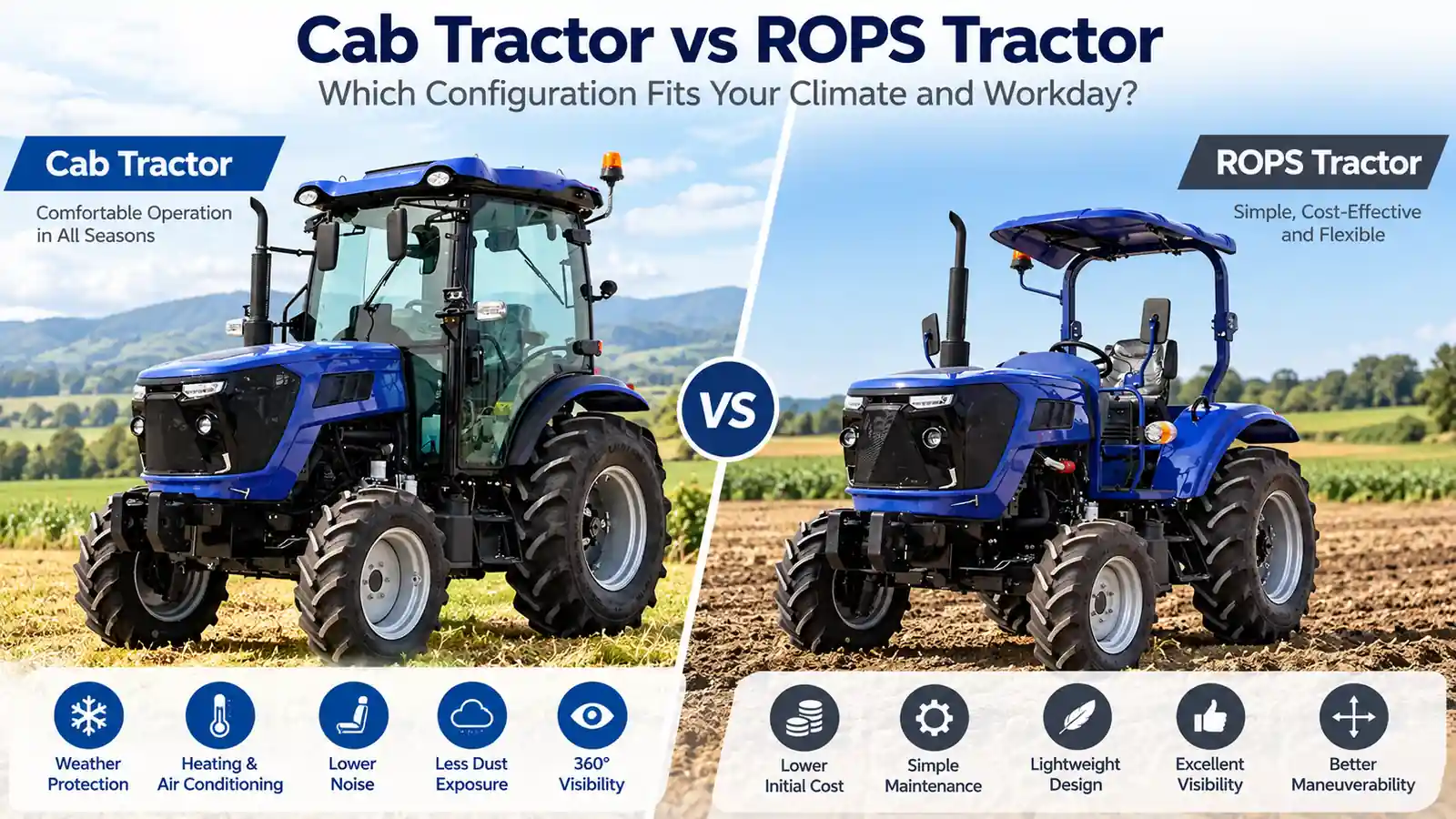
Illustrative comparison of work environments and agricultural applications for cab and open-station tractors.
Heat, dust and chemical exposure
Air conditioning can reduce thermal load during longer shifts, but should be assessed together with solar gain, air distribution and maintenance. For dry mowing and cultivation, appropriate filtration and positive sealing may help reduce dust exposure. For pesticide work, buyers should ask whether the cab has the relevant EN 15695 operator-protection category; ordinary cabin dust filters should not be marketed as chemical protection.
Mild climates and short seasonal jobs
Open-station tractors may be attractive for intermittent mowing, orchard-floor maintenance, yard transport and estate work in manageable weather. Their simpler access and absence of enclosed-cab systems can be valuable, especially where tall machines cannot pass under trees or through older buildings. Operator exposure and local risk assessments still determine whether they are suitable.
IV. Workday Design, Visibility and Safety Trade-Offs
A longer shift increases the importance of ergonomics
For a six-to-eight-hour work period, evaluate seating, control reach, pedal spacing, entry and exit, noise, vibration, forward sightlines and the rear implement view. A cab may improve climate comfort but can obstruct specific views; an open station can have excellent direct sightlines but exposes the operator. For loader work, test visibility to the bucket at ground level and raised positions with the actual attachment.
Never treat comfort equipment as safety certification
Obtain evidence for the actual rollover protective structure and seat belt arrangement. Confirm applicable tractor type approval, road lighting and braking requirements, and any destination-specific documentation. An agricultural tractor placed on the European market is subject to a regulatory framework that cannot be replaced by an informal “CE compliant” statement. Buyers should confirm the relevant tractor category and market approvals with the supplier.
V. Four Expensive Mistakes Buyers Can Avoid
1. Selecting by purchase price alone
The cheapest configuration may not be the lowest-cost option when exposure or stop-start work creates verified productivity losses. Conversely, an expensive cab can be underused on a tractor operating only a few hours each month. The purchase decision must reflect annualized cost and realistic operational value.
2. Ignoring entry height and actual machine envelope
Measure doorways, orchard canopies, overhead cables, tyre-dependent machine height and sloping access routes before ordering. A tractor listed at 2.60 m high will not fit an entrance measured at 2.50 m. Do not assume a folding ROPS may remain lowered during normal operation.
3. Assuming all enclosed cabs have the same equipment
Cab presence does not confirm heating, AC, filtered pressurization, sound insulation, approved structural protection or crop-spraying suitability. Request itemized descriptions and model-specific certification where relevant.
4. Comparing mismatched equipment packages
A 4WD tractor with different tyres, hydraulic options, ballasting or PTO specification cannot be used to isolate the value of an operator station. Compare like-for-like configurations and list each excluded option in the quotation.
VI. Calculate Cab Value With a Simple TCO Model
An illustrative five-year comparison
Suppose equivalent tractors cost €23,000 (open ROPS, delivered) and €27,700 (cab, delivered). The initial cab premium is €4,700. Assume cab-related service and energy add €180 per year, the holding period is five years, and resale differences are ignored. Additional undiscounted cost: €4,700 + (5 × €180) = €5,600, equivalent to €1,120 per year.
If one genuinely additional productive hour produces €35 in net contribution, the buyer would need €1,120 ÷ €35 = 32 economically useful hours per year to recover the illustrative premium. This is a threshold, not a predicted productivity uplift. Do not count hours made unsafe or agronomically inappropriate by ground conditions. Include financing, opportunity cost and differing residual values in a formal investment appraisal.
Input | ROPS | Cab |
Delivered purchase cost | €23,000 | €27,700 |
Annual extra cab upkeep | — | €180 |
Five-year extra cab cost | — | €5,600 |
Annual break-even at €35/net hour | — | 32 hours |
Assess peak-season downtime separately
One missed operating hour during a critical contractor schedule may carry more consequence than an hour in an idle month. Identify the tasks where the operator station—not traction, field condition or attachment capacity—actually controls availability. This prevents overstating the value of an enclosed cab.
VII. A Six-Step Procurement Workflow
Step 1 — Write the task profile: annual hours, consecutive hours, season, duty cycle and operator exposure. Step 2 — Measure working clearances and transport dimensions. Step 3 — Verify horsepower, PTO speed, linkage category, hydraulic requirements, ballast and tyre suitability for each implement. Step 4 — List mandatory safety, emissions and destination-market approvals. Step 5 — Test cabin ventilation, visibility, seating and access during representative operating tasks. Step 6 — Compare delivered cost, maintenance, residual value and credible recovered work hours over the intended ownership period.
A practical supplier inquiry should specify the destination country, intended implements, expected field conditions, desired cab or open-station arrangement and required documents. Avoid finalizing the order until the supplier returns a model-specific equipment list.
VIII. Applying the Framework to the OXPLO 25–70 HP Range
Compact tasks: OXPLO OXT254
OXPLO lists the OXT254 as a 25 HP four-wheel-drive compact tractor with an 8F+8R gearbox, Category I linkage and 540/1000 rpm PTO. This makes it a starting point for evaluating lighter mowing, estate work and compatible small implements. The published overall height is 2,600 mm, so orchard canopy and building entry measurements are particularly important. Buyers considering an open-station OXPLO specification should request written confirmation of ROPS, seating, overall dimensions and the actual destination-market configuration.
Explore the OXPLO OXT254 25 HP tractor
Larger mixed-farm jobs: OXPLO OXT704
OXPLO publishes the OXT704 as a 70 HP 4WD farm tractor with 12F+12R transmission, Category II linkage and a 540/760 rpm PTO. This class may be considered for mixed farming, heavier implements, transport and longer workdays when the complete machine and implement match the task. OXPLO customers considering a cab should confirm the actual heating/AC specification, glazed visibility, filtration, protective structure approvals and overall transport envelope rather than assuming all OXT704 cab packages are identical.
Review the OXPLO OXT704 70 HP tractor
Select the OXPLO configuration before choosing the price tier
Across the OXPLO 25–70 HP tractor range, dealers can compare operating roles first and then confirm options. A compact OXPLO tractor should not be selected simply because it is cheap to ship, while a 70 HP OXPLO tractor should not be purchased only for the perceived benefit of a larger cab. OXPLO quotations are most useful when buyers describe real applications and require a written match between model, operator station, attachment and destination-market documents.
Browse the OXPLO tractor product category
Compare OXPLO models and customization options
See OXPLO parts and support information
IX. FAQ: Common Buyer Questions
Is a cab tractor always safer than a ROPS tractor?
No. Verify the certified rollover structure and seat belt on either configuration. A cab enclosure alone is not proof of rollover certification.
Which is better for vineyards and orchards?
A compliant open-station tractor may help with access, while a cab may be preferable for longer exposure-prone tasks. Measure canopy, rows and turning clearance before choosing.
Does a cab tractor consume more fuel?
Air-conditioning load and configuration weight may affect fuel demand, but there is no defensible universal penalty. Request comparable data under relevant duty cycles.
Can every open station tractor be upgraded to a cab?
No. Retrofitting can affect structural protection, mounts, electrical systems, weight and type approval. Use manufacturer-approved solutions.
What should European dealers request from OXPLO?
Ask OXPLO for model-specific specifications, exact operator-station equipment, relevant approvals and documentation, implement compatibility, parts arrangements and shipment configuration.
X. Conclusion: Buy for the Climate, Clearance and Actual Workday
A cab tractor is often justified where environmental exposure and sustained shifts impose real operating costs. An open-station ROPS tractor can be the more practical and economical choice for seasonal or clearance-constrained work, provided the correct protective structure and operating practices are in place. Neither station compensates for undersized horsepower, unsuitable implements or missing regulatory documentation.
OXPLO buyers should shortlist horsepower and attachments first, verify site access and safety requirements second, and price the operator-station choice third. For help comparing OXPLO models, send the farm application, destination market, annual hours, implement list and cab/ROPS preference with your inquiry.
Contact OXPLO and explore its tractor range
Image note: Editorial images in this guide are AI-generated illustrations of configuration concepts, not verified photographs of specific OXPLO production models. Quoted cost figures are hypothetical examples, not OXPLO prices.