
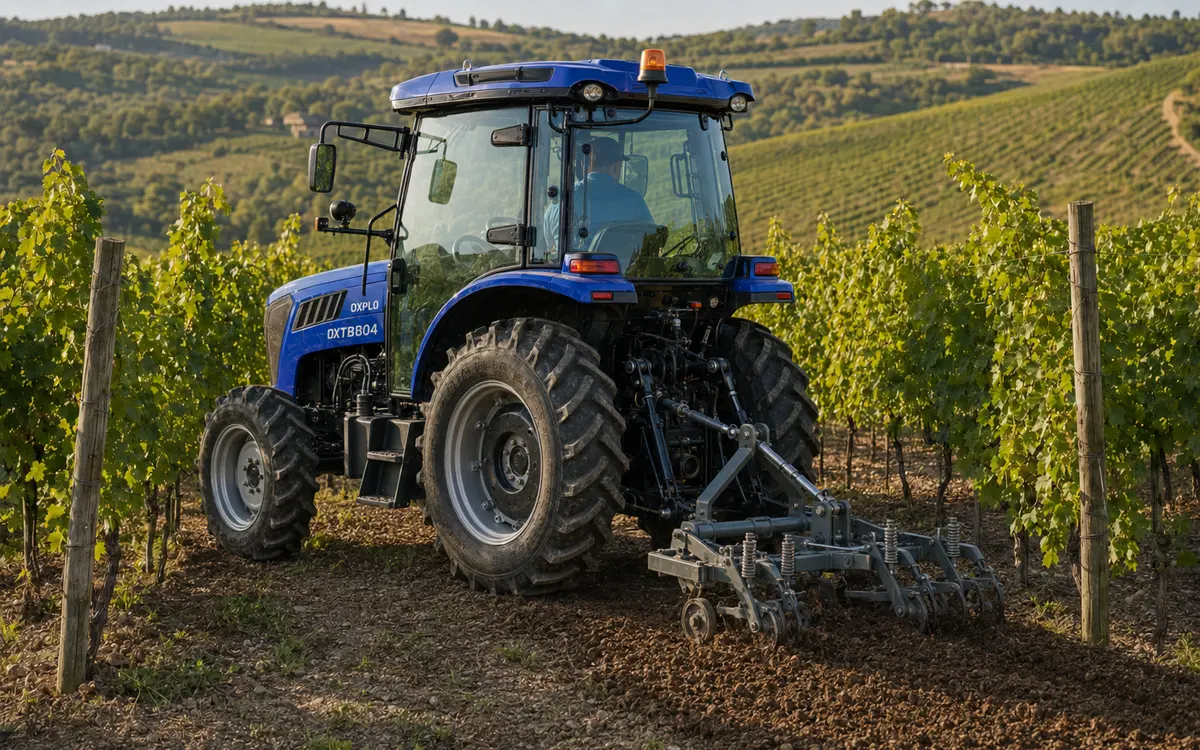
If you are searching for tractor price Poland, the difficult part is not finding a number. The difficult part is understanding what that number actually includes. Two new tractors can carry almost the same horsepower rating and still differ dramatically in price because the chassis, transmission, hydraulic system, hitch category, cab specification, tyres, documentation and after-sales package are not equivalent.
For a B2B buyer, dealer or farm manager, the purchase decision therefore should not begin with “Which tractor is cheapest?” It should begin with three questions: What work must the tractor complete? Which configuration is required to complete it reliably? And what will that machine cost per productive hour over its working life?
Key purchasing principle Do not compare tractor prices until every quotation has been converted to the same technical specification and the same delivery basis. Otherwise, the lowest number on the page may be the most expensive machine to operate. |
I. Tractor Price Poland in 2026: Why the Market Is So Difficult to Compare
Current Polish and European listings visible to Polish buyers show a very wide spread in new-tractor pricing. In August 2026, public Polish listings included new 50 HP 4WD machines at roughly PLN 40,000–75,000 depending on size and equipment, while a 70 HP cab tractor could appear around PLN 80,000. Other 70–75 HP tractors with more established dealer networks, heavier chassis or richer equipment can move well beyond PLN 100,000.
Those figures are useful as market signals, not as a universal price list. A low advertised price may refer to a compact machine, a simplified cab, limited hydraulic specification, a different tax basis or a configuration that still requires additional equipment. A higher price may already include road equipment, a front loader, wider tyres, more hydraulic outlets or local dealer preparation.
Power class | Typical buyer focus | Main price drivers |
25–40 HP | Small farms, estates, orchards, grounds maintenance | Compact dimensions, cab/open station, tyres, PTO, implements |
50 HP tractor | Livestock, grassland, mixed farming, transport | 4WD, transmission, cab, linkage, hydraulic outlets, loader preparation |
60 HP utility tractor | Mixed farming and higher recurring workload | Larger chassis, Category II linkage, transmission range, tyres |
70 HP tractor | Mixed farms, heavier implements, transport, loader work | 12×12 transmission, Category II hitch, cab, hydraulics, road equipment |
75 HP specialised/premium | Contracting, professional agriculture, specialist crops | Dealer network, electronics, transmission, homologation package, factory options |
Net price, gross price and delivery basis are not the same number
Another source of confusion is price presentation. Machinery listings may be shown net of VAT, gross, ex-warehouse or under a delivery term that shifts transport costs to the buyer. For procurement purposes, every offer should be rewritten into one common line: tractor configuration + included options + documentation + delivery to the same location + taxes and fees applicable to the buyer.
If one quotation is EXW, another is FOB and a third is delivered to a Polish warehouse, the headline prices cannot be compared directly. This is one of the most common reasons an “inexpensive” imported tractor becomes more expensive once it reaches the farm.
II. Why Two Tractors With the Same Horsepower Can Have Completely Different Prices
1. 2WD versus 4WD: rated power is not the same as usable traction
A 50 hp tractor with two-wheel drive may look attractive on paper, but traction determines whether engine power is converted into useful drawbar work. On wet grassland, loose soil, sloping fields or during loader work, wheel slip can consume part of the available power. Four-wheel drive costs more, but on many Polish farm applications it protects productivity rather than simply adding specification.
2. Chassis weight and tyre footprint change the working result
A light tractor can run out of traction before it runs out of engine power. A very heavy tractor can create unnecessary rolling resistance, soil compaction and tyre cost. The correct setup balances horsepower, machine mass, ballast and tyre footprint. This is why buyers should compare operating weight and tyre size alongside engine power.
3. Transmission choice affects how well the tractor stays inside its efficient operating window
An 8F + 8R mechanical transmission can be entirely suitable for straightforward field work and transport. A 12F + 12R transmission provides more speed steps and can make it easier to match engine rpm, ground speed and implement load. The commercial value appears when the tractor changes tasks frequently or works many hours per year. More ratios are not automatically better; they are valuable when the duty cycle actually uses them.
4. Hitch category and PTO compatibility can be more important than horsepower
Many buyers choose horsepower first and inspect their implements later. That sequence is risky. Start with the mower, plough, cultivator, seeder, spreader, sprayer, trailer or loader attachment already used on the farm. Record implement weight, required PTO speed, linkage category, hydraulic connections and recommended tractor power. If the existing implement fleet requires Category II geometry or greater lift reserve, a larger 60–70 HP platform may be cheaper than forcing a compact 50 HP machine to work outside its intended envelope.
5. Cab specification changes both price and operator output
An open-station tractor and a cab tractor cannot be treated as equivalent simply because they share the same engine rating. Heating, air conditioning, visibility, seat quality, work lights and noise control influence how long an operator can work effectively. At 100 hours per year this may be a comfort decision. At 700 hours per year it becomes a productivity and labour-retention decision.
III. The Hidden Costs Behind a New Tractor Purchase
A serious tractor price Poland comparison should move from purchase price to landed cost, and then from landed cost to total cost of ownership (TCO). The buyer needs to know what it costs to put the machine to work and what it costs to keep it working.
TCO logic Total Cost of Ownership = acquisition cost + logistics + financing + fuel + maintenance + tyres + repairs + downtime − residual value. The lowest purchase price is only one input in this equation. |
1. Front loader, mounting frame and attachments
A tractor-only offer may exclude the front loader, loader brackets, hydraulic lines, bucket, counterweight or third-function hydraulics. If loader work is part of the business case, ask for both the tractor-only price and the ready-to-work price. Otherwise, two offers that appear PLN 15,000 apart can become almost identical after the missing equipment is added.
2. Freight, port handling and inland transport
For imported equipment, confirm the Incoterm and the exact delivery point. Freight, terminal handling, customs processing, inland haulage and unloading should be visible before the deposit is paid. A useful comparison point is not “FOB origin port”; it is “delivered to the buyer’s farm or warehouse in Poland.”
3. Documentation, type approval and road-use requirements
Before ordering, confirm which conformity and registration documents apply to the exact tractor configuration and intended use. Agricultural tractors placed on the EU market can fall under EU vehicle type-approval requirements, and road registration in Poland requires the appropriate documentation. The buyer should also confirm the engine emissions configuration, braking, lighting and any road-use equipment required for the intended operation.
The key risk is simple: documentation should be verified before shipment, not after the tractor arrives. A machine that cannot be registered or used as intended ties up capital without generating productive hours.
4. Parts lead time is a cost, even when the part itself is cheap
Downtime during mowing, planting, harvest or livestock operations can cost more than the failed component. Buyers should ask where filters, belts, seals, hydraulic components, electrical parts and wear items are stocked; which parts are considered routine; and how quickly critical components can be dispatched. Parts availability is part of the tractor price even when it does not appear on the invoice.
IV. 50 HP Tractor vs 70 HP Tractor: Which One Makes Better Financial Sense?
For many small and medium farms, the practical sizing decision is not between two brands. It is whether a 50 hp tractor can handle the recurring workload efficiently or whether moving to a 70 hp tractor provides enough additional capacity to justify the higher acquisition and operating cost.
When a 50 HP tractor usually makes sense
A 50 hp tractor is often a rational fit for grassland maintenance, livestock support, mowing, spraying, fertiliser spreading, lighter soil preparation, small-to-medium trailer work and general farmyard duties. The benefit is not only a lower purchase price. A correctly sized compact tractor can reduce turning space, machine weight, tyre cost and capital tied up in unused capacity.
- The existing implements are within the tractor’s linkage, PTO and hydraulic limits.
- Access through gates, barns or narrower working areas matters.
- Annual operating hours are moderate and heavy tillage is not the dominant task.
- The buyer values a compact platform more than maximum drawbar capacity.
When a 70 HP tractor becomes the safer choice
A 70 hp tractor becomes more attractive when the farm uses heavier Category II implements, larger mowers, more demanding PTO equipment, heavier trailers or a front loader frequently. It also creates capacity reserve. A machine that spends every season near its traction, hydraulic or lift limit may complete the job, but it can lose time and increase mechanical stress.
- Heavier tillage or larger PTO-driven implements are recurring work, not occasional exceptions.
- Category II implement compatibility is required.
- Transport loads and loader work are significant parts of the duty cycle.
- The tractor will accumulate high annual working hours and needs more capacity reserve.
The better sizing question: what is the recurring load factor?
Instead of asking whether a 50 HP tractor can technically pull an implement, ask what proportion of its practical capacity the job consumes for hundreds of hours per year. A tractor occasionally working hard is normal. A tractor that is constantly at its limit is undersized. The reverse is also true: buying 70 HP for work that rarely requires more than 30–40 HP can produce poor capital efficiency.
Decision factor | 50 HP tractor | 70 HP tractor | Procurement implication |
Access & manoeuvrability | Usually easier in tight yards and gates | Larger chassis requires more space | Measure gateways, turning areas and storage before purchase |
Implement class | Often Category I / lighter implements | Often Category II / broader compatibility | Check the farm’s existing implement fleet first |
Loader & transport | Suitable for moderate duty | More reserve for frequent/heavier work | Price loader-ready configuration, not tractor-only |
Capital cost | Lower | Higher | Compare cost per productive hour, not invoice value alone |
Capacity reserve | Lower | Higher | Useful when workload is seasonal, heavy or expanding |
V. How to Calculate Whether a More Expensive Tractor Is Actually Cheaper
Purchasing teams often approve equipment according to the acquisition budget. Operations teams experience the cost per working hour. The second number is normally more useful for comparing tractors that will be kept for several years.
A simple ownership model starts with depreciation: purchase price minus expected residual value, divided by planned productive hours. Then add fuel, scheduled service, repair reserve, tyres, financing and downtime exposure. The model does not need to be perfect. It only needs to be consistent across the machines being compared.
Illustrative five-year comparison
Item | Tractor A | Tractor B |
Purchase price | PLN 90,000 | PLN 115,000 |
Annual productive hours | 500 h | 500 h |
Planned ownership | 5 years | 5 years |
Estimated residual value | PLN 35,000 | PLN 50,000 |
Five-year depreciation | PLN 55,000 | PLN 65,000 |
Depreciation per productive hour | PLN 22/h | PLN 26/h |
In this simplified example, the more expensive tractor adds only PLN 4 per productive hour in depreciation. If it completes work faster, reduces contractor use, matches the farm’s existing implements better or avoids even a few days of peak-season downtime, the PLN 25,000 difference in purchase price may be commercially justified.
The right commercial question Do not ask only “Why is this tractor PLN 25,000 more?” Ask “What additional output, compatibility, serviceability or risk reduction do I receive for that PLN 25,000?” |
VI. How OXPLO Approaches Tractor Selection for Polish Buyers
This is where OXPLO’s tractor range becomes relevant. OXPLO currently focuses on tractors up to 75 HP, covering compact and utility-class machines for orchards, livestock operations, mixed farms, grassland, property maintenance and related applications. The useful way to compare the OXPLO range is not by horsepower alone, but by chassis size, linkage category, transmission and the implements the buyer already owns.
You can review the full OXPLO tractor range before narrowing the selection to a specific model.
OXPLO OXT504: a compact 50 HP tractor platform
The OXPLO OXT504 is rated at 37 kW / 50 HP and uses 4WD, an 8-forward + 8-reverse transmission and Category I rear linkage. Its published overall width is 1,560 mm, which keeps it within the compact OXT chassis family while providing more engine output than the smaller OXPLO models.
For a Polish buyer, the OXPLO OXT504 is most logical when compact access still matters but the workload has moved beyond light estate work. Typical examples include grassland maintenance, livestock support, fertiliser spreading, PTO-driven work and farm transport where Category I implement compatibility remains appropriate.
See the OXPLO OXT504 50 HP tractor specifications.
OXPLO OXT704: a 70 HP utility tractor with a larger working platform
The OXPLO OXT704 is rated at 51.5 kW / 70 HP. OXPLO lists the model with 4WD, a 12-forward + 12-reverse transmission, Category II rear linkage and dual-speed PTO. The published platform is larger and heavier than the OXT504, which changes the tractor’s implement compatibility and working role—not just its engine output.
For mixed farms, livestock operations, wider-row agricultural work, heavier transport and more demanding implement use, the OXPLO OXT704 provides more capacity reserve than a compact 50 HP tractor. That does not mean every buyer should move to 70 HP. OXPLO recommends matching the tractor to the recurring workload, because unused horsepower still carries acquisition and operating cost.
See the OXPLO OXT704 70 HP tractor specifications.
Do not treat OXPLO OXT504 and OXT704 as a simple 20 HP step
The OXPLO OXT504 and OXPLO OXT704 represent different platforms. The OXT504 retains a compact chassis and Category I linkage. The OXT704 moves to a longer wheelbase, larger tyres, Category II linkage and a 12F + 12R gearbox. When a buyer already owns Category II implements, the larger OXPLO platform may make more economic sense even if the nominal horsepower requirement looks modest.
For a broader horsepower comparison, read the OXPLO Guide to Choosing Between 25 HP, 40 HP, 50 HP and 70 HP Tractors.
VII. What to Send OXPLO Before Requesting a Tractor Quotation
A useful OXPLO quotation should be built from the application, not from horsepower alone. The more operating information the buyer provides, the easier it is for OXPLO to avoid quoting a machine that is technically capable but commercially mismatched.
- Country and final delivery location in Poland.
- Main farm type, crops and terrain conditions.
- Farm area and expected annual tractor hours.
- Existing implements, including model, weight and linkage category where possible.
- Required PTO speeds and hydraulic connections.
- Front-loader requirement and expected material/load type.
- Cab or open-station preference.
- Tyre preference and working surfaces.
- Road-use and registration requirements.
- Required conformity, shipment and commercial documentation.
OXPLO can then confirm the relevant tractor model, configuration, optional equipment and shipping basis. This process is more reliable than asking OXPLO—or any supplier—for “your best price on a 50 HP tractor” without describing the work the tractor must perform.
Confirm support and warranty terms before the purchase order
The procurement review should also cover routine parts, service information, warranty scope and the process for technical support. OXPLO provides separate support and warranty information so buyers can review these items before purchase rather than treating after-sales service as an afterthought.
OXPLO Support • OXPLO Warranty Policy • OXPLO Shipping & Delivery
VIII. Buyer Checklist: What to Confirm Before Paying a Tractor Deposit
A. Tractor specification
- Rated engine power and rated engine speed
- 2WD or 4WD
- Transmission configuration
- PTO speeds and shaft specification
- Three-point linkage category and lift requirements
- Hydraulic outlets and flow requirements
- Front and rear tyre sizes
- Overall dimensions, wheelbase and operating weight
- Front-loader compatibility and counterweight requirement
B. Commercial terms
- Net or gross price basis
- Included options and attachments
- Incoterm and exact delivery point
- Freight, inland transport and unloading responsibility
- Payment terms and deposit requirements
- Pre-delivery inspection or commissioning scope
- Warranty scope and exclusions
C. Documentation and compliance
- Documentation required for the exact tractor configuration
- Engine emissions configuration for the target market
- Road lighting and braking equipment where applicable
- Registration requirements for intended use in Poland
- Confirmation of documentation before shipment
D. After-sales support
- Recommended service intervals
- Routine service-parts list
- Critical spare-parts lead time
- Technical manuals and parts documentation
- Support contact and warranty claim process
Procurement rule A quotation without a confirmed specification is only a price. It is not yet a procurement decision. |
Conclusion: Compare Productive Capacity, Not Just Tractor Price
There is no single correct answer to “How much does a new tractor cost in Poland?” The Polish market includes compact low-cost tractors, mainstream utility machines and heavily specified professional models. The same horsepower figure can therefore sit on tractors designed for very different workloads.
For a buyer comparing tractor price Poland, the most useful benchmark is not PLN per horsepower. It is the expected cost per productive hour after configuration, logistics, serviceability, downtime and residual value are considered.
A well-matched 50 hp tractor can be the stronger investment when the farm needs compact dimensions, Category I implements and moderate recurring loads. A 70 hp tractor can be the safer investment when Category II implements, heavier transport, loader work or higher annual utilisation demand more capacity reserve.
OXPLO’s current tractor range covers this decision path from compact 25 HP models through the OXPLO OXT504 50 HP tractor and OXPLO OXT704 70 HP tractor. Rather than choosing the OXPLO model with the highest horsepower, buyers should select the OXPLO platform that matches their existing implements, working environment and five-year operating plan.
Explore OXPLO tractors • Visit the OXPLO website • Contact OXPLO for a configuration-based quotation.
IX. Frequently Asked Questions
Q1. What is a realistic new tractor price in Poland?
There is no single market price because tractor size, drivetrain, cab, transmission, hydraulics, dealer package and delivery basis vary widely. Public 2026 listings show that compact 50 HP machines can sit well below larger dealer-supported 50 HP tractors, and the same pattern continues in the 70–75 HP class. Compare like-for-like specifications before using any listing as a benchmark.
Q2. Is a 50 HP tractor enough for a small farm?
Often yes. A 50 hp tractor can be suitable for grassland, livestock support, mowing, spraying, spreading, lighter cultivation and general transport. The deciding factors are implement requirements, terrain, annual hours and the proportion of time the tractor would operate near its practical limit.
Q3. When should I choose a 70 HP tractor instead?
A 70 hp tractor is more appropriate when the farm regularly uses heavier Category II implements, performs more demanding PTO work, moves heavier trailers, operates a loader frequently or needs more reserve for high seasonal workloads.
Q4. Which OXPLO model corresponds to the 50 HP class?
The OXPLO OXT504 is the 50 HP model in OXPLO’s compact OXT chassis group. OXPLO lists it with 4WD, an 8F + 8R transmission, Category I linkage and a compact 1,560 mm published width.
Q5. Which OXPLO model corresponds to the 70 HP class?
The OXPLO OXT704 is a 70 HP utility tractor. OXPLO lists the OXT704 with 4WD, a 12F + 12R transmission, Category II linkage and a larger utility platform suited to broader implement compatibility and higher recurring workloads.
Q6. Does OXPLO provide front-loader or attachment options?
OXPLO supports tractor attachment selection and can discuss loader-compatible configurations according to model, hydraulic requirements, attachment type and counterweight needs. Buyers should request a ready-to-work quotation if loader work is part of the application.
Q7. What information should I give OXPLO to get a useful quotation for Poland?
Send OXPLO the delivery location, farm type, annual working hours, existing implements, required PTO and linkage, loader requirements, tyre preference and road-use or documentation needs. OXPLO can then discuss the appropriate model and configuration rather than quoting horsepower alone.
Q8. Where can I review OXPLO tractor specifications and support information?
Use the OXPLO tractor category page for the current model range, the OXT504 and OXT704 product pages for detailed specifications, and the OXPLO Support and Warranty pages for after-sales information.