
A practical European buyer’s guide to feeding routes, safe bale handling, trailer selection and whole-farm operating cost.
On a cattle farm, feeding cannot stop because a tractor cannot fit through a barn entrance, a loader attachment is wrong for the forage, or a trailer cannot safely cross a wet yard. These are not occasional inconveniences. In winter, a small equipment mismatch can become a recurring daily delay.
The same machine may retrieve hay before breakfast, deliver silage to several feed points, move clean bedding and pull a trailer before returning to pasture maintenance. The buying challenge is therefore not simply finding enough horsepower. It is matching the tractor, loader, bale handler, trailer and route to the jobs that must happen every day.
This guide explains how to specify a tractor for cattle farming from the work backwards: identify the bottleneck, check the engineering limits, compare realistic configurations and calculate the operational consequences before ordering.
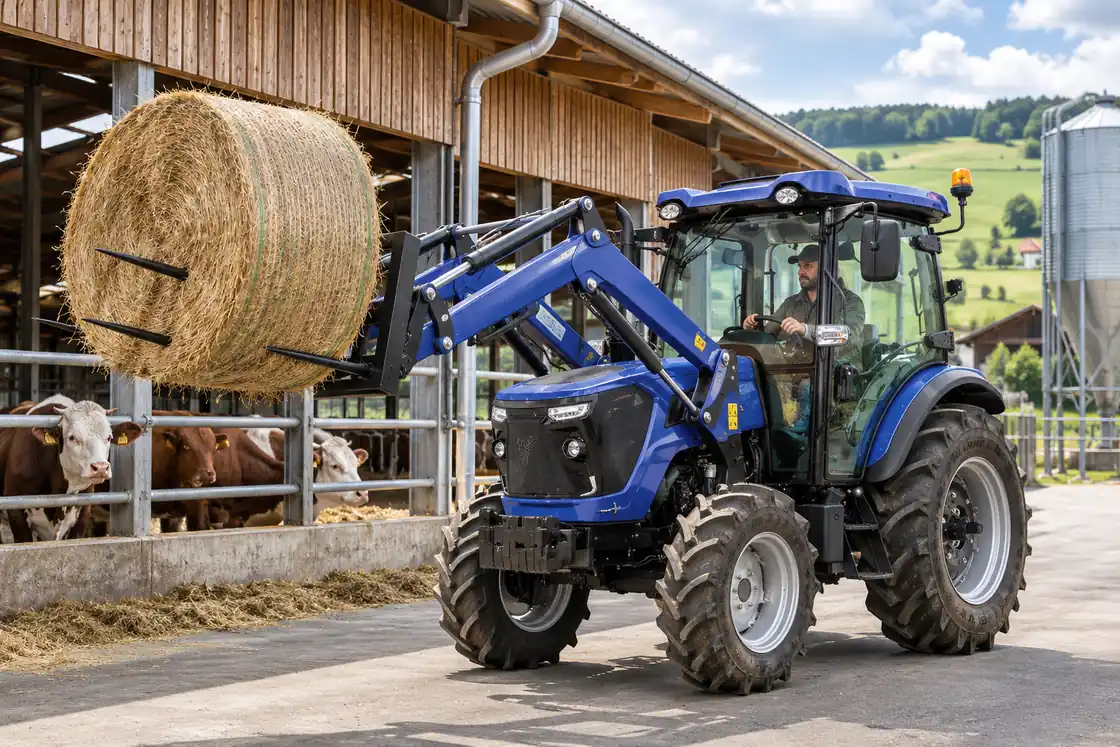
Figure 1. Tractor and bale fork during cattle-feed handling. Illustrative scene; attachment availability and safe lifting capacity must be confirmed.
I. The Bottleneck on European Cattle Farms Is Often the Working Route
Daily feeding exposes problems that field specifications do not show
A tractor that performs well on open grassland can still be awkward inside an older livestock yard. Low doors, tight corners, uneven concrete, slippery ramps and livestock crossings all affect how quickly a bale can be delivered. During wet weather, tyres and braking become more important; during winter, reduced daylight makes visibility and yard traffic control equally critical.
Imagine a farm with separate hay storage and three feeding locations. The operator can lift a bale at the store, but has to make two extra reversals at each delivery point. Choosing a larger tractor might increase available engine power while making the route worse. The lost minutes occur at every feeding cycle, not just during peak fieldwork.
The first purchasing question should be: Where does today’s equipment slow the routine, and how many times does that delay recur? That is more informative than asking whether 50HP or 70HP is generally better for cattle.
Measure the complete machine, not just its published width
Record the narrowest gate, clear doorway height, tightest turn, surface gradient, feeder position and location of pedestrians or cattle. Then remeasure the proposed machine with its intended tyres, loader, forks and any trailer attached. Tractor body width alone is not an operating clearance.
For example, a hypothetical barn entrance is 1,800 mm wide. A tractor listed at 1,560 mm would have only 120 mm of theoretical clearance per side when perfectly centred; a 1,760 mm machine would have only 20 mm per side. Neither calculation establishes safe access. Real clearance must account for the attachment envelope, steering, uneven surfaces, door edges and a sensible operating margin. The 1,760 mm option should not be assumed usable through such an opening.
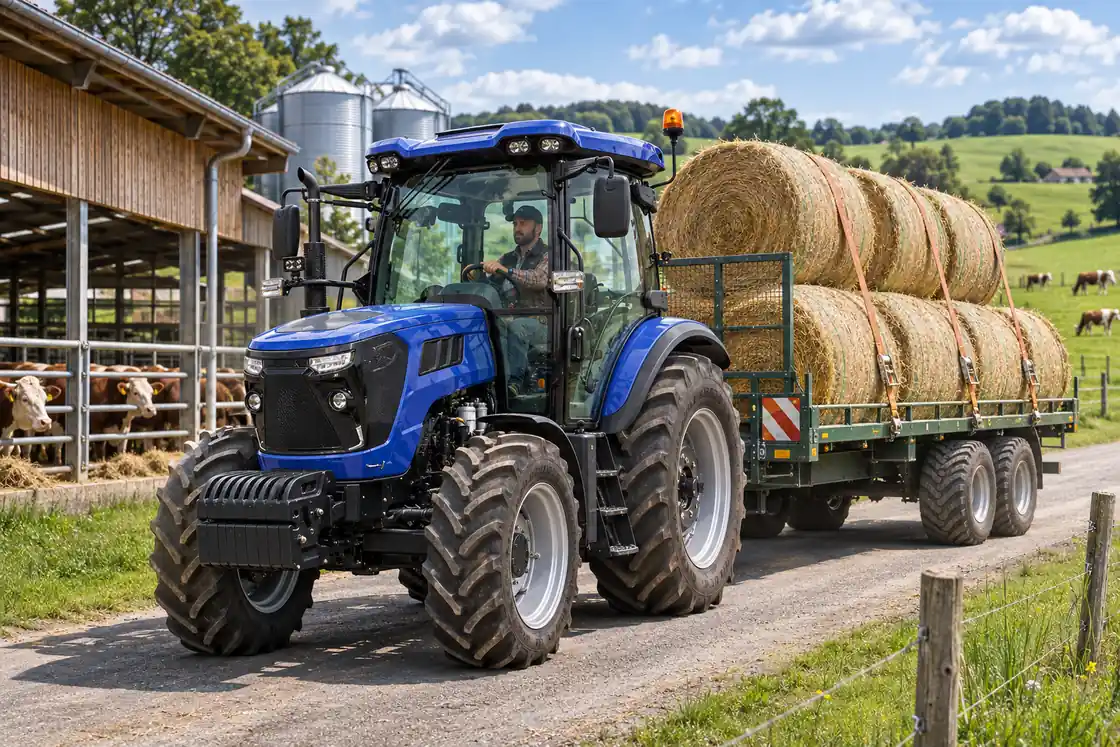
Figure 2. Barn passage and bale-handling access. Illustrative scene; measure the complete tractor and attachment envelope before purchase.
Use a short site survey before asking for quotes
- Record the maximum measuredbale mass and whether it is dry hay or wrapped silage.
- Measure required lift height and where the load’s centre of gravity will sit.
- Measure all critical doorways, turns, slopes, surface conditions and trailer unloading areas.
- List your existing rear implements, linkage categories, PTO speeds and hydraulic needs.
- Estimate daily loader cycles, towing trips and seasonal grassland hours.
II. Map the Daily Jobs Before Sizing the Tractor
Start with a task-by-task workload, not an average farm size
A 40-acre livestock unit feeding at one central barrier may be easier to serve than a smaller farm with scattered buildings. A tractor for cattle farming must be matched to the actual handling cycle, not acreage alone. Headcount alone is also insufficient: dairy, beef, breeding and youngstock systems can have different feeding layouts and material flows. Build the equipment specification around the heaviest recurring task and the most restrictive working route.
Job | Equipment interface | Buying constraint |
Move dry round bales | Front loader + rated spear/fork | Actual bale weight, load centre, height |
Move wrapped silage | Loader + non-puncturing grab | Film protection and hydraulic compatibility |
Handle loose bedding/feed | Suitable bucket | Material density and feed hygiene |
Move hay between stores | Tractor + appropriate trailer | Loaded mass, braking, route, hitch |
Mow pasture | Rear implement / PTO | Required power, PTO speed, linkage |
Winter yard maintenance | Tyres, lighting, approved attachment | Traction, operator sightlines, ground conditions |
Worked workload: why the heaviest bale changes the decision
Suppose a farm normally handles 500 kg dry hay bales but sometimes purchases wrapped silage bales that weigh materially more. If the buyer specifies a loader from the routine hay weight only, the machine may be unsuited to the seasonal task. Obtain representative weighbridge or supplier records and use the heaviest credible operating load for the relevant attachment assessment.
The daily forage quantity is a separate calculation. Diets should be set using animal class, liveweight, forage dry matter and nutritional advice; a tractor-buying article cannot infer a safe ration from cattle numbers. Instead, record tonnes handled, bales moved, deliveries completed and distances travelled. These are direct inputs to a livestock farm tractor setup.
Organise the route as a work cycle
A useful planning sequence is retrieve → travel → position → unload → return → change attachment, with safe vehicle stopping and inspections built into the routine. Count the time at each stage. This exposes whether the machine is truly underpowered, whether the yard needs a one-way route, or whether frequent implement changes are the real cost driver.
Keep people and animals away from operating machinery. UK HSE farm-transport guidance recommends separating vehicles from pedestrians and designing routes to reduce reversing; these principles are useful operating controls across European farms, alongside local legal obligations.
III. Specify the Loader, Bale Fork and Ballast as One Rated Combination
Horsepower is not a safe bale-lifting rating
When selecting a tractor for cattle farming, evaluate the front loader at the actual loading point and required height, not by engine output. Published loader figures may be measured at the pivot pins, at a specified distance forward, or at a particular lift position. Those figures cannot be compared without the same reference conditions. Bucket or fork weight, forward projection and the tractor’s front-axle and tyre limits can all change the permitted operating load.
Consider an example of a 650 kg bale on a 110 kg attachment. The combined suspended mass is 760 kg before checking the position of the load centre. That does not mean a loader labelled “760 kg” is suitable. Request a capacity chart or approved rating for the actual fork or grab, lifting geometry and height. Respect the lowest applicable limit of the loader, attachment, axle, tyres and complete tractor-loader combination.
Choose the attachment to protect the forage
A bale fork for cattle farm work is not automatically suitable for every bale. A rated bale spear may be appropriate for unwrapped dry round hay; an approved multi-tine fork may suit some square-bale arrangements. Wrapped silage generally needs a non-puncturing grab with compatible hydraulic connections so the plastic film is not damaged. A standard loader bucket is not a substitute for a secure bale-handling device.
Also verify the coupler standard, locking mechanism, fork projection and clear view of the load. When a grab requires auxiliary hydraulics, the availability and specifications of the required circuit must be confirmed rather than assumed from the tractor’s general hydraulic system.
Rear counterweight and travel height are part of the specification
A bale carried forward of the front axle increases front-end load and shifts the combined centre of gravity. This is why ballast is not an optional afterthought. Manufacturer-approved rear ballast, tyres and axle load limits must be considered together; adding an arbitrary weight does not certify safe stability. When travelling, keep the loader low as practical, avoid sharp turns or side slopes, and operate only within the approved limits for the surface.
A useful acceptance test is to check the actual machine and attachment under an approved, controlled load: can the operator lift to the required feeding position, retain clear visibility, stop securely and manoeuvre without entering livestock or pedestrian areas? Test procedures should follow the manufacturer’s instructions and local safety rules.
IV. Match the Hay Trailer to Mass, Brakes and Access
Payload is not the same as permitted train weight
For hay trailer tractor requirements, remember that a tractor for cattle farming must tow within its approved limits. Distinguish the trailer’s payload rating from its gross mass, hitch loading, braking arrangement and the tractor’s permitted towing or train mass. A trailer may have enough room for bales but still be unsuitable for the tractor or local roads.
Illustrative calculation: four 650 kg bales create 2,600 kg of cargo. If the trailer itself weighs 1,100 kg and there is no other cargo, its estimated loaded mass is 3,700 kg. This is only arithmetic, not a safe towing recommendation. Check the approved trailer, tractor, coupling, axle and braking ratings; load securing and distribution; and the relevant jurisdiction’s road rules.
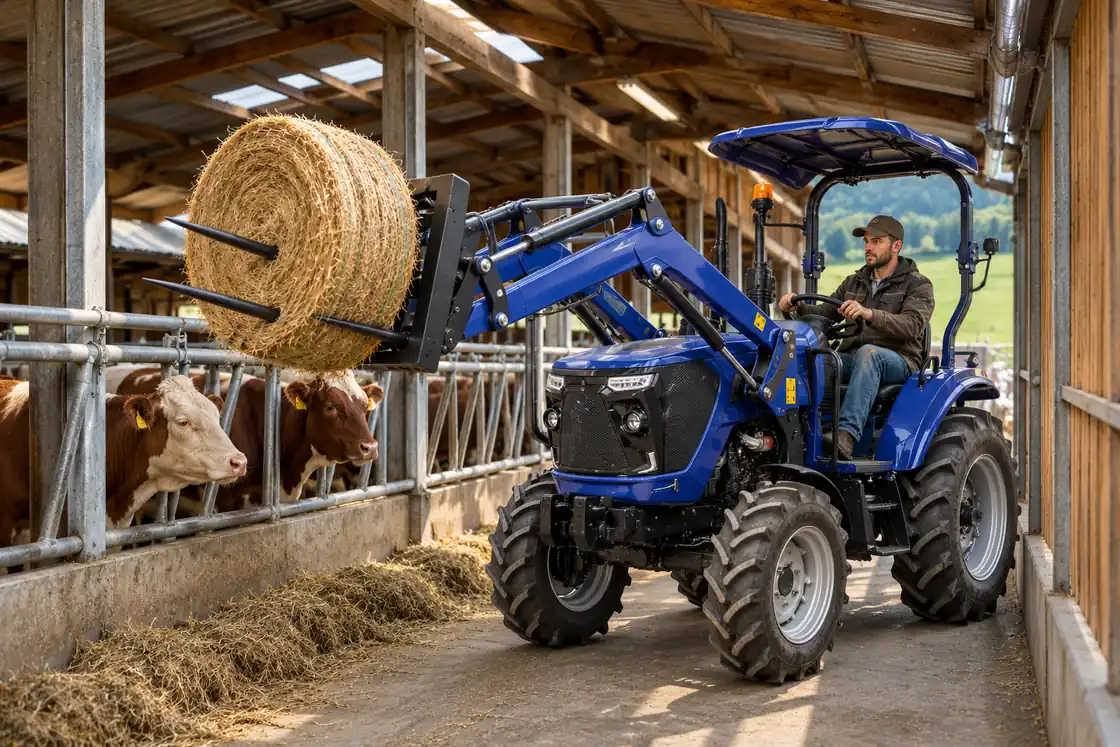
Figure 3. Hay-bale transport on a European farm route. Illustrative scene; actual trailer mass, brakes and coupling require verification.
Compare trip count with yard manoeuvrability
Suppose a farmer must shift twelve bales from a field store. A two-bale trailer needs six loaded journeys; a four-bale trailer needs three. In theory the larger unit reduces trips, but this saving can disappear if it cannot turn into the feed yard or requires a different tractor, braking system or access route. Compare time per complete trip, including loading, reversing, securing and unloading.
Treat road transport and on-farm towing separately
A 4WD tractor may have useful traction on wet grass, but 4WD does not increase the permitted trailer mass or replace a suitable braking system. Confirm drawbar/hitch ratings, legal coupling arrangements, required service and parking brakes, lighting, tyres and public-road approvals. Do not mount a loaded trailer to an improvised towing point or assume that an agricultural attachment can travel on public roads without further checks.
V. Remove Hidden Costs From the Feeding Routine
A small delay repeated all winter becomes expensive
The easiest cost to miss is repeated non-productive movement. If an improved storage layout and working sequence safely reduce 10 minutes of unnecessary manoeuvring per operating day, over 250 days the farm saves about 41.7 hours. At an illustrative all-in labour cost of €22 per hour, that is approximately €917 per year. This is a scenario for the reader to test against their own operation—not an observed saving from a particular machine.
The reverse can also occur. Purchasing a tractor that is too wide for the existing barn may force extra short trips or manual rehandling, creating a new labour burden despite its higher rated power.
Winter downtime carries a different cost from seasonal delays
A missed mowing window can sometimes be rescheduled; livestock feeding generally cannot. Procurement teams should therefore look beyond purchase price to the availability of filters, loader pins, hydraulic hoses, tyres, service instructions and technical support. Record the tractor’s expected annual hours and the consequences if the main feeding machine is unavailable for a day.
A practical total-cost-of-ownership comparison includes annualised purchase and financing costs, fuel, routine servicing, replacement components, insurance, labour, downtime, and resale value. Compare suppliers on the same ownership period and duty cycle. Never convert a speculative efficiency assumption into a guaranteed payback claim.
Know when a telehandler or second machine is the safer option
If the farm routinely stacks heavy bales high, works at significant forward reach or runs intensive loading shifts, a dedicated telehandler or other rated material handler may be more appropriate than a tractor-mounted front loader. A single tractor is versatile, but versatility is not permission to exceed the loader’s stability envelope. A second machine may also protect feed continuity where no practical backup exists.
VI. European Procurement Checks: Compliance, Service and Acceptance
Match legal documents to the actual tractor and destination
European buyers should define where the tractor will be used before placing a deposit. Private-yard operation and routine public-road transport can involve different requirements for lighting, braking, coupling, registration and driver eligibility. For EU markets, Regulation 167/2013 provides the agricultural vehicle type-approval framework. A valid certificate of conformity (CoC), where applicable, needs to match the approved vehicle type, variant and version. It does not certify every optional loader, fork, trailer or later modification.
For a tractor intended for cross-border deliveries, ask the seller to identify the approval basis, engine emissions evidence, operator-protection documentation and any national requirements relevant to the supplied specification. Separate machinery and trailer obligations may apply. Reviewing an official EU tractor type-approval summary is more reliable than treating a generic certificate photograph as sufficient proof. Buyers should have their local competent authority or specialist verify registration questions if there is doubt.
Make service continuity part of the purchasing decision
A farm that has one main feeding tractor should ask three practical questions: which components commonly require routine replacement, how will those parts be identified, and what happens if the machine becomes unavailable during a winter feeding period? Useful evidence includes the maintenance schedule, consumable part numbers, loader and hydraulic servicing instructions, warranty exclusions and an agreed route for technical support. A lower purchase price may not compensate for uncertain parts identification or prolonged downtime.
For an importer or dealership, the service obligation extends to the end customer. Agree who diagnoses faults, who supplies service documents, which party pays transport for warranty parts, and whether local-language operating materials are required. Do not assume guaranteed local stock or an on-site engineer merely because after-sales support is advertised. Record the actual terms in the purchase agreement.
Define acceptance checks before shipment
A practical acceptance plan should list the ordered tyre size and overall width, operator station, hydraulic outlets, loader mounting and locking mechanism, bale-handling attachment, rear ballast, towing coupling, safety equipment and supplied documents. Require the correct ratings and instructions for the completed combination. Where possible, conduct a controlled functional demonstration under manufacturer-approved conditions and record any deviations before dispatch.
Dimensions matter as much as specifications. The farmer should review a final configuration drawing against the measured building entrance, lift height and trailer route. If the proposed machine requires a new doorway, different attachment or separate handling vehicle, that change belongs in the total project cost—not in an unexpected expense after delivery.
Give every supplier the same application brief
- Destination country, public-road usage and requested market documents.
- Animal operation type, daily feeding locations and peak working hours.
- Maximum measured bale mass, forage type and required positioning height.
- Narrowest access, turning room, gradient and wet-weather operating conditions.
- Trailer tare mass, expected payload, brake system, coupling and route.
- Existing linkage category, PTO implements, spare-parts and service expectations.
A consistent brief allows quotations to be compared on approved working capability rather than headline horsepower. Ask suppliers to identify any unverified assumption explicitly. The right specification is the one that solves the documented job without shifting new risks to the farm operator or dealer.
VII. Which OXPLO Tractor Platform Fits the Job?
Compare chassis and implement compatibility, not just HP
Once the operating limits are documented, choosing a tractor for cattle farming becomes a comparison of practical platforms. The OXPLO 25–70HP tractor range offers several relevant platforms. OXPLO lists the OXT504 as a compact 50HP 4WD tractor, while the OXT604 and OXT704 use a larger utility platform. Those differences affect access, implement compatibility and speed choice; they do not establish an approved loader or towing capacity.
Published base specification | OXPLO OXT504 | OXPLO OXT604 | OXPLO OXT704 |
Rated engine output | 50HP | 60HP | 70HP |
4WD | Yes | Yes | Yes |
Transmission | 8F+8R | 12F+12R | 12F+12R |
Overall width | 1,560 mm | 1,760 mm | 1,760 mm |
Wheelbase | 1,800 mm | 2,010 mm | 2,010 mm |
Rear linkage | Category I | Category II | Category II |
Initial evaluation | Tight access | Frequent mixed work | Higher seasonal power demand |
These are currently published OXPLO base-tractor specifications; optional tyres, cab, loader and market configuration can change the actual supplied machine. No loading or towing rating should be inferred from this table.
OXPLO OXT504: keep compact access on the shortlist
The OXPLO OXT504 50HP tractor lists a 1,560 mm width, 1,800 mm wheelbase, 8F+8R transmission and Category I rear linkage. On a farm constrained by tight buildings and existing Category I equipment, the smaller platform can be valuable. Its 50HP engine should not, however, be treated as proof that an occasional heavy silage bale is within a chosen loader’s rating.
OXPLO OXT604: a larger utility platform for regular mixed tasks
The OXPLO OXT604 60HP tractor has a 2,010 mm wheelbase, 12F+12R transmission and Category II rear linkage. For an operation combining frequent trailer movement, pasture work and loader tasks, OXPLO’s larger platform merits assessment. The trade-off is a listed width of 1,760 mm and the need to confirm fit with existing implements; additional engine power cannot fix a narrow barn entrance.
OXPLO OXT704: assess power demand outside the feeding shift
The OXPLO OXT704 70HP tractor retains the published larger Category II platform and 12F+12R gearbox while increasing rated engine power to 70HP. It may justify evaluation when the same machine performs more demanding seasonal PTO and field tasks. For a farm spending nearly all its time in a confined feed yard, the extra horsepower may deliver little benefit unless the wider duty cycle requires it.
OXPLO also lists the OXT404 40HP tractor and other models in its general range. If handling loads and farm tasks are modest, buyers should not exclude a smaller machine before reviewing access and approved duty limits. For close technical comparisons, see the OXPLO article on OXT504 versus OXT604 chassis and loader fit.
How OXPLO can turn the application brief into a configuration review
For an OXPLO enquiry, send the same workload and access measurements before selecting accessories. The OXPLO tractor configuration page helps buyers discuss horsepower, tyres and optional equipment; the OXPLO attachments and parts support page gives a starting point for parts and compatibility questions. For specific engineering checks, use the OXPLO guide to front loaders, pallet forks and bale forks. The final quotation should identify the actual loader model, attachment ratings, hydraulics, ballast and towing arrangement—not just a general attachment description.
Confirm country documentation, after-sales terms and the final specification
Ask OXPLO to provide the model- and configuration-specific documents relevant to the destination country. Its EU tractor import documentation guide explains useful verification steps, while the OXPLO warranty policy describes one-year or three-year arrangements subject to agreed terms. Confirm the precise coverage, exclusions and parts process in writing; do not infer blanket certification or local stock availability. The OXPLO agricultural handling solutions page also outlines how tractor transport, feed movement and material handling work together on a farm.
With a complete brief, OXPLO can compare the OXT504, OXT604 and OXT704 against the customer’s daily routine, then document the outstanding checks before an order is placed. The resulting recommendation should make the trade-offs visible: access against chassis size, implement compatibility against budget, and productivity against downtime risk.
VIII. FAQ: Buying a Tractor for a Cattle Farm
Q1. What HP tractor is suitable for cattle farming?
A1. There is no universal HP threshold for a tractor for cattle farming. Some lighter farm tasks may suit a 40–50HP class tractor, while more demanding mixed-farm or PTO workloads may justify evaluating 60–70HP machines. Define loader capacity, towing requirements, terrain and access before deciding. An OXPLO recommendation must be based on the exact model and attachments, not engine power alone.
Q2. Can a 50HP tractor lift a 650 kg hay bale?
A2. Possibly, but the engine rating does not answer the question. The supplier must verify the complete loader/attachment combination at the intended load centre and height, including tyres, axles and ballast. Do not infer safe bale capacity from the tractor’s HP or listed rear-linkage capacity.
Q3. Should I buy a bale spear, bale fork or silage grab?
A3. Use a rated attachment suited to the actual bale shape and packaging. Dry round hay and large square bales may need different supports; wrapped silage normally calls for a non-puncturing grab. Check coupling, hydraulic requirements and load stability before buying.
Q4. How do I size a hay trailer for a livestock tractor?
A4. Calculate loaded trailer mass from its unladen mass plus measured cargo and additional equipment. Verify hitch and axle ratings, tractor towing limits, braking, tyre and lighting requirements, and the available turning space. An advertised payload alone is insufficient.
Q5. Is a cab or ROPS tractor better for winter cattle work?
A5. A cab may improve operator comfort during cold or wet routines, but overall machine height and visibility must be checked against the buildings. ROPS and seat-belt use, correct guarding and manufacturer instructions remain essential. Select the final OXPLO operator-station configuration only after measuring the site and reviewing the required safety provisions.
Q6. Does OXPLO provide EU CoC for every tractor and attachment?
A6. Do not assume universal coverage. Ask OXPLO for the applicable documents tied to the precise tractor type and supplied configuration, and confirm separate equipment and destination-country obligations. CoC requirements for a tractor are not automatically equivalent to loader or trailer approvals.
Q7. What should a European dealer send with a quotation enquiry?
A7. Send the destination market, intended road use, narrowest access, heaviest bale, lift height, trailer specification, existing implements and annual duty cycle. OXPLO can then discuss suitable base tractors and document the outstanding configuration and compliance checks before price and delivery terms are finalised.
IX. Conclusion: Buy a Feeding System, Not an Isolated Tractor
The best tractor for cattle farming is the one that repeatedly completes the farm’s actual jobs without unsafe lifting, avoidable rehandling or a mismatch with its buildings and trailers. Start with bale weights, routes, working heights and trailer mass. Then check the complete tractor-loader-fork-ballast combination and calculate the real operating cycle. Horsepower comes after those requirements—not before them.
For European livestock farms and machinery dealers, OXPLO provides compact and utility 4WD tractor choices, including the OXT504, OXT604 and OXT704. Each has a different working envelope and trade-off. OXPLO can help structure an application-based configuration review, but the final loader, trailer and market documents must be confirmed against the exact order.
Share your maximum bale mass, barn entrance width, required lifting height, trailer loading, daily operating hours and destination country. Visit the OXPLO website to discuss an appropriate tractor and attachment shortlist before committing to a purchase.