
A tractor can enter a vineyard row on a winter inspection and still become an expensive mismatch during summer maintenance. Foliage spreads into the working corridor, a side-shift mower extends beyond the wheel track, and the tractor reaches a headland too short to complete a clean turn. None of those problems can be corrected simply by purchasing more horsepower.
For an Italian vineyard owner, contractor or machinery dealer, the buying question is not whether a machine looks compact. It is whether the tractor, implement, operator and field layout form a workable system through the entire growing season. A successful purchase must clear the vines, complete the task, turn without damaging posts, and meet the buyer’s documentation and service requirements.
This guide explains a repeatable selection method for a vineyard tractor Italy enquiry: measure the actual corridor, calculate the operating envelope, test turning geometry, compare implement requirements and only then assess a suitable tractor configuration.
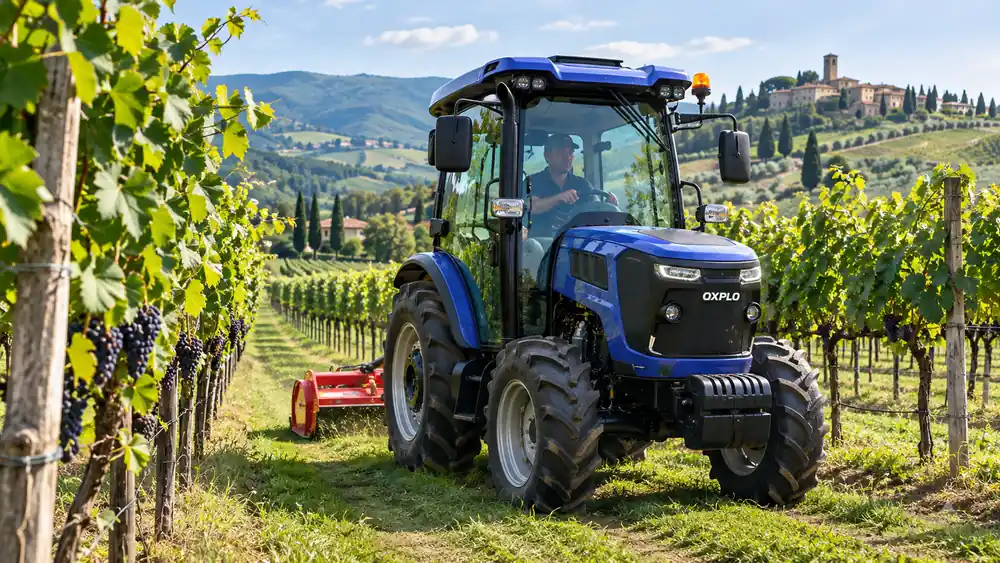
Figure 1. Concept scene: a cab tractor operating in a wider-row Italian vineyard. Site dimensions and implement compatibility require separate verification.
I. Why a Tractor That Fits Between Vines Can Still Be the Wrong Purchase
The catalogue width is only the beginning
The first mistake is to compare the distance between vine-row centre lines with the tractor’s published width. Row spacing is a planting measurement, not an unobstructed passage. Trellis posts, trunk alignment, weeds, side growth and uneven ground all consume space. A tractor body might pass on a straight route while its mirrors, protective components or fitted attachments do not.
The second mistake is to judge access in the quietest season. A winter survey can overestimate the room available after foliage growth. Research on vineyards in Apulia describes how mature vegetation reduces passage in Guyot and spurred-cordon systems; it also discusses overhead vegetation in traditional tendone systems. That evidence explains why seasonal clearance, not the best-case clearance, must drive the purchasing decision.
One field imposes several independent limits
A machine must pass four separate checks: lateral space along the row, vertical space below wires and canopy, implement clearance while working, and the full turning envelope at row ends. Passing three checks does not compensate for failing the fourth. On a cross-slope, stability and traction create another independent acceptance condition.
The hidden commercial cost is not always an obvious collision. Operators may slow down, leave unmown strips, make repeated three-point turns or stop work until vines are pruned. During short spraying or mowing windows, those small compromises can disrupt the work schedule.
Use a go/no-go rule before discussing price
Treat any configuration as a no-go until its worst-case working width, height and swept turning path are demonstrated to be compatible with the site. A provisional “it should fit” is not a verified specification. A dealer should be able to show which measurements support the recommendation and which still need checking.
II. Calculate Working Width, Not Just Row Spacing
Measure the narrowest usable corridor at multiple heights
Measure row centre spacing, but separately measure intrusions from foliage, posts and structures. Take readings at the row entrance, mid-row, narrowest section and exit across representative blocks. Measure at tyre, engine, operator-station and canopy heights. Include permanent structures and the expected mature-season condition rather than relying on one photograph.
For preliminary screening, use these two simple equations:
Usable width = Row-centre spacing − Left-side intrusion − Right-side intrusion
Total lateral margin = Usable width − Maximum working equipment width
The maximum equipment width includes everything present in the operating position, such as guards, mirrors and side-shift attachments. For a centred tractor, half the total margin remains on each side. This is a static screening method, not a substitute for dynamic clearance or a manufacturer-approved safe-distance rule.
Worked example: a nominal 2.40 m row is not necessarily wide enough
Field measurement | Illustrative value |
Row-centre spacing | 2,400 mm |
Left canopy intrusion | 250 mm |
Right canopy intrusion | 250 mm |
Usable corridor | 1,900 mm |
Example tractor width | 1,560 mm |
Total clearance remaining | 340 mm |
Per-side clearance if centred | 170 mm |
Suppose the site assessment calls for a provisional 200 mm operating allowance on each side. The required corridor is 1,560 + 200 + 200 = 1,960 mm, which exceeds the available 1,900 mm by 60 mm. The tractor fits geometrically, but it fails this planning allowance. The 200 mm figure is illustrative, not a universal vineyard safety standard; the site and operating conditions determine the appropriate clearance.
This is the practical meaning of tractor working width between vine rows: the relevant dimension is the widest component in the position used for real work, not simply the vehicle dimension printed in a brochure.
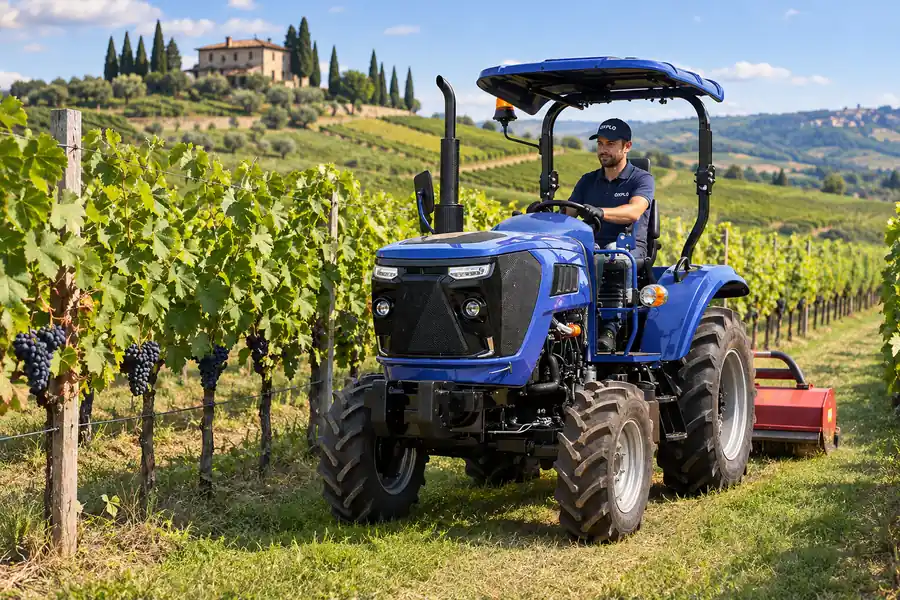
Figure 2. Concept scene: the actual corridor depends on vines, posts and seasonal canopy growth, not nominal row spacing alone.
Height, tyres and slope change the answer
Check the lowest overhead wire, branches and trellis structure in the machine’s operating path. The measured tractor height must include the actual operator station and approved protection configuration. Tyre options may change total height and track width; ground irregularities can shift the machine laterally relative to the vine line. Four-wheel drive may help traction on loose ground, but it does not establish rollover safety on cross-slopes.
III. Check Implement Overhang and the Full Turning Envelope
Straight-line clearance does not predict the path around a headland
A vineyard turning radius often refers to a defined point on the tractor, such as an outer tyre. It may not describe the space occupied by a rear-mounted mower, trailed sprayer or front weight during the turn. The tractor and its implement can sweep different arcs. A trailed machine may track inside the tractor’s path, while a mounted attachment can swing its outer corner toward an end post.
That is the critical reason to assess vineyard tractor overhang clearance. A tractor may clear the last vine while the implement does not. A sharp turn also changes the working angle of a PTO driveline; turning and lifting procedures must follow the attachment manufacturer’s instructions.
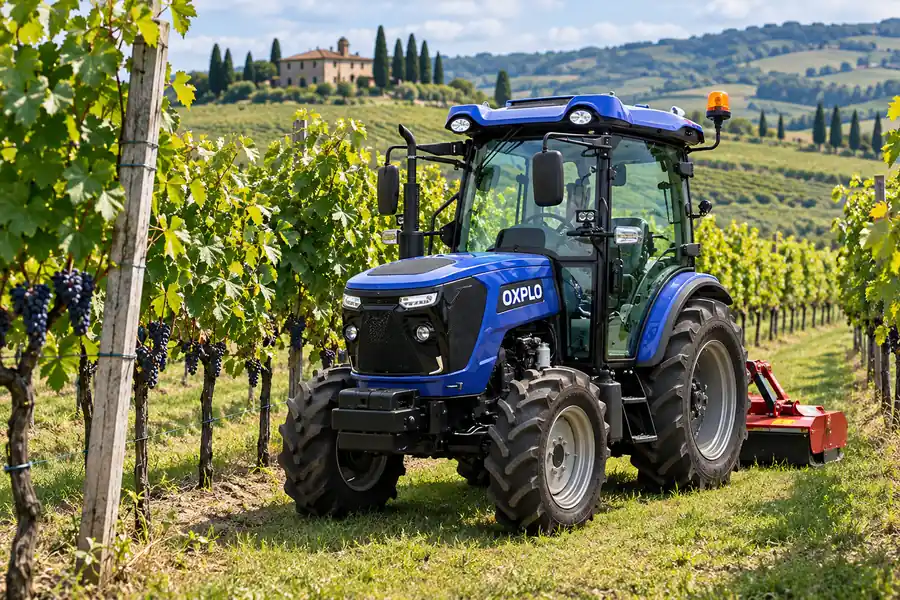
Figure 3. Concept scene: a rear mower changes the operating envelope. Verify its rearward projection and swept path during headland turns.
Request drawings in the operating position
Required measurement | Failure it helps prevent |
Maximum implement operating width | Clipping vines while mowing or cultivating |
Rearward projection from attachment point | Striking posts during entry or exit |
Side-shift reach and return path | Contact with vines on a steering correction |
Transport and approved lifted dimensions | Interference when leaving a row |
Hitch articulation and drawbar geometry | Inside tracking or jackknifing during turning |
For a side-shift mower, check clearance at maximum permitted offset, not just in its centred transport position. For a sprayer, include the tank, booms or guards, hoses, and any other projecting components in the actual installed configuration.
A repeatable field test for headlands
Mark a representative narrow headland and fixed obstacles. Using the intended combination in a clear, controlled area, a trained operator should complete the approved low-speed turn while an observer records the widest swept position. Note whether reversing is necessary, whether the implement must be repositioned, and how much distance remains to posts, drains and fences. Repeat the test for the key jobs, not just with an unladen tractor.
There is no useful universal headland number for every vineyard. A compact mounted mower, a long drawbar sprayer and a loaded trailer impose different geometry. If the headland is too short for a clean turn, consider an alternating-row route, a shorter compatible implement or a different machine class before accepting a routine sequence of reversing manoeuvres.
IV. Match the Tractor to the Jobs, Not to a Horsepower Label
List the seasonal jobs before deciding engine output
Most owners want one machine to do more than a single task. Common requirements include inter-row mowing, under-vine maintenance, light cultivation, material movement and trailer work. But each activity uses a different combination of power, geometry, hydraulics and traction. The priority is to avoid purchasing unused engine capacity while overlooking a critical PTO or hitch mismatch.
Job | Specify before purchase | Typical buying mistake |
Flail or rotary mowing | Working width, PTO input speed/power, guard clearance | Choosing only by deck width or tractor HP |
Under-vine cultivation | Hydraulic outlets/flow, side-shift reach, soil conditions | Ignoring maximum lateral extension |
Mounted sprayer support | PTO input, tank weight, width and stability | Checking tractor width but not full sprayer envelope |
Trailer transport | Trailer mass, coupling, braking and turning clearance | Assuming ability to tow means approved road use |
Mixed-farm mowing and yard work | Annual hours, tyre choice, hitch and ballast | Buying a larger tractor that cannot enter rows |
PTO and three-point linkage details can decide compatibility
Do not confuse engine-rated horsepower with PTO power available under load. Check the implement manufacturer’s required PTO power, shaft speed, spline profile, linkage category, acceptable implement mass and hydraulic connections. Two tractors of identical engine rating may have different PTO speed options. An attachment sold as “Category I” can still be unsuitable because of weight, geometry, or operating power.
Ask the supplier to verify the actual delivered combination in writing: PTO speed, shaft specification, hitch height and lift capacity, any required hydraulic remotes, tyre and ballast selection, and safe operating restrictions. A correct match saves money twice: it avoids unusable attachments and reduces preventable downtime during the season.
What matters to the dealer
For a dealer supplying several Italian farms, a dimensioned compatibility sheet can be more valuable than a generic feature list. It makes offers comparable, gives service staff a record of the intended configuration and reduces disputes when a customer’s existing mower or trailer cannot be connected. Where the customer runs multiple small vineyards, record the least accessible block rather than sizing the entire purchase around the easiest field.
V. Three Italian Vineyard Situations That Need Different Decisions
Wider rows: compact utility tractors may make economic sense
A vineyard with sufficiently wide, well-maintained passages and accessible headlands may not need a specialised ultra-narrow machine for every task. If daily work consists mostly of mowing, light cultivation and small trailer movements, a correctly configured compact 4WD utility tractor could be an economic choice. The key is to document a safe width and height margin with the actual attachments, then decide how much engine power the jobs require.
This is often where the procurement question shifts from “find the narrowest possible machine” to “avoid buying a larger platform than the workload justifies.” A smaller machine can also preserve gate access and simplify movement between vineyard blocks, provided it remains stable and suitable for the job.
Hillsides and terraces: geometry is only one constraint
On sloped or terraced sites, a narrow layout can coincide with cross-slope operation, uneven headlands and poor traction. Track width, centre of gravity, tyre condition, implement mass and travel direction all affect the safety assessment. 4WD does not eliminate rollover risk. Where the site falls outside a conventional tractor’s approved operating conditions, a dedicated slope-capable or specialised vineyard machine may be the correct answer, even if its initial purchase price is higher.
Low overhead canopies: a low-profile tractor may be essential
Some Apulian tendone vine-training systems create an overhead clearance problem rather than just a width problem. A peer-reviewed study from the University of Bari Aldo Moro describes vegetation around 1.90 m above the soil in this context. That is a reason to measure actual minimum overhead clearance, not a claim that all vineyards in Apulia share one height.
A low profile vineyard tractor is a distinct requirement. Do not assume a conventional tractor can be made suitable simply by lowering or removing a protective structure. If the required safe operating configuration cannot clear the site, reject it and assess purpose-built machinery instead. For operators seeking a narrow vineyard tractor Italy solution, this early rejection can save an entire round of unsuitable quotations.
VI. Quantify the Cost of Manoeuvres and Use a Pre-Order Acceptance Gate
Turning time becomes real cost when repeated all season
Consider an illustrative operation requiring 500 row-end turns per complete pass and six comparable passes each year. If a poorly matched tractor and attachment add 20 seconds per turn through reversing or repositioning, the extra annual time is 500 × 6 × 20 ÷ 3,600 = 16.7 hours. At an assumed combined labour-and-machinery rate of €45 per hour, that equals about €750 per year. These are scenario inputs, not measured savings from an Italian customer site.
The calculation excludes possible vine or trellis damage, missed spray windows, unnecessary soil compaction and extra wear. Conversely, a specialised tractor may carry a higher capital cost that is not justified for a wide, accessible property. Total cost of ownership should compare purchase and delivery, attachments, fuel, maintenance, labour, delays, expected lifetime and resale value—not invoice price alone.
A procurement checklist that turns a vague enquiry into a specification
- Field dimensions:narrowest mature-season row clearance, minimum overhead height, headland depth, access-gate width and representative slopes.
- Work plan:tasks, annual operating hours, seasonal deadlines, implement width, PTO needs and frequency of trailer use.
- Machine specification:actual tyre and operator-station configuration, maximum width and height, mass, hitch, PTO and hydraulic data.
- Operating verification:documented straight-pass clearance, full implement sweep, safe turning procedure and slope suitability.
- Purchase release:destination-market approval route, exact documents, parts identification, warranty arrangements and pre-shipment acceptance evidence.
A purchaser should approve the order only after the important uncertainties have been closed. If any field condition cannot be verified, put it on the quotation as an explicit technical condition rather than treating it as solved. This protects the owner from buying unsuitable equipment and gives the dealer a defensible record of what was agreed.
VII. Where OXPLO Fits: Select a Verified Configuration for Wider-Row Work
More power on the same published compact width
For Italian farms whose dimensions pass the checks above, the OXPLO tractor range offers an instructive comparison. The OXPLO OXT254, OXT304, OXT404 and OXT504 each have a published width of 1,560 mm and height of 2,600 mm, with four-wheel drive and a Category I rear linkage. Rated engine power rises from 25 to 50 HP without changing that listed width. This is useful when a buyer wants a power increase for a compatible mower or other implement while retaining the same nominal access envelope.
That benefit has a boundary: same published width is not proof of the same turning radius, PTO capacity, site clearance or hillside stability. Tyres and the actual delivered specification still matter. OXPLO does not need to present these utility models as dedicated ultra-narrow vineyard tractors to make their value clear.
OXPLO model | Rated power | Listed width × height | Most relevant first question |
OXT254 | 25 HP | 1,560 × 2,600 mm | Enough for light recurring maintenance? |
OXT304 | 30 HP | 1,560 × 2,600 mm | Is a modest power increase useful? |
OXT404 | 40 HP | 1,560 × 2,600 mm | Will PTO jobs be more frequent? |
OXT504 | 50 HP | 1,560 × 2,600 mm | Can higher-power Cat. I tools be matched? |
OXT604 | 60 HP | 1,760 × 2,800 mm | Is the larger Cat. II platform justified? |
OXT704 | 70 HP | 1,760 × 2,800 mm | Is the wider platform for mixed-farm work? |
Published specifications describe catalogue configurations, not guaranteed vineyard fit. For example, the OXT504 product page lists a 540/720 rpm PTO while other OXPLO comparison content differs; confirm the exact PTO speed and final machine specification on the quotation.
Which OXPLO model belongs on the shortlist?
For lighter mowing and routine upkeep, compare the OXPLO OXT254 25 HP tractor with the OXPLO OXT304 30 HP tractor. Their Category I linkages make the compatibility review straightforward, but the implement maker’s operating power and PTO requirements still control the decision. A buyer should not pay for extra horsepower without a corresponding task requirement.
For more frequent powered work, review the OXPLO OXT404 40 HP tractor and OXPLO OXT504 50 HP tractor. Both retain the listed 1,560 mm width. However, OXPLO’s OXT504 currently lists a different PTO speed combination from the OXT404, so an existing mower must be checked against the ordered version rather than assumed interchangeable.
The OXPLO OXT604 60 HP tractor and OXPLO OXT704 70 HP tractor move to a listed 1,760 mm width, 2,800 mm height and Category II rear linkage. They are better considered for broader mixed-farm duties or adequately spacious rows, not restricted pergola or ultra-narrow vineyards. In some operations, the sensible answer is one specialised vineyard machine for confined rows and an OXPLO utility tractor for surrounding farm work.

Figure 4. Original OXPLO tractor photograph supplied for product reference. Confirm the precise model and delivered specifications.
The practical value of configuration checks and support
OXPLO can help a buyer discuss tractors and matched equipment through the tractor configuration page and the attachments, parts and support resource. That discussion should start with field measurements, existing implement data, required PTO and hydraulic connections, the destination country and the final ordered configuration. It should also include spare-parts identification and what pre-shipment inspection evidence will be supplied.
For Italian importers and dealers, an engineering fit check is only half the approval process. EU Regulation (EU) No 167/2013 provides the vehicle type-approval framework relevant to agricultural tractors. The specific tractor version, applicable approval scope and vehicle-specific Certificate of Conformity (CoC), where required, need checking before a public-road registration commitment is made. An engine-emissions statement or general CE-related document is not a substitute for complete-vehicle approval. See the OXPLO guide to tractor CoC and EU registration for a dealer-focused document checklist.
A useful OXPLO quotation request is therefore: “We have a minimum 2.05 m mature-season corridor, a measured headland, a Category I mower requiring a stated PTO input, and delivery to Italy. Which exact OXPLO model, tyres, PTO configuration, operator station and available documents can you confirm?” This is more actionable than asking only for the lowest price of a 50 HP tractor. Buyers comparing multi-task packages can also consult the 40–60 HP tractor and attachment planning guide.
VIII. Frequently Asked Questions
Q1. What is the best tractor width for vineyards in Italy?
There is no nationwide optimum. The answer depends on the narrowest mature-season corridor, equipment projection, operator protection and headland geometry. Measure the particular field and compare it with the complete operating combination, not simply the row-centre distance.
Q2. Can a 1,560 mm tractor work between 2.40 m vine rows?
Possibly, but nominal row spacing is not enough evidence. In the example above, 500 mm of combined foliage intrusion leaves 1,900 mm available, or just 170 mm per side around a centred 1,560 mm tractor. That may fail the working allowance selected for the site.
Q3. Why does vineyard turning radius matter when the tractor fits the rows?
The steering circle of a bare tractor does not include every attachment. A rear mower can swing outward, while a trailed sprayer may cut inward. Verify the full swept path at the most restrictive headland and in the approved operating configuration.
Q4. What is the biggest overhang risk with vineyard mowing?
The outside rear corner of a mower or its hydraulic offset can approach posts or vine trunks during the row-end turn. Request operating-position drawings and check the fully extended position rather than relying on transport-width data.
Q5. Do I need a specialised low-profile tractor in Italy?
Where overhead structures or vegetation leave insufficient height for an approved conventional tractor, yes, a specialised low-profile machine or a different permitted operating method may be essential. A standard compact tractor must not be assumed suitable just because its width is modest.
Q6. Is 25 HP enough, or should I buy a 50 HP tractor?
Specify the implement and annual workload first. A compatible light-duty mower may not justify 50 HP, while a higher-demand tool may need additional power or a different PTO arrangement. Check PTO output and linkage as well as engine rating.
Q7. What should an Italian machinery dealer ask about CoC and after-sales support?
Ask whether the exact type, variant and version is covered by the applicable approval and which VIN-specific documents can be supplied. Confirm the national registration process separately. Also establish parts identification, warranty conditions and service responsibilities before shipment.
Q8. What should I send when requesting an OXPLO recommendation?
Send minimum row and overhead clearance, headland dimensions, slope information, seasonal jobs, implement make/model or PTO requirements, desired quantity and delivery destination. These details allow OXPLO to rule out unsuitable configurations before preparing a technical quotation.
IX. Conclusion: Buy the Tractor That Can Complete the Work
The correct selection method is to measure the narrowest field condition, calculate the complete working envelope, verify turns with the intended implement, check power and interfaces, and then review landed cost and documentation. The best-priced tractor is not a bargain if it must repeatedly reverse, damage trellis posts or sit idle because a mower does not fit.
For suitably spacious vineyard blocks and mixed farms, OXPLO offers compact 25–50 HP options and larger 60–70 HP utility configurations. OXPLO can help compare the published platforms and discuss attachments, operating requirements and available documentation. For severely restricted rows, steep terrain or low overhead canopies, the technically correct recommendation may be a specialised vineyard machine instead.
If you are considering a vineyard tractor Italy purchase, submit your measurements and implements through the OXPLO website. A useful recommendation begins with an accurate field specification—not a catalogue headline.
Technical references: Pascuzzi, Anifantis and Santoro, Agriculture (2020), research on compact-profile tractors and Apulian vineyards; European Commission overview of agricultural vehicle type approval under Regulation (EU) No 167/2013. Published machine specifications and example operating calculations should be reconfirmed for each order and site.