

A delivery truck has arrived with pallets of concrete blocks, but the only available machine is a tractor with a front bucket. Across the yard, loose gravel has developed deep ruts after overnight rain. The crew also needs a drainage trench before the next delivery. Which machine should the contractor buy—or hire—to prevent the same delays tomorrow?
For European building-material suppliers, rural contractors and small construction firms, choosing construction site material handling equipment is rarely a simple contest between horsepower and purchase price. A forklift may be excellent at positioning pallets but unsuitable for a deteriorated access road. A tractor loader can support mixed utility work yet may not have the approved capacity to stack heavy blocks. A backhoe loader combines digging and loading, but pays for that flexibility in complexity and, sometimes, slower repetitive handling.
The practical approach is to work backwards from material, route, lifting task, frequency and site conditions. This guide explains how to make that decision, when an equipment combination makes more sense than one multipurpose machine, and where verified OXPLO models may fit.
I. Why Construction Material Handling Goes Wrong
The real bottleneck is often the route, not the machine
On a construction project, the quoted lifting capacity is only useful if the machine can reach the load safely and place it where needed. A forklift may unload at the road entrance, but a narrow gate or soft gravel route may force workers to move each pallet again with another machine. That creates a second handling cycle, increases damage exposure and may hold the delivery vehicle on site longer.
Map the full workflow before comparing equipment: truck arrival → unloading point → temporary storage → workface → return trip. Note who else shares each route, whether a vehicle can reverse without entering a pedestrian zone, and how conditions change after rain. The best machine for the loading bay may not be the best machine for the entire route.
Packaged and loose materials demand different tools
Palletised bricks, bagged cement, boxed tiles and packaged timber need supported, controlled lifting. Load-centre distance, fork length, residual capacity and placement height matter more than bucket volume. Sand, crushed stone and excavated spoil require a correctly sized bucket and enough capacity for the material’s actual bulk density. Drainage jobs add excavation depth, rear working radius and stabiliser-ground requirements.
There is no universal winner among a forklift, tractor loader and backhoe loader. Each addresses a different primary job. Problems arise when an occasional secondary capability is treated as the machine’s core strength.
The hidden cost of an unsuitable machine
A low purchase price can conceal repeated double-handling, broken pallets, waiting trucks, excessive travel distances, surface repairs, overloaded attachments and machine downtime. A site manager should therefore record not only what a machine can lift, but how many complete tasks it can perform safely in the planned working window.
II. Forklift vs Tractor Loader vs Backhoe Loader: What Each Machine Does Best
Forklift: the benchmark for repetitive pallet handling
A purpose-built forklift offers a mast, fork carriage and controlled placement for repeated construction site pallet handling. On a firm, sufficiently level industrial yard, it is usually the first machine to evaluate for palletised bricks, stone, bagged materials and building products. A conventional diesel forklift is not automatically suitable for rough ground merely because it has pneumatic tyres.
Distinguish industrial forklifts, outdoor-capable industrial configurations, and purpose-built rough-terrain forklifts. The last category can offer greater ground clearance and a chassis better suited to compacted gravel or moderately uneven yards, but no forklift is exempt from ground-bearing, slope and stability limits. Highly uneven backfill, deep mud and unsupported trench edges can remain unacceptable.
Electric forklifts are worth considering where work takes place in a covered building-material warehouse, a ventilated loading area or a paved yard with a suitable charging plan. Diesel equipment may suit outdoor duties where charging access is limited, but emissions, noise, fuel logistics and applicable local restrictions must enter the decision.

Warehouse pallet handling with an OXPLO-style electric forklift (illustrative scene).
Tractor loader: a flexible site-support machine, not a rated forklift by default
A tractor with a manufacturer-approved front loader can be useful for shifting loose material, loading trailers and maintaining access areas. On rural projects, the same tractor may also perform compatible transport and land-management duties outside the construction phase. That year-round utilisation can be attractive to contractors who do not move pallets all day.
For pallet work, however, 60 HP does not mean a tractor can safely lift a given 1,500 kg pallet. The approved loader rating, front axle limits, tyres, fork attachment, ballast, hydraulic system and actual lifting geometry all govern usable capacity. A fork that physically connects to the front loader is not necessarily approved for the intended load.
Backhoe loader: valuable when digging and loading occur together
A backhoe loader combines a front bucket with a rear excavating assembly. It can make practical sense for short drainage jobs, utility trenching, backfilling, spoil removal and small mixed-work projects. One machine can move between two work types without organising a separate excavator for each minor task.
The compromise is important: a backhoe loader is not automatically an efficient pallet-stacking machine, and a front bucket’s lifting geometry cannot be converted into a safe fork rating. Frequent stockpile loading may also favour a dedicated wheel loader, while deep or continuous excavation may favour an excavator. Choose a backhoe loader when both functions produce recurring value, not simply because it advertises two functions.
Main selection question | Forklift | Tractor loader | Backhoe loader |
Frequent pallet unloading and stacking | Usually strongest fit, if site and capacity suit | Only with approved forks and rated capacity | Not the primary use; verify approval |
Loose soil or aggregate | Generally poor without specialised equipment | Useful at moderate volumes | Useful, particularly alongside digging |
Compacted gravel access | Rough-terrain type may be appropriate | Depends on tyres, loading and ballast | Depends on ground conditions and stability |
Drainage trench plus backfill | No excavating function | Not a primary excavation solution | Strong mixed-task case |
Year-round rural utility work | Narrower use | Often attractive with compatible implements | Attractive only if excavation recurs |
III. Five Technical Checks to Complete Before Shortlisting Equipment
1. Verify the load centre and rated capacity at height
A forklift rated at 3,500 kg does not necessarily lift any 3,500 kg pallet to every available height. Its capacity is tied to a specified load centre, mast and attachment configuration. As the centre of gravity moves forward, the overturning moment increases.
For example, a 2,000 kg load creates a simplified moment of 1,000,000 kg·mm at a 500 mm load centre and 1,400,000 kg·mm at 700 mm. That is 40% more moment with the same weight. This is an explanation of the risk, not a formula for deriving an approved capacity. Always obtain the manufacturer’s load chart or capacity plate for the actual mast, attachment and lift height.
Contractors should record the heaviest fully loaded pallet, dimensions, estimated centre of gravity, required height, attachment weight and any offset placement. For tractor and backhoe loader forks, request written attachment approval and a configuration-specific lifting chart rather than relying on hydraulic breakout force.
2. Test the route on its worst realistic day
Material handling on gravel requires more than traction. Check whether compacted ground can support the combined machine and load, including during braking, turning and stationary lifting. Inspect rut depth, lateral slope, puddles, drainage, buried utilities and newly filled trenches. A machine that can drive over a surface unloaded may still be unsafe when carrying a high or forward-positioned load.
A useful site walk should identify a dry-weather route and a wet-weather contingency. If the route is weak, improving and segregating the access road may be a better investment than buying a larger machine. Do not use a manufacturer’s maximum gradeability figure as permission to lift on a slope.
3. Measure access and unloading geometry
Record gate clear width and height, turning area, aisle width, truck-bed height, overhead obstructions, storage rack heights and the room needed to turn with the actual load. A machine that fits through an empty gate may not fit safely while travelling with a long pallet. Backhoe loaders also need a protected rear working zone and adequate room for any stabilisers used during digging.
4. Match attachment, machine and material
Pallet forks, loading buckets and lifting devices have different engineering limits. Ask for attachment model, mounting/locking details, approved capacity, weight, hydraulic flow and pressure requirements where applicable, and any effect on residual lifting capacity. For tractor loaders, confirm front axle loads, tyre ratings, rear counterweight and permitted loader combinations. Never assume an aftermarket attachment is acceptable solely because its pins or coupler fit.
For buckets, material density is critical. A hypothetical 0.6 m³ bucket filled with loose aggregate at 1,600 kg/m³ contains about 960 kg of material, before considering the bucket itself. This arithmetic does not establish that any particular backhoe or tractor loader can safely carry that payload; use its rated load and stability information.
5. Confirm the operating method, not just the specification sheet
Assess operator visibility, pedestrian separation, parking area, reversing routes, battery charging or refuelling arrangements, pre-use inspections and servicing access. In the EU, Directive 2009/104/EC sets minimum workplace requirements for work equipment, including suitable training, mobile-equipment traffic rules and the stability of lifting equipment in relation to the ground.
These checks must be adapted to the destination country’s national requirements and the actual machine. Equipment specification and site safety planning are complementary—not interchangeable.
IV. Three Construction Workflows—and the Equipment Choice They Suggest
Scenario A: A building-material distributor handling pallets every day
A distributor receives palletised concrete blocks and bagged cement every morning. Materials move from delivery trucks to covered storage and then to customers’ vehicles. The core problem is turnaround time: if unloading is slow, trucks queue, drivers wait and staff repeat movements to keep traffic flowing.
Best starting point: a suitably rated forklift, selected for the heaviest pallet at its actual load centre and maximum placement height. On a prepared concrete yard, an industrial model may be the most efficient choice. On a reliably compacted outdoor gravel yard, a genuine rough-terrain configuration may deserve closer evaluation. The buyer should assess whether road improvement is needed regardless of machine choice.
A tractor loader adds value only if pallet handling is infrequent and other utility work is substantial. A backhoe loader is a poor primary purchase when almost no excavation is performed. OXPLO forklift options can be compared against these use cases via the OXPLO forklift knowledge hub.

Truck unloading in a construction-materials yard using an OXPLO-style diesel forklift (illustrative scene).
Scenario B: A small civil contractor rebuilding drainage and access roads
The team digs shallow trenches, moves spoil, loads aggregate, grades around the site and occasionally receives palletised pipe fittings. Paying to keep a dedicated excavator and loader on site throughout a stop-start project may be inefficient.
Best starting point: a backhoe loader if excavation and loading frequently alternate and its digging depth, reach, bucket performance and ground stability meet the project requirements. A compact tractor loader may help with material transport but does not replace a real excavation function. Heavy or high pallet positioning should remain a separate, verified lifting task; some projects will still need a forklift or crane service on delivery days.
The contractor should make a task calendar before ordering. If trenching occupies only a small fraction of the work and bulk loading dominates, a wheel loader plus short-term excavation hire may offer better total productivity. This is a task-mix question, not a brand preference.
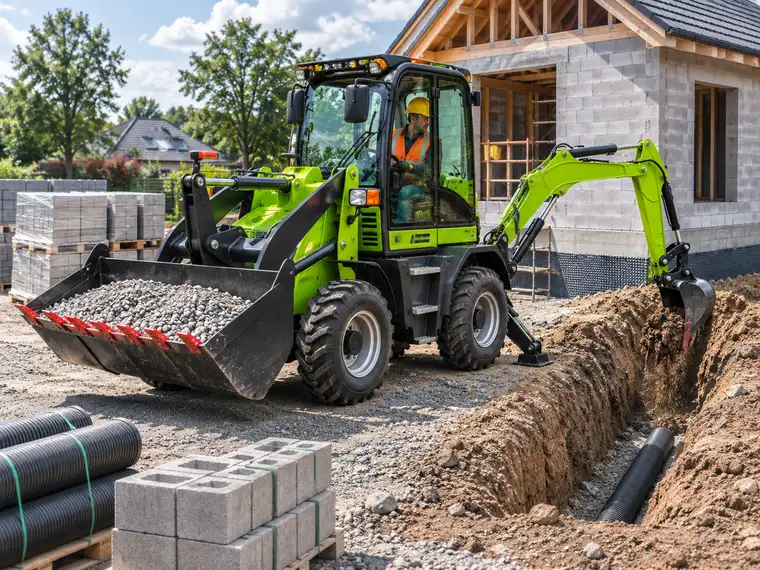
Backhoe loader supporting small-site trenching and aggregate handling (illustrative scene).
Scenario C: A rural renovation business with mixed annual jobs
A rural contractor repairs farm access tracks, loads soil, maintains properties, tows compatible trailers and occasionally receives building supplies. The machine may continue working after construction ends.
Best starting point: a tractor loader where the approved loader and implement package covers recurring jobs and the buyer values longer annual utilisation. A dedicated forklift becomes attractive if deliveries involve heavy pallets, repeated high placement or narrow indoor storage. A backhoe loader becomes attractive if trenching and drainage work are recurring rather than exceptional.
For these contractors, site access equipment selection also means checking road transport rules, attachment changeover time and whether operators will be trained for the specific equipment. One all-purpose purchase is sensible only if it eliminates more work and cost than it adds.

Tractor front-loader application for gravel handling on a rural building site (illustrative configuration).
V. The Cost of the Wrong Machine: A Decision Model
Compare completed movements, not advertised travel speed
Assume a prepared construction yard needs 30 pallet movements per working day. The figures below are illustrative cycle-time assumptions, not OXPLO or competitor performance claims.
Illustrative metric | Suitable forklift | Approved tractor-loader fork setup |
Pallet movements per day | 30 | 30 |
Full average cycle time | 5 minutes | 8 minutes |
Total time per day | 150 minutes | 240 minutes |
Difference over 20 workdays | Baseline | 30 additional hours |
The tractor-loader workflow uses 90 extra minutes per day in this example. But that does not mean buying a forklift automatically saves 30 billable hours. If the tractor is already owned, movements are infrequent or the forklift would sit unused most of the month, additional capital and maintenance costs may outweigh the apparent speed advantage.
Use the working formula:
Cost per completed handling task = (allocated ownership or hire cost + operator time + fuel/electricity + maintenance + delay and double-handling costs) ÷ completed tasks.
Calculate it separately for each option over the same period and workload. Add a realistic allowance for breakdowns, seasonal demand, machine delivery and operator availability.
Decide when two machines beat one
A combined solution is worth considering when the site has two simultaneous bottlenecks. For example, a forklift may need to unload pallets while a backhoe loader continues trenching. If one machine must stop one job to start another, delivery delays can overwhelm the attraction of a multipurpose machine.
Conversely, if aggregate moving takes only two days a month, short-term rental may make more sense than keeping a wheel loader idle. Dealers can use the same logic when advising customers: specify the primary machine around the dominant workload and fill intermittent gaps with hired or shared equipment.
VI. Where OXPLO Equipment Fits—and What European Buyers Must Verify
OXPLO OX35F: outdoor pallets on suitable compacted ground
The OXPLO OX35F rough-terrain forklift is listed with 3,500 kg nominal rated capacity, 225 mm minimum ground clearance and pneumatic rough-terrain tyres. These features make it a model to evaluate for outdoor building-material yards where a low-clearance industrial forklift might struggle on suitable compacted gravel or moderately uneven routes.
The buyer still needs the exact rated load centre, residual capacity at the chosen mast height, fork dimensions, turning clearance and ground-operating limitations. Importantly, the currently published engine information mentions a National II emission-standard configuration; this does not establish EU Stage V compliance or eligibility for placement on the EU market. Request destination-specific engine and conformity evidence before treating the model as a valid European purchase option.
OXPLO OX35L and CPD50: prepared yards and warehouses
The OXPLO OX35L diesel forklift lists 3,500 kg at a 500 mm load centre and 135 mm minimum ground clearance. That makes it a more natural candidate for firm, reasonably level loading yards than deeply rutted construction access. Its diesel configuration and market documentation must be confirmed for the intended location.
For heavy pallets on paved industrial surfaces, the OXPLO CPD50 electric forklift lists 5,000 kg at a 500 mm load centre and an 80 V/410 Ah lithium-ion battery. These figures are useful for preliminary screening, not proof of capacity for any high, long or offset load. Buyers should evaluate residual capacity, charging infrastructure, operating shifts, battery service support and the exact equipment supplied.
OXPLO OXT604: mixed rural work with the right loader package
The OXPLO OXT604 60 HP tractor is a 4WD utility model with a 12F+12R transmission and Category II rear linkage. It may suit contractors who need an agricultural or land-maintenance platform as well as approved loader duties. Explore the OXPLO tractor range and tractor configuration options if other horsepower levels are more appropriate.
The public tractor listing does not provide a verified front-loader pallet rating for a specific fork configuration. OXPLO buyers should therefore request a matched loader and fork specification, permissible axle loads, hydraulic requirements and ballast instructions before assuming suitability for construction pallets.
OXPLO OX15-20: combined loading and light excavation
The OXPLO OX15-20 wheeled backhoe loader lists a 0.6 m³ front bucket, 2,350 mm maximum digging depth and 3,500 mm maximum digging radius. This combination is most relevant to small trenching, site repairs, drainage and moderate material loading where shifting between digging and loading is common.
It should not be positioned as a direct replacement for a high-throughput wheel loader or a purpose-built pallet forklift. Ask for loading ratings, bucket-fill assumptions, rear stabiliser guidance and any approved fork arrangement for the actual machine.
A European procurement check that can prevent an unusable delivery
Before ordering any OXPLO equipment—or machinery from another supplier—request the exact model and engine configuration, applicable EU Declaration of Conformity and supporting documentation, ratings and load charts, approved attachment information, manuals in the languages required in the destination country, emissions evidence where applicable, spare-parts arrangements, warranty terms, and pre-shipment inspection records.
At the time of writing, EU machinery conformity is subject to Directive 2006/42/EC; Regulation (EU) 2023/1230 becomes generally applicable from 20 January 2027. Non-road mobile machinery and tractors can have additional equipment-specific rules, so a generic CE statement must not be used as a substitute for model- and market-specific verification. Requirements also differ for countries outside the EU, even when they are in Europe.
OXPLO provides an overview of its machine families in the OXPLO product catalogue and describes its configuration and sourcing approach on the OXPLO About Us page. A responsible supplier assessment should still be based on documentary evidence for the actual unit purchased.
VII. Frequently Asked Questions
Can a standard diesel forklift work on a gravel construction yard?
Sometimes, but only when the surface is sufficiently firm, smooth and level for that industrial truck’s approved operating conditions. Pneumatic tyres alone do not make a forklift rough-terrain rated. Assess the loaded route, slopes, ruts and ground bearing capacity; a genuine rough-terrain forklift may be the better choice for a suitably prepared outdoor yard.
Is a backhoe loader better than a forklift for pallets of bricks?
Usually not when repeated pallet lifting and stacking are the main job. A forklift offers a purpose-built mast and forks. A backhoe loader makes more sense when excavation and loading are frequent core tasks, and pallet lifting must not be attempted without an approved attachment and a capacity chart.
Can a 60 HP tractor lift a 1.5-ton pallet of building materials?
Horsepower alone cannot answer that question. The manufacturer’s approved loader rating at the actual reach and height, fork and pallet weight, front axle capacity, tyres and rear ballast determine whether the lift is permitted. Request these figures before selecting any tractor loader, including an OXPLO model.
When is a wheel loader better for building materials?
Where the dominant job is sustained bulk loading of sand, gravel, aggregate or soil. Choose by bucket payload, material density, tipping or rated operating load, dump height and hourly loading cycles. Pallet delivery and accurate stacking may still call for a forklift.
Should a small European contractor buy one multipurpose machine or rent a second machine?
Compare annual utilisation, simultaneous tasks, rental frequency, operator availability and cost per completed task. A tractor or backhoe loader may be economical for mixed intermittent work; a second specialised machine may be justified when material handling and excavation routinely compete for the same operating hours.
What documents should a European dealer request before importing a forklift or backhoe loader?
Request configuration-specific specifications, capacity data, appropriate machinery conformity documents, engine-emissions evidence where relevant, manuals, safety and attachment information, service and parts commitments, and inspection documentation. Confirm requirements for the exact destination country and do not treat a website’s broad European-market positioning as proof of regulatory compliance.
VIII. Conclusion: Start With the Workload, Then Choose the Machine
The right construction site material handling equipment is the equipment that completes the dominant tasks safely, repeatedly and at a defensible operating cost. Choose a suitably rated forklift when pallet unloading and precise placement dominate. Evaluate a tractor loader when rural utility work and moderate loading account for most of the year. Consider a backhoe loader when excavation and loading must regularly share one machine; compare a dedicated wheel loader where bulk-material cycles dominate.
For European customers, the decision is incomplete until ground conditions, actual residual lifting capacity, attachment approval and destination-market documents have been checked. These details can matter more than nominal horsepower, bucket size or headline capacity.
Ask OXPLO for an application-based equipment review. Share your destination country, heaviest load and its dimensions, required lift height, daily pallet or bucket movements, ground conditions, access measurements and excavation needs. OXPLO can use that information to discuss relevant configurations, clarify which ratings and documents still need verification, and help you assess whether one machine or a combination is more appropriate. Visit OXPLO to begin with your actual project requirements.