
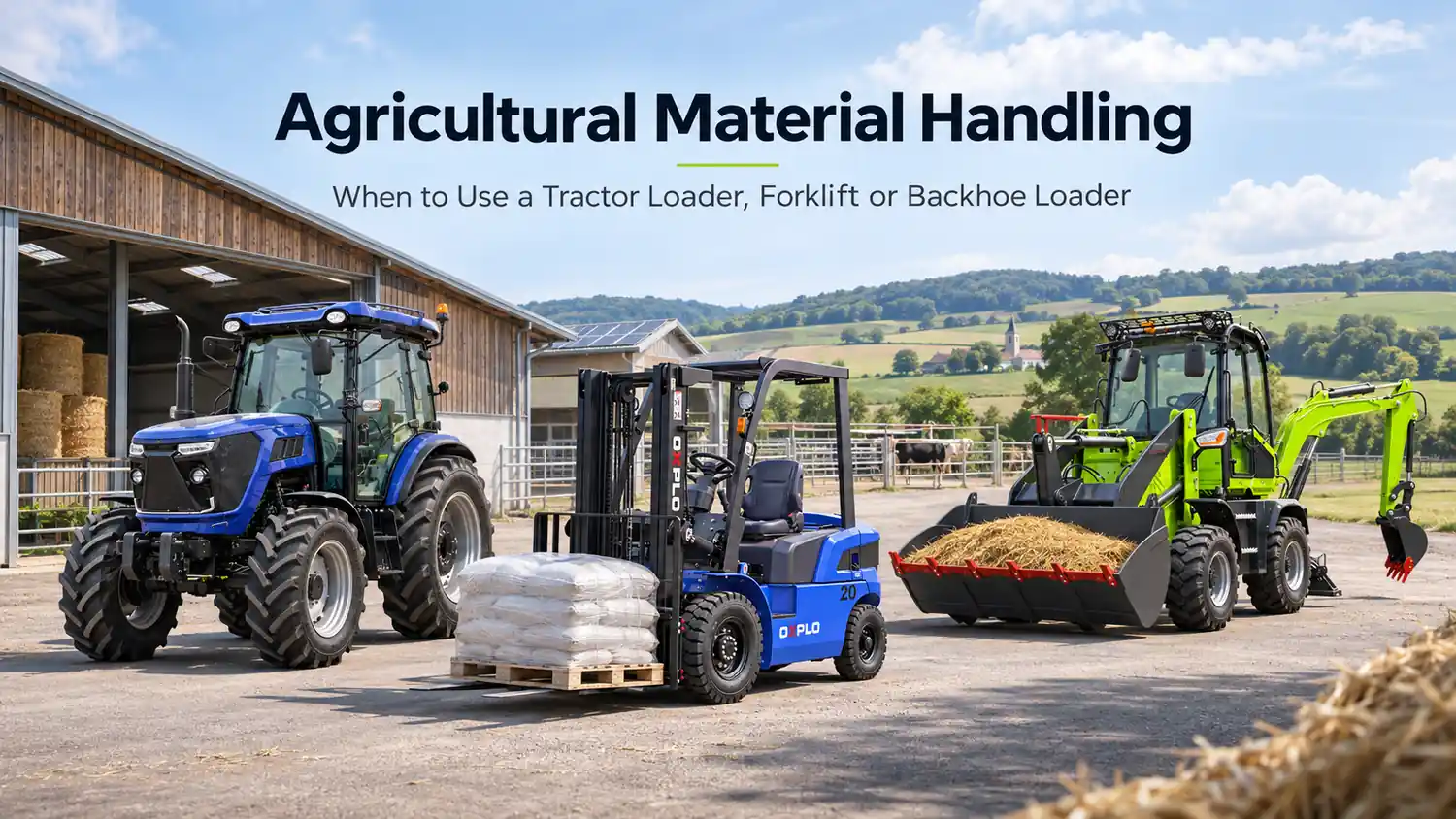
A livestock farm receives palletised feed on Monday, moves wrapped silage bales on Tuesday and repairs a drainage ditch before the next rainfall. All three jobs involve moving material, but they do not demand the same machine. A tractor loader may be useful across several farm tasks, a forklift is built for repeated pallet handling, and a backhoe loader adds excavation capability that neither of the other machines provides.
The mistake is to choose farm material handling equipment by advertised horsepower or nominal lifting capacity alone. Actual performance depends on load geometry, lifting height, ground conditions, access dimensions, daily handling cycles and attachment compatibility. For European buyers, the final specification also needs to meet the requirements applicable to the destination market.
This guide starts with the work the customer must complete, identifies where each equipment type succeeds or falls short, and shows how to evaluate relevant OXPLO machines without assuming that every configuration is suitable for every farm.
I. Map the Farm’s Material Flow Before Comparing Machines
One farm can contain three very different workplaces
A mixed farm may have soft field tracks, compacted gravel yards and a concrete storage building. A machine that travels comfortably through one area may not be suitable for safe lifting in another. The route matters just as much as the destination: a loaded forklift must negotiate the full journey, including turns, gradients, doorways and loading points.
Start by tracing a representative load. Where is it collected? How heavy is it, including its pallet or attachment? How far does it travel? Is it placed on the ground, onto a trailer or on a high rack? How often does the cycle repeat? For bales, record their actual weight and dimensions rather than relying on a typical figure. For pallets, note the distance from the fork face to the load’s centre of gravity.
A typical agricultural operation separates into three material flows:
- Field and livestock flow:bales, feed, crop bins and equipment moving over grass, tracks and working yards.
- Storage and dispatch flow:repeated pallet receipt, stacking, retrieval and lorry loading in relatively controlled spaces.
- Maintenance and earthworks flow:soil, gravel, drainage materials and excavated material around roads, ditches and farm buildings.
These flows may justify different machines. In the OXPLO agricultural handling solutions, tractor work and pallet handling are presented as related but distinct operations—a more useful starting point than treating every load as a tractor job.
A quick equipment-selection screen
Dominant task | First machine to evaluate | Decision that could overturn the choice |
Seasonal bale and feed movement alongside fieldwork | Tractor with approved front loader | Bale mass, loader chart, axle load and ballast |
Daily pallet unloading and warehouse stacking | Forklift | Load centre, residual capacity and aisle width |
Pallets on maintained but uneven outdoor yards | Suitable rough terrain forklift | Ground bearing, slopes and entrance width |
Drainage repairs plus intermittent loading | Backhoe loader | Required digging reach and actual work frequency |
Continuous high-volume gravel or manure loading | Dedicated wheel loader | Bucket payload, cycle rate and truck height |
The objective is not to buy the machine with the most functions. It is to avoid placing the farm’s most frequent activity on the least efficient machine.
II. Tractor Loader: Flexible Farm Work, With Important Lifting Limits
Where tractor loaders earn their place
A front loader can make sense when a tractor already performs mowing, cultivation, trailer work and routine livestock duties. One machine can then switch between approved attachments for loading feed, moving bales and transferring smaller quantities of bulk material. This can be attractive for mixed farms where loading is regular but not a full-time job.
However, tractor loader vs forklift is not simply a comparison of versatility. The tractor carries loading equipment ahead of the front axle, and each attachment changes the machine’s mass distribution and effective load position. A forklift is instead designed around a dedicated mast and counterweight system for material handling.
Why tractor horsepower cannot answer the bale question
Imagine a farm that regularly handles a 900 kg wrapped bale with a hypothetical 180 kg bale grab. The loader must support a combined mass of 1,080 kg in the intended geometry. That calculation is only a starting point: the machine must also remain within its approved lifting, axle, tyre and stability limits throughout the movement.
A figure measured at the loader’s pivot pins is not interchangeable with capacity at a bale’s centre of gravity. The load is usually farther forward, creating a larger overturning moment. Capacity can also change with lifting height. Buyers should request the complete machine-and-loader load information, not simply a maximum lifting figure on a sales sheet.
Four checks are essential before ordering a tractor loader: approved mounting brackets, hydraulic pressure and flow, front axle and tyre ratings, and manufacturer-approved rear ballast. Rear ballast may improve stability, but it does not increase a component’s permitted rating. A bale spear or grab also needs to match the bale type and retain the load appropriately. Wrapped silage may require a grip that avoids damaging the film.
How OXPLO tractor models can be screened
The OXPLO tractor range includes compact and utility models for different agricultural workloads. The OXPLO OXT504 50 HP 4WD tractor lists an overall width of 1,560 mm and Category I rear linkage. That can make it worth examining where barn access and compact implements matter. The OXPLO OXT704 70 HP 4WD tractor has a wider 1,760 mm listed chassis, 12-forward/12-reverse gearbox and Category II rear linkage, making it a different utility-tractor proposition.
Those specifications help assess access, implement matching and tractor duties. They do not prove that either OXPLO tractor can lift a specified bale. Front-loader availability, approved mounting, ballast requirements and capacity at the intended attachment load centre must be confirmed for the quoted configuration. OXPLO can review these details through its tractor configuration enquiry.
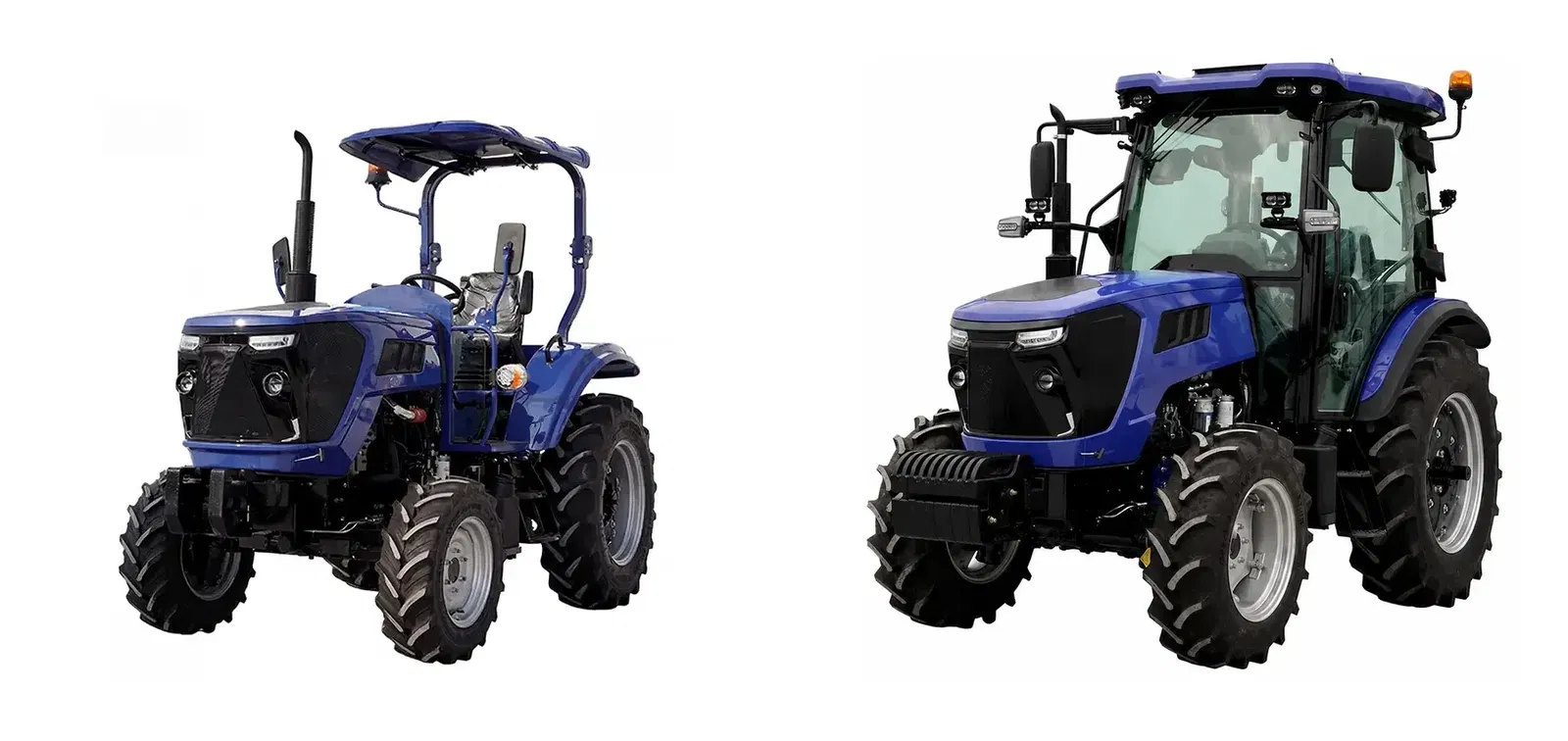
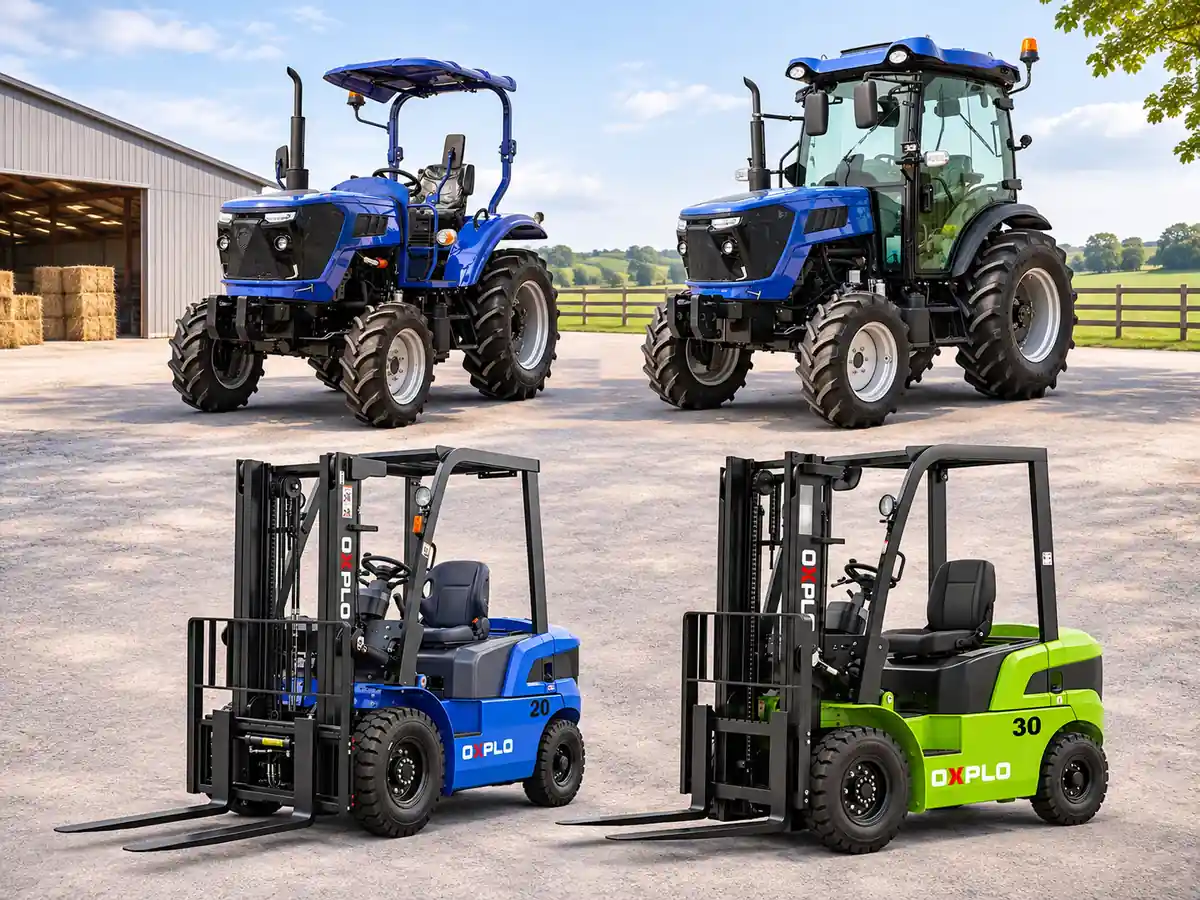
Figure 1. OXPLO OX254 open-station tractor (left) and OXT704 cab tractor (right), shown without front loaders. Verify loader fitment and capacity separately.
A tractor loader becomes the weaker choice when the farm’s primary task is continuous high stacking, rapid pallet cycles or precision movement inside a crowded warehouse. In those cases, the machinery’s agricultural flexibility may offer little advantage during the actual handling job.
III. Forklift: Solve the Pallet Bottleneck, Then Check the Yard
Repetition changes the economics
For a farm supply warehouse or cooperative, a few minutes added to each loading cycle can accumulate into hours. Forklifts are typically better suited to moving palletised feed, fertiliser and packaged produce because their mast-and-fork arrangement supports repeated positioning, lifting and stacking on appropriate surfaces.
But buyers frequently make two errors. First, they treat rated lifting capacity as available capacity at any height or load centre. Second, they assume a diesel-powered industrial forklift can operate wherever a farm tractor can travel.
Nominal capacity is not residual capacity
The OXPLO CPD20 electric forklift is listed at 2,000 kg rated load with a 500 mm load centre. Suppose a customer needs to lift a 1,800 kg pallet whose centre of gravity is 650 mm forward of the fork face. The pallet is below the nominal 2,000 kg figure, but the load creates a different overturning moment from the specified reference load.
A basic comparison illustrates the issue: 1,800 kg × 0.65 m = 1,170 kg·m, whereas 2,000 kg × 0.50 m = 1,000 kg·m. The longer load centre generates a larger moment despite the lower mass. This does not calculate a new allowable capacity. The approved rating plate or load chart for the specific mast, forks, attachment and height must determine whether the operation is permitted.
Farm buyers should state maximum pallet dimensions and required stacking height when requesting an OXPLO forklift quotation. Fork extensions, sideshifters and other attachments can further affect residual capacity.
Electric, industrial diesel and rough terrain are not interchangeable
The OXPLO CPD20 publishes a 76.8 V/280 Ah lithium battery configuration, 1,164 mm overall width and 2,190 mm minimum outer turning radius. These figures are useful for reviewing indoor access and charging plans. Electric operation produces no tailpipe exhaust at the truck, but buyers still need to check battery duty, charging arrangements, ventilation and suitability for their operating environment.
The OXPLO OX35L diesel forklift has a published 3,500 kg nominal capacity, 500 mm load centre, 1,210 mm width and 135 mm ground clearance. It is one option to evaluate for heavy pallet loading on maintained outdoor yards, provided its load chart and site conditions are suitable.
The OXPLO OX35F rough terrain forklift publishes a 3,500 kg nominal rating, 225 mm minimum ground clearance and 1,985 mm overall width. Compared with the OX35L, that listed OX35F configuration offers 90 mm more ground clearance but is 775 mm wider. The figures reveal an immediate customer trade-off: improved clearance may help on suitable gravel and compacted surfaces, while the greater width may rule it out at narrow gates and storage areas.
Rough terrain does not mean unrestricted mud or slope capability. Weak subsoil, wet ruts, side slopes and unprepared loading positions can still make lifting unsafe. Buyers should assess the complete loaded route and follow the relevant operating limits.
A further EU procurement point matters for the OXPLO OX35F: its publicly listed Yunnei YN25 engine information references a Chinese National II standard. That listing does not establish EU emissions compliance. Buyers should request the exact destination-market engine specification and machine documentation before proceeding with a European order.
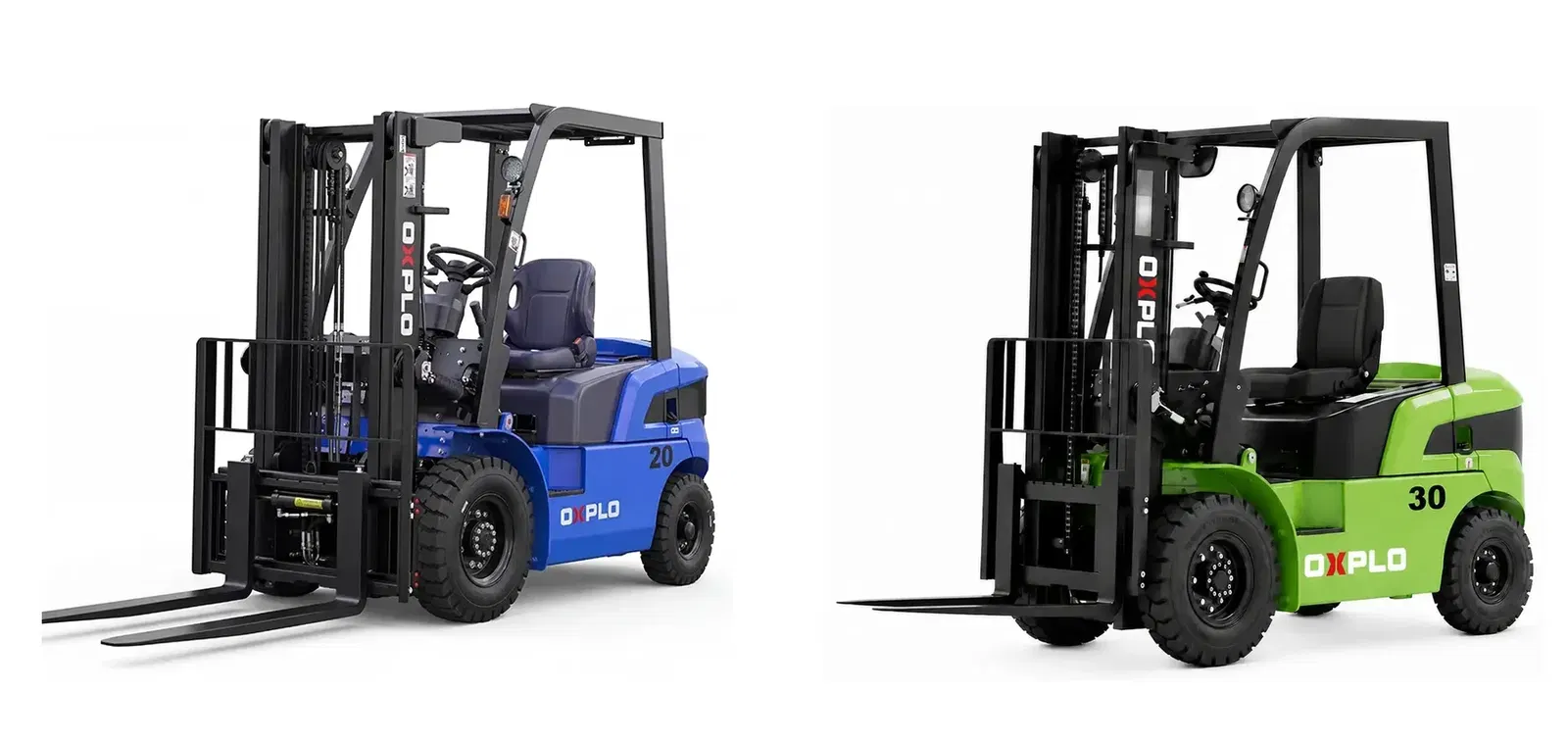
Figure 2. OXPLO OX20 diesel forklift (left) and CPD30 electric forklift (right). These reference models illustrate powertrain choice, not rough-terrain approval.
Sometimes the right investment is a better yard
If almost all forklift work occurs on flat concrete and only one short gravel section causes trouble, resurfacing and improving drainage may be more cost-effective than purchasing a wider specialist machine. OXPLO forklift selection should therefore start with both load data and a site map, not merely the request for “an outdoor forklift.”
IV. Backhoe Loader: Useful When the Farm Must Dig as Well as Load
The value is in task combination
A backhoe loader offers front loading and rear excavation on one machine. That can be useful for drainage work, small trenching projects, moving excavated soil, loading gravel and maintaining farm roads. A farm with recurring property maintenance may have enough use for both functions to justify the equipment.
The OXPLO OX15-20 wheeled backhoe loader lists a 2,350 mm maximum digging depth, 3,500 mm maximum digging radius, 0.6 m³ front bucket and 0.12 m³ excavator bucket. These published values help a buyer screen the machine against a proposed drainage or maintenance task. Actual suitability also depends on soil, trench geometry, working access and safe deployment of the machine’s support arrangements.
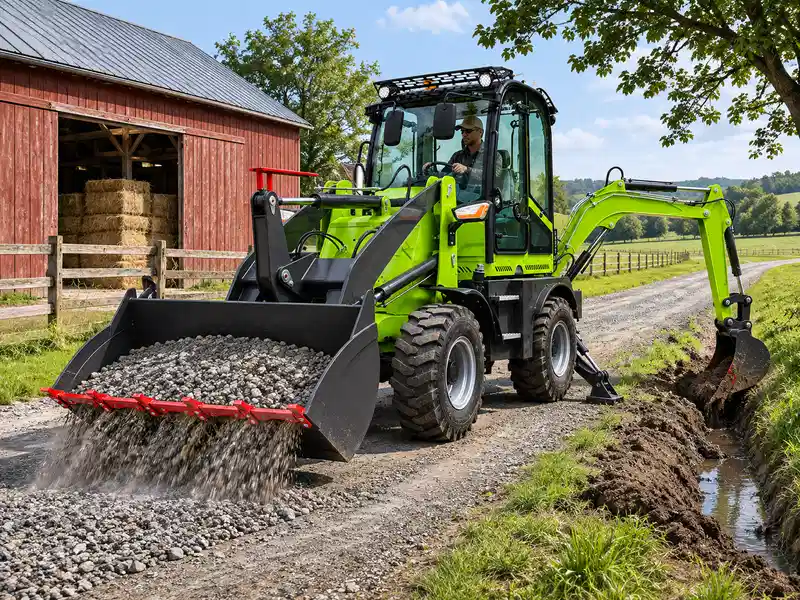
Figure 3. OXPLO wheeled backhoe loader: front bucket and rear excavator in one machine; rated capacities must be checked for the actual task.
A bucket size is not a safe material payload
If a hypothetical 0.6 m³ bucket is filled with material at a bulk density of 1.6 tonnes/m³, its contents would weigh about 0.96 tonnes. That is a material-density estimate, not an OXPLO OX15-20 rated payload. The manufacturer’s actual loading and stability limits govern whether that material can be carried under the intended conditions.
For pallet forks on a backhoe loader, the same principle applies: a physical mounting connection does not prove that the configuration is approved. Fork rating, load centre, lift height, locking arrangement and machine stability must all be verified.
Where the multi-purpose concept loses value
A backhoe loader can be appealing until one considers how frequently the work occurs. If the farm digs drainage only once a year, contracting that work may be cheaper than owning an excavation machine. If the business moves pallets continuously, the backhoe’s rear digging function adds little value to daily throughput. If the work is almost entirely bulk loading, a dedicated wheel loader may provide a better productive cycle.
OXPLO should therefore position the OX15-20 as an option to evaluate for combined loading and excavation, not as a universal replacement for a specialist excavator, tractor or forklift.
V. Five Farm Scenarios That Lead to Different Choices
Scenario 1: A livestock farm handling heavy round bales
The decision starts with bale mass, attachment type, stacking height and travel route. A tractor loader with an approved bale handler may be suitable when bales move across farm tracks and handling is interspersed with other tractor duties. A high stacking requirement or repeated heavy loading may justify a dedicated handler instead. For OXPLO tractor buyers, confirm loader compatibility and capacity before choosing between OXT504 and OXT704.
Scenario 2: A feed distributor unloading pallets all day
Here the bottleneck is usually the cycle, not the range of machine functions. A suitably rated forklift is the starting option. On a sound warehouse floor, an OXPLO CPD electric model may be worth evaluating; on a maintained outdoor yard, an appropriately configured diesel model may be relevant. Measure pallet load centres, aisle width, lift height and dispatch frequency before deciding.
Scenario 3: A farmyard with gravel, ruts and narrow gates
An outdoor forklift must fit through the actual gates and remain stable at loading positions. The OXPLO OX35F’s greater listed ground clearance should be assessed alongside its much wider chassis. If access is too narrow, improving the yard or revising the material-flow layout may be more sensible than selecting a rough terrain machine that cannot reach its workplace.
Scenario 4: A rural property maintaining ditches and tracks
When drainage excavation and front bucket loading are both recurring tasks, the OXPLO OX15-20 backhoe loader is an option for technical evaluation. Verify the digging depth, reach, soil conditions, route clearance and bucket loading limits. Where excavating is rare, include contractor hire in the comparison instead of assuming ownership is always economical.
Scenario 5: A cooperative with field collection and cold-store dispatch
The best system may involve more than one equipment type. Tractors move trailers between fields and the packing area; forklifts handle pallets inside the storage and dispatch facility. This separation can reduce task conflicts and avoid using a field-oriented machine for precision warehouse stacking. The OXPLO equipment overview provides a starting point for comparing categories, but each machine must be specified separately.
VI. Measure Cycle Time, Hidden Costs and Equipment Availability
A realistic productivity calculation
Consider a hypothetical farm warehouse moving 40 pallets per day. Both machines are assumed technically suitable for the load and site. If a tractor loader averages eight minutes per complete cycle and a forklift averages five minutes, the theoretical daily handling time is 320 versus 200 minutes: two hours released per day. Across 100 operating days, that equals 200 hours.
These numbers are illustrative assumptions, not measured OXPLO test data. More importantly, time released is not automatically cash saved. The financial benefit arises only if it reduces paid labour, overtime, contractor charges, delivery delays or another measurable cost, or creates additional productive capacity.
Three costs that brochures rarely make obvious
Attachment changeovers: A tractor may lose useful time changing between field implements, bale attachments and pallet forks. That time matters during peak season.
Scheduling conflicts: If the only tractor is needed for fieldwork while a delivery lorry is waiting, its theoretical versatility does not solve the simultaneous demand.
Single-machine downtime: One multi-purpose machine can create a larger operational interruption when it fails, although owning multiple machines adds maintenance and financing obligations.
Compare the total annual cost of each option: annualised purchase cost, fuel or electricity, maintenance, tyres, parts, finance, insurance, operator costs where relevant and downtime. For an existing tractor, allocate a reasonable share of cost to loader work rather than counting the whole tractor purchase twice.
A simple break-even screen
Suppose the incremental annual ownership cost of a dedicated forklift is €4,800. If each verified hour released from loading work has a net economic value of €25, the machine would need to generate approximately 192 such hours per year to cover that incremental cost (4,800 ÷ 25). This simplified example is not a forecast; it depends on the buyer’s actual costs, workloads and ability to use the saved time. Do not add the same labour or energy savings twice.
For many farms, the less visible benefit is predictability: the correct machine is available where deliveries arrive, and another machine can continue its agricultural work.
VII. Turn the Worksite Assessment Into an OXPLO Procurement Brief
The information that makes an equipment recommendation meaningful
A supplier cannot evaluate suitability from “I need a 3.5-ton forklift” or “I want a 50 HP tractor” alone. A useful enquiry should include:
- Loads:largest real load mass, pallet or bale dimensions, load centre and attachment mass.
- Placement:stacking height, trailer-bed height, dumping height or required digging depth.
- Ground:concrete, compacted gravel, soft soil, slopes, wet-weather exposure and drainage.
- Access:gates, doorways, aisle width, turning space and overhead restrictions.
- Duty cycle:loads per hour, shift length, travel distances and seasonal peaks.
- Attachments:bale grab, pallet forks, bucket, sideshifter and required hydraulic connections.
- Market:destination country, delivery scope, documentation and any public-road use.
With these details, OXPLO can discuss whether an OXPLO tractor, OXPLO forklift or OXPLO wheeled backhoe loader is a sensible starting point. A final recommendation still depends on a confirmed model-specific specification, not general catalogue language.
What European importers and dealers should verify
Ask for the exact configuration offered, the manufacturer’s approved lifting or digging information, applicable instructions, conformity documents, engine documentation, spare-parts information and written confirmation of attachment compatibility. Road use, if intended, may introduce separate requirements.
For machinery within its scope, the EU Machinery Directive 2006/42/EC remains applicable to machinery placed on the EU market before 20 January 2027, when Regulation (EU) 2023/1230 generally becomes applicable. The correct legal framework depends on machine type and transaction timing. Engine requirements should also be checked against the relevant legislation, such as Regulation (EU) 2016/1628 where applicable. Agricultural tractor type approval has a separate regulatory framework; do not assume approval for one OXPLO tractor or configuration extends to another machine category.
OXPLO’s parts, attachments and technical support information is useful during procurement. Before ordering, clarify the parts identification process, support scope, documentation, delivery terms and the availability of the exact attachment or engine configuration required.
A more useful question to ask OXPLO
Rather than asking “Which machine is best?”, send OXPLO the worksite description and ask: “Which configuration can safely handle our heaviest load at the required height, complete the daily cycle on our actual ground and be supplied with the documentation needed for our destination?”
That question creates a verifiable purchasing decision and reduces the risk of receiving a machine that looks adequate on paper but is unsuitable in daily operation.
FAQ: Farm Material Handling Equipment
Can a tractor loader replace a forklift on a farm?
For occasional pallet movement, sometimes—provided an approved fork-and-loader configuration has sufficient verified capacity and the worksite is suitable. For daily vehicle unloading, precision stacking and repeated warehouse cycles, a dedicated forklift is usually the better starting point.
Can a 50 HP tractor lift a 1,000 kg round bale?
Horsepower cannot answer that question. The supplier must verify loader capacity at the bale’s effective load centre, attachment mass, lift height, front axle and tyre ratings, ballast and operating conditions. OXPLO OXT504 buyers should request an approved front-loader specification rather than infer lifting capability from 50 HP.
Is a rough terrain forklift safe on wet grass and muddy fields?
Not automatically. Greater clearance and suitable tyres can help on some outdoor surfaces, but soft ground, deep ruts, side slopes and lifting on uneven terrain remain hazards. Machine-specific operating limits and a site assessment are necessary.
When should a farm choose a backhoe loader rather than a tractor loader?
When excavation is a meaningful recurring part of the workload. A backhoe loader can combine trenching, drainage repair and loading, whereas a tractor loader is usually more closely integrated with fieldwork, PTO implements and agricultural transport.
Is electric or diesel better for an agricultural warehouse?
Electric forklifts are often worth evaluating for suitable indoor or paved work because they produce no tailpipe emissions at the truck. Battery duty, charging and temperature conditions matter. Diesel models may suit appropriate outdoor work, but their emissions compliance, ventilation, ground conditions and actual operating requirements still need evaluation.
What should a European dealer ask OXPLO before ordering several machines?
Request a model-by-model configuration list, dimensions, load ratings and charts, approved attachments, destination-market technical documents, engine information where applicable, spare-parts arrangements, delivery terms and inspection requirements. Do not assume one machine’s documentation covers the entire order.
Conclusion: Choose the Machine That Fits the Work, Not the Brochure
The right farm material handling equipment is the machine—or combination of machines—that can perform the real workload safely, repeatedly and economically. A tractor loader makes sense where agricultural duties and intermittent loading overlap. A forklift is more specialised for pallet receipt, stacking and dispatch. A backhoe loader earns its place when a farm needs both loading and recurring excavation.
The crucial checks are specific: actual load centre rather than nominal tonnes, verified loader performance rather than tractor horsepower, suitable ground rather than a generic “outdoor” label, and full operating cost rather than purchase price alone.
OXPLO offers agricultural tractors, electric and diesel forklifts, rough terrain forklifts and a wheeled backhoe loader for buyers to compare against those needs. Share your load weights, site conditions, required heights, duty cycle and destination country through the OXPLO contact page. With a precise worksite brief, the OXPLO team can discuss suitable configurations and identify what must be confirmed before procurement.