
A warehouse may handle 1,750 kg pallets comfortably at floor level, then discover that the same loads cannot be placed on its highest racks with the proposed forklift. Another site may want an extra 500 kg of lifting capacity but have no room to widen its working aisles. A building-materials supplier may have sufficient lifting capacity yet still find that the truck is unsuitable for the yard surface.
These are purchasing problems, not merely specification differences. In a 2 ton vs 2.5 ton forklift comparison, the useful question is not which truck has the larger number on its nameplate. It is which approved truck-and-attachment configuration can handle the most demanding normal task, in the actual building or yard, at an acceptable operating cost.
This guide is written for European warehouse operators, manufacturing plants, material-handling contractors and equipment dealers. It uses confirmed OXPLO CPD20 and CPD25 published specifications where available, clearly separates illustrative calculations from approved ratings, and shows what to verify before ordering.
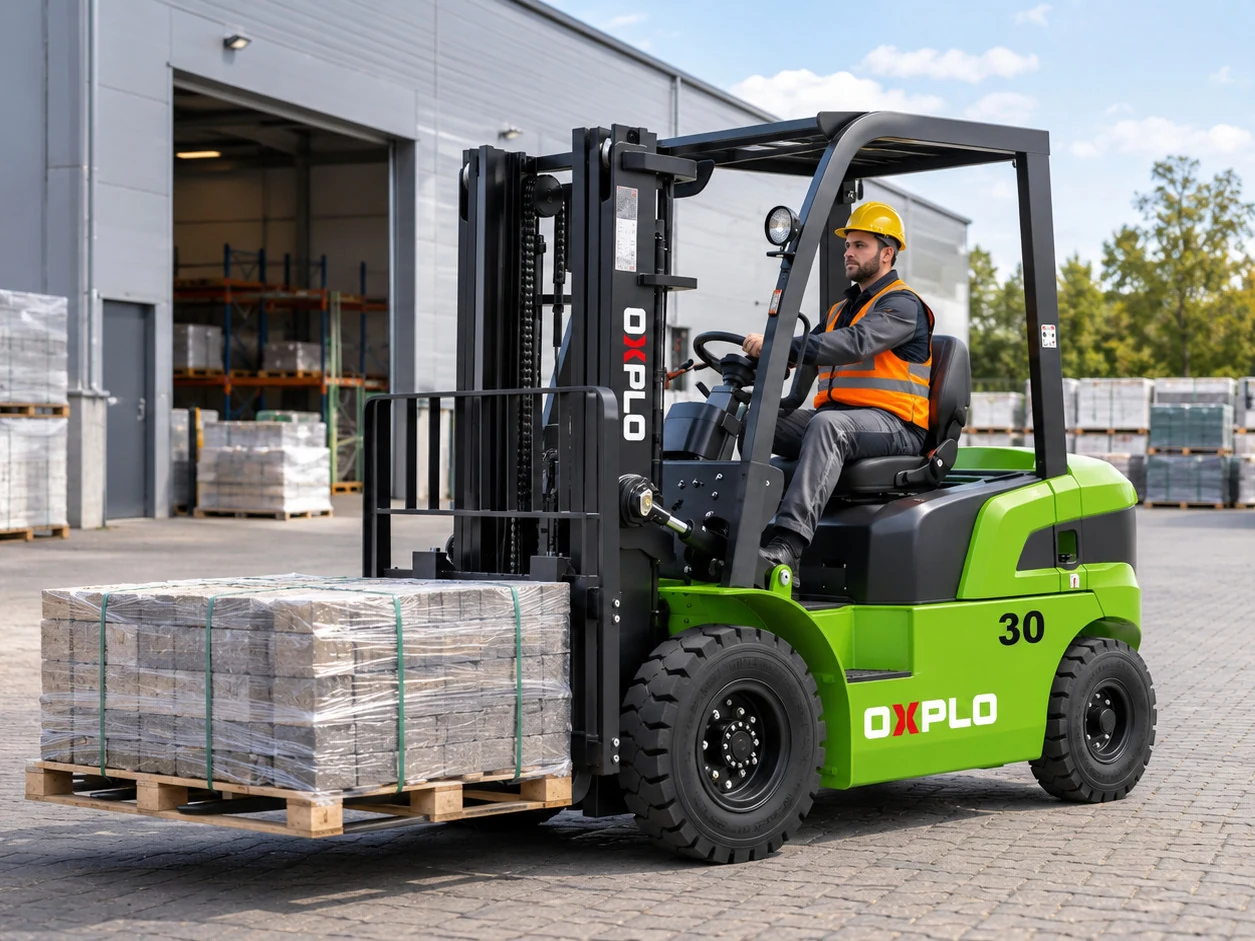
Illustrative electric forklift transfer on a paved material-handling yard; based on the supplied OXPLO electric forklift appearance.
I. When Is a 2-Ton Electric Forklift No Longer Enough?
The expensive mistake: treating the heaviest pallet as the whole job
A buyer who reports “our heaviest pallet is 1,900 kg” has not yet provided enough information to select a 2-tonne truck. That pallet could be short and evenly packed, or it could be a long industrial assembly whose centre of gravity sits well ahead of the fork face. It could be transported near the ground or placed on a high rack with a sideshifter. Each condition changes the required verification.
The real pain point is an intermittent task that the selected truck cannot legally and safely perform. If a warehouse must reserve another forklift for heavy pallets, split shipments or change storage locations, the apparent purchase-price saving can create a recurring operational exception. Equally, choosing 2.5 tonnes for a site that handles only light, standard pallets may add cost without improving throughput.
Build a load profile before comparing quotations
Record both the heaviest routine load and the hardest single lift. They may not be the same task. A weekly 2,100 kg crate moved at floor level and a daily 1,750 kg pallet placed high with a sideshifter require different checks. Include pallet and packaging mass in the load weight, and identify any unusually long, high or unevenly distributed goods.
For a practical RFQ, separate loads into typical and exceptional ranges, note how frequently each range occurs, and flag the loads that also require long forks, elevated stacking or ramps. If a required load exceeds the 2,000 kg nominal rating, the 2-tonne class is not an appropriate choice for that lift on the basis of its nominal capacity. A 2.5-tonne truck becomes a candidate—not an automatic approval.
II. Capacity at Height: The Test That Can Reverse the Decision
Load centre can matter more than the extra 500 kg
Forklift ratings are tied to a specified load centre. For both OXPLO models compared here, the published nominal rating uses a 500 mm load centre. The load centre is the horizontal distance from the vertical fork face to the load’s centre of gravity; it is not always simply half the pallet length when cargo distribution is uneven.
For illustration, a 1,800 kg load at a 500 mm centre produces a simplified moment of 900 kg·m. If the same load’s centre moves to 600 mm, that figure becomes 1,080 kg·m—a 20% increase in the load moment with no change in cargo weight. This explains the engineering concern, but it is not a formula for determining allowable forklift capacity. Only the approved capacity information for the complete truck configuration can establish whether the lift is permitted.
Machinery crates, bundled steel, timber packs and long production components deserve particular attention. Ask for the load drawing or measured centre of gravity where feasible. If the load will be handled with a clamp or extension, document the attachment before selecting the forklift. The Toyota Material Handling residual-capacity guide provides a useful independent explanation of how load centre, mast height and attachments influence permissible capacity.
A 3 m standard mast does not answer a 4.5 m stacking requirement
The listed OXPLO CPD20 and CPD25 configurations both show a two-stage, 3,000 mm mast. A buyer requiring 4,500 mm fork height must first establish whether a suitable alternative mast is offered for the exact model. Then the supplier must provide the residual-capacity chart for that mast, the actual load centre and any attachment. It would be incorrect to infer a 4.5 m lifting capability—or a safe load at that height—from the standard product listing.
Consider a hypothetical task: 1,850 kg, 600 mm load centre, 4,500 mm fork height and a sideshifter. Neither a “2,000 kg” nor a “2,500 kg” headline rating answers it. The buyer must receive written configuration-specific evidence. A larger rated truck can still be undersized at height, while another truck design may be more appropriate for frequent high-rack work.
How to check residual capacity without guessing
- Specify the actual combined weight of product, pallet and any removable load-handling accessory carried as part of the load.
- Record the measured or reliably established load centre and the maximum fork height required for that same load.
- Define the proposed mast, forks, sideshifter or other attachments before asking for the capacity chart.
- Ask the supplier to identify the permitted load at that height and centre for the final machine, reflected in the appropriate capacity information and markings.
- If no approved rating covers the task, change the configuration, change the handling method or select a different truck—not an assumed “safety margin”.
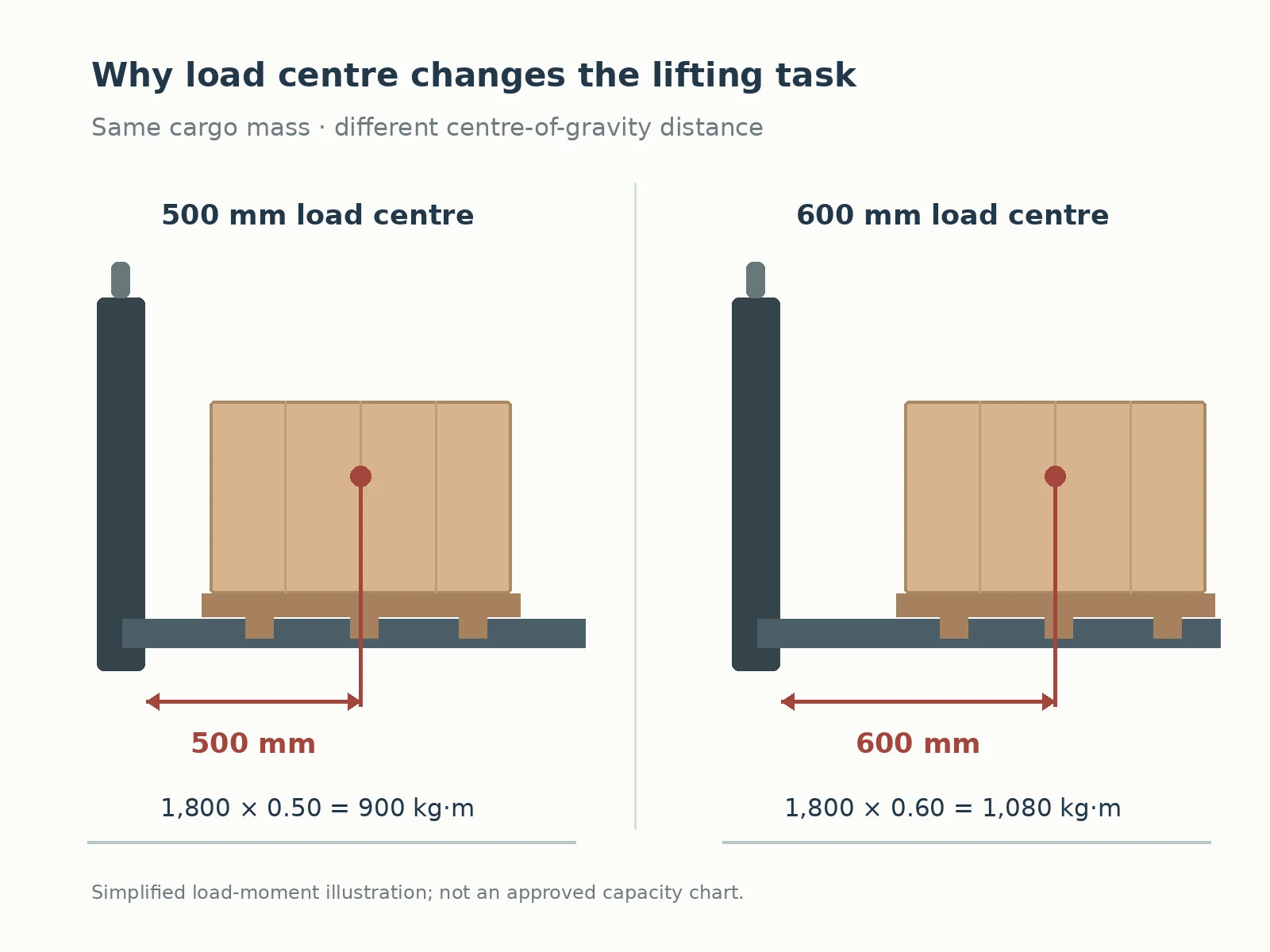
An identical load handled at a longer load centre creates a greater forward moment. Diagram is illustrative, not a machine capacity rating.
III. Will the Forklift Fit the Warehouse and Outdoor Route?
Vehicle width is only one part of the aisle test
An electric forklift capacity comparison becomes much more useful when the operator measures a real route. Both OXPLO trucks list an overall width of 1,164 mm, so upgrading from the CPD20 to the CPD25 does not increase their published vehicle width. The CPD25 is nevertheless 45 mm longer with forks and has a 50 mm larger published outer turning radius. That difference may be irrelevant in an open loading bay but important where a pallet must swing between closely spaced rack guards.
OXPLO publishes minimum right-angle aisle figures of 2,230 mm and 2,280 mm respectively. These figures should not be treated as a guaranteed safe working aisle for every pallet. Ask what pallet size, orientation, calculation convention and clearance the figures assume. A pallet-specific turning-path drawing or an on-site demonstration is more informative than comparing the truck width with the aisle width alone.
Test the complete route, not the easiest aisle
Measure the narrowest racking aisle, the cross-aisle turning area, doors, dock approach, low beams, pedestrian barriers and the clearance needed for the widest actual load. A facility with 1,200 mm-deep pallets, fork attachments or substantial pallet overhang can need more space than a bare-truck dimension suggests. If a driver must repeatedly reverse to make a turn, the extra manoeuvres can erase the benefit of nominal capacity.

Warehouse pallet-handling scene illustrating the importance of aisle and operating-route clearance.
Floor loading and ramps can overturn the purchasing decision
The published OXPLO truck weights are 3,280 kg for the CPD20 and 3,640 kg for the CPD25, a 360 kg difference. This matters when assessing older concrete slabs, mezzanines, freight lifts, dock levellers and trailer floors. But dividing total machine mass by a nominal floor area is not a valid structural check. Request loaded and unloaded axle loads and, where required, have a competent engineer assess wheel loads and the structure supporting them.
The models also list different full-load gradeability figures: 20% for CPD20 and 17% for CPD25 under the manufacturer’s specified conditions. Those figures do not establish safe operation on every ramp; surface traction, load positioning, visibility and operating instructions still govern. A larger capacity rating is not a substitute for a suitable route.
Paved yard use is not rough-terrain capability
A standard industrial electric forklift can be considered for approved transfers across clean, firm, suitably level paved yards. It should not be selected for deep gravel, mud, severe potholes or uneven construction ground solely because the buyer chooses 2.5 tonnes instead of 2 tonnes. Tyres, ground clearance, weather protection and manufacturer-approved ground conditions all need scrutiny. The OXPLO building-materials and outdoor-yards guide illustrates why equipment choice should follow the actual route and handling task.
IV. The Hidden Costs of Buying Too Small—or Too Large
Put a price on handling exceptions
Undersizing rarely appears as an immediate failure in a purchasing spreadsheet. It appears later as pallet splitting, waiting for a second truck, moving a heavy load to a lower shelf, hiring a specialist truck or interrupting a production schedule. To evaluate the additional capacity, estimate how often the smaller machine would need a different approved handling method.
Illustrative exception-cost calculation: suppose the site encounters eight such jobs each week, with each requiring 12 additional labour minutes. At a fully burdened labour rate of €45/hour over 48 working weeks, the extra labour is 8 × (12/60) × €45 × 48 = €3,456 per year. This is an assumed scenario, not an OXPLO customer result or a prediction of savings. Equipment rental, damaged goods and production delay are not included.
The calculation is useful only after the site confirms that the smaller truck genuinely cannot undertake those tasks. If both trucks are approved for every required lift, there may be no exception-cost saving to justify the larger purchase.
Oversizing has costs that may be less visible
The CPD25’s greater published machine weight can affect transport and floor assessments. Its slightly larger turning radius may impose further layout checks. A higher-capacity machine may also have a different acquisition price, service component cost or resale profile; these must be verified rather than assumed. If most loads are light and predictable, a CPD20 may deliver the same productive work with less initial capital tied up.
Treat the lithium battery and charger as one system
Both OXPLO models publish a 76.8 V / 280 Ah lithium battery specification, corresponding to approximately 21.5 kWh of nominal stored energy when multiplied arithmetically. This figure does not state usable energy, certified endurance or charging time. Shift length depends on the weight mix, route length, lift frequency, temperature and available charging windows.
For a two-shift warehouse, ask for the charger rating, compatible electrical supply, recommended charging schedule and battery warranty conditions. For a single-shift workshop, the decisive factor may be reliable charging overnight rather than a higher nominal tonnage. An RFQ should therefore describe operating hours and charging breaks as carefully as the maximum pallet weight. OXPLO can review the requested charger and battery configuration for the specific working schedule.
V. OXPLO CPD20 vs CPD25: What the Verified Numbers Mean
OXPLO lists the CPD20 2-Ton Electric Forklift and CPD25 2.5-Ton Electric Forklift for warehouse, logistics and manufacturing applications. The following values come from the published product pages, not a tested residual-capacity comparison. Final specifications and supplied options should be confirmed with OXPLO before an order.
Published specification | OXPLO CPD20 | OXPLO CPD25 |
Nominal lifting capacity | 2,000 kg | 2,500 kg |
Rated load centre | 500 mm | 500 mm |
Standard mast shown | 2-stage / 3,000 mm | 2-stage / 3,000 mm |
Overall width | 1,164 mm | 1,164 mm |
Length with forks | 3,570 mm | 3,615 mm |
Minimum outer turning radius | 2,190 mm | 2,240 mm |
Published minimum right-angle aisle figure | 2,230 mm | 2,280 mm |
Published truck weight | 3,280 kg | 3,640 kg |
Full-load gradeability | 20% | 17% |
Lithium battery listing | 76.8 V / 280 Ah | 76.8 V / 280 Ah |
Source: OXPLO CPD20 and CPD25 product pages. The aisle figures are manufacturer-published minima and are not a replacement for a pallet-specific working-layout assessment.
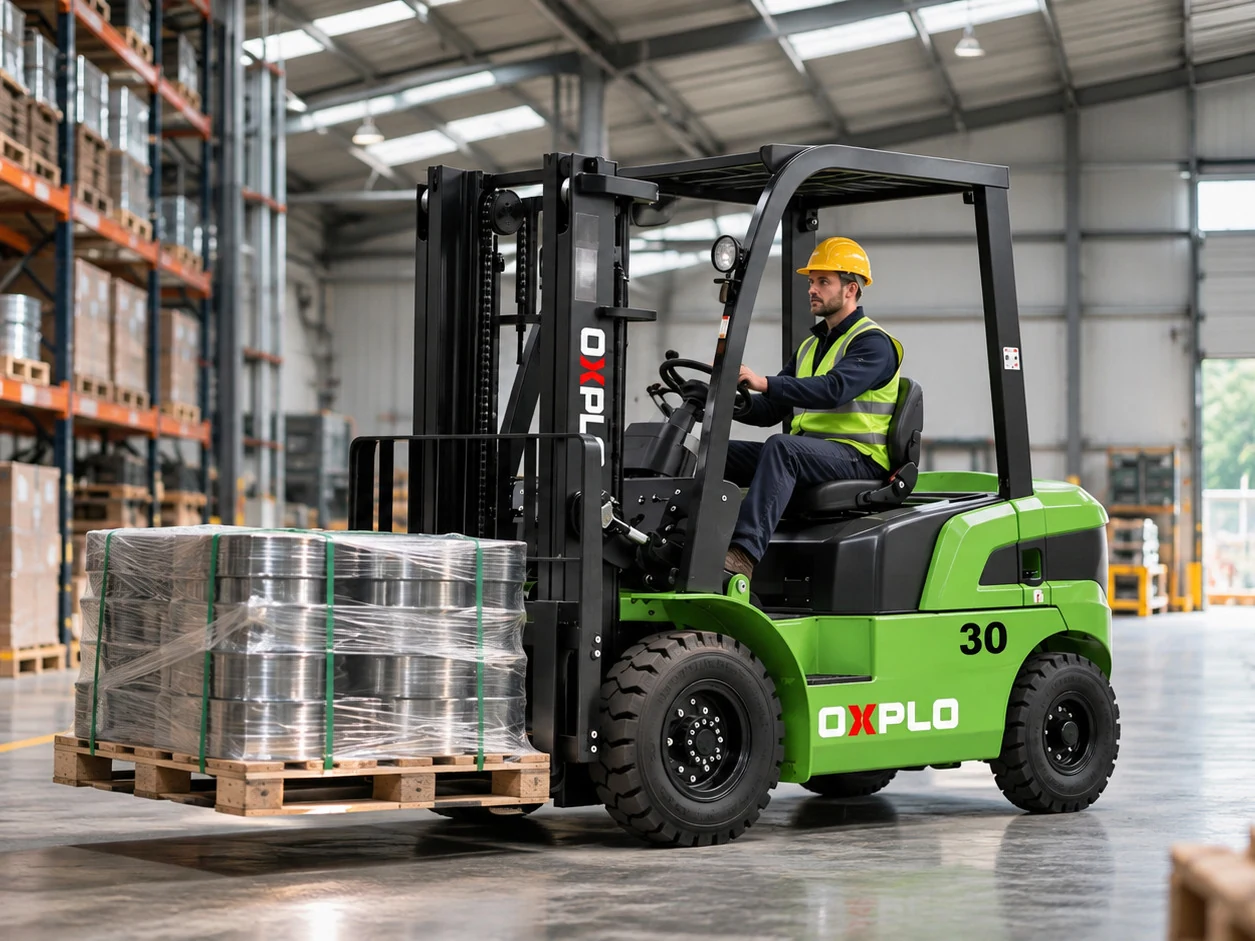
Illustrative warehouse handling scene featuring an OXPLO-style green forklift. This is not a verified CPD20 or CPD25 configuration image.
Where OXPLO CPD25 has a concrete advantage
The CPD25 provides 25% higher nominal lifting capacity while maintaining the same published overall width as the CPD20. That combination is relevant to a workshop upgrading from lighter pallet work to heavier components where widening the principal truck path is undesirable. It still needs confirmation of the actual pallet turning envelope, permissible load at height and floor loading. Extra nominal capacity is meaningful only if the final approved configuration can use it.
Where OXPLO CPD20 may be the better investment
The CPD20’s smaller published outer turning radius and lower truck weight may be useful in compact warehouses, weight-sensitive site infrastructure or operations where heavy loads are rare. If the verified load centre and height remain within its permitted capacity, there is no engineering reason to buy a CPD25 solely because the larger number sounds more future-proof. OXPLO’s warehouse and logistics solutions offer a useful context for matching forklifts to receiving, put-away and dispatch workflows.
When neither model should be selected from the catalogue alone
If the work requires a taller mast, substantial attachment derating, long irregular cargo or frequent operation on unsurfaced ground, the next step is not to assume that the CPD25 solves the problem. Ask OXPLO to evaluate the actual duty. A different configuration, another electric forklift class or a dedicated rough-terrain machine may be required. The broader OXPLO forklift range provides other categories for comparison.
VI. What European B2B Buyers Must Verify Before Ordering
Conformity documents must match the delivered forklift
For EU-market procurement, request the applicable conformity documentation for the specific model and final configuration, the required identification and markings, and instructions in the language(s) required by the destination market. Do not infer that a forklift complies with every EU requirement merely because a website displays certificates for other machinery.
The EU Machinery Directive 2006/42/EC remains the applicable machinery framework for products placed on the market before 20 January 2027. Regulation (EU) 2023/1230 becomes mandatory from that date, subject to its transitional provisions. The European Commission’s machinery guidance explains the transition. Buyers and importers should verify which obligations apply to their order and market-entry timing, rather than relying on a generic CE claim.
Make serviceability and charging part of the RFQ
A complete quotation should identify the specified mast and forks, battery and charger models, available attachments, technical documentation, spare-part ordering route, warranty coverage and the support process. For a distributor, these details affect the ability to commission, maintain and resell the machine—not just its initial price. OXPLO describes its general parts and support arrangements; availability and terms for each forklift should be confirmed in the purchase agreement.
Also check building power supply and plug standards, charging location, battery-handling instructions, workshop access and operator training obligations. These depend on the destination country and site. A forklift that arrives with the wrong charger or insufficient local documentation may become an avoidable commissioning problem even when its rated capacity is correct. For a more extensive import-document review, see OXPLO’s European forklift purchasing checklist.
VII. A Practical Selection Checklist for the Final Decision
Use the most demanding verified task, not the average pallet, as the final acceptance test. The scenarios below are screening examples, not approvals to operate. They show when to shortlist a model and when to stop and request more evidence.
Application brief | Initial decision | What must be verified |
Standard pallets, mostly 800–1,400 kg; moderate stacking | CPD20 worth evaluating | Actual load centre, mast rating, turning clearance |
Routine 2,100–2,300 kg industrial loads at 500 mm centre | CPD25 candidate | Approved capacity at real lift height, floor and attachment conditions |
1,850 kg long crate at 600 mm centre, 4.5 m lift | Neither confirmed | Optional mast availability and residual-capacity chart |
Paved warehouse-to-yard transfers with a ramp | Compare both | Tyres, ramp approval, traction and loaded axle loads |
The important distinction in 2 ton vs 2.5 ton forklift selection is whether the chosen truck can consistently perform the combined weight, height, geometry and terrain demands—not just one variable at a time.
Send a technically useful enquiry to OXPLO
A procurement team can shorten the quotation process by supplying OXPLO with a compact application brief:
- Load:maximum and typical pallet weights, dimensions, estimated centre of gravity and handling frequency.
- Lift:highest required fork position, rack design, chosen forks and attachments.
- Layout:minimum measured aisles, cross-aisle turning space, doors and vehicle loading points.
- Site:floor or dock restrictions, ramps, outdoor routes, surface condition and operating temperature.
- Energy and delivery:shifts per day, charging windows, available electrical supply, destination country and document requirements.
OXPLO can use this information to discuss the CPD20, CPD25 or another suitable option and identify which capacity charts, options and site checks remain necessary. If your concern is broader nominal-capacity planning, the related OXPLO article When Does a 2.5 Ton Electric Forklift Make More Sense Than a 2 Ton Model? discusses that purchasing trade-off in more detail.
FAQ: Electric Forklift Capacity, Height and Yard Fit
Can a 2-tonne forklift lift a 1,900 kg pallet to 4.5 m?
Not on the nominal rating alone. It requires an approved mast capable of the required fork height and a residual-capacity rating sufficient for the actual load centre and attachments. A 3 m standard mast cannot meet a 4.5 m requirement by itself.
Is the OXPLO CPD25 wider than the CPD20?
No. Both published product pages list 1,164 mm overall width. The CPD25 is longer and has a slightly larger listed outer turning radius, however, so the pallet-specific turning path still needs verification.
Does a quoted minimum right-angle aisle width guarantee pallet stacking clearance?
No. The figure must be interpreted alongside the test basis, pallet orientation, load dimensions, attachment geometry and necessary operating clearance. Request the full aisle specification or a turning-path assessment for the actual pallet.
Does a 2.5-tonne electric forklift always have more battery runtime?
No. The OXPLO CPD20 and CPD25 list the same nominal 76.8 V / 280 Ah lithium specification, but actual endurance depends on duty cycle and charging arrangements. Neither number proves how many productive hours a site will achieve.
Can a standard electric counterbalance forklift work on gravel?
Do not assume so. A firm, suitable paved yard is materially different from loose gravel or heavily rutted ground. The model and tyre configuration must be approved for the intended route; difficult terrain may require a specialist forklift.
Which documents should a European dealer request?
Request the final technical specification, load-capacity information, applicable declaration and identification documents, required manuals, battery and charger information, parts arrangements and clear warranty terms. Confirm that each document corresponds to the model and configuration actually shipped.
Conclusion: Buy the Capacity Your Operation Can Actually Use
The best 2 ton vs 2.5 ton forklift decision begins with a verified lifting task, not a brochure headline. OXPLO CPD20 is worth evaluating when most loads are comfortably within the smaller truck’s approved capacity and compact handling remains important. OXPLO CPD25 becomes attractive when the operation regularly needs more lifting capacity, especially because the two models share the same published overall width. Neither conclusion bypasses load-centre, high-lift, route or floor-loading checks.
A correct purchase avoids two equally costly outcomes: a forklift that cannot complete required work, and a larger machine that adds no measurable business value. To review your application with OXPLO, send your heaviest load, pallet size, lift height, narrowest working aisle, ground conditions and shift schedule through the OXPLO contact page. The result should be a configuration-specific selection, not simply a quotation based on tonnage.