
A farmer managing 160 acres asks a supplier a simple question: “Is a 50 HP tractor enough, or should I buy 70 HP?” Recommending a model from the acreage alone is one of the easiest ways to create an expensive mismatch. The wrong tractor may miss a cultivation window, struggle with existing implements or spend much of the year carrying capacity the farm never uses.
Consider two properties of roughly 160 acres (64.7 hectares). One is mostly pasture, with livestock, haymaking and daily trailer work. The other is intensively cultivated arable land, where heavy soil preparation and drilling must be finished before conditions deteriorate. They have the same area but very different horsepower, traction and scheduling requirements.
For European farmers, contractors and dealers, the right tractor size for 160 acres is the tractor-and-implement combination that completes essential jobs safely, within workable field days, at a defensible lifetime cost. This guide shows how to calculate field capacity, identify the limiting implement and decide where an OXPLO 40–70 HP utility tractor fits—and where it does not.

Illustrative aerial view: field layout, travel distance and headland geometry influence the time needed to manage 160 acres.
I. The Real Purchasing Problem: 160 Acres Is Not a Workload Specification
Separate property size from land that actually needs machinery
A 160-acre holding might contain 100 acres of arable fields, 40 acres of permanent pasture and 20 acres of woodland, buildings and tracks. Cultivating all 160 acres would therefore be a false assumption. The arable area needs cultivation and drilling, pasture may need mowing and spreading, and the rest may demand occasional maintenance only.
Even on fully cultivated land, field shape and travel time matter. Ten small, irregular fields can create more headland turns and road movements than one open block of equal acreage. Effective productivity may differ substantially despite identical tractor ratings.
Identify the operation that puts the farm at risk
Ask what happens if a job is not completed on time. Delayed mowing may be inconvenient; delayed drilling into a narrowing weather window can affect the whole cropping schedule. A machine sized for routine yard work may be entirely sensible for the former but inadequate for the latter.
The practical starting questions are: Which operations must be completed? How many hectares does each cover? What implement performs them? How many workable hours are available? Which operations overlap? The answers reveal the farm’s real machinery bottleneck.
Understand the hidden costs of getting the answer wrong
An undersized tractor can lose speed in heavier ground, operate with excessive wheel slip, require more passes or force a narrower implement. Extra hours increase labour, fuel use and exposure to weather delays. An oversized tractor can tie up capital, complicate access to older buildings and impose unnecessary soil loading. Both mistakes can cost more than the difference in purchase price.
II. Calculate Field Capacity Before You Choose Horsepower
Work backwards from the seasonal deadline
Assume, for illustration, that the whole 160 acres (about 64.7 ha) requires one field operation. The farmer has seven workable days, with eight productive field hours each day. That gives 56 productive hours, so the required effective field capacity is 64.7 ÷ 56 = 1.16 ha/h. This is a productivity target, not a horsepower recommendation.
The standard planning relationship is:
Effective field capacity (ha/h) = implement width (m) × working speed (km/h) × field efficiency ÷ 10
Field efficiency is a decimal; 70% is entered as 0.70. It allows for factors such as turning, overlap, filling and routine in-field adjustment. It generally does not cover long travel between distant fields, daily servicing or major repairs, which need additional time allowances. For the underlying machinery-planning method, see Iowa State University Extension’s field-capacity guidance.
Compare workable configurations, not just implement widths
Variable | Setup A | Setup B | Setup C |
Implement working width | 2.0 m | 2.5 m | 3.0 m |
Sustainable field speed | 6 km/h | 6 km/h | 7 km/h |
Assumed field efficiency | 70% | 70% | 75% |
Calculated field capacity | 0.84 ha/h | 1.05 ha/h | 1.58 ha/h |
Hours for 64.7 ha | 77.1 h | 61.7 h | 41.1 h |
Meets 56-hour target? | No | No | Yes |
Illustrative calculation only. These figures are not OXPLO field-test results, approved implement sizes or promised outputs.
Setup C meets the theoretical deadline, but only if its tractor can sustain 7 km/h at the specified working depth and quality. If heavy soil reduces speed to 4.5 km/h with the same 75% efficiency, field capacity falls to about 1.01 ha/h and the job takes approximately 63.9 hours. A wider implement has not solved the deadline problem.
Alternatively, at 6 km/h and 70% field efficiency, meeting 1.16 ha/h requires a working width near 2.76 m. Whether a given tractor can pull a suitable 2.76 m implement is a separate technical question. OXPLO’s disc-harrow matching guide explains why width must be considered alongside draft, soil and traction.

Illustrative operator perspective: usable field speed and working conditions, not acreage alone, determine productive capacity.
Calculate each operation separately
The 41–77 hours above cover only one pass. If cultivation, seedbed preparation and drilling are separate operations, each needs its own capacity estimate. Build a seasonal schedule and mark overlapping jobs. If one tractor must move feed each morning and cultivate in the afternoon, the assumed eight productive field hours may be unrealistic. This is the difference between an acreage calculation and usable tractor field capacity planning.
III. Match HP to Soil, Implements and Usable Traction
Engine HP is not PTO HP or drawbar power
An advertised 70 HP rating describes engine output, not 70 HP available at every working interface. PTO-driven machines require verified PTO power and shaft speed. Pulled tillage tools depend on drawbar power and traction. Hydraulically operated equipment introduces flow, pressure, valve and lifting requirements. Transmission losses, tyre slip and rolling resistance mean usable output differs from rated engine output.
A practical drawbar-power relationship is:
Drawbar power (kW) = draft force (kN) × field speed (km/h) ÷ 3.6
For example, an assumed draft force of 15 kN at 6 km/h requires 25 kW, or roughly 33.5 mechanical HP, at the drawbar. Actual engine power must be higher, and the conversion is not fixed. This example is a calculation, not a measured requirement of any OXPLO model or specific cultivator.
Soil and cultivation depth can overturn a brochure comparison
A shallow cultivator in previously worked soil may pull comfortably while a similar-width implement at greater depth in heavy clay produces much more resistance. Damp ground can increase slip; repeated passes can affect soil structure. The limiting factors may be traction, tyre choice, wheel ballast and ground condition rather than engine HP alone.
For an initial 160 acre tractor horsepower assessment, obtain the implement manufacturer’s power requirement for the exact working width, depth and design. Then compare that requirement with the tractor’s confirmed specification and expected operating conditions. Do not apply a universal “HP per acre” or “HP per metre” rule to every implement.
Verify the whole implement interface
Before replacing a tractor, list each existing mower, spreader, cultivator, trailer and loader. Record hitch category, PTO shaft and speed, implement mass, hydraulic pressure and flow, number of rear outlets, and required ballast. A Category I implement is not automatically suitable for a Category II platform without an approved matching arrangement; an adapter also does not override lifting or stability limits.
These checks matter especially when one tractor must cover several seasonal jobs. See OXPLO’s PTO, hydraulics and three-point hitch buying guide and attachments and support catalogue for relevant compatibility questions. Final suitability still depends on the exact ordered configuration.
IV. Three 160-Acre Farms, Three Different Machinery Strategies
Livestock and grassland: prioritise versatile daily work
On a 160-acre livestock property, the machine may work nearly every day but rarely perform deep primary tillage. Mowing, feeding, trailer transport, pasture maintenance and occasional loading are the recurring demands. A 40–70 HP utility tractor may be worth considering if its verified PTO, hydraulic, towing and implement limits fit those tasks.
The challenge is avoiding a tractor too wide for sheds or unable to handle the existing mower. For buyers with tight access, an OXPLO OXT504 can enter the shortlist because of its published compact width. Farms requiring Category II implements may instead compare the OXPLO OXT604. Heavy bale work needs an approved loader load chart and ballast assessment; tractor engine HP alone does not establish safe payload. OXPLO’s cattle-farm tractor configuration guide explores those practical trade-offs.
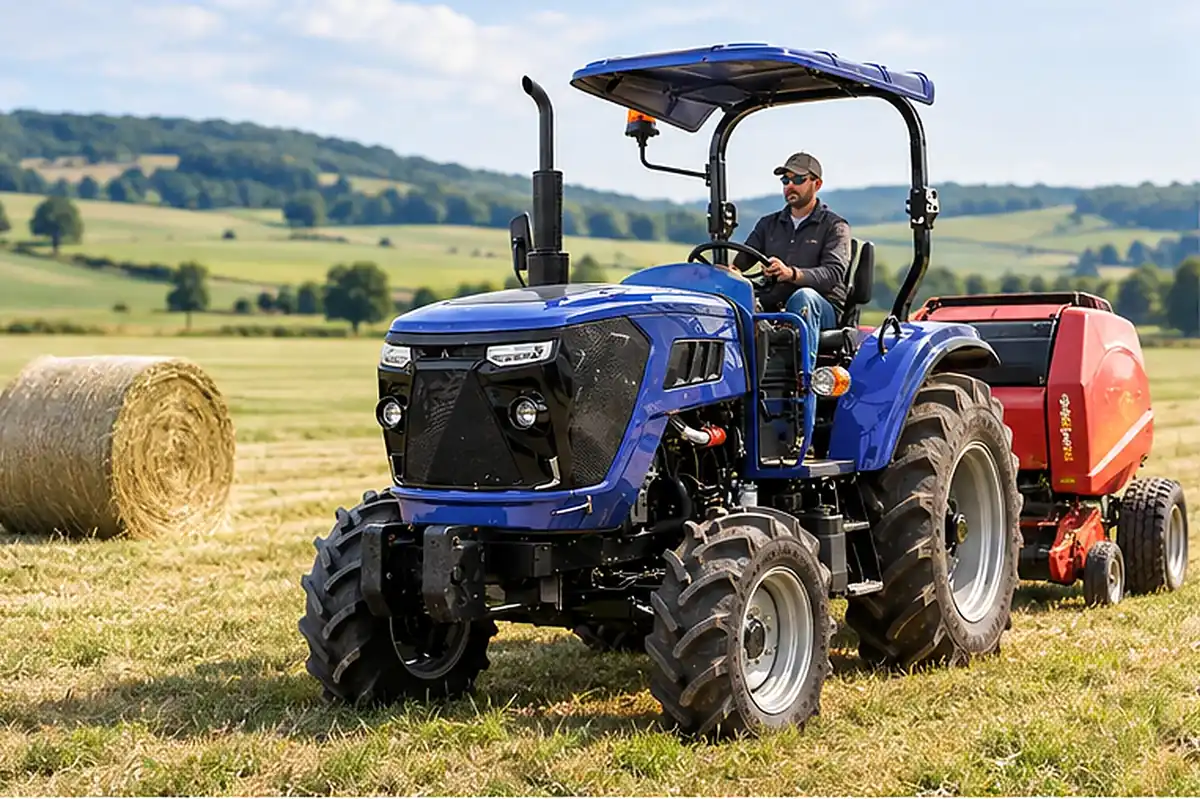
Illustrative grassland operation: PTO and implement compatibility can matter more than total farm size.
Arable farming with heavy clay: protect the planting window
An arable farm may be limited by the capacity of its primary cultivation machine, not by total yearly engine hours. If most of the 160 acres requires deep or high-draft work in a short period, a 25–70 HP OXPLO utility tractor may not be an adequate sole primary tillage tractor. The more credible solution could be a higher-powered tractor or a contractor for demanding passes, while an OXPLO utility model performs mowing, lighter cultivations, transport and support work.
That distinction saves buyers from buying the largest available model only to discover it cannot operate the implement needed to meet the deadline.
Fragmented mixed farm: access and versatility can outweigh peak HP
Small fields, narrow stone gateways, multiple plots and older agricultural buildings change the calculation. A nominally faster, wider setup can lose productivity in turning and travel. A compact tractor for medium farm duties may be more economical if its implements are correctly matched. However, if the existing fleet uses heavier Category II attachments, moving to a larger utility platform may be worth the access trade-off.
The appropriate strategy follows the most restrictive task or access point—not a headline acreage figure.
V. Where OXPLO 40–70 HP Tractors Fit—and Where They Do Not
Compare platforms, not only the 10 HP difference
OXPLO’s European tractor product range includes 25–70 HP models. For many 160-acre mixed-farm enquiries, the important distinction lies between the compact Category I OXT404/OXT504 platform and the larger Category II OXT604/OXT704 platform. They are not interchangeable merely because their engine ratings sit close together.
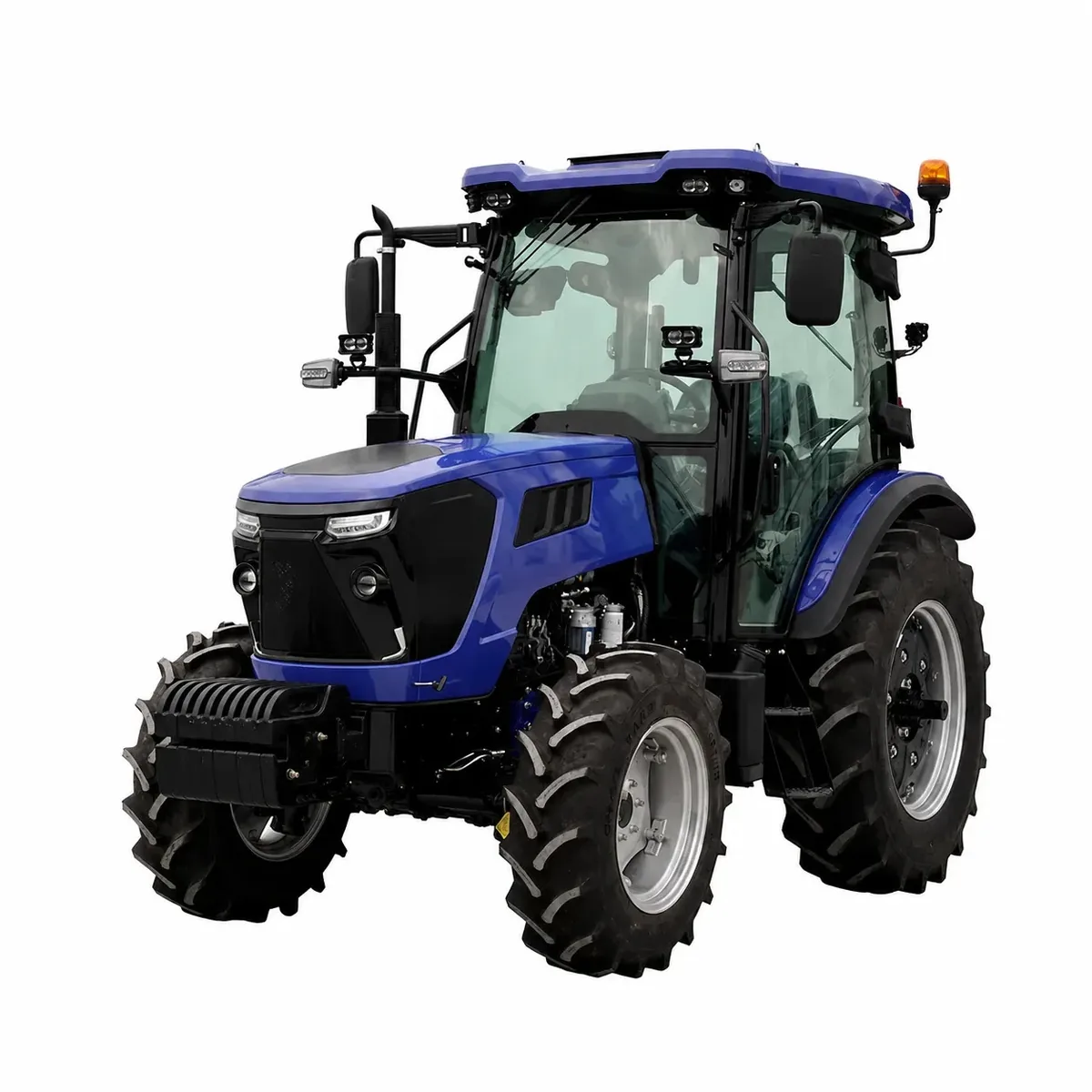
OXPLO tractor supplied reference photograph: actual model and configuration must be confirmed for each order.
OXPLO tractor | Published base features | Plausible role on a 160-acre property |
OXT404 | 40 HP; 4WD; 8F+8R; Category I | Lighter mixed-farm and pasture work with compatible implements |
OXT504 | 50 HP; 4WD; 8F+8R; 1,560 mm width; Category I | Compact-access livestock, mowing and general utility tasks |
OXT604 | 60 HP; 4WD; 12F+12R; 1,760 mm width; Category II | Larger utility platform for compatible mixed-farm equipment |
OXT704 | 70 HP; 4WD; 12F+12R; Category II | Higher-power utility work, subject to draft and capacity checks |
Current published base specifications, not guaranteed site performance. The supplied configuration, tyres, PTO speeds, operator station and attachments must be reconfirmed on the quotation.
When the OXPLO OXT504 is the better purchasing decision
The OXPLO OXT504 50 HP tractor lists a 1,560 mm width, 1,800 mm wheelbase, 8F+8R gearbox and Category I rear linkage. A buyer using compact Category I implements and navigating narrow gateways may value that platform more than an additional 10 HP. The published OXT504 PTO information is not fully consistent across OXPLO pages, so its actual supplied PTO speeds must be confirmed in writing.
Why the OXPLO OXT604 is more than “10 HP stronger”
The OXPLO OXT604 60 HP tractor lists a 2,010 mm wheelbase, 1,760 mm width, 12F+12R gearbox and Category II linkage. For buyers who need the larger attachment interface or more gear choices for recurring work, that platform change can matter more than engine rating alone. It does not, by itself, prove a particular loader lifting capacity, drawbar power or cultivator width. A comparison of the platforms is available in OXPLO’s OXT504 vs OXT604 technical guide.
When to consider the OXPLO OXT704—or a larger machinery class
The OXPLO OXT704 70 HP tractor offers the highest currently published rated power in OXPLO’s tractor range, alongside 4WD, 12F+12R transmission and Category II linkage. It is a candidate where confirmed implements require greater engine-power reserve. Yet 70 HP must not be presented as a universal solution for intensive cultivation across 160 acres. For high-draft, wide implements, another tractor class or contractor may be the responsible recommendation.
VI. What European Buyers Should Verify Before Placing an Order
Road access, dimensions and the finished configuration
Measure the narrowest gate, doorway, turning area and transport route, then compare against the complete configured machine, not only catalogue width. Mirrors, tyres, loader brackets and attachments can affect usable clearance. If public-road travel is planned, check the destination country’s rules for lighting, braking, marking, tyres, operating speed and registration.
EU approval documents must match the exact vehicle
For applicable vehicles, Regulation (EU) No 167/2013 provides the EU framework for agricultural-vehicle type approval. A buyer should request confirmation of the approval covering the specific ordered variant and the required Certificate of Conformity or other applicable documentation. Do not assume documentation associated with one approved OXPLO tractor type extends to every OXT model, tyre, cab, engine or road-use specification. See the official EUR-Lex regulatory summary.
Parts availability and lifetime cost matter more than a low entry price
A quotation should clarify warranty conditions, consumable and spare-parts supply, repair support, technical manuals and expected dispatch arrangements. A delayed repair during a narrow fieldwork window can be more costly than a modest saving on the purchase price.
For ownership comparison, estimate annual cost per productive hour = (annual ownership cost + annual operating cost) ÷ annual productive hours. Compare this with contractor costs and productivity per hectare. A larger tractor can be cheaper per hectare if heavily utilised and genuinely more productive, but not simply because it has a higher HP figure.
VII. A Practical Tractor Selection and Enquiry Checklist
Make five decisions in the correct order
- Define actual land use:separate arable area, pasture and maintenance-only land; list each recurring operation.
- Set the fieldwork deadline:calculate workable days, productive hours and the field capacity each job requires.
- Identify the limiting implement:confirm width, depth, draft or PTO demand, hitch type, hydraulics and safe transport requirements.
- Shortlist a tractor-and-implement package:compare traction, access, 4WD, linkage, gear choices and approved load limits before comparing prices.
- Check procurement evidence:obtain a model-specific quotation, confirmed specifications, applicable European documents and written support arrangements.
Provide OXPLO with information that supports a useful recommendation
For a concrete OXPLO selection discussion, share the destination country, cultivated area, soil type, field sizes, available workdays, existing implement models, gate dimensions and anticipated annual hours. State whether the tractor will be the farm’s only machine or a secondary utility tractor. This allows OXPLO to identify feasible 40–70 HP options—or to explain why the primary task is outside that range.
You can review the OXPLO tractor configuration page before submitting these details. A well-specified enquiry is more useful than asking for a price on “a tractor for 160 acres” without describing the work.
FAQ: Tractor Horsepower for a 160-Acre Farm
Is a 50 HP tractor enough for 160 acres?
It can be adequate for many compatible grassland, transport and mixed-farm tasks. It is not automatically enough for all primary tillage or planting duties. Check the heaviest implement and the required fieldwork window first.
Can an OXPLO 70 HP tractor work on a 160-acre farm?
Yes, the OXPLO OXT704 may suit properly matched utility and agricultural work on a property of that size. The acreage alone cannot establish that it will complete high-draft cultivation on time.
Does 4WD remove the need for more horsepower?
No. 4WD can improve traction in appropriate conditions, but it cannot compensate for inadequate engine or PTO power. Tyres, ballast, soil moisture and implement draft also matter.
Should I buy a wider implement to finish earlier?
Only when the tractor can maintain the intended speed and working depth. A wider tool that slows the tractor excessively may reduce real productivity rather than improve it.
What should a European buyer check beyond HP?
Verify hitch and PTO compatibility, hydraulic requirements, configured dimensions, safety and road-use equipment, applicable approval documents, spares and support terms. Request a confirmed specification for the exact vehicle being ordered.
Should a medium farm own one large tractor or use contractors?
If heavy work occurs only briefly each year, an OXPLO utility tractor for daily tasks plus contracted high-draft work may be more economical. Compare operating windows, contractor availability and total cost before choosing.
Conclusion: Buy Enough Tractor for the Work, Not Just the Acres
The correct tractor size for 160 acres depends on the operations to be completed, implement demand, soil resistance and the number of workable hours available. A 160-acre grassland farm and a 160-acre arable farm can need entirely different machinery systems.
For appropriate mixed-farm and grassland duties, OXPLO offers 40–70 HP options with distinct compact Category I and larger Category II platforms. The OXPLO OXT504 may appeal where access and compact attachments matter; the OXPLO OXT604 and OXPLO OXT704 deserve consideration where compatible utility tasks call for a larger platform or more engine power. None should be selected for high-draft cultivation without checking the exact implement and field capacity requirement.
If you are planning a purchase, send OXPLO your farm type, soil conditions, implement list, seasonal deadlines and destination country. The team can review relevant OXPLO tractors and confirm which specifications—and any important limitations—matter for your intended use.