
An attractive tractor quotation is not the same as a sale-ready tractor. A European dealer might receive a machine that starts perfectly but cannot be registered for its intended use, does not fit a customer’s mower, or needs a replacement hydraulic component that cannot be identified quickly. In each case, the distributor carries the immediate commercial problem—even when the underlying issue began with the supplier.
A practical tractor factory audit checklist should therefore test more than the appearance of the factory. It should connect the supplier’s legal identity, the approved vehicle configuration, assembly records, functional tests, shipment evidence and after-sales responsibilities. This guide is written for EU importers and agricultural dealers considering an unfamiliar tractor supplier or preparing a first wholesale order.
The aim is to answer a purchasing question: Can this exact tractor be sold to the intended customer, supported locally and reordered without repeating the same uncertainty?
I. Start With the Dealer’s Exposure, Not a Factory Tour
A low purchase price can conceal three different risks
Registration risk. A buyer orders 50 HP tractors for mixed farms where customers expect public-road travel between fields. The tractors arrive, but the vehicle-specific approval evidence does not match the configuration delivered. Freight, storage and finance costs continue while the dealer investigates. A generic CE-related document or an engine certificate does not resolve that discrepancy.
Application risk. A model is advertised with 4WD and a PTO, but a customer’s existing implement requires a different rear linkage category or PTO arrangement. The tractor may work correctly and still be unsuitable for that customer. The loss can include an attachment replacement, a discounted sale or an abandoned order.
Service risk. A small hydraulic fault can immobilise a tractor during a seasonal operation if the dealer cannot obtain an accurate part number, diagnosis or replacement. The component’s cost may be modest; the customer’s downtime and the dealership’s workshop time are not.
These are not reasons to reject overseas suppliers. They are reasons to define the evidence needed before a dealer commits money to inventory.
Write a one-page purchase brief before asking for prices
Record the destination country, intended road use, target customers, tractor quantity, actual field and yard tasks, existing implements, expected annual hours and preferred delivery date. Include measurements where access is critical: gate width, orchard row spacing, canopy clearance and turning space. Where attachments are involved, record the make, model, hitch category, PTO specification and hydraulic requirements.
This brief gives a tractor manufacturer factory inspection a measurable purpose. It also prevents the salesperson and the dealer from interpreting a vague phrase such as “standard European specification” in different ways.
II. Check the Approval Route Before the Tractor Enters Production
Separate whole-vehicle approval, CoC and component evidence
Regulation (EU) No 167/2013 provides the EU framework for approval and market surveillance of agricultural and forestry vehicles within its scope. For a tractor subject to the applicable EU whole-vehicle type-approval route, verify the approved type, variant and version, not just the trade name or horsepower.
A Certificate of Conformity (CoC) connects an individual vehicle to the relevant approved type under that route. The VIN, approved configuration and documentation must correspond. An engine emissions document concerns a different part of compliance; a generic CE-related certificate is not a substitute for the vehicle approval and CoC required in a particular case.
National approval or registration arrangements may apply in defined circumstances. Dealers should confirm the lawful route for the specific vehicle and intended country with the relevant authority or qualified approval adviser, particularly before non-refundable deposits or shipping commitments.
Ask for the regulatory evidence tied to the ordered build
Check the legal manufacturer and approval holder; vehicle category; type/variant/version; engine identity and applicable emissions approval; protective structure and cab or ROPS configuration; braking and lighting equipment; permissible masses; tyres; and road-use/towing equipment where relevant. Verify the issuance process for the vehicle-specific CoC if required. For private-label arrangements, the dealer must also assess whether branding or modifications create manufacturer obligations under the regulation.
The evidence should be checked before production specifications are frozen. A supplier’s claim that some versions have CoC support does not establish that the dealer’s chosen version will have it.
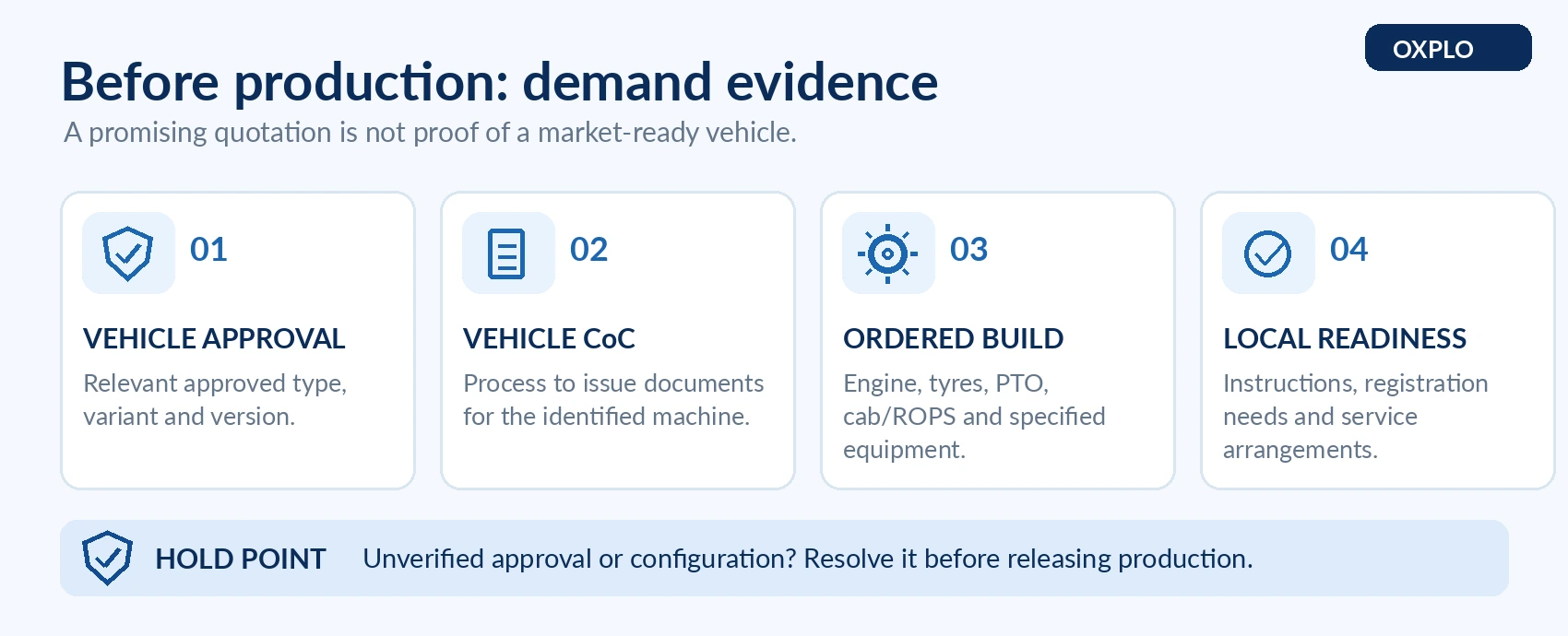
Audit visual 1. Verify the exact approval route, vehicle documentation and ordered tractor configuration.
Use an exception-led approval matrix
Audit item | Evidence to request | Decision if missing or inconsistent |
Manufacturer and approval holder | Legal identity, approval scope and responsible entity | Clarify contractual and regulatory responsibility |
Vehicle approval | Applicable approval identifier and covered type/variant/version | Hold production or shipment until verified |
Vehicle-specific documents | CoC procedure where applicable, VIN/plate details | Do not presume road-registration eligibility |
Engine and equipment | Engine ID, emissions evidence, approved braking/lighting/protection | Reconcile the proposed build with approval records |
Dealer handover | Required-language instructions, safety information, parts and service documents | Resolve the handover gap before retail release |
For a detailed explanation of the documentation distinctions, OXPLO also publishes an EU tractor type-approval guide. Treat a supplier’s guide as preparation—not as an alternative to official records.
III. Inspect Whether the Factory Can Repeat the Same Quality
Trace one ordinary tractor through the production records
A clean assembly hall and a polished demonstration unit do not prove that every production unit is built consistently. Select a tractor from normal production and ask the factory to connect its identification number to the engine, relevant drivetrain components, assembly record, inspection results and release authorisation.
A useful follow-up question is: “If this batch of hydraulic fittings were defective, which completed tractors would you inspect?” An inability to locate affected units creates a direct after-sales risk for a European distributor.
Examine the joints and systems most likely to create rework
Check documented controls for critical fastener tightening, fluid filling, hydraulic hose routing, electrical protection, cooling connections, steering components and brake adjustments. Look for hoses rubbing on moving parts, inadequate clamping, unsupported cables and inconsistent component identification. Ask whether appropriate torque tools and measurement equipment are controlled and calibrated.
An agricultural OEM audit checklist should not require a factory to claim zero defects. Instead, ask to see a real nonconformity record and evidence of containment, correction, retesting and prevention of recurrence. The ability to close a defect systematically is more informative than photographs of flawless paintwork.
Distinguish certification from machine-specific proof
An ISO 9001 certificate may support assessment of the quality management system within its certified scope. It does not by itself prove that an individual tractor passes functional tests or has valid EU whole-vehicle approval. Compare documented procedures with recent production records. If an outsourced facility performs a critical operation, identify who verifies and releases that work.
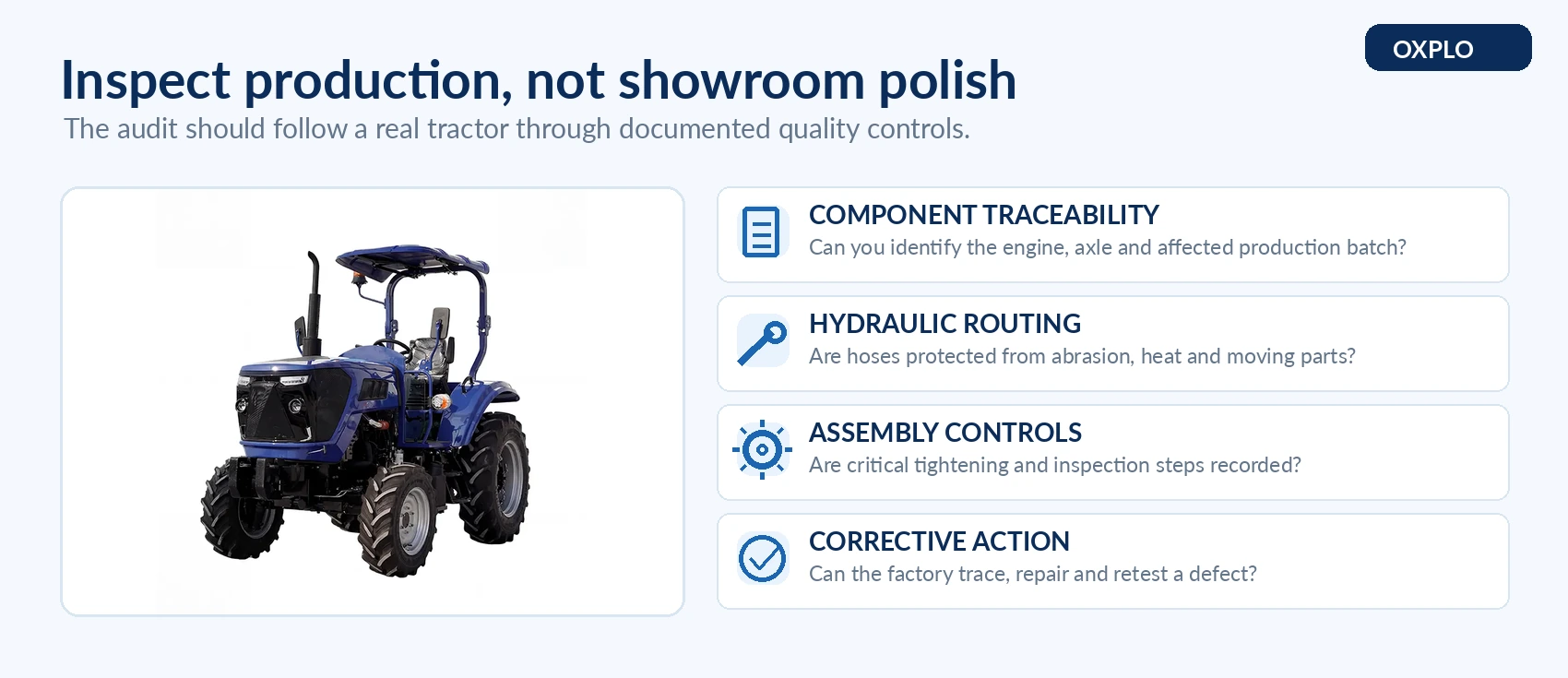
Audit visual 2. Document component traceability, hose routing, assembly controls and corrective actions.
IV. Build Acceptance Tests Around European Customers’ Jobs
Compact farm and orchard customers: test fit before output
For smaller holdings, estate maintenance or wider-row orchards, dimensions and implement fit may matter more than the largest engine rating. Measure the complete operating width with selected tyres, the height of the ordered cab or ROPS, turning clearance, rear-linkage geometry and PTO compatibility.
A 25 HP tractor that passes through the customer’s gate and operates an existing mower may be commercially more useful than a larger tractor that cannot access the work area. But a stated engine rating cannot prove that a particular implement is compatible; check implement power demand, weight, PTO speed and hitch class.
Livestock and mixed farms: test the full working system
A dealer selling tractors for feed handling, grassland maintenance, trailers and cultivation should verify transmission engagement, braking, steering, hydraulic response, rear linkage, PTO and traction under agreed safe test procedures. For a front-loader configuration, confirm mounting brackets, hydraulic connections, approved loading limits, axle loads and required ballast. Do not infer loader capacity or towing suitability from horsepower.
A tractor sample order verification process should tie every test to the written specification and the machine identification number. Use calibrated measuring instruments where quantitative results are required. Avoid improvised gradient, heavy-load or stability tests; use qualified personnel and approved test methods.
Make defects visible in the acceptance report
For each check, record the requirement, evidence, result, inspector, defect severity, corrective action and retest status. For example, “PTO functional demonstration passed” is weaker than a record identifying the specified PTO configuration, test condition and observed result. Critical safety, regulatory and functional discrepancies should prevent release until resolved.
OXPLO’s tractor configuration page describes discussion of PTO, hydraulic, tyre and implement requirements before ordering. An OXPLO dealer should submit the *actual implement specification* and request written compatibility confirmation rather than relying on a broad model description.
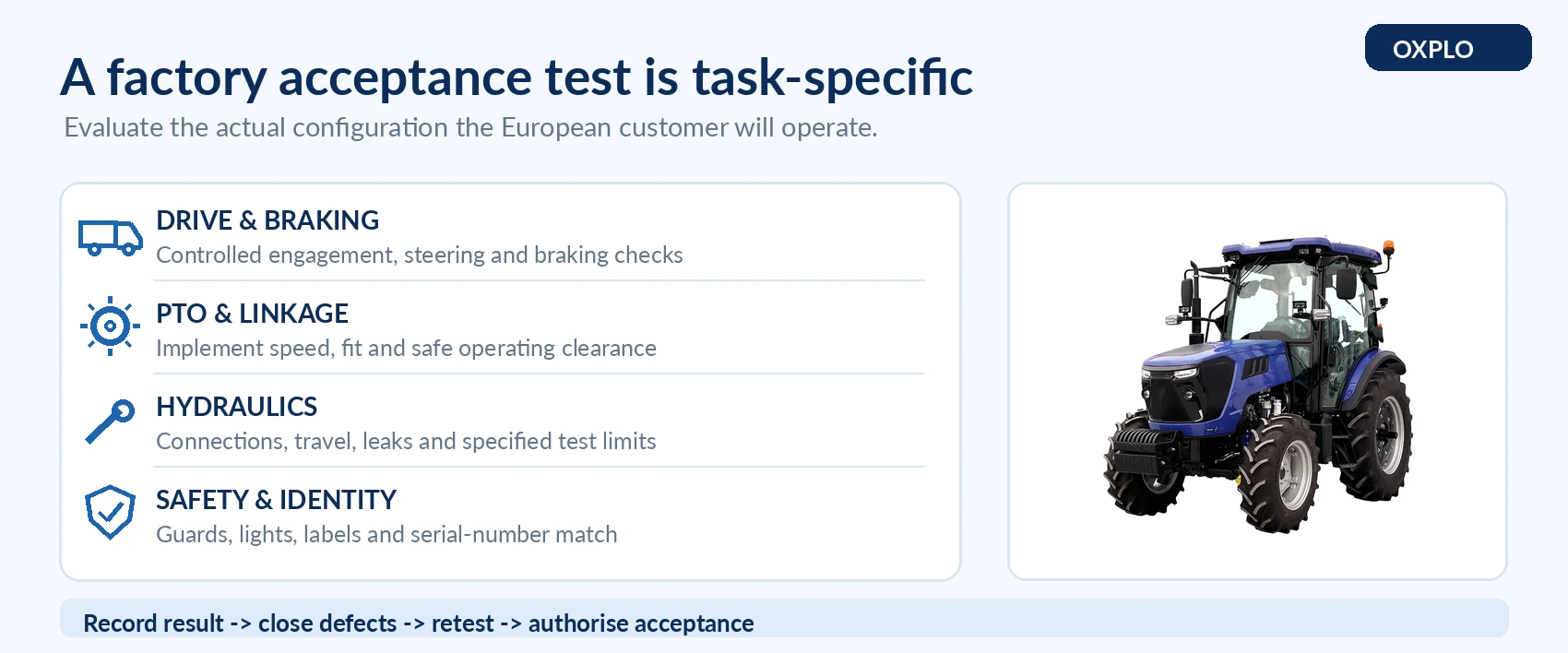
Audit visual 3. Connect acceptance tests with actual tractor applications and recorded results.
V. Use the First Order as a Controlled Production Trial
Three checkpoints are more useful than one final photograph
Pre-production release: Sign the exact engine, transmission, PTO, rear-linkage, tyre, operator-station, attachment and market-document specification. Agree who may authorise any component substitution.
Factory acceptance test (FAT): Inspect a representative completed unit and review production records, safe functional tests and corrective actions. Agree in advance which characteristics require unit-level checks and how sampling will be handled for larger batches. Sampling must not turn critical legal or safety issues into acceptable defects.
Pre-shipment release: Reconcile the list of actual machine identifiers with purchase records, inspection results, required documents, attachments, packing list and photographs. Do not treat photos of an unidentifiable demonstration tractor as proof of the shipment.
Apply a simple stop/hold/release rule
Stop: No credible approval route for the intended use, identity mismatch, unresolved safety defect or material deviation from the purchased specification. Hold: A correctable noncritical defect or missing supporting record that must be closed before release. Release: The agreed requirements are met, relevant records match and open defects are formally closed.
The purchase contract should specify inspection access, remediation rights, independent inspection where appropriate, shipment-release conditions and the allocation of extra inspection or storage costs following a failed acceptance.
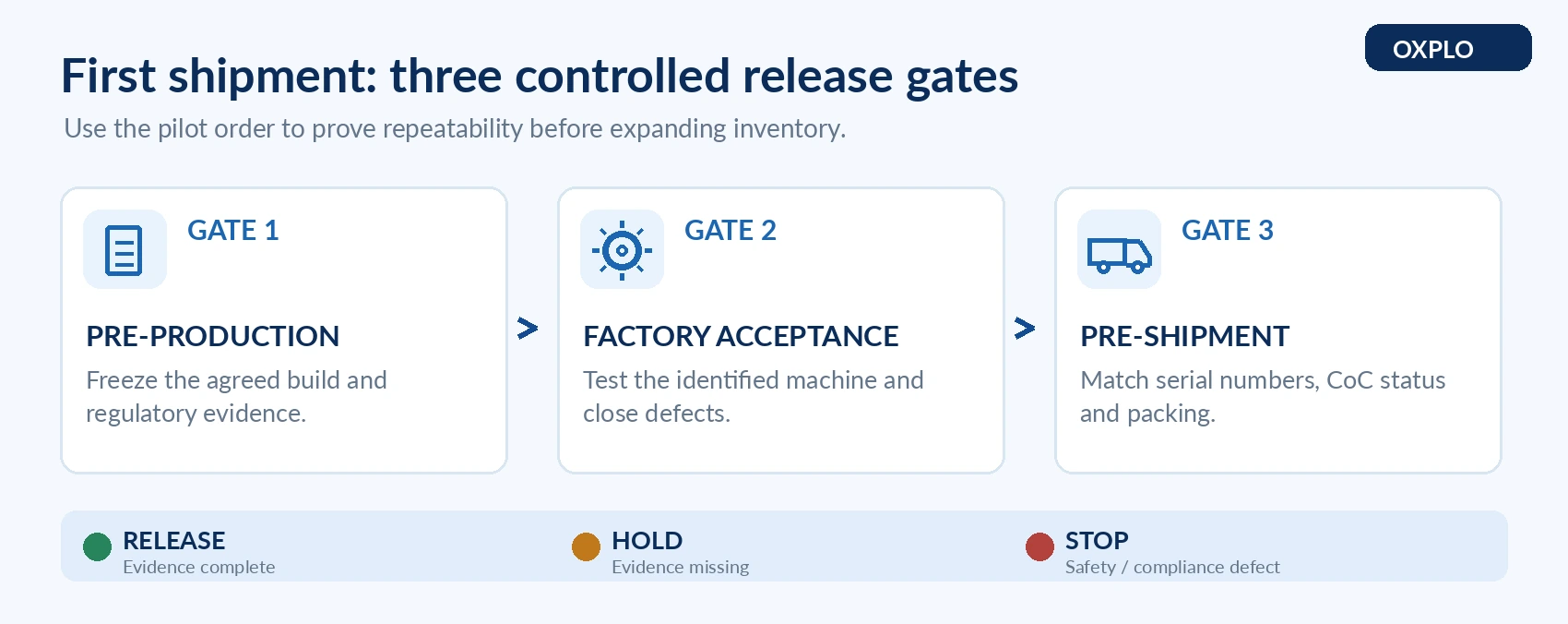
Audit visual 4. Use controlled release gates for production, acceptance and shipment.
Inspect again after arrival
Transport can loosen or damage components. The local pre-delivery inspection should cover shipping damage, tyre condition, fluid levels, leaks, protective guards, any reassembled equipment and operational checks. A passed FAT does not replace a destination PDI. The OXPLO article on European tractor dealer trial orders provides a complementary first-order planning framework.
VI. Compare Sale-Ready Cost and Service Readiness
Model the cost of inventory the dealer can actually sell
Factory price is only one input. A practical calculation is:
Sale-ready cost = factory purchase price + allocated freight and insurance + duties and import handling + inland delivery + inspection and PDI + initial parts provision + expected warranty cost.
For illustration only, assume a purchase price of €14,000, allocated freight and insurance of €1,000, import handling of €180, inspection of €220, PDI of €260 and warranty provision of €340. The illustrative total is €16,000 per tractor, excluding any applicable additional duties, non-recoverable taxes, financing or overhead. These are hypothetical figures, not OXPLO prices.
If an undetected assembly issue causes €800 in rework for each of eight tractors, the direct additional cost is €6,400 before accounting for seasonal downtime, customer inconvenience or delayed resale. That is why an independent inspection fee can be economically justified when the order risk warrants it.
Service evidence is part of supplier quality
Ask for a model-specific parts catalogue, maintenance schedule, filters and wear-part identifiers, claim procedure, fault-diagnosis guidance and written warranty allocation for parts, labour and freight. Test whether the supplier can identify a replacement part from a machine serial number and photographs without an extended email chain.
OXPLO publishes a parts and support centre covering service enquiries, attachment information and claim preparation, plus a warranty policy describing one-year or three-year arrangements subject to the relevant terms. For any OXPLO order, the dealer should have the exact warranty duration, exclusions, parts lead-time expectations and cost responsibilities confirmed in its contract.
Set the reorder gate before the trial starts
A first shipment should reveal whether the dealership can register vehicles where required, demonstrate them with customer implements, complete PDI efficiently, resolve faults and achieve acceptable margins. Track real inquiries and time-to-sale by model. A small batch cannot establish a reliable defect rate statistically, but one unresolved critical compliance problem is sufficient reason to pause another order.
VII. Where OXPLO Fits Into a European Dealer Audit
Choose the platform, not simply the biggest HP number
The verified OXPLO tractor range lists six 4WD models from 25 to 70 HP. Its published specifications distinguish a compact Category I group from a larger Category II utility platform. That distinction helps dealers align the model mix with existing implements, working space and recurring customer jobs.
OXPLO model group | Published reference points | What the dealer should validate |
OXT254 / OXT304 | 25 / 30 HP; compact 4WD; Category I | Access, basic workload and exact gearbox/PTO configuration |
OXT404 / OXT504 | 40 / 50 HP; compact 4WD; Category I | Implement demand, loader suitability and PTO specification |
OXT604 / OXT704 | 60 / 70 HP; larger 4WD platform; Category II | Larger implements, permitted loading, ballast and road equipment |
The OXPLO OXT254 may suit a dealer targeting compact maintenance and light agricultural work where dimensions and compatible Category I implements dominate the purchasing decision. The OXPLO OXT404 and OXPLO OXT504 offer higher compact-platform power while retaining Category I linkage in their published base specifications.
For customers needing a different implement class and larger platform, the OXPLO OXT604 and OXPLO OXT704 publish Category II linkage and 12F + 12R transmissions. The actual machine’s compatibility and approved configuration still need verification; no published horsepower figure establishes a specific lifting, towing or registration capability.
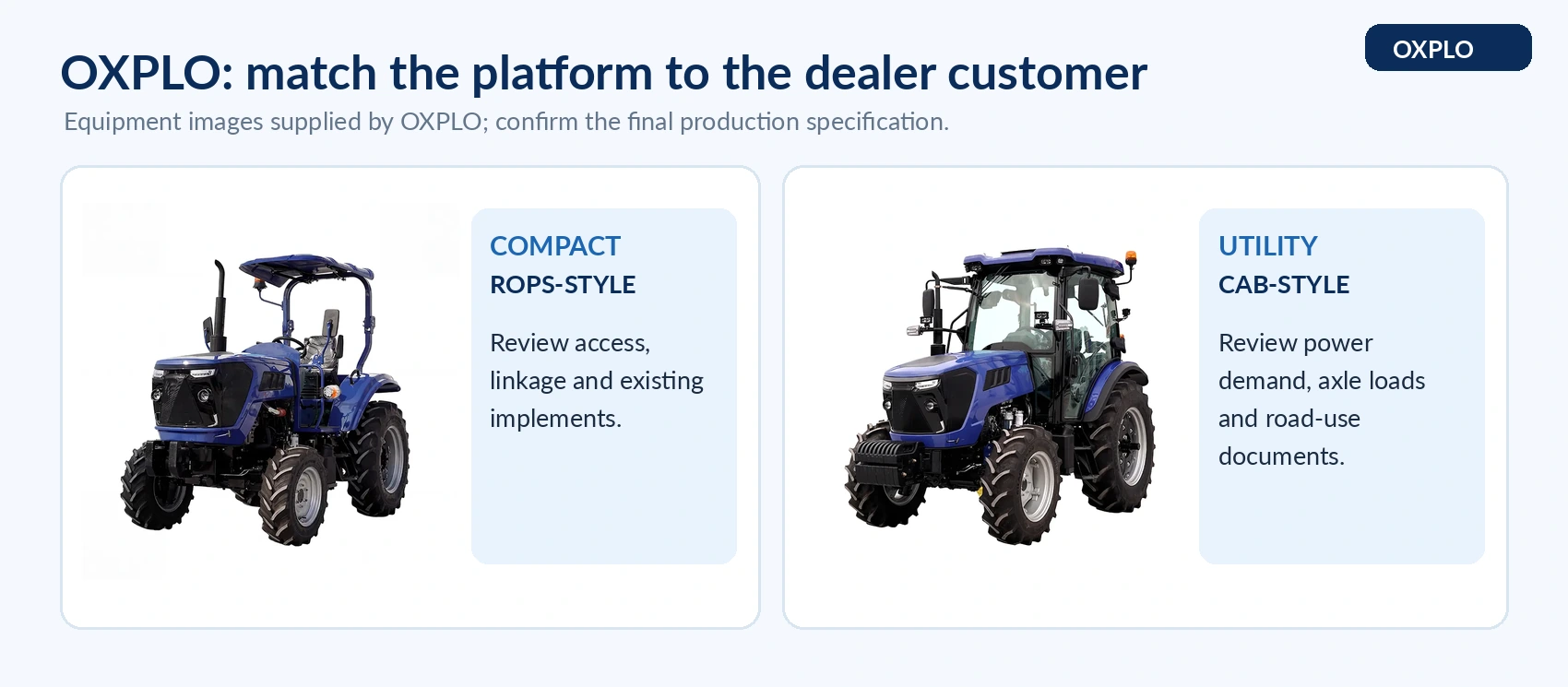
Audit visual 5. Compare compact and utility tractor platforms against dealer customer requirements.
A useful warning from the OXPLO catalogue itself
OXPLO’s current configuration comparison and the individual OXT254 product page show different gearbox information. Rather than choosing whichever number looks more attractive, a dealer should ask OXPLO to identify the actual production gearbox in the signed technical specification and acceptance test. That is exactly what a disciplined supplier audit is designed to catch. Similar confirmation is prudent for any published PTO data or optional market equipment.
What OXPLO can contribute—and what the dealer must still verify
OXPLO describes application-based configuration discussions, pre-shipment photographs or videos, international order coordination, selected-model CoC support and replacement-parts assistance. These are relevant capabilities because they can give a dealer more evidence at each purchasing stage. They are not blanket proof that every OXPLO configuration has EU approval, a CoC, a particular Stage V engine or guaranteed parts availability.
The strongest OXPLO enquiry is therefore specific: destination country; required models and quantities; intended road use; customer’s implement list; tyre/cab/ROPS preferences; target delivery conditions; requested approval evidence; FAT checklist; and initial spare-parts requirements. The OXPLO first-shipment stock-mix guide can help with trial inventory decisions before requesting a final OXPLO quotation.
Frequently Asked Questions
What is the single most important item in a tractor factory audit checklist?
A link between the actual ordered tractor and its evidence: the signed configuration, applicable approval route, production record, VIN/identification details, test results and service information. A visually impressive factory is not enough if that chain cannot be demonstrated.
Can a tractor manufacturer factory inspection be completed remotely?
Document review, live demonstrations and VIN-linked photographs can support remote due diligence. However, they may not prove that a demonstration represents normal production. An independent physical inspection is often justified when purchase value, supplier history or unresolved technical risks are significant.
Is a Stage V engine or a CE document sufficient for EU tractor registration?
No. Engine-emissions and CE-related evidence address different requirements. Where the applicable vehicle-approval route requires whole-vehicle approval and a CoC, dealers must verify that the specific tractor version and vehicle identity are covered. Confirm national registration procedures before ordering.
Why should dealers verify rear-linkage categories on 40–70 HP tractors?
Rear-linkage category, geometry and allowable loads determine whether existing implements can be connected and operated appropriately. In OXPLO’s published range, the compact OXT404/OXT504 models list Category I, while OXT604/OXT704 list Category II. Power alone does not establish compatibility.
Can OXPLO provide documents and pre-shipment evidence for a dealer order?
OXPLO describes selected-version documentation support and pre-shipment photos or videos. The dealer should request confirmation for the exact model, ordered variant, VIN, destination and agreed inspection scope before relying on those arrangements.
What should trigger a second wholesale tractor order?
Verified local demand, acceptable sale-ready economics, compatible implements, completed applicable documentation, closed critical defects and a workable service-parts process. A single quick sale is not enough to establish repeat-order readiness.
Conclusion: Turn the Factory Audit Into a Purchasing Decision
The purpose of a tractor factory audit checklist is not to collect signatures or complete a factory visit. It is to prevent a dealer from paying for machines that cannot be sold as intended, cannot use customers’ existing equipment or cannot be supported efficiently after delivery.
Start with customer applications and the intended registration route. Freeze the technical specification, audit the factory’s repeatable assembly controls, test identifiable production units, inspect the shipment and calculate the full sale-ready cost. When any critical piece of evidence is missing, delay the release rather than shifting uncertainty into dealer inventory.
For distributors evaluating OXPLO, the 25–70 HP model range creates choices for compact and utility applications, while OXPLO’s configuration, inspection-image and support channels provide practical starting points for evidence-based procurement. Each promised feature or document should still be matched to the exact tractor and confirmed in writing.
To discuss an OXPLO trial order, send the destination country, proposed models and quantities, existing implements, road-use requirements and inspection expectations through the OXPLO contact page. Ask for an order-specific specification, available approval evidence, FAT arrangements and spare-parts proposal before committing to production.