
A practical, numbers-led guide to choosing the first tractors, implements and service parts for a European dealership.
A distributor can receive six perfectly functional tractors and still struggle to sell half of them. The problem may be that the 70 HP units are too large for local estates, a 50 HP model cannot accept the implements customers already own, and the dealer has no correct maintenance filters when the first service is due.
A tractor dealer first shipment succeeds when the machines match real buying demand, can be legally supplied for their intended use, and remain affordable to stock and maintain. This guide shows how to determine distributor first order quantities, build a practical implement mix, check European documentation and set a replenishment plan. All quantities and prices below are worked examples, not a factory offer or a guaranteed container load.
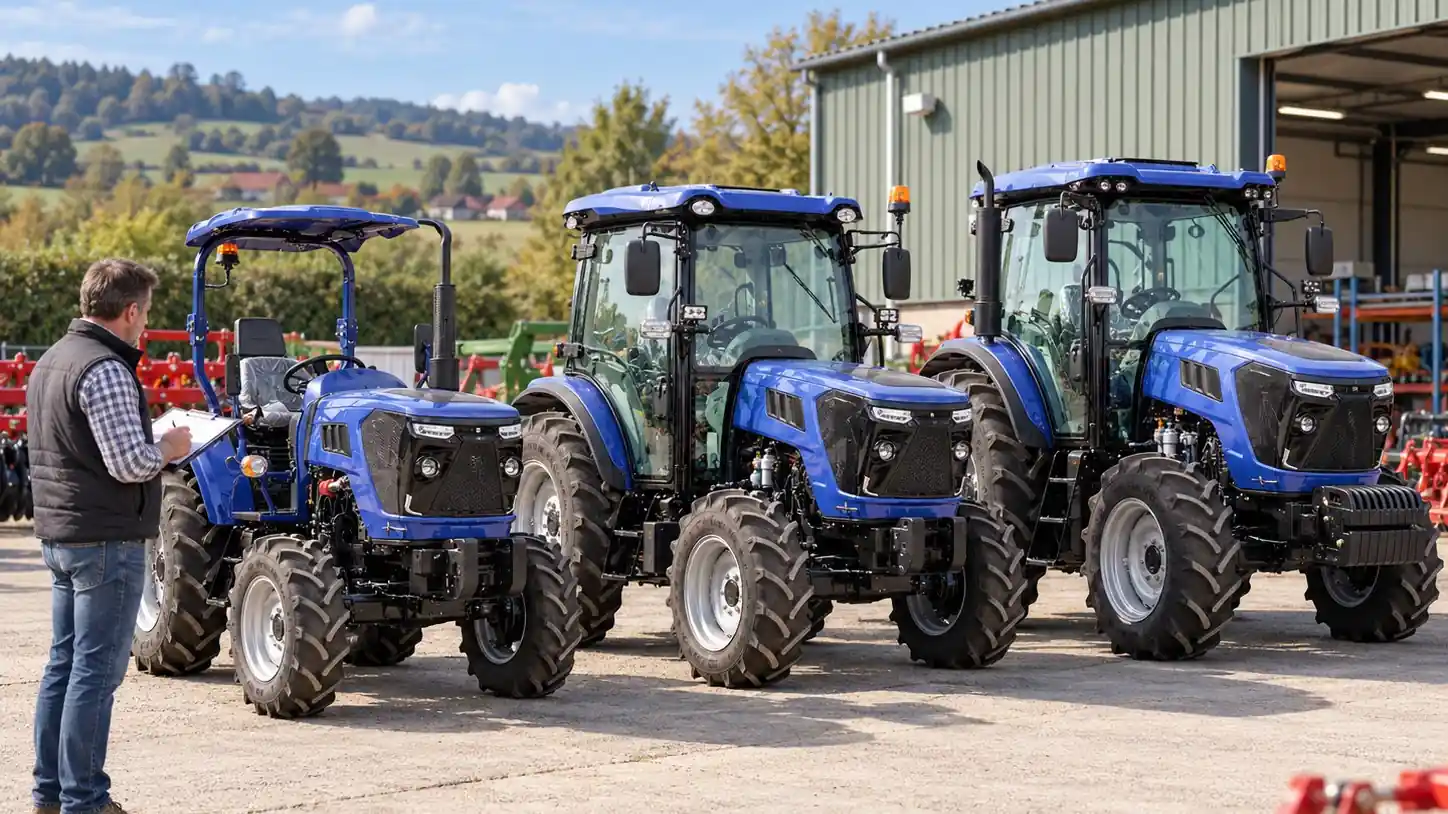
Figure 1. Illustrative OXPLO-style starter assortment at a European dealership, based on supplied tractor references; not an actual dealer delivery.
I. Why the First Shipment Can Fail Before the First Sale
The hidden cost is not the purchase price—it is the wrong inventory
A larger order may reduce freight per tractor, but it also increases money tied up in units that have not yet proved themselves in the local market. Every extra machine requires space, insurance, inspection and potentially finance charges. A price advantage disappears quickly if the dealer discounts an unsuitable model months later.
For example, a tractor with a €15,000 sale-ready cost remains unsold for 120 days. At a 10% annual cost of capital, its financing or opportunity cost is approximately €493 (€15,000 × 10% × 120 / 365). Four comparable unsold tractors can immobilise €60,000 before storage or price reductions are considered. This is an illustrative calculation, not a typical industry holding-cost rate.
Three mismatches drive expensive first-order mistakes
- Demand mismatch:Buying mostly high-power tractors for customers whose actual work is mowing, small-farm cultivation and property maintenance.
- Configuration mismatch:Selling a machine by engine HP without checking three-point linkage category, PTO speed, hydraulic outlets, tyre size or loader requirements.
- Market-entry mismatch:Treating import clearance or engine documentation as proof that the specific tractor is approved for the intended sale and registration route.
The operational consequence is the same: good equipment becomes difficult inventory. The aim of the first shipment is to prove repeatable sales and support capability, not to display every catalogue model.
II. Build a Tractor Dealership Starter Stock Plan From Real European Demand
Translate customer jobs into specifications
Separate customers by application before grouping them by horsepower. An orchard buyer may be limited by gateway width, canopy height and turning radius. A livestock operation may need loader reach, sufficient ballast and hydraulic capacity. A mixed farm may care most about whether its existing mower and tiller will connect properly.
Buyer type | Typical job | What to verify before quoting |
Small farm / estate | Grass cutting, property maintenance, light cultivation | Access width; PTO and implement power; Category I linkage |
Orchard / vineyard | Row maintenance, mowing, light transport | Actual row clearance, overall height, turning space |
Mixed farm | Tillage, mowing, transport | Linkage category; PTO speed; transmission; trailer requirements |
Livestock farm | Feed and bale handling, loader work | Loader ratings, ballast, axle limits, hydraulic circuits |
Contractor | Longer hours and varied seasonal tasks | Duty cycle, service turnaround, suitable implement platform |
These are application-screening rules, not claims that a particular horsepower guarantees performance. A 50 HP engine does not automatically permit a heavier implement; PTO output, hitch geometry and machine stability may be the limiting factors.
Use the enquiry pipeline before committing capital
For each serious enquiry record the country, application, existing implements, budget, cab or ROPS preference, registration requirement and likely buying date. Then separate firm orders from demonstration demand and speculative stock.
Consider this hypothetical 90-day forecast, based on qualified leads rather than website clicks:
Power band | Qualified enquiries | Assumed close rate | Expected sales |
25–30 HP | 6 | 25% | 1.50 |
40–50 HP | 9 | 25% | 2.25 |
60–70 HP | 3 | 25% | 0.75 |
Total | 18 | 25% | 4.50 |
This suggests the strongest initial demand is in the 40–50 HP band. It does not mean that 4.5 tractors should literally be ordered or that 25% is a European industry conversion benchmark. With little trading history, a dealer should stress-test the forecast using a lower close rate, a delayed season and a slower replenishment time.
Avoid a single “European market” assumption
Demand in Poland, Czechia, Hungary and Slovakia may differ by farm structure, local equipment fleets, price sensitivity and distribution relationships. The same principle applies elsewhere in Europe. A dealer serving small estates should not copy the first order of a contractor-focused agricultural supplier. Organise inventory around the enquiries your territory can actually convert.
III. Set First Container Tractor Model Mix and Quantities
Example: six tractors, three distinct selling roles
For a small distributor with the example demand pattern above, the following is a plausible starting stock proposal. The primary objective is to keep enough depth in the most likely selling category without creating several one-off configurations.
Category | Tractors | Stock share | Role |
25 HP compact | 2 | 33.3% | Smaller holdings and maintenance |
50 HP general farm | 3 | 50.0% | Mainstream mixed-farm demand |
70 HP utility | 1 | 16.7% | Larger applications / demonstration |
Total | 6 | 100% | Demand-planning example |
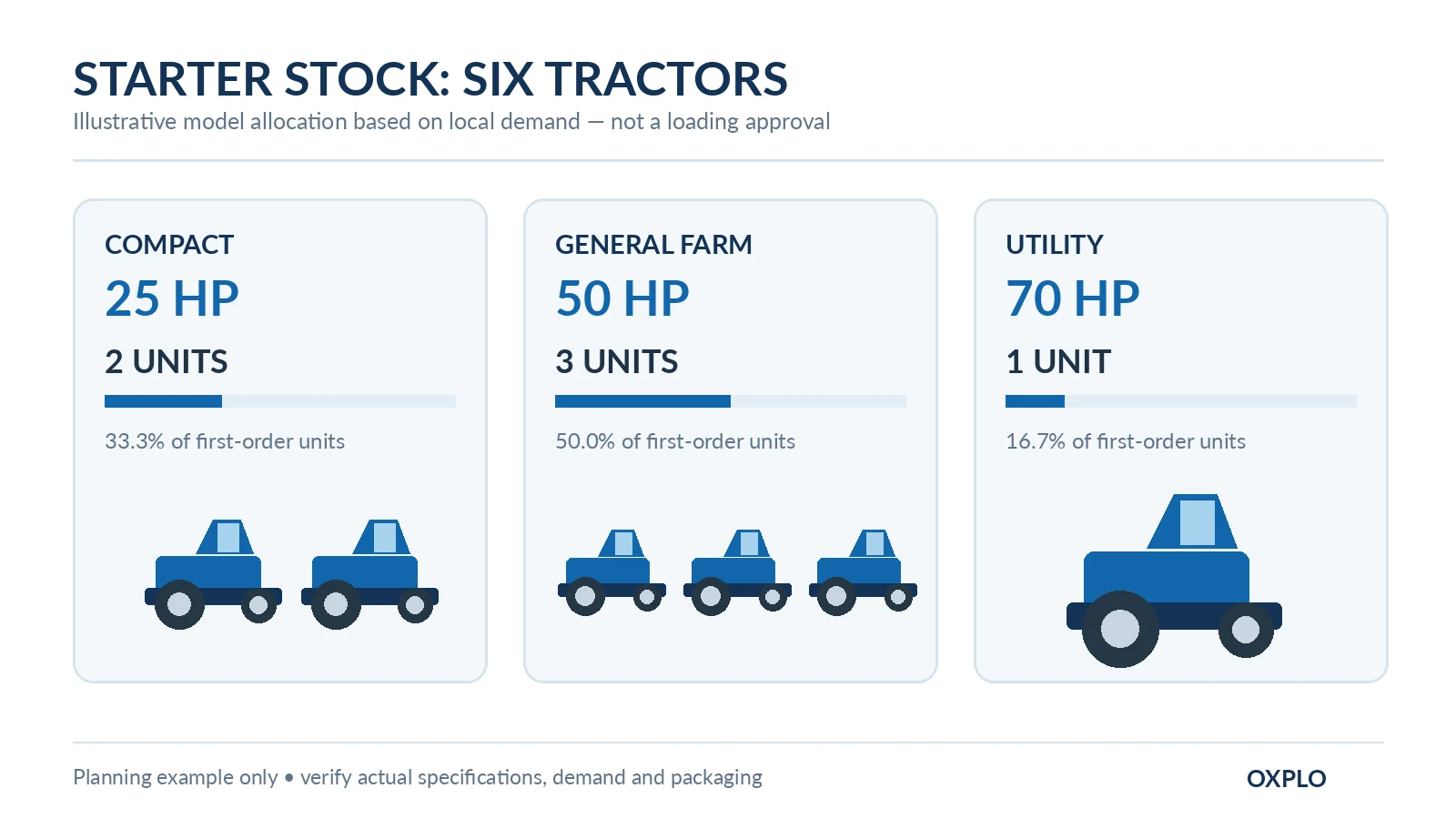
Figure 2. Example starter allocation: two 25 HP, three 50 HP and one 70 HP tractor; not a confirmed container load.
Why not one each of six models? A customer seeking two identical 50 HP machines cannot be served from a showroom containing six different configurations. Greater model variety also complicates service-parts stock, staff training and pricing. A narrow initial assortment can be easier to sell and replenish.
Decide which units are retail stock and which are demonstrations
A demonstration tractor is not automatically equivalent to sale-ready stock. It accumulates hours and may require a different resale allowance. Label the inventory position of each unit: customer-committed, sale-ready, or demonstration. This also prevents the dealer from accidentally counting the same demo unit as immediately deliverable inventory.
A six-unit order is not an approved six-unit container load
The phrase first container tractor model mix refers to the purchasing plan—not proof of physical capacity. Request an actual packing plan showing transport dimensions, gross weight, removed components, loading sequence and tie-down arrangements. Include any loader frames, buckets, tillers or spare parts packed with the tractors.
The loading decision must respect container door dimensions, payload and floor limits, cargo-securing requirements, weight distribution and safe unloading at the destination. If the preferred stock mix does not fit the proposed container, compare alternative freight arrangements instead of adding an unsuitable tractor merely to fill a space.
IV. Calculate Attachment Quantities Around Workable Tractor Packages
Attach an application—not simply an accessory
A tractor implement bundle for dealers should correspond to a job the farmer can complete after delivery. A compact maintenance package might include a mower; a mixed-farm package may require a tiller or loader; a livestock package may need a loader and bale-handling attachment. These are alternatives determined by local demand, not universal bundles.
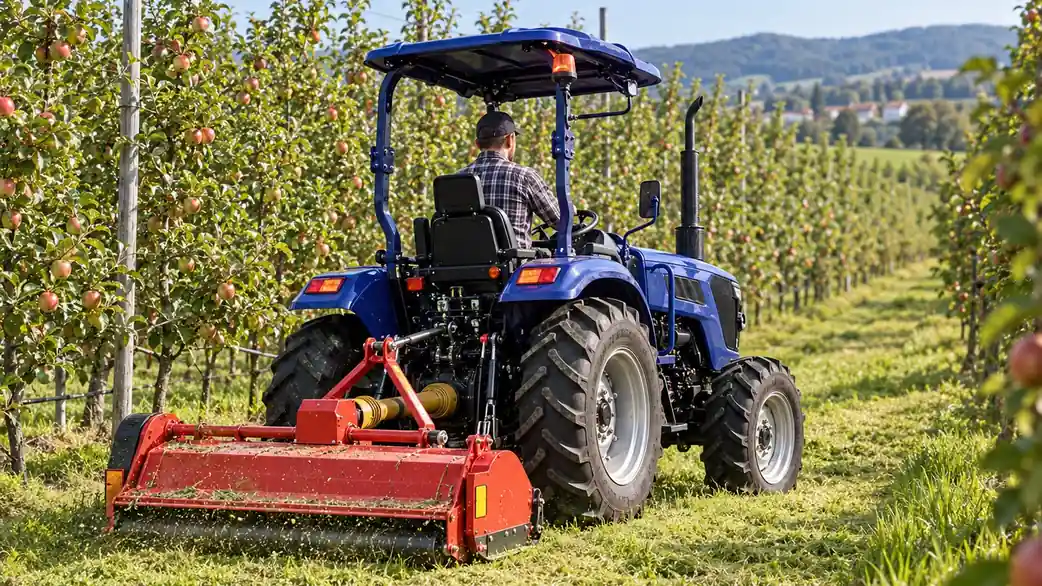
Figure 3. Illustrative compact tractor and mower in an orchard; row clearance, PTO and hitch compatibility must be checked.
The following eight-attachment example supports six tractors, with no assumption that every tractor must ship with an implement:
Customer application | Implement | Quantity |
Compact maintenance | Compact mower | 1 |
Small-farm soil work | Compact rotary tiller | 1 |
Grassland | Compatible mower | 1 |
Mixed-farm cultivation | Rotary tiller | 1 |
Material handling | Model-matched loader kit | 2 |
Livestock handling | Compatible bale fork | 1 |
Larger-field cultivation | Suitable disc harrow | 1 |
Total | Eight illustrative implements | 8 |
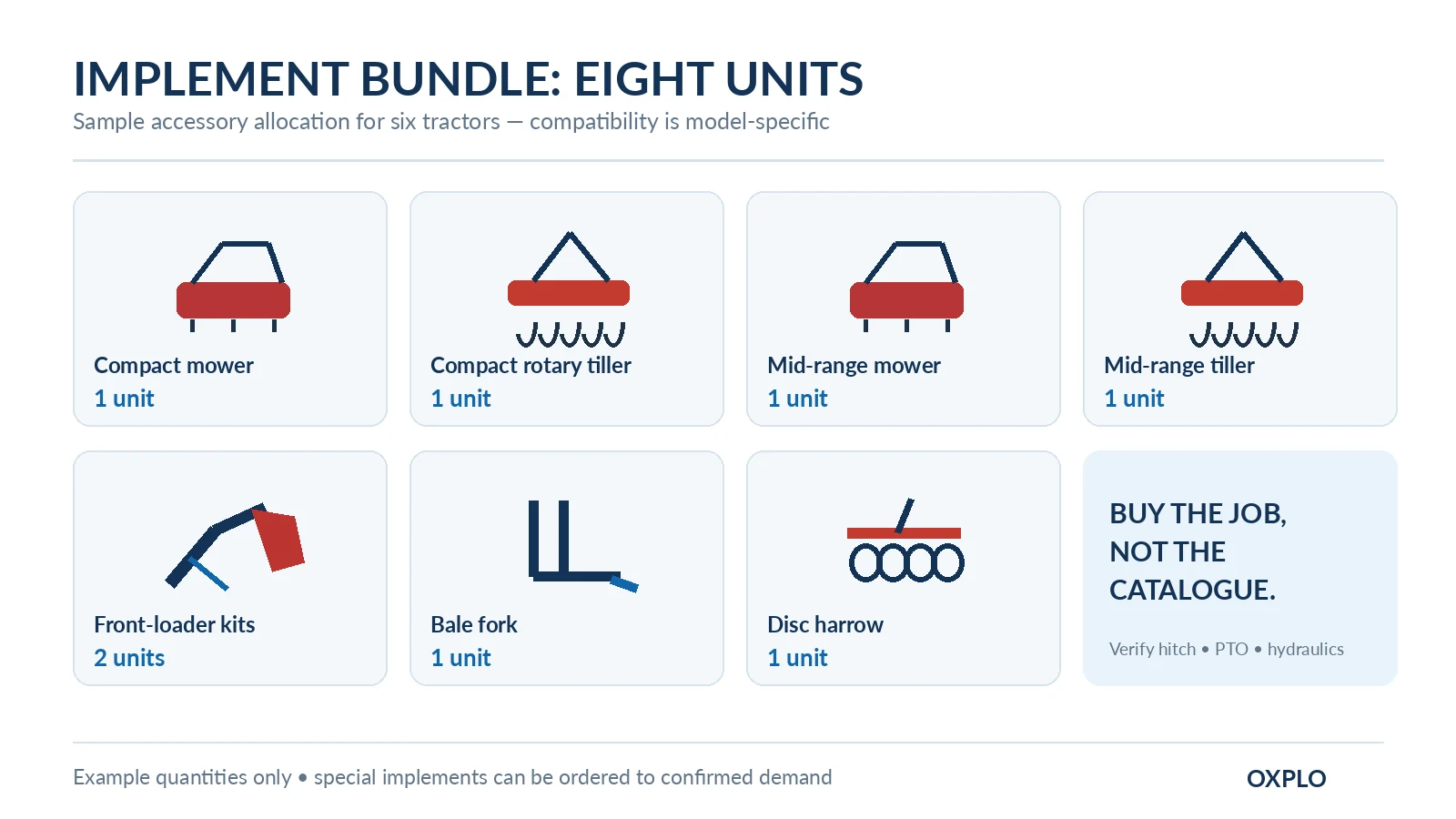
Figure 4. Example eight-unit implement bundle for different applications, subject to matching checks.
This produces 1.33 implements per tractor in the example. The figure is not an industry target. If local customers already have suitable attachments, stocking extra implements may slow cash recovery. If more enquiries are about livestock loading, reallocating spending from tillers to suitable loader packages may be more sensible.
Four technical checks can prevent a return or failed handover
- PTO:Check speed, spline, delivered PTO power, driveline length and the implement manufacturer’s operating range. Engine HP is not PTO HP.
- Three-point hitch:Confirm Category I or II, pin dimensions, geometry, lifting capacity and implement mass; adapters do not guarantee safe compatibility.
- Hydraulics:Verify outlet count, pressure, flow and the functions needed for the attachment.
- Front loader:Check mounting brackets, rated load at the specified position, axle limitations, attachment interface and required counterweight.
A dealer should record the compatibility decision in a tractor–implement worksheet. This reduces the risk of promising “loader ready” or “compatible with existing tools” without verifying the particular machine supplied.
Keep specialist implements on a confirmed-order basis
A practical purchasing policy separates frequently requested implements, a small demonstration set and specialist tools supplied against an identified customer order. This preserves choice without turning the first shipment into a warehouse of slow-moving accessories.
V. Plan Initial Service Parts and European Compliance Together
A missing filter can cost more than the filter itself
A dealer spare parts initial order must support scheduled maintenance and plausible early service work. Otherwise an inexpensive component can immobilise a tractor at a critical seasonal moment while the dealer organises international freight, service travel and customer communication.
For six tractors, a basic calculation might begin with one correctly specified maintenance kit per unit during the relevant service window, plus two additional kits for the configurations expected to accumulate the most hours. That produces eight kits—but not eight identical kits unless the actual engines and parts are common.
Add limited quantities of model-appropriate belts, hoses, seals, electrical components and hydraulic fittings after confirming part numbers and the supplier’s replacement lead times. Keep expensive, uncommon components under an agreed replenishment or warranty process rather than stocking them without evidence of demand.
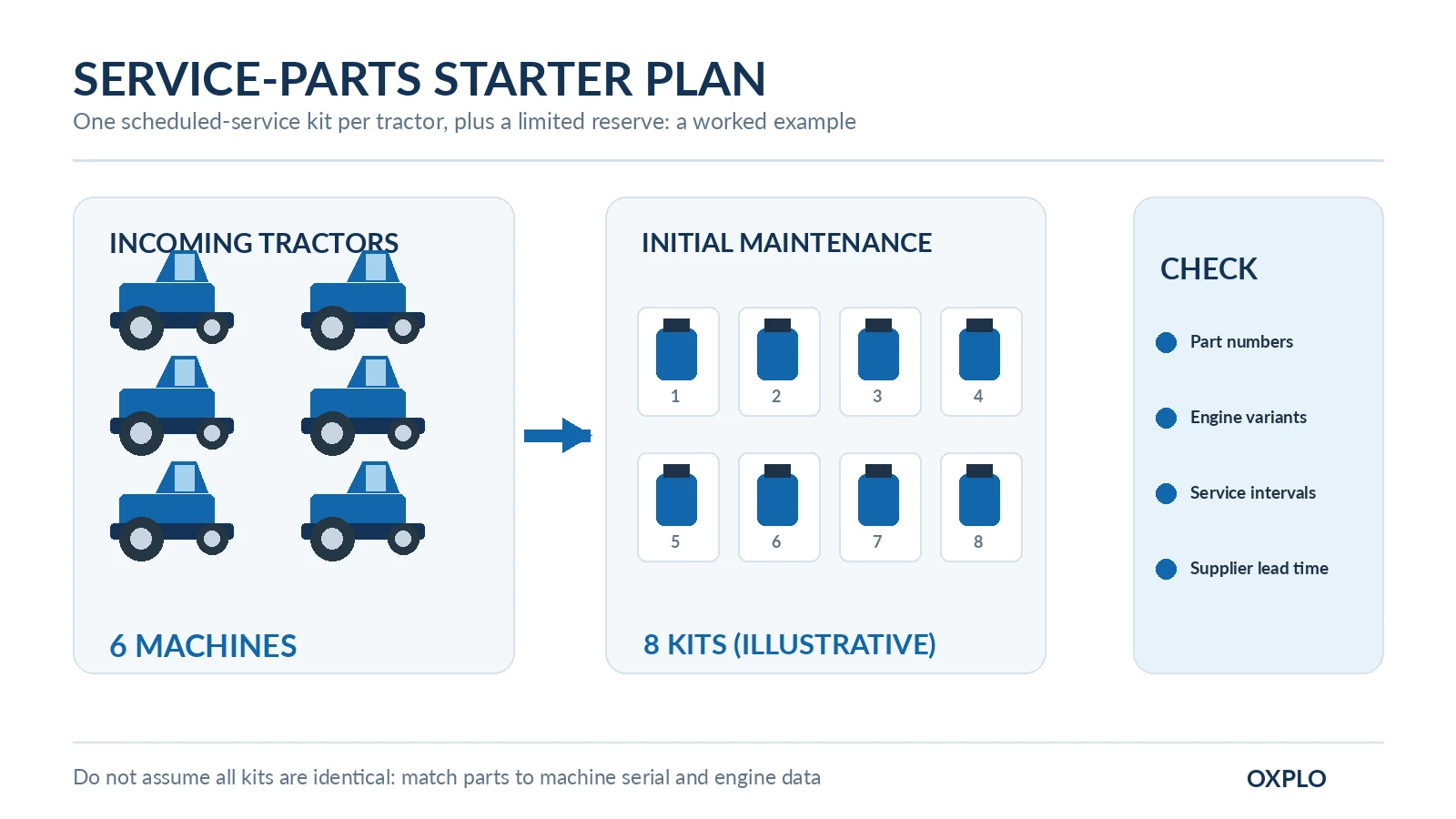
Figure 5. Example first-service preparation: six machine-specific kits plus two reserve kits.
Define a complete service and warranty workflow
Before delivery, the distributor should obtain maintenance schedules, parts diagrams, serial-number identification rules and a technical escalation contact. The warranty process should define photographic evidence, operating-hour records, diagnostic checks, responsibility for parts freight and labour, and the approval required before repairs.
The goal is not to promise instant replacement of every part. It is to make routine support predictable and ensure that a machine can be diagnosed without prolonged back-and-forth with the manufacturer.
EU Stage V, CoC and whole-vehicle approval are not interchangeable
For European business, documentation can determine whether a tractor is commercially saleable. EU Regulation No 167/2013 provides an approval framework for agricultural and forestry vehicles within its scope. Applicable engine-emissions requirements, including those associated with EU Stage V, are a separate technical question.
A vehicle-specific Certificate of Conformity (CoC), where required under the applicable approval route, must correspond to the relevant approved vehicle type and configuration. A generic CE-related document or proof concerning the engine alone is not evidence that every tractor variant can be registered in every destination market.
Before confirming a shipment for road-use customers, match the applicable approval evidence to the exact model, variant, engine, tyres, operator station, lighting, brakes, towing equipment and intended registration jurisdiction. Where information is incomplete, obtain clarification before an irreversible production or freight commitment.
For buyers who need a broader procurement document checklist, the related European tractor dealer trial-order guide covers the technical files and acceptance steps in more detail.
VI. Test Profitability, Cash Exposure and Reorder Timing
Calculate margin on the sale-ready unit, not the factory invoice
A supplier discount is only one input. A realistic sale-ready cost includes purchase price, allocated freight and insurance, duties and handling, inland delivery, pre-delivery inspection and a reasonable allowance for warranty costs. Recoverable VAT, financing expenses and operating overhead should be tracked separately where appropriate.
Illustrative dealer calculation | Amount |
Sale-ready cost per tractor | €14,500 |
Proposed selling price, ex. VAT | €18,000 |
Initial gross contribution | €3,500 |
Initial gross margin | 19.4% |
Price after 10% discount | €16,200 |
Revised cost after extra €250 service expense | €14,750 |
Revised contribution | €1,450 |
Revised margin | 9.0% |
These numbers are illustrative, not OXPLO selling prices, distributor discounts or expected industry margins. They demonstrate how a seemingly modest discount and an unplanned service cost can reduce a dealer’s unit economics sharply.
Use inventory position—not an empty showroom—to trigger replenishment
A useful rule is Reorder point = Demand during replenishment lead time + Safety stock. Suppose a model sells at 0.25 unit per week, confirmed replenishment takes eight weeks, and the dealer wants one unit of buffer. The reorder point is three units of inventory position (0.25 × 8 + 1). Inventory position is on-hand stock plus confirmed incoming units minus backorders.
When a first order includes only three units of that model, the calculation shows why the dealer should clarify repeat-order options before the first shipment arrives. Longer order lead times may justify more safety stock, but speculative inventory should still be weighed against the cost of capital.
A 90-day review should decide the second order
Track unit sell-through, gross contribution by model, stock age, qualified enquiries, attachment take-up, support incidents and parts availability. If four of six tractors sell, the unit sell-through is 66.7%; the next question is which models sold at acceptable margins, not whether four is a superficially encouraging number.
The second order should follow observed demand. A first shipment is a commercial test that produces better evidence than the original forecast.
VII. How a Small European Dealer Can Apply This Framework to OXPLO
OXPLO provides three clearly different stocking positions
The published OXPLO tractor range includes six 4WD models from 25 to 70 HP. For the six-unit example above, a dealer could initially examine the OXPLO OXT254, OXT504 and OXT704 as three different product positions. This is an illustrative shortlist, not an OXPLO starter package, minimum order requirement or confirmed container-loading plan.
OXPLO model | Published configuration | Example units | Best purchasing rationale |
OXT254 | 25 HP; 4WD; Cat. I | 2 | Compact jobs and smaller holdings |
OXT504 | 50 HP; 4WD; Cat. I | 3 | Compact power for mixed-farm duties |
OXT704 | 70 HP; 4WD; Cat. II | 1 | Higher-power utility applications |
The OXPLO OXT254 25 HP compact tractor has a published width of 1,560 mm and a Category I linkage. It is worth evaluating for estate upkeep, mowing and wider-row orchard work. OXPLO buyers should still check gates, row spacing and canopy clearance; “compact” does not automatically mean suitable for every vineyard.
The OXPLO OXT504 50 HP tractor combines higher power with the smaller Category I platform and a listed 8F + 8R transmission. For customers who want more engine output but continue to use suitable Category I implements, this distinction may be commercially useful.
The critical step is comparing that machine with the OXPLO OXT604 60 HP utility tractor. The OXT604 moves to a larger Category II platform and a 12F + 12R transmission. OXPLO dealers should not present the difference as “just another 10 HP”: existing hitch equipment, duty cycle and loader requirements could make the 60 HP model the more appropriate recommendation.
The OXPLO OXT704 70 HP tractor offers a Category II platform for appropriate larger-farm work. For a new distributor, one OXPLO 70 HP demonstration or sale-ready unit may be a better starting position than several uncommitted larger machines, depending on the actual lead pipeline.
Turn the OXPLO range into customer-ready configurations
Through the OXPLO tractor configuration page, dealers can review model selection, available attachment types, PTO matching, hydraulic requirements and other configuration questions. An OXPLO quotation request is more useful when it names the intended job and the existing implements rather than requesting horsepower alone.
- Smallholding package:Evaluate the OXPLO OXT254 with a correctly matched mower or tiller; verify implement power, hitch dimensions and access width.
- Mixed-farm package:Evaluate the OXPLO OXT504 against the customer’s Category I equipment; move to an OXT604-based quote when Category II requirements, hydraulics or heavier workloads justify it.
- Utility package:Evaluate an OXPLO OXT704 with suitable rear implements or an approved loader arrangement, subject to actual lift/load ratings and ballast requirements.
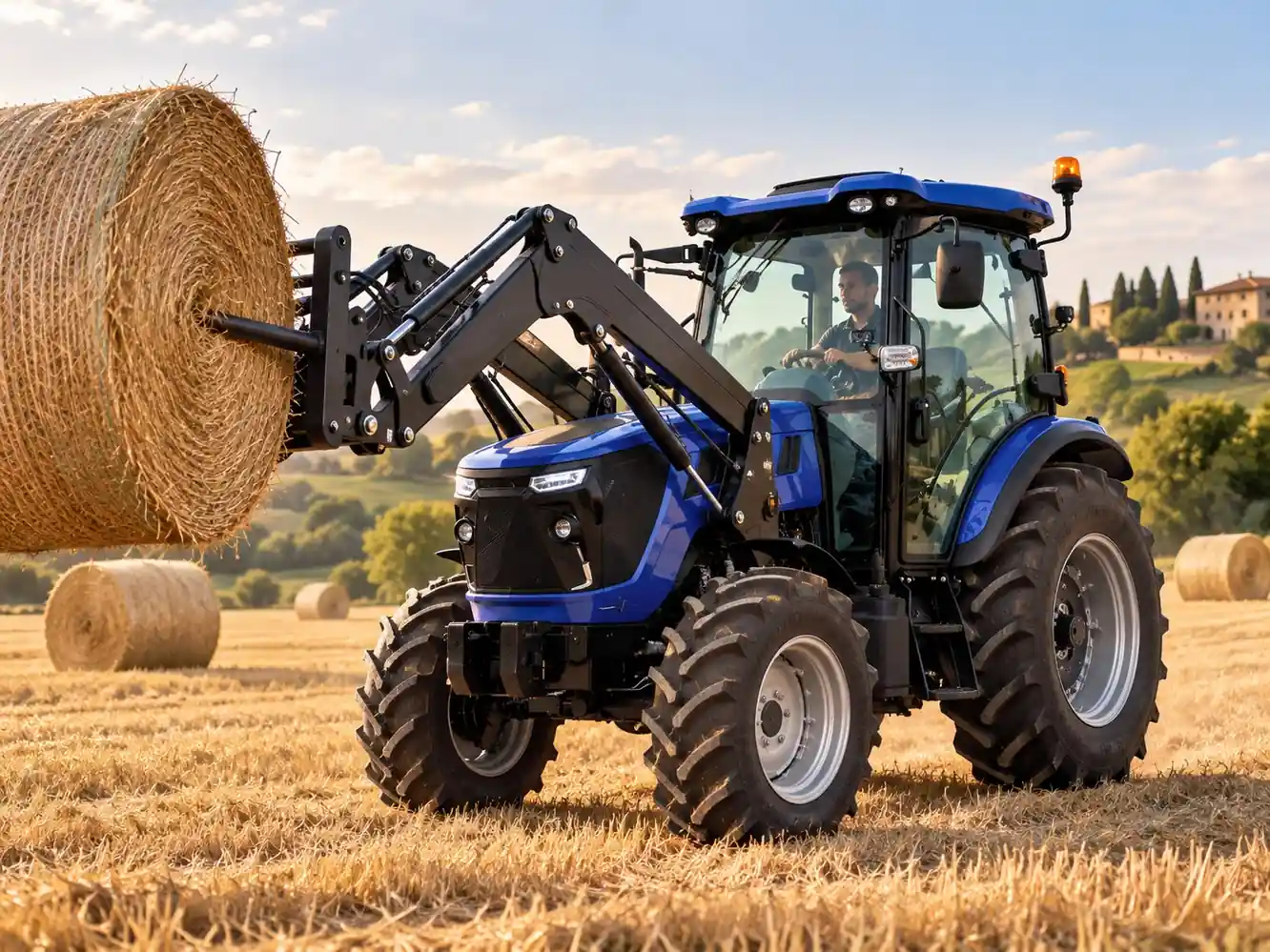
Figure 6. Illustrative cabbed utility tractor handling a round bale; actual loader, fork and ballast specifications must be verified.
The published OXPLO attachments and parts information can support that discussion, but every tractor–implement combination must be confirmed for the supplied variant. This gives a dealer a practical reason to choose an OXPLO configuration without claiming that every attachment is interchangeable.
Make the first quotation include delivery, documents and service
For each OXPLO model, request a final technical specification, model- and destination-specific approval evidence, an equipment-level packing list and a written initial spare-parts proposal. OXPLO describes its shipping and delivery process as dependent on product quantity, destination and agreed terms; this should be converted into an order-specific quotation rather than an assumed transit time.
OXPLO also publishes a warranty policy describing one-year or three-year arrangements subject to applicable terms. The OXPLO dealer agreement should state the agreed period, exclusions, parts freight, workshop labour and claim-handling steps. The OXPLO support hub is a starting point for discussing attachment selection and service support.
A dealer can compare the full OXPLO tractor product range before deciding whether the example quantities really match its local demand. When preparing the first OXPLO purchase enquiry, include the target country, model mix, customer tasks, implement list, expected registration pathway, service-parts needs and desired delivery date.
Frequently Asked Questions
How many tractors should a small distributor order first?
There is no standard quantity. An initial six-unit mix is useful for illustration, but the right distributor first order quantities depend on qualified enquiries, cash limits, lead times, demonstration needs and supplier conditions. A smaller validated trial may be safer than filling a container with speculative stock.
What is the safest tractor dealership starter stock mix?
Start with a limited assortment serving clearly different jobs, then give more quantity to the strongest supported demand category. Check whether buyers require compact Category I tractors or a larger Category II utility platform rather than stocking every horsepower band equally.
Should attachments always ship with tractors?
Only when the package matches verified customer needs. A dealer may stock one or two commonly requested implements, use a demo attachment for sales work and quote specialised equipment against confirmed orders. Tractor horsepower alone does not establish attachment compatibility.
Which service parts are essential in the first shipment?
Start with model-appropriate routine service kits, selected common-service components and agreed emergency replenishment arrangements. Use engine and tractor part numbers—not generic labels—to create the parts order.
Does an EU Stage V engine guarantee road registration?
No. Engine emissions requirements and whole-vehicle approval are separate matters. Check the relevant approval and CoC requirements for the exact configuration and destination before order commitment.
How can a dealer request an OXPLO stock recommendation?
Send OXPLO a brief showing country, qualified demand by power category, available capital, desired models, attachment applications, documentation needs and service expectations. The OXPLO contact page provides the route for a configuration and shipping enquiry.
Conclusion: The Right First Shipment Creates Repeat Sales
The first shipment should not be judged by how many tractors fit in a container or by the discount shown on the invoice. It should be judged by how many machines are technically appropriate, saleable at a sustainable margin and supportable after handover.
For a small European distributor, the strongest process is to validate customer applications, select a narrow model mix, check implement compatibility, budget service parts, verify vehicle documentation and set the reorder trigger before inventory runs low. Those decisions reduce the risk of tying up cash in machines that are difficult to sell.
OXPLO offers 25–70 HP tractor options that dealers can evaluate against these practical requirements. To assess an OXPLO first order, prepare a short stock plan with model quantities, country, intended applications, attachment needs and compliance questions, then discuss the proposed configuration with OXPLO. The aim is not the largest initial purchase; it is a repeatable dealer business with the right equipment available when customers need it.