
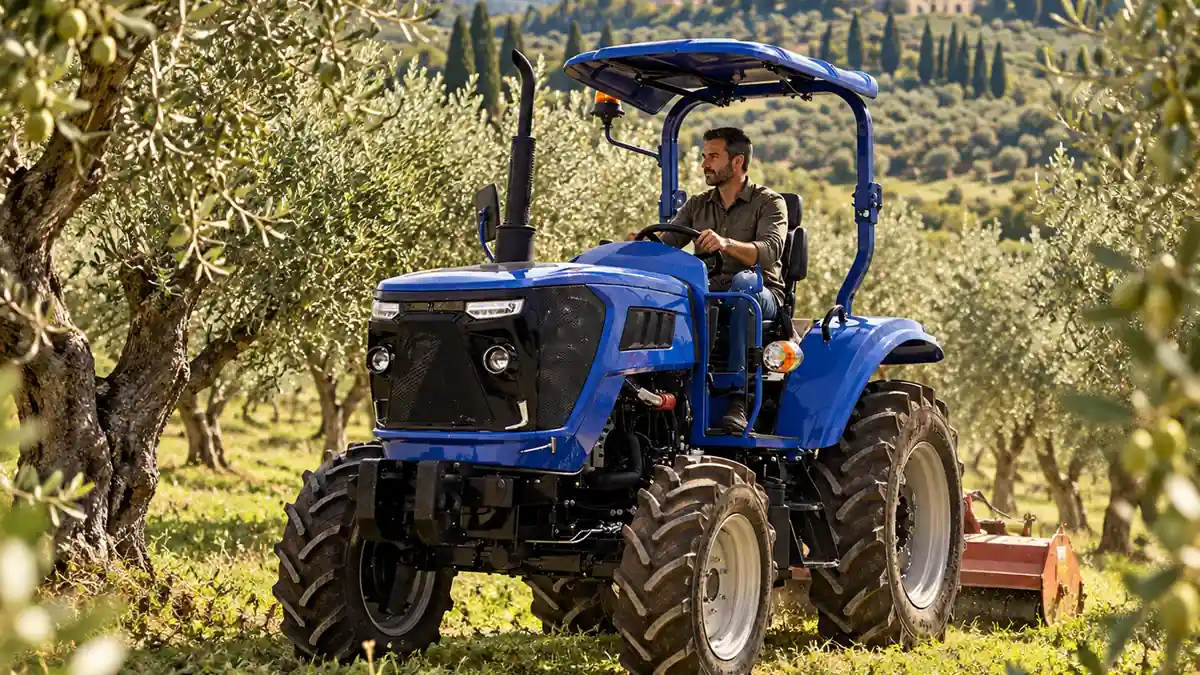
A 50 HP tractor can have enough engine power to drive a mower and still be the wrong machine for an Italian olive grove. If its roof catches low branches, its mower cannot reach the trees, or it cannot turn safely at a terrace boundary, additional horsepower will not recover the lost working time.
For growers in Tuscany, Umbria, Puglia and other olive-producing regions, the buying decision is not simply which tractor has the best specification on paper. It is whether one machine can enter the site, handle the most demanding recurring implement, work safely on the available terrain and reduce the cost of annual orchard maintenance. This guide explains how to select a tractor for olive groves using measurements, implement data and operating costs rather than marketing labels.
I. Start with the Jobs That Cost Italian Olive Growers the Most
Different orchard layouts create different bottlenecks
A traditional hillside grove with mature, irregular trees is a very different workplace from a modern orchard with managed rows. The first may lose hours to reversing, branch clearance and difficult access. The second may be limited mainly by mowing speed, seasonal labour availability and the cost of moving equipment between plots. A contractor serving both farms cannot assume that the same machine will provide the same productivity.
Three questions should shape the first site visit: How much land is actually tractor-accessible? Which work still requires a second operator or handheld machine after the tractor passes? And how many times will the same work be repeated in one year? The answer identifies where machinery investment has a chance to pay back.
The hidden cost is often the second pass
Consider an illustrative orchard that needs 20 hours of tractor mowing followed by 12 hours of strimming around trunks and obstacles. A faster tractor that cuts its own time by 20% saves only four hours; the overall job falls from 32 to 28 hours. A change in mower offset, route planning or tree-zone treatment that reduces supplementary labour can be more valuable than a larger engine.
This is why a compact tractor for olive groves should be assessed as part of a mowing system, not as a standalone machine. Ask where the tractor will actually drive, which strips remain untouched and whether the attachment can safely work near trunks without damaging bark or irrigation lines.
II. Measure Row Width, Canopy Height and Headlands Before Horsepower
Calculate usable width, not planting distance
An olive grove tractor width requirement cannot be derived from row-centre spacing alone. If two tree rows are 4.8 m apart and branches extend 1.1 m inward from each side, the estimated open corridor is 4.8 − 1.1 − 1.1 = 2.6 m. A tractor 1.56 m wide appears to leave 0.52 m on either side, before allowing for tyres under load, slope, branch movement, guards or an offset attachment.
At the narrowest location, repeat the measurement at the height occupied by the tyres, bonnet, operator protection and implements. A trunk-level measurement can be misleading where branches overhang the lane. Record the smallest sustained passage—not the average width across the orchard.
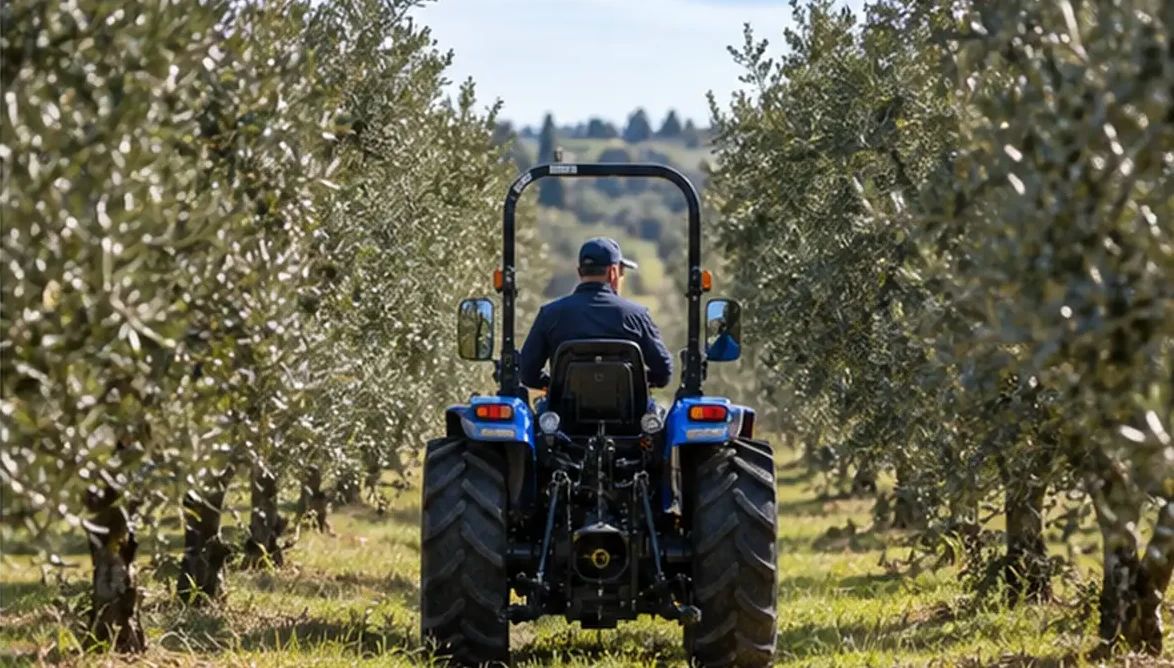
Row clearance: measure the narrowest usable corridor and the lowest canopy along the whole route.
A four-point survey prevents an expensive delivery mistake
Site measurement | What the buyer must record | The decision it affects |
Narrowest working corridor | Clear horizontal width at the machine’s occupied height | Whether tractor and implement can pass |
Lowest unavoidable canopy or obstacle | Height above the running surface, including uneven ground | Operator station, ROPS and exhaust clearance |
Headland and gateway | Available turning envelope, walls, ditches and posts | Whether turns are possible with a mower or trailer |
Tracks and slopes | Surface, ruts, lateral fall, gradients and drop-offs | Travel route, tyres, ballast and safety review |
Imagine another orchard with only 1.40 m of effective corridor and a low canopy. A 1.56 m-wide, 2.60 m-high tractor is not made suitable by choosing a smaller horsepower rating. The sensible options are to reassess pruning without compromising tree management, create a different safe route or use machinery designed for that restricted space.
Never treat folding or removing ROPS as routine clearance management
Tractor row clearance under olive trees also includes roll-over protection. Do not plan normal field work around operating with a protective structure removed or left folded contrary to the manufacturer’s instructions. If the canopy regularly conflicts with a tractor’s protective envelope, select equipment whose certified operating configuration fits the grove. This is particularly important on terraces and slopes, where loss of roll-over protection can have severe consequences.
Check the entire turn, not only the tractor’s wheelbase
A short wheelbase does not guarantee that a rear mower, PTO shaft or loaded trailer will clear a terrace wall. Ask for a trial route or a dimensioned turning assessment that includes the attachment swing and the operator’s sight line. The most restricted headland can dictate the feasible mower width for the whole property.
III. Select the Mower and Verify PTO Power as One System
Four mower types solve different problems
A tractor mower for olive orchards should be chosen according to the vegetation and remaining labour after each pass. Rotary mowers can suit ordinary floor grass; flail mowers may be appropriate for heavier vegetation and suitable prunings within the implement’s rated material size. Offset equipment can reach certain row edges, while purpose-designed inter-tree tools may reduce manual work around trunks. They are not interchangeable, and every type has guarding and terrain limits.
Implement type | Best starting application | What must be checked |
Rotary mower | Relatively even grass between rows | Throw protection, working width, surface stones |
Flail mower | Dense grass and approved small pruning residues | Rated PTO power, flail type, debris limits |
Offset mower | Verges and some canopy-edge strips | Offset reach, hydraulic demand, side loading |
Inter-tree mower | Vegetation near trunks | Obstacle sensing, trunk protection and irrigation |
Avoid purchasing a wider mower solely to reduce the number of passes. In an irregular olive orchard, a 1.4 m implement that runs continuously may finish sooner than a 1.6 m implement that needs repeated lifting and backing. Compare effective hectares per hour, not brochure cutting width.
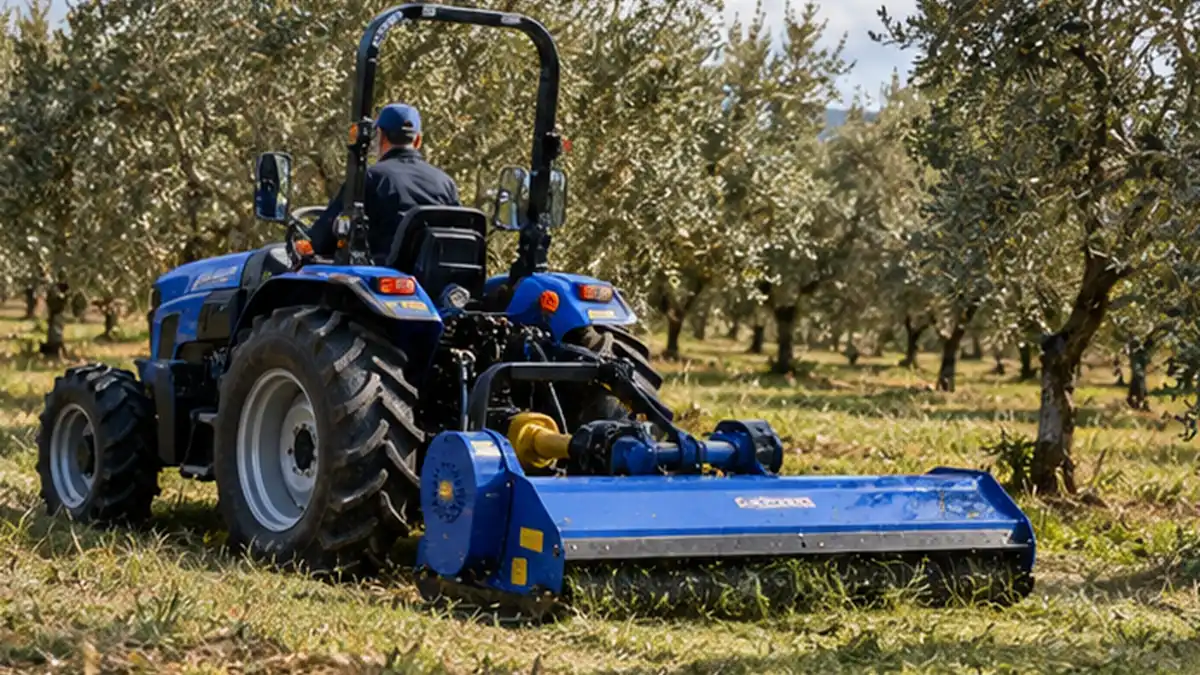
Flail mowing: verify PTO power, implement width and tractor–attachment compatibility.
Engine HP is not the same as PTO HP
PTO-driven mowers require power at the shaft, after driveline losses. For example, if a flail mower specifies 28 HP minimum at the PTO, a tractor rated at 30 HP at the engine cannot automatically be judged compatible. Ask the implement manufacturer for minimum and recommended PTO power under the intended crop load, then obtain the tractor’s confirmed PTO output.
Also verify PTO rpm, shaft spline, implement mass, centre of gravity, three-point linkage category, hydraulic flow and remote valves. A mismatch in any one of these can stop a job even when the engine feels sufficiently powerful. For a deeper explanation of the sizing logic, see this guide to tractor efficiency and usable field power.
Set a realistic operating speed
Long, dense grass, uneven limestone ground, stones and pruned material can require slower travel and more frequent inspections. Do not size the tractor using a mower’s nominal maximum speed. Instead, ask what speed it can sustain while delivering an acceptable cut, maintaining PTO rpm and following the orchard’s safe route. Equipment with only just enough power on an ideal field may be inefficient in a grove with mixed vegetation.
IV. Manage Hillside Traction, Soil Cover and Seasonal Work
4WD improves traction; it does not certify a safe slope
A 4WD tractor for sloping olive groves can improve grip on grass, loose soil and access tracks, but it does not remove the risk of roll-over or loss of braking control. Safe operation depends on the particular machine and its load, tyre choice, track width, ballast, implement geometry, ground condition and the manufacturer’s operating instructions.
Cross-slope mowing can be more demanding than climbing an access track. An offset mower changes side loading; a loaded trailer changes the forces on a descent. Before quoting a tractor for a hillside property, distinguish slopes that can be driven safely from terraces or edges where a different method is necessary. Do not apply a generic maximum slope angle to every configuration.
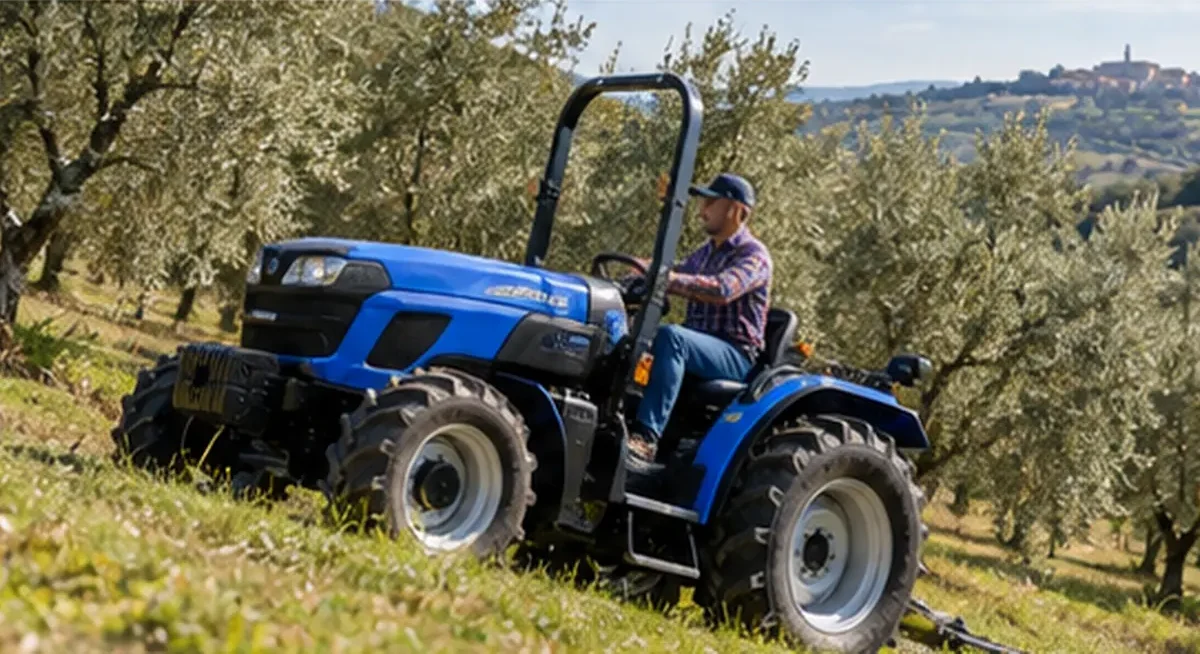
Hillside work: traction, terrain and machine stability must be assessed separately.
Mowing strategy also affects orchard soil
Very short cutting or repeated cultivation is not always the best soil-management choice. On erosion-prone slopes, appropriately managed vegetative cover can help protect the soil surface. On water-limited sites, however, cover vegetation may compete for moisture and need timely mowing. Fire risk, local agronomic guidance and rainfall patterns must be considered. The objective is not the cleanest-looking ground; it is a workable, maintainable orchard floor.
For sections that cannot be safely entered by a conventional tractor, evaluate specialist equipment or professional contract work rather than pushing a compact tractor outside its limits.
Build a seasonal task matrix before buying
Annual task | Equipment question | Hidden cost if overlooked |
Repeated orchard-floor mowing | Can the mower cover the lane and maintain PTO speed? | Extra labour and repeated passes |
Pruning-residue management | Is the residue within the tool’s approved size and load? | Blockages, wear and poor cut quality |
Fertiliser and small-input movement | Are hitch, trailer and braking arrangements suitable? | Manual handling and multiple journeys |
Harvest-season support | Can the route, trailer and unloading point handle the load? | Waiting time and damaged access tracks |
Occasional specialised operations | Is ownership cheaper than hiring a contractor? | Underused equipment and capital tied up |
A useful tractor for olive orchard work is one that completes the frequent jobs reliably. Expensive specialist harvesting or difficult steep-terrain work may be better subcontracted when annual utilisation is low.
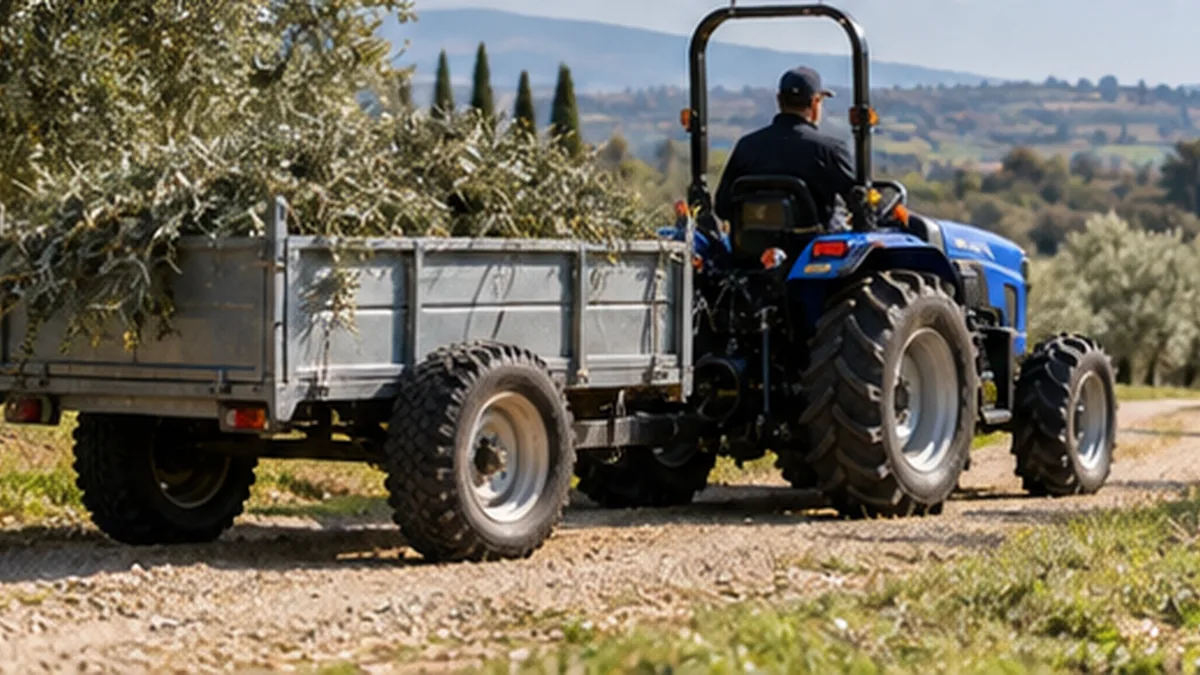
Seasonal operations: transport duties can affect the optimum orchard tractor configuration.
V. Calculate Field Capacity and Total Cost Before Upgrading
A worked example: why operational fit beats advertised speed
Effective field capacity can be estimated with working width (m) × travel speed (km/h) × field efficiency ÷ 10. The efficiency factor accounts for overlap, turning, obstruction avoidance and routine short stops. It should be measured or estimated conservatively for the actual grove.
Assumption for a 12 ha mowing job | Option A | Option B |
Effective working width | 1.4 m | 1.6 m |
Safe average working speed | 4.0 km/h | 4.2 km/h |
Field efficiency, assumed | 65% | 70% |
Effective capacity | 0.364 ha/h | 0.470 ha/h |
Hours for 12 ha | 33.0 h | 25.5 h |
In this illustrative calculation, not an OXPLO field test, Option B saves about 7.5 hours per mowing round. Across three comparable rounds, that is approximately 22.4 hours a year. At a hypothetical combined labour-and-machine time cost of €35/hour, the gross annual time saving is roughly €784.
If the better-performing system costs €3,000 more initially, its simple payback from that one saving is about 3.8 years. But this is not a profit guarantee: extra repairs, fuel, financing, maintenance, site restrictions and differences in residual value can change the result. If Option B cannot physically enter the orchard, its theoretical advantage is irrelevant.
Calculate cost per workable hectare, not only the purchase price
A practical ownership model includes acquisition and delivery, depreciation or financing, fuel, service parts, tyre and mower wear, operator time, downtime and eventual resale value. Divide the annual relevant cost by the actual annual treated hectares across all operations. If the tractor will be used for transport and maintenance as well as mowing, allocate costs sensibly across those tasks.
Buyers comparing a 25 HP and a 50 HP unit should ask whether the extra power solves a recurring bottleneck. If the limiting factor is canopy height or hand-trimming around trunks, paying for more HP may not reduce cost per hectare. The same reasoning appears in this tractor horsepower selection guide.
VI. Match a Proven Tractor Platform to the Orchard’s Actual Constraints
Where the OXPLO 25–50 HP range can be considered
Once a site passes the access and safety screens, the OXPLO tractor range provides 25, 30, 40 and 50 HP options for wider-row orchard maintenance and mixed small-farm work. The currently published OXPLO OXT254, OXT304, OXT404 and OXT504 dimensions are 3,180 × 1,560 × 2,600 mm (L × W × H), with 4WD, an 8F + 8R transmission and a Category I rear linkage.
That common published width is commercially relevant: a buyer can compare more engine output without assuming a wider listed chassis. However, the 2,600 mm published height is an important limitation. These standard configurations must not be marketed as ultra-low orchard tractors for mature trees with restricted canopy clearance. The final operating envelope, tyres, protection structure and attachments still need confirmation.
OXPLO model | Rated engine power | Published PTO speeds | Where to begin evaluating it |
OXT254 | 25 HP | 540 / 1000 rpm | Light regular mowing and compatible small attachments |
OXT304 | 30 HP | 540 / 1000 rpm | Light work needing a modest power increase |
OXT404 | 40 HP | 540 / 1000 rpm | More frequent mixed orchard and PTO work |
OXT504 | 50 HP | 540 / 720 rpm | Higher engine reserve with compatible Category I tools |
For model-specific dimensions and equipment, review the OXPLO OXT254 25 HP tractor, OXPLO OXT304 30 HP tractor, OXPLO OXT404 40 HP tractor and OXPLO OXT504 50 HP tractor. PTO speed differences matter: do not assume that the OXT504 shares the 540/1000 rpm arrangement of the smaller three models.
What OXPLO can help solve—and what it cannot
For a grower with sufficient row and canopy clearance, OXPLO can support selection of a suitable engine-power class, tyre and operator-station configuration and compatible attachments. Through the OXPLO tractor configuration service, buyers can submit mower data so the requested PTO speed, six-spline shaft, Category I linkage, hydraulic requirements and implement weight can be checked against the quoted machine.
This approach helps avoid three common procurement failures: paying for power that is rarely used; discovering too late that an existing mower does not fit; and ordering equipment without agreeing on destination-market specifications. The OXPLO parts and attachment support page is useful when reviewing future service and wearing-part needs. Exact parts availability and delivery commitments should be agreed for each order.
OXPLO cannot solve a 1.40 m lane with a published 1.56 m-wide tractor, and 4WD cannot make unsafe terraces safe. Saying so at the quotation stage is better than selling a machine that creates higher labour and after-sales costs.
One-machine planning for growers and distributors
A small grower may seek one OXPLO tractor for floor mowing, limited input transport and general maintenance. A contractor may prioritise shorter turning and attachment-change times across several clients. An Italian distributor may compare the OXPLO compact models as a 25–50 HP range, with the same published chassis width but different power and PTO choices, rather than stocking only the largest model.
Customers who move harvest bins, supplies or implements between farm areas can also consult the OXPLO agricultural handling application page. Each transport task still needs a separate check of trailer mass, braking, coupling and local road-use requirements. For broader use cases, the OXPLO orchard and vineyard tractor guide provides a starting comparison of power classes.
VII. Confirm Italian Documentation and Send a Useful RFQ
Separate EU vehicle approval from general CE paperwork
For tractors intended for road registration or regulated market placement in Italy, European documentation is not a generic box to tick. Regulation (EU) No 167/2013 establishes an EU agricultural and forestry vehicle type-approval framework; a vehicle Certificate of Conformity (CoC) relates to the approved vehicle type. CE-related documentation for other equipment or components does not automatically substitute for a vehicle CoC. Engine emissions, including applicable Stage V requirements, must also be checked for the actual supplied configuration.
Before purchasing OXPLO machinery for Italy, identify the intended vehicle category, road-use requirement, exact engine and operator-protection package, approved specification and documents available for that model. Never assume that every OXPLO configuration is registered or approved for Italian road use. OXPLO can confirm what documentation is available for the proposed order; buyers and dealers should verify the applicable registration pathway with competent local authorities. The EU regulation text is the authoritative starting point.
Send OXPLO a specification-led request, not just ‘price for 40 HP’
A serious quotation request should include orchard location, minimum usable lane width, lowest canopy height, gateway and headland dimensions, slope and surface photographs, planned annual working hours, the mower’s manufacturer and model, PTO power and speed requirements, hitch and hydraulic details, transport loads and whether Italian registration is required.
That information lets OXPLO identify where further site checks or implement confirmation are needed. It also enables dealers to compare machine quotations on the same delivered specification, including accessories, documentation, pre-shipment inspection, shipping terms, service parts and warranty conditions. See the OXPLO custom tractor and attachment options and company capability overview for the published scope of configuration and export support.
Use a three-gate purchase decision
Gate 1 — Access and safety: Confirm the complete machine-and-implement envelope, safe routes and turning space. Gate 2 — Work capability: Confirm real PTO output, mower load, hydraulics, linkage, tyre and trailer requirements. Gate 3 — Commercial readiness: Confirm the agreed model configuration, Italian documentation, total delivered cost, parts plan and after-sales terms. If any gate fails, revise the proposed configuration before placing the order.
VIII. Frequently Asked Questions
What HP tractor is suitable for olive groves in Italy?
There is no universal horsepower requirement. A 25–30 HP class tractor may be worth evaluating for lighter mowing and seasonal upkeep where access permits. A 40–50 HP class can make sense where compatible implements need more power or operating hours are greater. OXPLO recommends starting from the most demanding recurring implement rather than from orchard area alone.
Is a compact tractor for olive groves always narrow enough?
No. A ‘compact’ label does not certify canopy or row clearance. The published OXPLO OXT254–OXT504 width is 1,560 mm and height is 2,600 mm; these configurations suit only sites where the full working envelope fits. A narrow historic grove may require dedicated low-profile machinery instead.
Can an OXPLO tractor operate my existing flail mower?
Potentially, but only after technical checks. Send OXPLO the mower model, rated PTO horsepower, required rpm, shaft, hitch category, mass and hydraulic needs. Do not equate engine HP with PTO HP or assume all OXPLO models have the same PTO speed configuration.
Is 4WD enough for hillside olive orchards?
No. OXPLO 4WD models can offer traction advantages under suitable conditions, but a slope’s safety depends on track, centre of gravity, tyres, ballast, attachment load, soil and manufacturer limits. Dangerous terraces or cross-slopes may call for specialist alternatives or contracted work.
Can one tractor cover mowing and harvest support?
It may cover compatible floor care, light hauling and everyday maintenance, provided loads and equipment are within the machine’s limits. Specialist olive harvesting machinery requires its own interface and capacity review. OXPLO can evaluate a proposed tractor-and-attachment combination but should not be assumed compatible with every harvesting system.
Which documents should an Italian OXPLO dealer request?
Request the confirmed model and engine specification, relevant emissions and protection information, applicable vehicle approval or CoC status, road equipment details, parts and warranty terms, and shipment documents. If the tractor must be registered in Italy, resolve the approval path before paying a deposit. Buyers can start an application-based enquiry through the OXPLO website.
IX. Conclusion: Match the Grove, the Mower and the Annual Workload
A successful tractor for olive groves is not the model with the largest engine or the most attractive headline price. It is the machine that fits the narrowest route, can work safely with the intended implements and delivers an acceptable cost per workable hectare across the year.
For suitable wider-row Italian orchards, the OXPLO 25–50 HP 4WD series offers several engine-power choices within the same published 1,560 mm chassis width, alongside attachment selection and configuration support. For very low canopies or unsafe terraces, OXPLO’s standard compact tractor dimensions may rule those models out—and that is useful information to establish before purchase.
To obtain a meaningful recommendation, send OXPLO your row and canopy measurements, a few site photographs, annual jobs, mower specifications, destination in Italy and registration requirement. The result should be a technically checkable configuration and quotation, not simply a tractor price. Explore the OXPLO tractor catalogue to compare the available power classes.