
A technical guide to tractor efficiency, tractor performance, traction, horsepower and field productivity
A tractor can have more horsepower and still finish less work per day. It can burn fewer litres per hour and still cost more per hectare. It can also feel powerful at the engine while wasting a large share of that power through wheel slip, poor gearing, excessive ballast or an implement that is badly matched to the chassis.
That is why tractor efficiency should not be treated as a single specification. A more useful engineering definition is this: tractor efficiency is the amount of useful field output produced from a given combination of fuel, time, machine capacity and ownership cost.
For a farm manager, contractor or equipment buyer, the objective is therefore not to buy the highest tractor horsepower available. The objective is to build a tractor-and-implement system that can complete the required work at the right speed, within the available weather window, while controlling fuel use, labour hours, wear and total cost of ownership (TCO).
The practical chain is simple to describe, but difficult to optimize in the field:
Engine Power -> Transmission -> Tyres & Traction -> Implement -> Field Speed -> Productive Output
When any link in that chain becomes the bottleneck, extra engine power may deliver little or no improvement. The rest of this guide explains how to identify that bottleneck before spending money on a larger tractor.
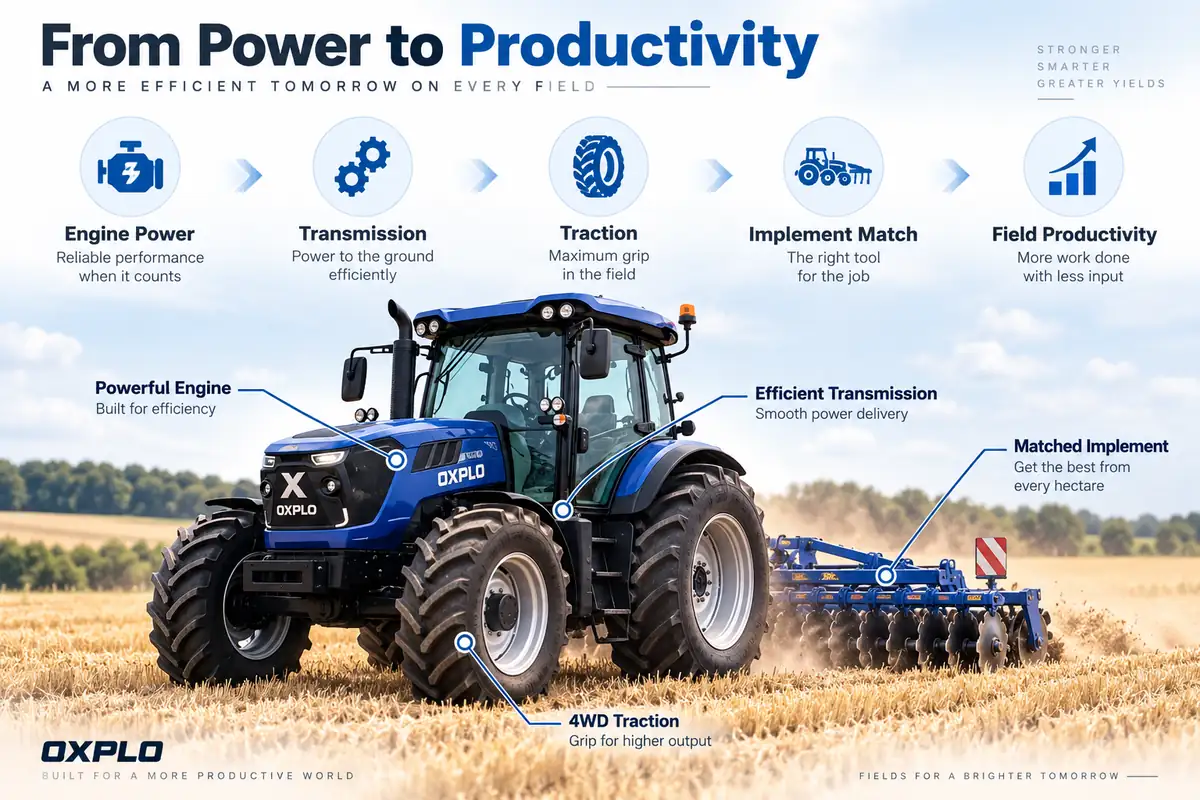
Tractor efficiency is a system: engine power, transmission, traction, implement matching and field productivity.
I. Why Tractor Efficiency Is Often Misunderstood
Horsepower Is Capacity, Not Productivity
Rated engine horsepower describes potential output at the engine. It does not tell you how much useful power reaches the PTO, the drawbar or the ground. Nor does it tell you whether the tractor can maintain the correct implement speed when soil resistance increases, whether tyres can transfer torque without excessive slip, or whether the operator loses too much time on headland turns.
This is the first purchasing trap. Buyers compare two tractors by horsepower because horsepower is easy to compare. Field productivity is harder. It depends on the tractor, implement, soil, field geometry, operator and task working together.
Five Layers of Farm Tractor Efficiency
- Engine efficiency: how effectively fuel is converted into mechanical output.
- Powertrain efficiency: how much engine output survives transmission and driveline losses.
- Traction efficiency: how effectively axle torque becomes forward motion instead of tyre spin.
- Implement efficiency: whether the tractor provides the right PTO, drawbar, hydraulic and hitch capacity for the task.
- Field efficiency: how much theoretical capacity becomes completed hectares after turns, overlap, adjustments, loading and delays are included.
A tractor can be strong in one layer and weak in another. This is why a brochure number alone cannot describe farm tractor efficiency.
II. Where Tractor Power Is Actually Lost
Engine Power Is Only the Starting Point
Agricultural work consumes power through different outlets. PTO-driven equipment such as rotary mowers and tillers depends on stable PTO performance. Tillage and trailer work can be constrained by drawbar power and traction. Loader work adds hydraulic flow, pressure, cycle time and machine stability to the equation.
This distinction is not academic. The Nebraska Tractor Test Laboratory evaluates tractor performance through separate procedures such as PTO, hydraulic and drawbar testing because those outputs describe different working capabilities. A tractor that is adequate for one power path may be poorly suited to another.
Technical reference: Nebraska Tractor Test Laboratory
Transmission Ratios Can Limit Tractor Performance
Consider an implement that works best at approximately 5.5 km/h. If one gear gives 4.3 km/h and the next gives 6.5 km/h, the operator has to choose between low productivity and an overloaded drivetrain or poor work quality. A useful gearbox is not simply one with many ratios; it is one that provides usable ratios around the speeds required by the farm’s recurring jobs.
Part-load operation matters as well. When drawbar demand is light, running a low gear at high engine speed can waste fuel. Extension guidance commonly recommends selecting a higher gear and reducing throttle where the task allows it, provided PTO requirements and safe operating conditions are maintained.
Power Reserve Has Value – But Only When It Is Used
A tractor should not operate at its limit every hour. Some reserve helps the machine absorb harder soil, steeper sections, heavier material and seasonal variation without constant downshifting. But excessive reserve is expensive because the farm pays for engine capacity, chassis mass and ownership cost that may remain unused.
The engineering target is not maximum horsepower. It is sufficient continuous capacity plus a sensible reserve for the farm’s difficult conditions.
III. Why Tractor Traction Determines Real Field Performance
Wheel Slip Is a Diagnostic Signal
Some wheel slip is necessary because agricultural tyres must deform and shear the soil slightly to produce tractive force. Excessive slip, however, converts engine output into tyre rotation rather than forward movement. The engine is still consuming fuel, but field speed falls and fuel per hectare rises.
Penn State Extension notes that excessive wheel slip wastes energy, while too little slip can indicate that the tractor is carrying more ballast than necessary. Practical targets vary by operation, tyre and soil, so the correct figure should be checked against the tractor and tyre manufacturer’s recommendations rather than treated as a universal number.
Technical reference: Penn State Extension – tractor wheel slip and energy use
A Fast Power-Limited vs Traction-Limited Test
- Engine speed remains stable but tyres spin heavily: the system is likely traction-limited.
- Tyres maintain grip but engine speed drops sharply under load: the system is more likely power-limited or incorrectly geared.
- Engine and traction both look acceptable but hectares per hour remain low: investigate implement width, turning time, overlap and workflow.
This three-step diagnosis prevents one of the most expensive mistakes in tractor purchasing: solving a traction problem by buying more horsepower.
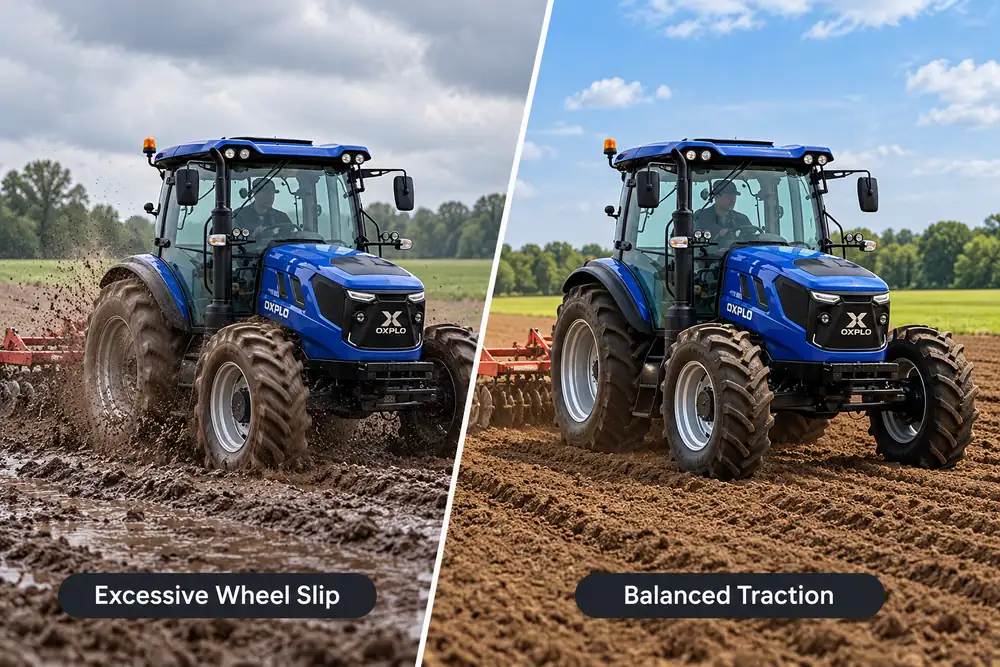
Wheel slip diagnosis: excessive slip wastes available power, while balanced traction turns axle torque into forward motion.
Ballast Is a Trade-off, Not a Cure-All
Too little ballast can increase slip and reduce stability. Too much ballast increases rolling resistance, tyre loading, fuel demand and soil compaction. More weight may improve traction today while increasing future tillage resistance or damaging soil structure tomorrow. That is a real operating trade-off, especially on wet ground.
Tyre Pressure and 4WD Are Part of the Powertrain
Tyre inflation changes the size and shape of the contact patch. Correct pressure can improve traction and reduce unnecessary soil loading, while incorrect pressure can make an otherwise adequate tractor feel weak. Four-wheel drive does not create horsepower, but it can improve the percentage of available power that becomes useful pull on loose soil, slopes, wet grass and mixed farm surfaces.
IV. Match Tractor Horsepower to the Work, Not the Marketing Number
PTO-Limited Work
For mowers, rotary tillers, balers and other PTO-driven equipment, the key questions are continuous PTO demand, required PTO speed and the ability to hold that speed under real crop or soil load. A tractor may have sufficient rated horsepower but still be a poor match if the implement pushes the engine near maximum load throughout the job.
Drawbar-Limited Work
Ploughing, discing and other draft-intensive work depend on usable drawbar pull. Chassis weight, tyres, ballast and soil condition may matter as much as engine rating. If the tractor spins before the engine reaches its useful load range, the bottleneck is not simply horsepower.
Hydraulic-Limited Work
Loader productivity is often misdiagnosed as an engine-power issue. Slow lift or dump cycles may instead reflect hydraulic flow, pressure, valve characteristics, loader geometry or the need to maintain safe ballast and axle loading. Always evaluate loader work as a hydraulic-and-stability problem, not only an HP problem.
Implement Size Must Match More Than HP
Before buying, record the implement’s working width, weight, PTO requirement, PTO speed, hitch category, hydraulic demand and preferred working speed. Then check whether the tractor can carry, power and control the implement safely. A technically attachable implement is not automatically a productive match.
Undersizing usually appears as constant full-load operation, frequent downshifts, poor working speed and little reserve. Oversizing appears more quietly: higher purchase cost, unnecessary weight, larger turning space, more compaction risk and capacity that is rarely used.
V. How to Measure Tractor Productivity Correctly
Start with Effective Field Capacity
Theoretical capacity assumes that the full implement width is used continuously. Real fields include turns, overlap, adjustments, transport between passes and other delays. Iowa State University machinery guidance therefore distinguishes theoretical capacity from effective field capacity.
Effective Capacity (ha/h) = Working Width (m) x Speed (km/h) x Field Efficiency / 10
Example: a 1.8 m implement operating at 6 km/h with 75% field efficiency produces approximately 0.81 ha/h. If a higher-horsepower tractor uses the same implement at the same speed and does not reduce delays, additional horsepower does not increase hectares per hour.
Technical reference: Iowa State University – Estimating the Field Capacity of Farm Machines
Measure Fuel per Hectare, Not Only Fuel per Hour
Hourly fuel consumption can create the wrong conclusion. Assume Tractor A uses 6 L/h and completes 0.65 ha/h, while Tractor B uses 7 L/h and completes 0.90 ha/h. Tractor A uses about 9.23 L/ha. Tractor B uses about 7.78 L/ha. In this simplified example, the tractor with higher hourly fuel consumption uses roughly 16% less fuel per hectare because it completes more useful work in the same time.
Fuel Intensity (L/ha) = Fuel Use (L/h) / Effective Capacity (ha/h)
Add Labour and Ownership Cost
Operating Cost per Hectare = Fuel + Labour + Wear + Maintenance + Depreciation + Financing + Downtime
This is the business metric that matters. A low fuel rate does not compensate for poor field capacity if the operator, tractor and implement spend substantially more hours completing the same area.
Do Not Ignore the Weather Window
Field capacity has a risk-management value as well as a cost value. If one tractor-and-implement combination completes 8 ha/day and another completes 11 ha/day, the difference becomes critical when rain is forecast and only two workable days remain. Missing a tillage, planting or forage window can create costs far beyond the fuel bill.
This is why tractor productivity should be sized against the hectares that must be completed inside the available field days, not simply against an annual average workload.
VI. Common Tractor Efficiency Problems and How to Diagnose Them
The quickest way to improve a tractor system is to identify the limiting variable before changing equipment. The following table turns common field symptoms into a diagnostic sequence.
Field Symptom | Likely Cause | Common Wrong Response | Better Check |
High engine RPM, low ground speed | Excessive wheel slip | Buy more HP | Tyre pressure, ballast, soil condition, 4WD |
Engine bogs under load, tyres still grip | Power shortage or wrong gear | Add more ballast | Gear ratio, working depth, implement size, HP reserve |
High fuel per hectare | Low effective field capacity | Focus only on L/h | Speed, width, overlap, turning and idle time |
Slow loader cycles | Hydraulic limitation | Move to a larger engine only | Hydraulic flow, pressure, valve and loader geometry |
Good pull but slow total job time | Workflow limitation | Replace the tractor | Field layout, headlands, transport, loading and adjustment delays |
Low slip but high fuel use | Possible over-ballasting | Add more weight for security | Ballast, tyre load, rolling resistance and soil compaction |
VII. A 10-Minute Tractor Efficiency Audit
Before changing tractors, tyre sizes or ballast, record one representative pass in the field. A short data log is often enough to show where the system is losing output.
Record | Why It Matters | What to Look For |
Engine RPM and selected gear | Shows engine loading and speed strategy | Constant full-load operation or unnecessary high RPM |
Theoretical vs actual ground speed | Allows wheel-slip estimate | Large speed loss under load |
Implement width and working depth | Defines the real load on the tractor | Oversized implement or excessive depth |
Completed area and field time | Measures actual tractor productivity | Low ha/h despite adequate power |
Fuel used | Connects energy input to useful output | High L/ha rather than merely high L/h |
Turning, idle and adjustment time | Identifies workflow loss | Excessive non-working minutes per hour |
Soil and slope conditions | Explains variation between fields | Traction problem only in wet or steep areas |
Do not change tractor horsepower until this audit tells you which variable is limiting output. That one discipline prevents many expensive specification changes that do not address the real problem.
VIII. Matching OXPLO 25-70 HP Tractors to Real Workloads
Once the workload has been diagnosed, horsepower becomes easier to select. OXPLO currently organizes its farm tractor range from 25 HP to 70 HP, covering compact Category I machines through larger Category II utility platforms. The important point is that OXPLO models should be selected by operating bottleneck and implement system, not simply by moving up the horsepower list.
See the full OXPLO 25-70 HP tractor and attachment range for model and application guidance.
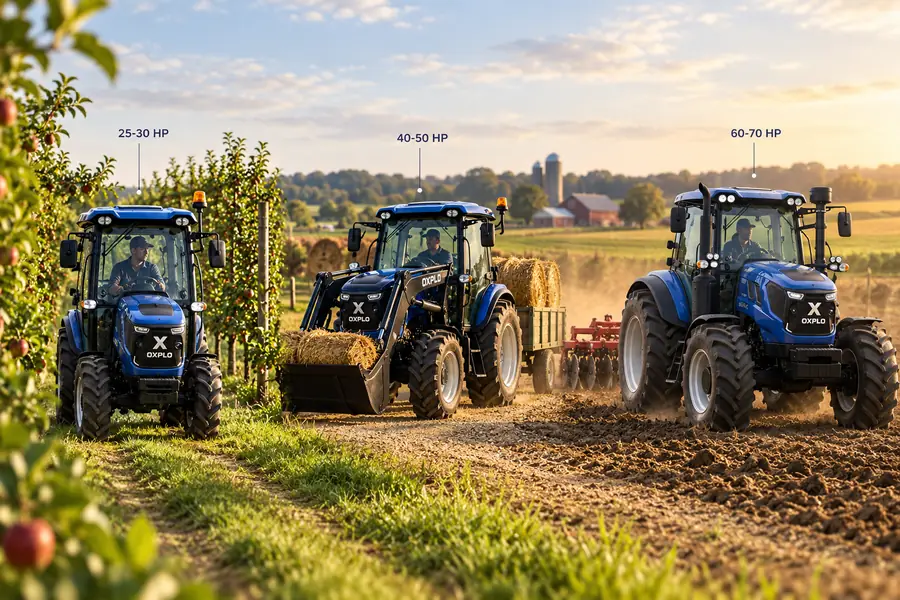
OXPLO 25-70 HP tractor classes should be matched to access, implement demand, traction requirements and recurring workload.
When Compact Access Matters: OXPLO OXT254 and OXT304
For orchards, estates, paddocks, grounds maintenance and other work where turning space and access are major constraints, OXPLO’s compact 25-30 HP models prioritize manoeuvrability rather than heavy draft capacity. The OXT254 is rated at 25 HP and the OXT304 at 30 HP; both are currently listed with 4WD, an 8F + 8R transmission and Category I rear linkage.
Model links: OXPLO OXT254 25 HP tractor | OXPLO OXT304 30 HP tractor
The efficiency question in this class is usually not “How much more horsepower can I buy?” It is “Can I complete mowing, light cultivation and transport without giving up the access advantages that make a compact tractor productive?” OXPLO buyers should therefore measure gate width, row spacing, headland space and implement dimensions before focusing on engine output.
When More PTO Reserve Matters: OXPLO OXT404 and OXT504
The OXPLO OXT404 and OXT504 occupy the 40-50 HP compact utility range. The OXT404 is rated at 40 HP and the OXT504 at 50 HP. OXPLO currently lists both with 4WD, an 8F + 8R transmission and Category I linkage, making them relevant where mixed-farm work, mowing, soil preparation, transport and more frequent PTO use need additional power without immediately moving to the larger Category II chassis.
Model links: OXPLO OXT404 40 HP tractor | OXPLO OXT504 50 HP tractor
For an OXPLO buyer, the useful decision here is whether the farm is power-limited on a compact chassis or whether it has actually outgrown the compact implement platform. If existing Category I implements, access limits and light-to-medium workloads remain the governing constraints, more compact-platform power may be more efficient than simply stepping into a heavier machine.
When Traction and Implement Capacity Become the Bottleneck: OXPLO OXT604 and OXT704
The move from 50 HP into OXPLO’s 60-70 HP range is more than an engine upgrade. The OXT604 and OXT704 are currently listed with 12F + 12R transmissions and Category II rear linkage. The OXT604 product page also lists a 2,010 mm wheelbase, 2,500 kg weight and larger tyre package, illustrating a broader shift in chassis and implement capability.
Model links: OXPLO OXT604 60 HP utility tractor | OXPLO OXT704 70 HP farm tractor
This is a critical buyer insight: moving from a 50 HP tractor to a 60-70 HP tractor can mean moving into a different working platform with different mass, tyres, transmission ratios, hitch category and implement compatibility. For heavier cultivation, larger implements, demanding transport or longer annual workloads, that platform change may create more productivity than horsepower alone.
IX. How to Evaluate an OXPLO Tractor Before Ordering
A productive OXPLO configuration should be built from the job backward. Before requesting a quotation, prepare a short operating profile so OXPLO can evaluate the tractor, attachments and destination-market configuration as one system.
1. Define the Recurring Workload
List the three jobs that consume the most hours each year. Do not size an OXPLO tractor around a rare task while ignoring mowing, transport, cultivation or loader work that happens every week.
2. Define the Largest and Most Demanding Implement
Provide working width, weight, PTO speed, PTO power demand, hitch category, hydraulic demand and expected field speed. OXPLO can then confirm whether the proposed tractor class is compatible instead of relying on horsepower alone.
3. Describe Soil, Slope and Seasonal Conditions
Tell OXPLO whether the tractor will work on dry loam, wet clay, grassland, sloping access tracks or mixed surfaces. This affects the value of 4WD, tyre selection, ballast and the size of the traction reserve required.
4. Confirm Access and Transport Restrictions
Provide gate width, row spacing, building height, turning space and any road-transport constraints. OXPLO compact tractors may deliver higher practical efficiency than a larger model where access is the dominant operational limit.
5. Confirm the Destination-Market Configuration
For international orders, confirm the exact engine configuration, tyres, lighting, braking, operator-protection equipment, attachments and model-specific documents required for the destination country before production or shipment. OXPLO’s tractor-selection page states that configuration and available model-specific documentation should be confirmed before ordering.
Start with the OXPLO tractor selection page or visit the OXPLO website to review the current range.
X. Frequently Asked Questions
What is tractor efficiency?
Tractor efficiency is the ability of a tractor-and-implement system to convert fuel, machine capacity and operator time into useful field output. In practice, it should be evaluated with metrics such as hectares per hour, fuel per hectare, labour per hectare and total operating cost rather than engine horsepower alone.
Does more tractor horsepower always improve productivity?
No. More tractor horsepower improves productivity only when power is the limiting factor and the additional capacity can be converted into higher sustainable speed, wider implements, greater working depth or fewer delays. If traction, field geometry or implement width is the bottleneck, additional horsepower may provide little benefit.
How do I know whether a tractor is traction-limited?
If the engine holds speed while the tyres spin and actual ground speed falls, the tractor is likely traction-limited. Check tyre pressure, ballast, soil condition and 4WD before assuming the tractor needs more engine power.
Is a heavier tractor always better for traction?
No. Additional mass can improve traction up to a point, but over-ballasting increases rolling resistance, tyre loading, fuel use and soil compaction. Weight should solve a defined traction or stability problem, not be added automatically.
How should I compare OXPLO 50 HP and 60 HP tractors?
Do not compare only the 10 HP difference. The OXPLO OXT504 is positioned on the compact Category I platform, while the OXPLO OXT604 moves to a larger Category II platform with a 12F + 12R transmission and a larger published chassis. Compare implement category, tyre and traction needs, access, workload and working speed before deciding.
Which OXPLO tractor range is suitable for compact farms?
OXPLO currently offers 25-50 HP compact models for a range of orchard, small-farm, mowing and mixed utility work, while OXPLO OXT604 and OXT704 provide larger 60-70 HP Category II platforms for more demanding operations. The correct choice depends on implements, terrain, annual hours and access rather than farm size alone.
XI. Conclusion: Buy Productive Capacity, Not Horsepower
Efficient tractors do not simply produce power. They convert power into completed work with as little avoidable loss as possible.
That means tractor efficiency depends on the complete system: engine output, transmission ratios, tyre pressure, ballast, 4WD traction, implement matching, field speed, headland losses, operator workflow and the number of workable days available.
A tractor with lower hourly fuel use can still be more expensive per hectare. A heavier tractor can create more traction but also more compaction. A higher-horsepower tractor can deliver more capacity, but only when the farm has an implement, field and workload that can use it. These trade-offs are why tractor performance should be measured in productive output and TCO, not in horsepower alone.
OXPLO’s 25-70 HP tractor range gives buyers several platform choices, from compact Category I tractors to larger Category II utility models. The strongest OXPLO selection process therefore starts with the application: recurring jobs, implements, terrain, access, annual workload and destination-country requirements. Once those variables are known, OXPLO can be evaluated as a working system rather than as a horsepower number.
To review current models, visit OXPLO Tractor Solutions or the main OXPLO website. For a model recommendation, prepare your farm type, main implements, soil and slope conditions, required PTO or loader work, and destination country before contacting OXPLO.