
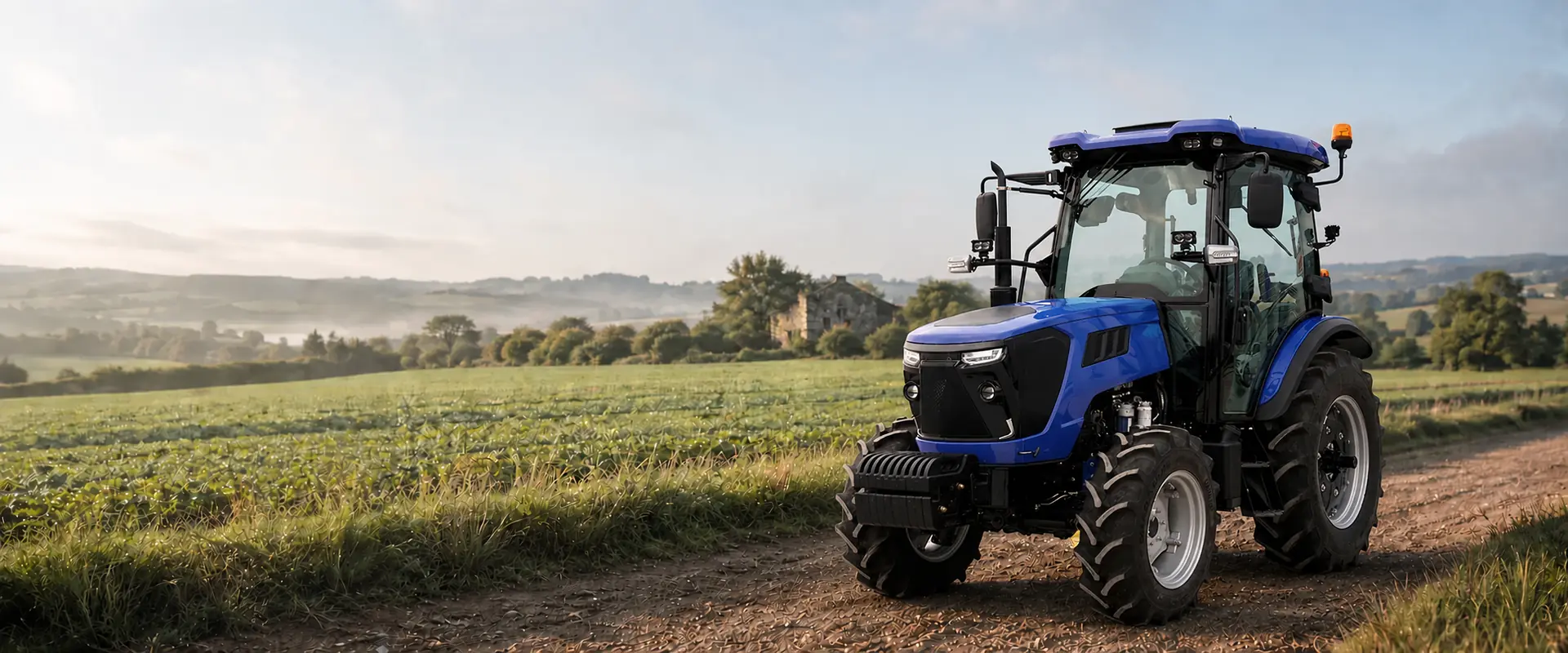
How to match engine output, PTO demand, traction, hydraulic capacity and field deadlines
When buyers ask, “How much horsepower does my farm need?”, they are usually asking the wrong first question.
Tractor horsepower is only the starting point. It describes an engine’s rated output, but it does not tell you whether the tractor can hold PTO speed in heavy material, transfer power to the ground on wet soil, lift a mounted implement safely, or finish a seasonal job inside the available weather window.
Undersizing creates obvious production problems: slow field speed, excessive wheel slip, frequent downshifting and long hours near full engine load. Oversizing is quieter but can be equally expensive. The buyer pays for capacity that may rarely be used, while accepting higher weight, a larger turning envelope, more soil compaction and higher ownership cost.
The sound approach is to work backward from the job system: implement, soil, terrain, field capacity, access limits and annual utilization. Only after those variables are clear should a buyer decide whether a 25 hp tractor, 40 hp tractor, 50 hp tractor or 70 hp tractor is the appropriate platform.
I. Why the Wrong Tractor Horsepower Becomes a Long-Term Cost
A mismatched tractor rarely looks wrong on delivery day. The machine starts, the implement attaches and the first demonstration may appear acceptable. The failure usually becomes visible only after several hours of continuous work, when soil conditions change or when the operator must meet a real deadline.
Consider a rotary tiller that can technically turn behind a small tractor. On dry, previously worked soil, the combination may operate normally. In wet clay or compacted ground, however, engine load rises, PTO speed falls and travel speed must be reduced. The tractor still “works,” but the hectares completed per hour decline sharply. Labour, fuel and schedule risk all increase.
What Undersizing Looks Like in Daily Operation
- The engine spends long periods near maximum load, leaving little reserve for denser crop, slopes or wet patches.
- PTO speed falls as material density increases, reducing cutting, shredding or tillage quality.
- The operator must downshift repeatedly and cannot maintain the implement’s intended working speed.
- Wheel slip increases during draft work, so fuel is consumed without producing proportional field progress.
- The three-point linkage, hydraulic system or front axle reaches its limit before the engine does.
- Seasonal work takes longer, increasing exposure to rain, labour shortages and delayed planting or harvest.
Why Oversizing Is Not a Free Safety Margin
A larger tractor can provide useful reserve, but reserve is only valuable when the work can use it. A 70 hp tractor pulling an implement designed for a 40 hp tractor may operate at a light engine load while still carrying higher capital cost, tyre cost and transport weight. On small fields, the larger machine may also lose time at every headland because of its turning radius and total length with the implement attached.
The correct target is therefore not maximum horsepower. It is sufficient capacity for the peak task, with a sensible operating margin, while keeping the tractor productive during routine work.
Key principle: Buy enough tractor for the highest-probability peak workload, not for the smallest present task or the largest imaginable future task. |
II. Engine HP, PTO HP and Drawbar HP Are Not the Same
One of the most common purchasing errors is treating every horsepower figure as interchangeable. Power is lost as it moves through the driveline, and different jobs consume power in different ways.
Engine Horsepower
Engine horsepower is the rated output measured at the engine under specified conditions. It is the number most often used to name a tractor class: 25 HP, 40 HP, 50 HP or 70 HP. It is useful for comparison, but it does not tell you how much power reaches a PTO-driven implement or the drawbar.
PTO Horsepower
PTO horsepower is the usable output available at the power take-off after driveline and accessory losses. Rotary cutters, tillers, balers, chippers, sprayers and pumps must be matched to PTO output, not only to the engine rating.
If an implement requires 35 PTO HP, a tractor advertised as 40 engine HP is not automatically suitable. The buyer must check the tractor’s rated PTO output and confirm that the engine can maintain the required PTO speed under continuous load.
Drawbar Horsepower
Drawbar horsepower is the power that remains after the tyres transfer engine output through the driveline and into the soil. It determines how much useful pull is available for ploughs, subsoilers, discs and loaded trailers.
Field drawbar performance changes with four-wheel drive, tyre construction, ballast, tyre pressure, soil moisture, slope, speed and slip. Agricultural engineering guidance commonly estimates that only a portion of maximum PTO power becomes useful drawbar power in field conditions. The exact ratio varies widely, which is why a poorly ballasted higher-horsepower tractor can underperform a better-configured lower-horsepower machine.
Engineering takeaway: Horsepower sets the power ceiling. Tyres, ballast, gearing, chassis weight and soil conditions determine how much of that power becomes productive work. |
III. Six Variables to Evaluate Before Choosing Horsepower
1. Start with the Most Demanding Implement
Do not choose the tractor first and then search for implements it can barely operate. Build an implement plan for the next three to five years and identify the peak requirement in each category: PTO power, draft load, hydraulic demand, lift capacity and transport stability.
For every implement, record:
- Minimum and recommended PTO horsepower
- Implement weight and centre of gravity
- Three-point hitch category
- PTO speed and spline specification
- Required hydraulic flow, working pressure and number of remote valves
- Recommended operating speed and working width
- Ballast requirements and transport axle loads
Minimum power usually means the implement may operate under favourable conditions. Recommended power is the more useful planning figure. Heavy clay, slopes, dense grass, high ambient temperatures and long operating days justify additional reserve.
2. Separate PTO Work from Draft Work
Mowing, tilling, baling and shredding are primarily PTO-intensive. Ploughing, ripping and discing are draft-intensive. Loader work is governed by a different set of limits: hydraulic flow, front axle capacity, machine weight, wheelbase, counterweight and stability.
This is why a simple question such as “What width implement can a 40 hp tractor handle?” has no universal answer. A light finish mower and a soil-engaging tiller of the same width can impose completely different loads.
3. Calculate Required Field Capacity
Project managers should manage hectares per hour and deadline risk, not horsepower alone. A practical estimate begins with:
Field-capacity formula: Theoretical field capacity (ha/h) = implement width (m) × operating speed (km/h) ÷ 10. Effective field capacity = theoretical capacity × field efficiency. |
For example, a 1.8 m mower travelling at 6 km/h has a theoretical capacity of 1.08 ha/h. If field efficiency is 75% after accounting for turning, overlap and short stops, effective capacity is approximately 0.81 ha/h.
If the business must finish 10 hectares in a 10-hour window, that combination is already marginal. The answer may be a wider implement, a higher sustainable working speed or a second machine. Each option changes the required tractor horsepower, implement weight and operating cost.
4. Adjust for Soil, Moisture and Slope
Dry sandy loam and wet clay should not receive the same tractor recommendation. On soft, slippery or sloping ground, traction often limits output before engine power does. Once the tyres spin, more throttle mainly creates heat, tyre wear and fuel consumption.
Evaluate four-wheel drive, differential lock, agricultural or turf tyres, front and rear ballast, tyre pressure, total machine mass, and braking stability during loaded downhill transport. If the machine cannot transmit its power, buying more engine horsepower will not solve the real problem.
5. Measure Width, Height and Turning Space
Orchards, vineyards, greenhouses, older barns and livestock passages impose hard dimensional limits. Measure the narrowest entrance, row spacing, canopy or doorway height, headland depth, and the tractor’s total length with the implement in working and transport positions.
A 70 hp tractor may finish open-field work faster, but if it needs several reversing movements at every headland or cannot enter a storage building, a compact 40 hp tractor may deliver higher real productivity.
6. Include Annual Working Hours
Annual utilization determines whether additional capacity earns a return. A tractor used for occasional mowing, trailer movement and estate maintenance may benefit more from manoeuvrability and simple servicing than from maximum output.
When one machine must cover frequent mowing, soil preparation, feed handling, transport and loader work during narrow seasonal windows, additional horsepower, wider gear selection and a heavier chassis can reduce labour hours and delay risk. In that case, the larger platform may lower total cost even when its purchase price is higher.
IV. 25 HP vs 40 HP vs 50 HP vs 70 HP: Where Each Tractor Fits
The following ranges are a decision starting point, not an implement compatibility guarantee. Always verify the implement manufacturer’s PTO, hydraulic, weight and hitch requirements.
Power class | Typical work | Main advantage | Watch this boundary |
25 HP | Estate care, mowing, light tillage, small trailers, orchard floor maintenance | Compact dimensions and efficient light-duty operation | Limited reserve for heavy PTO work, draft work and frequent loader use |
40 HP | Mixed small farms, regular mowing, light-to-medium cultivation, livestock property maintenance | Balanced power and manoeuvrability | Heavy implements may exceed PTO, chassis or Category I limits |
50 HP | Frequent grass work, transport, feed handling and variable PTO loads | More reserve for changing material and longer working days | Extra engine power does not automatically increase lift or traction |
70 HP | Mixed farming, wider implements, heavier transport, Category II work and loader operations | Higher field capacity and a more substantial platform | Higher cost, weight, compaction and turning-space requirements |
When a 25 hp Tractor Makes Sense
A 25 hp tractor is well suited to small farms, estates, paddocks and wider-row orchards where most work is light and space matters. Typical jobs include mowing between rows, light rotary tillage, spreading fertilizer, moving a small trailer, maintaining tracks and handling general property work.
Its advantage is low-load efficiency and access. Its boundary is sustained draft or PTO demand. If the three-year plan includes a larger tiller, heavy rotary cutter, baler or frequent front-loader work, 25 HP can become a production bottleneck sooner than expected.
When a 40 hp Tractor Is the Better Balance
A 40 hp tractor often fits compact mixed farms that need one machine to perform several seasonal tasks. Compared with 25 HP, it offers more reserve for mowing, soil preparation, spreading and transport while remaining small enough for many restricted entrances and short headlands.
The 40 HP class is not a universal midpoint. If the core implement already operates near the tractor’s PTO limit, or if wet soil creates high traction losses, a 50 hp tractor is usually the more stable choice.
When a 50 hp Tractor Earns Its Extra Power
A 50 hp tractor becomes useful when work is more frequent, crop density varies or the seasonal window is tight. The additional reserve helps maintain PTO speed in heavy grass, sustain working speed during soil preparation and support longer days of transport and feed handling.
However, compare the platform, not only the engine. If the 40 HP and 50 HP models share similar chassis, axle, hydraulic and three-point systems, the additional 10 HP mainly improves power reserve. It may not permit a heavier implement or larger loader payload.
When a 70 hp Tractor Becomes the Productive Choice
A 70 hp tractor generally enters a more substantial utility-tractor class. It is better suited to mixed farming, larger mowing and cultivation equipment, frequent loaded transport, Category II implements, loader work and professional grounds maintenance.
The productivity gain usually comes from the whole platform: longer wheelbase, larger tyres, greater machine mass, more transmission ratios and a higher hitch category. For light mowing and occasional transport on small fields, those same characteristics may add unnecessary weight and cost.
V. Five Horsepower Mistakes That Increase TCO
Mistake 1: Choosing by Farm Area Alone
Farm size says little about task intensity. Twenty hectares of orchard, arable land and livestock pasture can require three very different tractors. Orchard work is constrained by width, height and turning radius. Arable work is governed by draft load and field capacity. Livestock operations may depend more on loader stability, mowing and transport.
Mistake 2: Matching an Implement to Engine HP
If the implement manual specifies PTO horsepower, compare it with rated PTO output. Engine horsepower is not a substitute. Running continuously at the edge of PTO capacity encourages speed drop, inconsistent work quality and higher fuel consumption per hectare.
Mistake 3: Assuming More HP Means More Lift
Rear lift capacity depends on hydraulic pressure, linkage geometry, structural strength and load centre. Front-loader capacity also depends on front axle limits, hydraulic flow, wheelbase, counterweight and stability. A tractor can have enough engine power and still be unable to lift an implement safely.
Mistake 4: Ignoring Ballast and Tyre Pressure
Too little ballast increases slip. Too much ballast increases rolling resistance, compaction and driveline load. Tyre pressure must match tyre construction, axle load and travel speed. Excessive pressure reduces the contact patch and can increase slip; insufficient pressure at high transport loads can damage the tyre.
Mistake 5: Buying Only for Today’s Lightest Job
A tractor sized only for current maintenance work may be unable to operate the implements purchased two years later. Yet buying two power classes larger for an uncertain future project is also poor capital allocation. Build the specification around high-probability tasks over the next three to five years and reserve capacity for the most important recurring workload.
TCO reminder: A cheaper tractor that requires 30 additional labour hours every season may have a higher total cost than a more productive model with a higher purchase price. |
VI. A Seven-Step Tractor Selection Workflow
- Build an annual job list. Record each task, area, frequency, operating month and required completion window.
- Identify the peak task. Find the highest PTO, drawbar, hydraulic, lift and transport demand; these limits may come from different implements.
- Collect implement specifications. Request minimum and recommended PTO HP, working width, speed, weight, hitch category, PTO speed and hydraulic requirements.
- Apply a conditions factor. Account for slope, wet soil, clay, dense crop, heat and long continuous working days rather than relying on minimum laboratory requirements.
- Verify physical compatibility. Measure entrances, rows, canopy height, buildings, headlands and the complete tractor-implement combination.
- Calculate total cost of ownership. Compare purchase, transport, setup, implements, fuel, maintenance, tyres, labour, downtime, depreciation and future compatibility.
- Request a confirmed configuration. The quotation should state more than the model and engine power; it should confirm PTO, transmission, hitch, hydraulic system, tyres, ROPS or cab, ballast, braking, lighting and destination-country documentation.
VII. Matching OXPLO Tractors to the Workload
Only after the workload analysis is complete should the buyer move to a specific OXPLO tractor. OXPLO offers practical power steps at 25 HP, 40 HP, 50 HP and 70 HP, allowing the selection to follow implement demand rather than forcing every customer into one general-purpose machine.
OXPLO OXT254: A 25 HP Compact Platform
OXPLO OXT254 25 HP Tractor is rated at 18.4 kW / 25 HP and uses four-wheel drive, an 8F+8R transmission and a Category I hitch. The OXT254 is a logical OXPLO option for light agricultural work, grass care, paddocks, orchard-floor maintenance and properties where access is more important than heavy draft capacity.
OXPLO OXT404: A Balanced 40 HP Choice
OXPLO OXT404 40 HP Tractor is rated at 29.4 kW / 40 HP, with four-wheel drive, an 8F+8R transmission and a Category I hitch. Within the OXPLO range, it suits buyers who need broader capability than a 25 hp tractor but still require a compact footprint for mixed farm and estate work.
OXPLO OXT504: More Reserve at 50 HP
OXPLO OXT504 50 HP Tractor is rated at 37 kW / 50 HP and combines four-wheel drive, an 8F+8R transmission and a Category I hitch. The OXT504 is the stronger OXPLO fit when operating hours are higher, PTO demand varies and the buyer still needs compact access.
OXPLO OXT704: A 70 HP Utility Tractor Platform
OXPLO OXT704 70 HP Tractor is rated at 51.5 kW / 70 HP, with four-wheel drive, a 12F+12R transmission and a Category II hitch. It is the OXPLO platform for mixed farming, heavier transport, larger implements, livestock operations and more demanding loader or grounds-maintenance work.
The most important transition in the OXPLO line is not simply from 50 HP to 70 HP. The OXT254, OXT404 and OXT504 sit on compact Category I platforms, while the OXT704 moves into a larger Category II working system with a longer wheelbase, higher machine mass and more transmission ratios. That changes implement compatibility, stability and production capacity—not only engine output.
Before OXPLO confirms a configuration, buyers should provide the destination country, primary implements, soil and slope conditions, annual working hours, access dimensions, tyre preference and whether a front loader is required. OXPLO can then evaluate the tractor as a complete working system instead of recommending a model from horsepower alone.
VIII. OXPLO Buyer Checklist Before Requesting a Quotation
A useful quotation request allows OXPLO to check the actual operating limits. Include the following information:
- Primary jobs and the months in which they must be completed
- Implement make, model, PTO requirement, weight and hitch category
- Field area, soil type, average slope and typical moisture conditions
- Narrowest entrance, row spacing, height restriction and headland size
- Expected annual operating hours and daily peak operating time
- Need for a cab, ROPS, front loader, remotes, ballast or special tyres
- Road-use expectations and destination-country compliance documents
This information helps OXPLO separate an engine-power problem from a traction, hydraulic, lift or access problem. It also reduces the risk of ordering a tractor that is powerful enough on paper but incompatible with the buyer’s implements.
IX. Frequently Asked Questions
Q1. Is a 25 hp tractor enough for a small farm?
Yes, when the core tasks are mowing, light tillage, spreading, small-trailer transport and property maintenance. If the work plan includes heavy cultivation, baling or frequent loader work, compare PTO, hydraulic and chassis limits before choosing an OXPLO 25 HP model.
Q2. Is a 40 hp tractor always better than a 25 hp tractor?
No. A 40 hp tractor provides more reserve, but a 25 hp tractor may be more economical and manoeuvrable in narrow, light-duty conditions. OXPLO recommends comparing both tractors against the same implement list and deadline, not comparing horsepower in isolation.
Q3. Should I choose a 40 hp tractor or a 50 hp tractor?
If both machines use a similar chassis, first identify whether engine power is the actual limit. A 50 hp tractor is the safer option for denser material, longer PTO work and tighter seasonal windows. A 40 hp tractor may be sufficient for routine mixed-farm maintenance. OXPLO can check the intended implement specifications before the configuration is finalized.
Q4. Is a 70 hp tractor too large for orchard work?
Not necessarily in wide-row orchards, but dimensions matter more than the headline power. Check width, height, canopy clearance, slope and headland space. Where access is restricted, an OXPLO compact tractor may produce more useful work per day than a larger 70 HP platform.
Q5. How much horsepower reserve should a tractor have?
There is no universal percentage. Start from the implement manufacturer’s recommended PTO power, then account for soil, slope, crop density, climate and continuous operating time. Do not use engine horsepower as a direct substitute for PTO output.
Q6. What information does OXPLO need to recommend a tractor?
OXPLO needs the destination country, main jobs, implement specifications, field conditions, access dimensions, annual hours and required options. With that information, OXPLO can compare the OXT254, OXT404, OXT504 and OXT704 as working platforms rather than as four horsepower numbers.
Conclusion: Select the Working System, Not Just the Horsepower Number
Choosing the right tractor horsepower is not a contest between 25, 40, 50 and 70. The right decision is the machine that can maintain implement speed, transmit power to the soil, meet hydraulic and lift requirements, fit the site and complete the work inside the available time.
A 25 hp tractor is often the economical answer for light maintenance and restricted spaces. A 40 hp tractor balances compact dimensions with broader utility. A 50 hp tractor provides useful reserve for higher operating hours and variable PTO loads. A 70 hp tractor becomes valuable when the business needs a Category II platform, heavier traction, larger implements and greater field capacity.
OXPLO’s role is to help the buyer connect those technical limits to a workable specification. Share the implement data, land conditions, access restrictions and annual operating plan with OXPLO before ordering. That short engineering conversation can prevent years of avoidable fuel, labour, compatibility and downtime costs.
To compare the available configurations, visit the OXPLO tractor range or submit your implement requirements for a model-specific recommendation.