

You already own a farm trailer. It works behind an older, heavier tractor, and now you want a more compact 50 HP machine that can also mow pasture, move feed and fit through narrow buildings. Will the new tractor handle the trailer?
That is the real question behind 50 hp tractor trailer towing. A loaded trailer that moves easily across a concrete yard may become difficult to control on wet grass. A coupling that physically fits may exceed its approved vertical load. A tractor that can pull uphill may still be unable to manage the trailer safely downhill.
For European farm owners and equipment dealers, the purchase decision must connect five things: actual trailer mass, approved tractor limits, braking, the mechanical hitch and the route. This guide shows how to check them before ordering, and how to compare OXPLO’s compact OXT504 with the larger OXT604 without confusing horsepower with certified towing capacity.
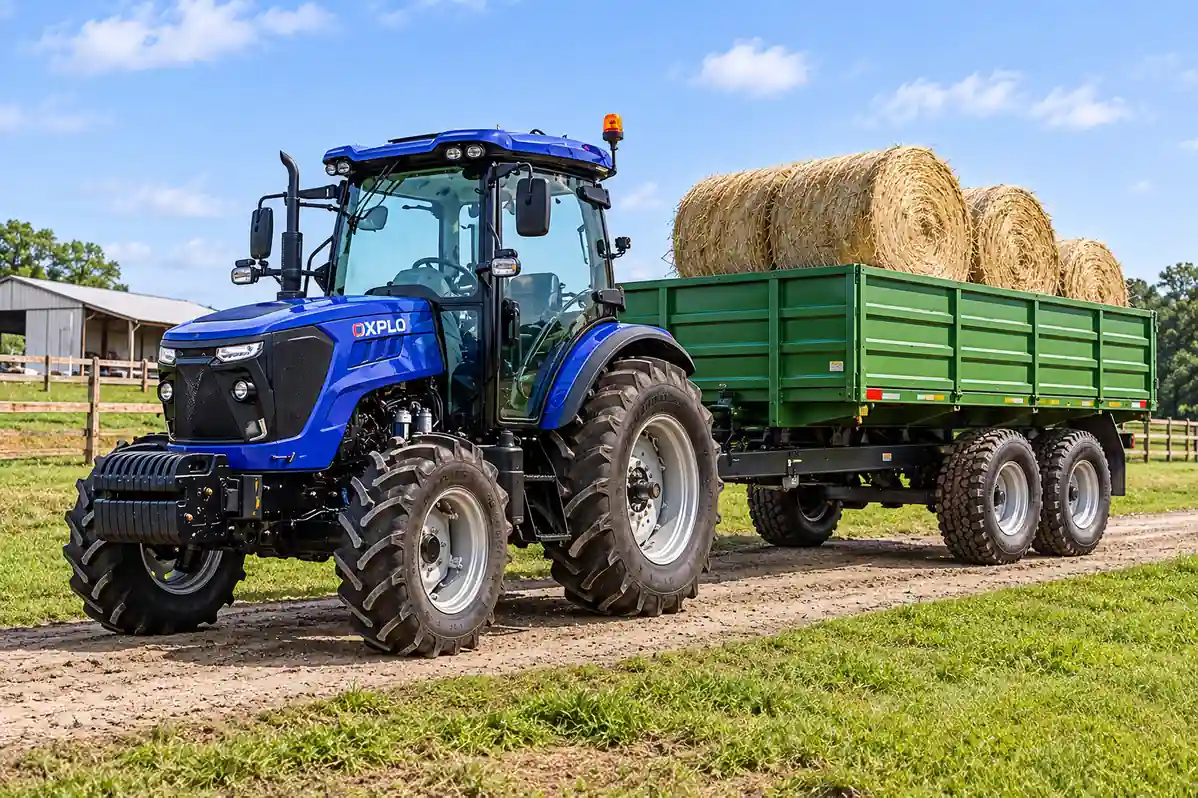
Illustrative farm transport scene: towing suitability depends on the complete tractor–trailer combination, not horsepower alone.
I. Start With the Trailer You Actually Own
“Three tonnes” can describe three different weights
When a farmer says, “My trailer is three tonnes,” clarify whether that means the trailer’s empty weight, payload allowance or gross loaded mass. The tractor does not pull a marketing label; it pulls the complete loaded trailer. Include the trailer structure, cargo, spare wheels, tools and any fitted equipment.
For example, imagine an existing feed trailer weighing 1,050 kg empty, carrying 2,300 kg of feed and another 100 kg of equipment. Its illustrative loaded mass is 3,450 kg. This is a calculation example, not an approved towing recommendation for any OXPLO tractor.
Before discussing a tractor model, obtain the trailer plate and documentation, check axle and tyre limits, and preferably weigh the combination in its heaviest normal loading condition. Where cargo shifts, as with grain or loose feed, consider how load placement changes the vertical force at the drawbar.
Trailer weight and hitch load are separate limits
A single-axle or close-coupled trailer can transfer meaningful vertical load to the tractor hitch. That force may increase rear-axle loading while reducing available steering-axle load. A turntable trailer can behave differently. Neither arrangement is automatically safe merely because its gross weight falls below a stated figure.
The permitted trailer mass, static vertical coupling load, tractor axle ratings and coupling-component rating must all be satisfied. European mechanical-coupling requirements also address front-axle loading: see Commission Delegated Regulation (EU) 2015/208. When a seller cannot supply the relevant model-specific limits, treat the combination as unverified, not approved by assumption.
II. Five Checks That Determine Whether the Combination Works
1. Check the approved towing mass—not just engine power
A 50 HP engine is approximately 37 kW at its rated output, but engine power is not a towing certificate. Available drawbar power depends on transmission losses, speed, tyre grip and the work needed to move the tractor itself. A heavier tractor with the same engine power may behave differently because its weight distribution, tyres, brakes and wheelbase differ.
Ask for the exact tractor configuration’s permitted braked and unbraked towing masses, operating-speed conditions and any restrictions on trailer type. If these figures are absent from the brochure, request the applicable technical or approval documents. Do not derive a tow rating from tractor mass, wheelbase or three-point hitch category.
2. Match the trailer braking system to the tractor
Trailer braking is a common hidden purchasing risk. Older agricultural trailers may use hydraulic brakes; others have pneumatic or approved inertia/overrun arrangements. A tractor’s ordinary hydraulic implement outlet is not automatically an approved trailer brake control. Matching hose fittings does not prove matching pressure, response, control logic or emergency operation.
Request both sides’ brake-system specifications: service-brake interface, parking arrangements, emergency/breakaway response, required connectors and any approved operating restrictions. The EU agricultural braking framework is set out in Regulation (EU) 2015/68, with requirements varying by vehicle category and configuration. Local road-use rules must also be considered.
3. Verify the real towing coupling
A Category I rear three-point linkage is not the same as an approved agricultural trailer hitch. Clevis-and-pin, pickup-hook, piton-fix or approved ball systems need compatible dimensions, installation, locking and load ratings. Check the horizontal rating, permissible static vertical load, hitch height and clearance through full turns. Never solve a mismatch with an unapproved high or improvised tow point.
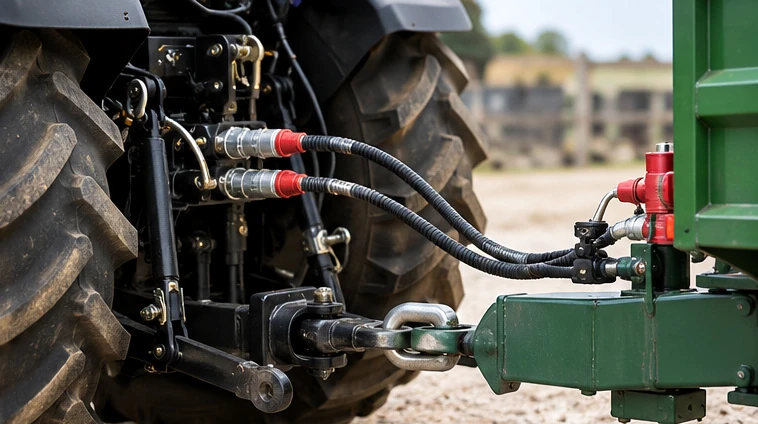
Illustrative detail: an agricultural trailer coupling and hose connections. Actual brake circuits and hitch ratings must be verified for the specific tractor and trailer.
4. Recheck axle loads, tyres and steering
A trailer may be within its permitted gross mass while the vertical hitch load overloads the tractor rear axle or leaves too little weight on the steering axle. Verify actual tyre load capacities and inflation requirements for the intended load and speed. Ballast may help traction in some situations but can also increase axle loads, fuel demand and soil damage. The final ballast plan must be reviewed for the whole combination.
5. Define the route and legal use
Private farmyard work, a steep field track and public-road travel create different risks and documentation needs. Identify the steepest section, softest ground, narrowest gate, tightest turn and highest intended speed. For European orders, ask what vehicle approval, registration, lighting, braking and national requirements apply to the specific tractor, trailer and destination country. The EU framework in Regulation (EU) No 167/2013 does not replace every national road-use rule.
III. Why a Trailer That Pulls on Level Ground Can Become Unsafe on a Slope
Traction, not horsepower, may be the first limit
On dry concrete, tyres can transmit more pulling force than on wet grass or loose soil. In deep ruts, extra energy is consumed deforming the ground and moving the trailer wheels. Four-wheel drive can distribute propulsion between tractor axles, but it does not raise the tractor’s approved towing limit or guarantee tyre adhesion in every condition.
A useful engineering estimate for steady uphill travel is: trailer resistance ≈ loaded trailer mass × 9.81 × (gradient as a decimal + rolling-resistance coefficient). Suppose a hypothetical 3,500 kg trailer climbs a 5% grade and an assumed rolling-resistance coefficient of 0.03 is used. The estimated pulling resistance is about 2.75 kN, before acceleration and other real-world losses. The assumed coefficient is illustrative; actual resistance varies substantially with the surface and tyres.
This calculation is useful for understanding why the route matters. It is not a declaration that any OXPLO tractor can tow 3,500 kg: tyre adhesion, approved mass, brake performance, coupling loads and operating conditions must still be checked independently.
The return journey may be the more dangerous journey
Downhill, the trailer’s forward momentum and gravitational force can push on the tractor. If trailer braking is inadequate, the driver may lose steering authority or the combination may jackknife, particularly while turning on slippery ground. The UK Health and Safety Executive warns that a slope safely climbed is not necessarily safe to descend; see its tractor overturning guidance.
Before regular hauling, inspect drainage, rut depth, side slopes and field exits. Plan safer routes and appropriate operating speeds rather than treating a larger engine as the solution. Do not conduct improvised maximum-load or slope-limit tests: commissioning and any performance verification should follow the manufacturers’ instructions and use competent personnel.
A practical field inspection takes less guesswork than a horsepower argument
Walk or assess the intended route with the operator. Record which areas become slippery after rain, where a loaded trailer must brake, and whether there is space to turn without crossing a bank or ditch. Note whether the route will be used in winter or during harvest, when equipment is often operating at its busiest and ground conditions are least predictable.
IV. Three Farm Buying Scenarios: What Changes the Decision?
Scenario A: A livestock farm with narrow feed-yard access
A small livestock business wants one tractor for pasture mowing, yard work and feed delivery. Its current trailer has a known load rating and compatible brakes, but the narrowest building entrance limits machine width. Here, a compact platform can matter more than an extra 10 HP. The buyer should first measure the clear opening and turning route, then compare the confirmed tractor width, including the chosen tyres and attachments.
The OXPLO OXT504 50 HP tractor lists a 1,560 mm overall width, 1,800 mm wheelbase, 4WD and an 8F + 8R gearbox. These make it worth evaluating where compact access and several lighter-to-moderate farm tasks must coexist. They do not establish that a particular feed trailer is approved for towing.
Scenario B: A mixed farm with wet clay and a downhill lane
The farm’s greatest constraint is not gate width but a wet, sloping route between its field and grain store. A tractor can lose grip while hauling uphill; the trailer can then become harder to control on the return descent. The decision must prioritise an approved braking arrangement, suitable tyres, axle and coupling loads, safe routing and realistic trip frequency. Reducing each load or improving the route may offer more benefit than changing engine power alone.
If the operator also runs larger implements for long periods, the larger OXPLO utility platform may deserve comparison. But a 60 HP tractor without the necessary approved trailer-brake interface is not an automatic upgrade for this job.
Scenario C: A machinery dealer matching a buyer’s existing trailer
A dealer is asked to quote a compact 50 HP tractor for a customer who already owns a trailer. Quoting only tractor horsepower and price creates avoidable risk: the customer may later discover incompatible brake couplers, a different hitch height or missing documentation for public-road use.
Before requesting a final OXPLO quotation, collect a photo of the trailer identification plate, the trailer’s gross permitted mass, the drawbar eye or coupling, the brake connections, a brief route description and the destination country. This evidence lets OXPLO review a real equipment package rather than guessing from a trailer nickname or stated payload.
V. Where the OXPLO OXT504 and OXT604 Fit
OXT504: keep a compact working platform
Within the OXPLO range, the OXT504 is the highest-rated model on the compact OXT chassis group. Its published 50 HP output, 4WD, 1,560 mm overall width, 8F + 8R transmission and Category I rear linkage are relevant to farmers balancing access, routine transport and existing compact implements. See the official OXT504 product specification.
For a farmer who must pass through restricted farm buildings and also operate a compatible mower or tillage implement, those dimensions and interface choices can be genuine advantages. However, neither the Category I rear linkage nor 4WD confirms a trailer-hitch rating or brake compatibility. The dealer should request the complete ordered configuration and its applicable towing documentation.

OXPLO blue cab tractor — actual product reference image supplied by OXPLO. Confirm the precise supplied model and configuration.
OXT604: a larger chassis for wider mixed-farm duties
The OXPLO OXT604 60 HP tractor moves to a larger published platform: 2,010 mm wheelbase, 1,760 mm width, 12F + 12R transmission and Category II rear linkage. For buyers with broader implement requirements or more frequent mixed-farm work, these differences can justify evaluating the OXT604 alongside the compact OXT504.
Published specification | OXPLO OXT504 | OXPLO OXT604 |
Rated engine power | 50 HP / 37 kW | 60 HP / 44.1 kW |
Drive / transmission | 4WD / 8F + 8R | 4WD / 12F + 12R |
Listed overall width | 1,560 mm | 1,760 mm |
Wheelbase | 1,800 mm | 2,010 mm |
Listed base-machine mass | 2,200 kg | 2,500 kg |
Rear three-point linkage | Category I | Category II |
Buyer’s initial priority | Compact gates; compatible implements | Larger platform; varied recurring work |
Source: OXPLO’s currently published product pages. Figures describe base tractor platforms, not certified towing masses or complete delivered configurations. Confirm ordered tyres, operator station, hitch, brakes and destination-market documents in writing.
The OXT604’s increased size and additional gear ratios may be useful for broader work, but its published mass does not justify inferring a higher approved towing rating. Conversely, the OXT504 may be a better physical fit for a restricted yard even when the farmer originally asked for a larger machine. The choice should come from the job, not from the model badge.
For a deeper configuration comparison, see the OXPLO OXT504 vs OXT604 guide and the related article on daily cattle-farm tractor tasks. These can help dealers align the tractor with non-towing tasks before committing to one machine.
VI. The Commercial Decision: Fewer Trips or a More Versatile Tractor?
Count real transport cycles, not just purchase-price differences
A tractor-trailer combination that requires lower loads may create additional journeys, particularly during harvest or regular feeding. But a larger tractor carries its own acquisition, storage, maintenance and sometimes access costs. The trade-off is best assessed with a simple workload calculation.
For example, suppose a farm must move 6 tonnes of material on each transport day. If two different, fully approved trailer arrangements safely carry 2 tonnes and 3 tonnes per loaded trip, they require three and two loaded trips respectively. At an illustrative 20-minute complete cycle, that is 60 versus 40 minutes per transport day. Across 40 such days, the theoretical difference is about 13 hours. These numbers are hypothetical and exclude queueing, weather delays, field layout and other work.
The larger transport package is only economical if the time savings and other operational benefits justify its cost and if the route, braking, tyres and legal limits allow it. OXPLO dealers should therefore ask about transport days per year, typical load sizes and other tractor duties—not just the biggest trailer the customer owns.
The overlooked costs are compatibility mistakes and downtime
A wrongly specified brake interface can delay delivery or require costly changes. An incompatible hitch can make an apparently attractive purchase unusable. Underspecified tyres and repeated brake overheating can increase servicing demands. Conversely, choosing a wider OXPLO model without checking the gate opening may prevent the machine from doing its everyday jobs.
Before comparing total prices, request a quote that identifies the exact tractor variant, the approved tow coupling and trailer-brake equipment if available, tyres, lighting, manuals, required documents, spare-parts process and what is not included. The OXPLO parts and technical support page provides a starting point for discussing parts identification and ongoing equipment support; specific commitments should be confirmed in the commercial documents.
VII. The Six-Item Checklist to Send Before Requesting an OXPLO Quote
A detailed enquiry is more valuable than “Please quote a 50 HP tractor.” Send OXPLO the information below so the proposed machine can be reviewed against the actual trailer and farm job.
- Trailer identity and loading:Make, model, identification-plate photo, empty mass, permitted gross mass and typical heaviest cargo.
- Trailer brakes:Hydraulic, pneumatic, inertia or other approved arrangement; clear photos of connectors, controls and relevant documentation.
- Coupling and drawbar:Eye or ball type, dimensions, hitch height, the manufacturer’s coupling ratings and any relevant vertical nose-load data.
- Operating route:Firm yard, wet grass, clay, gravel, slopes, narrow turns and the highest planned transport speed.
- Farm constraints and other jobs:Minimum clear gate width, barn height, existing PTO equipment, Category I/II implements and annual hours.
- Destination and road use:Country, whether public-road use is planned, required documentation and any existing registration or approval details.
With these details, the OXPLO team can review the fit between the farm’s existing equipment and an OXT504 or OXT604 quotation. Where a towing limit, brake interface or destination-market document cannot be confirmed, the responsible next step is further technical verification—not a performance promise.
Explore the OXPLO tractor product range or use the OXPLO tractor configuration page to describe your operating requirements. For B2B dealers, request that the final purchase documents list each agreed configuration and attachment separately.
Frequently Asked Questions (FAQ)
How many tonnes can a 50 HP tractor tow?
There is no universal tonnage for every 50 HP tractor. The specific machine’s approved braked and unbraked towing masses, brake and hitch configuration, axle ratings and operating restrictions determine what is permissible. Horsepower alone cannot establish an approved limit.
Can a 50 HP tractor tow a 5-tonne farm trailer?
It may or may not be possible with a particular tractor-trailer combination. First determine whether “5 tonnes” is payload or total loaded mass. Then verify the exact tractor’s approved trailer mass, coupling, brakes and axle loads. Do not treat a generic 50 HP rating or a demonstration on level ground as approval.
Does 4WD make trailer towing safe on wet hills?
4WD can help a tractor develop pulling traction on variable ground. It does not guarantee downhill control, change the permitted towing mass or compensate for poor trailer brakes. Wet slopes must be assessed for braking, steering, tyres and route suitability.
Can I tow a trailer from the tractor’s Category I three-point linkage?
A Category I linkage specification does not by itself authorise trailer towing. Use only a manufacturer-approved and correctly rated towing system for that tractor and trailer combination. An unsuitable elevated tow point can introduce serious instability.
Can a hydraulic implement outlet operate trailer brakes?
Not unless the manufacturer explicitly confirms an approved and compatible trailer braking function. Auxiliary hydraulic outlets are not automatically designed for regulated trailer service braking. Verify the brake control, pressures, connectors and emergency provisions in the technical documents.
Should I choose the OXPLO OXT504 or OXT604 for a livestock farm?
Start with barn access, existing implements, annual workload and trailer compatibility. OXPLO OXT504 offers a compact 1,560 mm listed width and Category I platform; OXPLO OXT604 offers a larger 1,760 mm listed width and Category II platform. Neither choice should be made from engine power alone, and trailer towing limits need written verification.
Conclusion: Buy a Matched Tractor–Trailer Combination, Not a Horsepower Number
For 50 hp tractor trailer towing, the most useful buying question is not “Will it move the trailer?” but “Will this exact tractor, trailer and route work together within their approved mechanical and operating limits?”
A compact OXPLO OXT504 may be worth evaluating for a farm where narrow gates, existing compact implements and multiple seasonal jobs matter. An OXPLO OXT604 may suit buyers comparing a larger utility platform and more varied recurring work. In either case, the trailer’s actual loaded mass, braking, coupling loads, tyres, ground conditions and destination-market documentation must be checked before the combination is approved for use.
If you are selecting an OXPLO tractor for an existing farm trailer, share the trailer plate, braking type, hitch dimensions, typical loads, route conditions and destination country through OXPLO tractor configuration enquiries. Those six details make a useful technical recommendation possible—and help avoid a costly mismatch after delivery.