

A 15-acre farm does not necessarily need a large tractor. Yet a machine that manages weekly mowing comfortably may still struggle with a rotavator in heavy soil or fail a trailer-braking check. For a European buyer comparing a 30 HP or 40 HP tractor, the expensive mistake is to treat acreage as a horsepower specification.
Consider one hypothetical 15-acre (approximately 6.07-hectare) mixed smallholding: 2.4 hectares of cultivated land, 1.7 hectares of orchard, 1.1 hectares of grassland, and the remainder in tracks, buildings and service areas. Its owner wants one tractor for three recurring jobs: rotary cultivation, moving materials by trailer, and maintaining orchard rows. These figures illustrate a decision, not a typical European farm or an OXPLO customer case.
The useful question is not simply “30 HP or 40 HP?” It is: Which job sets the minimum tractor requirement, which constraints cannot be solved with extra engine power, and what must be confirmed before placing an order? This guide applies that question to the OXPLO tractor range and, in particular, the OXT304 and OXT404 compact models.
I. One Farm, Three Jobs: Find the Limiting Task First
The Most Frequent Job Is Not Always the Most Demanding
A smallholding may mow every week, tow materials several times a month and cultivate the soil only a few days each season. Mowing accounts for the most hours, but cultivation might dictate the minimum usable power. On another farm, the tiller is modest and the real bottleneck is a loaded trailer on steep, wet access tracks.
Start with an operating worksheet. Record each job’s implement, peak load, area or distance, ground condition and time window. Then distinguish a hard constraint—such as inadequate braking, an incompatible hitch or insufficient orchard clearance—from a productivity constraint, such as taking longer to cultivate a field. Hard constraints are not solved by buying more horsepower.
Actual job | Question that can rule out a tractor | What additional engine power may change |
Rotary cultivation | Does the implement’s PTO power, speed, hitch and weight match? | Ability to operate a compatible, more demanding tiller without overload |
Trailer transport | Is the loaded combination approved, controllable and adequately braked? | Ability to maintain performance under a permitted load, especially on climbs |
Orchard maintenance | Can tractor and implement pass through rows and turn safely? | Capacity for a suitably matched higher-power mower or sprayer drive |
Rank the Constraints in the Right Order
Measure access and confirm safety-related limits first; check implement interfaces second; estimate working time third; compare delivered cost last. This avoids paying for 40 HP only to discover that a standard-height machine cannot enter the orchard or that an existing attachment needs a different linkage category. For buyers already owning implements, OXPLO’s PTO, hydraulics and three-point hitch guide is a useful companion to this three-job assessment.
II. Job One — Rotavator Work: Is PTO Power the Real Bottleneck?

Rotary tillage with a rear-mounted rotavator; illustrative field operation.
Engine HP Is Not the Power Delivered to the Tines
The tractor’s advertised 30 HP or 40 HP is rated engine output. It is not a promise of identical power at the PTO shaft. Losses and operating conditions mean the usable PTO output must be checked separately. A rotavator marked “minimum 28 PTO HP,” for example, cannot be approved for an OXPLO OXT304 merely because its engine is rated at 30 HP. Nor does the OXT404’s 40 HP engine rating prove any specific PTO output without documentation.
The implement manufacturer’s requirements should specify PTO speed, minimum or recommended power, working width, mass and hitch interface. OXPLO lists 540/1000 rpm PTO speed options and a Category I rear linkage on the model pages for both tractors, but compatibility also depends on driveline length, shaft arrangement, lift performance, clearances and any hydraulic functions. If the tiller’s rating is given in engine HP rather than PTO HP, clarify the basis with the manufacturer before comparing figures.
Soil and Depth Can Change the Answer More Than Acreage
A 1.4-metre rotavator on previously worked, reasonably dry soil is a different task from the same tool operating deeper in compacted clay. Power demand increases with soil resistance, depth, tine configuration and working speed. Wet soil can also smear, compact and damage the seedbed; a larger tractor does not make unsuitable cultivation conditions acceptable.
This is where a 30 HP tractor can be a sensible choice: the owner uses an approved smaller tiller, accepts a narrower pass and has flexibility to work when the ground is suitable. A 40 HP tractor deserves closer consideration if the required implement genuinely needs higher usable PTO output and the farm has a narrow planting or cultivation window. If a heavy implement exceeds the Category I hitch or stability limits, neither OXPLO compact model should be treated as suitable without a different, verified solution.
Check the Time Saving Before Paying for More Power
For planning, effective field capacity can be approximated as: hectares per hour = working width (m) × speed (km/h) × field efficiency ÷ 10. Field efficiency accounts for turning, overlap and non-working movements. Take the hypothetical 2.4-hectare cultivation area and assume 3.5 km/h with 70% field efficiency:
- At a 1.2 m working width, capacity is about 0.294 ha/h, requiring approximately 8.2 hours.
- At a 1.5 m working width, capacity is about 0.368 ha/h, requiring approximately 6.5 hours.
The difference is roughly 1.6 hours per pass. This is an illustrative calculation, not a claim that either implement belongs on the OXT304 or OXT404; both must be matched independently. It also assumes both combinations can sustain the same working speed. On a farm cultivating only once or twice annually, the saving may not justify a more expensive tractor. For repeated cultivation within short weather windows, it might matter more.
III. Job Two — Farm Trailer Transport: Horsepower Cannot Replace Brakes
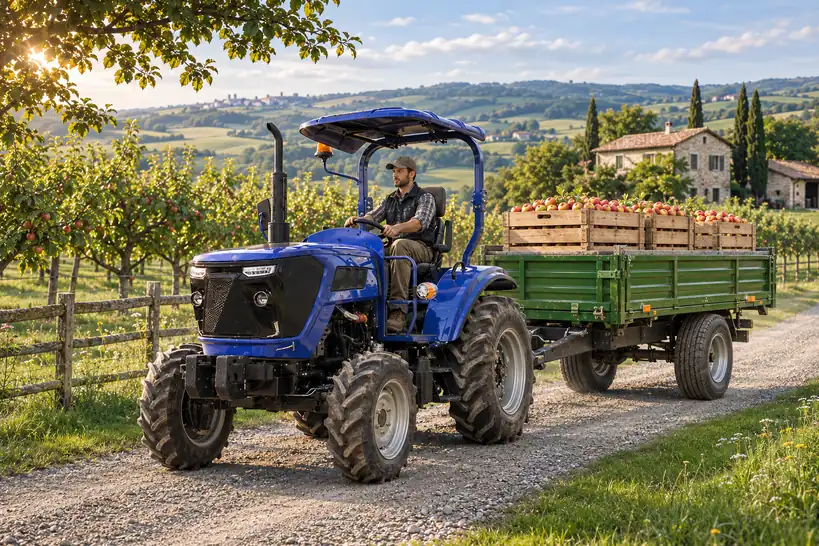
Farm trailer transport on a rural track; illustrative operation.
Start With Loaded Mass, Not an Empty Trailer Demonstration
A trailer that moves easily when empty can become a very different load after harvest. For example, an 800 kg trailer carrying 1,200 kg of materials has a 2,000 kg loaded mass. That figure is a hypothetical arithmetic example—not an approved towing limit for any OXPLO model.
Before specifying the tractor, ask for the trailer’s permissible gross mass, coupling and vertical hitch loads, axle loading and brakes. Compare these with the exact tractor’s rated towing arrangements, drawbar/hitch limits, tyre conditions and operator instructions. The route matters too: a short, level farm track creates different demands from a long downhill section with loose gravel.
Where OXPLO 4WD Helps—and Where It Does Not
Both the OXPLO OXT304 and OXT404 are listed as 4WD models. Extra driven-wheel traction may help on grass, soft ground and changing farm surfaces. Yet 4WD does not increase a certified towing rating or substitute for compatible trailer brakes. If a loaded trailer loses control downhill, 10 additional engine horsepower is not the remedy. Proper load distribution, a suitable braking system, appropriate tyres and a safe route are more important.
Where an approved towing combination is already safe, the 40 HP OXPLO may be worth evaluating if the 30 HP tractor cannot maintain acceptable performance on repeated climbs. Even then, the final decision needs the manufacturer’s configuration-specific towing and braking data. Never infer towing capacity from tractor horsepower or listed tractor mass alone.
The European Road-Use Question
If the tractor or trailer will use public roads, the destination country can affect the necessary vehicle approval, registration, lighting and braking arrangements. Regulation (EU) No 167/2013 provides the EU framework for agricultural and forestry vehicle type approval, but the buyer must still check the rules applicable to the actual configuration and its intended use. Request documents covering the specific ordered tractor, not a generic certificate from another model or variant.
IV. Job Three — Orchard Maintenance: Measure the Working Envelope
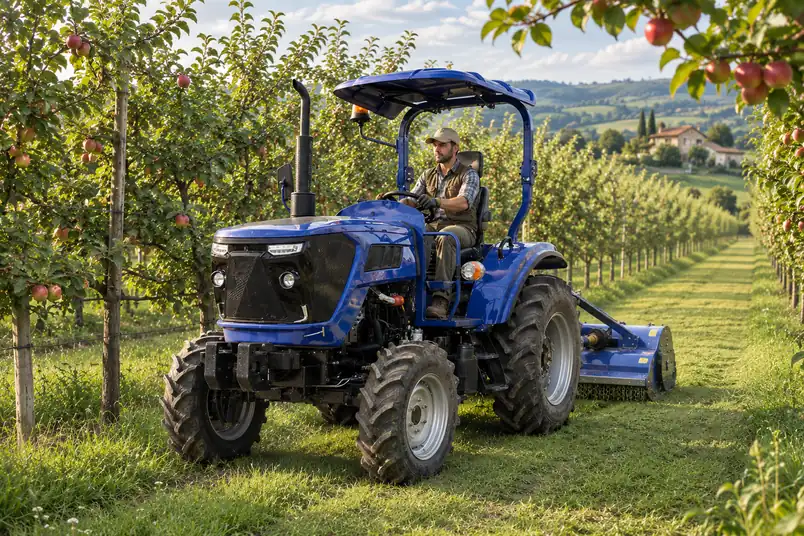
Maintaining orchard grass with a rear-mounted mower; illustrative operation.
A 40 HP Tractor May Be No Wider Than a 30 HP Tractor
Fruit growers often worry that more engine power means a machine too wide for orchard rows. That is not necessarily true. The current OXPLO OXT304 and OXT404 model pages both list an overall width of 1,560 mm, a length of 3,180 mm and an overall height of 2,600 mm. The extra engine output of the OXT404 therefore comes without an increase in these published dimensions. This is a meaningful OXPLO comparison for a buyer trying to retain compact access while gaining power.
But the published dimensions are only the starting point. If the usable corridor between branches and irrigation equipment is 1,900 mm, the nominal lateral space around a centred 1,560 mm tractor is just 340 mm in total. That is not a declared safe clearance. Tyre variation, steering movement, slope, mud, implement overhang and operator error can consume that margin.
Check the Canopy, Headlands and Full Attachment Width
Measure the narrowest gateway, the lowest unavoidable canopy point, the actual working aisle and the headland needed for turning with the mower or trailer attached. Low branches can exclude a tractor even when its body fits the row. The tractor’s operator-protection equipment and supplied market configuration also influence actual height. Never remove or modify protective structures to force a machine under trees.
For grass maintenance, assess mower power demand, cutting width, side clearance and terrain. A compact 30 HP configuration may be enough for regular light cutting. A 40 HP machine may allow a more demanding compatible mower, but cannot fix an aisle that is too narrow. For orchard spraying, tank mass, PTO/hydraulic requirements and any necessary operator protection require a separate check; the OXPLO tractor-for-spraying guide explains why row width and attachment mass belong in that decision.
Know When Neither Model Fits
The correct answer might be neither 30 HP nor 40 HP. Very low canopies, exceptionally narrow passages, difficult side slopes or heavily loaded front attachments can require a specialised platform or a different work method. An honest specification process should rule out unsuitable equipment before price negotiation—not after delivery.
V. When Is the Extra 10 HP Actually Worth Paying For?
Use a Three-Outcome Decision Instead of a Bigger-Is-Better Rule
Start with 30 HP: If the rotavator’s verified PTO demand fits, the trailer combination is permitted and controllable, the orchard has sufficient access, and the working window is flexible, the OXPLO OXT304 is a credible shortlist option. Additional power may create little measurable benefit during routine mowing or transport on level ground.
Investigate 40 HP: If the farm has recurring PTO work that genuinely exceeds the OXT304’s verified output, or an approved task would be completed substantially more efficiently with added engine reserve, evaluate the OXPLO OXT404. Its listed compact width is an advantage only if the complete supplied machine and implements still fit the site.
Choose another solution: If the actual restriction is Category II implement geometry, hitch capacity, trailer certification, orchard height or steep-ground stability, increasing from 30 to 40 HP will not resolve it. The farm may need a different tractor platform, a different attachment or occasional contracted work. The OXPLO horsepower selection guide helps buyers compare power classes, but it does not replace a model-specific engineering check.
Compare Total Ownership Cost With a Realistic Work Schedule
Ten extra horsepower represents a one-third increase in nominal engine rating, not a guaranteed one-third improvement in output. Tractor productivity may instead be constrained by turning time, soil moisture, permissible speed, braking or the width of an existing implement.
A practical upgrade test is: annual value of time saved − additional annual running cost, compared against the additional delivered purchase cost. Include finance, servicing, fuel under comparable work, storage, transport, depreciation and any attachment changes. Use supplier quotes and the farm’s own hours—not invented fuel savings or universal payback claims. For a job needed once a year, a contractor can be more economical than owning excess capacity year-round.
VI. OXPLO OXT304 vs OXT404: What Buyers Can Verify Before Ordering
A Compact Chassis Comparison That Matters in Practice
The OXPLO OXT304 and OXT404 are relevant to this 15-acre scenario because both are currently marketed as 4WD compact tractors with a Category I rear linkage. On their dedicated product pages, OXPLO lists the following reference specifications:
Published item | OXPLO OXT304 | OXPLO OXT404 |
Rated engine output | 22 kW / 30 HP | 29.4 kW / 40 HP |
Drive | 4WD | 4WD |
Overall size, L × W × H | 3,180 × 1,560 × 2,600 mm | 3,180 × 1,560 × 2,600 mm |
Rear linkage category | Category I | Category I |
Listed PTO speed choices | 540 / 1000 rpm | 540 / 1000 rpm |
Listed wheelbase | 1,800 mm | 1,800 mm |
Sources: OXPLO OXT304 product page and OXPLO OXT404 product page. These are publicly published reference values; supplied specification, PTO output, hitch lifting capacity, tyres, operator station, towing/braking provisions and destination-market equipment must be confirmed in writing. The site’s general model-comparison material does not always use identical configuration details, so the approved order specification should control.
The OXPLO Advantage Is a Choice of Power Within a Similar Envelope
For the hypothetical farm, OXPLO’s useful differentiator is not a claim that one tractor automatically performs all three jobs. It is the availability of 30 HP and 40 HP rated engines with the same listed overall width and Category I implement interface. That lets a buyer examine the true power bottleneck without assuming that moving to 40 HP must also require a larger published chassis.
For a farm whose existing Category I mower and tiller are already compatible with the OXT304, OXPLO does not need to push the higher-powered machine. If the tiller’s verified PTO demand rules out 30 HP while the orchard geometry still suits the compact platform, the OXT404 becomes the more relevant candidate. If the farm’s implement requires a larger Category II system, a different platform deserves review, regardless of what the engine HP number says.
What a European Buyer or Dealer Should Send OXPLO
A vague enquiry such as “quote me a 40 HP tractor for 15 acres” usually produces follow-up questions. A more useful request includes:
- Destination country and intended road use:registration, documentation, braking and lighting requirements.
- Rotavator details:make/model, required PTO HP and rpm, operating width, implement mass and hitch category.
- Trailer details:empty and permissible loaded mass, hitch type, braking arrangement, slopes and route surface.
- Orchard measurements:narrowest usable aisle, lowest obstruction, headland space and mower dimensions.
- Operating plan:hours per year, peak seasonal deadline, existing implements, desired tyres and operator-station requirements.
- Purchase package:requested spare parts, manuals, delivery terms and support requirements.
The OXPLO tractor configuration page helps frame model and attachment choices, while OXPLO Support outlines parts, attachments and technical assistance. Buyers should ask which exact documentation and support terms apply to their quotation. They should not assume every OXPLO tractor variant has the same European approval documents or that a loader option is suitable without its own capacity, hydraulic and stability checks.
VII. Frequently Asked Questions
Is a 30 HP Tractor Enough for a 15-Acre Farm?
It can be, especially when the property uses moderate-size, compatible implements and the working schedule allows smaller passes. For the OXPLO OXT304, verify PTO power and attachment limits before approving the rotavator; confirm trailer rating and orchard clearance separately. Fifteen acres alone cannot guarantee suitability.
Will a 40 HP Tractor Finish Tilling One-Third Faster?
No. The engine rating is roughly one-third higher than 30 HP, but field productivity depends on implement width, actual operating speed, soil conditions, headland turns and stoppages. A larger machine only improves throughput when the full tractor–implement system can convert the additional power into useful work.
Can the OXPLO OXT404 Use My Existing Category I Rotavator?
Its published rear linkage is Category I and PTO options are listed as 540/1000 rpm. That is a reason to investigate compatibility, not a universal guarantee. Check the implement’s exact power requirement, hitch geometry, operating mass, shaft dimensions, PTO speed and any hydraulic needs against the final OXPLO specification.
Is 4WD Enough for Towing a Loaded Farm Trailer on Wet Tracks?
No. The 4WD configurations listed for the OXPLO OXT304 and OXT404 may improve traction, but safe towing still depends on approved masses, load distribution, tyres, braking arrangements, gradients and the operating route. More driven wheels do not replace trailer brakes.
Which Is Better for a Narrow Orchard, OXT304 or OXT404?
Both currently show a 1,560 mm overall width, so neither has a published width advantage. Choose only after checking row clearance, canopy height, turning envelope, attachment overhang and the supplied tractor configuration. The 40 HP option is justified when a compatible orchard task specifically needs additional engine output.
What Should European Dealers Check Beyond the Purchase Price?
Confirm the exact tractor variant, implement compatibility, destination-market documentation, road-use equipment if relevant, warranty terms, parts availability, delivery scope and who handles technical support. These checks reduce the risk of receiving an attractive-looking machine that is not ready for the customer’s intended work.
VIII. Conclusion: Buy for the Hardest Job, Not the Headline Horsepower
The best 30 HP vs 40 HP decision for a 15-acre farm starts with one question: Which of the three jobs places the strictest verified requirement on the tractor? Rotary cultivation may set the PTO threshold; towing may depend on braking and traction; orchard maintenance may be limited by the physical working envelope. None of those answers can be supplied by acreage alone.
For buyers whose implements and timetable fit the smaller power class, the OXPLO OXT304 deserves serious consideration. Where recurring work needs more verified engine or PTO capability without sacrificing the listed compact width, the OXPLO OXT404 may be a stronger shortlist candidate. And when the limitation is hitch category, stability, road compliance or access, a different solution is more responsible than simply choosing more horsepower.
To discuss a suitable configuration, send OXPLO your rotavator model, trailer maximum loaded mass, orchard row and canopy measurements, destination country and seasonal workload. Review the OXPLO tractor models or contact the OXPLO team for a configuration-specific assessment before ordering.