
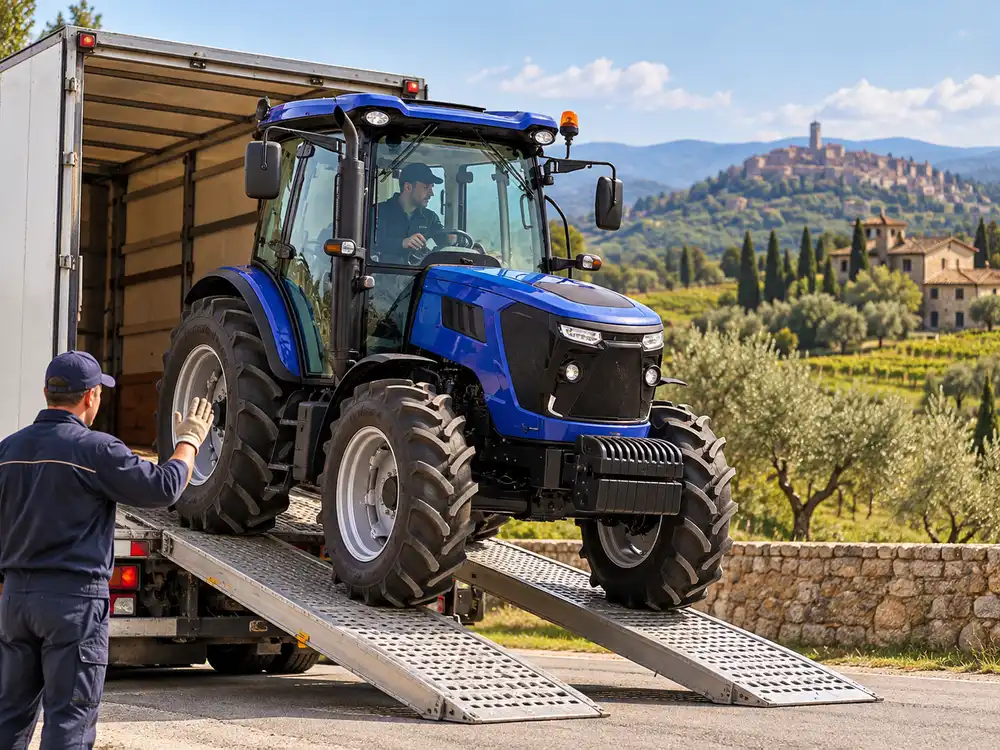
Two suppliers can quote the same tractor at substantially different delivered prices—and the lower number can still create the higher final bill. One quote may end at the port. Another may cover inland transport but exclude unloading, import VAT or assembly. A third may say “door to door” without identifying who can legally act as the importer.
For French and Italian farms and machinery dealers, tractor delivery cost Europe is therefore not one freight rate. It is a set of commercial, mechanical and customs decisions that must fit the exact machine and destination. A useful quotation should tell the buyer what is included, what is excluded, when risk passes and when the tractor will actually be available for work.
The most expensive mistake is to confirm transport before confirming the equipment configuration and the responsibilities at destination. The framework below reverses that sequence.
I. Why the Lowest Tractor Delivery Quote Can Cost More
The three prices buyers often confuse
An equipment price covers the specified tractor and any agreed options. A landed-cost estimate adds the cost of getting it through the agreed import and delivery process. A ready-to-work budget goes further: unloading, reassembly, inspection, possible registration and the first operating preparations. These are three different financial questions. A delivery quote should not answer one while appearing to answer all three.
A farm manager trying to start mowing before a weather window and a distributor preparing ten demonstration units face different consequences from the same delay. The farm may need substitute equipment; the dealer may incur warehouse handling and postponed customer handovers. Both need a delivery scope that is auditable rather than a single all-inclusive sounding number.
Where cost leakage usually begins
Most unexpected tractor import delivery charges arise from five avoidable gaps: the shipment is priced before cab and loader options are frozen; arrival-terminal charges are not allocated; customs identity or paperwork is incomplete; the final farm address is treated like a conventional warehouse; or nobody has agreed who unloads and reassembles the machine.
Consider a quotation marked “delivered to Italy.” It may mean road transport from the port to a named address, not import clearance, tax payment or unloading. The phrase alone is not an Incoterms rule. Ask for the exact Incoterms 2020 term and named place, followed by a written list of inclusions and exclusions.
Time is a cost variable, not just a delivery-date concern
A lower freight offer may involve more handovers or an uncertain arrival window. If the tractor misses five days of scheduled work and the buyer rents an alternative for an illustrative €180 per day, that creates €900 of additional expense. This is a scenario calculation, not an estimate of typical European hire rates. The decision rule is to compare quoted cost + foreseeable handling + delay exposure, not freight cost alone.
II. How Tractor Configuration Changes Shipping and Delivery Costs
Start with the work, then select the tractor and shipping method
A 50 HP tractor is not automatically the right choice for a 50 HP search query. Working width, turning space, implement category, PTO demand, tyre type, ballast, loader duty and operating surface influence the useful configuration. Those same choices determine dimensions, securing points, handling requirements and sometimes the transport method.
A narrow vineyard access road in France can make width more important than engine output. An Italian mixed farm using a mounted implement, trailer and front loader may place greater value on hitch category, machine mass and hydraulic compatibility. These should be checked before a freight forwarder commits to a loading plan.
Published model differences that matter
For a concrete comparison, consider a compact 50 HP tractor platform against a larger 70 HP utility platform with the following published specifications. These describe the tractors as listed, not necessarily the final packing envelope.
Decision factor | 50 HP compact platform | 70 HP utility platform |
Rated engine output | 50 HP / 37 kW | 70 HP / 51.5 kW |
Published overall dimensions | 3,180 × 1,560 × 2,600 mm | 3,980 × 1,760 × 2,800 mm |
Listed machine weight | Approx. 2,200 kg | Approx. 2,500 kg |
Transmission | 8F + 8R | 12F + 12R |
Rear linkage | Category I | Category II |
Commercial question | Does compact access meet the implement load? | Is larger implement capability used enough to justify the platform? |
Published product data can change with cab, tyres, guarding, attachments and destination specification. Confirm gross shipping dimensions and weight from the approved packing plan.
Why a loader and cab can change the landed price
Adding a front loader does not merely add an equipment line to the invoice. The buyer must verify hydraulic connections, bucket or bale-fork shipment, rear counterweight, transport restraint, whether the loader is attached or removed for shipping, and who refits it. A cab choice can change total height and loading clearance. If a tractor exceeds a container-door limit in its shipping state, the forwarder may need a different packing strategy, specialized equipment or another mode of carriage.
Three practical options should be compared: (1) secured standard or high-cube container loading where dimensions allow; (2) open-top or flat-rack handling when required and available; or (3) ro-ro movement when the equipment and service route meet the carrier’s rules. None is consistently cheapest. Add destination assembly and damage-exposure considerations before choosing.
Do not price the catalogue dimension as the packing dimension
Ask for the shipping-state length, width, height, gross weight, centre of gravity and securing plan after the configuration is approved. Record what will be removed, how hydraulic ports and exposed components are protected, and which tools or torque specifications are needed at arrival. The container door, not only nominal internal volume, can be the limiting dimension.
III. What Is Included in a France or Italy Door-to-Door Quote?
Use a six-line cost breakdown rather than one “delivered” figure
A useful tractor door to door delivery Europe quotation should allocate every major cost to a party. The following structure can be copied into a request for quotation:
Cost group | What to require in writing |
1. Export preparation | Final equipment specification; packaging; dismantling; export documents; origin-side transport and loading. |
2. International carriage | Origin and destination ports; container or ro-ro mode; freight; cargo insurance and named insured party. |
3. Arrival and customs | Terminal charges; release documents; customs broker; tariff classification; importer of record; EORI. |
4. Duties and VAT | Who declares and pays each tax; assumptions used; treatment of import VAT and any recoverability. |
5. European inland haulage | Exact postcode and street/farm address; final delivery vehicle; restricted access; appointment rules. |
6. Unloading and readiness | Who unloads; lifting equipment; assembly; pre-delivery inspection (PDI); registration-related tasks if required. |
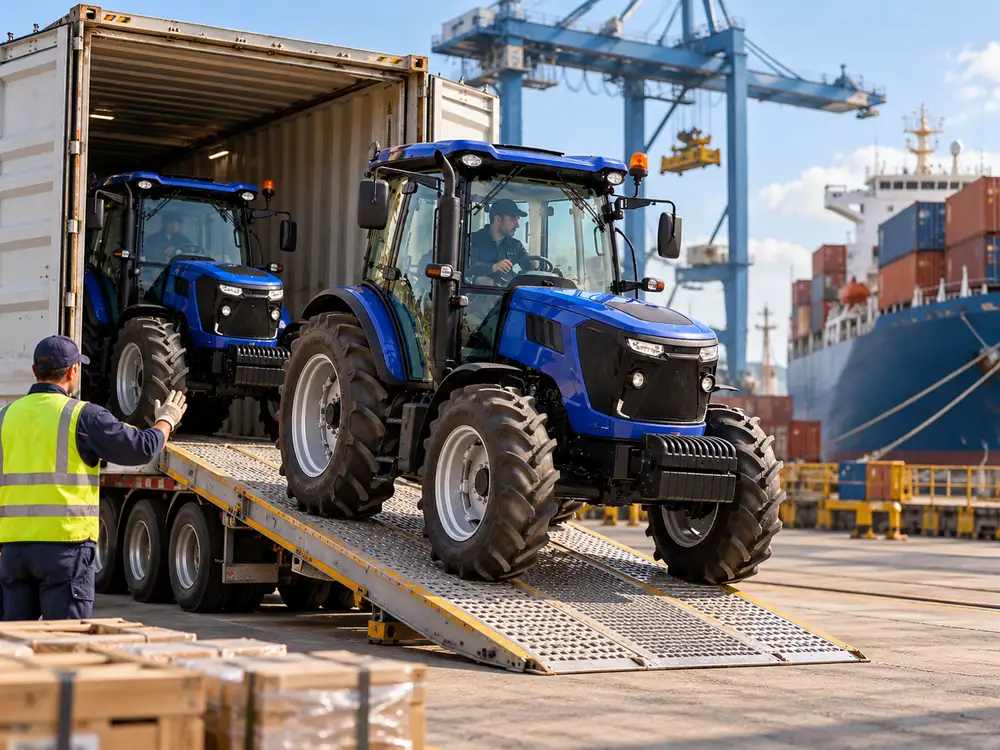
Illustration: port handling can affect freight, clearance, terminal charges and final delivery timing.
CIF, DAP and DDP solve different parts of the job
Under CIF, the seller pays the agreed freight and minimum required insurance to the named destination port for suitable sea carriage, but the buyer generally manages import formalities and onward transport; risk transfers at loading on the vessel at origin. DAP places the seller in charge of carriage to the named destination, while the buyer normally performs import clearance and pays import duties and taxes. DDP places import clearance and applicable import-duty/tax responsibilities on the seller, subject to a legally executable customs and tax arrangement. DAP and DDP normally deliver on the arriving vehicle ready for unloading, unless the parties agree otherwise.
A DDP tractor quotation needs more than the label “DDP France” or “DDP Italy.” Ask who will be importer of record, how VAT will be handled, which broker is appointed and whether the seller can lawfully carry out those obligations. If the importer or VAT arrangement is unclear, a properly specified DAP offer can be more controllable for an established EU distributor. See the ICC Incoterms 2020 explanatory rules for the formal allocation of responsibilities.
Customs classification and import VAT need separate checks
European import duty is not reliably determined by the generic word “tractor.” The full product classification, technical characteristics, origin and current TARIC measures determine the applicable treatment. Attachments shipped with the tractor may require separate tariff analysis. Do not assume that a rate valid for one tractor subcategory automatically applies to a second model or accessory.
EU customs operations require a valid EORI arrangement for the relevant economic operator. The import VAT taxable amount generally starts from customs value and can include import charges and incidental transport or insurance amounts not already included, subject to the applicable rules. The country of import, customs procedure and destination information matter. European Commission guidance explains EORI requirements and the import VAT taxable amount.
The standard VAT rates for general comparison are 20% in France and 22% in Italy, but this is not a shortcut to the final cash cost. A business that can deduct import VAT may have a different net economic cost from a buyer that cannot. Also check which state legally records the import and whether domestic reporting or deferment arrangements apply. Consult the EU country VAT rates and a qualified local customs/VAT adviser for the actual transaction.
Delivery to an address is not unloading, assembly or registration
A tractor can reach a farm gate while still requiring a low-loader unloading plan, component refitting, fluid and fastener checks, function tests or registration documents. Record these tasks as named responsibilities. In particular, shipping documents, CE-related paperwork, engine-emission evidence, whole-vehicle EU type approval and a vehicle Certificate of Conformity (CoC) are not interchangeable. Road-registration requirements must be checked against the exact vehicle and intended use before shipment. The relevant EU vehicle framework includes Regulation (EU) No 167/2013.
IV. France vs Italy: Two Practical Buying Scenarios
Scenario A: A French vineyard with restricted access
Imagine a vineyard operator purchasing a tractor for mowing, light cultivation and moving equipment between plots. The access gate is narrow; the farm uses existing Category I implements and expects occasional movement on public roads. A tractor chosen solely for a larger horsepower number could be too wide for the site or incompatible with the current implement package.
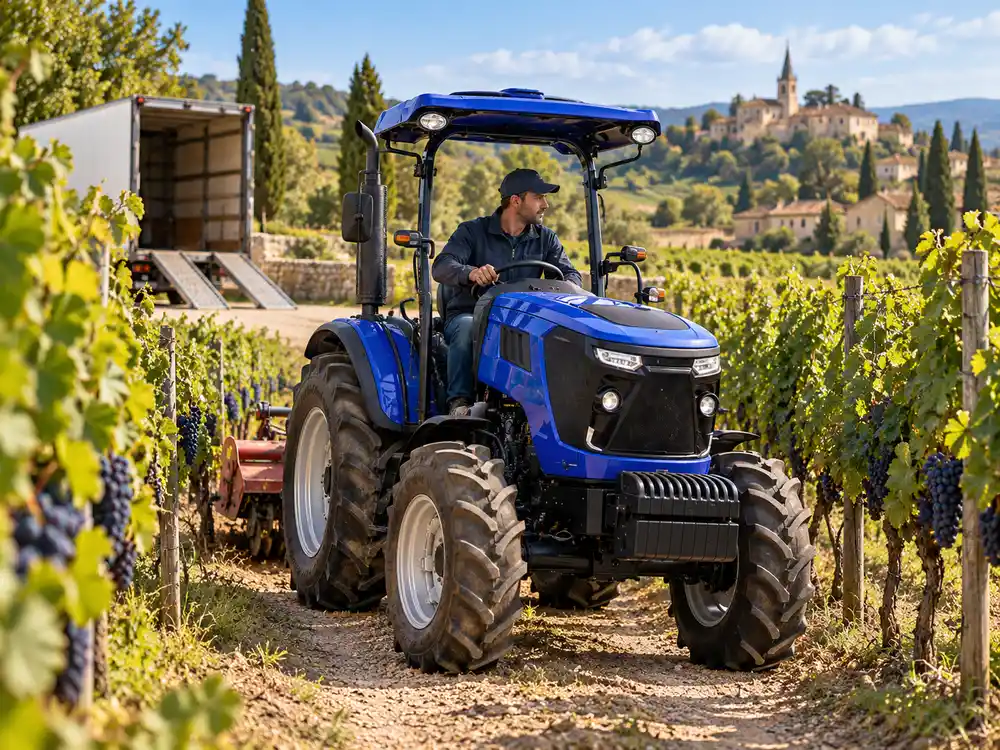
Illustration: a French vineyard buyer must check row width, gate access and implement compatibility.
Before requesting a tractor shipping cost to France, the buyer should supply four dimensions: narrowest gate opening, usable inter-row width, overhead clearance and available turning area. A fifth input is the implement matrix—PTO speed, hitch category, working width, mass and hydraulic demand. Separately, the buyer must identify any road-use documentation needed for the intended registration pathway.
The engineering trade-off is clear: a compact platform can reduce access problems, but it must still provide enough usable capacity for the heaviest planned task. If the machine requires cab or loader disassembly for loading, include the reinstatement plan in the quotation. A low shipping bill is of little use if the tractor cannot enter the vineyard or operate the owner’s tools.
Scenario B: An Italian orchard or mixed farm far from the port
Now consider an orchard and livestock business that needs mowing, trailer movement and periodic feed handling. A larger utility tractor may suit the workload, but its attachment package and final road transport dimensions are more complex. The farm entrance may have a tight bend, weak surface or limited unloading space. These cannot be inferred from the city name in the freight request.
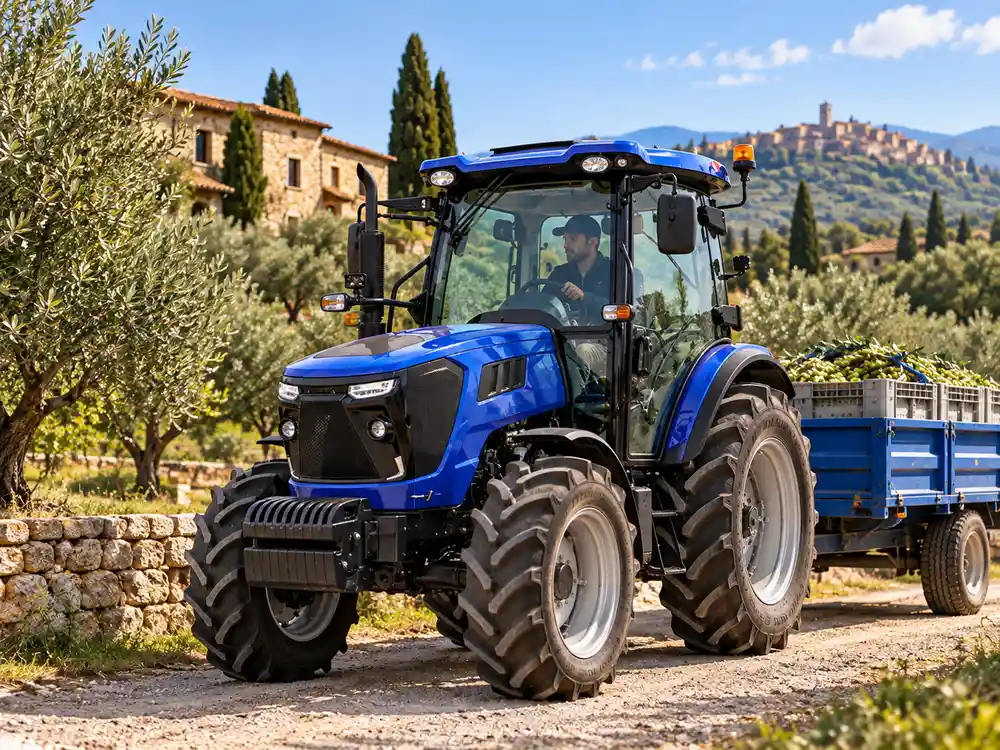
Illustration: an Italian orchard delivery plan should account for rural road access and farm-ready setup.
Before requesting a tractor shipping cost to Italy, confirm the complete postcode and delivery point, truck access and turning dimensions, load-bearing ground conditions, whether a ramp or suitable lifting equipment exists, and the person responsible for accepting the load. Where the final kilometres are unsuitable for the original truck, request a priced transshipment option instead of discovering the constraint on delivery day.
The commercial choice may favour a higher-capability tractor when it replaces multiple routine jobs, but only if the additional purchase, freight and handling cost is justified by real annual utilization. For occasional loader use, compare a smaller tractor and outsourced lifting rather than assuming a heavier machine is automatically more economical.
Scenario C: A European dealer importing demonstration units
A dealer should evaluate the model mix, not merely a single unit’s purchase price. A compact tractor that attracts orchard customers and a Category II utility machine for mixed-farm clients may form a more useful trial order than two similar models. But the dealer also needs specification consistency, parts planning, country-specific documents, inspection evidence and a realistic route from port arrival to customer demonstration.
For a trial shipment, tie the packing list and commercial invoice to exact models, serial numbers when available, attachments and declared weights. Require confirmation of conformity documentation available for each configuration before committing to registration-dependent sales. The dealer’s cost of a non-saleable demonstration unit can exceed a modest ocean-freight saving.
V. How to Calculate the True Ready-to-Work Cost
Separate landed cost, recoverable tax and work-readiness expenditure
For decision-making, use a line-item calculation instead of one unqualified “landed price”: equipment + export and international freight + destination handling + duties + inland transport + non-recoverable taxes + unloading/assembly + risk allowance. Where any cost is already included in a seller’s DAP or DDP price, remove that duplicated line before adding totals.
Treat import VAT distinctly: show the cash-flow requirement and the post-recovery economic cost under the buyer’s actual tax position. Do not deduct VAT automatically unless the importer’s entitlement and reporting method are confirmed. The same rule applies to any broker, storage or service charge with a separate VAT invoice.
A transparent worked example for quotation comparison
The following illustration assumes a tractor imported from China and delivered to a designated farm address. The figures are teaching inputs, not current freight rates, customs assessments or an OXPLO price offer. The actual duty is assumed to be zero purely to keep the arithmetic readable; it must be verified for the real tariff code and origin.
Illustrative expense | Amount (€) |
Tractor and agreed export-ready configuration | 18,000 |
Export logistics, sea freight and insurance | 2,600 |
Destination handling and broker service | 650 |
Inland transport to the named farm | 1,350 |
Unloading, reinstatement and PDI | 450 |
Total before VAT / illustrative ready-to-work spend | 23,050 |
Assume only for this example that the applicable import VAT base is €22,600 and that the destination charges are treated as specified in the underlying invoices. At 20%, the illustrative French VAT is €4,520; at 22%, Italian VAT would be €4,972. The respective VAT-inclusive arithmetic totals are €27,570 and €28,022. These are not real import declarations; the customs value, taxable amount, import state and VAT treatment must be determined transaction by transaction.
If a buyer can fully recover the relevant import VAT under the applicable rules, the economic cost analysis should not treat the entire VAT charge as a permanent expense. If recovery is unavailable, the amount may materially affect the budget. This is why comparing a DDP total against a DAP total without normalizing the tax treatment is often misleading.
Calculate the price of delivery uncertainty
Use a small sensitivity test before signing: add one possible terminal storage event, one rebooking or transshipment event and a realistic cost of missed farm work. As an illustration, an apparent €800 freight saving is erased by €250 of unexpected handling and €900 of replacement machine hire. This does not mean always choose the expensive quote; it means buy the scope that you can verify and manage.
A simple control is to demand three dates and three owners: expected readiness for dispatch, estimated port arrival and agreed farm-delivery window; plus the people responsible for customs, road transport and unloading. This converts a vague freight estimate into an operational plan.
VI. How OXPLO Helps Buyers Prepare for Delivery
Match an OXPLO tractor to the work before costing its shipment
The OXPLO tractor range currently covers six 4WD models from 25 HP to 70 HP. For restricted-access vineyard or estate work, buyers can review the OXPLO OXT254 25 HP model alongside other compact configurations. When power reserve is needed without leaving the compact Category I platform, the OXPLO OXT504 50 HP tractor is a practical comparison point. For a larger Category II implement system, the OXPLO OXT604 60 HP tractor and OXPLO OXT704 70 HP tractor merit consideration.
OXPLO lists the OXT504 at 3,180 × 1,560 × 2,600 mm and approximately 2,200 kg, with an 8F + 8R transmission and Category I linkage. The OXPLO OXT704 is listed at 3,980 × 1,760 × 2,800 mm and approximately 2,500 kg, with 12F + 12R and Category II linkage. The OXPLO engineering conversation should begin with the customer’s gate and canopy clearance, implement requirements, annual operating hours and loader duty—not the desire to buy the highest horsepower available.
Customers comparing several OXPLO models can use the tractor customization and application guide to frame questions about tyre choice, PTO, linkage, hydraulic interfaces and attachments. For a deeper explanation of why engine output does not by itself establish field productivity, see the OXPLO horsepower selection guide.
Make configuration, inspection and shipping documents one package
Before an OXPLO buyer confirms an order, the useful process is to freeze a model-specific specification, review the available destination-market documents, confirm attachment compatibility, then request inspection photos or video and packing details for the approved equipment. OXPLO describes configuration review, model-specific document checking and pre-shipment inspection support in its current tractor information.
OXPLO customers should request that the confirmed quote identifies the machine, attachments, tyres, operator station, loading state and destination country. Where a front loader is specified, also verify hydraulics, ballast and any component removal; the OXPLO front-loader selection guide explains why these details matter in daily operation. None of these checks should be replaced by an assumption that a generic brochure model will match the shipped tractor.
Quote the exact destination and agree what is not included
OXPLO states that shipping quotations are based on order details, shipping terms and the complete delivery address; shipping availability, charges and timing vary by order. The OXPLO shipping and delivery information therefore provides a sensible starting point, not a universal promise of DDP service, import tax payment, road registration or on-site unloading.
For a practical OXPLO delivery quotation, send the selected model and attachments, quantity, final postcode and address, site access constraints and requested trade term. Ask OXPLO to indicate the available delivery scope, estimated shipment plan, any known exclusions and which items require the buyer’s customs broker or local service partner. The buyer should verify whether any proposed DDP structure is workable before relying on a fixed all-in figure.
Plan dealer handover and after-sales support before shipment
OXPLO also provides a support and spare-parts information page for technical guidance, attachments and parts enquiries. A dealer ordering OXPLO tractors should identify consumable parts, product manuals, attachment interfaces and PDI responsibilities before the machines leave the factory. This reduces the risk that an OXPLO unit reaches the showroom but cannot be demonstrated or handed over efficiently.
The practical value is not a claim that every OXPLO tractor can be registered or delivered under identical terms. It is the opportunity to resolve the right configuration, document availability and logistics responsibility early—when corrections are usually cheaper than at an EU terminal or farm entrance.
VII. Frequently Asked Questions
Q1. What determines tractor delivery cost Europe for France or Italy?
The final cost depends on the tractor’s actual shipping dimensions, attachments, packing and transport mode, origin and destination ports, customs treatment, inland journey and agreed unloading scope. OXPLO can review delivery options after the exact model, order quantity and destination are provided. There is no responsible one-price estimate for every French or Italian address.
Q2. Can I obtain a DDP tractor quotation from OXPLO?
Ask OXPLO which delivery terms are available for the specific order. A DDP proposal must identify a legally workable importer, customs broker and VAT treatment; OXPLO’s published shipping policy does not establish that DDP is available for every destination or product. Compare any OXPLO DDP offer with a correctly scoped DAP offer rather than judging only the headline total.
Q3. Is the OXPLO OXT504 easier to ship than the OXPLO OXT704?
OXPLO publishes smaller overall dimensions and listed weight for the OXT504, but a confirmed shipping comparison must use the selected cab, loader, tyres, packing and allowed carriage method. A smaller catalogue size can help, yet it does not guarantee a lower final delivered price in every shipment.
Q4. Does an OXPLO tractor supplied with CE-related documents automatically qualify for road registration?
No. Import customs clearance, CE-related product documentation, engine-emission requirements, whole-vehicle type approval and CoC documentation answer different questions. OXPLO buyers should request model- and configuration-specific document information before ordering, then confirm the intended French or Italian road-use and registration requirements with the relevant authority or specialist.
Q5. Does “delivery to my farm” include unloading and commissioning?
Not automatically. DAP and DDP generally provide delivery on the arriving vehicle ready for unloading. For an OXPLO farm delivery, confirm the unloading party, equipment required, any reassembly, PDI and access restrictions in the final quotation. If those services are desired, agree them expressly rather than relying on the words “door to door.”
Q6. What should I send OXPLO to receive a useful quotation?
Send OXPLO your destination country, full address and postcode, required model or horsepower range, annual jobs, existing implements, front-loader and cab preferences, quantity and site restrictions. Include whether you need documentation for public-road use. Use the OXPLO contact page to request an application-specific tractor and shipping discussion.
VIII. Conclusion
An attractive tractor price is only the start of a sound import decision. The safest way to compare offers for France or Italy is to freeze the actual machine configuration, check its transport envelope and market paperwork, assign import and unloading responsibilities, and calculate the cost of making it usable—not merely the cost of reaching a port.
For buyers assessing tractor landed cost EU, a carefully defined DAP or DDP scope can be more valuable than an unexplained “door-to-door” promise. OXPLO’s 25–70 HP range gives farms and dealers several different working platforms to consider, while OXPLO’s configuration, documentation and shipment discussions can help buyers put the right questions on the table before ordering. Explore the OXPLO tractor models or request a configuration-specific quotation with your application, quantity and delivery location.