

A tractor can have enough engine horsepower and still be the wrong machine for your farm. It may be too wide for orchard entrances, too light for demanding cultivation, incompatible with your existing implements, or inefficient for daily loader work. For European buyers, an additional risk appears after selection: the supplied configuration may not have the documents needed for its intended market or road use.
The compact tractor vs utility tractor decision is therefore not simply a comparison of farm acreage or purchase prices. The real question is whether the tractor can complete your most demanding recurring job, with compatible equipment, within the available working window and at an acceptable lifetime cost.
This guide gives farm managers, dealers, and procurement teams a practical framework to decide when a compact tractor is sufficient, when a utility tractor is justified, and what to verify before ordering a small farm tractor.
I. Why Tractor Size Is a Business Decision, Not a Horsepower Contest
The cost of choosing too small
An undersized tractor often looks adequate in a sales brochure because the engine power appears close to an implement manufacturer’s minimum requirement. In the field, however, heavy crops, wet soil, slopes, or repeated loading cycles can expose insufficient PTO power, traction, hydraulics, or stability.
The immediate result may be lower working speed, more wheel slip, smaller loader loads, and additional trips. The bigger loss can be missed operating windows: a tillage job that must be completed before rain or a grassland operation that must fit between other farm activities.
The cost of choosing too large
An oversized machine has different penalties. Higher ownership costs are easier to measure, but wider turning circles, restricted access to old farm buildings, unnecessary weight, and compaction on wet ground can be more disruptive. More horsepower does not guarantee more hectares completed per hour in a small, irregular field.
A better purchasing rule is to select the smallest complete tractor platform that passes every critical task—not the smallest engine that appears capable of turning the implement.
II. Five Engineering Checks That Separate Compact and Utility Tractors
1. Measure access before looking at power
For orchards and vineyards in Italy, France, and similar farming environments, the limiting dimension may be the gate, row spacing, overhead canopy, or headland. A 1,560 mm-wide tractor entering a 1,900 mm opening has 340 mm of nominal total clearance; a 1,760 mm-wide tractor has only 140 mm. Neither result proves the passage is safe: tyres, attachments, uneven ground, steering error, and a site-specific clearance allowance also matter.
The practical sequence is to measure the narrowest entrance, the smallest turning area, the lowest obstruction, and the tractor’s actual width and height in the quoted configuration. Standard compact tractors are not automatically specialised narrow-vineyard tractors.
2. Check PTO output, not only engine HP
A mower, rotary tiller, baler, or other powered implement consumes power at the PTO shaft. Engine HP and PTO HP are not interchangeable. A machine advertised with 50 engine HP cannot automatically be approved for an implement requiring 50 PTO HP. Confirm published or measured PTO output, shaft and spline compatibility, rated PTO speed, and an appropriate operating gear.
Continuous heavy vegetation or deep tillage may require operating reserve beyond a nominal minimum. If the implement cannot maintain its specified operating speed, field quality and productivity may fall even though the engine itself is functioning normally.
3. Treat the hitch, hydraulics, and loader as a complete system
Compact tractors commonly use Category I three-point linkages, while larger utility platforms often use Category II. The category affects attachment geometry, but it does not tell the whole story. An implement also has a working mass and a centre of gravity; rear lift capacity may be quoted at different measuring positions.
Front-loader decisions are equally configuration-specific. A bale may be within a loader’s advertised lift rating but unsuitable at the required load centre or lift height. Check approved loader capacity, front-axle loads, hydraulic flow and pressure, compatible tyres, attachment geometry, and rear ballast. A higher engine rating by itself does not establish safe loader performance.
4. Match weight and tyres to soil conditions
Four-wheel drive can help on damp grass, soft soil, and variable yard surfaces, but traction and stability are not the same problem. Wheel slip depends on tyre type, inflation pressure, weight distribution, draft resistance, and ground condition. Adding mass may help some draft tasks while worsening compaction under wet conditions.
In parts of Poland and Germany where field operations may encounter seasonal moisture, a heavier utility platform should be chosen only if its usable draft capacity and implement compatibility outweigh the additional ground-pressure considerations.
5. Estimate working capacity under real field conditions
A larger implement may deliver a clear gain where open fields and seasonal deadlines dominate. Use the standard planning relationship:
Effective field capacity (ha/h) = Implement width (m) × Operating speed (km/h) × Field efficiency ÷ 10.
Illustrative fieldwork input | Compact setup | Utility setup |
Working width | 1.5 m | 2.1 m |
Average work speed | 5 km/h | 5 km/h |
Assumed field efficiency | 75% | 75% |
Effective capacity | 0.56 ha/h | 0.79 ha/h |
Estimated time for 12 ha | 21.3 hours | 15.2 hours |
The wider configuration saves approximately 6.1 hours per pass in this hypothetical case. It is not a tractor performance claim: the comparison assumes both combinations can maintain speed, working depth, and the stated field efficiency. In narrow or fragmented fields, more turning and transport time may reduce the advantage.
III. Four European Farm Scenarios—and the Better Starting Point
Orchard or wider-row vineyard: access first
Farm problem: mowing, light cultivation, and seasonal spraying support must be completed between trees, narrow entries, and low branches. Starting point: a compact tractor that clears the site and supports the intended mower or sprayer. A utility tractor is worth considering only if the additional implement capability has a clear use and the site safely accommodates its dimensions.
Do not make a selection from overall horsepower alone. Collect gate width, row spacing, canopy clearance, PTO demand, and the weight of any rear-mounted tank or attachment.
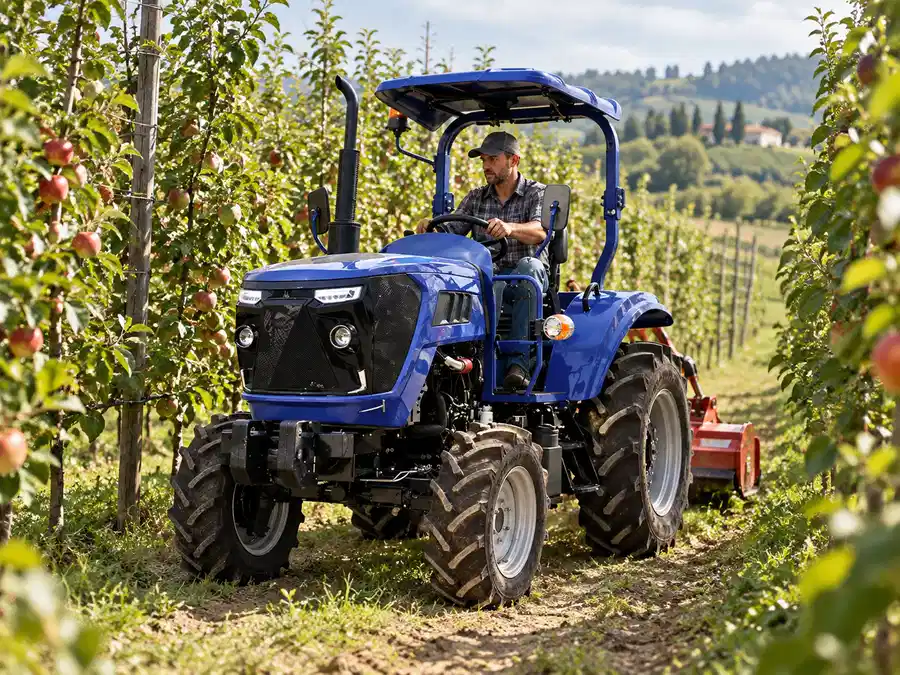
Compact tractor working between orchard rows — illustrative application.
Mixed arable farm: field deadlines first
Farm problem: cultivation and seedbed preparation have to fit into a short dry-weather window. Starting point: compare the draft requirement, hitch class, working width, field speed, and effective field capacity of the proposed implement combinations. A utility tractor may be justified if it safely supports a wider cultivation implement and consistently saves valuable workdays.
If a compact unit already completes the job in time, using a larger machine may provide little economic benefit. The correct comparison is the cost per completed job, not simply the acquisition cost per horsepower.
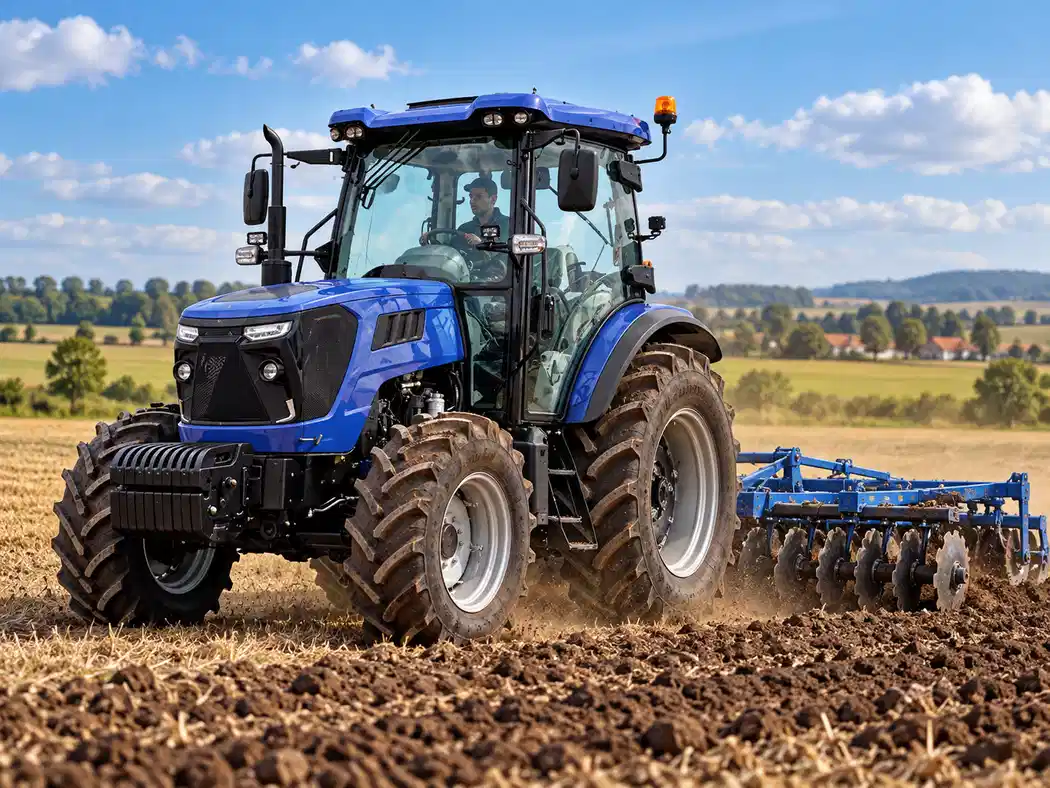
Utility tractor operating a disc harrow — illustrative application.
Livestock and grassland operation: loader cycles first
Farm problem: a single tractor mows pasture, transports feed, moves bedding, and handles bales. Starting point: calculate the heaviest real load, the required lift height, the number of loading cycles per day, and the farmyard’s available turning space. Frequent heavier handling often supports a utility-platform evaluation, provided an approved tractor-loader-ballast combination is available.
Occasional light handling is different. An appropriately configured compact tractor may be more efficient and easier to store, especially if farm buildings have restricted entrances.
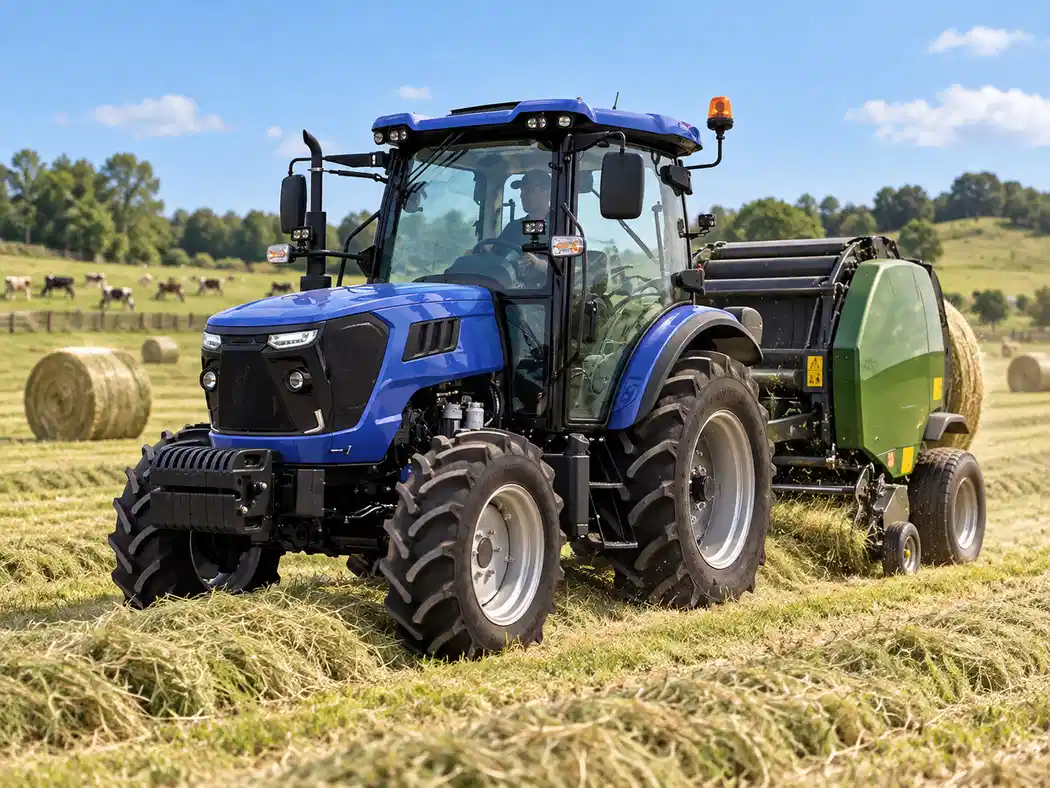
Utility tractor with a round baler on a grassland farm — illustrative application.
European agricultural dealer: configuration and documentation first
Business problem: customers request different HP levels, cab options, front loaders, and attachments, but a single generic quotation cannot address every country or application. Starting point: build a model-by-model configuration matrix showing the quoted tractor, available options, implement interface, and the conformity and registration documents that can be supplied for each destination.
A dealer should not assume that a certificate for one tractor or operator-station configuration automatically covers another. Quotation accuracy is part of after-sales risk management.
IV. Use Total Cost of Ownership to Test Whether Bigger Pays
Calculate the cost of capacity you will actually use
A utility tractor often carries a higher purchase and operating cost, but may earn it back through wider implements, fewer loader cycles, reduced contractor charges, or lower risk of missing critical field deadlines. A compact tractor can be more economical when annual utilisation is low and the farm’s tasks remain within its capability.
Use annual TCO = annualised capital cost + fuel + maintenance + repairs + tyres + insurance + other relevant expenses. Then divide annual TCO by actual annual operating hours, and compare the total cost of completing the same tasks.
Consider an illustrative case in which the utility configuration costs €1,600 more per year. At a hypothetical labour value of €25 per hour, it would need to save 64 labour hours annually to offset that difference through labour savings alone. Savings from contracting, avoiding delays, and doing new kinds of work must be evaluated separately.
If the farm uses the larger implement from Section II only three times per year, the estimated time saving is about 18 hours—not enough, by itself, to recover the full €1,600. These are planning assumptions, not OXPLO field-test data or market quotations.
A decision rule for small farms
When the workload is mostly mowing and lighter maintenance, choose a compact platform that can complete the tasks safely. When heavy tillage, Category II implements, loader handling, or contracted work form a significant share of annual hours, evaluate the next utility class. When heavy work is occasional, compare renting equipment or outsourcing it before paying for year-round unused capacity.
V. European Procurement Checks That Prevent Expensive Surprises
Distinguish CE-related paperwork, Stage V, vehicle approval, and COC
European buyers sometimes receive a document described simply as “CE certification” and assume it covers every legal requirement. That is unsafe. Engine-emissions compliance is not equivalent to whole-vehicle type approval, and neither is a substitute for checking the precise paperwork required for the intended market and use.
For applicable agricultural vehicles in the EU, Regulation (EU) No 167/2013 provides a framework for vehicle type approval and certificates of conformity (COC). Ask the supplier what documentation applies to the exact model, variant, and destination country; confirm registration or public-road use requirements with the appropriate authority. Non-EU European countries may have different rules.
Verify the final machine, not a generic product photo
The quotation should identify the tractor model, engine and emissions configuration, operator station (cab or ROPS), tyres, PTO, hydraulic connections, hitch, lighting, braking, loader, and any implements. If a customer requires a particular cabin, loader, or road-use package, obtain written confirmation of compatibility and relevant documentation before shipment.
Treat after-sales and landed cost as part of procurement
Ask how service parts are identified and ordered, what warranty terms apply, and what assistance is available for commissioning and troubleshooting. Compare delivery terms, freight, insurance, import charges, and included attachments—not just the factory price. Before dispatch, request the approved configuration sheet and relevant inspection or loading records.
VI. Where OXPLO’s 25–70 HP Tractors Fit—and Where They Do Not
The OXPLO tractor range includes six 4WD models between 25 HP and 70 HP. The practical value of this range is the ability to compare working platforms, rather than assume that an extra ten horsepower is always an upgrade. The model selection below is based on the specifications OXPLO currently publishes; the supplied configuration must be confirmed in writing.
OXT254 and OXT304: manageable power for routine small-farm work
The OXPLO OXT254 25 HP tractor and OXPLO OXT304 30 HP tractor are natural starting points for wider-row orchards, paddocks, property maintenance, and compatible mowing or lighter cultivation. Their published Category I linkage and 1,560 mm overall width make access and smaller implements central to the buying discussion.
OXPLO should not recommend these machines for heavy draft tasks merely because a customer wants the lowest entry price. The implement’s working load, PTO requirement, field conditions, and expected hours still set the minimum viable configuration.
OXT404 and OXT504: greater engine output on a compact chassis
The OXPLO OXT404 40 HP tractor and OXPLO OXT504 50 HP tractor are relevant when mixed-farm tasks require more power while compact access remains important. The OXT504 is especially instructive: OXPLO publishes it as a 50 HP, 4WD machine with 1,560 mm overall width, an 1,800 mm wheelbase, 8F + 8R transmission, and Category I linkage.
For a customer with narrow entrances and existing Category I implements, the OXPLO OXT504 may solve a genuine problem: more rated engine power without moving to a physically larger utility tractor. The trade-off is equally important—it does not become a Category II heavy-implement tractor just because the engine produces 50 HP.
OXT604 and OXT704: move up when the platform must change
The OXPLO OXT604 60 HP tractor moves to a larger utility platform, and the OXPLO OXT704 70 HP tractor extends rated power on the larger platform. Buyers considering heavier implements, frequent material handling, or greater seasonal workloads should compare these models with the compact range.
Published specification | OXPLO OXT504 | OXPLO OXT604 |
Rated engine power | 50 HP | 60 HP |
Drive | 4WD | 4WD |
Overall width | 1,560 mm | 1,760 mm |
Wheelbase | 1,800 mm | 2,010 mm |
Listed machine weight | 2,200 kg | 2,500 kg |
Transmission | 8F + 8R | 12F + 12R |
Rear three-point linkage | Category I | Category II |
The OXT504 vs OXT604 comparison reveals the central decision of this guide: for some customers, the improvement is not the extra 10 HP. It is the larger OXPLO chassis, broader transmission-ratio selection, and Category II interface. Those changes matter only when they address the customer’s actual implements and workload.
For customers researching loading work, OXPLO’s tractor with front-loader buyer’s guide covers stability and loader specification in more detail. For those still deciding on rated power, the 25–70 HP tractor selection guide provides a complementary comparison.
How OXPLO can help build a quote around the job
OXPLO lists a broad range of tractor attachments, but not every attachment is appropriate for every model. The OXPLO tractor configuration page and attachments and parts support page provide starting points for a matched package covering compatible implements, tyre choices, and available support information.
A useful request to OXPLO is not “Please quote a 50 HP tractor.” It is “We have a 1.9 m gate, a Category I mower requiring a stated PTO output, 350 annual tractor hours, and delivery to Italy. Which OXPLO tractor, PTO configuration, tyres, documentation, and shipping arrangement can you confirm?” That request makes it possible to eliminate unsuitable configurations before price negotiations begin.
VII. Frequently Asked Questions
Is a compact tractor sufficient for a 10-hectare farm?
Often, but acreage alone cannot answer the question. A 10-hectare orchard focused on mowing and light maintenance may fit an appropriately configured compact tractor; a 10-hectare holding with heavy cultivation and a tight weather window may require a larger utility platform. OXPLO can compare its compact and utility models against the actual implements and work schedule.
Is a 50 HP compact tractor equivalent to a 60 HP utility tractor?
No. OXPLO’s OXT504 and OXT604 differ in size, transmission and rear linkage, not only engine output. An OXPLO OXT504 may better suit restricted access and Category I equipment, whereas the OXT604 is the starting point when Category II compatibility and a larger platform are required.
Can I use my existing mower, disc harrow, or rotary tiller with OXPLO?
Possibly. Send OXPLO the implement model, required PTO speed and power, hitch category, working weight, hydraulic needs, and intended working conditions. OXPLO can then review the candidate tractor-and-implement combination; no attachment should be assumed compatible solely because both products appear in the same catalogue.
Do OXPLO tractors include a COC for every European market?
Do not assume so. Request written confirmation of the precise vehicle approval, COC availability where applicable, emissions and other documents for the quoted OXPLO model and configuration in your destination market. This is particularly important if public-road registration or a specific cab or loader configuration is required.
When is a utility tractor worth the higher ownership cost?
When its additional implement compatibility, traction capability, loader productivity, or effective field capacity produces a measurable benefit across the farm’s annual workload. Compare the OXPLO compact and utility candidates on completed-work cost and operational constraints rather than engine HP alone.
What should I send OXPLO to receive a useful tractor recommendation?
Give OXPLO your destination country, farm application, estimated yearly operating hours, dimensions of narrow access routes, current implements, loader load and lift-height requirements, preferred cab or ROPS, tyre needs, and public-road use or documentation requirements. The OXPLO team can use this information to discuss a realistic configuration and quotation.
VIII. Conclusion: Select the Platform That Solves Your Farm’s Bottleneck
The best answer to compact tractor vs utility tractor begins with the farm’s bottleneck. If access, lighter implement work, and annual ownership cost dominate, a compact platform often makes sense. If heavier rear implements, recurring loader operations, or tight fieldwork windows dominate, a larger utility platform may deliver value that a smaller machine cannot.
Make the decision in this order: workload → access and soil conditions → PTO, hitch and hydraulic compatibility → field capacity → annual TCO → destination-market documentation. Engine horsepower comes into that process, but it should not lead it.
With six 4WD models spanning 25–70 HP, OXPLO can discuss both compact and utility configurations against a buyer’s real application. Share the job requirements, current implements, and destination country—not just a horsepower target—to obtain a more useful model comparison.
Next step: Contact OXPLO for a tractor and attachment configuration review. Include the main farm tasks and the heaviest recurring implement or loader load so the OXPLO recommendation can focus on technical fit before price.
Editorial note: Published OXPLO product specifications and optional configurations may be updated. PTO speeds, transmission data, loader specifications, and regulatory documents should be verified against the final model-specific quotation.