
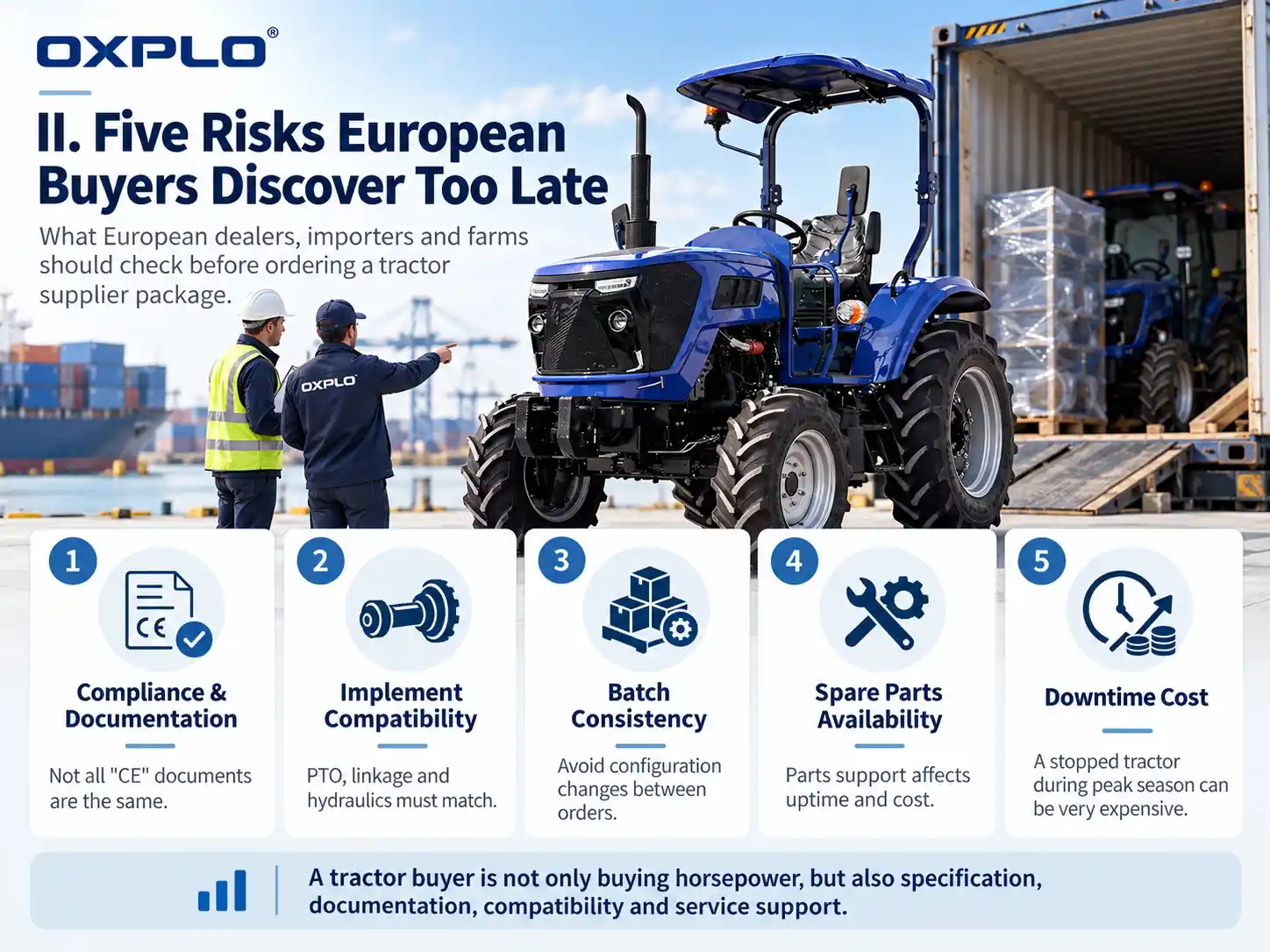
A tractor can arrive looking exactly like the machine you ordered and still become a procurement problem. The engine configuration may not match the documentation expected for the destination market. The PTO or three-point linkage may not suit the implements already owned by the customer. A second production batch may arrive with component changes that complicate parts stocking. And when a hydraulic fitting, filter or electrical component is needed two years later, the supplier may not be able to identify which version was installed.
For a European dealer, fleet operator or commercial farm, those are not minor specification issues. They affect registration, resale, inventory turnover, service workload, seasonal uptime and total cost of ownership (TCO).
That is why choosing a tractor supplier should not begin with the question, “Who has the lowest 50 HP price?” It should begin with a much more demanding question: “Which supplier can repeatedly deliver the exact configuration, documentation, parts support and technical response my market or operation needs?”
This guide shows how to answer that question. It is designed for buyers comparing a farm tractor supplier, sourcing wholesale tractors, evaluating a tractor supplier China option for Europe, or building a long-term relationship with an agricultural machinery supplier.
I. Why Choosing a Tractor Supplier Is Harder Than Comparing Tractor Prices
Two suppliers can quote tractors that look almost identical on paper: 50 HP, 4WD, diesel engine, PTO, three-point linkage, cab and front-loader option. Yet those machines can create very different ownership outcomes.
The difference is usually not visible in the headline specification. It appears in the details: which engine is actually installed, whether PTO speed and spline match local implements, whether the hitch category fits the buyer’s attachment fleet, how hydraulic outlets are configured, whether road-use equipment is correct, how spare parts are identified, and whether the same specification can be repeated six months later.
A capable tractor supplier is therefore controlling a configuration, not merely selling a model name.
Why this matters by buyer type
- Farm buyers risk purchasing a tractor that cannot efficiently operate the implements they already own.
- Dealers risk importing a configuration that is difficult to resell or expensive to support locally.
- Fleet operators risk multiplying maintenance complexity across every unit in the fleet.
- Contractors risk losing revenue when a machine stops inside a short planting, mowing or harvesting window.
The supplier evaluation process has to reflect those different operating risks.
II. Five Risks European Tractor Buyers Often Discover Too Late
1. Documentation does not match the exact tractor
A generic statement such as “CE available” is not enough for a professional European purchase. Agricultural and forestry tractors are covered by the EU type-approval framework under Regulation (EU) No 167/2013. Buyers should confirm which model, engine and configuration the supplied documents apply to, and what is required in the destination country.
Reference: EUR-Lex — Regulation (EU) No 167/2013
2. Horsepower is correct, but the implement interface is wrong
A tractor advertised at the right engine horsepower can still be unsuitable if PTO output, PTO speed, spline, hydraulic flow, lift capacity, Category I/II linkage, implement weight or ballast requirement is wrong. European buyers often already own mowers, rotary tillers, trailers, sprayers, balers or loaders. Compatibility must be confirmed against those implements, not inferred from engine HP.
3. The sample is good, but the second batch is different
Component substitutions are normal in manufacturing, but uncontrolled substitutions are a procurement problem. If the second batch uses different filters, alternators, hydraulic fittings or electrical components without traceability, the dealer effectively inherits multiple service specifications under one product name.
4. Spare parts exist, but cannot be identified quickly
“We can provide spare parts” sounds reassuring until the tractor is stopped during the busiest week of the season. The real question is whether the supplier can identify the correct part from a model, serial number, part number, photo and operating history, then confirm availability and delivery time.
5. The FOB price looks low, but the landed and operating cost is high
Freight, import charges, local assembly, compliance work, spare-parts stocking, financing, downtime and dealer inventory carrying cost can easily exceed the difference between two factory quotations. This is why a supplier comparison should be built around TCO rather than unit price alone.
III. Start With the Farm Job, Not the Horsepower
A weak request says: “Please quote your 50 HP tractor.” A professional request describes the work the tractor must perform.
Build an application brief before asking for quotations
Requirement | Information to Define |
Main jobs | Mowing, tillage, transport, loader work, spraying, cultivation |
Implements | Type, width, weight, manufacturer and minimum power requirement |
PTO | Required speed, spline and continuous load |
Three-point linkage | Category I, Category II or other interface requirement |
Hydraulics | Flow, rear remotes, loader valve and coupler requirement |
Terrain | Flat, rolling, steep, wet, loose or hard surface |
Access | Row spacing, gate width, building height and turning area |
Tyres / ballast | Agricultural pattern, traction requirement and stability |
Annual use | Estimated operating hours and seasonal peaks |
Destination | Country, road-use requirement and documentation |
Quantity | Trial unit, fleet batch or recurring dealer stock |
This application-first approach forces every tractor supplier to respond to the same operating requirement. It also reveals which suppliers understand the work and which suppliers are simply matching your enquiry to the nearest model number.
Horsepower is only the first filter
Engine HP does not automatically tell you PTO performance, traction, hydraulic capability, lift capacity or whether the chassis is suitable for the intended implement. The limiting implement should normally set the minimum useful configuration.
For example, a farm using a heavy PTO-driven mower should verify PTO power demand and the ability to maintain PTO speed under load. A loader-intensive livestock operation should focus more heavily on chassis, hydraulic performance, ballast and axle loading. A vineyard buyer may accept lower horsepower if compact dimensions and manoeuvrability are the dominant constraints.
IV. Dealer, Fleet and Farm Buyers Need Different Supplier Strategies
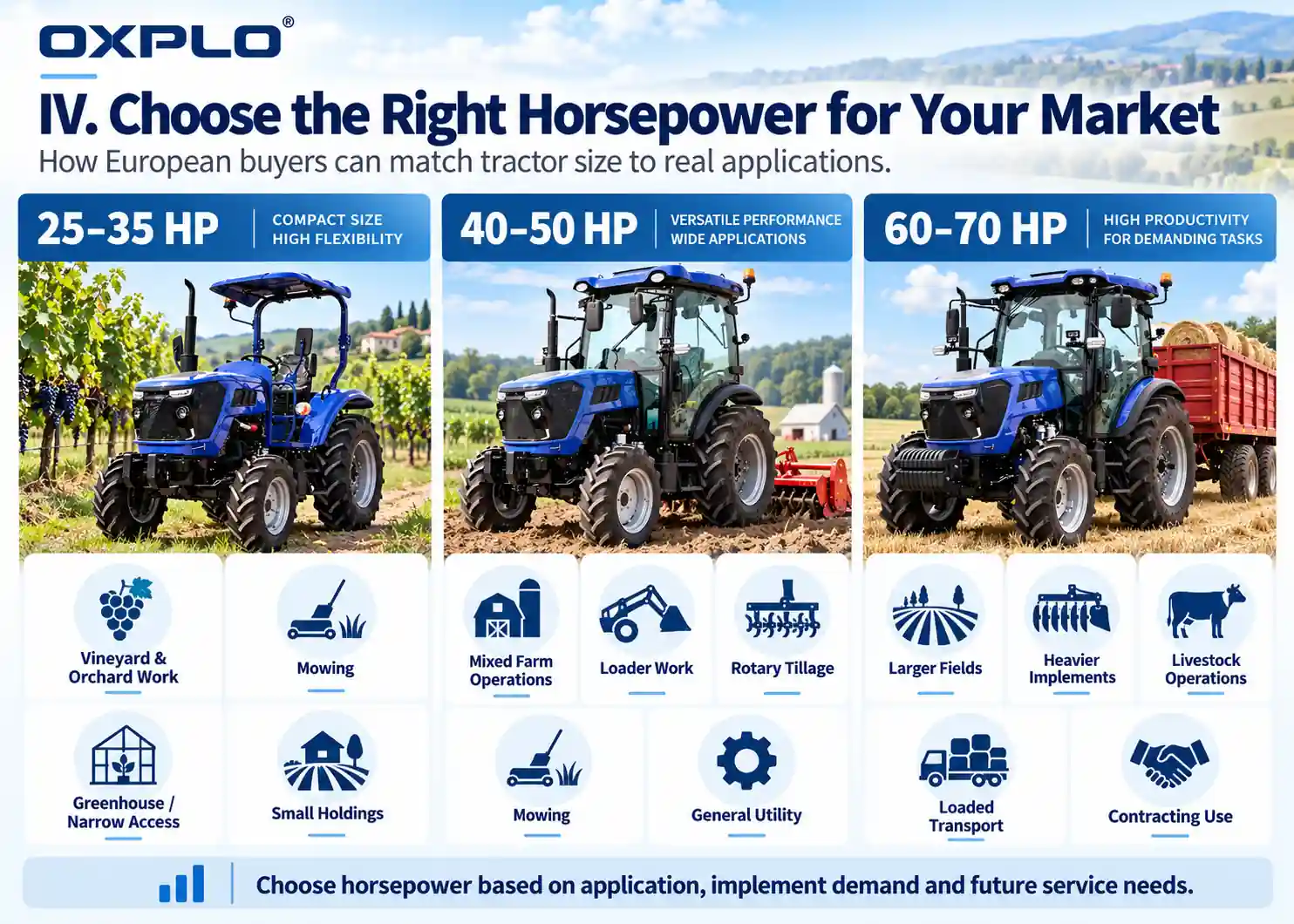
Match tractor horsepower to real applications, implement demand and local market needs.
Farm buyers: solve a defined workload
For a farm, the tractor itself remains the centre of the decision. The buyer should prioritise implement compatibility, terrain, access, annual hours, maintenance capability and spare-parts availability. Oversizing is not automatically safer: extra weight, larger turning radius, higher acquisition cost and unnecessary fuel use can be disadvantages when the workload does not justify them.
Fleet buyers: standardise before you scale
Fleet purchasing should reduce variation. Filters, belts, hydraulic components, electrical parts, tyre sizes and service intervals should be common wherever practical. A small saving on the purchase price can be lost if every batch creates another parts list and another technician learning curve.
Dealers: machine suitability is not the same as inventory suitability
A dealer is making a forecast about future customers. The right stock mix depends on local crops, farm size, common implements, cab preference, winter use, road movement, financing and dealer service capability. A dealer serving vineyards should not build inventory the same way as a dealer serving livestock farms or broad-acre mixed farming.
A practical dealer stock question is not “Which horsepower sells best in Europe?” It is “Which two or three configurations solve the largest number of recurring jobs in my territory without creating excessive parts and service complexity?”
V. What European Buyers Should Confirm Before Ordering
Model-specific conformity and approval documents
Confirm what documents are available for the exact tractor model and configuration. Do not assume one certificate or one engine approval covers every variant in the supplier’s catalogue. Ask what will accompany the machine and which items need to be retained by the importer or dealer.
Engine and emissions configuration
European buyers should confirm the exact engine installed, its identification, the applicable emissions configuration and whether that configuration matches the documentation for the destination market. This confirmation should happen before production, not after the container arrives.
PTO and three-point linkage
Check PTO speed, spline and the three-point hitch category against the existing implement fleet. A dealer should think in terms of the installed base of implements in the territory: a tractor that forces customers to replace or adapt equipment is harder to sell, even when its engine power is attractive.
Road-use equipment
If tractors will travel between fields on public roads, confirm the destination-specific requirements for lighting, braking, mirrors, labels and other road-use equipment. The supplier should know which elements are part of the factory configuration and which responsibilities remain with the importer or dealer.
OXPLO example: confirm by model, not by assumption
OXPLO’s current European tractor pages list six 4WD power classes from 25 to 70 HP and explicitly state that CE-related documents should be confirmed by model and configuration. See OXPLO 25–70 HP tractor options and European order support.
VI. Why the Cheapest Tractor Can Produce the Highest TCO
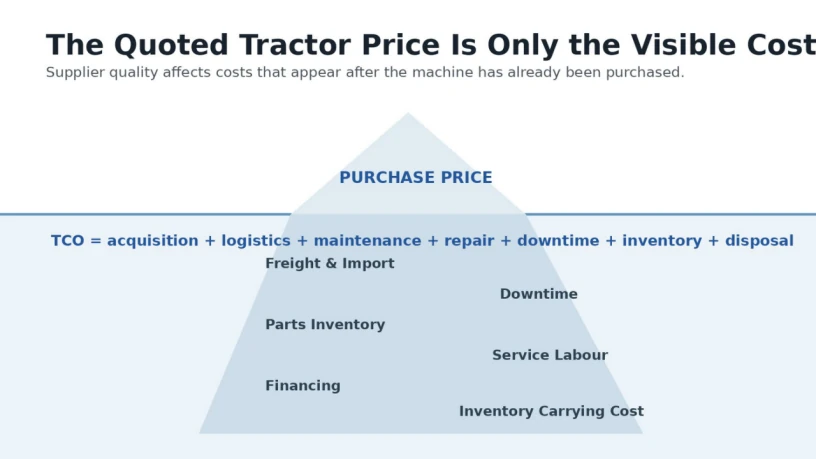
Quoted purchase price is only one part of total cost of ownership.
A practical tractor TCO model should include acquisition, freight, import costs, financing, scheduled maintenance, unscheduled repair, downtime, parts inventory, technician labour, inventory carrying cost and eventual disposal or resale.
Consider a dealer that saves USD 1,000 per tractor on a ten-unit order. The immediate saving is USD 10,000. That saving can disappear if the supplier delivers inconsistent components, creates one unresolved documentation problem, forces the dealer to hold a wider parts inventory or causes several machines to wait for parts during peak season.
This does not mean the more expensive quotation is automatically better. It means the supplier comparison must quantify downstream risk rather than treating FOB price as the entire purchasing decision.
A useful commercial rule
Rewrite every quotation into the same cost basis: identical tractor specification + identical options + identical documentation + identical delivery point + the same tax assumptions. Only then compare price.
VII. How to Audit a Tractor Supplier Before Paying a Deposit
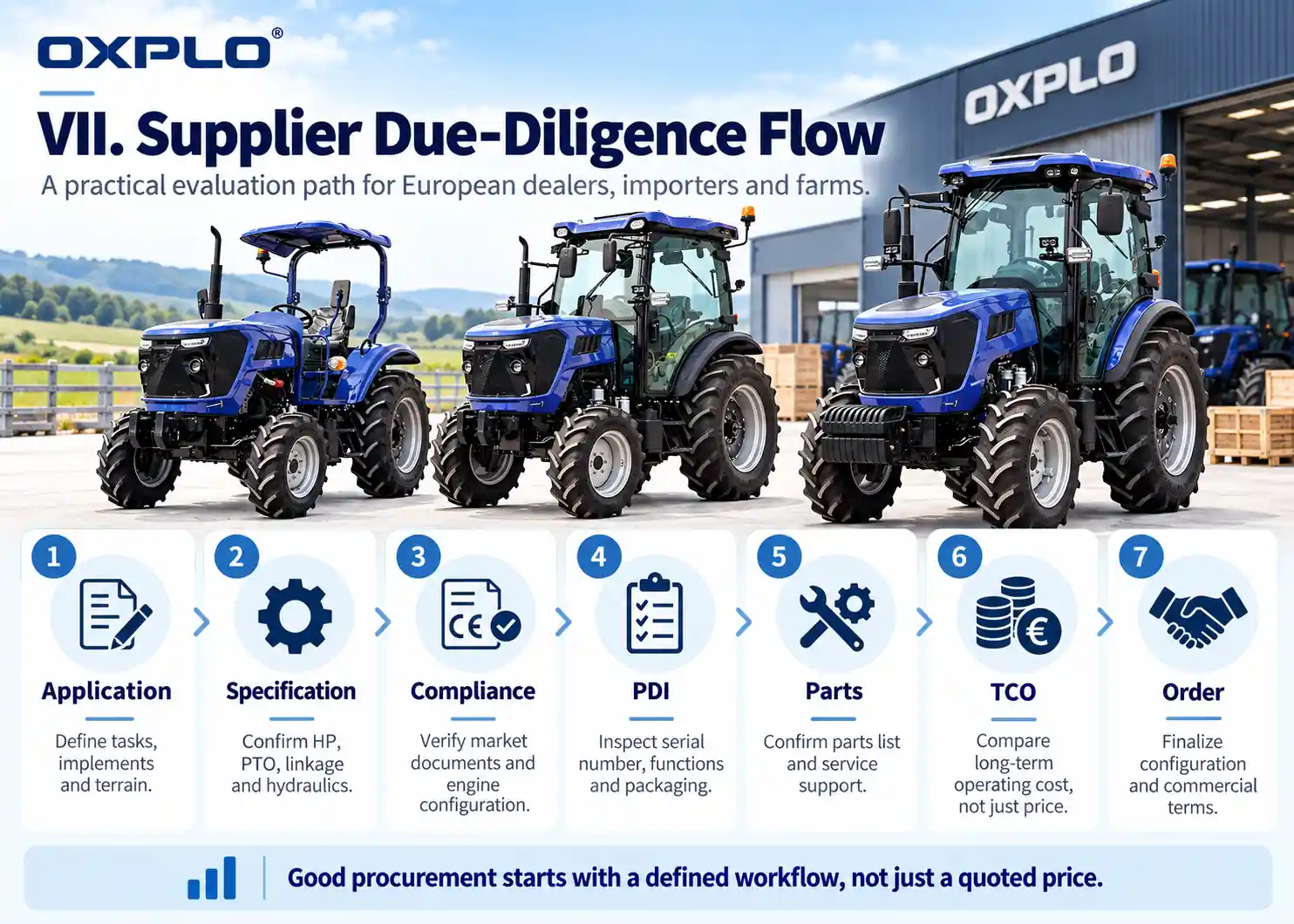
A practical supplier due-diligence flow for European dealers, importers and farms.
Ask for a configuration sheet
The configuration sheet should identify the actual machine being purchased, not simply the catalogue family. It should cover model, rated power, engine identification, transmission, 2WD/4WD, PTO, hitch category, hydraulic outlets, tyre sizes, dimensions, cab/open station, attachments, ballast and destination-market items.
Test the supplier with a real technical question
Instead of asking only for price, send a working scenario: implement width and weight, annual hours, field type, terrain, transport load and destination. Then observe whether the supplier asks follow-up questions. Useful questions about PTO demand, implement weight, slope, road movement and hydraulics are evidence that the supplier is evaluating the application rather than merely closing the enquiry.
Check batch-change control
Ask whether major component substitutions are communicated before production, whether serial numbers can be tied to configuration records and whether service parts can be identified later from the tractor serial number. Manufacturing can evolve; what matters is whether the change is controlled and traceable.
Check the support workflow
A useful support process is specific: model + serial number + operating hours + symptom + photos/video + diagnosis + parts identification + repair guidance. A vague promise of “one-year warranty” is not a service workflow.
VIII. Eight Red Flags When Evaluating a Tractor Supplier
1. The supplier asks only for horsepower and quantity.
A technical supplier should also ask about implements, terrain, use hours, destination and working conditions.
2. “CE no problem” is the complete compliance answer.
Ask which model, engine and configuration the documents cover.
3. There is no final specification sheet.
If the commercial agreement only says “50 HP tractor with cab,” too many details remain open to interpretation.
4. The supplier cannot provide a parts catalogue or stable part identification.
Future service becomes dependent on photos, memory and personal contacts.
5. Major components change without notification.
Dealers can end up stocking parts for several undocumented versions of the same model.
6. Only polished marketing images are available.
A professional buyer should be able to review actual production, serial plates, packing and pre-shipment inspection evidence.
7. Warranty exists, but the claim process is undefined.
Ask who diagnoses the issue, what evidence is required and how parts or technical guidance are supplied.
8. Technical questions always return to price.
If the supplier cannot discuss PTO, linkage, hydraulics, ballast or implement compatibility before the order, after-sales support is unlikely to be easier.
IX. How to Structure a Trial Order Before Buying Wholesale Tractors
The first order should reduce uncertainty, not maximise volume.
Stage 1 — Trial units
Use one or two representative machines to validate local implement compatibility, documentation, transport, dealer preparation, operator feedback, service access and parts identification.
Stage 2 — Small commercial batch
After the trial configuration is proven, order a small batch around the most common local applications. Track assembly time, customer questions, parts demand and any configuration changes.
Stage 3 — Specification freeze
Document the final engine, PTO, hitch, hydraulic, tyre, electrical, cab and attachment configuration. This becomes the baseline for repeat orders.
Stage 4 — Scale the dealer or fleet programme
Only after the configuration and support process are proven should the programme expand into a wider model mix or larger recurring orders.
This staged approach is particularly important when evaluating a new tractor supplier China relationship for Europe. The buyer gains real evidence before committing working capital to a larger inventory position.
X. Pre-Shipment Inspection Checklist for Imported Tractors
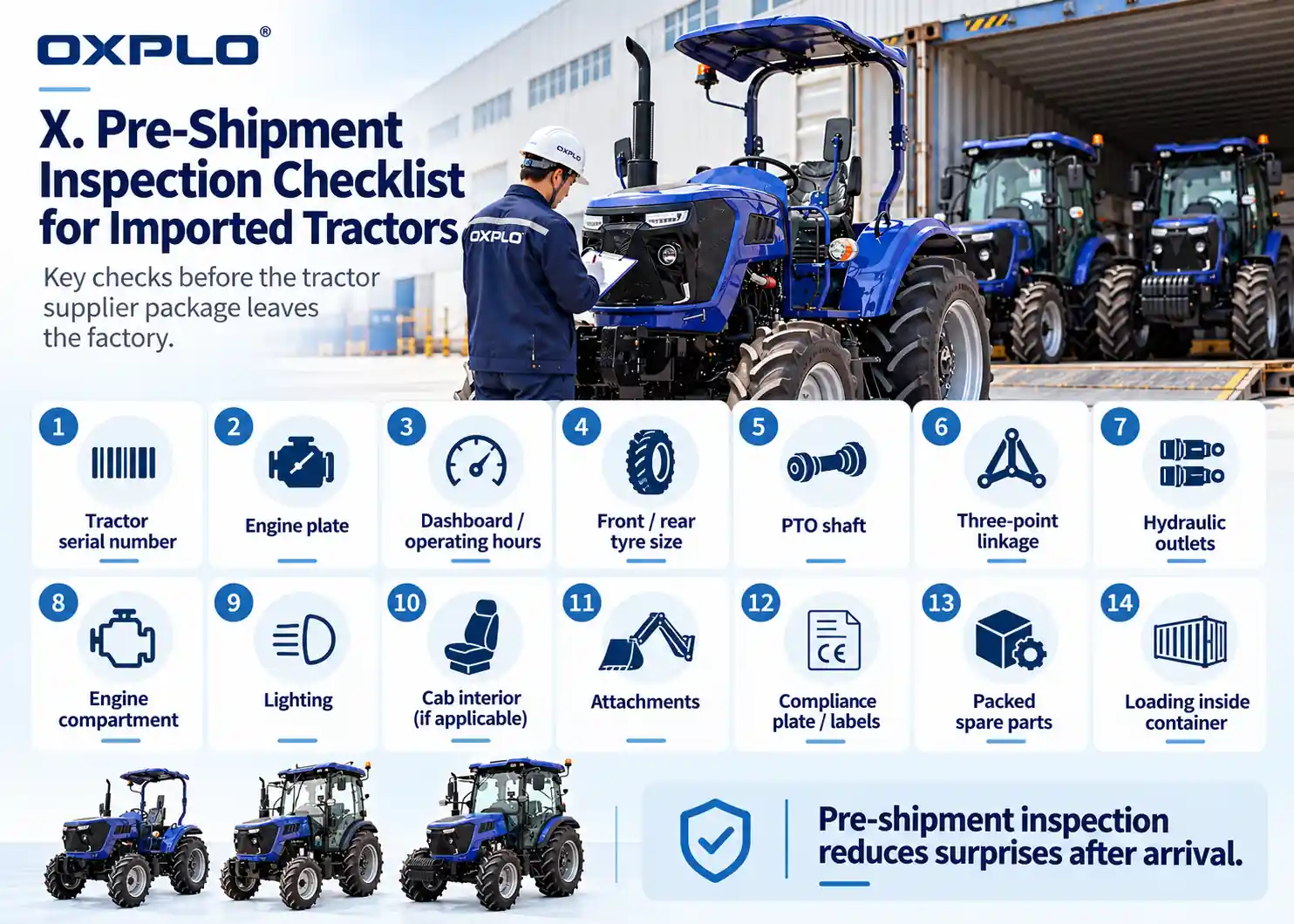
Pre-shipment inspection should verify the ordered tractor configuration before loading.
A pre-delivery or pre-shipment inspection should link the purchase order to the exact machine. For dealer orders, each inspection record should be tied to the tractor serial number.
Identity and configuration
- Model and serial number
- Engine identification
- Transmission and 4WD configuration
- Front and rear tyre sizes
- PTO speed/spline
- Three-point linkage category
- Hydraulic outlets
- Cab/open-station configuration
- Ordered loader, counterweights and attachments
Functional checks
- Cold or normal starting behaviour where practical
- Forward/reverse operation
- Steering and brakes
- 4WD engagement
- PTO engagement
- Three-point lift
- Hydraulic outlet function
- Instrument panel and lights
- Visible leaks, damaged hoses or loose wiring
Packing and documents
- Manuals and labels
- Commercial and packing documents
- Model-specific conformity documents
- Spare-parts package
- Attachment packing
- Container loading and securing
For remote international purchasing, ask the supplier to provide dated photos or video showing the serial plate, engine plate, PTO, linkage, tyres, hydraulic couplers, dashboard, attachments, packing and container loading.
XI. Spare Parts and Seasonal Downtime: The Cost Buyers Forget
A tractor that stops during winter storage and a tractor that stops inside a five-day mowing window do not create the same business loss. For agriculture, downtime cost is highly seasonal.
Evaluate parts before the machine is purchased
Ask the tractor supplier for a recommended first-service and first-year parts package based on expected operating hours. Depending on the model, this may include oil filters, fuel filters, air filters, hydraulic filters, belts, seals, fuses, switches and other recurring service items.
Dealers should go further and ask which parts are sensible to stock locally, how parts are identified, whether exploded diagrams are available and how urgent shipments are handled.
OXPLO support workflow
OXPLO’s current support page asks customers to prepare the machine model, serial number, purchase date, issue description, operating hours and photos/videos when support is required. It also lists parts identification, maintenance guidance, fault-code analysis and remote troubleshooting as possible forms of technical assistance. See OXPLO Parts & Technical Support.
That structure matters because cross-border after-sales service depends on accurate identification. The faster the supplier can move from “what machine is this?” to “what component and action are required?”, the lower the avoidable downtime.
XII. How to Evaluate a Tractor Supplier in China for the European Market
A tractor supplier China sourcing strategy can offer useful advantages: broader configuration flexibility, direct factory communication, OEM/ODM possibilities, attachment combinations and competitive dealer pricing. Those advantages are real, but they come with responsibilities for the importer.
Clarify five issues before payment
- Standard vs optional equipment: cab, air conditioning, tyres, rear remotes, weights, loader, PTO, lighting and attachments.
- Final specification control: the quotation, technical sheet and production order should describe the same machine.
- Packing and container plan: confirm wheel/cab removal where applicable, corrosion protection, attachment packing and load securing.
- Incoterm and landed cost: EXW, FOB, CIF and delivered pricing cannot be compared as though they contain the same responsibilities.
- After-sales workflow: define how diagnosis, parts identification, technical guidance and warranty claims will be handled across borders.
The goal is not to eliminate every sourcing risk. It is to convert unknown risks into controlled processes before the buyer commits to volume.
XIII. How OXPLO Approaches European Tractor Procurement
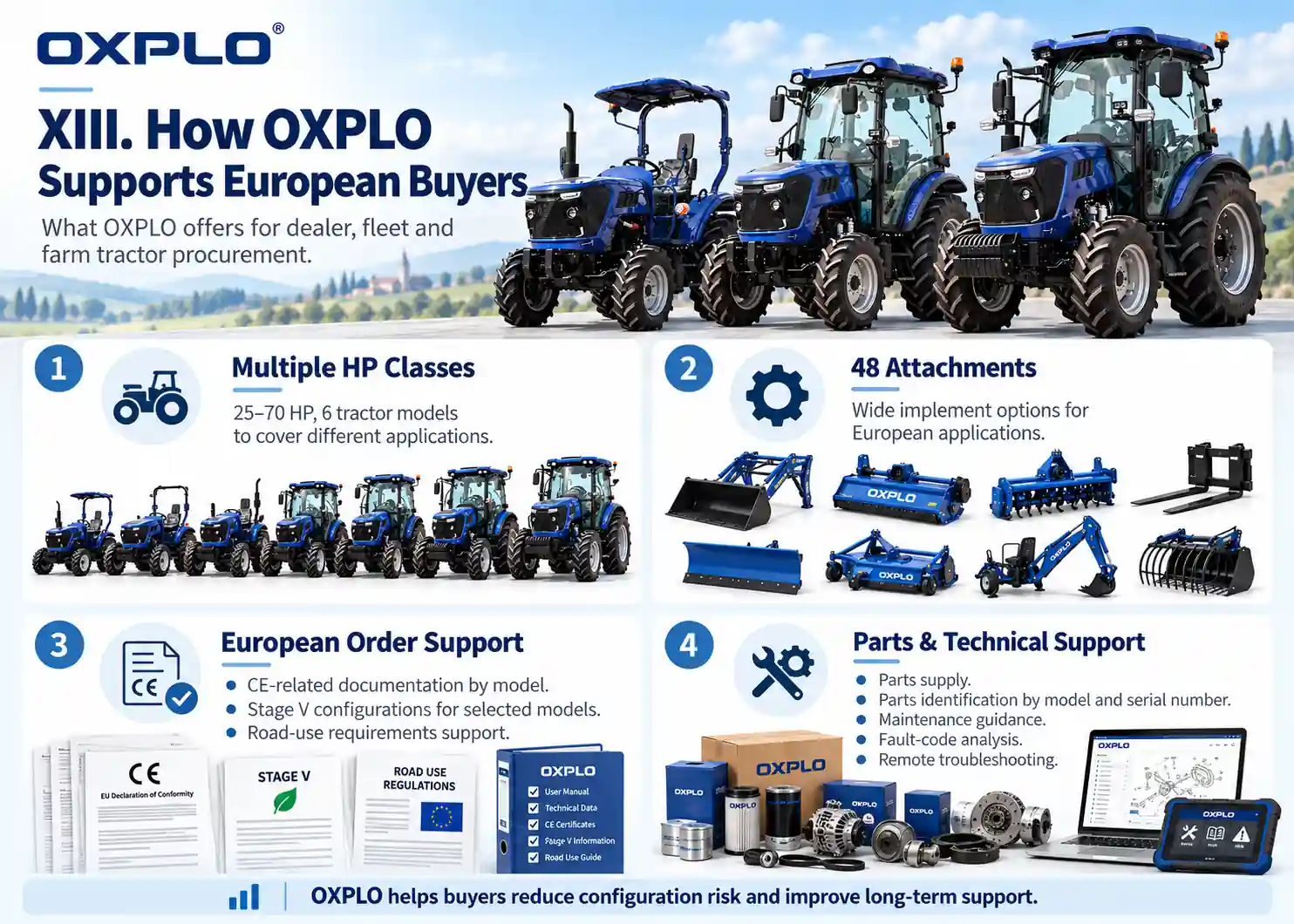
OXPLO support for European buyers: HP coverage, attachments, documentation, parts and technical support.
OXPLO’s current tractor range covers six listed 4WD models from 25 HP to 70 HP. The important point for a dealer is not simply that OXPLO has six horsepower numbers; the range spans different work profiles and two hitch categories, allowing buyers to build a more coherent product mix around customer applications.
25–30 HP: compact work
The OXPLO OXT254 and OXT304 are positioned for vineyards, orchards, mowing, light transport and other applications where access and manoeuvrability are important. These models use Category I linkage in the current public specification.
40–50 HP: versatile mixed-farm work
The OXPLO OXT404 and OXT504 move into more recurring mowing, tillage, transport and mixed-farm applications. The OXT504, for example, is currently listed at 50 HP with 4WD, 8F + 8R transmission and Category I linkage, making it relevant to buyers who need more power while remaining within a compact implement platform.
View the OXPLO OXT504 50 HP tractor.
60–70 HP: larger utility platform
The OXPLO OXT604 and OXT704 move into a larger Category II utility platform for heavier implements, larger fields, more frequent transport and higher daily workload. This is an important purchasing distinction: moving from 50 HP to 60–70 HP changes more than engine output; it changes the platform available to the buyer.
Compare OXPLO tractor models and applications.
48 attachment options: useful because tractors work inside an implement system
OXPLO currently lists 48 tractor attachment options across soil preparation, mowing, transport, planting and other jobs. The business value is not the number itself. The value is the ability to discuss tractor and implement compatibility in the same purchasing process — HP, PTO, hitch category, hydraulics, implement weight and working conditions can be checked before the machine becomes dealer stock.
Explore OXPLO tractor attachments and support.
European order support: verify the destination configuration
OXPLO’s European tractor page states that model-specific CE-related documents are available for applicable models and configurations and encourages buyers to confirm destination-market requirements before ordering. That is the correct procurement approach: documentation should be tied to the machine being purchased rather than treated as a generic marketing label.
Parts and technical support: build traceability into the relationship
For dealer and multi-unit purchases, OXPLO supports parts enquiries, technical assistance and bulk-order discussions. Support requests are structured around machine identification and evidence, which is essential when the machine and service team are in different countries.
For a serious OXPLO quotation, the most useful enquiry is therefore not simply “send me your dealer price.” Provide destination country, applications, implements, required horsepower range, annual workload and expected quantity. OXPLO can then discuss the configuration as a procurement package rather than as a generic tractor listing.
Visit the OXPLO tractor selection and dealer/bulk order page.
XIV. 25 Questions to Ask Every Tractor Supplier
- Which tractor configuration do you recommend for my actual implements and workload — and why?
- What is the exact engine model and rated output?
- What PTO speed, spline and usable PTO specification apply?
- What three-point hitch category and lift capacity are supplied?
- What hydraulic flow and rear outlets are available?
- What are the front and rear tyre sizes?
- What ballast is recommended for my loader or implement?
- What are the machine dimensions and ground clearance?
- Which items in your product photos are optional?
- Which destination-market documents apply to this exact configuration?
- What engine/emissions configuration will be installed?
- What road-use equipment is included?
- Can you provide the final specification sheet before deposit?
- How are specification changes controlled after the order?
- Can the tractor serial number be linked to its production configuration?
- Can you provide a PDI record by serial number?
- Will you provide pre-shipment photos/video of the actual units?
- Is there a parts catalogue with stable part numbers?
- Which service parts should I stock locally?
- How do you identify a part if the buyer does not know its part number?
- What information is required for a warranty or technical-support request?
- What is the typical process for urgent parts?
- What is included in the quoted Incoterm?
- How are tractors and attachments packed for container shipment?
- What trial-order structure do you recommend before a larger dealer or fleet purchase?
XV. Conclusion: Buy a Supply System, Not Just a Tractor
European buyers are not only buying a tractor. They are buying a specification, a documentation package, an attachment interface, a spare-parts system and a future service relationship.
For a farm, the supplier must help match the machine to the work. For a fleet, the supplier must also control repeatability and maintenance complexity. For a dealer, the supplier becomes part of a much larger commercial system that includes compliance, inventory, local service, spare parts and repeat orders.
A disciplined buying sequence is therefore:
APPLICATION → SPECIFICATION → EU CHECK → TRIAL → PDI → PARTS → LANDED COST → SCALE
If several of those stages remain unresolved, the procurement process is not finished — even if the tractor price has already been negotiated.
For buyers evaluating OXPLO as a tractor supplier, the current 25–70 HP range, 48 attachment options, European order support, model-specific documentation confirmation, parts enquiries and technical-assistance workflow provide a practical starting framework for dealer, fleet and farm discussions.
Start with the work, not the catalogue. Visit OXPLO Machinery or send your application details for a tractor recommendation.