
A practical implement-compatibility guide for European farmers, contractors, dealers and equipment buyers
Buying a tractor by horsepower alone is one of the easiest ways to end up with a machine that looks correct on paper but performs poorly once real implements are connected. A 50 HP tractor may have enough engine output for the job and still be the wrong purchase because the PTO speed, PTO shaft, hydraulic circuit, three-point hitch, implement weight or ballast requirement does not match the customer’s working system.
This problem is especially relevant in Europe, where a single tractor is often expected to mow, cultivate, spread fertiliser, move trailers, maintain grassland and support loader work across the same season. The question is therefore not simply, “How much horsepower do I need?” The more useful question is, “What must this tractor power, lift and control every week?”
The following buying framework treats tractor PTO, tractor hydraulics and the three-point hitch as one implement interface. It is designed to help buyers avoid the common situation where a machine is technically connectable but operationally disappointing.
I. Why Horsepower Alone Creates Expensive Tractor-Matching Errors
A tractor does not create value in isolation. It becomes productive only when engine output can be transferred into useful work through the correct interface. PTO-driven implements need the right rotational speed and usable PTO power. Hydraulic implements need the correct flow, pressure and valve arrangement. Mounted equipment needs the correct hitch category, lift capability and geometry. Front and rear attachments also change axle loading and stability.
That is why two tractors with the same rated horsepower can deliver very different results on the same farm. One may run a mower comfortably but cycle a loader too slowly. Another may have plenty of hydraulic performance but use a hitch platform that is poorly matched to the farm’s existing implement fleet.
Technically Compatible Is Not the Same as Operationally Matched
It helps to classify compatibility at three levels. The first level is “not compatible”: the implement cannot connect or operate correctly. The second is “technically compatible”: the implement connects and functions. The third is “operationally matched”: the tractor can perform the job repeatedly with adequate power reserve, hydraulic response, stability and operator control.
Compatibility Level | What It Means | Typical Risk |
Not Compatible | PTO, hydraulic or hitch interface does not match | Cannot commission the implement without changes |
Technically Compatible | The implement connects and operates | May still be slow, unstable or near the tractor’s limit |
Operationally Matched | Power, flow, lift, stability and reserve fit recurring work | Best basis for predictable productivity and TCO |
A mower spinning correctly in the yard does not prove that the tractor can hold PTO speed through dense grass for an eight-hour day. A loader lifting one bucket does not prove that the hydraulic cycle time is productive when hundreds of cycles are required. A rear implement that fits the linkage does not prove that front axle load remains adequate when the implement is raised for road transport.
Buyer rule: Do not approve a tractor because each individual interface “works.” Approve the complete tractor–implement combination for the customer’s normal workload. |
II. Tractor PTO: Why “540 RPM” Is Not Enough Information
The tractor PTO is one of the most important agricultural power interfaces because it transfers mechanical power directly from the tractor to implements such as rotary tillers, mowers, spreaders, post-hole diggers and other driven equipment. For any PTO tractor purchase, however, the PTO cannot be reduced to one line in a quotation such as “PTO: 540 rpm.” That is not enough information for a professional purchase.
Check PTO Speed, Shaft and Spline Separately
The implement manufacturer’s required PTO speed must be the starting point. If a driven implement is operated materially above its intended shaft speed, driveline and gearbox components can be subjected to overspeed. If it is operated below the intended speed, cutting quality, spreading pattern, rotor performance or throughput may fall.
However, PTO rpm does not automatically tell you the physical shaft configuration. Export tractor configurations and implement drivelines vary. A safe procurement specification therefore states the PTO speed, shaft specification and spline count separately. “PTO included” or “540 compatible” is too vague for a B2B order.
Engine Horsepower and PTO Horsepower Are Not the Same Number
Rated engine horsepower is not the same as power available at the PTO shaft. Mechanical and auxiliary losses occur before engine output reaches the implement. If an implement manufacturer specifies a minimum PTO horsepower, compare that requirement with usable PTO output rather than assuming that the engine’s advertised horsepower is the same value.
This becomes more important under heavy field conditions. Dense vegetation, deeper tillage, higher travel speed, slope and changing soil resistance can all increase demand. A tractor operating exactly at an implement’s minimum PTO requirement may technically work but provide little reserve when conditions become difficult.
For recurring commercial work, the recommended PTO horsepower range is usually more useful than the absolute minimum. Minimum tells you whether the implement may operate. Recommended power is a better indicator of whether the tractor can maintain production when conditions are less favourable.
III. Tractor Hydraulics: Flow, Pressure and Cycle Time Matter
Hydraulic performance becomes critical as soon as the tractor is expected to run a front loader, hydraulic cylinder, grapple, mower head or hydraulic motor. This is one of the specifications buyers most often discover too late because quotations sometimes describe the system only as “standard hydraulics.”
A useful hydraulic review should identify pump flow, operating pressure, usable auxiliary flow, the number and type of remote circuits, whether continuous flow is required, the return-line arrangement and the coupler configuration. Loader valve requirements should also be confirmed when a front loader is part of the current or future plan.
Flow Controls Speed; Pressure Creates Force
In simplified terms, hydraulic flow largely influences how fast a cylinder or hydraulic motor can operate, while hydraulic pressure influences available force or torque. This distinction explains why a tractor can have enough pressure to lift a loader bucket but still feel slow during repetitive loading because the available flow is limited.
A useful theoretical relationship is: Hydraulic Power (kW) ≈ Flow (L/min) × Pressure (bar) ÷ 600. Real usable power is lower because the pump, valves, hoses and actuator introduce losses. The formula is not a substitute for the manufacturer’s hydraulic data, but it is a useful way to understand why pressure alone does not describe system productivity.
Small Cycle-Time Differences Become Labour Cost
Consider a loader configuration that adds eight seconds to one complete lift–dump–return cycle. At 150 cycles per working day, the difference is about 20 minutes. Across 100 working days, that is roughly 33 labour hours. For occasional loader use, the difference may be irrelevant. For livestock yards, contractors or repeated material handling, it can become a real operating-cost issue.
The correct question is not, “Which tractor has the biggest hydraulic pump?” It is, “What hydraulic demand does my most frequent attachment create?” Overspecifying hydraulics adds cost without value when attachments cannot use the additional capacity. Underspecifying it turns every repetitive task into a productivity penalty.
Count Hydraulic Functions, Not Just Couplers
A row of hydraulic couplers does not automatically confirm that the implement is fully compatible. Count the independent functions. One double-acting cylinder requires control in both directions. Multiple cylinders may need separate circuits. Hydraulic motors may require continuous flow, low-restriction return or a dedicated drain arrangement. Those requirements should be identified before the tractor is ordered.
IV. 3 Point Hitch Tractor Compatibility: Category, Lift and Stability
The three-point hitch is often reduced to “Category I” or “Category II,” but category is only the first compatibility check. A 3 point hitch tractor must also be evaluated for implement geometry, lift requirement, centre of gravity and the effect of the attachment on tractor stability.
Category I and Category II Are Working Platforms, Not Only Different Pin Sizes
Category I is commonly associated with smaller, lighter implement systems, while Category II is used with larger utility tractors and heavier equipment. Adapters and bushings can sometimes solve a physical pin mismatch, but they cannot change the tractor’s wheelbase, mass, lift geometry, PTO output or front axle loading.
This is why “we can use an adapter” should never be the final engineering answer. The real question is whether the implement is appropriate for the complete tractor platform.
Published Lift Capacity Is Not the Same as Usable Implement Weight
Suppose a rear hitch is rated for 1,200 kg and the implement weighs 1,050 kg. That comparison alone does not prove suitability. The load acting on the linkage depends on where the implement’s centre of gravity sits relative to the hitch. A longer implement places more of its mass farther behind the tractor, increasing leverage and affecting both lift requirement and front axle load.
When comparing tractor specifications, ask where the lift rating is measured and how the proposed implement is carried. A nominal lift figure without its measurement condition is not a complete compatibility statement. Good tractor specifications should state the measurement basis clearly enough for the buyer to compare the number with the actual implement geometry.
Ballast Is Part of the Configuration
A heavy rear implement transfers load away from the front axle. If the front becomes too light, steering response, front-wheel traction and slope stability can deteriorate. Front-loader work creates the opposite problem by increasing front axle loading, so suitable rear ballast may be required. For recurring loader or heavy mounted-implement work, ballast is not an afterthought; it is part of the machine configuration.
V. Check PTO, Hydraulics and Hitch as One Working System
Many buying mistakes happen because the purchaser checks PTO, hydraulics and the rear hitch as three separate yes/no items. All three may appear compatible and the machine can still be poorly matched.
Example: 50 HP Tractor With a Rotary Tiller
Assume a 50 HP tractor has the correct hitch category and the correct PTO speed for a rotary tiller. On paper, the combination looks right. Field performance can still be poor if the tiller is too wide, usable PTO reserve is small, the soil is heavy, working depth is aggressive, tyre traction is inadequate or the implement moves too much load away from the front axle. The failure is not one incorrect specification; it is a system mismatch.
Example: Tractor With a Front Loader
A buyer may request a loader because the tractor will move feed, soil, fertiliser, pallets or bales. Engine horsepower alone says very little about loader productivity. Hydraulic flow, valve configuration, loader geometry, front axle loading, attachment type and counterweight all become part of the operating system. A configuration that is acceptable for occasional loading may be frustrating for daily material handling.
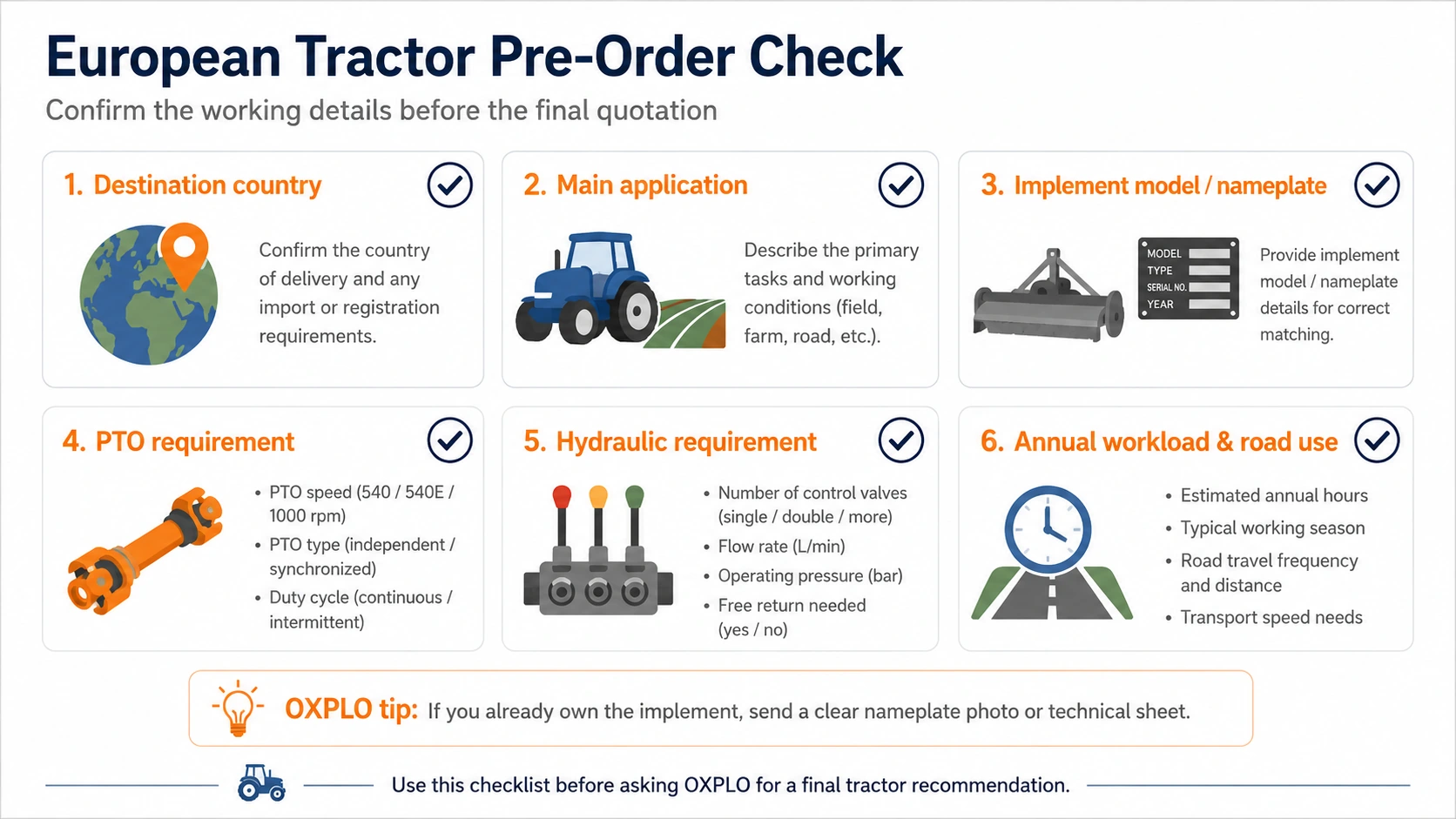
Figure 1. OXPLO pre-order checklist for European buyers. Confirm the destination, application, implement, PTO and hydraulic requirements before the final quotation.
The critical distinction: “Can operate” and “should operate every day” are different questions. Dealers and fleet buyers should specify for recurring workload, not a one-time demonstration. |
VI. What European Buyers Need to Confirm Before Shipment
European farm conditions add another layer to tractor selection because the machine often needs to integrate with an existing implement fleet, fit older farm infrastructure and meet destination-market requirements. These variables should be resolved before production and shipment, not after the tractor reaches the customer.
Existing Implements May Be More Valuable Than the New Tractor
Established farms and dealers may already own mowers, tillers, spreaders, trailers and cultivation equipment. Replacing serviceable implements simply because the new tractor uses a different interface can erase the saving from a lower purchase price. Record the existing implement PTO speed, spline, hitch category, weight, working width and hydraulic requirements before selecting the replacement tractor.
Access and Terrain Can Eliminate a Tractor Before Horsepower Matters
For vineyards, orchards, livestock yards and older farm properties, gateway width, row spacing, headland turning space, building height, slope and soft ground can matter as much as engine output. A heavier tractor can improve traction and stability but also increase turning space and soil loading. A smaller tractor may preserve access but have less reserve for heavy implements. There is no universal optimum; the trade-off must be connected to the actual site.
Road Use and Destination-Market Documentation Must Be Confirmed
For EU orders, buyers should confirm the applicable vehicle approval and emissions configuration for the exact tractor and intended use. Regulation (EU) No 167/2013 establishes the EU approval framework for agricultural and forestry vehicles, while tractor engine emission provisions are linked to the EU Stage V framework through the relevant regulatory structure. The practical procurement lesson is simple: do not reduce European compliance to a generic “CE yes/no” question.
For tractors expected to use public roads, the final configuration may also need market-specific confirmation of lighting, braking, mirrors, tyres, operator protection, vehicle approval or conformity documentation and registration-related equipment. Requirements can vary by vehicle category and destination country, so the final quotation and specification sheet should identify what is actually supplied.
VII. Build an Implement Compatibility Matrix Before Requesting the Tractor
The most reliable RFQ starts with the work and the implement fleet, not with a bare horsepower request. Instead of writing “Need 50 HP 4WD tractor—please quote,” create a short compatibility matrix. This lets the supplier see the true peak demand of the application and prevents the tractor from being selected around one isolated number.
Requirement | Rotary Tiller | Mower | Fertilizer Spreader |
Implement type / model | Rotary Tiller | Flail Mower | Fertilizer Spreader |
Working width | 1.6 m | 1.8 m | 1.2 m |
Minimum / recommended PTO HP | 35 / 45 HP | 25 / 35 HP | 20 / 30 HP |
PTO speed + shaft / spline | 540 rpm, 6-spline | 540 rpm, 6-spline | 540 rpm, 6-spline |
Hydraulic flow / pressure | Low / standard | Low / standard | N/A |
Hydraulic functions / remotes | 0-1 | 0 | 0 |
Hitch category | Cat I | Cat I | Cat I |
Operating weight / centre of gravity | Medium | Medium | Light |
Working frequency | Seasonal | Frequent | Seasonal |
Special requirement | Heavy soil reserve | Stable mowing speed | Even spread pattern |
The 10-Minute Pre-Purchase Check
- Main application and seasonal workload.
- Existing implement make and model.
- Minimum and recommended PTO horsepower.
- Required PTO speed.
- PTO shaft and spline specification.
- Hydraulic flow and pressure requirement.
- Number and type of hydraulic functions.
- Three-point hitch category.
- Implement operating weight, dimensions and centre-of-gravity considerations.
- Destination country, road-use expectation and access constraints.
If several of items 3 through 9 are unknown, model selection is probably premature. Ask for the implement technical sheet first. That ten-minute check is usually cheaper than sourcing adapters, changing hydraulic components or discovering after delivery that the tractor cannot work productively with the customer’s equipment.
VIII. How OXPLO 25–70 HP Tractor Platforms Address Different Working Problems
Once the implement requirements are clear, the model decision becomes much easier. OXPLO currently offers a 25–70 HP tractor range for European farm applications, with six power options and up to 48 attachment options on the OXPLO Tractor Custom page. The important point is that the range is not simply a ladder of horsepower numbers. It contains two different working platforms.
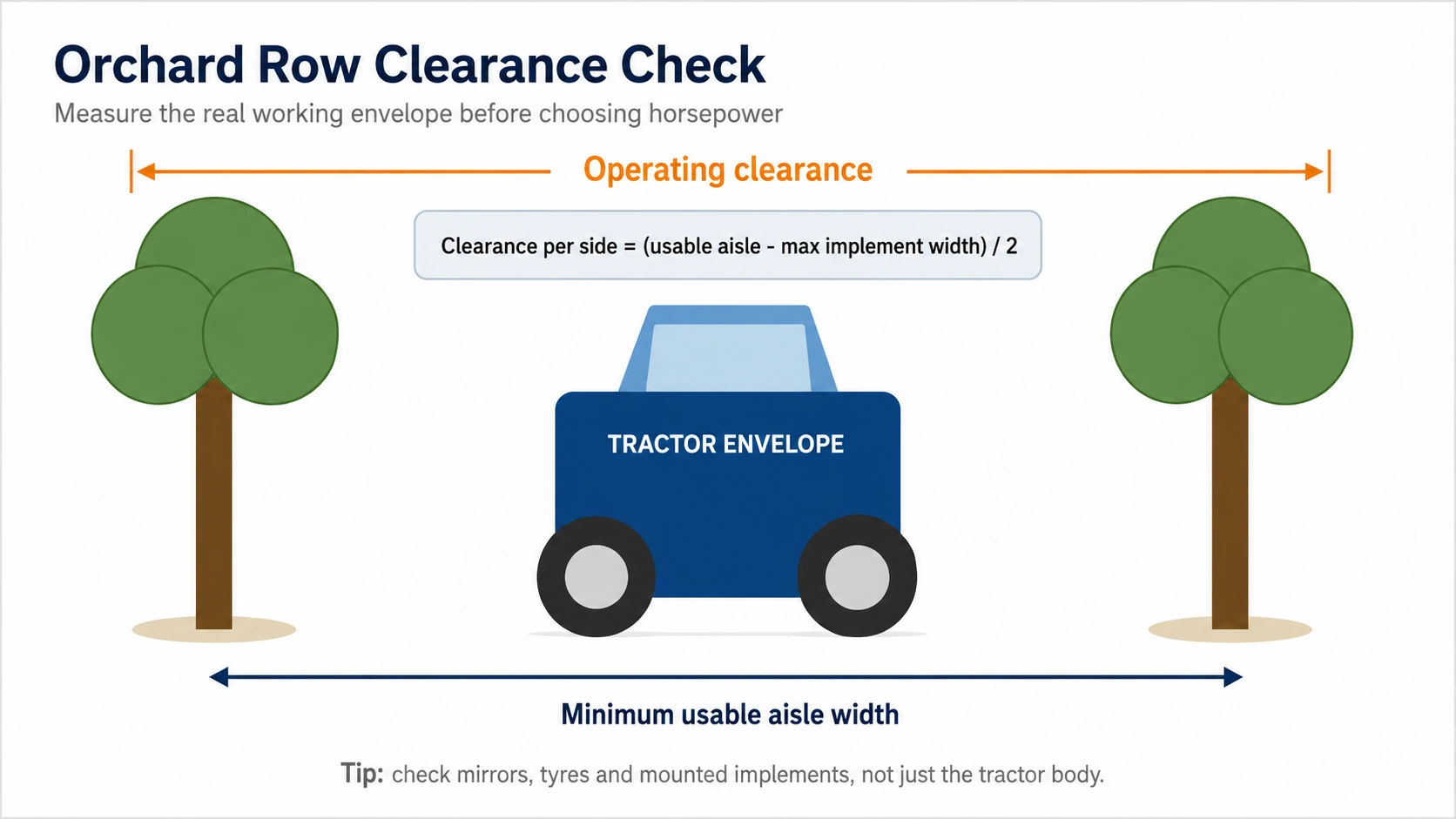
Figure 2. Sample implement compatibility matrix. Replace the example data with your actual implement fleet before choosing tractor specifications.
OXPLO Compact Category I Platform: OXT254 Through OXT504
The compact side of the OXPLO range is aimed at buyers who need useful agricultural power without automatically moving into a larger utility chassis. This is particularly relevant to European orchards, wider-row vineyards, livestock properties, estates, grassland and small-to-medium mixed farms where access remains important.
At the lower end, the OXPLO OXT254 25 HP tractor uses 4WD, an 8F + 8R transmission, Category I linkage and a published 540/1000 rpm six-spline PTO. It is intended for mowing, light cultivation, spreading, trailer movement and routine property work where adding unnecessary machine bulk would not improve productivity.
At the top of the compact platform, the OXPLO OXT504 50 HP tractor retains the compact Category I concept while increasing rated output to 50 HP. OXPLO currently lists the OXT504 with 4WD, 8F + 8R, Category I linkage and a six-spline 540/720 rpm PTO. For a European buyer, its value is not “50 HP is better.” Its value is that more output is available while compact access and Category I implement compatibility remain part of the working system.
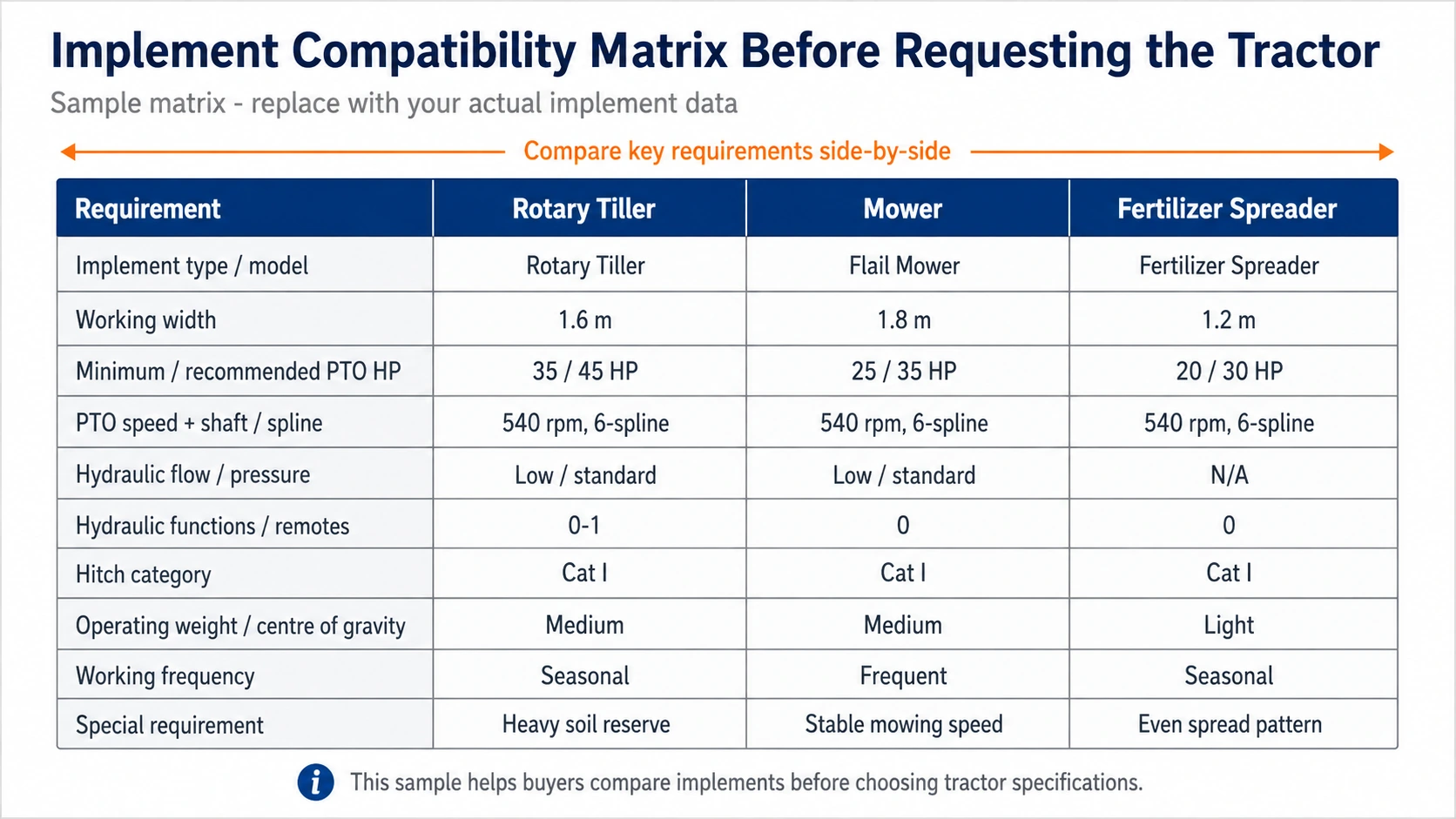
Figure 3. Orchard row clearance check. Measure the real working envelope before selecting a compact tractor for orchard work.
OXPLO OXT604 and OXT704: The Move to a Category II Utility Platform
The most important specification jump in the OXPLO range is not simply another ten or twenty horsepower. It is the transition from the compact Category I tractor platform to a larger Category II utility platform.
The OXPLO OXT604 60 HP utility tractor is the entry point to that larger platform. OXPLO currently lists it with 4WD, a 12F + 12R transmission, Category II rear linkage, 540/760 rpm PTO, a 2,010 mm wheelbase and approximately 2,500 kg listed machine weight. That change matters when customers use larger Category II implements, work longer hours or require a more substantial platform for recurring material handling and mixed-farm operations.
The OXPLO OXT704 70 HP tractor carries the same Category II utility concept with 70 HP, 12F + 12R and a published 540/760 rpm PTO. The OXPLO OXT704 is therefore more relevant when the buyer’s workload, implement size and seasonal deadlines justify additional reserve—not simply because 70 HP is the larger number.
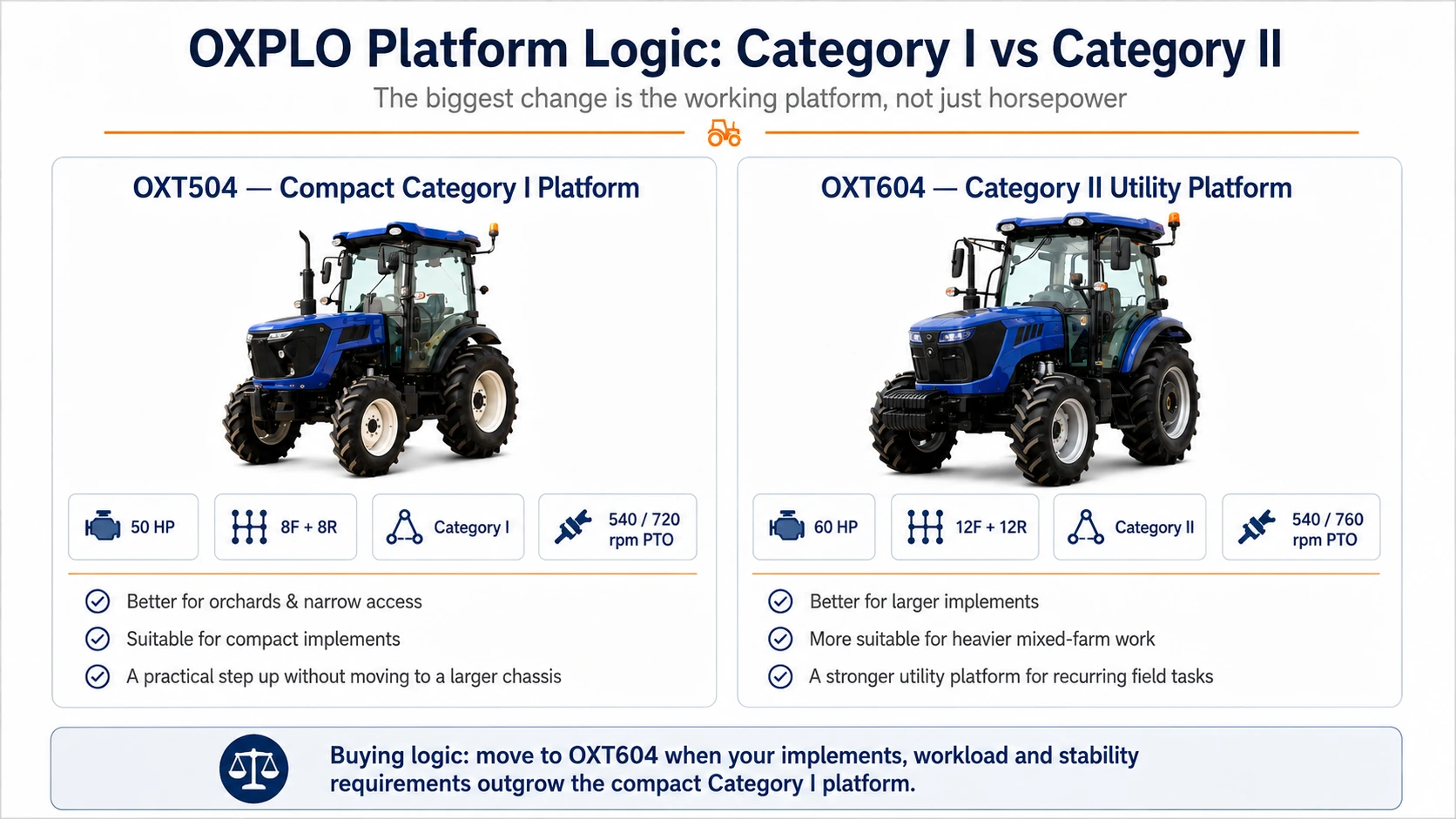
Figure 4. OXPLO platform transition: OXT504 compact Category I versus OXT604 Category II utility tractor.
Representative OXPLO Model | Rated Power | Transmission | Rear Linkage | Published PTO | Best Buying Logic |
OXT254 | 25 HP | 8F + 8R | Category I | 540 / 1000 rpm | Compact recurring maintenance and light farm work |
OXT504 | 50 HP | 8F + 8R | Category I | 540 / 720 rpm | More output while retaining compact Category I platform |
OXT604 | 60 HP | 12F + 12R | Category II | 540 / 760 rpm | Move to larger utility platform and Category II implements |
OXT704 | 70 HP | 12F + 12R | Category II | 540 / 760 rpm | Higher recurring workload, broader mixed-farm use and more reserve |
OXPLO recommends treating this table as a shortlisting tool, not a substitute for the final order specification. PTO configuration, tyres, operator station, loader preparation, market-specific equipment and documentation should be confirmed on the final OXPLO quotation and specification sheet.
IX. What OXPLO Can Help Confirm Before You Order
A useful supplier process should begin with the customer’s work rather than asking only, “Which horsepower do you want?” OXPLO can use the application, existing implements and destination market to narrow the configuration and identify which details still need confirmation before production.
When the Customer Already Owns Implements
Send OXPLO the implement model, nameplate photo or technical sheet. That gives the OXPLO team a practical basis for checking PTO speed, shaft/spline, hitch category, implement weight and hydraulic demand against the selected tractor. For dealers, this is particularly useful when the local market already has a large installed base of Category I or Category II equipment.
When the Tractor Will Perform Several Jobs
Rank the jobs by annual operating hours, peak load and seasonal urgency. OXPLO can then evaluate whether the tractor should be optimised for compact access, PTO-driven work, mixed-farm transport, Category II compatibility or a larger recurring workload. The objective is not to make every customer buy more horsepower; it is to avoid paying for capacity that is rarely used while still keeping enough reserve for the jobs that determine farm productivity.
When a Front Loader Is Planned Now or Later
Tell OXPLO about loader requirements at the quotation stage even if the loader is not being purchased immediately. Loader compatibility, hydraulic connections, attachment type and counterweight requirements can then be discussed before the tractor configuration is locked. This reduces the risk of buying a PTO-focused tractor and later discovering that the planned material-handling setup needs different hydraulic or ballast provisions.
When the Tractor Is Destined for Europe
Provide OXPLO with the destination country and expected use, including whether road travel is required. OXPLO can then confirm the available engine, operator protection, lighting, braking, tyre and documentation package for the specific market and model. OXPLO’s current tractor custom page also highlights model-specific CE documents and international order support; the exact documentation supplied should still be confirmed for the final configuration.
X. Pre-Order Tractor Specifications Every Buyer Should Confirm
Before paying a deposit, the buyer should be able to review one final document that describes the complete working configuration. This is where generic website information becomes verified tractor specifications for the actual order.
Powertrain
- Rated engine power and rated speed.
- Drive configuration and transmission.
- Tyre sizes and tyre option selected for the destination/application.
Tractor PTO
- PTO speed or speed options.
- PTO shaft and spline count.
- Available PTO power where specified.
- Operating method and driveline compatibility.
Tractor Hydraulics
- Pump and usable auxiliary flow where relevant.
- Working pressure.
- Remote-valve quantity and type.
- Coupler, continuous-flow and return requirements.
- Loader valve requirements if a front loader is included or planned.
3-Point Hitch and Stability
- Category I or Category II.
- Lift capacity and measurement condition.
- Implement geometry and operating weight.
- Front or rear ballast requirement.
- Clearance and transport stability.
European Market Configuration
- Destination-country emissions/approval configuration.
- Operator protection and guarding.
- Lighting, braking, mirrors and road-use equipment where applicable.
- Conformity/type-approval documentation supplied with the specific order.
For buyers still deciding which horsepower class is appropriate, the OXPLO horsepower selection guide provides a broader comparison. For attachments, parts and ongoing equipment support, see the OXPLO Support page.
XI. FAQ: Tractor PTO, Hydraulics and 3-Point Hitch
What is the most important tractor PTO specification?
There is no single number. Confirm PTO speed, shaft/spline configuration and the implement’s recommended PTO horsepower. For a PTO tractor, matching should be based on the implement technical sheet, not engine horsepower alone.
Is a 50 HP tractor automatically suitable for a 50 HP implement?
No. First determine whether the implement requirement refers to engine horsepower or PTO horsepower. Then check PTO speed, shaft, hitch category, implement weight, stability and hydraulic requirements.
What matters more in tractor hydraulics: flow or pressure?
They solve different problems. Pressure influences available force, while flow strongly influences actuator or motor speed. Loader productivity can therefore be limited even when the pressure figure appears adequate.
How many hydraulic remotes do I need?
Count the independent hydraulic functions on the attachment. Multiple cylinders may require separate circuits, while hydraulic motors can require continuous flow and a suitable return arrangement.
What is the difference between Category I and Category II?
Category II is a larger implement interface typically associated with larger utility tractors and heavier implements. Do not evaluate the difference only by pin diameter; geometry, lift demand, machine mass and stability also matter.
Which OXPLO tractors use the compact Category I platform?
The current OXPLO compact range includes OXT254, OXT304, OXT404 and OXT504. The OXPLO tractor range should be used for shortlisting, with the final PTO and destination-market configuration confirmed on the quotation.
Which OXPLO tractors use Category II linkage?
The current OXPLO OXT604 and OXT704 published specifications use Category II linkage and the larger 12F + 12R utility platform. These models are more relevant when the farm’s implements and recurring workload have moved beyond a compact Category I system.
What should I send OXPLO for a more accurate recommendation?
Send the destination country, main application, existing implement model or technical sheet, PTO requirement, hydraulic requirement, annual operating hours, access/terrain conditions and whether a front loader is required. If the implement is already owned, a clear nameplate photo is often more useful than simply saying “I need a mower tractor.”
XII. Conclusion: Specify the Working System, Not Just the Horsepower
The correct tractor is not the machine with the highest horsepower that fits the budget. It is the tractor that can operate the customer’s real implement fleet with the correct tractor PTO, sufficient tractor hydraulics, the right three-point hitch, appropriate stability and enough working reserve for the season.
That changes the buying sequence: Job → Implement → PTO → Hydraulics → Hitch → Weight and Stability → Tractor Platform.
For customers comparing the OXPLO 25–70 HP tractor range, this approach makes the model differences much clearer. OXPLO OXT254 through OXT504 address buyers who need compact Category I tractor platforms for mowing, cultivation, transport and routine mixed-farm work. OXPLO OXT604 and OXT704 move into a larger Category II utility platform for customers whose implements, material handling and recurring workload justify the change.
Neither OXPLO platform is automatically better. The correct OXPLO tractor is the one whose interfaces and chassis match what must be connected to the machine and what that equipment must accomplish during the working season.
Before requesting a final OXPLO quotation, prepare six items: destination country + application + implement model + PTO requirement + hydraulic requirement + annual workload. With those details, OXPLO can evaluate the tractor as a complete working system rather than guessing from horsepower alone.
Recommended OXPLO Resources | |