
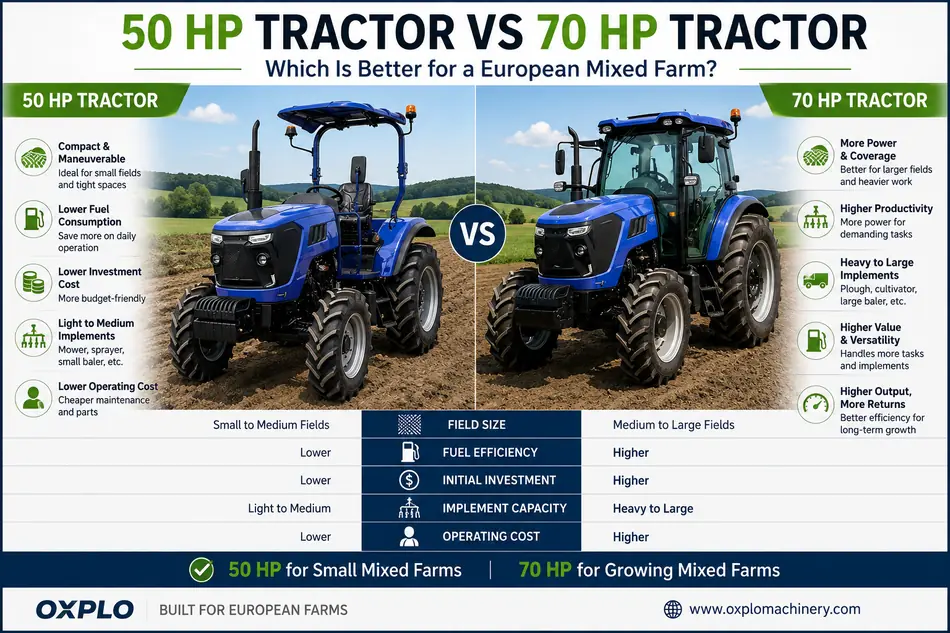
A practical selection guide for buyers comparing tractor horsepower, compact tractor platforms, utility tractors and implement compatibility.
A tractor can have the right horsepower and still be the wrong machine for the farm.
That usually happens when the buying process starts with a number – 30 HP, 50 HP or 70 HP – and works backwards. The tractor arrives with enough engine output, but another limitation appears: it is too wide for an old building entrance, the transmission has no comfortable working speed for a rotary tiller, the three-point hitch does not match an existing implement, or the loader setup needs more ballast than expected.
For buyers searching for a tractor for small farm operations, these are not unusual edge cases. They are the details that determine whether the machine becomes the farm’s most-used tool or an expensive compromise.
European agriculture makes the decision less predictable. Eurostat’s 2020 agricultural census shows how widely farm structures vary across the EU. Farm area alone therefore cannot tell a buyer how much tractor is actually needed.
A better way to specify the machine is to treat the tractor as part of a working system: implements, ground conditions, access, required work rate, tractor platform and operator workload. Tractor horsepower matters, but it should not be the first or only filter.
I. Why Farm Size Is a Poor Tractor Specification
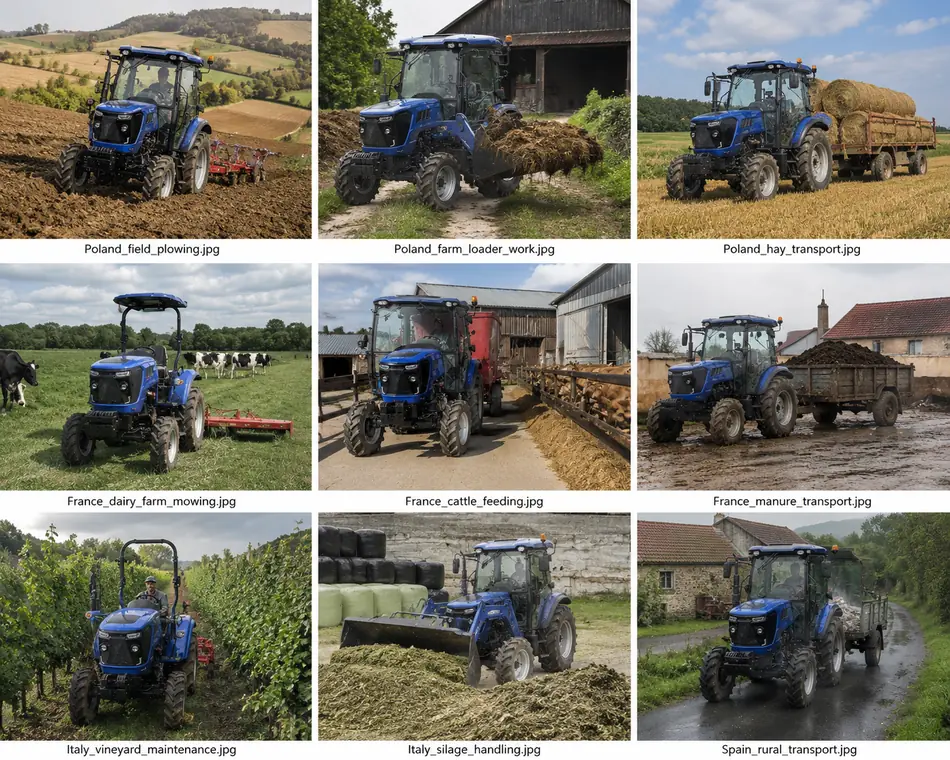
A 15-hectare vineyard and a 15-hectare livestock farm can need tractors from completely different classes. The vineyard may care most about width, turning space, PTO work and low soil disturbance. The livestock farm may spend far more hours moving feed, maintaining pasture, handling materials and towing trailers.
Even two mixed farms of the same size can be different. One may consist of large, dry, level fields. The other may have several separated plots, wet gateways, slopes, narrow public-road access, old farm buildings and short weather windows. The second farm can impose a much harder tractor duty cycle without having more hectares.
Start With Where the Tractor Actually Spends Its Hours
Before comparing tractor horsepower, list the recurring jobs and estimate how much of the annual operating time each one consumes. A simple workload table is more useful than a farm-size rule of thumb.
Farm Task | Approx. Share of Tractor Time | Main Tractor Demand |
Mowing / pasture maintenance | 25% | PTO performance, manoeuvrability |
Trailer transport | 20% | Stability, gearing, braking |
Rotary tillage | 20% | PTO power, traction |
Loader / material handling | 15% | Hydraulics, ballast, axle loading |
Spreading / spraying | 10% | PTO, low-speed control |
General farm work | 10% | Versatility and access |
If most annual hours are light mowing and transport, sizing the entire machine around one heavy operation performed twice a year may leave too much capital tied up in unused capacity. The reverse mistake is just as common: choosing a very small tractor for everyday jobs and then losing an entire day whenever the seasonal heavy job arrives.
Practical rule: Size the tractor around the most demanding recurring workload – not the easiest task and not a rare extreme job. |
II. Tractor Horsepower Is Useful Only When You Know Where the Power Has to Go
Horsepower is easy to compare, which is exactly why buyers tend to give it too much weight. A tractor does not use engine power in one way. Depending on the job, useful power is required at the PTO, through the tyres at the drawbar, or indirectly through the hydraulic system.
Engine HP Is Not PTO HP
A mower, rotary tiller, baler or other PTO-driven implement does not care about the number printed on the bonnet. It cares about usable power at the PTO shaft. Some engine output is consumed before it reaches the PTO, so an implement requiring a certain PTO horsepower cannot be matched safely by assuming engine HP and PTO HP are the same.
The practical question is whether the tractor can hold the required PTO speed when the implement reaches normal working load. A demonstration in light grass or unloaded conditions proves very little. Dense vegetation, wet residue and harder soil expose an undersized setup quickly.
A Small Drop in Working Speed Can Become a Large Seasonal Loss
Take a 1.8 m implement operating at 6 km/h. Theoretical field capacity is approximately:
Field Capacity Implement Width (m) x Working Speed (km/h) / 10 |
At 1.8 m and 6 km/h, theoretical capacity is 1.08 ha/h. If insufficient power or traction repeatedly forces the operator down to 4 km/h, it falls to 0.72 ha/h – roughly one-third less before headland turns, overlap, refilling and other field losses are counted.
This is why a small farm tractor that can technically operate an implement may still be too small to operate it economically.
Ten More Horsepower Does Not Automatically Mean a Bigger Working System
Suppose a 40 HP and 50 HP compact tractor use a similar chassis, the same linkage category, similar axle ratings and similar tyre sizes. The extra 10 HP can give useful engine reserve, but it does not automatically mean the tractor can safely carry a much heavier mounted implement or loader payload.
This distinction matters around 40-50 HP. Buyers often assume they are moving into a completely different class of tractor when they may actually be gaining engine output while retaining a compact platform. Sometimes that is exactly the right choice. Sometimes the farm needs a larger chassis, Category II linkage or more hydraulic and axle capacity instead.
III. Seven Tractor Features That Deserve More Attention Than Another 10 HP
Once the approximate power range is clear, the specification sheet becomes more useful. It also becomes more dangerous if numbers are compared without knowing how they are measured.
1. Dimensions: Start With the Narrowest Place on the Farm
Measure the narrowest gateway, barn entrance, row spacing, headland depth and storage height before choosing the tractor. Do not rely on memory or nominal building dimensions.
If an entrance is 1.75 m wide and a tractor is listed at 1.70 m, that is not necessarily comfortable clearance once tyres, mudguards, mirrors, tyre settings and steering movement are considered. For a tractor for small farm use, 100-200 mm can change daily usability.
Wheelbase matters as well. A longer wheelbase generally supports stability and ride quality; a shorter machine is often easier to manoeuvre in confined yards and rows. Neither is universally better.
2. Transmission: Ignore the Gear Count Until You Look at the Working Speeds
“12 gears” is not automatically better than “8 gears”. What matters is whether the transmission provides useful ground speeds at the engine speed needed for the job.
Rotary tilling may require the engine near the speed needed to maintain 540 PTO rpm while the tractor itself moves slowly. Mowing can need a different travel speed at roughly the same PTO requirement. If one gear is too slow and the next is too fast, the impressive gear count on the brochure does not solve the problem.
For livestock and loader work, reverse ratios and direction changes also deserve attention. Poor forward/reverse matching becomes tiring very quickly when the operator changes direction dozens of times per hour.
3. PTO: Check Speed, Power and Continuous Demand
Confirm available PTO speeds, shaft configuration, rated PTO output where provided, the engine speed required to maintain the intended PTO speed, and the implement manufacturer’s minimum requirement.
A light rotary tiller in dry soil for twenty minutes is a different duty cycle from a mower working dense vegetation for several hours. Modest power reserve is valuable; running continuously at the edge of the machine’s capability usually costs time and component life.
4. Three-Point Hitch: Lift Capacity Needs a Measurement Point
A quoted rear lift figure is not enough. Buyers should ask where the lift capacity is measured and consider the implement’s centre of gravity.
A long flail mower or rotary tiller can impose much more leverage than a compact implement of the same mass. That changes rear lift performance, front axle loading, steering feel and ballast requirement.
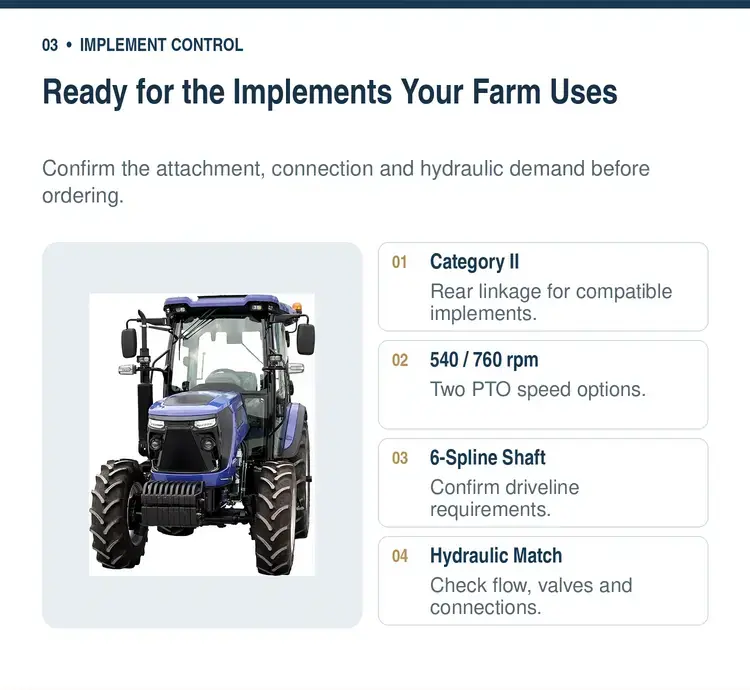
Linkage category matters too. Category I and Category II are different implement ecosystems, not cosmetic labels. A farm that already owns several Category II implements can create a costly mismatch by selecting a compact Category I tractor merely because the engine horsepower looks adequate.
5. Hydraulics: Find Out What the Published Flow Number Includes
One manufacturer may publish total pump flow. Another may publish implement-circuit flow. A third may list steering and working circuits separately. Those figures cannot be compared until the definition is clear.
For loader work, ask about usable implement hydraulic flow, operating pressure, hydraulic remotes, loader valve arrangement, cycle performance and attachment connections. Higher flow can improve cycle time, but loader productivity still depends on geometry and the tractor underneath it.
6. Loader Capacity: Ask Where the Load Is Measured
A loader capacity may be quoted at the pivot pins, at a particular height or under another defined condition. Move the load farther forward and the mechanical situation changes.
A bale, pallet or bucket load creates a moment around the tractor. Evaluate load mass, load centre, lift height, wheelbase, front axle capacity, tyre capacity and rear ballast together. “Loader compatible” does not mean every hydraulically possible lift is sensible.
7. Tractor Weight and Tyres: Traction Has a Cost
A very light tractor can struggle to transfer engine power to the ground. A very heavy tractor can compact ground that did not need to be compacted.
More mass can help cultivation traction and loader stability. On wet grassland, orchard floors, soft soils and paddocks, unnecessary mass can become a disadvantage. Tyre size, construction, tread and inflation pressure change the picture again.
The goal is not maximum tractor weight. It is enough usable weight and tyre contact area for the work being done.
IV. Five Tractor Specifications Buyers Commonly Misread
A specification is useful only when two suppliers are measuring the same thing. These five lines deserve a follow-up question before quotations are compared.
Brochure Line | What Buyers Often Assume | What to Ask Instead |
“50 HP” | All 50 HP is available at the PTO or wheels. | Is this rated engine power? What PTO output is available and at what engine speed? |
“Rear lift: 1,500 kg” | Any 1,500 kg implement can be carried. | Where is the lift capacity measured, and what happens with a long implement centre of gravity? |
“Hydraulic flow: 40 L/min” | All 40 L/min is available to the loader or remotes. | Is this total pump flow or usable implement-circuit flow? |
“Loader lift: 800 kg” | The tractor can lift an 800 kg pallet in normal operation. | At what point, height and load centre is the capacity measured, and what ballast is assumed? |
“12F + 12R” | More gears guarantee better productivity. | What are the actual ground-speed steps around the speeds used for PTO work, loader work and transport? |
These questions sound basic, but they remove a surprising amount of bad specification comparison. A buyer does not need to become a tractor engineer; the buyer simply needs enough context to understand what the number really represents.
V. Compact Tractor or Utility Tractor? The 40-50 HP Decision Is More Important Than It Looks
There is no universal horsepower line where a compact tractor suddenly becomes a utility tractor. Chassis design, linkage category, wheelbase, axle capacity and intended duty matter more than the badge.
When 25-30 HP Is Enough
A 25-30 HP compact tractor can make good economic sense when most annual work is mowing, estate maintenance, light cultivation, spreading, small-trailer transport, wider-row orchard work or paddock maintenance. Compact dimensions are useful every day in this type of workload.
The boundary appears when larger PTO implements, heavier soil work or frequent loader operations become normal rather than occasional. If those jobs are already part of the farm plan, buying exactly for today’s light workload can create another tractor purchase sooner than expected.
Why 40-50 HP Is Often the Real Decision Zone
This range can provide considerably more useful engine reserve without automatically forcing the buyer into a substantially larger tractor. For many small and medium mixed farms, that balance is attractive: one machine can cover mowing, tilling, spreading, transport, grassland work and occasional material handling.
But the engine cannot be judged in isolation. A 50 HP compact tractor may still use Category I linkage, compact tyres and a chassis designed around access and manoeuvrability. For some farms, that is the advantage. For farms using heavier Category II implements or doing daily loader work, it may be the limitation.
Staying on a compact platform simply because “50 HP should be enough” can be false economy when the real requirement is chassis, hydraulic or implement capacity.
When 60-70 HP Starts to Make More Sense
The move to 60-70 HP becomes more rational when the whole workload changes: implements become larger or heavier, Category II linkage is required, annual tractor hours increase, transport loads grow, loader use becomes routine, or seasonal work must be finished in a tighter window.
At that point the buyer is not paying only for tractor horsepower. The value is often in the larger working platform – wheelbase, operating mass, tyre package, transmission range and implement compatibility.
VI. Which Features Matter Most for Your Type of Farm?
There is no reason to give every specification equal importance. A vineyard, livestock farm and mixed arable operation should not rank tractor features in the same order.
Main Farm Work | Prioritise | Check Carefully | Do Not Automatically Maximise |
Vineyard / orchard | Overall width, turning space, PTO, tyres | Actual width and headland requirement | Drawbar power |
Mowing / grass maintenance | PTO reserve, tyres, manoeuvrability | PTO output and working speed | Tractor mass |
Mixed farming | Transmission, PTO, 4WD, linkage versatility | Implement compatibility | Extreme compactness |
Livestock / loader work | Hydraulics, wheelbase, ballast, axle capacity | Loader geometry and hydraulic circuit | Engine HP alone |
Soil preparation | Traction, gearing, weight, hitch | PTO / drawbar demand | Loader specification |
Farm transport | Stability, brakes, gearing, tyres | Road and trailer configuration | Ultra-short wheelbase |
Estate / property work | Compact dimensions, simple attachment use | Access and implement fit | Heavy utility platform |
This is a better starting point than asking whether a 20- or 30-hectare farm needs 40 or 50 HP. A tractor for medium farm livestock work may need a stronger utility chassis even when engine demand is moderate. A tractor working similar acreage in an orchard may need the opposite: less width, lower mass and easier turning.
The useful comparison is always between the farm’s recurring constraints and the tractor’s complete platform.
VII. The Hidden Cost Is Usually Not the Tractor Price
Purchase price is visible. The cost of an unsuitable tractor appears slowly, which is why it is so easy to underestimate.
Simplified TCO Purchase + Finance + Fuel + Maintenance + Repairs + Tyres + Labour + Downtime – Residual Value |
The Slightly Undersized Tractor
Suppose a farm saves money by buying one tractor class smaller. Most of the year it seems fine. During mowing or cultivation season, however, it works one gear lower, travels more slowly, operates close to full load and becomes more sensitive to difficult ground conditions.
If the machine adds 15 hours to a seasonal operation, the penalty is not merely 15 hours of diesel. It is 15 hours of operator time, depreciation, maintenance exposure and lost weather flexibility. That is where a low purchase price can become an expensive working hour.
The Oversized Tractor Is Harder to Notice
Oversizing creates fewer obvious complaints because the tractor finishes the work. It simply carries unnecessary cost every time it does so: higher capital, larger tyres, more transport mass, less access and potentially more soil loading.
If a 70 HP utility tractor spends most of the year doing jobs comfortably handled by a 40-50 HP compact tractor, the problem is not capability. It is capital utilisation.
For a small or medium European farm, the target is therefore not the cheapest machine and not the largest affordable machine. It is the tractor that spends most of its life in an efficient working range while keeping enough reserve for regular peak loads.
VIII. A Practical Tractor Selection Process Before You Ask for a Quotation
The quality of the recommendation depends heavily on the information sent to the supplier. “Please quote a 50 HP tractor” gives very little engineering information. A better enquiry describes the work.
1. List the Main Jobs
Record the five or six jobs the tractor will perform most often and, if possible, estimate annual hours. Do not size the tractor around a theoretical application that may never happen.
2. List Existing and Planned Implements
For every important implement, record type, working width, weight, hitch category, PTO speed, minimum PTO power and hydraulic requirement. If the implement already exists, send the model or specification sheet.
3. Measure Access
Provide the narrowest gate, barn door, row spacing, height restriction and turning area. A technically powerful tractor that cannot reach the work is still the wrong tractor.
4. Describe Ground and Terrain
State whether the tractor will mainly work on dry cultivated ground, heavy clay, wet grassland, slopes, loose soil or hard farm roads. This affects tyres, traction, ballast and power reserve.
5. Define Loader Work Properly
Do not write only “front loader required”. State what the loader will handle – feed, soil, fertiliser bags, a 400 kg pallet, round bales or something else – and the required lift height.
6. State the Required Work Rate
If mowing, tillage or transport must be completed within a specific weather window, say so. A larger tractor can be justified by time rather than by the implement’s minimum horsepower.
7. Confirm Destination-Market Approval and Documentation
For EU-bound tractors, confirm the approval and documentation applicable to the exact tractor category, engine configuration and destination country. Do not rely on a generic statement such as “EU compliant”.
For complete agricultural and forestry vehicles in the EU, the type-approval framework includes Regulation (EU) No 167/2013. In practice, buyers should ask what approval, conformity, engine/emissions and destination-market documents apply to the exact ordered configuration. Implements and attachments may have a different conformity route and should be checked separately.
This is also a useful point to separate mechanical suitability from paperwork. The right tractor is not automatically the right import or registration configuration. Both need to be confirmed before the order is finalised.
IX. How the OXPLO 25-70 HP Range Fits This Selection Logic
Once the workload, implements and farm geometry are clear, horsepower becomes useful again. OXPLO currently structures its European tractor offering across 25, 30, 40, 50, 60 and 70 HP. Buyers can review the OXPLO tractor range or use the OXPLO tractor configuration page to compare the platform around the actual application rather than choosing by HP alone.
The useful distinction inside the OXPLO range is the change from compact Category I tractors into a larger Category II utility tractor platform. That change affects far more than engine output.
OXPLO 25-30 HP: Keep the Platform Compact When the Work Is Genuinely Light
The OXPLO OXT254 and OXPLO OXT304 sit at the compact end of the range. They are the more relevant OXPLO choices when mowing, orchard maintenance, light cultivation, spreading and modest transport dominate the annual workload.
For buyers searching for a tractor for small farm work, this class makes sense when access and low unnecessary machine mass create more daily value than higher drawbar capacity. The key is to check the heaviest recurring PTO implement before deciding that 25-30 HP is enough.
OXPLO 40-50 HP: More Reserve Without Immediately Leaving the Compact Class
The OXPLO OXT404 and OXPLO OXT504 occupy the middle of the OXPLO compact tractor range. This is often the most interesting zone for a small farm tractor that has to do several different jobs through the year.
The commercial advantage is not simply “more horsepower.” A 40-50 HP OXPLO compact tractor can give more reserve for PTO work, transport and soil preparation while retaining a more manageable footprint than the larger utility platform.
The limit still has to be respected. If the farm’s recurring jobs require Category II implements, heavier loader work or a more substantial chassis, adding engine power inside the compact platform will not remove that mismatch. OXPLO buyers should therefore compare implement category and work pattern before treating the OXT504 as a substitute for a larger utility tractor.
OXPLO 60-70 HP: Choose the Larger Platform Because the Job Needs It
The OXPLO OXT604 and OXPLO OXT704 move into the larger OXPLO utility tractor platform with Category II linkage and a broader 12F + 12R transmission arrangement.
This class is more appropriate when larger implements, higher transport loads, frequent loader work or longer annual operating hours justify the larger working system. For a tractor for medium farm operations, those platform differences can matter far more than the extra 10 or 20 HP shown on a comparison table.
OXPLO does not need every customer to move to the largest model. A 30 HP OXPLO tractor can be the correct commercial choice if access and light PTO work dominate. An OXPLO OXT604 or OXT704 is more rational when the farm repeatedly needs the larger linkage, transmission range and utility platform. The job should decide.
OXPLO Attachments: The Tractor Is Only Half of the Working System
OXPLO also offers a broad tractor attachment range, with up to 48 attachment options shown across its tractor configuration and support content. This matters on small and medium farms because the return on one tractor often depends on how many seasonal jobs it can cover.
A mower, rotary tiller, trailer, harrow, spreader or loader should not be selected merely because it can be attached physically. OXPLO configuration work should check tractor horsepower, PTO speed and power, linkage category, hydraulic requirement, implement mass and any ballast implications together.
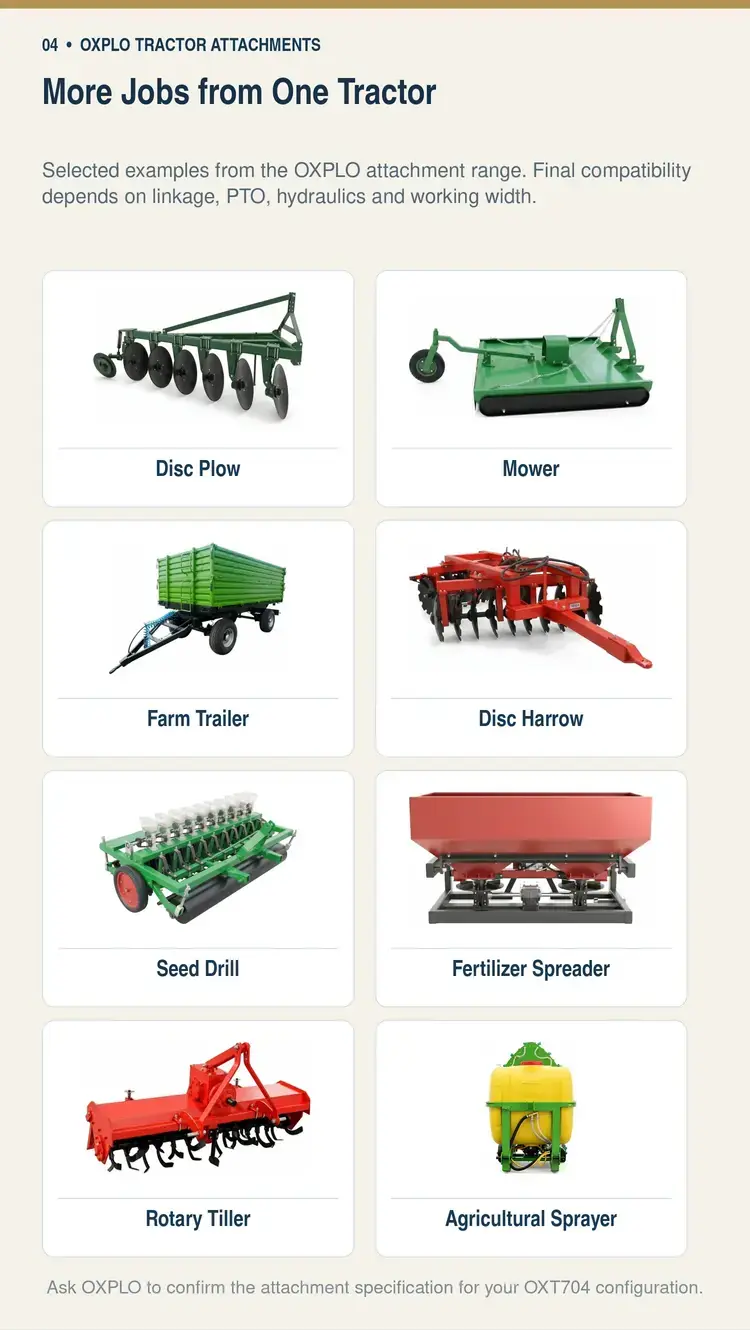
This is where a relatively modest tractor can outperform a larger but poorly matched machine. If the tractor-implement system is correct, the farm gains productive hours. If the interface is wrong, more engine power rarely fixes the underlying problem.
X. Conclusion: Specify the Work Before You Specify the Tractor
For small and medium European farms, no single feature should dominate the buying decision – not even tractor horsepower.
A tractor can have enough engine output and still have the wrong dimensions, transmission ratios, PTO configuration, hitch category, hydraulic circuit, operating weight, loader geometry or tyre setup. Those mistakes are much harder to correct after purchase than choosing between 40 and 50 HP on a quotation.
A more reliable decision order: Farm layout -> recurring jobs -> implements -> required work rate -> tractor platform -> tractor horsepower -> options and documentation |
A 25-30 HP compact tractor can be a rational tractor for small farm applications where access, mowing and light PTO work dominate. A 40-50 HP compact tractor often makes sense when one machine must cover a wider mix of work without becoming unnecessarily large. A 60-70 HP utility tractor becomes more convincing when Category II implements, heavier loader work, higher transport loads or longer annual working hours become normal rather than occasional.
For an OXPLO recommendation, the most useful information is not simply “I need 50 HP.” Send the farm type and terrain, narrowest access width, main implements, PTO requirements, loader work and destination country. The OXPLO team can then compare the compact and utility platforms around the actual work and confirm the relevant model, attachments and available model-specific documentation before the order is finalised.
That is the point of the OXPLO range: not to make a larger horsepower number the default answer, but to give buyers enough steps between 25 and 70 HP to choose a tractor that fits the farm rather than forcing the farm to fit the tractor.
Useful OXPLO pages: Tractor range, tractor configuration, and individual OXT model pages are linked throughout this guide for quick specification checks. |