
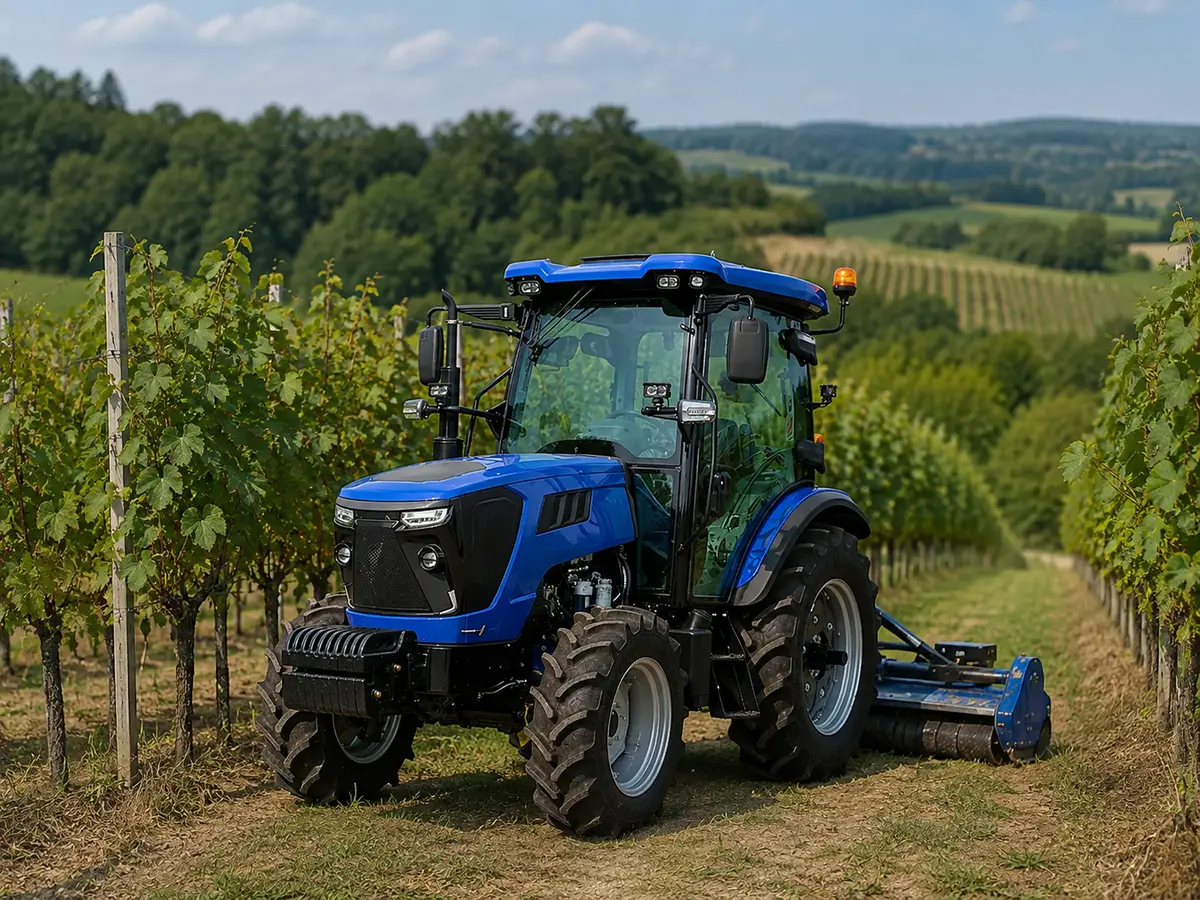
OXPLO Guide to 25 HP, 40 HP, 50 HP and 70 HP Tractors
A practical method for matching tractor horsepower with implements, field capacity, terrain and total cost of ownership
Choosing a tractor often begins with a deceptively simple question: How many hectares do I farm, and how much horsepower should I buy?
That question is understandable, but it is not enough. Farm size tells you how much work exists; it does not tell you how demanding the work is, how quickly it must be completed, whether the ground is wet or sloping, or how much PTO power and hydraulic capacity the implements require. A 10-hectare orchard and a 10-hectare grassland operation can need very different tractors.
The correct sequence is to define the work, identify the limiting implement, and then verify engine power, PTO output, traction, lift capacity, dimensions and the available working window. Only after that should a buyer decide between a 25 HP, 40 HP, 50 HP or 70 HP tractor.
I. Why Tractor Sizing Decisions So Often Go Wrong
Most buyers face two opposite risks.
The first is undersizing. The tractor may technically operate the implement, but only in a low gear and at a low travel speed. When the soil becomes wet, the field begins to slope or crop residue becomes denser, engine speed falls, PTO speed becomes unstable and the tyres continue to slip. The machine is not completely unable to work; it simply completes too little work per hour. The real loss appears during a short planting, mowing or cultivation window.
The second risk is oversizing. A higher purchase price is only the visible cost. A larger body and turning radius can restrict access to orchards, livestock buildings, greenhouses and older farm gateways. A heavier machine can also increase soil compaction, while a move from Category I to Category II implements may create new costs for adapters, replacement equipment and transport.
For that reason, ‘Can it pull the implement?’ is not a sufficient buying standard. A better question is: Can the tractor-and-implement combination complete the regular worst-case job at a useful speed, while maintaining safe steering, braking, lifting and transport stability?
II. Tractor Horsepower Is a System, Not a Single Number
Engine Horsepower Is Not the Same as Usable PTO Power
Product pages normally show rated engine horsepower. PTO-driven equipment such as rotary cutters, mowers, tillers, balers and spreaders uses power available at the PTO shaft. Some power is lost through the drivetrain, so a 40 hp tractor should not be treated as if every one of those 40 horsepower is continuously available to the implement.
Ask the implement supplier for minimum PTO horsepower, not only the tractor’s nameplate rating. If the implement requirement sits close to the tractor’s limit, the system will have little reserve for dense grass, deeper cultivation, slopes or difficult soil.
Traction Depends on Weight, Tyres, Ballast and Ground Conditions
Ploughing, trailer work and loader operations depend heavily on traction. Two tractors with similar tractor horsepower can deliver very different drawbar performance when their operating weight, axle load distribution, tyre size and drive configuration differ.
Four-wheel drive can improve grip on loose soil, wet grassland and slopes, but 4WD cannot correct poor ballast or incorrect tyre pressure. Iowa State University Extension notes that correct ballast and tyre pressure help improve traction, tyre life and fuel use while reducing unnecessary wheel slip and compaction. Axle loading should be adjusted for the drive type and implement mounting method, rather than by adding weight without calculation. See the technical reference.
Three-Point Hitch Category Defines the Implement Ecosystem
Compact tractors in the 25-50 HP range commonly use a Category I three-point linkage, while heavier utility tractors often use Category II. The difference is not simply physical size. Pin dimensions, lift capacity, implement geometry and implement weight all affect compatibility.
A farm that already owns several Category I implements may incur unexpected costs when it moves directly to a Category II platform. Conversely, a buyer planning to use wider and heavier professional implements can create a long-term bottleneck by remaining on a compact Category I chassis.
Hydraulic Performance Determines Whether Loader Work Is Practical
Front loaders, hydraulic tipping trailers and some mowing equipment require more than engine power. They also require suitable hydraulic flow, pressure, valve count and coupler types. Asking whether a loader can be fitted is not enough. Buyers should confirm rated lift capacity, lift height, load centre, cycle time, attachment interface and rear counterweight requirements.
Dimensions Decide Whether the Tractor Can Reach the Work
Orchards and older farms are especially sensitive to dimensions. Overall width must fit the narrowest gateway and the usable row spacing. Height must account for the cab or ROPS and the tree canopy. Turning space must also include implement tail swing. A higher-capacity 70 HP tractor has no operational value if it cannot enter the rows where the work takes place.
III. Comparing 25 HP, 40 HP, 50 HP and 70 HP Tractors
|
Power class |
Best matched work |
Main advantage |
Typical boundary |
|
25 HP |
Estate care, paddock maintenance, light mowing, spreading, short transport and light cultivation |
Compact operation and sensible cost for regular light-duty work |
Heavy tillage, wide PTO implements, frequent loader work and tight weather windows |
|
40 HP |
Small mixed farms, grassland maintenance, orchard-floor work, more frequent mowing and light-to-medium cultivation |
Useful balance between compact access and productive capacity |
Heavy Category II implements, deep tillage and loaded trailer work on steep ground |
|
50 HP |
More frequent grassland, cultivation, transport and PTO work |
More power reserve while a compact Category I platform may still be retained |
Ten additional horsepower cannot solve a chassis, hydraulic or implement-weight mismatch |
|
70 HP |
Mixed farms, livestock, wider-row orchards, contracting, heavier transport and loader work |
Heavier platform, broader gearing and Category II implement compatibility |
Higher cost and greater sensitivity to gateways, row width, turning space and soil loading |
When Is a 40 hp Tractor the Right Middle Ground?
The 40 HP class is frequently searched because it sits between a light maintenance machine and a larger utility tractor. That position is useful, but it does not make the category universally suitable for small farms.
A 40 hp tractor is often a sound choice when the main work includes regular mowing, spreading, light tillage, trailer movement and general farm maintenance; the implements use Category I linkage; and the available space does not favour a longer or wider machine. In those conditions, 40 HP can provide more reserve than 25 HP without immediately bringing the size and cost of a 70 HP platform.
However, if the core job is heavy soil engagement, loaded uphill trailer work, frequent front-loader operation or a large amount of work within a short weather window, the apparent middle ground may become an operating constraint. The correct comparison is then 50 HP or 70 HP, not continuous full-load operation of a smaller tractor.
IV. Four Common Mistakes and the Hidden Costs They Create
Mistake 1: Converting Farm Area Directly into Horsepower
Twenty hectares used mainly for periodic mowing is not equivalent to twenty hectares requiring repeated cultivation, seeding, transport and material handling. Area must be converted into task volume, annual frequency and allowable completion time before tractor horsepower can be selected.
Mistake 2: Treating Rated Power as Continuous Available Capacity
An implement whose minimum requirement exactly matches the tractor’s rated power may run in ideal conditions, but it leaves little reserve for wet soil, a gradient or heavier crop material. Regular operation at high load and low engine speed can also increase thermal stress and wear on the clutch and drivetrain.
Mistake 3: Checking Implement Width but Ignoring Implement Weight
A wider mower usually needs more PTO power, but it is also likely to be heavier. The fact that the three-point linkage can lift an implement does not prove that the tractor can steer and transport it safely. If front-axle load becomes too low, steering control deteriorates. Adding front ballast then requires a fresh check of tyre capacity, axle loading and braking performance.
Mistake 4: Using More Horsepower to Hide a Tyre or Ballast Problem
When tyres slip, buyers often conclude that more horsepower is required. In reality, excessive tyre pressure, incorrect ballast, worn tyres or an unsuitable tread pattern may prevent the available engine power from reaching the ground. Adding tractor horsepower can increase wheel speed without increasing productive drawbar work.
V. A Six-Step Tractor Selection Workflow
Step 1: Build an Annual Task Matrix
List the work expected over the next three years, not only the job that is most urgent today. Record the operation type, area or transport volume, annual frequency, acceptable completion time, terrain, typical soil moisture, road-transport needs and the specifications of existing implements.
- Operations: mowing, tillage, ploughing, seeding, spreading, spraying, trailer work and loading.
- Work quantity: hectares per pass, tonnes moved, trailer distance or loader cycles.
- Constraints: slope, soil condition, row spacing, gateways, buildings and public-road use.
- Implement data: PTO speed, required PTO power, linkage category, operating weight and hydraulic demand.
Size the tractor around the highest-frequency work and the most time-critical job. If an extreme task occurs only once or twice each year, contracting it out may cost less than buying a larger tractor that remains underused for the rest of the season.
Step 2: Use the Limiting Implement to Set the Minimum Configuration
For every planned implement, verify six items: minimum engine horsepower, minimum PTO horsepower, three-point hitch category, implement weight, hydraulic flow and couplers, and recommended travel speed. A failure in any one of these areas cannot always be corrected by increasing engine output. A 50 HP engine does not turn Category I into Category II, nor does it automatically add hydraulic valves.
Step 3: Test Capacity Against the Weather Window
A practical estimate of effective field capacity is:
Effective field capacity (ha/h) = implement width (m) x travel speed (km/h) x field efficiency / 10
Field efficiency should account for turning, overlap, refilling, adjustment and short stops. Iowa State University Extension likewise identifies implement width, operating speed and field efficiency as the principal variables in field-capacity estimates. Review the machinery-selection reference.
For example, a tractor working with a 2.0 m implement at 7 km/h and 75% field efficiency has an estimated effective capacity of 1.05 ha/h. Completing 40 hectares would require about 38 working hours. If the reliable window is only four days at eight hours per day, the available 32 hours are insufficient.
At that point, the buyer has three choices: sustain a higher practical speed, use a wider implement matched to a higher-capacity tractor, or add a second machine. If inadequate power reduces speed from 7 km/h to 5 km/h, capacity falls from 1.05 ha/h to 0.75 ha/h – a reduction of about 29%. This is the classic case of a tractor that can operate the implement but still fails the business requirement.
Step 4: Verify Access and Stability
Measure the narrowest gateway, usable row width, lowest overhead clearance and smallest turning area. Compare those limits with the complete transport dimensions after tyres, cab, front loader and rear implement have been installed. Bare-tractor dimensions are not enough.
Step 5: Keep a Rational Reserve
Frequent PTO and drawbar work should include enough reserve for wet soil, slopes and denser crop material. Reserve does not mean buying the largest tractor available. Unnecessary machine weight, tyres and implement size increase purchase, transport, maintenance and soil-compaction costs.
Step 6: Compare Total Cost per Effective Working Hour
Total cost of ownership includes more than purchase price. A useful comparison should include depreciation or finance, fuel, insurance, scheduled servicing, tyres, wear parts, implement adaptation, transport, downtime and operator time.
Cost per effective working hour = annual ownership and operating cost / annual productive hours
A lower-priced tractor that is repeatedly overloaded, slow or prone to downtime can have a higher cost per completed hectare. An oversized tractor with very low annual utilisation can also be expensive because its fixed cost is spread across too few productive hours.
VI. Matching Farm Requirements to the OXPLO 25-70 HP Range
Only after the task, implement and working-window calculations are complete should the buyer compare models. The OXPLO tractor range currently covers 25, 30, 40, 50, 60 and 70 HP. The four OXPLO models most relevant to this guide are compared below.
|
OXPLO model |
Rated power |
Drive / gearbox |
Linkage and PTO |
Best-fit requirement |
|
25 HP / 18.4 kW |
4WD; 8F + 8R |
Category I; 540/1000 rpm |
Light mowing, estate and paddock care, spreading, light cultivation and short transport |
|
|
40 HP / 29.4 kW |
4WD; 8F + 8R |
Category I; 540/1000 rpm |
Compact access with more frequent mixed-farm work and higher implement demand than an entry model |
|
|
50 HP / 37 kW |
4WD; 8F + 8R |
Category I; 540/720 rpm* |
More power reserve while retaining a compact platform and Category I implement system |
|
|
70 HP / 51.5 kW |
4WD; 12F + 12R |
Category II; 540/760 rpm |
Mixed farming, livestock, contracting, heavier transport and more frequent multi-season work |
*Final PTO, engine, tyre, cab, lighting and destination-market specifications must be confirmed in the order specification sheet.
OXPLO OXT404 vs OXT504: More Power on the Compact Platform
The published dimensions of the OXPLO OXT254, OXPLO OXT404 and OXPLO OXT504 are 3,180 x 1,560 x 2,600 mm with a 1,800 mm wheelbase. All three are compact Category I models. Moving from the OXPLO OXT404 to the OXPLO OXT504 provides more engine-power reserve, but it does not automatically provide the Category II linkage, 12F + 12R transmission or longer wheelbase of the OXPLO OXT704.
This distinction matters for buyers searching for a 40 hp tractor. If the bottleneck is PTO load and the farm wants to retain its compact Category I implements, the OXPLO OXT504 may provide useful reserve. If the bottleneck is implement category, transmission range, operating weight or heavier loader and transport work, moving to the OXPLO OXT704 platform is the more meaningful change.
OXPLO OXT704: A Different Utility Platform, Not Just More Horsepower
The OXPLO OXT704 is listed at 3,980 x 1,760 x 2,800 mm, with a 2,010 mm wheelbase and an approximate total weight of 2,500 kg. It should not be treated as a larger-engined OXPLO OXT404; it is a different utility platform intended for heavier implements and a broader range of work. View the OXPLO OXT704 specifications.
When comparing the OXPLO OXT404 and OXPLO OXT504, the main decision is how much power reserve is needed within the compact platform. When comparing the OXPLO OXT504 and OXPLO OXT704, the buyer should focus on whether Category II implements, more ratios, larger dimensions and a heavier chassis are required.
What to Send OXPLO Before Requesting a Quotation
A message that says only ‘Please quote a 40 hp tractor’ forces the supplier to guess. A more complete request helps the OXPLO team confirm a realistic configuration, identify compatibility risks and prepare a more accurate quotation.
- Destination country and final operating location.
- Farm area and primary crops or livestock activity.
- Narrowest gateway, row spacing, height restriction and maximum slope.
- Main operations and how often each operation occurs.
- Number of days available for the most time-critical operation.
- Brand, model and working width of existing implements.
- Minimum engine and PTO horsepower required by each key implement.
- PTO speed and spline requirements.
- Category I or Category II linkage requirements.
- Implement weight and three-point lift requirement.
- Hydraulic flow, pressure, valve and coupler requirements.
- Front-loader requirement, including target lift weight and lift height.
- Field, turf or road-transport tyre requirements.
- Cab, ROPS, lighting, braking and road-use requirements.
- Local emissions, conformity and documentation requirements.
Based on this information, OXPLO can help confirm tyres, PTO, linkage, cab equipment, loader options and the documents available for the intended market. For a European project, buyers should also verify destination-country requirements for engine emissions, road registration, operator protection, lighting, braking and conformity documentation before ordering. Explore the full OXPLO tractor range or contact OXPLO with the complete task list.
VII. Frequently Asked Questions
Q1. What Farm Size Is a 40 hp Tractor Suitable For?
There is no reliable answer based on hectares alone. If the main work is mowing, spreading, light cultivation and transport, a 40 HP model can serve a wide range of small and mixed farms. If the same area requires deep tillage, loaded uphill transport or completion within a very short weather window, 50 or 70 HP may be required. Calculate capacity from implement width, operating speed and available hours.
Q2. Is the Difference Between 25 HP and 40 HP Mainly Speed?
No. A 40 hp tractor can provide more reserve for frequent PTO work and higher loads, but the real difference also depends on chassis weight, gearing, tyres, PTO output and implement compatibility. If two machines share a similar chassis, the 40 HP advantage is mainly additional power reserve; it does not automatically deliver a higher linkage category or more hydraulic capacity.
Q3. Is 50 HP Always Better Value Than 40 HP?
Only when the additional power shortens a critical operation, improves performance under a regular load or supports planned implements. If the farm performs mostly light maintenance, the extra horsepower may not produce additional revenue or measurable time savings. The OXPLO OXT404 and OXPLO OXT504 comparison should therefore begin with the implement and workload, not the price difference alone.
Q4. When Should I Move Directly to 70 HP?
A 70 HP platform is usually more appropriate when the key implements require Category II linkage, drawbar and transport loads are higher, front-loader work is frequent, more operating ratios are needed, or a 40-50 HP platform cannot complete the work within the available window. The OXPLO OXT704 is designed for this broader utility role, but access dimensions, axle loads, braking, tyres and destination-country rules must still be checked.
Q5. How Much Horsepower Reserve Should I Allow?
Avoid applying a fixed percentage without considering the job. Start with the key implement’s minimum PTO or engine-power requirement, then evaluate wet ground, gradients, crop density, altitude and annual workload. If the implement minimum is already close to the tractor rating, ask OXPLO to validate the tractor-and-implement combination rather than relying only on a catalogue figure.
Q6. What Information Does OXPLO Need to Recommend a Tractor?
OXPLO needs the destination country, intended tasks, farm layout, existing or planned implements, annual working hours and required options. Providing this data allows OXPLO to compare an OXT254, OXT404, OXT504 or OXT704 on the basis of actual operating risk rather than horsepower alone.
Conclusion: Choose the Smallest Tractor That Reliably Completes the Work
The right tractor is not the largest machine the budget will allow, and it is not the smallest machine that can barely operate the implement. It is the smallest reasonable platform that can complete the farm’s core work under real terrain, load and weather-window conditions.
A 25 HP tractor is appropriate for regular light-duty maintenance. A 40 hp tractor often offers a practical balance between compact access and farm productivity. A 50 HP tractor provides more reserve for frequent work, while a 70 HP tractor moves into a heavier implement, transport and multi-purpose utility platform. The real decision points remain the implement, working time, traction, hydraulics, dimensions and total cost of ownership – not tractor horsepower in isolation.
Buyers comparing the OXPLO OXT254, OXPLO OXT404, OXPLO OXT504 and OXPLO OXT704 can send OXPLO their destination country, task list, implement specifications, annual working hours and access dimensions. OXPLO can then help confirm an appropriate configuration before the buyer commits to a tractor and attempts to adapt the farm around it. Request an OXPLO tractor recommendation.