
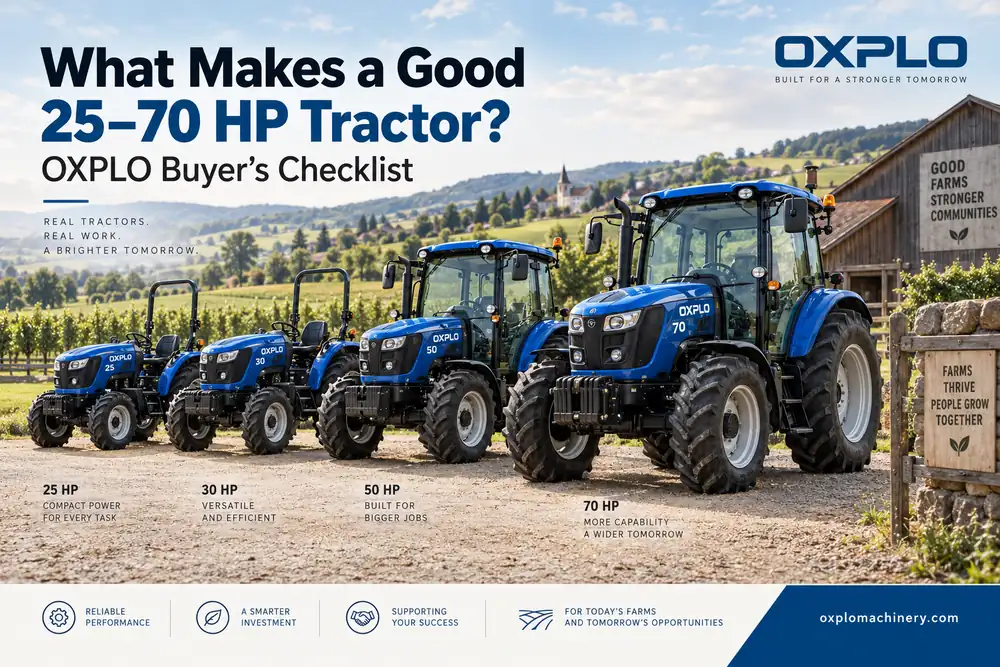
A practical framework for evaluating horsepower, implements, PTO, linkage, traction, hydraulics, productivity and total cost of ownership.
Core buying principle: A good tractor is not the machine with the highest horsepower. It is the machine whose power, chassis, implement interface and operating cost are correctly matched to the work. |
A buyer replaces an underpowered 50 HP machine with a 70 hp tractor. The new tractor has more engine power, but the existing implements are Category I, several farm buildings have restricted access, and the loader was ordered without a complete ballast plan. The horsepower problem is solved, yet three new operating problems have been created.
This is why tractor selection cannot be reduced to a single horsepower number. Engine output matters, but the useful work delivered in the field depends on how that power reaches the PTO, tyres, hydraulic system and implement. The right decision also depends on access width, annual working hours, soil conditions, operator workflow and the cost of downtime.
This farm tractor buying guide is designed as a decision tool for B2B buyers, farm managers, contractors and equipment distributors evaluating tractors between 25 and 70 HP. The objective is not to recommend the largest machine. It is to show how to identify the smallest platform that can complete the required work reliably, with enough reserve for realistic future demand.
I. Why Tractor Buyers Get Horsepower Selection Wrong
Engine HP Is Only the Starting Point
The rated horsepower on a specification sheet describes engine output. Agricultural work, however, uses that output through different paths: PTO-driven implements, drawbar traction, hydraulic functions, transport and loader work. A tractor can therefore have adequate engine power and still perform poorly if the transmission ratios, tyre package, ballast, linkage or implement are badly matched.
The first question should not be “How much horsepower can I afford?” It should be “Where will the horsepower be used?” A mower or rotary tiller places a different demand on the tractor than a plough, loaded trailer or front loader. Treating those jobs as if they require the same specification is one of the fastest ways to buy the wrong machine.
Undersizing and Oversizing Both Create Cost
An undersized tractor makes its weakness obvious: reduced ground speed, repeated downshifts, poor PTO reserve, narrower implements, excessive working hours and greater pressure on the operator to keep the job moving. The cost appears as lost field capacity and longer seasonal windows.
Oversizing is less obvious because the machine still completes the job. The penalties show up elsewhere: higher capital cost, larger tyres, more weight to transport, wider turning space, possible soil compaction and reduced manoeuvrability around rows, gateways and buildings. Power reserve is useful; unused platform size is not automatically productive.
Power Class | Usually Makes Sense When | Check Carefully | Common Buying Mistake |
25–30 HP | Orchards, estates, mowing, light PTO work, compact access | Row/gate width, PTO requirement, implement weight | Buying too small for recurring cultivation |
40–50 HP | Mixed farming, grassland, transport, regular PTO work | Category I limits, ballast, hydraulic demand | Assuming 50 HP always means a mid-size utility chassis |
60 HP | Heavier recurring work, loader use, broader implement range | Category II compatibility, dimensions, tyre package | Looking only at the extra 10 HP |
70 HP | Cultivation, transport, heavier implements, multi-purpose farm use | Annual utilisation, access, TCO, loader/ballast package | Buying reserve power that is rarely used |
II. Start With the Implement, Not the Tractor
Build an Annual Work Map Before Comparing Models
A professional selection process starts with the jobs that must be completed during the year. Write them down as actual operations rather than vague categories such as “farm work.” List mowing, rotary tillage, ploughing, disc harrowing, seeding, fertiliser spreading, trailer transport, loader work, bale handling and grading separately. Then identify how often each task occurs and whether it is occasional, seasonal or part of the weekly workload.
This simple step prevents a common procurement error: selecting a tractor around the most visually impressive task rather than the most economically important recurring workload.
For Every Implement, Confirm Five Interfaces
- Power demand: the implement manufacturer’s recommended tractor power range, including any minimum PTO power requirement.
- PTO: shaft type, required speed and driveline limits.
- Three-point hitch: Category I or Category II geometry and pin size, plus implement centre of gravity.
- Weight and lift: implement mass, overhang and the tractor’s approved linkage/axle loading.
- Hydraulics: required flow, pressure, number of remotes and whether continuous flow is required.
A statement such as “this implement worked behind another 50 hp tractor” is not enough evidence. Two tractors with the same engine rating can use different hitch categories, PTO speeds, weights, tyre packages and hydraulic configurations. Compatibility must be checked against the actual machine and the actual implement.
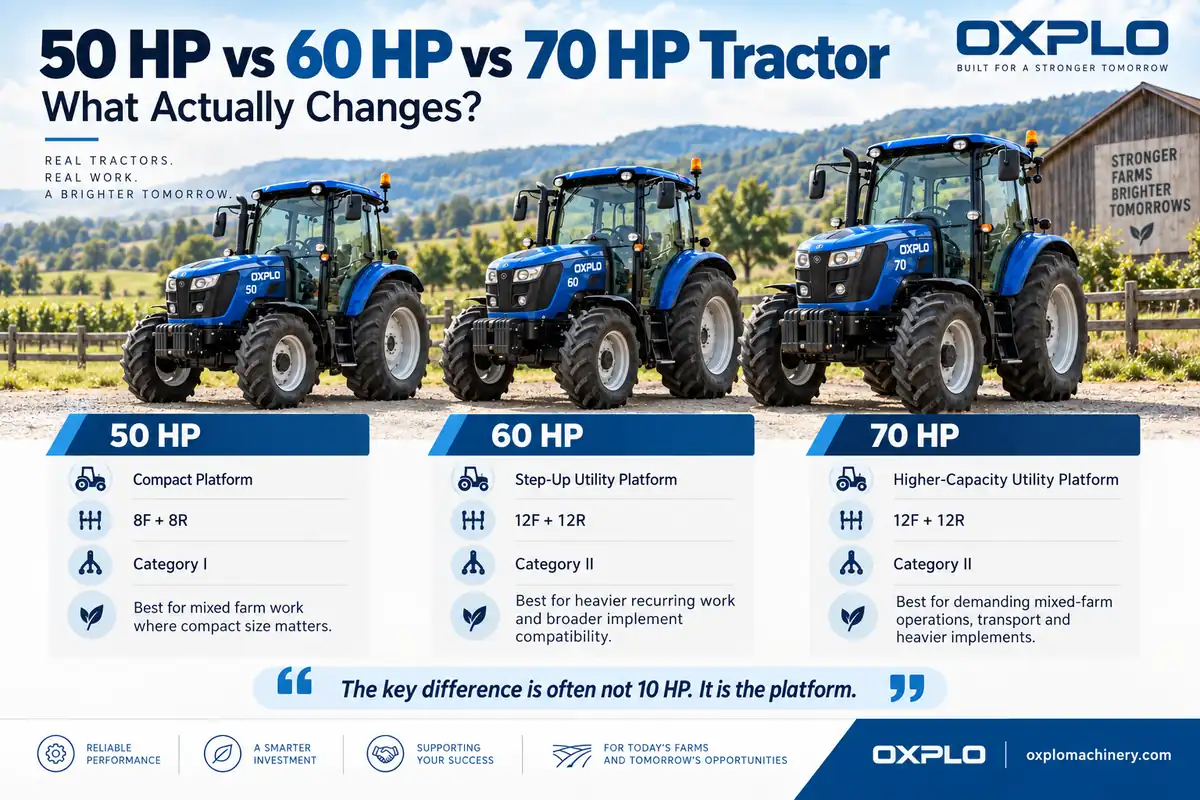
III. Can the Tractor Put Its Power Into the Ground?
4WD Improves Traction, but It Does Not Replace Correct Setup
Four-wheel drive is valuable on damp grass, loose soil, slopes, uneven tracks, cultivation work and loader operations. It increases the number of tyres contributing useful tractive effort. But 4WD does not remove the need for correct tyres, tyre pressure and weight distribution.
If the tyre is wrong for the surface, ballast is badly distributed, or the implement removes too much load from the front or rear axle, additional engine power can simply create more wheel slip. In that situation, buying another 10 HP does not address the limiting factor.
Weight Is Both an Asset and a Trade-Off
A heavier platform can improve traction, stability and loader behaviour. It can also support larger tyres and heavier implements. The trade-off is increased soil loading, transport weight and sometimes reduced agility in confined spaces. This is why the useful question is not “Is the heavier tractor stronger?” but “Does the operation need the additional platform mass often enough to justify it?”
Front Loader, Hydraulics and Ballast Must Be Specified as One System
Loader capability should never be treated as a yes/no option. Ask for the loader capacity, loader mass, hydraulic connections, bucket or bale-fork mass, front-axle implications and the recommended rear ballast. A front loader changes the tractor’s centre of gravity and axle loading. Ordering the loader without defining the ballast strategy is an incomplete engineering decision.
IV. Transmission, PTO and Hydraulics Decide Daily Productivity
Gear Count Matters Because Working Speed Matters
A specification such as 8F + 8R or 12F + 12R is not valuable simply because one number is larger. Its value lies in the availability of a suitable ground speed for the implement and soil condition. If one gear is too slow and the next is too fast, the operator either loses field capacity or overloads the engine and driveline.
More usable ratios are particularly valuable when one tractor performs cultivation, mowing, transport and loader work, because each job has a different ideal speed window. Reverse ratios also matter when the duty cycle includes repeated direction changes in yards or during material handling.
PTO Compatibility Is a Procurement Gate, Not a Footnote
Confirm PTO shaft type, rated speed and the implement manufacturer’s required input speed before ordering. Do not assume that every tractor in the same horsepower class uses the same PTO combination. The final quotation should clearly state the supplied PTO configuration so the purchasing specification and the delivered machine can be checked against the implement list.
“Hydraulic Output Available” Is Not a Complete Specification
For loader work and hydraulic implements, ask for pump flow, working pressure, available rear remotes, lift requirements and any continuous-flow demand. If the public product page does not show these values, the correct response is to request a configuration-specific technical sheet rather than estimate them from engine horsepower.
V. 50 HP vs 60 HP vs 70 HP Tractor: When Should You Step Up?
Stay With a 50 HP Tractor When Compact Access Still Has Economic Value
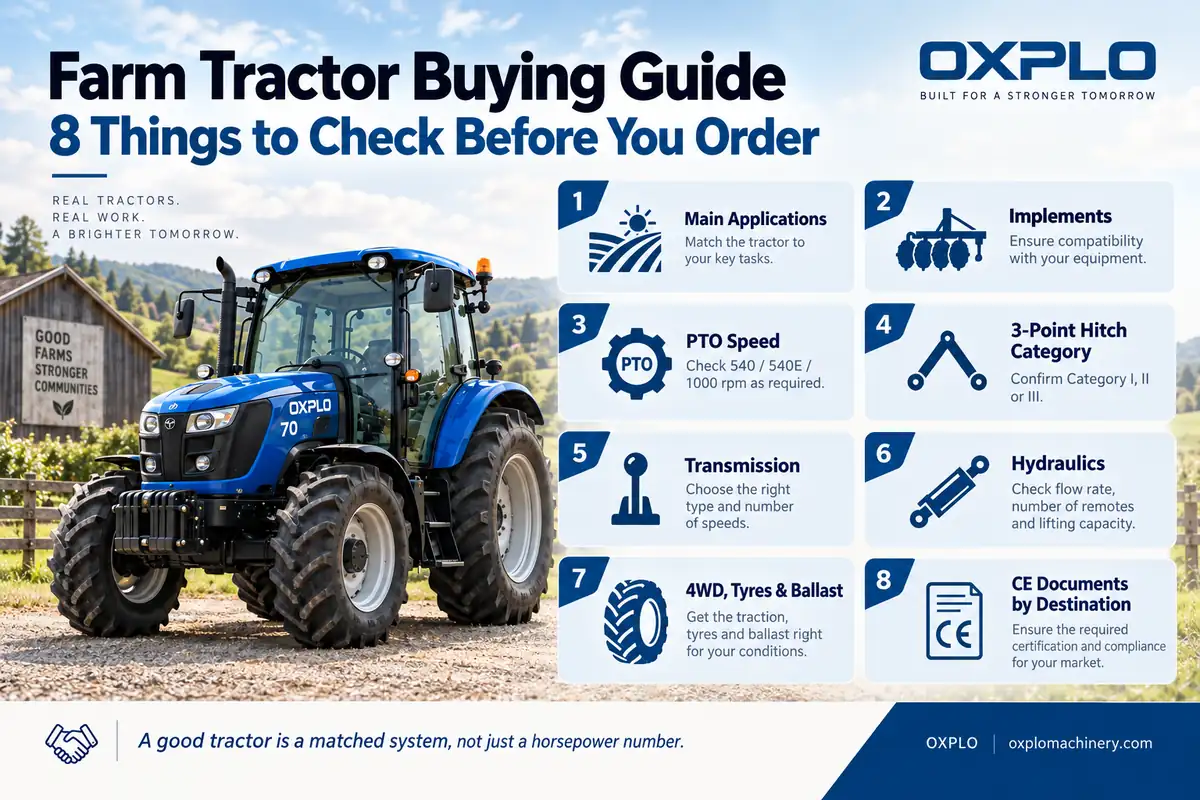
A 50 hp tractor can be the right answer when the existing implement fleet remains compact, access width matters, annual workload is moderate and most work does not require the mass or linkage of a larger utility platform. For many mixed farms, moving to a larger tractor purely for reserve power can add cost without increasing utilisation enough to pay for it.
Move to 60 HP When the Platform Change Solves a Real Constraint
The important transition from 50 to 60 HP is often not the extra 10 HP. It is the move to a larger chassis, broader implement interface, larger tyres or more flexible transmission. If the farm is repeatedly limited by implement compatibility, traction, stability or working-speed choice, a 60 hp tractor can be a more meaningful upgrade than the engine number suggests.
Choose a 70 HP Tractor When the Additional Capacity Will Be Used
A 70 hp tractor makes the strongest business case when higher load is recurring rather than occasional: regular cultivation, heavier Category II implements, transport, loader work, livestock support, professional land management or contracting. The right question is not “Can I afford 70 HP?” It is “Will 70 HP reduce annual working hours, broaden implement utilisation or replace another machine?”
Key decision rule: The step from 50 HP to 60 HP or 70 HP should be justified by a constraint you can name: implement category, traction, annual hours, loader duty, transport, working speed or future equipment plan. |
VI. Calculate Productivity and TCO Before You Buy
Use Field Capacity to Turn Horsepower Into Working Hours
One practical way to compare tractor-and-implement combinations is to estimate effective field capacity:
Field Capacity (ha/h) ≈ Implement Width (m) × Working Speed (km/h) × Field Efficiency ÷ 10 |
Example: a 2.0 m implement operating at 6 km/h with 75% field efficiency delivers approximately 0.90 ha/h. If the tractor cannot hold the load and speed falls to 4.5 km/h, effective capacity falls to roughly 0.675 ha/h. Completing 20 hectares would take about 22.2 hours in the first case and 29.6 hours in the second—a difference of roughly 7.4 working hours for that operation.
This does not prove that the larger tractor is automatically better. It gives the buyer a way to value the productivity gap against purchase cost, fuel, labour, maintenance and the number of times the operation occurs each year.
Compare Total Cost of Ownership, Not Quotation Price Alone
A simple three- to five-year TCO model should include purchase price, finance cost where relevant, fuel, operator hours, routine maintenance, tyres, implement changes, downtime risk and expected resale value. If a cheaper tractor adds 60 working hours per year and the combined labour-and-machine time is valued at €35 per hour, the additional time is worth €2,100 per year. Over three years that is €6,300—before considering the operational cost of missing a short weather window.
This is the commercial logic behind correct sizing: buy enough tractor to protect the workflow, but do not pay for platform capability the operation cannot use.
VII. OXPLO 25–70 HP Buyer’s Checklist
Once the application, implement interfaces and TCO have been defined, the OXPLO range can be evaluated as a set of platforms rather than a list of horsepower numbers. OXPLO currently publishes six 4WD tractor power options from 25 to 70 HP, with compact Category I models at the lower end and larger Category II utility models at 60–70 HP.
Explore the range: OXPLO 25–70 HP Tractors & Attachments
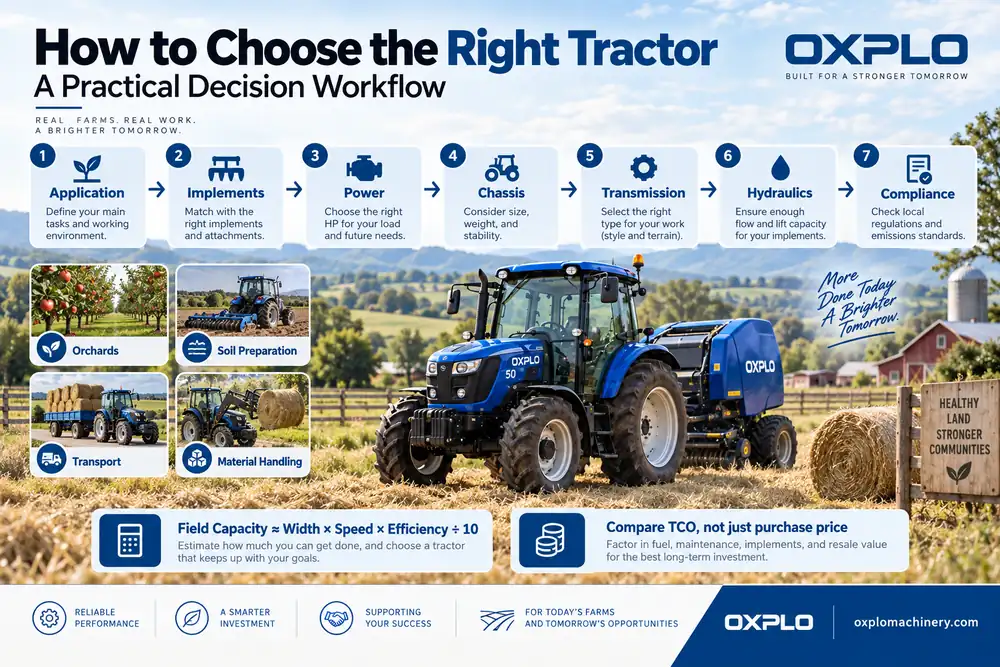
OXPLO Model | Power | Transmission | Rear Linkage | Platform Role |
OXT254 | 25 HP | 8F + 8R | Category I | Compact entry model for light-duty farm and estate work |
OXT304 | 30 HP | 8F + 8R | Category I | Compact platform with modest additional power reserve |
OXT404 | 40 HP | 8F + 8R | Category I | Higher-output compact model for broader mixed-farm duties |
OXT504 | 50 HP | 8F + 8R | Category I | Maximum output in the compact OXT chassis group |
OXT604 | 60 HP | 12F + 12R | Category II | Entry point to OXPLO’s larger utility platform |
OXT704 | 70 HP | 12F + 12R | Category II | Higher-capacity utility platform for demanding mixed-farm work |
- OXPLO OXT254 – 25 HP compact 4WD tractor
- OXPLO OXT304 – 30 HP 4WD tractor
- OXPLO OXT404 – 40 HP compact farm tractor
- OXPLO OXT504 – 50 HP 4WD farm tractor
- OXPLO OXT604 – 60 HP 4WD utility tractor
- OXPLO OXT704 – 70 HP 4WD farm tractor
The 50-to-60 HP Breakpoint Is More Than 10 HP
This is the most useful comparison in the current OXPLO range. The published OXPLO OXT504 specification lists 50 HP, 8F + 8R, Category I linkage, a 1,800 mm wheelbase, 2,200 kg listed weight and 6.5-16 / 11.2-24 tyres. The published OXPLO OXT604 specification moves to 60 HP, 12F + 12R, Category II linkage, a 2,010 mm wheelbase, 2,500 kg listed weight and 8.3-20 / 12.4-28 tyres.
For a buyer deciding between the OXPLO OXT504 and OXPLO OXT604, the most important question may therefore be Category I versus Category II, not 50 versus 60. If existing implements are Category I and access is tight, OXPLO OXT504 can preserve compact-platform advantages. If the farm needs Category II compatibility, a larger tyre package, more transmission ratios and a heavier utility chassis, OXPLO OXT604 addresses a different class of requirement.
When the OXPLO OXT704 70 HP Tractor Makes Sense
The published OXPLO OXT704 specification lists 70 HP, 4WD, a 12F + 12R transmission, Category II linkage, a 2,010 mm wheelbase, 2,500 kg total weight and 8.3-20 / 12.4-28 tyres. OXPLO positions the OXT704 for mixed farming, livestock and grassland work, wider-row orchards where dimensions permit, transport, agricultural contracting, land maintenance and material handling with a correctly specified loader package.
For a buyer searching specifically for a 70 hp tractor, the OXPLO OXT704 should therefore be evaluated as a complete utility platform: implement compatibility, PTO requirement, loader duty, access dimensions, annual hours and destination-market equipment all need to be confirmed together.
The OXPLO Pre-Order Technical Checklist
- Destination country and intended use: farm-only, road travel, contracting or municipal work.
- Main applications and approximate annual working hours.
- Existing and planned implements, including make/model where available.
- Required PTO shaft and PTO speed for each powered implement.
- Required rear linkage category and implement weight/geometry.
- Hydraulic requirements: flow, pressure, remotes and loader needs.
- Minimum gate, row and building access dimensions.
- Tyre and traction requirements based on soil, slope and transport duty.
- Front-loader attachment, hydraulic connection and rear-ballast requirement if applicable.
- Operator station, cab, lighting, mirrors, guarding and other destination-specific equipment.
- Braking, road-use and conformity-document requirements for the destination market.
- Final signed/confirmed specification sheet before payment and shipment.
Parts, attachments and technical support: OXPLO Support
OXPLO’s public pages also note that tyres, operator station, lighting, guarding, attachments and destination-market equipment can vary by configuration. For B2B orders, treat the website as the selection starting point and the final OXPLO quotation/specification sheet as the configuration-control document.
VIII. FAQ: Choosing a 25–70 HP Farm Tractor
Is a 70 hp tractor too large for a small farm?
Not necessarily. Farm area alone is a weak sizing rule. A smaller operation with recurring cultivation, loaded transport, Category II implements and loader work may justify 70 HP, while a larger area dominated by light mowing may not. Evaluate workload, implement width, access and annual utilisation.
Should I choose a 50 hp tractor or a 60 hp tractor?
Compare the platform, not only the 10 HP difference. In the current OXPLO range, the OXPLO OXT504 is a compact Category I 8F + 8R platform, while the OXPLO OXT604 moves to Category II, 12F + 12R, a longer wheelbase and larger tyres. That is a structural change in capability, not just an engine upgrade.
When does a 70 hp tractor provide a better return than 60 HP?
When the extra output is used repeatedly—for example, to maintain working speed with heavier implements, support higher annual hours, combine transport and field work, or improve utilisation across several seasonal operations. If the additional power is rarely used, the TCO case becomes weaker.
Is 4WD necessary in the 25–70 HP class?
4WD is particularly useful on damp grass, loose soil, slopes, cultivation work and loader applications. It still depends on correct tyres, tyre pressure and ballast. 4WD cannot compensate for a badly matched implement or incorrect weight distribution.
What information should I send OXPLO for a tractor recommendation?
Send OXPLO the destination country, farm size, main applications, terrain, existing implements, required PTO, loader requirement, access limits and estimated annual working hours. OXPLO can then compare the relevant models and confirm a more appropriate configuration.
Can I rely on the website specification as the final order specification?
Use the website for model selection, then request a confirmed OXPLO specification sheet for the exact order. PTO, tyres, cab/operator-station equipment, lighting, loader setup and destination-market documentation should be stated in the final quotation or technical confirmation.
IX. Conclusion: A Good Tractor Is a Matched System, Not a Horsepower Number
A 25–70 HP tractor should be selected as a working system. Engine output matters, but it only creates value when the PTO, transmission, hitch, hydraulics, tyres, ballast and chassis are matched to the implement and the operating environment. The correct machine is the one that completes the annual workload without creating avoidable capital cost, downtime or compatibility problems.
For buyers comparing a 50 hp tractor, 60 hp tractor and 70 hp tractor, the biggest decision may be the platform transition rather than the horsepower increase. That is especially clear in the current OXPLO range, where OXPLO OXT504 remains a compact Category I platform and OXPLO OXT604/OXT704 move into a larger Category II utility configuration.
OXPLO’s 25, 30, 40, 50, 60 and 70 HP range gives B2B buyers several points at which to balance compact access against heavier recurring work. OXPLO can also discuss compatible tractor attachments, loader requirements, tyres and market-specific equipment according to the selected model and destination.
Before requesting price alone, send OXPLO the work profile. That makes it possible to compare the OXPLO OXT504, OXPLO OXT604 and OXPLO OXT704—or a smaller OXPLO model—against actual operating requirements rather than recommending a tractor from horsepower alone.