
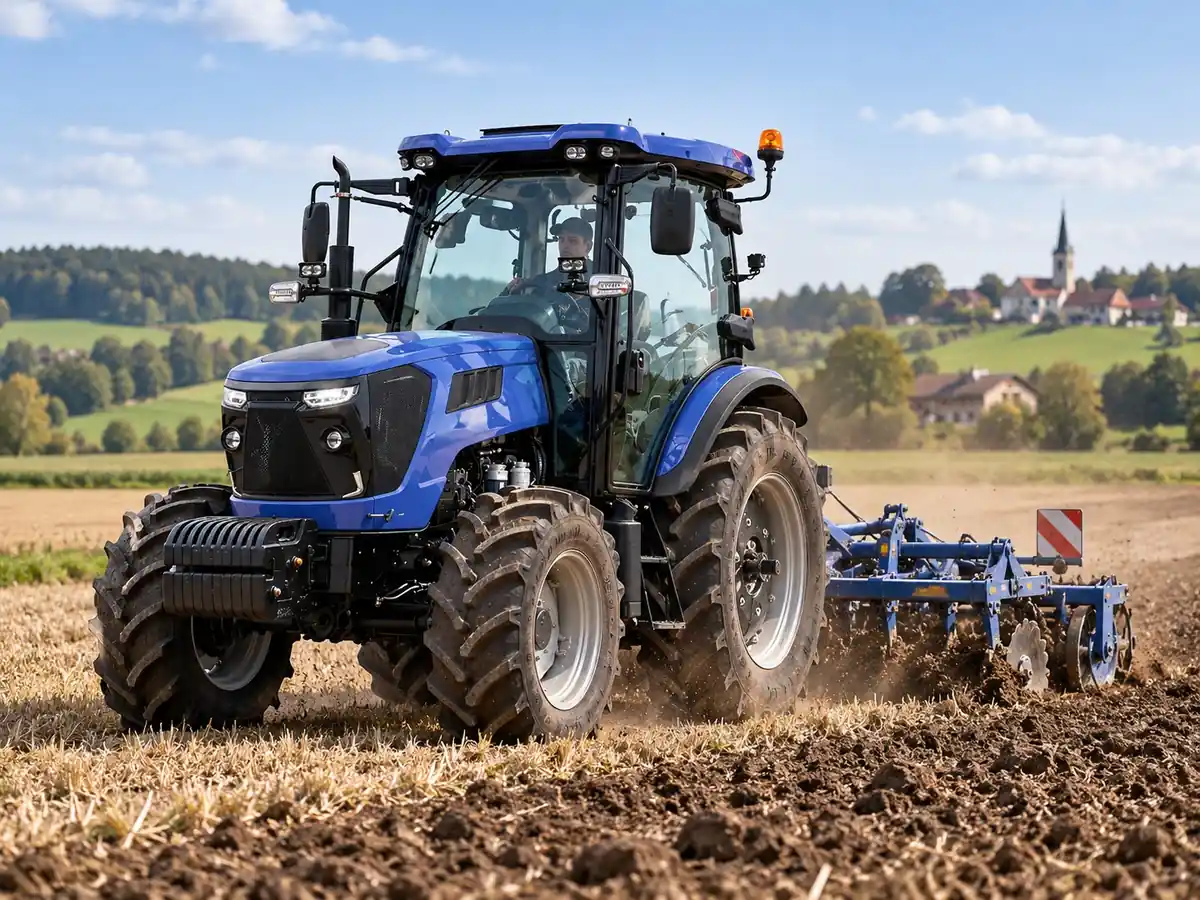
A tractor warranty looks simple on a quotation. Twelve months. Twenty-four months. Engine covered. Parts available. Yet when a tractor actually stops during planting, mowing, haymaking or harvest, the number printed on the warranty certificate is only one part of the problem. The buyer still needs a diagnosis, the correct part, a repair path and a realistic way to get the machine back into work.
That is why experienced B2B buyers evaluate tractor after sales service as an operating system rather than a promise. They ask how the tractor is identified, what evidence is needed, who decides whether a failure is covered, how spare parts are matched, whether a local technician can carry out the work and what happens after the formal warranty period ends.
I. The Real Cost of Tractor Downtime
For European farms and contractors, machinery downtime is rarely evenly distributed through the year. A tractor can be relatively non-critical in a quiet period and become operationally essential a few weeks later when weather, soil moisture and crop timing compress several jobs into a narrow working window.
This is what makes tractor warranty decisions commercially important. The cost of a failed sensor, relay, hydraulic valve or seal is not only the price of the component. It can trigger express freight, technician time, a replacement machine, missed field capacity and schedule disruption.
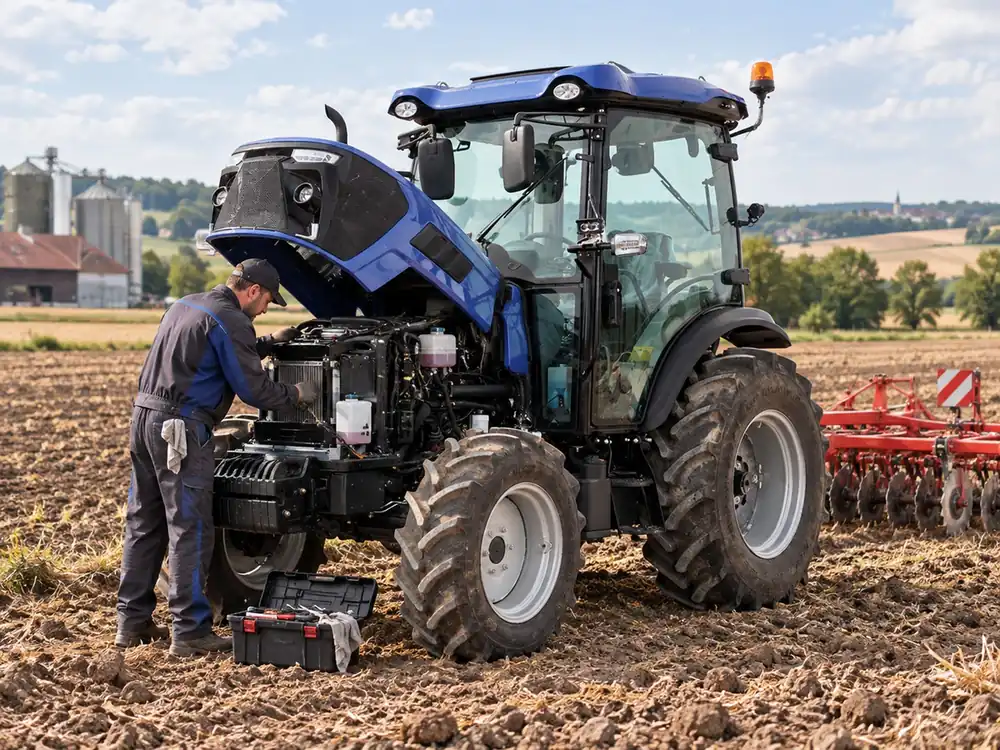
Field downtime is a time problem before it becomes a parts problem: the faster the fault is identified and the repair path is confirmed, the lower the operational disruption.
A useful downtime model
For purchasing decisions, think in terms of total recovery cost rather than component price:
Downtime Cost = |
Consider an illustrative example. A failed €80 sensor might be inexpensive by itself, but the total event can exceed €2,000 if it also requires international express freight, an outside technician, temporary tractor hire and delayed field work. The exact figures will vary by country and season; the point is that recovery time often dominates the economics of a small failure.
Why agricultural time windows change the calculation
A manufacturing plant may be able to reschedule a maintenance task. A farm often cannot reschedule weather. Seeding, cultivation, mowing, baling, spraying and harvest all depend on conditions that may last only a few days. A farm tractor warranty therefore has to be judged partly by how well the support process protects machine availability during those windows.
II. Why a Longer Tractor Warranty Is Not Always Better
Many buyers compare warranty offers as if duration were the main variable: 12 months versus 24 months, or one supplier versus another. Duration matters, but it is not enough. A long warranty with slow diagnosis, uncertain parts identification and unclear freight responsibility can create more downtime than a shorter but well-structured support system.
Five variables determine whether a warranty works in practice
- Coverage: which components are included, excluded or treated as wear items.
- Diagnosis: how the supplier identifies the root cause and what evidence is required.
- Parts: how the exact replacement component is matched to the machine and production configuration.
- Repairability: whether a qualified local technician can complete the repair with remote guidance or service information.
- Continuity: whether parts and technical support remain available after the formal warranty ends.
A tractor supplier that cannot explain these five points clearly may still be able to offer a long warranty on paper. What the buyer does not yet know is how quickly that warranty can be converted into a working tractor.
III. The Five-Layer Tractor Support Test
Before comparing warranty periods, use a simple five-layer test. It turns a vague after-sales promise into a set of operational questions that can be checked before the deposit is paid.
Layer | What to verify | Why it matters |
1. Identification | Model, serial number and original configuration can be traced. | Correct machine identification is the starting point for every later decision. |
2. Diagnosis | The supplier can work from fault codes, photos, videos, operating conditions and maintenance history. | Good evidence reduces guessing and repeated communication. |
3. Parts | Replacement parts are matched by model, serial number, part number and image—not horsepower alone. | Wrong parts create a second downtime event. |
4. Repair | There is a practical path for qualified local repair, remote guidance and verification after the repair. | Cross-border equipment cannot depend on a factory engineer visiting every site. |
5. Continuity | The supplier can support maintenance and replacement parts after the warranty expires. | Most of the tractor’s working life happens after the initial warranty period. |
IV. 10 Questions to Ask Your Tractor Supplier Before Ordering
These questions are designed for B2B buyers, farms, dealers and equipment distributors. The point is not to make the sales process difficult; it is to expose uncertainty before the machine is thousands of kilometres away from the factory.
1. What exactly is covered by the tractor warranty?
Why it matters. “Whole tractor warranty” is not a technical definition. Engines, transmissions, axles, hydraulic components, electrical systems, clutches, seals, tyres and wear items may be treated differently.
A good answer. The supplier provides written coverage, exclusions and claim conditions for the exact model or commercial agreement.
Red flag. The only answer is “everything is under warranty,” with no written component scope or exclusions.
2. When does the warranty start—and is there an operating-hour limit?
Why it matters. A warranty might begin at production, shipment, delivery or commissioning. A time limit may also be combined with an operating-hour limit.
A good answer. The start trigger and any “months or operating hours, whichever comes first” rule are stated in the quotation or warranty document.
Red flag. Sales and technical staff give different answers about when coverage begins.
3. Which items are classified as normal wear or maintenance parts?
Why it matters. Filters, belts, clutch friction materials, brake linings, tyres, hoses, seals and other service items are often handled differently from manufacturing defects.
A good answer. Wear items and scheduled maintenance parts are identified before purchase so there is no surprise during the first claim.
Red flag. The distinction between failure and normal wear is only introduced after a problem occurs.
4. What maintenance records must be kept?
Why it matters. Oil specification, filter changes, cooling-system care, hydraulic maintenance and inspection history can affect both failure analysis and warranty decisions.
A good answer. The supplier explains which records, intervals and maintenance evidence should be retained.
Red flag. No maintenance documentation is discussed until a claim is rejected.
5. What is the exact warranty-claim workflow?
Why it matters. A claim should move through a defined path: machine identification → evidence → diagnosis → coverage decision → parts/repair → verification.
A good answer. The supplier requests the model, serial number, operating hours, issue description, fault codes and photos/videos when relevant, then explains the next step.
Red flag. Every problem is handled informally through a salesperson with no structured information request.
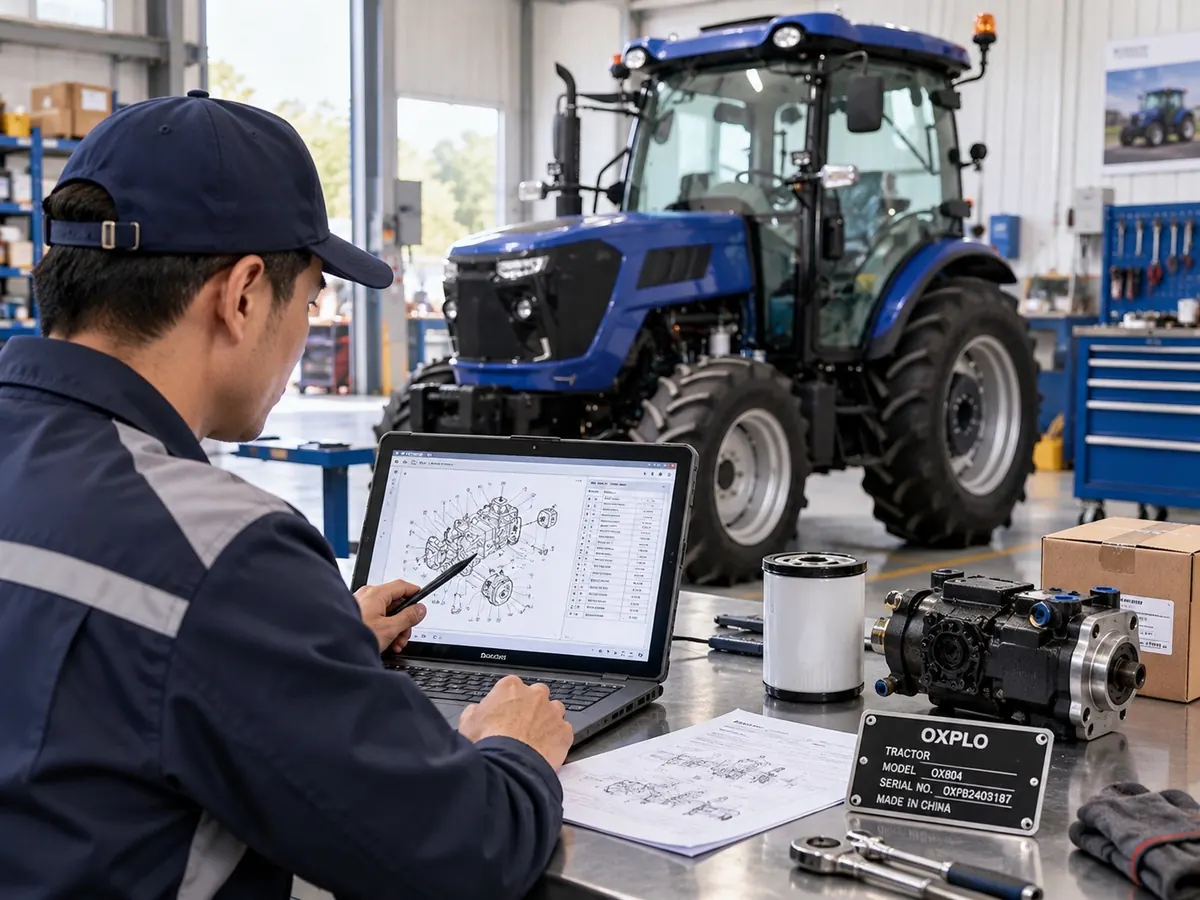
A structured support process starts with machine identification and evidence-based diagnosis before a replacement part is selected.
6. Who pays for parts, labour, freight and return shipping?
Why it matters. “Free replacement part” does not automatically mean free technician labour, international freight, customs charges or return freight for a defective component.
A good answer. Cost responsibility is separated clearly into parts, shipping, local labour, travel and any return requirement.
Red flag. The phrase “free warranty” is used without defining what is actually free.
7. Can a qualified local technician repair the tractor without voiding coverage?
Why it matters. For cross-border equipment, local repair is often the fastest path. The supplier should define which work can be done locally and which interventions require approval.
A good answer. The supplier can provide remote guidance, service information or approval for qualified local repair where appropriate.
Red flag. The only theoretical repair path depends on sending a factory technician internationally for ordinary faults.
8. How are spare parts identified before they are shipped?
Why it matters. “50 HP tractor hydraulic pump” is not enough information. Different production batches and configurations can use different components.
A good answer. Parts are checked against model, serial number, part number, installation position and photos before shipment.
Red flag. Parts are selected only by horsepower or a vague component name.
9. What technical support is available after delivery?
Why it matters. Useful tractor support begins with setup, operation and maintenance—not only emergency repairs.
A good answer. The supplier can support operating questions, maintenance guidance, fault-code analysis, parts identification and remote troubleshooting according to the issue.
Red flag. “After-sales service” only means that a salesperson can forward a message to someone else.
10. What happens after the warranty expires?
Why it matters. A tractor may work for many years, while the formal warranty covers only the early part of its life.
A good answer. Maintenance parts, replacement components and technical assistance remain available for supported models after warranty.
Red flag. The supplier cannot explain how older machines or serial numbers will be supported.
V. An Illustrative Downtime Scenario: Same Failure, Two Support Systems
Imagine two farms experience the same mid-season hydraulic sensor failure. The component itself is inexpensive. What differs is the quality of the support process. The following is an illustrative workflow—not a claim about any specific supplier or a guaranteed service time.
Stage | Supplier A: Unstructured | Supplier B: Structured |
Initial report | “Hydraulic problem” sent by chat. | Model, serial number, operating hours, fault code, photo and video submitted. |
Diagnosis | Repeated questions over several days. | Technical team narrows the issue from evidence and operating conditions. |
Part identification | Part selected from a generic description. | Part checked against machine record and part reference. |
Repair | Local technician waits for instructions. | Qualified local technician receives repair guidance where appropriate. |
Outcome | Higher risk of delay or wrong-part shipment. | Higher chance of one correct shipment and a clear verification step. |
The commercial lesson is straightforward: the tractor warranty does not create value when a claim is approved. It creates value when the machine returns to productive work with fewer avoidable delays.
VI. What European Tractor Buyers Should Verify Before Shipment
European buyers have an additional reason to connect pre-order configuration with after-sales support: a tractor is not just an engine and gearbox. The original market configuration affects later parts, service and compatibility decisions.
Configuration records that matter later
- Engine and destination-market configuration.
- PTO speed and spline specification.
- Three-point linkage category and lift requirements.
- Hydraulic requirements and auxiliary valve configuration.
- Tyres, ballast and wheel setup.
- Operator station, lighting, braking and road-use equipment where applicable.
- Front-loader or attachment interfaces.
- Model-specific conformity or CE-related documents required for the destination market.
This is also why model and serial-number discipline matters. Two tractors with the same headline horsepower can sit on different platforms and use different linkage categories, transmissions, PTO arrangements, tyres or attachments. When the original configuration is recorded correctly, later parts identification becomes faster and less ambiguous.
The cheapest after-sales problem is the one prevented before production
Some support problems are not failures at all. They begin as specification errors: an implement that needs a different PTO speed, a three-point linkage mismatch, insufficient hydraulic requirements, a tyre package that does not suit the site or an attachment selected only by horsepower. A disciplined pre-order check is therefore part of after-sales risk control.
VII. Why Parts Support Matters More After the Warranty Ends
Most of a tractor’s economic life occurs after the initial farm tractor warranty has expired. For a dealer, fleet buyer or farm expecting to keep a machine for many seasons, the long-term questions are therefore about parts continuity and technical traceability.
- Can the supplier still identify the tractor by model and serial number several years later?
- Can maintenance parts be ordered separately?
- Can the supplier distinguish similar-looking components from different configurations?
- Is technical guidance still available for supported machines after the warranty period?
- Can the buyer source routine service items in advance rather than waiting for a failure?
This shifts the buying question from “How many months is the warranty?” to “How will this tractor be supported throughout its working life?” That is a much better predictor of long-term ownership friction.
VIII. How OXPLO Structures Tractor Support
OXPLO’s current Support page separates support into parts and attachments, warranty support and technical assistance. Rather than publishing one blanket warranty period for every machine, OXPLO states that coverage depends on the product model, component and commercial agreement, with the applicable period, exclusions and claim procedure confirmed in the quotation, warranty document or purchase agreement.
For a warranty request, OXPLO asks buyers to prepare the machine model, serial number, purchase information, operating hours and a clear description of the issue; photos, videos, fault codes and maintenance records may also be requested. That structure supports evidence-based diagnosis instead of treating every problem as a generic “tractor fault.”
For spare parts, OXPLO asks for the model, serial number, part number and clear photos where available, then confirms availability and delivery after verification. This matters because a correct part match is one of the simplest ways to avoid a second downtime event.
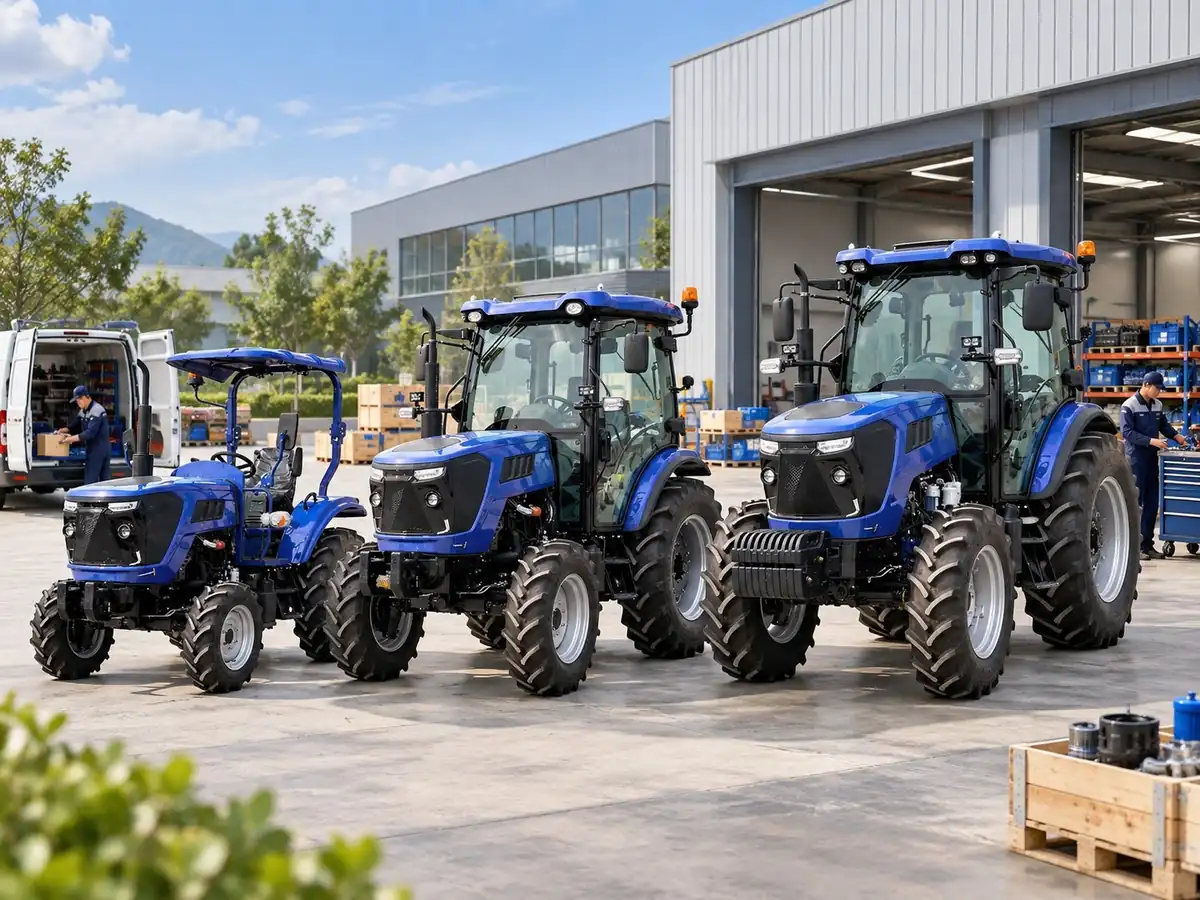
A support system is broader than a warranty document: machine records, parts supply, technical guidance and local service pathways all contribute to uptime.
Why OXPLO’s 25–70 HP range makes configuration records important
The OXPLO tractor range currently spans six models from 25 HP to 70 HP. That is not simply a horsepower ladder. The compact OXT254 and OXT504 are Category I platforms, while the larger OXT604 and OXT704 move to Category II utility platforms with different transmission and implement interfaces. This is exactly why OXPLO support starts with the exact machine rather than a generic horsepower description.
OXPLO model | Public rating | Platform cue | Why it matters for support |
OXT254 | 25 HP | Compact, Category I | Light-duty parts and attachment matching should use exact model/configuration. |
OXT504 | 50 HP | Compact, Category I | Higher output on a compact platform; PTO and attachment details still need confirmation. |
OXT604 | 60 HP | Larger utility, Category II | Different working system from the compact range; parts and implement interfaces change. |
OXT704 | 70 HP | Larger utility, Category II | 12F+12R / larger utility platform requires correct machine-specific support data. |
Preventing support problems before the tractor ships
OXPLO’s tractor configuration page asks buyers to confirm PTO and linkage requirements, hydraulic needs, tyre choices, attachment compatibility and destination-market details before the order is finalized. For European buyers, OXPLO can also confirm model-specific CE-related documentation and pre-shipment inspection information for the selected configuration.
This is an important point: OXPLO tractor support is not only reactive. A substantial part of after-sales risk can be removed before production by matching the tractor, attachment and destination-market requirements correctly.
Useful OXPLO product pages for technical confirmation
- OXPLO OXT254 – 25 HP compact 4WD tractor
- OXPLO OXT504 – 50 HP 4WD farm tractor
- OXPLO OXT604 – 60 HP 4WD utility tractor
- OXPLO OXT704 – 70 HP 4WD farm tractor
- OXPLO Support – warranty, parts and technical help
IX. Pre-Order Tractor Warranty Checklist
Before you pay the deposit, get the following points confirmed in writing:
- ☐ Warranty period and exact start date.
- ☐ Any operating-hour limit.
- ☐ Covered components and exclusions.
- ☐ Definition of wear and maintenance parts.
- ☐ Required maintenance schedule and records.
- ☐ Warranty-claim information and evidence required.
- ☐ Who decides whether the failure is covered.
- ☐ Responsibility for parts, freight, local labour and return shipping.
- ☐ Whether qualified local repair is allowed and when factory approval is required.
- ☐ How spare parts are identified and verified before shipping.
- ☐ Technical support available after delivery.
- ☐ Parts and support availability after the warranty expires.
- ☐ Final PTO, linkage, hydraulic, tyre and attachment configuration.
- ☐ Destination-market documents and pre-shipment inspection records.
A stronger purchase order |
X. Conclusion: Buy a Support Process, Not Just a Warranty Number
A good tractor warranty is not defined only by months. It is defined by what happens between the first fault report and the moment the tractor returns to work. For European farms, dealers and contractors, that means clear coverage, disciplined machine identification, evidence-based diagnosis, accurate parts matching, a practical local repair path and long-term parts continuity.
OXPLO’s support approach is built around those practical steps: confirming the exact machine and configuration, collecting the information needed to diagnose a problem, matching replacement parts carefully and supporting operation, maintenance and troubleshooting throughout the equipment’s working life. Buyers should still confirm the exact OXPLO warranty period, covered components, exclusions and cost responsibilities for their specific quotation—because a serious B2B purchase should never depend on a generic promise.
If you are comparing a new farm tractor for Europe, review the OXPLO 25–70 HP tractor range, check the OXPLO Support page, and send OXPLO your farm type, implements, working conditions and destination country so the machine and support requirements can be confirmed before ordering.