
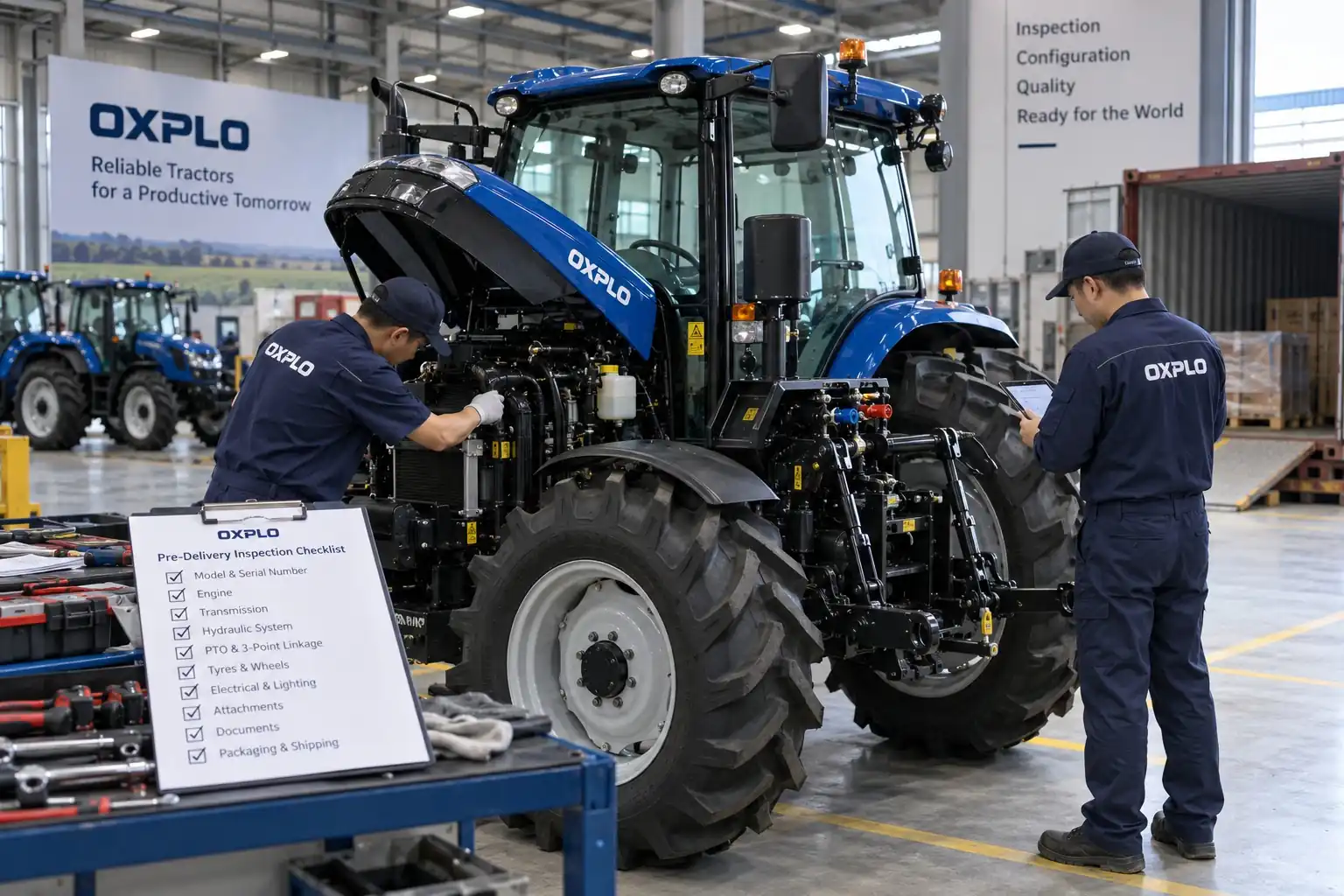
A tractor problem found on the factory floor is usually inexpensive. The same problem found after ocean freight, customs clearance, inland delivery and seasonal deployment can become a supply-chain problem.
That is the commercial reason a tractor pre delivery inspection should never be treated as a quick photo session before the container door closes. A useful inspection must verify that the tractor being shipped is the tractor the buyer actually specified, that it can operate with the intended implements, that its destination-market configuration is correct, and that the shipment can be traced if something is missing or damaged.
For European importers, distributors and farm operators, this distinction matters. A tractor can start, drive and look clean while still being the wrong delivery. The PTO may not match the mower. The linkage category may not match the customer’s implements. A hydraulic outlet may be missing. Tyre width may create access problems. Documentation may not correspond to the exact engine or market configuration.
The core principle A successful pre shipment inspection does not ask only, “Is this tractor working?” It asks, “Is this exact machine ready to perform the buyer’s intended work in the destination market?” |
I. Pre-Delivery Inspection Is Really Landed-Risk Control
The visible defect is rarely the most expensive part of a failed delivery. The expensive part is everything that happens after the defect is discovered overseas.
A missing fitting or incorrect configuration can trigger replacement parts, international courier costs, local technician labour, machine downtime, delayed field work and dealer or customer complaints. For seasonal agricultural work, timing can be more important than the price of the part itself. A tractor that arrives after the mowing, planting or soil-preparation window has already imposed a business cost even if the hardware can eventually be corrected.
This is why a strong tractor quality inspection works as a risk filter. It moves problem detection to the point in the supply chain where correction is still fast and controllable.
A useful cost model Post-shipment correction cost = replacement parts + international freight + local labour + downtime + delayed farm work + customer/dealer handling. PDI is designed to stop avoidable errors before they enter this cost chain. |
II. Risk 1: The Tractor Delivered Is Not the Tractor You Specified
“50 HP, 4WD tractor” is not a complete technical specification. Two tractors with the same horsepower can differ in transmission, PTO speed, PTO spline, linkage category, hydraulic outlets, tyres, operator station, lighting, engine configuration and optional attachments.
The first PDI gate should therefore be configuration identity, not cosmetics. The inspector should work from the final purchase order, approved quotation or signed specification sheet and trace every physical machine back to that document.
Start with machine identity
- Tractor model and drive type (2WD / 4WD as ordered).
- Machine serial number and engine serial number.
- Rated power and confirmed engine model.
- Transmission and listed forward/reverse ratios.
- PTO speed and spline specification.
- Three-point linkage category.
- Tyre sizes, tread type and wheel configuration.
- Cabin, ROPS, lighting and operator-station options.
- Front loader, hydraulic options and other ordered attachments.
A common inspection mistake is to check only what is easy to see. Paint, panels and tyres are visible; PTO configuration, hydraulic connections and documentation require deliberate verification. The difficult items are often the ones that determine whether the machine can work on day one.
III. Risk 2: The Tractor Runs, but It Cannot Work with the Buyer’s Implements
This is one of the most frustrating delivery failures because the tractor may be mechanically healthy. It starts, drives and passes a basic road test. Yet the customer cannot connect the mower, rotary tiller, trailer, loader or other implement that justified the purchase.
Not every delivery problem is a manufacturing defect. Many are specification-control failures.
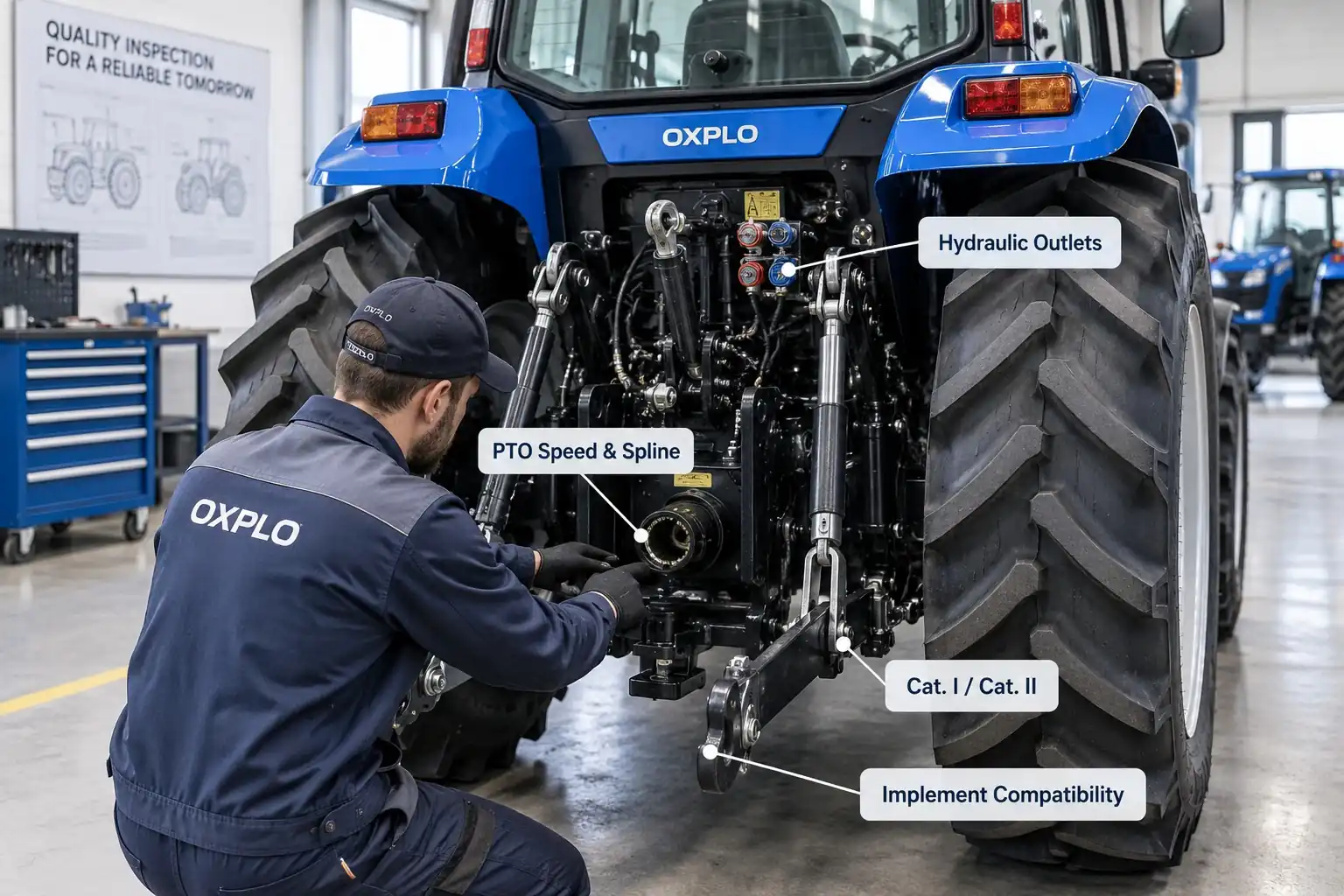
PTO, linkage and hydraulic verification are working-system checks, not cosmetic checks. The exact configuration must match the implement plan.
Verify PTO compatibility, not just PTO rotation
A basic video showing a PTO shaft turning proves very little. The inspection should verify the ordered PTO speed, spline specification, engagement and disengagement, guarding and compatibility with the intended implement. If the buyer has already provided the implement specification, the PDI should check the tractor against that requirement.
Check Category I / Category II before shipment
The three-point linkage category is part of the working system. A buyer who already owns Category I implements may create a new compatibility problem by moving to a larger Category II tractor without checking connection geometry and implement requirements. “More horsepower” is not automatically an upgrade if it breaks the implement system the farm already uses.
Hydraulics must be tested under the intended configuration
For a standard rear implement, confirm lift and lower function, hydraulic connectors, hoses, leakage and holding behaviour. If a front loader is included, the PDI should go further: cycle the loader, inspect the hydraulic routing and couplers, verify the attachment interface and confirm the agreed ballast or counterweight arrangement where applicable.
IV. Risk 3: The Tractor Works, but the European-Market Configuration Is Wrong
For European buyers, compliance and registration questions should be resolved before shipment, not after arrival. The relevant framework depends on the vehicle category, engine, intended use and destination country. EU agricultural and forestry tractor type approval is governed by Regulation (EU) No 167/2013, while Stage V engine emissions for non-road mobile machinery are addressed by Regulation (EU) 2016/1628 and related implementing rules.
This is why “Does this tractor have CE?” is often too broad to be a useful first question. A stronger purchasing question is: “What conformity, type-approval, engine-emission, manual, label and supporting documentation applies to this exact tractor configuration in my destination market?”
The answer should be tied to the actual unit or approved configuration being shipped. Buyers should also separate farm use from road-use requirements. A tractor that can operate on private land may face additional requirements if it must be registered or driven on public roads.
What European buyers should verify before release
- Exact engine model and applicable emissions documentation.
- Vehicle / machinery conformity documentation relevant to the selected configuration.
- Required labels, markings and serial-number consistency.
- Operator manual and maintenance documentation in the agreed language.
- Lighting, braking, guarding and road-use equipment required for the intended application.
- Destination-country requirements that cannot be solved by a generic “Europe” configuration.
Important boundary A factory PDI is not a substitute for destination-country legal review. Its role is to make sure the machine and documents being shipped are the machine and documents that were actually approved for the order. |
V. Risk 4: The Tractor Passes Factory QC but Is Not Ready for Shipment
A tractor can pass functional testing and still be poorly prepared for a long international shipment. The inspection therefore needs a separate shipment-readiness gate after mechanical QC.
Look for fluid seepage, loose components, battery and electrical protection where required, vulnerable lamps or mirrors, unsecured tools or spare parts, exposed attachments and insufficient protection against movement during loading and transport. The objective is not to make the tractor look packaged; it is to prevent vibration, contact and handling from turning a good tractor into a damaged delivery.
Packing should be traceable, not improvised
Loose accessories are a recurring source of disputes. A practical system is to assign identifiers to accessory boxes, spare-parts boxes and separate attachments, then match those identifiers to the packing list and loading photos. If several tractors with different configurations share one shipment, the box-to-machine relationship should be clear before loading.
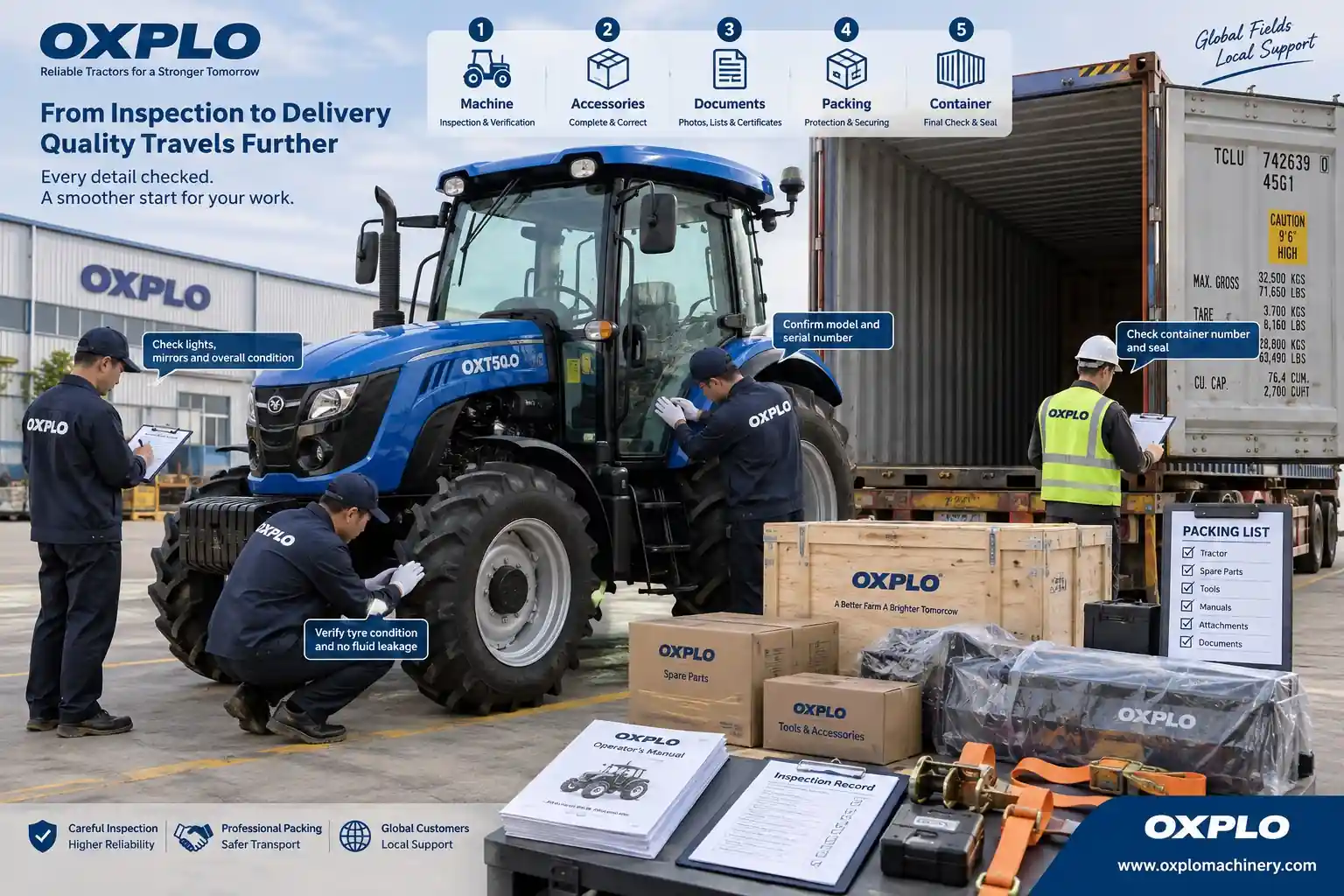
A shipment-release gate should connect the machine, accessories, documents, packing and container record. Missing parts are easier to prevent than to investigate after delivery.
VI. Risk 5: Something Is Missing, but There Is No Evidence Chain
A five-minute inspection video is not a complete record. When a shipment dispute occurs, the useful evidence is usually specific: which serial number was loaded, which box was present, what condition was documented, and what container or seal number was recorded.
A strong pre shipment inspection therefore creates a traceable evidence package rather than a collection of attractive photos.
Build the record around the machine serial number
- Final configuration sheet / purchase order reference.
- Tractor serial-number photo and engine identification photo.
- Four-side machine condition photos.
- Cold-start and instrument-panel video.
- Transmission, steering and brake function checks.
- PTO, three-point linkage and hydraulic operation video.
- Tyre specification and accessory photos.
- Manuals, labels and agreed documentation.
- Packing and container-loading photos.
- Container number and seal number.
This record has two jobs. First, it gives the buyer visibility before shipment. Second, it forces the supplier’s own teams to cross-check production, QC, warehouse, documentation and logistics before the tractor leaves the factory.
VII. The Practical Tractor Pre Delivery Inspection Workflow
A reliable PDI is easiest to manage as a sequence of release gates. Each gate answers a different risk question; passing one does not automatically mean the next has been passed.
Release Gate | What to Verify | Risk Controlled |
1. Order identity | Model, serial numbers, engine, options | Wrong machine or wrong specification |
2. Static mechanical check | Fluids, leaks, fasteners, tyres, visible damage | Early defect or assembly issue |
3. Dynamic function test | Cold start, transmission, steering, brakes, instruments | Machine cannot operate normally |
4. Working-system check | PTO, linkage, hydraulics, loader/attachments | Implements cannot be used |
5. Market/document check | Manuals, labels, conformity/emissions documents | Registration/compliance/support delay |
6. Packing check | Accessories, spares, vulnerable components, securing | Missing parts or shipping damage |
7. Loading evidence | Machine/box count, container, seal | Weak traceability after shipment |
Cold start: do not hide the machine’s first behaviour
Whenever practical, a cold-start check is more informative than showing an engine that has already been warmed. Record starting behaviour, idle stability, instrument warnings, unusual noise, abnormal persistent smoke and obvious fluid leakage. Avoid diagnosing engine condition from smoke colour alone; context, load and duration matter.
Transmission, steering and brakes: the tractor must move under control
Select representative forward and reverse gears, confirm clutch or shuttle operation as applicable, test steering through a practical range and verify service and parking brakes. The purpose is not a long endurance test; it is to detect obvious functional errors before transport.
Electrical and operator station: small defects create immediate dissatisfaction
Check the dashboard, lights, indicators, warning devices, horn, battery terminals, switches and any ordered cabin equipment. These are inexpensive problems at the factory and irritating problems after delivery.
VIII. Five Pre-Shipment Checks European Tractor Buyers Often Miss
The items below are easy to underestimate because they are not always visible in a standard walk-around video. Yet each can decide whether the tractor fits the farm.
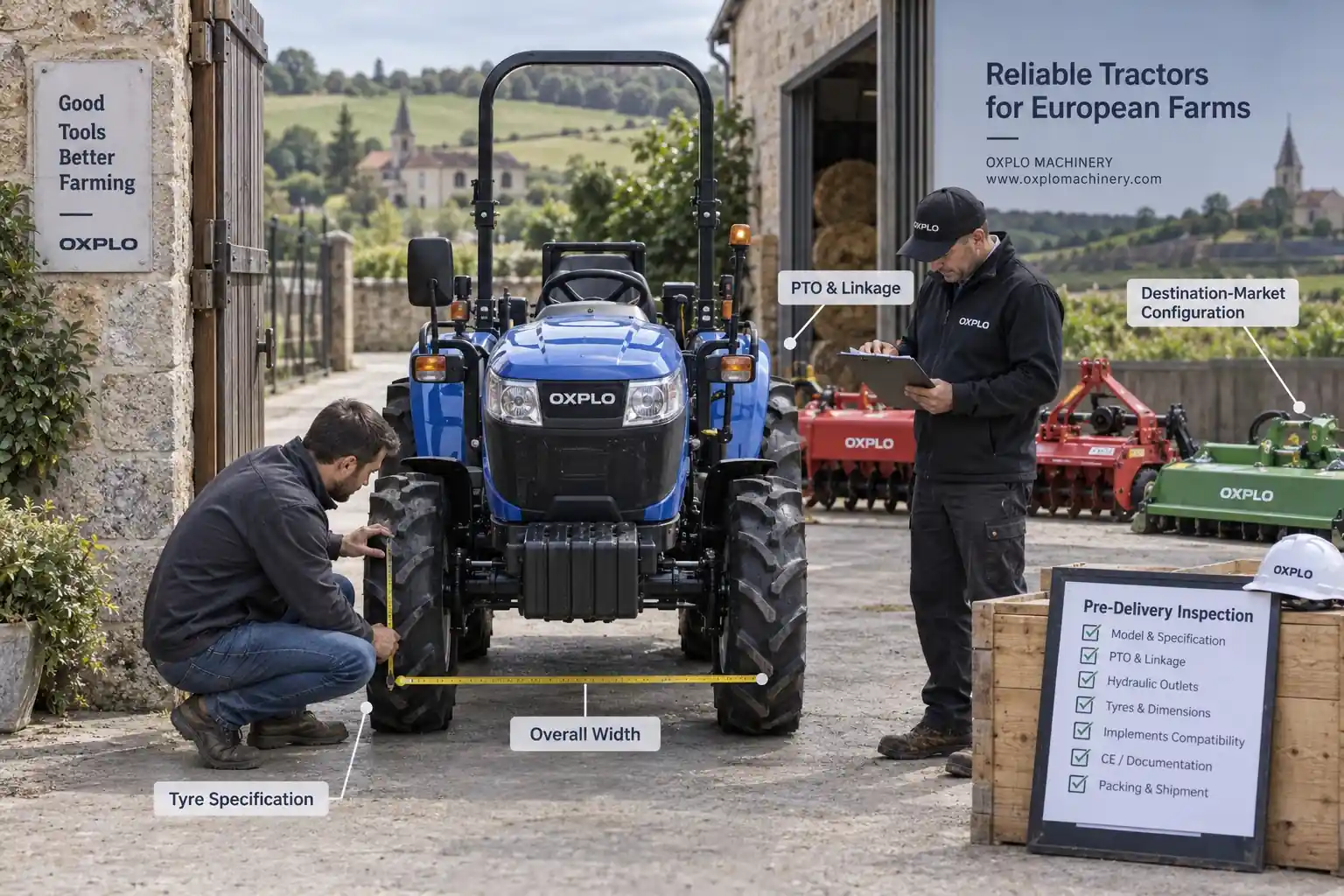
European buyers should inspect the tractor as a farm working system: dimensions, tyres, implements and destination-market configuration all matter.
1. PTO compatibility, not just PTO operation
Confirm speed, spline and implement requirement. A rotating shaft is not proof of compatibility.
2. Linkage category and implement geometry
Check Category I / Category II and the implements the buyer actually owns or plans to buy.
3. Overall width, height and access constraints
Measure against gates, livestock buildings, orchard/vineyard rows and storage areas. Ten extra horsepower may come with a larger platform.
4. Destination-market documentation
Confirm exact engine and machine documentation before loading, especially when registration or road use is part of the plan.
5. Attachment and hydraulic compatibility
Loaders, mowers and other attachments must be reviewed as a system: connection, hydraulic demand, weight, ballast and working envelope.
IX. How OXPLO Connects Configuration Control with Pre-Delivery Inspection
This is where OXPLO’s tractor range becomes relevant. OXPLO currently presents six tractor power classes from 25 HP to 70 HP, but OXPLO does not treat horsepower as the only purchasing variable. The OXPLO range moves from compact Category I platforms into larger Category II utility platforms, which changes implement compatibility, chassis dimensions and transmission choices.
Review the current OXPLO 25–70 HP tractor range and compare the configuration before requesting a final quotation.
OXPLO example: OXT504 versus OXT604
The OXPLO OXT504 is currently published as a 50 HP, 4WD compact tractor with an 8F + 8R transmission, Category I linkage and a listed width of 1,560 mm. The OXPLO OXT604 moves to 60 HP, 12F + 12R, Category II linkage, a longer 2,010 mm wheelbase and a larger tyre/chassis package. That is not simply a 10 HP increase. It is a change in working platform.
See the published specifications: OXPLO OXT504 | OXPLO OXT604
For an OXPLO buyer, this distinction matters during tractor pre delivery inspection. If the order was selected because the farm relies on Category I implements and compact access, PDI must confirm those features. If the order was moved to an OXPLO OXT604 because heavier Category II implements and more frequent loader work are required, the inspection criteria should change accordingly.
OXPLO should inspect against the final specification sheet, not against a generic product page
OXPLO’s public pages are useful for model comparison, but the final order may include destination-market equipment, tyre choices, hydraulic options, attachments or documentation requirements. The controlling document for PDI should therefore be the approved quotation or final specification sheet for the exact machine being shipped.
This approach is especially important when published information contains model-dependent or configurable items such as PTO speed. OXPLO buyers should request the exact supplied PTO, linkage, engine and documentation details in the final quotation and make those fields part of the PDI record.
X. What OXPLO Buyers Should Send Before the Tractor Is Built
A good PDI starts before production. OXPLO can make a more reliable recommendation when the customer describes the working system instead of asking only for a horsepower price.
Before OXPLO confirms a tractor, send the following information:
- Destination country and whether road registration or public-road use is expected.
- Farm type, terrain, slope and typical ground conditions.
- Annual working hours and the heaviest recurring tasks.
- Existing implements: type, width/weight, PTO requirement and linkage category.
- Hydraulic outlet and loader requirements.
- Gate, row, building or height restrictions.
- Tyre preference and traction priorities.
- Required manuals, labels and supporting documentation.
OXPLO can then use these inputs to narrow the model class, confirm the PTO and linkage system, review attachment compatibility and define the OXPLO pre-delivery inspection points that are specific to that order.
Useful OXPLO links: Tractor Configuration & Attachments | OXPLO Support | All OXPLO Products
XI. Buyer’s Farm Tractor Checklist Before Shipment Release
Check | What to Verify | Release |
Identity | Model, serial number, engine, drive type | ☐ |
Engine | Cold start, idle, warnings, leaks | ☐ |
Transmission | Forward/reverse operation, clutch/shuttle | ☐ |
Steering & brakes | Steering response, service brake, parking brake | ☐ |
PTO | Speed, spline, engagement, guarding | ☐ |
3-point linkage | Category, lift/lower, pins and stabilisation | ☐ |
Hydraulics | Outlets, hoses, lift function, leakage | ☐ |
Tyres & dimensions | Size, direction, condition, access dimensions | ☐ |
Electrical | Lights, instruments, horn, switches | ☐ |
Attachments | Model, interface, hydraulic/weight compatibility | ☐ |
Documents | Manuals, labels, conformity/emissions documents | ☐ |
Packing | Accessories, spares, protection, securing | ☐ |
Loading | Machine/box count, photos, container and seal | ☐ |
XII. Frequently Asked Questions
What is a tractor pre delivery inspection?
It is a documented verification performed before shipment to confirm that the tractor matches the approved order, operates correctly, works with the intended implements, includes the required documents and accessories, and is properly prepared for transport.
Is a pre shipment inspection the same as a factory quality inspection?
Not exactly. Factory QC may focus on manufacturing and function. A buyer-focused pre shipment inspection also checks the final configuration, destination-market documentation, accessories, packing and shipment evidence.
Should I inspect a tractor based on horsepower alone?
No. Horsepower is only one selection variable. PTO, linkage, hydraulics, tyres, dimensions, transmission, attachments and the destination-market configuration can change whether the tractor is suitable.
What should a tractor inspection video show?
At minimum: machine identification, cold start where practical, instrument panel, basic driving functions, steering/brakes, PTO, linkage/hydraulic operation, tyre and attachment details, and the packing/loading condition.
What should European buyers confirm before shipment?
Confirm the exact engine and applicable emissions documentation, relevant conformity/type-approval documentation, manuals and labels, road-use or registration needs, and that these documents correspond to the configuration being shipped.
How does OXPLO support pre-delivery verification?
OXPLO can confirm the final tractor configuration, attachment compatibility and destination-market requirements during quotation and order review, then use the agreed specification as the basis for pre-delivery and pre-shipment checks. Buyers should request order-specific photos, videos and documentation before release.
XIII. Conclusion: Find the Problem Before the Container Door Closes
The best tractor pre delivery inspection is not the longest checklist. It is the inspection that connects the farm application, final specification, physical machine, documents, accessories and shipment record into one traceable chain.
For a European buyer, the goal is simple: the tractor that arrives should be the tractor that was selected, configured and approved—and it should be ready to connect to the intended implements and start work with minimal correction after delivery.
OXPLO’s 25–70 HP range gives buyers several platform choices, from compact Category I tractors to larger Category II utility tractors. The value of that range only appears when OXPLO and the buyer confirm the real working requirements before production and then verify the same requirements during PDI.
Before asking OXPLO for a final price, send the destination country, primary tasks, implements, PTO/linkage requirements, access dimensions, hydraulic/loader needs and expected annual workload. OXPLO can then discuss the appropriate configuration and define what must be verified before shipment.
Discuss Your Tractor Configuration with OXPLO
References & Further Reading
- OXPLO Tractor Customization & Model Comparison
- OXPLO OXT504 – 50 HP 4WD Farm Tractor
- OXPLO OXT604 – 60 HP 4WD Utility Tractor
- OXPLO Support – Parts, Attachments & European-Market Guidance
- EU Regulation (EU) No 167/2013 – Agricultural and Forestry Vehicle Type Approval
EU Regulation (EU) 2016/1628 – Stage V / Non-Road Mobile Machinery Engine Emissions