
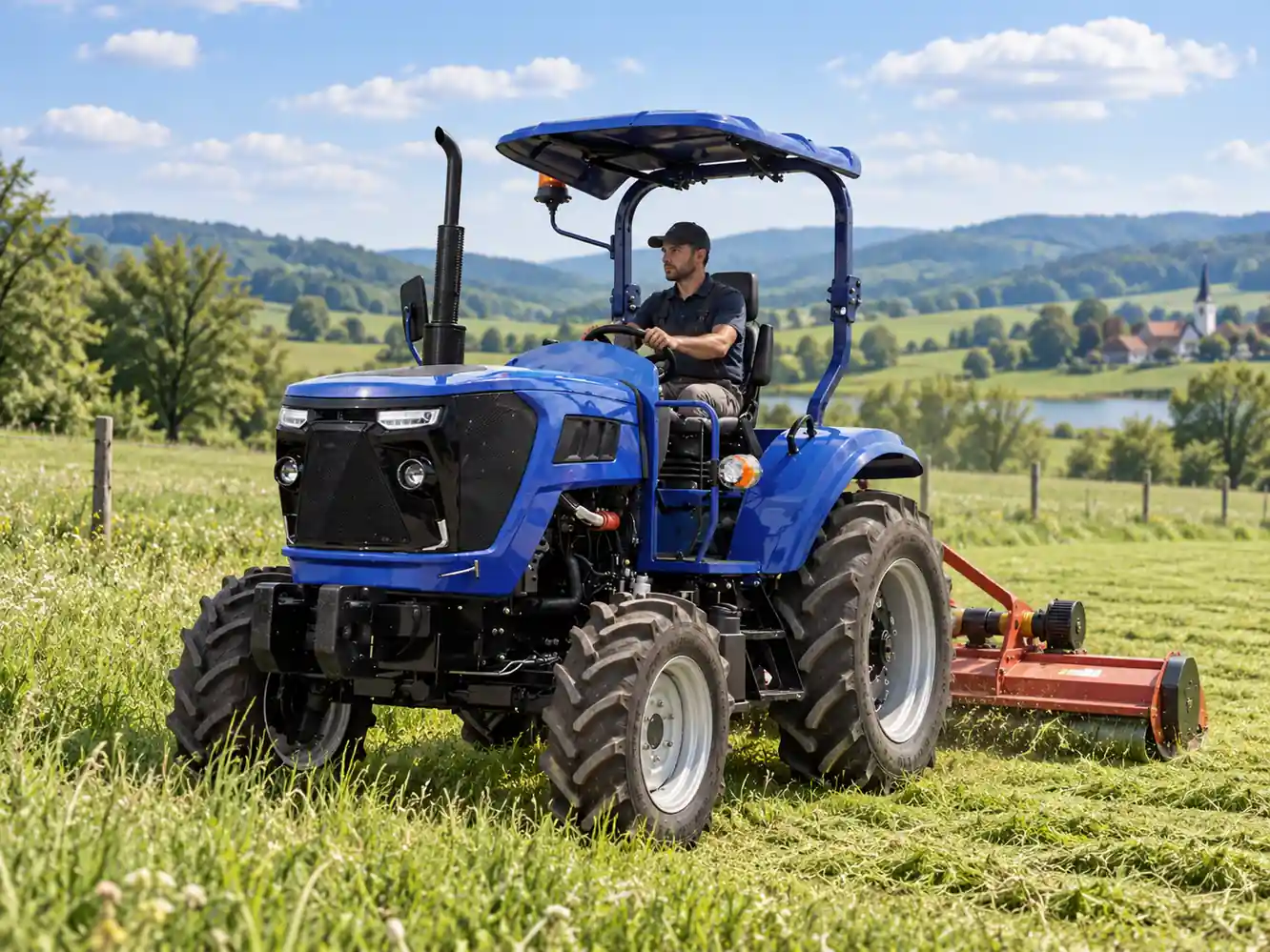
A 70 hp tractor sits in a deceptively difficult buying class. It is large enough to move beyond many compact-tractor jobs, yet still compact enough to be considered for mixed farms, livestock operations, grassland, agricultural transport and general-purpose contracting. That versatility is useful, but it also creates a common procurement mistake: buyers select the tractor first and only later discover that the implement, PTO, hydraulic, traction or access requirement should have determined the machine.
The right question is not simply, “Do I need 70 horsepower?” The better question is, “Does my hardest recurring job require the complete working platform that comes with a 70 hp tractor?” That platform includes usable PTO performance, drawbar traction, transmission ratios, tractor mass, tyre setup, three-point linkage, hydraulic capacity, physical dimensions and the time available to finish the job.
This guide is written for farm owners, procurement managers, dealers and contractors who want to avoid paying for the wrong capacity. It focuses on where purchasing decisions fail, what to verify before requesting a quotation, and how to translate tractor specifications into field productivity and total cost of ownership.
Core buying principle: Choose the tractor around the hardest recurring implement and workload – not the other way around. |
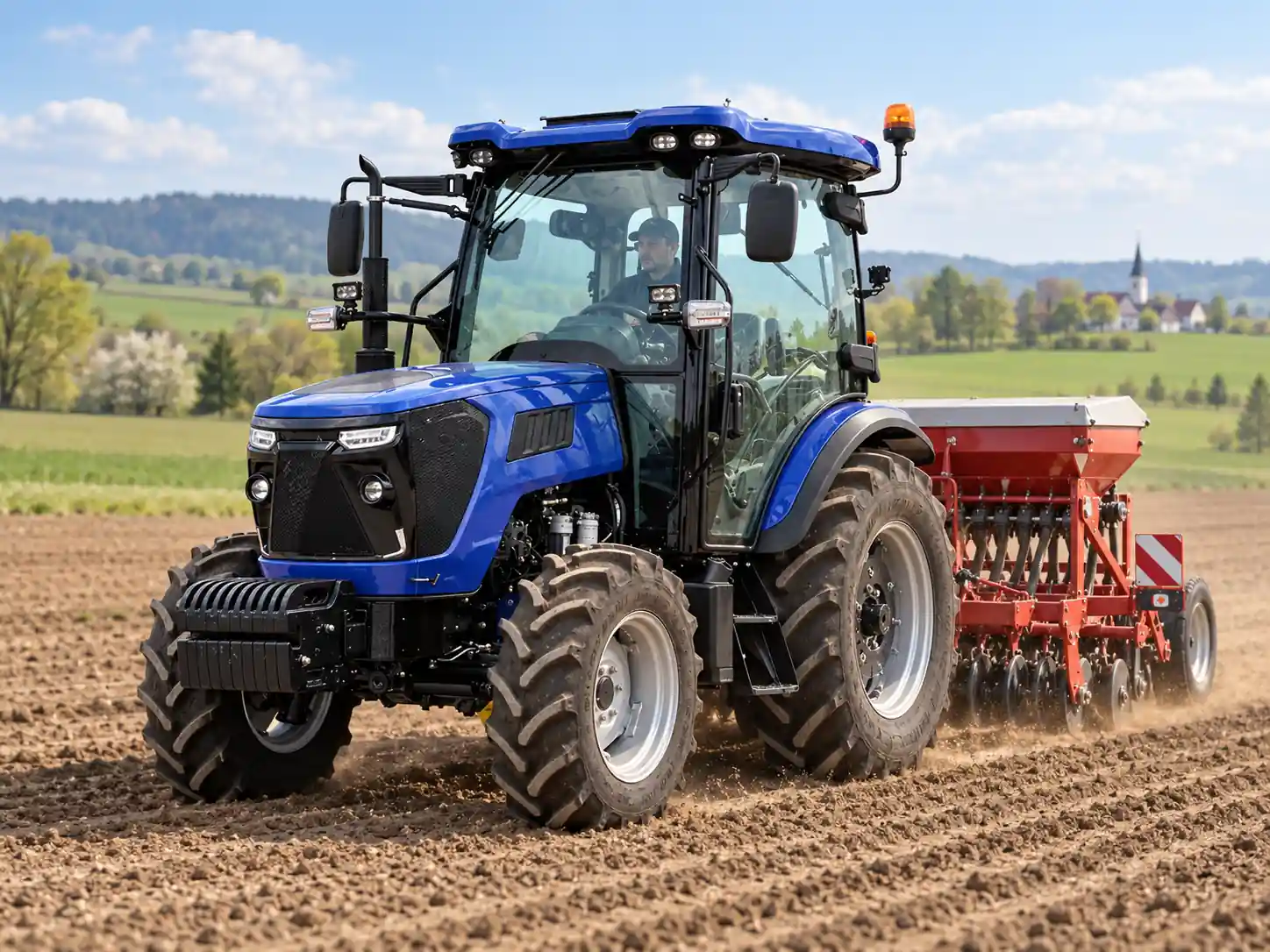
Illustrative seeding scenario: the useful question is whether the tractor can sustain the required working width, draft load and daily output under real field conditions.
I. Start With the Hardest Recurring Job, Not Farm Acreage
Farm size is a useful screening input, but it is a poor primary sizing rule. Two farms with the same hectares can need completely different tractors. One may spend most of the year mowing, spreading fertiliser and moving light trailers. Another may cultivate heavier soil, handle bales every day and need to finish field preparation before a short rain window closes.
The second farm can require a larger working platform even if its acreage is smaller. That is because tractor demand is created by work, not by a map boundary.
Before comparing a 70 hp tractor for sale, identify the job that creates the highest recurring load or the greatest scheduling risk. For each important implement, write down the operating width, manufacturer power requirement, PTO requirement, linkage category, implement mass, hydraulic demand, intended working speed and the conditions in which it will be used.
A simple implement-first matrix is more useful than a generic acreage chart because it exposes the real limiting variable. A mower can be PTO-limited. A plough can be drawbar-limited. A loader can be hydraulic- and stability-limited. A tractor that looks correct on horsepower alone can still be wrong at the interface.
Decision Input | What to Record | Why It Changes the Tractor |
Implement | Type, width, weight, manufacturer HP range | Defines the basic power and chassis demand |
Power path | PTO, drawbar, hydraulic or mixed | Shows which tractor subsystem must carry the load |
Field condition | Soil type, slope, moisture, surface | Changes draft, traction and wheel-slip risk |
Working window | Hours or days available to complete work | Turns capacity into a scheduling issue |
Access | Gate, shed, row width, overhead clearance | Can rule out an otherwise capable tractor |
Annual use | Hours per year and task mix | Determines whether extra capacity earns its cost |
II. A 70 HP Tractor Is a System, Not an Engine Number
Engine horsepower is only one part of a working tractor. For a buyer, four separate questions matter: how much power the engine can produce, how much usable power reaches a PTO implement, how effectively the tractor can transfer power to the soil, and whether the hydraulic system can operate the selected equipment.
Engine HP vs. PTO HP
PTO-driven equipment such as mowers, balers and rotary tillers does not care about the badge on the bonnet. It needs the required PTO speed and enough usable PTO power to maintain operation when crop density, working depth or material flow increases. A tractor that repeatedly loses engine speed may technically run the implement but still deliver poor productivity.
Drawbar Power and Traction
Tillage and loaded transport shift the problem toward traction. The power path becomes engine -> transmission -> tyres -> ground. If the tyres cannot convert available power into forward motion, more engine output alone will not solve the bottleneck. The result can be wheel spin, lower ground speed, extra fuel per completed hectare and unnecessary tyre wear.
Hydraulics and Loader Work
Loader work introduces another layer. Hydraulic flow, pressure, valve configuration, front-axle loading, ballast and counterweight become as important as horsepower. This is why “70 HP is enough for a loader” is not a complete engineering answer. The loader, attachment, intended load and hydraulic requirement must be checked as a complete system.
Procurement warning: Do not accept “compatible with 70 HP tractors” as proof of compatibility. Confirm PTO, hitch, hydraulics, mass and the specific attachment interface. |
III. The Hidden Cost of Buying Too Small
An undersized tractor often does not fail dramatically. It fails slowly, through extra hours and reduced capacity. The operator downshifts more often. Working depth is reduced. Implement width is kept smaller. Wheel slip increases. Field speed falls. A job that should finish before the weather changes runs into another day.
This is the point many buyers miss: a tractor should not be judged only by whether it can complete a task. It should be judged by whether it can complete the task at the required quality, at a sustainable load, inside the available working window.
Suppose one tractor-implement combination can sustain 2.5 m of working width at 7 km/h while another can sustain 3.0 m at the same speed and 75% field efficiency. The approximate effective capacities are 1.31 ha/h and 1.58 ha/h. That is about a 20% difference in productive capacity. This is an illustration, not a universal 70 HP implement rule, but it shows how a seemingly small capacity gap turns into labour hours and weather-window risk.
The hidden cost is cumulative. More engine hours bring maintenance events forward. More operator hours increase labour cost. More time in the field reduces the ability to switch to another seasonal task. When rainfall or soil moisture determines when work can happen, delay can be more expensive than the fuel difference between two tractor classes.
IV. The Hidden Cost of Buying Too Large
Oversizing is harder to notice because the machine usually performs the job easily. The business case can still be weak. A larger tractor ties up more capital, occupies more storage, uses a larger turning envelope, carries more mass across the soil and may require more expensive tyres or attachments.
On an older European farm, physical size can become more important than engine output. A tractor that is 150 mm too wide for a gateway or too tall for a livestock building is not more productive; it simply creates a new operating constraint.
The correct target is therefore not “the biggest tractor I can afford.” It is the smallest tractor platform that can reliably complete the hardest recurring jobs with enough reserve for realistic field conditions. That distinction protects both productivity and total cost of ownership.
V. Four Operating Profiles That Can Justify a 70 HP Farm Tractor
1. Your 50 HP Tractor Can Do the Job – But It Works at the Limit
This is one of the clearest upgrade signals. The smaller tractor can still pull the implement, but it needs frequent downshifts, cannot hold the preferred working speed, or spends long periods close to maximum load. A 70 hp farm tractor can make commercial sense when the additional reserve is used repeatedly rather than occasionally.
2. Your Implement Platform Is Moving Into Category II
A move from a compact Category I tractor into a Category II utility platform is not merely a horsepower change. It can alter which mounted implements can be used, how much implement mass can be carried, the tractor’s dimensions, tyre package and the way power is transferred to the ground. Buyers planning heavier mowers, cultivators, ploughs or other Category II implements should treat the linkage transition as a major part of the purchase decision.
3. One Tractor Must Work Across the Entire Agricultural Year
Mixed farms often ask one tractor to do several very different jobs: soil preparation in spring, mowing and grassland work in summer, bale handling, trailer transport, material movement and general maintenance. In this case a 70 hp 4wd tractor is valuable when its transmission, PTO, hitch and hydraulic configuration allow the farm to use the machine across multiple seasons instead of owning separate tractors for every task.
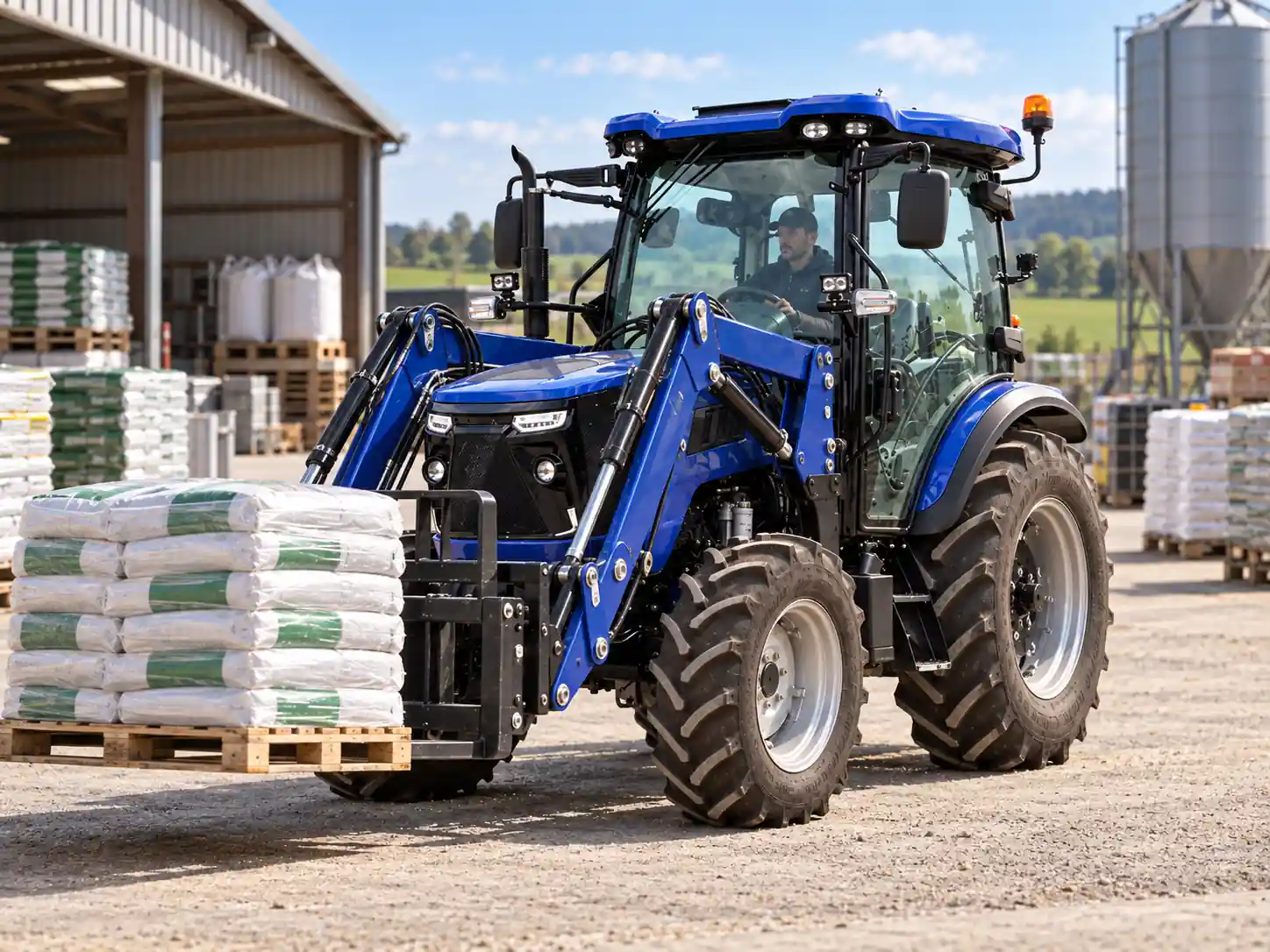
Illustrative loader scenario in a farm supply yard: loader selection must include hydraulics, axle loading, ballast and the type of material handled.
4. You Are a Dealer or Contractor Selling Utilisation, Not Just Horsepower
Dealers and agricultural contractors should evaluate a 70 hp tractor differently from a single-purpose farm owner. The key commercial question is how many recurring customer jobs the same platform can cover with a manageable set of attachments. A tractor that supports cultivation, grassland work, transport and loader tasks can create higher annual utilisation, but only if service parts, attachment interfaces and configuration documentation are standardised before delivery.
VI. When You Should Not Buy a 70 HP Tractor
A credible buying guide must also explain when 70 HP is unnecessary. More horsepower is not automatically more economical.
A smaller tractor may be the better choice when most work involves light mowing, spraying, property maintenance, light transport or other low-draft tasks; when the farm has narrow orchard rows or old buildings; when the existing implement fleet is largely Category I; or when annual utilisation is too low to justify the extra capital tied up in a larger platform.
This is especially important in orchards and vineyards. A 70 HP tractor may have abundant power for orchard-floor maintenance and spraying, yet still be the wrong machine if width, height or headland turning space limits access. A 40-50 HP tractor that reaches every working area can be more productive than a more powerful machine that spends time manoeuvring or simply cannot enter part of the farm.
A useful decision rule: If the extra horsepower does not remove a recurring bottleneck, it is probably not creating enough value to justify the larger platform. |
VII. 4WD, Tractor Mass, Tyres and Ballast: Turning Horsepower Into Useful Work
A 70 hp 4wd tractor does not create more engine power because all four wheels are driven. What four-wheel drive changes is the tractor’s ability to convert available power into traction under soft, uneven or high-draft conditions.
This matters on damp grassland, cultivated soil, slopes, muddy tracks and loader yards. If the engine holds speed but the tyres spin and actual ground speed falls, the machine is traction-limited rather than power-limited. The first response should be to examine tyre pressure, tyre type, ballast, axle loading, soil conditions and 4WD use before assuming a larger engine is required.
Ballast also involves a trade-off. Too little weight can increase wheel slip and reduce field capacity. Too much weight increases rolling resistance, tyre loading and soil compaction. The correct setup solves a defined traction or stability problem; it does not add mass automatically.
Illustrative 70 HP platform reference on a European-style farm: tyre setup, ballast, tractor mass and working environment should be evaluated together rather than by horsepower alone.
VIII. PTO, Category II Linkage and Hydraulics: The Interfaces That Decide Compatibility
PTO Speed and Spline
Check the implement’s required PTO speed, spline and power demand. Do not assume that every 70 hp tractor uses the same PTO configuration. If your farm already owns PTO equipment, list those interfaces in the RFQ so the supplier can verify compatibility before production.
Three-Point Linkage
The hitch category should be checked before purchase, especially when upgrading from a compact tractor. Moving into Category II can open access to heavier implements, but it can also make part of an existing Category I attachment fleet less convenient without adapters or replacement equipment. That conversion cost belongs in the purchasing decision.
Hydraulic Demand
For loaders, tipping trailers and hydraulically driven attachments, request the actual hydraulic specification required by the application. You need more than the statement “hydraulics included.” Confirm the relevant flow, pressure, remote-valve arrangement and connection requirements for the selected equipment.
Implement Mass and Stability
A tractor may have enough engine power for an implement but still be a poor match if the mounted weight, centre of gravity or transport load is wrong for the chassis. Heavy rear implements and front-loader work should be evaluated with ballast, axle loading and transport stability in mind.
IX. European Buyer Pre-Order Checklist: Verify the Configuration Before the Deposit
European buyers should treat market documentation and road-use equipment as part of the specification, not as paperwork to solve after the tractor arrives. EU Regulation No. 167/2013 provides the type-approval framework for agricultural and forestry vehicles, while the exact requirements that apply to a specific tractor depend on vehicle category, configuration, intended use and destination market.
Official reference: EUR-Lex – Regulation (EU) No 167/2013
The practical lesson is simple: do not assume that seeing the words “CE” or “Stage V” in a sales conversation automatically resolves every destination-country, registration or road-use requirement. Confirm the exact engine and market configuration, the model-specific documents available, and any lighting, braking or road equipment required for the intended use before placing the order.
Before Paying the Deposit | Why It Matters |
Exact engine and market configuration | Emissions and market configuration can vary by model and destination. |
Model-specific CE-related documents | Documents must correspond to the actual supplied configuration. |
PTO speed and spline | Prevents incompatible PTO-driven equipment. |
Three-point linkage category | Determines mounted-implement interface and upgrade cost. |
Hydraulic requirements and remotes | Critical for loaders, trailers and hydraulic attachments. |
Tyre and ballast package | Changes traction, stability, ground pressure and dimensions. |
Overall width and height | Older gates, sheds and orchard rows can become the real limit. |
Lighting, braking and road equipment | Important where the tractor will enter public-road or transport use. |
Manual and document language | Supports operators, dealers and local servicing. |
Pre-shipment photos/video | Catches configuration or packing errors before international freight. |
X. TCO: Compare Cost per Completed Job, Not Purchase Price Alone
The purchase price is visible on day one. Most ownership costs are paid later. A useful 70 hp tractor decision therefore compares ownership cost, operating cost, labour, downtime exposure and productivity together.
Simple TCO frame: Annual Tractor Cost = Ownership Cost + Operating Cost + Labour Cost + Downtime/Delay Exposure. |
Ownership cost includes depreciation, financing or cost of capital, insurance and storage. Operating cost includes fuel, filters, lubrication, tyres, repairs and routine service. Labour becomes important when one tractor needs materially more hours to finish the same work.
A smaller tractor can burn less fuel per hour and still cost more per hectare if it must run more slowly, use a narrower implement or make additional passes. Conversely, a larger tractor can cost more per hour and still reduce cost per completed job if the farm regularly converts the extra capacity into useful field output.
For decision-making, calculate at least three numbers from your own farm records: extra annual working hours, operator cost per hour and the number of high-demand days when delay creates a real agronomic or commercial penalty.
Additional annual labour cost = extra working hours x operator cost per hour. Delay exposure can be approximated by dividing the additional working hours by realistic productive hours available per day. This converts a vague “bigger tractor is faster” claim into a business calculation.
If the high-load job occurs only a few days per year, contractor hire or rental may produce a lower TCO than owning a 70 HP platform. If the same high-load demand appears across cultivation, grassland, transport and material handling throughout the year, additional capacity becomes easier to justify.
XI. How the OXPLO OXT704 Fits This Decision Framework
Once the workload genuinely points to the 70 HP class, the next step is to compare a specific machine against the same engineering checklist. The current OXPLO OXT704 70 HP 4WD Farm Tractor is positioned as the larger Category II utility platform in the OXPLO tractor range.
According to OXPLO’s current product information, the OXT704 is rated at 51.5 kW / 70 HP at 2,400 rpm and combines 4WD, a 12-forward + 12-reverse transmission, Category II rear linkage and a 540/760 rpm PTO. OXPLO currently lists overall dimensions of approximately 3,980 x 1,760 x 2,800 mm, a 2,010 mm wheelbase, 308 mm minimum ground clearance and approximately 2,500 kg total weight. Final specifications should be confirmed for the ordered configuration.
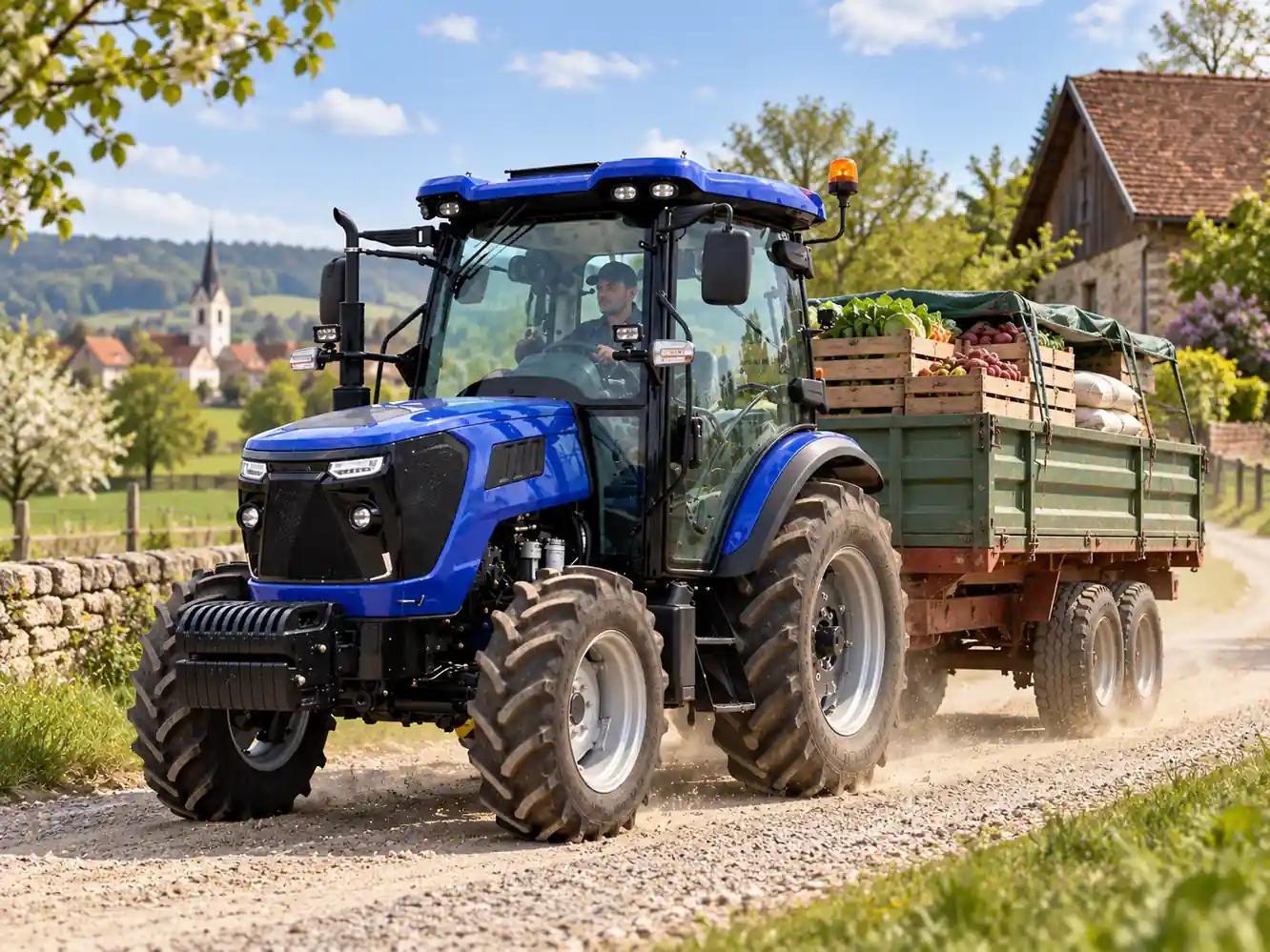
OXPLO OXT704 in mixed-farm transport work: a 70 HP platform often needs to support field work, loader tasks and local haulage across the agricultural year.
Why the 12F + 12R Transmission Matters
For OXPLO OXT704 buyers, the 12F + 12R transmission should be understood as a work-matching feature rather than a brochure number. Cultivation, PTO work, yard manoeuvring and transport need different ground speeds. More usable ratios help the operator find a gear that holds engine load and field speed without constantly operating at the wrong compromise.
Why Category II Matters
The OXPLO OXT704 sits on the larger Category II side of the current OXPLO range. For a buyer moving up from Category I equipment, this can be more important than the headline horsepower difference because it changes the implement ecosystem around the tractor.
Why 4WD Matters for the OXT704 Buyer
The OXPLO OXT704’s 4WD layout is relevant when the farm regularly works on soft ground, grassland, slopes, cultivation or loader tasks. It does not remove the need for correct tyres and ballast, but it gives the buyer a traction platform suited to the kinds of workloads that normally justify 70 HP in the first place.
Why Dimensions Still Need to Be Measured on the Farm
OXPLO lists the OXT704 at approximately 1,760 mm wide. That is still a measurement to compare with the narrowest gateway, livestock building, machinery shed, orchard row and transport route. OXPLO can supply the technical dimensions; the buyer must compare them with the real farm.
XII. OXPLO 50 HP vs. 60 HP vs. 70 HP: The Real Boundary Is the Platform
The most useful OXPLO comparison is not simply 50 vs. 60 vs. 70 horsepower. It is the point at which the farm moves from the compact Category I platform into the larger Category II utility platform.
OXPLO Model | Published Power | Transmission | Rear Linkage | Best Buying Question |
OXT504 | 50 HP | 8F + 8R | Category I | Do compact access and the existing Category I implement fleet still dominate the decision? |
OXT604 | 60 HP | 12F + 12R | Category II | Has the farm outgrown the compact implement platform but not the power reserve? |
OXT704 | 70 HP | 12F + 12R | Category II | Does the annual workload justify more engine reserve across heavier field, transport and loader work? |
For many customers, moving from the OXPLO OXT504 to the OXPLO OXT604 or OXT704 is therefore a platform decision: different linkage category, larger utility architecture and broader heavy-implement intent. The extra 10 or 20 HP only creates value when those platform changes solve a real bottleneck.
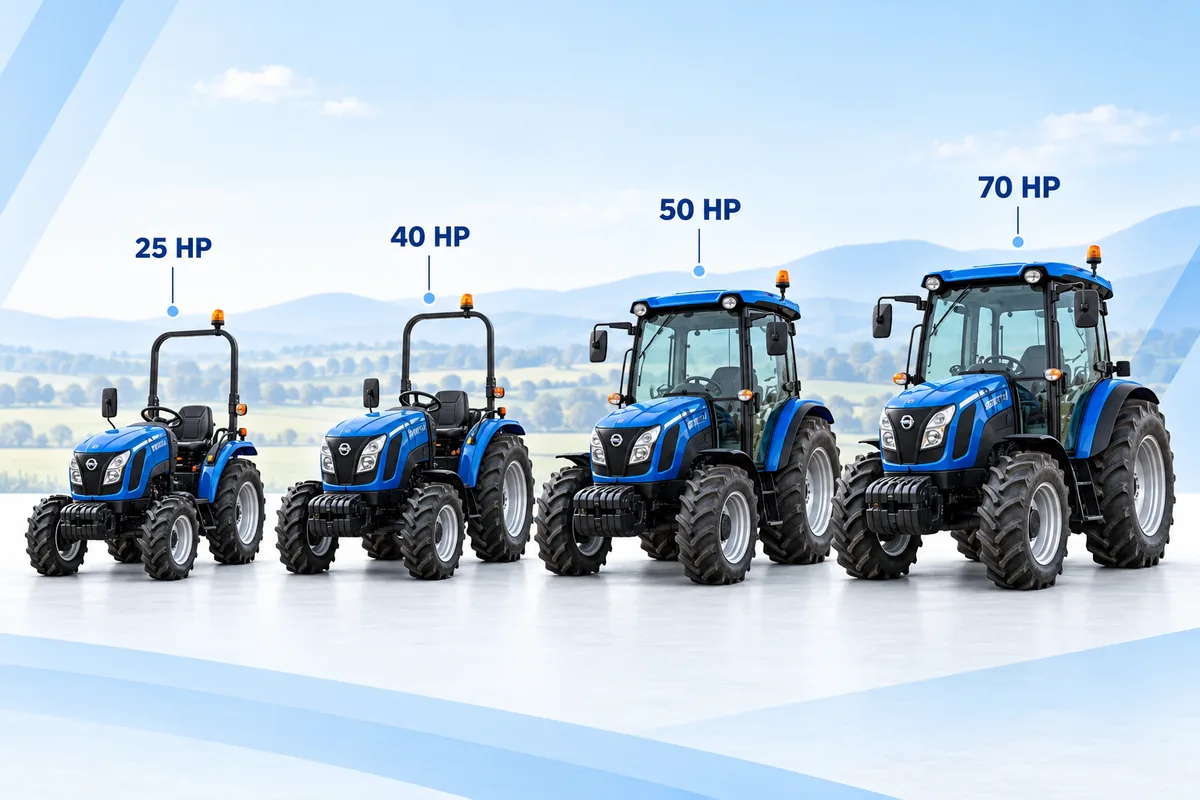
OXPLO OXT504, OXT604 and OXT704 front-loader lineup – useful for visualising the move from the compact 50 HP platform into the larger 60-70 HP utility class.
Compare the wider range on the OXPLO tractor page and review the specific OXT504, OXT604 and OXT704 specifications before deciding where the real boundary sits for your workload.
XIII. What to Send OXPLO Before Asking for a 70 HP Tractor Price
A buyer who sends only “70 hp tractor for sale – please quote” is likely to receive a price, but not necessarily a comparable solution. OXPLO can make the quotation more useful when the application data arrives before the final configuration is fixed.
Send OXPLO the destination country, farm type, main crops or livestock activity, annual working hours, primary jobs, existing implement list, required PTO speed and spline, linkage requirement, hydraulic needs, loader or trailer requirement, soil and terrain conditions, tyre preference, cab requirement, road-use intention and any critical width or height restrictions.
- Destination country and intended operating environment.
- The hardest recurring job and the implement used for it.
- Existing PTO, linkage and hydraulic interfaces.
- Annual utilisation and seasonal working-window constraints.
- Loader, trailer, front-attachment or rear-implement requirements.
- Tyre, ballast, cab, lighting and road-equipment preferences.
- Any documentation or inspection requirements before shipment.
OXPLO currently presents a 25-70 HP tractor range and an application-led configuration process. See the OXPLO Tractor Customisation page for model comparison, attachment options, PTO/linkage confirmation, tyre and hydraulic configuration, and pre-shipment inspection support.
This workflow matters because a B2B buyer is not really purchasing a number of horsepower. The buyer is purchasing a working configuration that must arrive with the correct interfaces, documents and attachments for a defined job.
XIV. FAQ: Questions Buyers Should Answer Before Ordering
Is a 70 HP tractor enough for ploughing?
It can be, but the answer depends on plough width, working depth, soil resistance, field slope, tyre grip and intended speed. Use the plough manufacturer’s requirement and your soil conditions rather than assuming that every plough of a certain size matches every 70 hp tractor.
Is a 70 HP 4WD tractor better than a 2WD tractor?
For soft ground, slopes, cultivation and loader work, 4WD can improve the ability to convert engine power into traction. It does not replace correct ballast or tyre setup, and it is not automatically valuable if the operation is mostly light work on firm surfaces.
Can a 70 HP tractor operate a front loader?
Many tractors in this class can be configured with a loader, but the correct question is whether the selected loader, attachment, hydraulic demand, front-axle loading and counterweight are compatible with the tractor. OXPLO recommends confirming the loader configuration rather than relying on an unverified generic lifting claim.
What size implements can a 70 HP farm tractor use?
There is no universal width. Implement design, soil draft, working depth, PTO demand and speed can change the power requirement significantly. Use manufacturer requirements and actual field conditions to size the implement.
Should I buy a 50 HP, 60 HP or 70 HP OXPLO tractor?
Start with the implement platform and the annual workload. The OXPLO OXT504 remains a compact Category I 50 HP platform. The OXPLO OXT604 and OXPLO OXT704 move into the larger Category II utility class with 12F + 12R transmissions. Choose 70 HP when the additional reserve is repeatedly useful, not simply because it is available.
Do I need Stage V for a tractor in Europe?
Engine and emissions requirements depend on the specific market, vehicle configuration and applicable rules. Ask the supplier to confirm the exact engine and destination-market configuration and provide the model-specific documentation available before ordering. Do not rely on a generic sales label.
Can a 70 HP tractor be used on public roads in Europe?
That depends on the vehicle category, equipment, approval documentation, registration rules and destination country. Confirm lighting, braking, road equipment and required documents before purchase if public-road use is part of the job.
What should I ask OXPLO to confirm on the OXT704?
Ask OXPLO to confirm the final engine and market configuration, PTO speed and spline, Category II linkage, hydraulic requirements, tyres and ballast, dimensions, loader or trailer needs, road equipment, attachments and destination-country documentation for the exact order.
XV. Conclusion: Is a 70 HP Tractor Right for You?
A 70 hp tractor is not automatically the right machine for a larger farm, and it is not automatically excessive for a smaller one. The correct decision is created by recurring workload, implement interfaces, traction, access, annual utilisation and the amount of time available to finish critical jobs.
If the farm is repeatedly constrained by heavier cultivation, Category II implements, frequent transport, loader work, grassland operations or a tight seasonal schedule, a 70 hp 4wd tractor can provide useful reserve and a broader utility platform. If most work remains light and access is tight, a smaller machine may produce a better return.
For buyers whose workload genuinely points to this class, the OXPLO OXT704 provides a current 70 HP 4WD platform with a 12F + 12R transmission, Category II linkage and dual-speed PTO. The important step is to configure it around the work rather than buying it from the horsepower number alone.
Before requesting a final quotation from OXPLO, prepare your implement list, farm access limits, annual workload, destination country and required documents. Then use the OXPLO OXT704 product page and the OXPLO tractor configuration page to turn a generic 70 hp tractor enquiry into a technically comparable B2B quotation.
The buying question should therefore end where this guide began: not “How much does a 70 HP tractor cost?” but “Which 70 HP tractor configuration will complete my work reliably, at the lowest practical cost per completed job?”
OXPLO Product & Support Links: Website | Tractor Range | OXT704 | Customisation | Support