
Technical buying guide for selecting a tractor for muddy fields
Buying a tractor for wet ground is not mainly a horsepower problem. It is a traction and soil-support problem first, and a power problem second. That distinction matters because wet fields can make a perfectly capable tractor behave like the wrong machine: tyres spin, the tractor sinks, drawbar pull falls away, and the operator responds by adding throttle or ballast. Sometimes that helps. Sometimes it makes the field worse.
The difficult part is that several variables move at the same time. Wet soil carries less load. A sinking tyre creates more rolling resistance. More ballast may improve grip but also increases axle load. Wider agricultural tyres can spread the load, but only if the tyre construction, inflation pressure and actual working weight are matched properly. A larger engine cannot correct a poor tyre-to-soil interface.
For a buyer, the practical question is not simply “Which tractor has enough HP?” It is “What is the lightest and simplest working system that can pull my implements, maintain useful tractor traction and avoid unnecessary soil damage?” That is a more demanding question, but it usually leads to a better machine choice and a lower total cost of ownership.
Quick rule before you compare models Start with soil condition and implement demand. Then check loaded weight, tyres, 4WD and ballast. Horsepower comes after those questions, not before them. |
I. Why Wet Ground Changes the Tractor Selection Logic
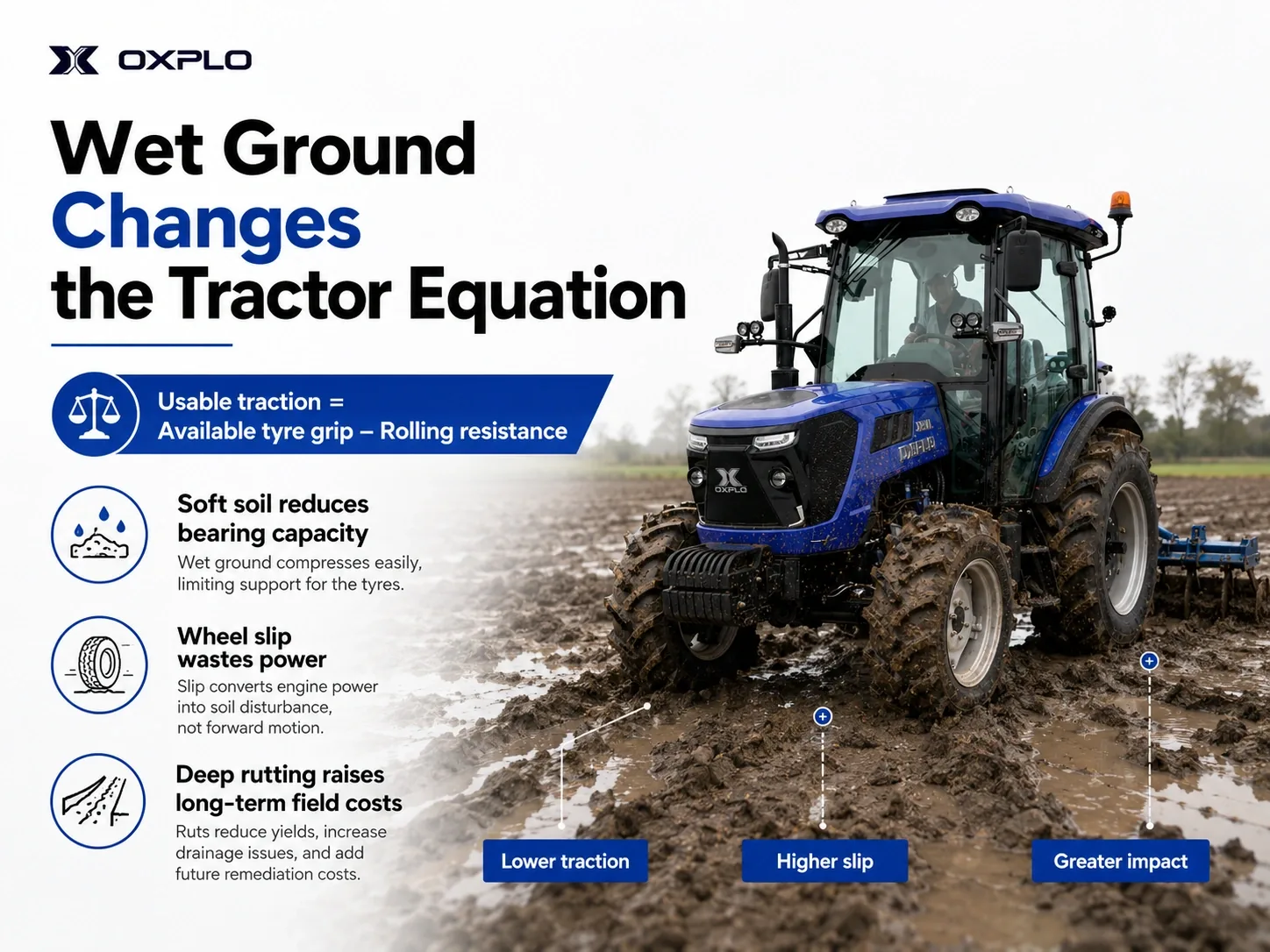
Soil bearing capacity falls before the tractor runs out of power
A muddy field is not just a dry field with less grip. The structure underneath the tyre is weaker. On wet clay, clay loam or poorly drained ground, the soil can deform under load before the engine is anywhere close to its limit. That is why the first visible warning is often a rut rather than a stalled engine.
A shallow rut is inconvenient. Repeated high axle loads on wet soil are more serious because compaction can move deeper into the profile. Surface marks may be repaired during later cultivation, while deeper compaction can continue to affect drainage, rooting and future draft requirement. In other words, a tractor can “get through” the field and still be too costly for the field.
Sinkage turns engine power into rolling resistance
Once the tyre sinks, the tractor has to climb out of the depression it is continuously creating. That raises rolling resistance. The engine may still have spare power, but part of that power is now being spent pushing soil rather than moving the implement.
A useful way to think about the situation is simple: available tyre grip has to cover rolling resistance before any useful drawbar pull remains. This is why two tractors with similar rated power can behave very differently on the same wet patch. Tyre footprint, operating weight and soil condition decide how much of the engine output actually reaches the job.
II. Do Not Size a Tractor for Muddy Fields by Horsepower Alone
More power helps only when the ground can use it
Heavy tillage, large PTO implements and loaded trailers obviously need enough engine reserve. The mistake is assuming that difficult ground automatically requires the largest available tractor. If the tyres are already slipping, another 10 or 20 HP may simply deliver more torque to a contact patch that cannot use it.
Imagine two tractors can both operate the same mower. One is a moderate-power machine with a manageable working weight; the other is a larger platform that carries considerably more mass. On firm soil, the larger tractor may offer useful reserve. On a soft field where the job itself does not require that reserve, the extra mass can increase sinkage without increasing output.
That does not mean a light tractor is always the right tractor for wet ground. A machine that is too small may need excessive slip to pull the implement, may run at high engine load for too long, or may become unstable with a heavy mounted tool. The correct target is minimum sufficient power with a sensible traction reserve.
Work backwards from the implement
Before looking at model numbers, list the heaviest recurring jobs: implement type, working width, implement mass, PTO requirement, hydraulic demand and whether the tool is mounted or trailed. That gives you a power floor. Only then should you decide how much extra capacity is justified by annual working hours, future implements or seasonal workload peaks.
This is also where many “just in case” purchases become expensive. Buying a much larger platform for a job that rarely needs it adds capital cost, tyre cost and soil load every hour the tractor is used. A little reserve is sensible. Unused size is not free.
III. 4WD, Differential Lock and Real Tractor Traction
Why a 4WD farm tractor usually makes sense on wet ground
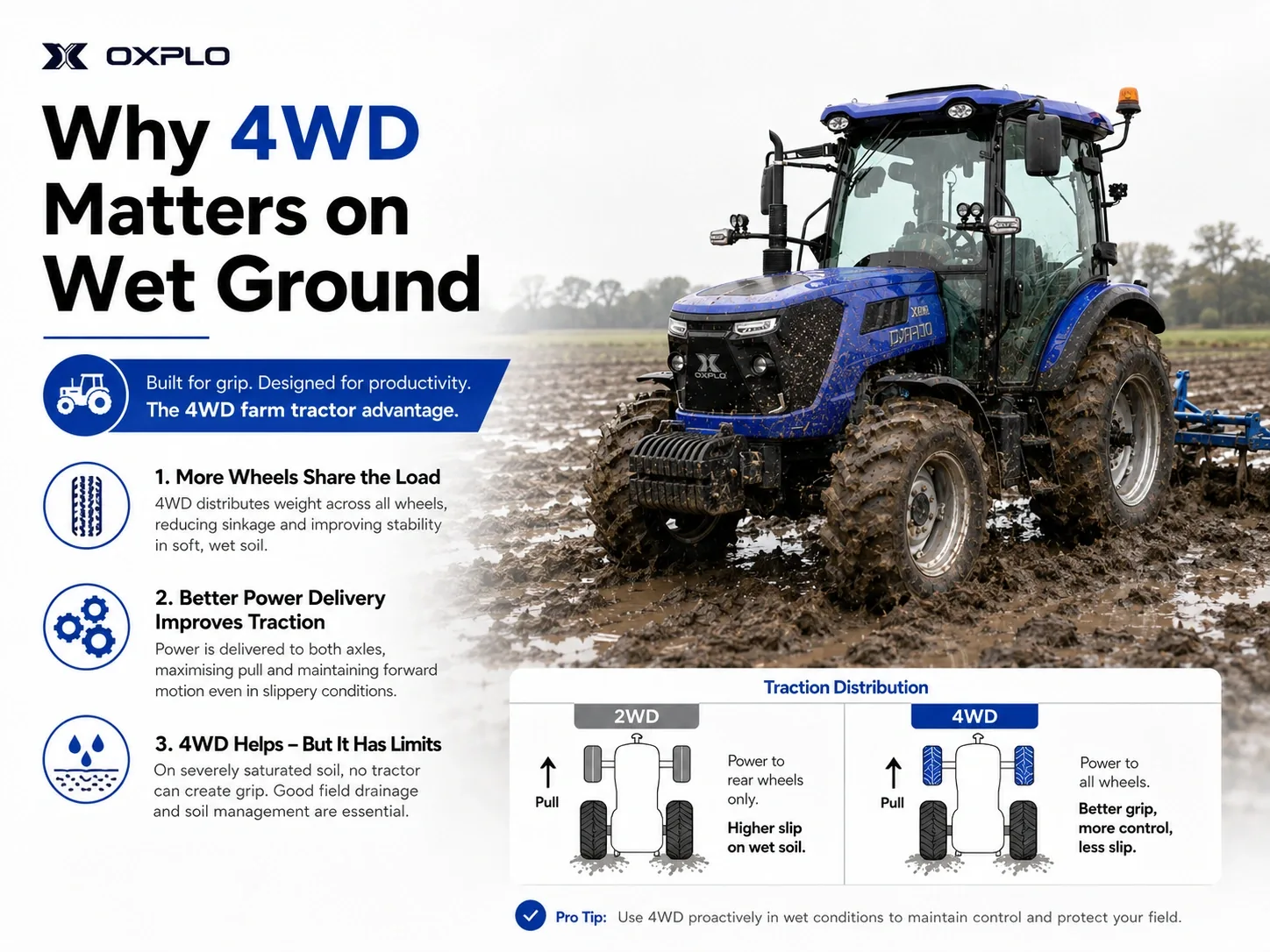
For soft fields, wet grass, muddy tracks and uneven ground, a 4WD farm tractor is usually the more practical starting point. More driven wheels allow a larger share of the tractor’s weight to contribute to traction. That is valuable when one axle is close to its grip limit or when a front loader changes axle loading.
The important limitation is often missed: 4WD improves the use of available grip, but it does not improve the soil’s bearing capacity. If all four tyres are sinking into saturated soil, four-wheel drive will not make the field firm. It can simply keep the wheels turning for longer while the rut gets deeper.
Use differential lock before the tractor is fully stuck
Differential lock is most useful when left and right wheel grip is uneven, for example when one side of the tractor is on firmer ground and the other side crosses a soft strip. It should be treated as a traction-management tool, not a recovery plan. Once the tractor is bellied down or the tyres are digging aggressively, the correct response is usually to reduce the load, change the route or stop the operation.
If wheel slip rises suddenly, do not make throttle the first adjustment. Check the gear, tyre pressure, ballast, implement draft and the condition of the field. A good operator protects traction before trying to create more of it.
IV. Agricultural Tyres and Ground Pressure: Where Many Setups Go Wrong
Tyre width helps, but footprint is the real issue
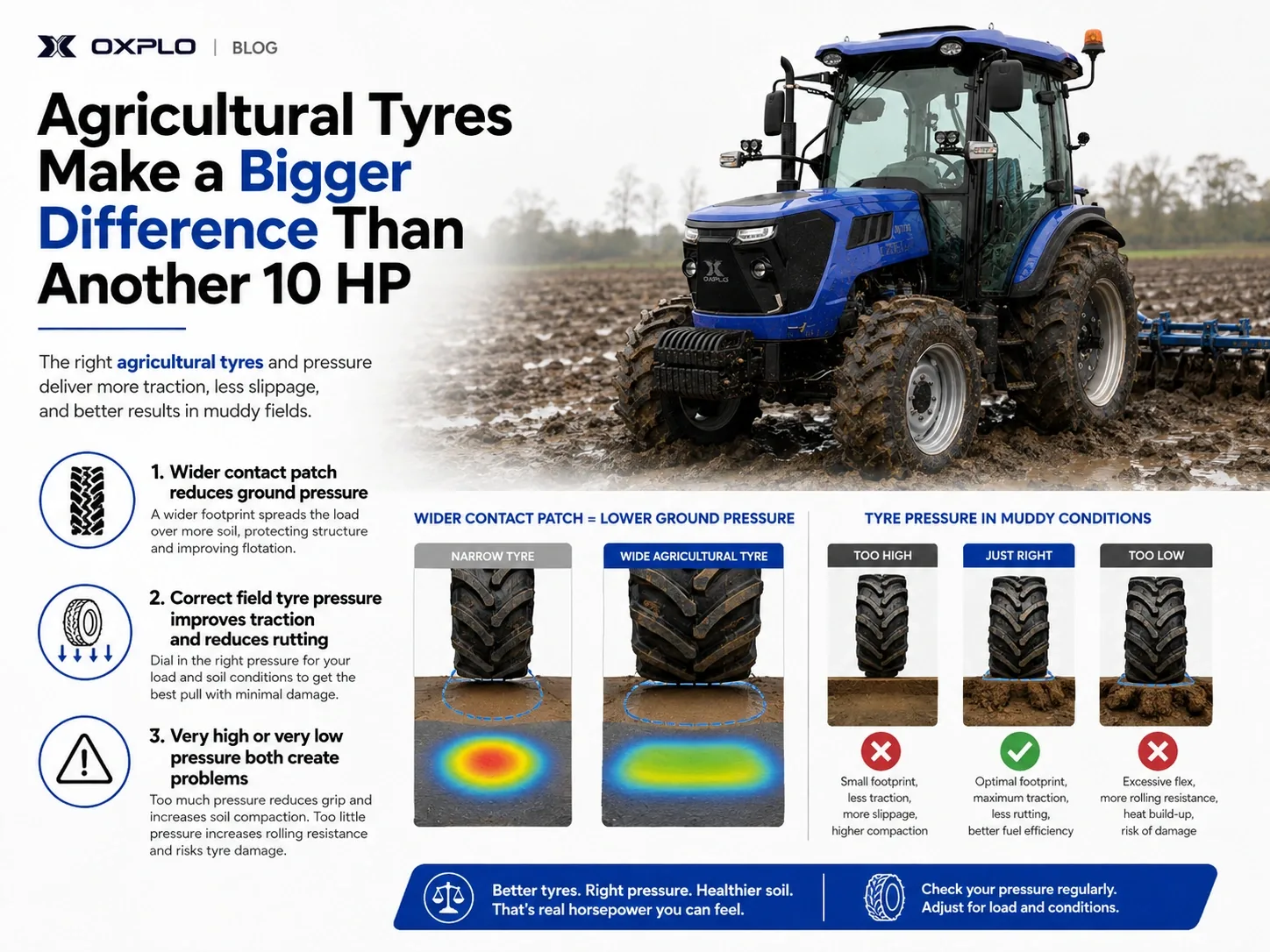
Agricultural tyres are part of the traction system, not a cosmetic specification. Wider tyres can increase contact area and reduce local ground pressure, but width alone does not tell you how the tyre will behave. Construction, diameter, load rating, inflation pressure, axle load and operating speed all matter.
This is particularly important when choosing a tractor for difficult terrain. A tyre that works well on a dry road transfer can be a poor field setup if it is run at unnecessarily high pressure. The tyre becomes stiffer, the usable footprint gets smaller and the tractor gives away grip exactly where it needs more contact.
Do not copy someone else’s tyre pressure
There is no universal “mud pressure” that can be copied from another farm. A safe field pressure must come from the tyre manufacturer’s load table and the actual axle load at the intended speed. That axle load changes when you add front weights, a loader, a mounted implement, a full fuel tank or a heavy rear attachment.
Running lower pressure within the tyre’s approved load envelope can increase the footprint and reduce unnecessary soil pressure. Running too low can damage the casing, cause bead movement or create excessive heat during road travel. The engineering target is not the lowest pressure. It is the lowest safe pressure for the real load and speed.
When IF/VF tyres are worth the extra cost
IF and VF tyre technology can be useful on farms with high annual field hours, heavier axle loads or a strong need to protect soil structure. The business case is weaker when the tractor spends most of its time on dry ground, does light seasonal work or rarely reaches the load conditions where the extra tyre capability matters. Better technology still has to earn its cost.
V. Ballast, Wheel Slip and Drawbar Efficiency Must Be Managed Together
Ballast is useful until it becomes dead weight
Adding ballast can improve tractor traction when a drive axle is too lightly loaded. This is why ballast is not inherently bad. The problem starts when weight is added without checking whether the tractor is actually short of usable axle load.
Too little ballast can produce excessive slip and poor drawbar efficiency. Too much ballast raises rolling resistance, increases sinkage and adds soil compaction risk. On wet ground, the penalty arrives quickly because the soil cannot support the extra mass as easily as dry ground can.
The right question is therefore not “How much weight can I add?” but “How much weight does this job require to transfer the available power without unnecessary slip?” Ballast should solve a traction problem, not simply make the machine feel more planted.
Use wheel slip as a diagnostic signal
Some slip is normal in drawbar work. Visible high-speed spinning, rapidly deepening ruts or repeated loss of forward speed is not. When those signs appear, investigate the setup rather than forcing the tractor harder. A lower gear, a different route, a smaller implement bite or postponing the wettest area can deliver more work per litre than adding throttle.
VI. Soil Compaction Is the Cost That Does Not Appear on the Fuel Bill
A stuck tractor creates an obvious cost: lost time, recovery equipment and sometimes damaged tyres or driveline components. Soil damage is quieter. It can stay in the field long after the tractor has left.
Repeated traffic on wet soil can reduce pore space and make drainage slower. In heavy soil, cultivation while the profile is too wet can also smear the soil and create dense layers that are difficult to correct later. The operator may finish today’s job, then pay for the decision with extra tillage, poorer trafficability and narrower work windows later in the season.
For that reason, the total cost of a tractor for muddy fields should not be limited to purchase price, fuel and scheduled maintenance. A more realistic TCO view includes field repair, extra passes, tyre wear, recovery time, delayed operations and the cost of working around damaged areas.
There is a practical management point here: “Can the tractor enter?” and “Should the tractor enter?” are different questions. The second one usually saves more money.
VII. Work Pattern and Timing Can Beat a Bigger Tractor
Reduce repeat traffic before you buy more machine
Wet conditions are not always avoidable. Livestock farms still need feeding and transport. Contractors still have schedules. Long rainy seasons can leave narrow operating windows. When the tractor must work, route planning matters.
- Use established wheel tracks where practical instead of creating a new path on every pass.
- Keep transport routes consistent so damage is concentrated rather than spread across the field.
- Reduce unnecessary headland turns and repeated empty crossings.
- Work the firmer parts first and return to low areas when conditions improve.
- Stop before the tyres cut a shallow rut into a deep one.
These decisions sound operational rather than technical, but they directly change the load the tractor places on the soil. A well-configured tractor used badly can still cause damage. A moderately sized tractor used with disciplined traffic planning can often finish the same work with less disruption.
VIII. What to Tell a Supplier Before You Ask for a Quote
“I need a 50 HP tractor” is not enough information
If you want a supplier to recommend a genuine tractor for wet ground, give them enough information to evaluate the whole working system. A useful enquiry should include the following:
- Soil type: sand, loam, clay loam, heavy clay, peat or another dominant condition.
- Wetness pattern: occasional rain-softened ground, seasonal wetness, poor drainage, standing water, muddy tracks or soft conditions across the whole field.
- Terrain: flat, rolling, sloped, terraced or irregular ground, plus any narrow gateways or access constraints.
- Implements: type, working width, weight, PTO speed/power demand, hydraulic requirement and whether mounted or trailed.
- Actual working load: tractor, fuel, operator, ballast, loader and implement – not bare machine weight alone.
- Operating pattern: annual hours, field-to-road ratio, transport distance and how often the tractor must work before the ground has fully dried.
- Tyre expectations: standard agricultural tyres, wider options, radial preference or a need to prioritise low ground pressure.
A useful supplier question Do not ask only which model has enough horsepower. Ask which tyre, ballast and implement combination keeps the tractor productive at your expected working weight. |
IX. Matching OXPLO Tractors to Wet-Field Work
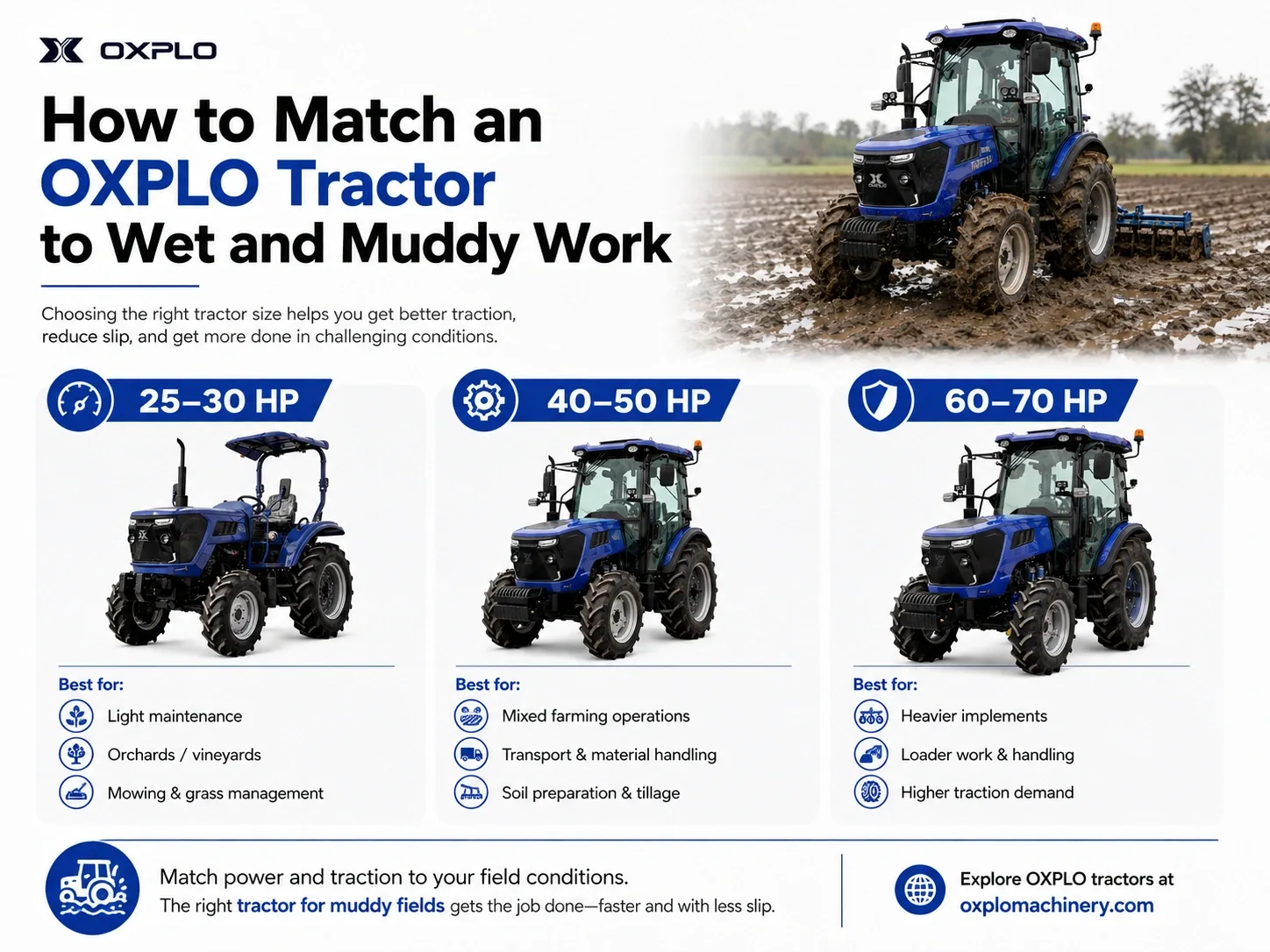
After the field and implement analysis is complete, the model choice becomes much easier. OXPLO’s current tractor range covers 25, 30, 40, 50, 60 and 70 HP, giving buyers several steps between compact maintenance work and a larger Category II utility platform. OXPLO’s configuration page also groups the range by practical farm workload rather than by horsepower alone.
For buyers who want to compare applications before choosing a model, see the OXPLO 25–70 HP tractor configuration guide. It includes application ranges for vineyards and orchards, soil preparation, mixed-farm transport and material handling, together with available attachment options.
OXPLO 25–30 HP: compact work where access and manageable size matter
OXPLO OXT254 is a 25 HP 4WD compact tractor with an 8F + 8R transmission and Category I linkage. OXPLO OXT304 raises the output to 30 HP while remaining in the compact class. For wet-ground work, these OXPLO models make the most sense when the recurring jobs are mowing, light cultivation, orchard or paddock maintenance, and light transport rather than heavy draft work.
The advantage of the smaller OXPLO platform is not that low horsepower is automatically better in mud. It is that a buyer who does not need a heavy implement system has less reason to carry a larger chassis across soft ground. If the implement demand is modest, keeping the platform manageable can be a sensible part of the traction strategy.
OXPLO 40–50 HP: the mixed-farm middle ground
OXPLO OXT404 provides 40 HP with 4WD, an 8F + 8R gearbox and Category I linkage. OXPLO OXT504 moves to 50 HP while staying in the compact OXT chassis group. This OXPLO range is relevant when the farm needs more PTO reserve and more frequent mixed work, but does not yet require the larger Category II platform.
For muddy fields, the 40–50 HP decision should be driven by the implement list. If both OXPLO models can comfortably operate the farm’s main tools, the buyer should compare annual load, tyre options, working speed and future attachment plans rather than simply choosing the larger engine.
OXPLO 60–70 HP: a larger working system for heavier recurring jobs
OXPLO OXT604 is a 60 HP 4WD utility tractor with a 12F + 12R transmission and Category II linkage. OXPLO OXT704 increases rated power to 70 HP and uses the same larger-platform logic. These OXPLO tractors are the more appropriate starting point when the farm regularly handles larger implements, heavier transport, loader work or a workload that would keep a smaller tractor near its limit.
Here, the trade-off becomes more important. The larger OXPLO platform gives the operator more working capacity, but its tyre setup and loaded axle weights deserve closer attention on soft ground. A 60–70 HP tractor for muddy fields should be configured as a complete system: implement, tyre, ballast, load distribution and working route all matter.
X. A Practical OXPLO Buyer Checklist Before Final Configuration
Before OXPLO confirms a tractor, use the following checklist to remove the most common unknowns. It is deliberately more detailed than a normal quotation request because wet-ground performance is sensitive to configuration.
Field and route
- Dominant soil type and the areas that stay wet longest.
- Whether the problem is the whole field, isolated low spots or only farm tracks.
- Slope, turning space, gate width and any road-transfer requirement.
- How soon after rain the tractor normally has to return to work.
Machine and tyre setup
- Confirm 4WD for the intended operating conditions.
- Confirm front and rear tyre size, construction and available alternatives.
- Ask OXPLO to confirm tyre options against the expected working load, not only the bare tractor.
- List any loader, front weight, rear ballast or heavy mounted implement that changes axle load.
- Check whether the selected OXPLO tractor has the linkage category and transmission range the implements require.
Implements and attachments
OXPLO lists a broad range of tractor implements on its tractor attachment support page. Before ordering, match each attachment by power demand, PTO requirement, linkage geometry, hydraulic demand and weight. Attachment availability does not automatically mean every attachment is suitable for every OXPLO tractor.
OXPLO can then confirm the tractor model, tyre setup, attachments and destination-market configuration together. That is a much safer procurement process than selecting a model first and trying to make the farm fit the tractor later.
XI. Conclusion: Choose the Working System, Not Just the Horsepower
A reliable tractor for muddy fields is the result of several ordinary decisions being made in the right order. The soil must be able to carry the machine. The tyres must put enough usable footprint on the ground. 4WD and differential lock must be used as traction tools, not as a substitute for field judgement. Ballast must solve a traction problem without becoming unnecessary axle load.
Only after those points are understood does horsepower become a useful comparison. A 25–30 HP tractor can be the correct answer for light recurring work. A 40–50 HP tractor can be a better mixed-farm compromise. A 60–70 HP utility tractor may be necessary when heavier implements and higher annual workload genuinely demand it. None of those categories is automatically “better” for mud.
OXPLO’s 25–70 HP range gives buyers several platforms to work from, but OXPLO model selection should still begin with the application. Soil type, implement demand, loaded weight, tyre preference, terrain and destination market should all be confirmed before the final configuration is fixed.
You can review the OXPLO tractor range, compare application-based configurations on the OXPLO tractor solutions page, or visit OXPLO to discuss a tractor for wet ground around your actual implements and field conditions.
Before requesting a quotation Send OXPLO your soil type, main implements, working width, loaded operating condition, terrain, tyre preference and destination country. Those details are more useful than horsepower alone. |
Editorial note: Tractor specifications and model availability should be confirmed against the latest OXPLO product sheet before publication or quotation.