
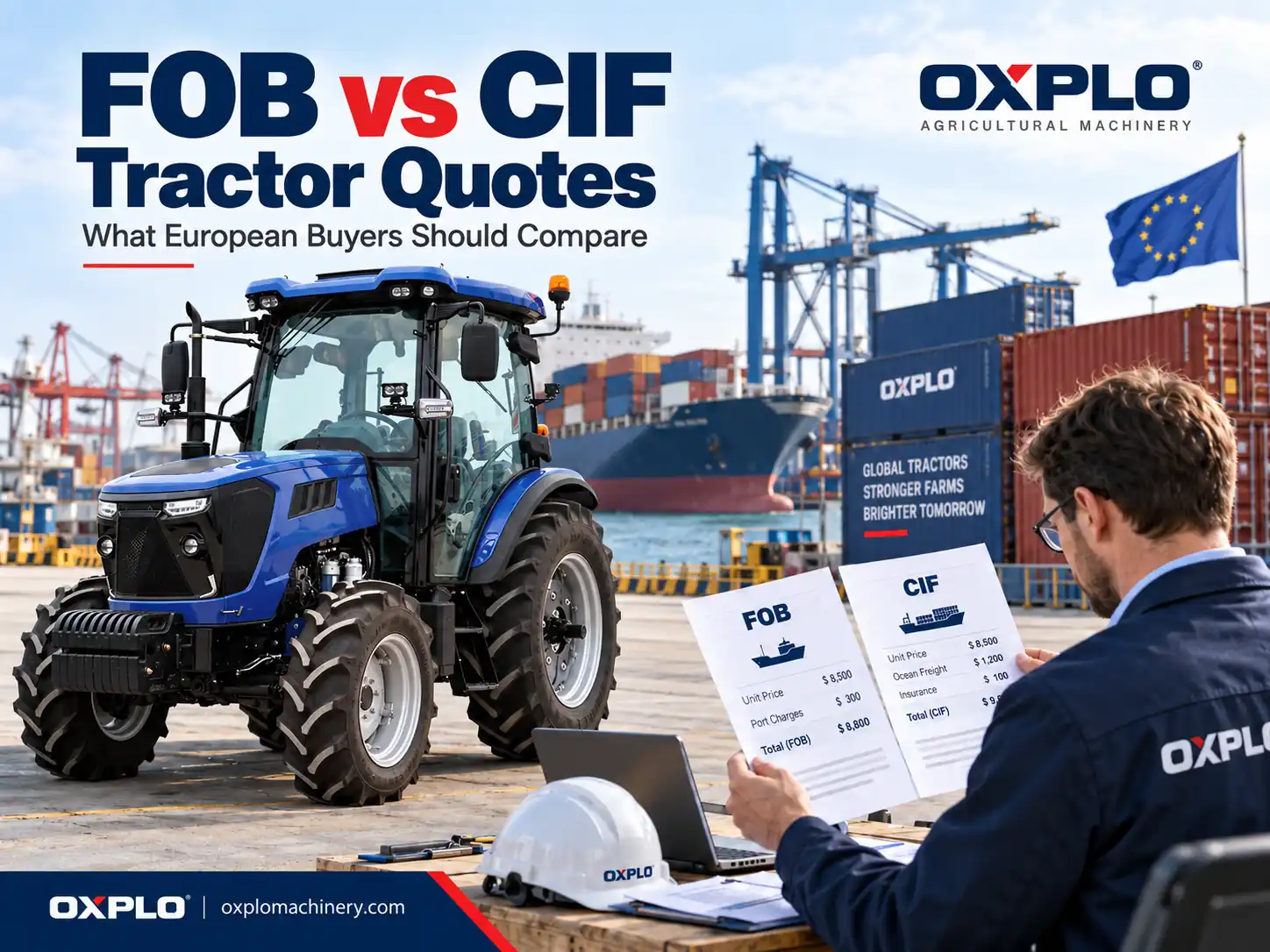
A tractor quote can look inexpensive and still become expensive by the time the machine is ready to work in Europe. That is the practical problem behind most FOB-versus-CIF comparisons. A buyer may see one tractor at EUR 15,000 FOB and another at EUR 17,000 CIF and assume the first option is cheaper. But the numbers are not measured at the same cost boundary. One may exclude ocean freight, insurance, destination handling and inland delivery; the other may include some of those items but still leave customs clearance, local haulage and port charges to the buyer.
For European importers, distributors and farm-equipment buyers, the useful question is therefore not simply ‘Which Incoterm is cheaper?’ The better question is: What will one complete tractor actually cost when it reaches my warehouse, can be assembled if required, matches my implements and is ready to sell or put to work? This guide builds the comparison around that decision.
I. Why the Cheapest Tractor Quote Often Becomes Expensive After Arrival
The biggest purchasing mistake is to treat a tractor quotation as if the quoted unit price were the purchase cost. In international machinery procurement, the price on the quotation is only one layer. A tractor moves through a chain of commercial and physical handovers: factory preparation, inland transport in the exporting country, terminal handling, export formalities, ocean transport, destination-port handling, customs, inland haulage and sometimes reassembly or commissioning.
The three types of “cheap” quotation
In practice, a low quote is often cheap for one of three reasons. First, the tractor specification is not equivalent. Two machines may both be described as 50 HP tractors while one includes 4WD, a cab, additional hydraulic outlets, weights and a specific tyre package and the other does not. Second, the logistics boundary is different. One supplier may quote only to the loading port while another includes freight to Europe. Third, the machine may be cheaper to buy but more expensive to make usable after arrival because of disassembly, implement mismatch, local modification or incomplete documentation.
That is why a procurement team should normalize the machine before normalizing the price. Horsepower, drive type, transmission, PTO, three-point linkage, hydraulic outlets, tyres, cab or ROPS, weights and attachments should be checked line by line. Only after the technical configuration is aligned does FOB-versus-CIF comparison become meaningful.
Use one decision metric: cost per ready-to-work tractor
A useful internal metric is ready-to-work landed cost. This is broader than the commercial invoice but more useful for management. It asks what one tractor costs after all predictable expenses required to place it at the buyer’s working or selling location are included. For a dealer, that may be the warehouse. For a project buyer, it may be the farm or jobsite.
II. FOB vs CIF: Cost Responsibility Is Only Part of the Difference
FOB and CIF are often simplified as ‘buyer pays freight’ versus ‘seller pays freight’. That shortcut hides the most important procurement details. Under Incoterms® 2020, FOB means the seller delivers the goods on board the vessel at the named port of shipment. Risk transfers when the goods are on board. Under CIF, the seller arranges and pays the main ocean carriage and minimum insurance to the named port of destination, but risk still transfers when the goods are on board at the port of shipment, not when they arrive in Europe.
Cost destination is not the same as risk destination
This distinction matters because CIF may include freight to Rotterdam, Hamburg or Gdańsk while the buyer still carries the transit risk from the shipment point once delivery under the rule has occurred. A procurement team that assumes ‘CIF means the supplier is responsible until Europe’ may discover the misunderstanding only after a damage claim.
Insurance is included under CIF – but check the coverage
CIF also requires the seller to arrange cargo insurance, but the standard minimum under Incoterms® 2020 is limited cover comparable to Institute Cargo Clauses (C), unless the parties agree otherwise. Agricultural machinery has exposure to impact, glass breakage, corrosion, loading damage and component damage. A buyer should therefore ask not only whether insurance is included, but what risks are covered, what exclusions apply, what insured value is used and how claims are handled.
Containerized machinery may justify another Incoterm
FOB and CIF are sea or inland-waterway rules. ICC guidance notes that when goods are containerized, handed to a carrier at a terminal, or moved through multimodal transport, FCA, CPT or CIP may align more closely with the actual delivery chain. This does not mean FOB or CIF can never appear on a tractor deal. It means buyers should understand where the machine is physically handed over and where risk is intended to transfer before accepting the Incoterm simply because ‘we always use FOB’.
III. Compare Ready-to-Work Cost, Not Just the Quoted Tractor Price
The most reliable way to calculate tractor import cost Europe is to choose one common endpoint and rebuild every supplier quote to that endpoint. For example: supplier factory to buyer warehouse in Poland; or supplier factory to buyer warehouse in Germany. The endpoint must be the same for every quotation.
Build a landed-cost worksheet
A practical landed-cost model can include the tractor purchase price, export-side charges not included in the quotation, international freight, cargo insurance, destination terminal charges, customs broker fees, customs duty if applicable, inland delivery, predictable storage or demurrage exposure, bank charges, exchange-rate costs and any reassembly or pre-delivery work required after arrival.
Import VAT should normally be tracked separately from permanent economic cost because recoverability depends on the buyer’s tax position and local rules. For cash-flow planning, however, it may still be a substantial amount payable at import. European Commission guidance also makes clear that the taxable amount for import VAT can include customs value plus duties and certain incidental expenses such as transport and insurance when they are not already included.
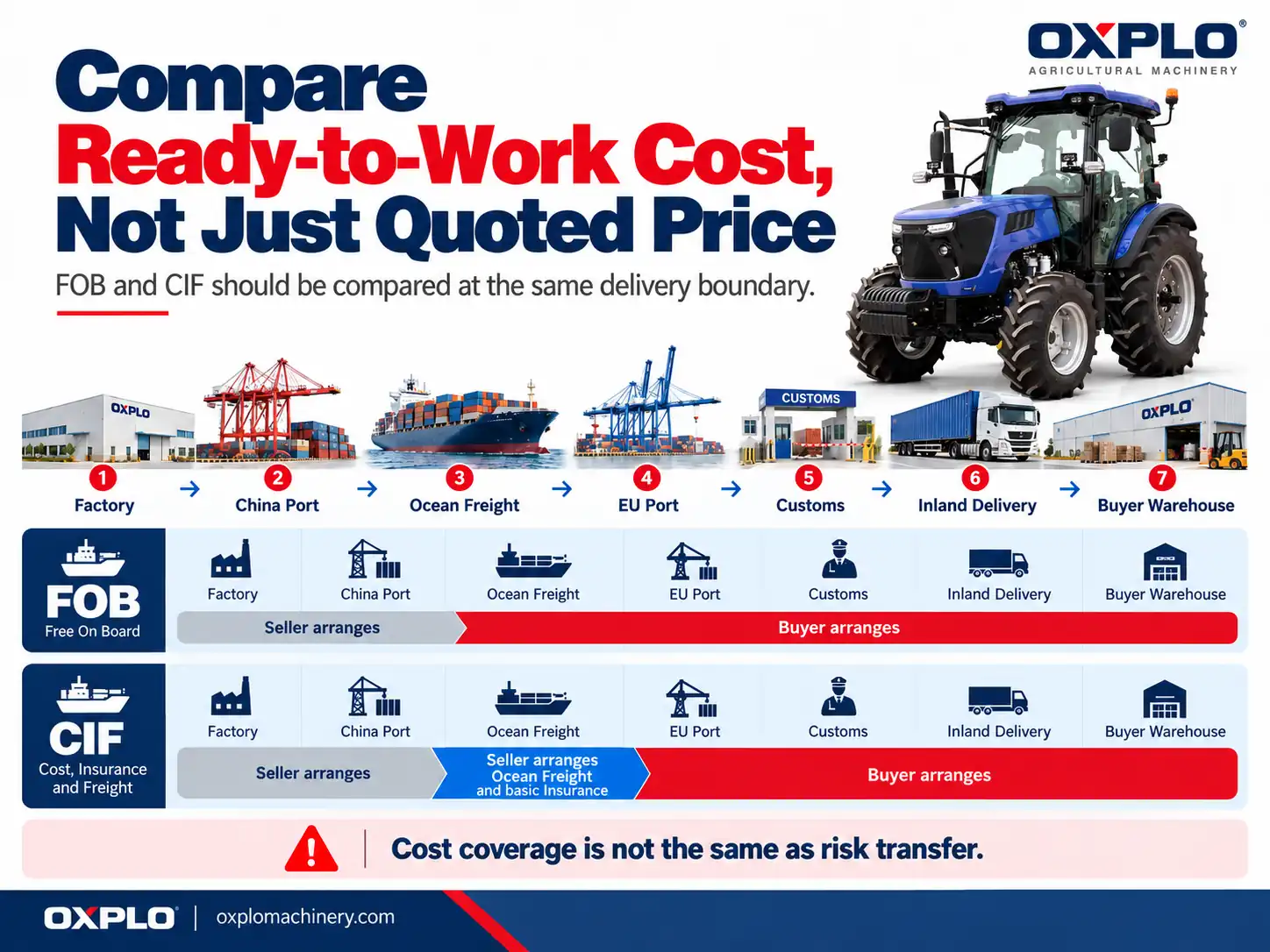
Figure 1. Normalize FOB and CIF quotations to the same delivery boundary before comparing them.
Illustrative comparison
Cost Item | Supplier A – FOB | Supplier B – CIF |
Tractor quotation | EUR 18,200 | EUR 20,300 |
Ocean freight | EUR 2,400 | Included |
Insurance | EUR 90 | Included |
Destination charges | EUR 700 | EUR 1,150 |
Customs broker | EUR 180 | EUR 180 |
Inland delivery | EUR 900 | EUR 900 |
Cost before import taxes | EUR 22,470 | EUR 22,530 |
The example is illustrative, not a market freight quote. Its purpose is to show the logic: a large headline price difference can almost disappear once both offers are converted to the same endpoint. That is why professional buyers compare a cost stack rather than two unit prices.
IV. Seven Hidden Costs That Can Change Tractor Import Cost in Europe
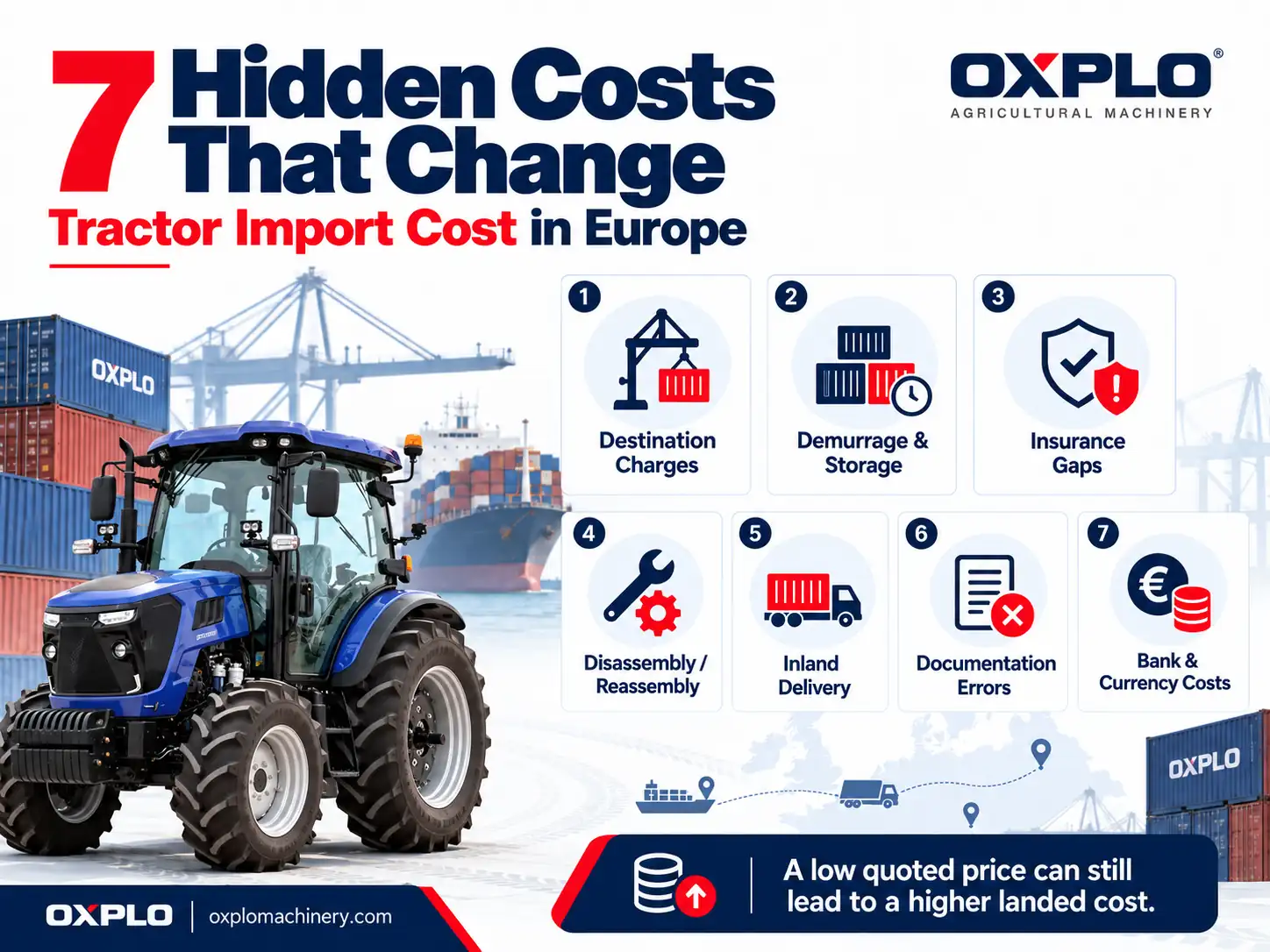
Figure 2. Hidden costs can reverse the apparent advantage of a low FOB or CIF price.
1. Destination terminal charges
A CIF port name does not automatically mean every destination-port fee is included. Terminal handling, documentation, release, security and local service charges may still be payable by the consignee. Ask the supplier or forwarder to state clearly which destination charges are included and which are excluded.
2. Demurrage and storage
Machinery that cannot be cleared or collected on time can generate storage and equipment-related charges quickly. Common causes include document discrepancies, late customs instructions, inspection delays and poor inland-delivery scheduling. The cheapest freight can become expensive if the free-time arrangement is weak or unclear.
3. Insurance gaps
Minimum insurance and adequate machinery insurance are not always the same thing. Cab glass, body panels, lights, hydraulic components and exposed fittings can be damaged without a total loss of the machine. Buyers should understand deductible levels, exclusions and the evidence required for a claim.
4. Disassembly and reassembly
Tractors may be partially disassembled to reduce shipping dimensions. Wheels, ROPS, exhaust components, mirrors, lights or attachments may be removed depending on the configuration. This can improve container utilization but create labor, lifting and commissioning cost at destination. Shipping-efficient is not always delivery-efficient.
5. European inland delivery
A low ocean rate to a major port is not automatically the lowest total logistics cost. A dealer in Poland, the Czech Republic or inland Germany should compare port-to-warehouse haulage as part of the decision. The best port is the one that minimizes the whole route, not necessarily the ocean leg alone.
6. Documentation errors and classification uncertainty
An invoice, packing list, bill of lading and machine description should be internally consistent. Classification also matters. EU customs duty depends on tariff classification, customs value and origin. Buyers should confirm the likely CN classification with their customs broker before shipment instead of assuming that every product described as a ‘tractor’ receives the same treatment.
7. Bank, currency and payment costs
Multiple international payments can add bank fees and foreign-exchange exposure. For distributors importing repeatedly, these costs are small per transaction but meaningful over a year. Landed-cost models should use the actual payment currency and a realistic exchange-rate assumption rather than only the supplier’s quotation currency.
V. European Import Checks: CN Code, Duty, VAT and Documents
European buyers should treat customs and market-entry checks as part of quotation review, not as a task to start after the vessel has sailed. The EU Combined Nomenclature is an eight-digit classification system used for customs purposes. Classification influences duty and can also affect non-tariff measures. The correct code depends on the actual machine and should be confirmed by the importer or customs adviser.
Separate the commercial quote from the regulatory decision
A supplier can provide technical information and a reference HS or CN code, but the importer remains responsible for the customs declaration. The same principle applies to market-specific technical documentation. Buyers should verify the final engine configuration, operator-protection arrangement, lighting and braking requirements, and available conformity documentation for the destination country before order confirmation.
Do not treat import VAT as a simple percentage of the tractor price
Import VAT is calculated according to the applicable national and EU rules. The taxable base can include customs value, duties and certain incidental costs. The cash requirement at import and the long-term net economic cost may therefore be different, particularly when the importing business is entitled to recover input VAT. A customs broker or accountant should validate the actual calculation for the destination country.
VI. Why Tractor Configuration Changes Shipping Cost
Tractor shipping cost cannot be estimated reliably from horsepower alone. The physical machine determines the transport plan. A cab tractor can be taller than an open-station unit. Larger tyres increase overall height and width. A heavier chassis affects handling. Front weights, loaders and implements change both packing and space utilization. A quote for ‘one 50 HP tractor’ is therefore not enough information for a precise freight comparison.
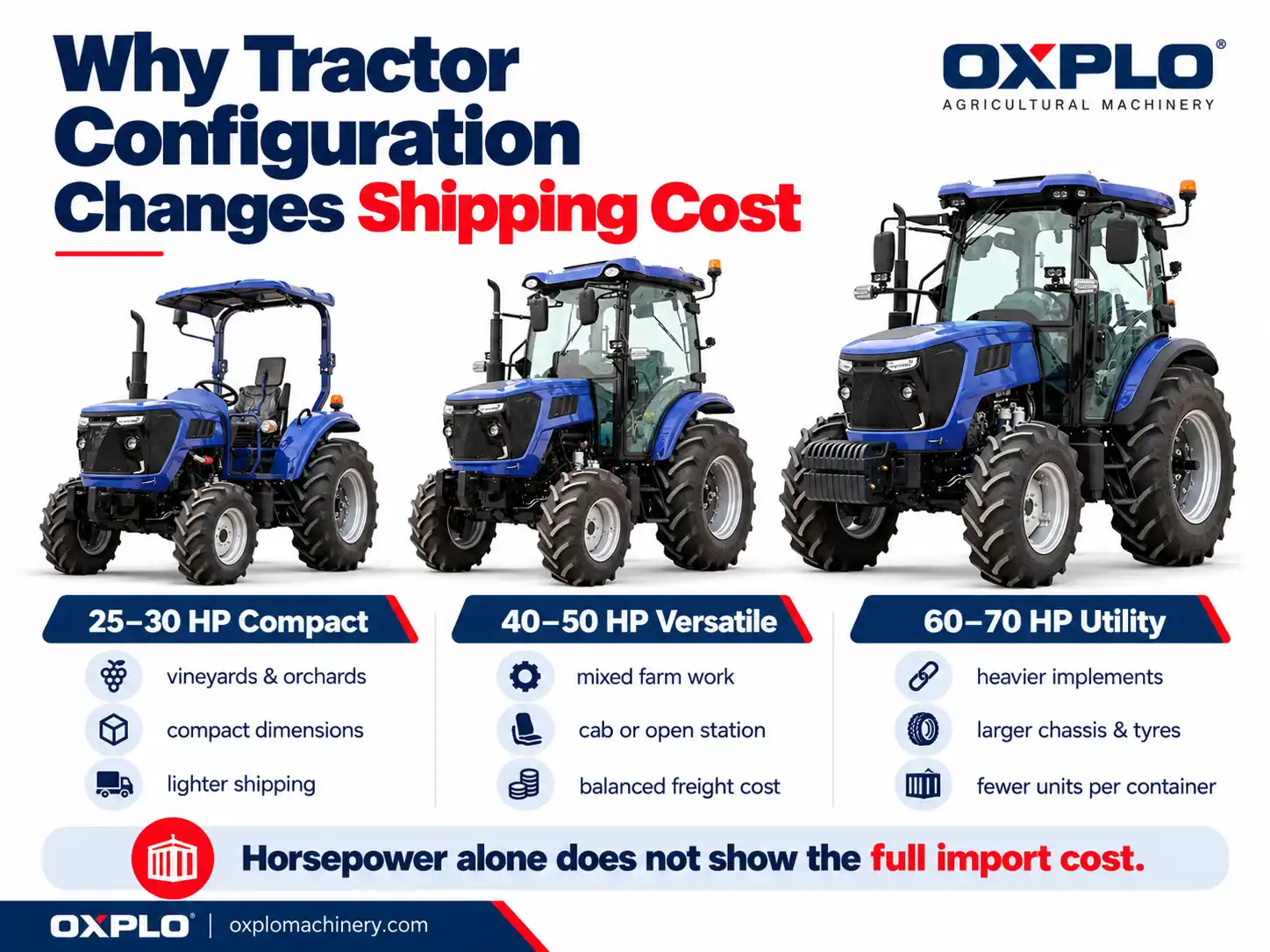
Figure 3. Different tractor platforms can require different packing, container utilization and handling plans.
25-30 HP compact tractors
Compact tractors used in vineyards, orchards and smaller properties may have a smaller shipping envelope, particularly in open-station configurations. But tyre choice, ROPS or canopy height and attached equipment still matter. The buyer should ask for packed dimensions, not only operating dimensions.
40-50 HP versatile tractors
This range is commonly purchased for mixed-farm work, mowing, soil preparation and transport. Cab versus open-station configuration can materially change height and packing. The same nominal horsepower can therefore produce a different freight cost per unit depending on the exact configuration and how many tractors fit into the selected shipping unit.
60-70 HP utility tractors
Larger utility platforms typically combine heavier implements, larger tyres, longer wheelbases and more substantial chassis structures. These factors can reduce the number of units per container or change the preferred shipping method. A buyer should therefore request units-per-container information together with the tractor quotation.
Ask one question that exposes the whole logistics plan
Ask: ‘How many complete tractors can be shipped in the proposed container or transport method, what must be removed for shipping, and what work is required after arrival?’ That question connects freight price with real delivery cost and helps expose hidden reassembly requirements early.
VII. FOB, CIF or Another Incoterm? Choose Based on Your Buying Situation
FOB may suit experienced importers
FOB can work well when the buyer has a reliable forwarder in the exporting country, imports regularly, wants control over vessel selection and freight procurement, and has enough shipment volume to negotiate logistics costs. The buyer also gains clearer visibility into the actual freight component instead of receiving one combined CIF price.
CIF can simplify the first steps for a new importer
CIF can reduce front-end coordination when the buyer has limited experience arranging overseas freight. The supplier handles the main carriage and minimum insurance to the named destination port. However, the buyer should still clarify destination charges, import clearance, inland delivery and insurance limits before accepting the quote.
FCA or CIP may better match containerized transport
Where the tractor is packed into a container and handed to a carrier before vessel loading, an Incoterm designed around carrier handover can sometimes reflect the logistics chain more accurately. The correct rule should follow the real physical handover and the parties’ intended risk allocation rather than habit.
VIII. What a Decision-Ready Tractor Quotation Should Include
A useful tractor quotation should support a purchasing decision, not merely display a unit price. It should let the buyer understand what machine is being purchased, where the seller’s cost responsibility ends, how the machine will be shipped and what must still be arranged in Europe.
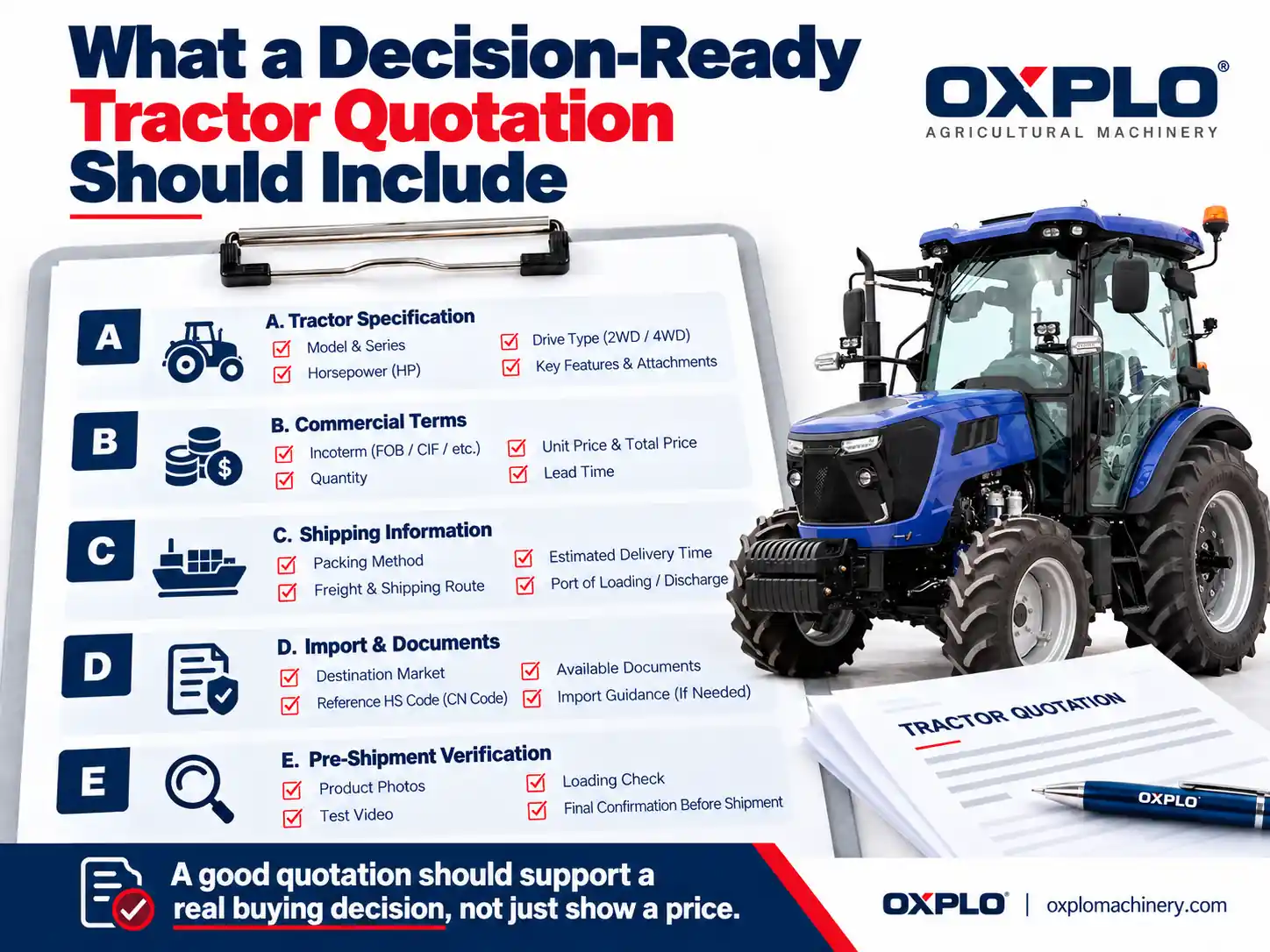
Figure 4. A decision-ready tractor quotation combines technical, commercial, logistics and verification information.
A. Tractor specification
- Model and rated horsepower
- 2WD or 4WD
- Transmission and PTO configuration
- Three-point linkage category and hydraulic outlets
- Tyres, weights, cab or open-station configuration
- Attachments and interface requirements
B. Commercial terms
- Unit price and total price
- Quantity
- Incoterm plus named port or place
- Payment terms
- Production lead time
- Quotation validity
C. Shipping information
- Packing method and packed dimensions
- Units per container or shipping unit
- Items removed for transport
- Port of loading and port of discharge
- Freight and insurance inclusions
- Destination charges included or excluded
D. Import and documentation information
- Destination market
- Reference HS/CN information for buyer verification
- Available model-specific documents
- Engine and market configuration to be confirmed before order
- Import-side items that remain buyer responsibility
E. Pre-shipment verification
- Product photos
- Operational or test video where applicable
- Attachment confirmation
- Serial/model confirmation
- Packing and loading check
IX. How OXPLO Helps European Buyers Build a More Complete Tractor Quotation
This is where a supplier can add value without replacing the buyer’s customs broker or local compliance adviser. OXPLO currently offers six 4WD tractor models across the 25-70 HP range for vineyards, orchards, mixed farms, livestock operations, mowing, transport and other agricultural work. The useful point for a quotation is not simply that OXPLO has several horsepower levels; it is that the model and configuration can be matched to the actual work before the logistics quote is finalized.
OXPLO starts with the working requirement, not only horsepower
For a European buyer, OXPLO can structure the discussion around destination country, farm type, main implements, PTO requirements, linkage, hydraulics, tyre choice, quantity and preferred shipping term. Buyers can review the OXPLO tractor range and compare the available 25-70 HP platforms before asking for a final logistics quotation.
Configuration affects both field suitability and import cost
For example, the OXPLO OXT504 50 HP 4WD tractor is listed with an 8F+8R transmission and Category I linkage. A buyer comparing it with a larger platform should compare not only horsepower but also dimensions, tyres, linkage, intended implements and the resulting packing plan.
OXPLO can confirm configuration and available documents before dispatch
OXPLO’s tractor configuration page describes model selection, implement matching, destination-specific document confirmation, pre-shipment inspection and parts/technical support. For European importers, these steps help turn a basic tractor price into a more complete purchasing package.
Pre-shipment verification reduces expensive surprises
OXPLO can use photos, videos and loading checks to confirm the selected tractor and attachments before dispatch. This does not eliminate every transport or customs risk, but it gives the buyer better evidence that the ordered configuration, packing plan and shipment are aligned before the machine leaves the factory.
X. A Practical Buying Workflow for European Importers
- Define the work first: field size, terrain, implements, towing, PTO load, lifting and daily workload.
- Normalize tractor specification across suppliers before comparing prices.
- Request the named Incoterm and exact port or delivery point.
- Request packed dimensions, units per container and any disassembly required.
- Ask for a breakdown of freight, insurance and destination charges.
- Confirm reference CN classification, import process and available technical documents with the appropriate local adviser.
- Calculate both cash required at import and net ready-to-work landed cost.
- Check pre-shipment photos, videos, attachments and packing before dispatch.
- Compare supplier offers using cost per usable tractor at the final business location.
For repeat importers and dealers, this process should become a standard quotation template. The benefit is not only lower cost. It also reduces internal approval time because purchasing, finance, logistics and technical teams are evaluating the same cost boundary and the same machine specification.
XI. FAQ: FOB and CIF Tractor Imports to Europe
Q1. Is a CIF tractor price the final cost delivered to my warehouse?
A1. Usually no. CIF covers the seller’s carriage and minimum insurance to the named destination port under the rule, but import clearance, duties or taxes, destination charges not included in the carriage contract and inland delivery may still remain with the buyer. Confirm the exact inclusions in writing.
Q2. Is FOB always cheaper than CIF?
A2. No. FOB may show a lower headline price because the buyer will purchase the freight separately. The useful comparison is the same-endpoint landed cost. Depending on freight rates, destination charges and buyer logistics capability, either structure can produce the lower total cost.
Q3. What should I send a supplier to get an accurate tractor quotation?
A3. Send destination country, required horsepower range, main jobs, implements, PTO and hydraulic needs, cab or open-station preference, tyre requirements, quantity, preferred destination port and final delivery location. The more complete the technical input, the more meaningful the shipping quote becomes.
Q4. Why do two 50 HP tractors have different shipping costs?
A4. Overall dimensions, cab height, tyres, weight, front weights, attached equipment, packing method and the number of units that fit into the shipping unit can all differ even when rated horsepower is the same.
Q5. Can OXPLO provide both FOB and CIF quotations?
A5. The requested commercial structure should be discussed with OXPLO based on destination, quantity, shipping method and current freight conditions. The buyer should ask that the named port/place and included cost items are clearly stated on the final quotation.
XII. Conclusion: Compare Cost per Ready-to-Work Tractor, Not Price per Machine
FOB and CIF are not competing quality labels. They are different ways to divide transport cost, responsibility and risk. A European buyer gains very little by choosing the lowest FOB tractor price if the machine configuration is incomplete, container utilization is poor, destination costs are unknown or the tractor requires unexpected work after arrival. The same is true of an attractive CIF tractor price that leaves important port and inland costs undefined.
The stronger purchasing method is to define one cost boundary and one technical specification, then compare every supplier against both. That converts tractor import cost Europe from a vague freight estimate into a decision-ready landed-cost model.
If you are evaluating a 25-70 HP tractor for the European market, OXPLO can help you build the quotation around the actual application, configuration, attachments, quantity and destination. Review OXPLO tractors and agricultural machinery, then provide your destination country, required horsepower, implements and delivery port so the commercial and shipping assumptions can be confirmed before order.