
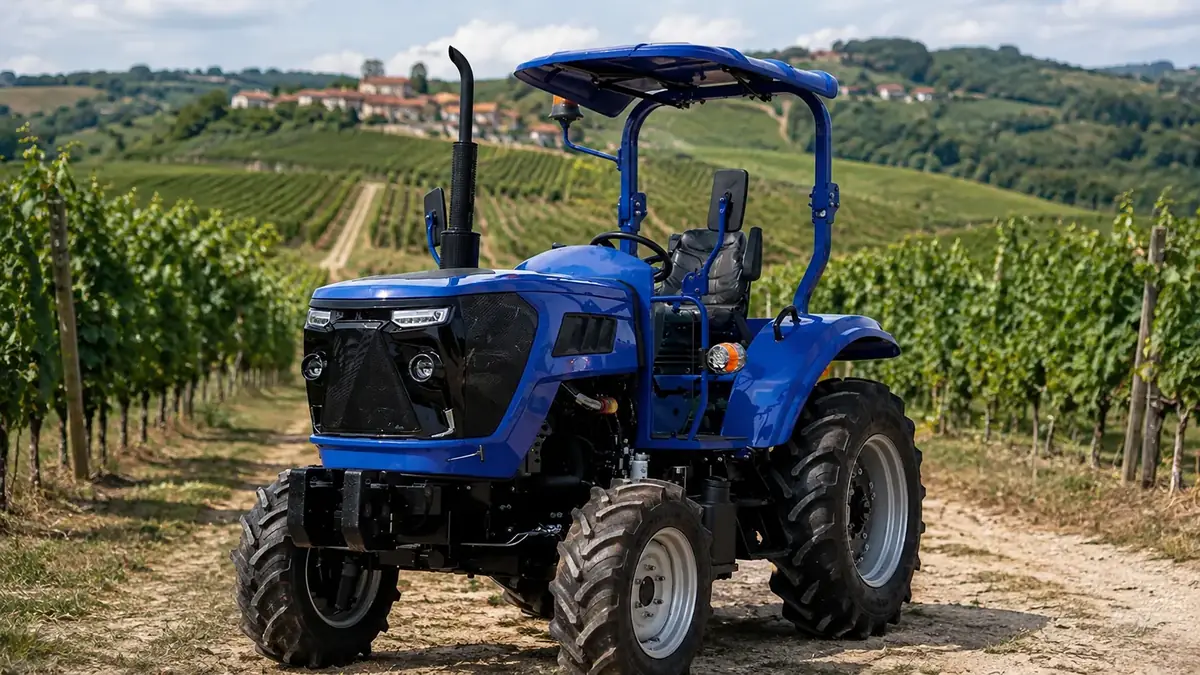
A practical European buying guide to row geometry, tractor width, stability, PTO and implement matching, soil compaction, seasonal work windows, compliance and total cost of ownership.
Horsepower is usually the first number discussed when a vineyard starts comparing tractors. It is easy to understand, easy to put into a quotation and easy to compare between models. The problem is that vineyard work is rarely limited by engine output alone.
A 25 hp tractor may be perfectly adequate for mowing, light cultivation and short-distance transport, yet still be the wrong machine because it is too wide for the working row, poorly matched to the PTO load, awkward at the headland or too heavy for repeated traffic on wet soil. A 40 or 50 HP tractor can create the opposite problem: useful reserve power, but more mass and a larger working envelope than the vineyard can use efficiently.
For a vineyard tractor, the better starting question is not “How much horsepower do I need?” It is “How much usable tractor can I fit into this vineyard while still operating the implements at the required field capacity?”
That working envelope includes row spacing, mature canopy, posts, gateways, headlands, slope, soil bearing capacity, implement dimensions, PTO demand and the number of working hours available during critical seasonal windows. Once those constraints are measured, horsepower becomes much easier to size.
I. Why Horsepower Is the Wrong Starting Point
European vineyards vary too much for a single horsepower rule to be useful. A modern wider-row vineyard on relatively level ground can use a conventional compact tractor very differently from an older vineyard with tight rows, stone walls, steep access tracks and short headlands.
A request such as “I need a 30 HP tractor for vineyard work” therefore leaves out most of the information required for a responsible recommendation.
- Minimum effective row width during the growing season
- Headland depth and narrowest gateway
- Maximum working slope and cross-slope conditions
- Soil type, drainage and typical wet-season trafficability
- Main implements, their weight and working width
- PTO speed and power demand
- Hydraulic demand and hitch category
- Annual tractor hours and peak-season work windows
- Whether public-road travel or registration is required
Horsepower solves load, not access
Engine power tells you how much rated output is available before drivetrain and PTO losses. It does not tell you whether the tractor can repeatedly pass between vine rows, turn with a trailed sprayer, stay stable on a cross-slope or carry the selected implement without compromising steering.
A larger engine can be useful when the implement genuinely needs the reserve. It cannot correct a poor dimensional fit. The target is enough power reserve inside a machine envelope that the vineyard can actually use.
II. Measure the Vineyard Before Comparing Tractors
Row spacing is not the same as usable working width
A nominal two-metre row spacing does not mean that a tractor has two metres of free space. The working width is reduced by trellis posts, irrigation lines, canopy growth, imperfect row alignment, tyre movement on uneven ground and the clearance the operator needs to correct the steering line.
For an established vineyard, measure the narrowest effective passage during the growing season rather than relying on the winter appearance of the rows. Mature canopy can remove a surprising amount of usable clearance.
Consider a vineyard with a minimum effective working width of 1,800 mm and a tractor listed at 1,560 mm overall width. The arithmetic leaves 240 mm in total, or roughly 120 mm per side. That may be enough to enter the row. It is not automatically enough to work there comfortably every week.
The remaining margin still has to absorb uneven terrain, sidewall movement, canopy intrusion and normal steering correction. In practice, “can enter the row” and “can work the row repeatedly without contact or operator stress” are different standards.
Check the implement envelope, not just the bare tractor
The tractor does not work alone. A flail mower may be wider than the rear tyres. A rotary tiller has its own transport and working width. A sprayer can add considerable length and rear mass. A trailer follows a different turning path from the tractor itself.
A useful pre-purchase check is:
Working envelope = tractor width + implement envelope + operating clearance
If the tractor fits but the attachment cannot work without touching vines, posts or irrigation hardware, the system does not fit.
Headlands and gateways are production constraints
Row width gets most of the attention because it is obvious. Headland depth often causes more lost time. A compact tractor that turns cleanly by itself can become awkward when connected to a long trailed sprayer or trailer.
Measure the row, the headland and the narrowest gateway as one route. Repeated three-point turns, reversing and realignment may only add seconds to each row, but they compound across a full day of mowing or spraying.
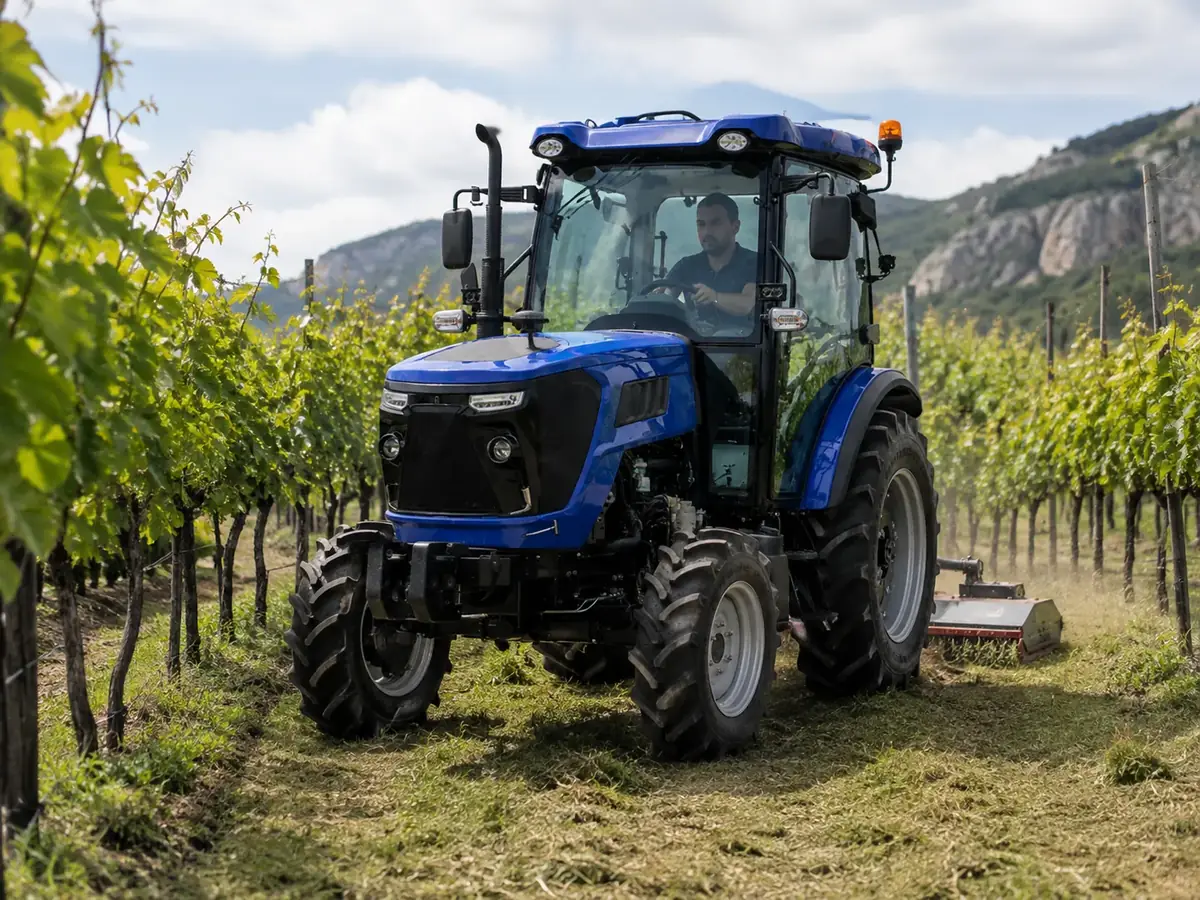
III. Compact Tractor, Narrow Tractor and Vineyard Tractor Are Not Interchangeable Terms
Compact tractor
A compact tractor generally describes a smaller agricultural platform with moderate power and manageable dimensions. It may be useful for estates, small mixed farms, orchards, grounds maintenance and wider-row vineyards.
Narrow tractor
A narrow tractor is defined more directly by the lateral space it is designed to work in. Its width, wheel-track options, operator station and bodywork are chosen around restricted row access.
Specialised vineyard tractor
A specialised vineyard tractor usually goes further, packaging the machine around tight row access, low profile, close manoeuvring, operator protection and vineyard-specific implements.
This distinction matters because a compact vineyard tractor can be suitable for vineyard work without being a specialised narrow tractor. Buyers should verify millimetres, not rely on category names.
For very tight traditional vineyards, a purpose-built narrow tractor may be the only sensible platform. For wider modern plantings, a standard compact 4WD tractor can be more versatile because it can leave the vineyard and handle transport, estate maintenance or other farm tasks without requiring a second machine.
IV. Stability Is a Trade-Off: Narrower Is Not Automatically Better
Track width and row access pull in opposite directions
Vineyard access encourages a narrow machine. Cross-slope stability generally benefits from a wider support base. The correct setup therefore is not the narrowest possible tractor. It is the widest stable configuration that still clears the working row.
Stability also depends on centre of gravity, implement position, ballast, tyre configuration, travel direction, speed and ground condition. A width figure by itself cannot certify a tractor as suitable for sloping vineyard work.
4WD improves traction, not the laws of physics
Four-wheel drive is useful on wet grass, loose soil, sloping access tracks and during trailer or loader work. It improves the ability to transmit torque through more tyres. It does not make an overloaded, top-heavy or poorly ballasted tractor safe on a steep cross-slope.
A front loader changes the balance of the machine
A loader increases front axle load and changes the tractor’s centre of gravity. Raise the bucket and the centre of gravity rises further. Heavy rear-mounted equipment creates the opposite problem by unloading the front axle and reducing steering authority.
Ballast should therefore be treated as axle-load management, not as a generic instruction to make the tractor heavier.
V. Soil Compaction Belongs in the Buying Decision
Vineyards expose the soil to a traffic pattern that is easy to underestimate: the same inter-row lanes may be used repeatedly for mowing, spraying, cultivation, canopy work, transport and harvest support. That repetition matters, particularly when the soil is wet enough to lose bearing capacity.
Compaction risk depends on more than tractor weight. Axle load, tyre size, tyre construction, inflation pressure, soil moisture and the number of passes all influence what happens below the surface.
A bigger tractor does not automatically lower TCO
If additional horsepower allows a wider implement, fewer passes or a faster operation within the correct agronomic window, the extra mass may be justified. If the work is mainly light mowing and transport, carrying a larger chassis through the same lanes all season can add cost without adding output.
For a small tractor for vineyard work, look at total operating weight with fuel, operator, ballast and implement fitted. Bare shipping weight is not the number the soil experiences.
Tyre pressure is a setup variable, not a fixed farm number
Road-biased tyre pressure can reduce the usable footprint in the field. Pressure that is too low for the axle load and speed can damage the tyre. The correct field pressure should come from the tyre manufacturer’s load-pressure data and the real operating load.
This is one reason two tractors with the same rated horsepower can behave very differently in the same vineyard.
VI. PTO, Transmission and Implement Matching Determine Real Working Capacity
Choose the work first, then the implement, then the tractor
A useful selection sequence is:
Work → Implement → PTO / Draft / Hydraulic Demand → Tractor
Build the tractor around the recurring jobs rather than buying the tractor first and then searching for attachments that happen to fit.
Vineyard Work | What to Check |
Mowing | Working width, PTO demand, crop/grass density |
Rotary cultivation | PTO demand, soil resistance, working depth |
Spraying | Pump/PTO requirement, tank mass, refill time |
Trailer transport | Loaded mass, gradient, braking, road use |
Inter-row maintenance | Implement width, offset and ground clearance |
Loader work | Lift demand, front axle load and rear ballast |
“Can power it” is not the same as “should run it all season”
An implement manufacturer’s minimum horsepower recommendation establishes a floor. It does not guarantee the best field speed, fuel use or duty cycle. A 25 hp tractor that spends every heavy mowing pass near full load may finish the work, but the operational penalty can appear as lower speed, more downshifting and longer days.
Gear ratios can matter more than another 5 HP
Vineyard work frequently requires controlled low speed while maintaining the correct PTO speed. If one gear is too slow and the next is too fast, the engine may have enough power while the transmission still prevents efficient operation.
When comparing a tractor for vineyard use, check the useful working-speed range, forward/reverse ratios, PTO speeds and how easy it is to change direction at the headland.
VII. Productivity Is About Finishing the Job Inside the Work Window
Mowing, spraying, cultivation and harvest support are not jobs that can always be delayed until convenient. Rainfall, soil moisture, disease pressure and crop stage can create a narrow operating window.
That changes the business meaning of horsepower. The useful question becomes: can the tractor and implement combination complete the required hectares before the window closes?
Use field capacity to expose hidden losses
A simplified field-capacity model is:
Effective field capacity ≈ travel speed × implement width × field efficiency
Field efficiency is where vineyard geometry appears in the calculation. Headland turns, reversing, refilling, row alignment and short delays all reduce output. A tractor that is oversized for the rows may lose time manoeuvring. An undersized tractor may lose time because it cannot hold the intended speed under PTO load.
On a larger vineyard, a 20–30% reduction in field capacity is not a minor specification difference. It can translate into additional working days during a tight spraying or mowing period.
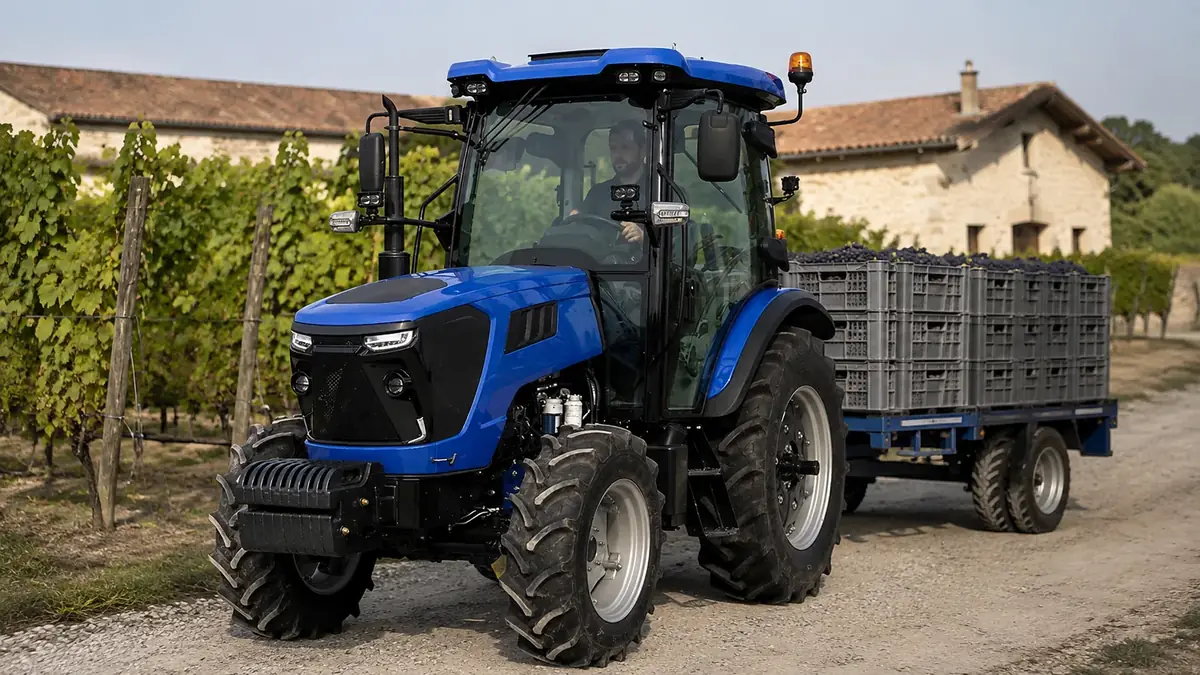
VIII. Compare Total Cost of Ownership, Not Purchase Price
A low purchase price can be attractive, but European operating costs make labour, downtime and parts availability difficult to ignore. A practical vineyard TCO model should include more than fuel and scheduled service.
TCO = Purchase + Fuel + Maintenance + Tyres + Labour + Downtime + Parts + Finance − Residual Value
For vineyard work, one more item belongs beside those costs: seasonal delay risk.
When the cheaper tractor becomes the expensive choice
If a lower-priced machine reduces daily field output, does not match the existing mower or sprayer, needs uncommon service parts or sits idle during a critical spray period, the original purchase saving can disappear quickly.
The reverse is also true. Buying unused horsepower is not free. A larger platform may increase capital cost, tyre cost, soil load and turning time without reducing the number of working hours.
Compare cost per productive hour and cost per completed seasonal operation. Those measures are closer to how a vineyard actually earns money.
IX. European Compliance Should Be Confirmed Before Shipment
For a European buyer, compliance is a configuration question, not a label to check at the end of the order.
Wheeled agricultural tractors placed on the EU market can fall under the EU agricultural and forestry vehicle type-approval framework. Requirements for the exact vehicle variant can involve type-approval documentation, engine emissions, braking, lighting, protective structures and other road or functional-safety provisions. Registration and public-road use can also differ by destination country.
Do not reduce the discussion to “Does it have CE?”
For the complete tractor, ask first which EU type-approval and Certificate of Conformity documentation is available for the exact variant being supplied, where applicable. Then confirm the engine emissions configuration, ROPS/protective structure, braking, lighting, tyres and national registration requirements.
Implements and attachments should be checked separately because their conformity route can differ from that of the tractor vehicle itself.
A better supplier question
Ask: “What approval, conformity and registration documents are available for this exact tractor configuration in my destination country?” That produces a much more useful answer than asking for a generic certificate.
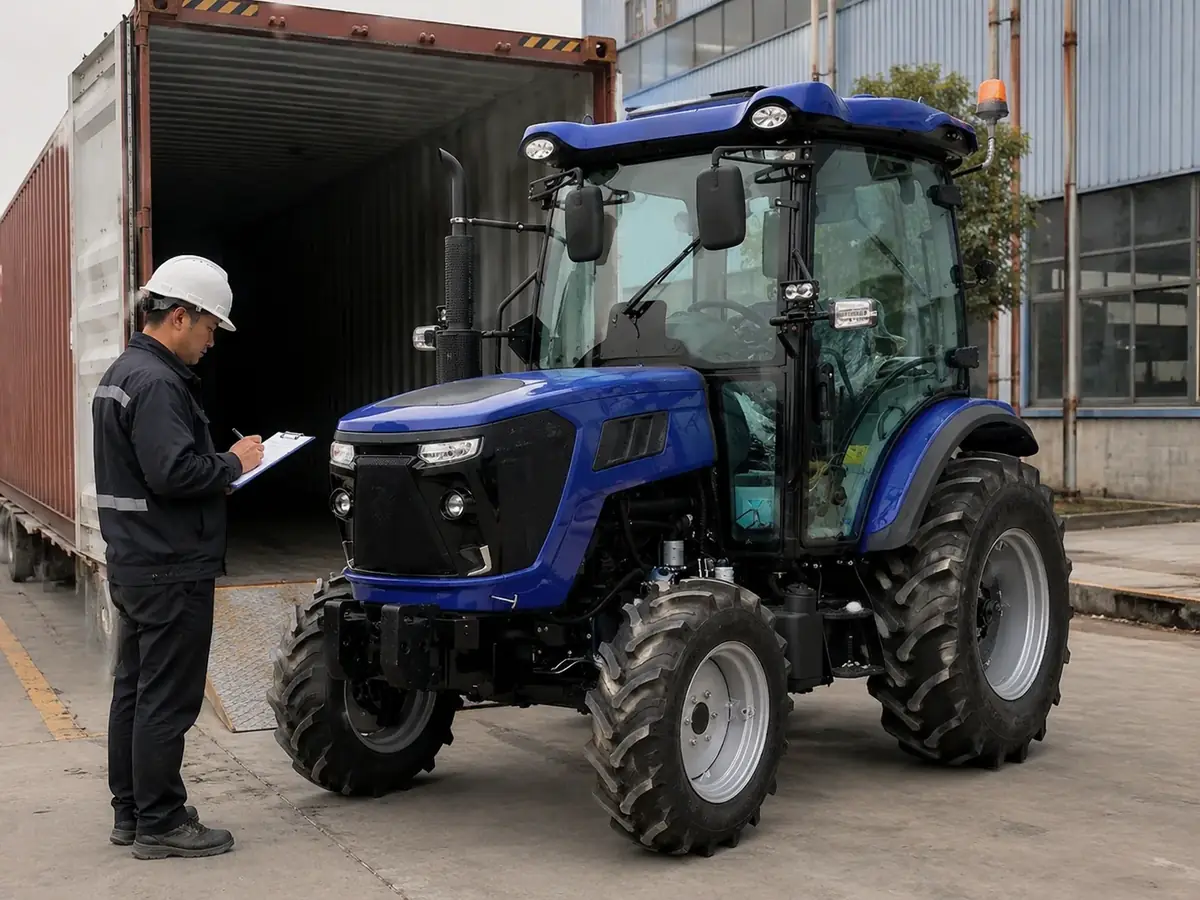
X. Where 25 HP, 30–40 HP and 50 HP Fit in Vineyard Work
25 HP: light work where access and low utilisation matter most
A 25 hp tractor can be a sensible choice for vineyard-floor mowing, light rotary cultivation, a compatible small sprayer, small-trailer movement and estate maintenance. It is particularly attractive where manoeuvrability and low annual utilisation matter more than reserve power.
The warning is simple: if 25 HP is already the minimum requirement of the vineyard’s main implement, there may be too little reserve for dense vegetation, slopes or long continuous PTO work.
30–40 HP: regular maintenance with more reserve
As area, PTO hours or implement weight increase, the 30–40 HP range often becomes easier to operate without moving to a substantially larger tractor. This can suit regular mowing, rotary tilling, moderate spraying and mixed transport.
50 HP: higher-duty work in wider rows
Around 50 HP can make sense when the same machine must cover heavier PTO work, transport, grassland maintenance or mixed-farm duties. The extra power only has value if the vineyard can accommodate the width, mass and turning envelope.
A 50 HP tractor that does not fit the row is not an upgrade over a 25 hp tractor. It is simply the wrong package.
XI. How OXPLO Fits This Selection Logic
Once the vineyard geometry, implement list and operating profile have been measured, model selection becomes much more straightforward. OXPLO offers a 25–70 HP tractor range for European farm applications, with the 25–50 HP compact OXT platform being the relevant part of the range for wider-row vineyard and orchard work.
Start with the OXPLO tractor range or use the OXPLO 25–70 HP tractor configuration guide to compare power classes and attachment combinations by application.
OXPLO OXT254: 25 HP compact entry point
OXPLO OXT254 is rated at 25 HP and uses 4WD, an 8F + 8R transmission, Category I rear linkage and 540/1000 rpm PTO. Its listed overall width is 1,560 mm. For a wider-row vineyard, that makes the OXPLO OXT254 relevant to mowing, light cultivation and routine transport where the measured row and headland envelope allow it.
OXPLO OXT304 and OXT404: more reserve on the compact platform
OXPLO OXT304 moves to 30 HP while retaining the published 1,560 mm width. OXPLO OXT404 increases output to 40 HP, also on the compact OXT chassis. These OXPLO models make more sense when the vineyard has regular PTO work or higher annual hours but still benefits from the compact-series footprint.
OXPLO OXT504: 50 HP where the workload justifies it
OXPLO OXT504 is the highest-powered model in the compact OXT chassis group at 50 HP. OXPLO lists the same 1,560 mm overall width for this platform, but the extra output should be justified by the implement list, annual workload and seasonal deadline. The published OXT504 specification uses Category I linkage and 540/720 rpm PTO, so PTO compatibility should be checked against the actual implement rather than assumed from the smaller OXPLO models.
The important boundary is that OXPLO’s compact 25–50 HP tractors should not be presented as universal replacements for specialised narrow vineyard tractors. If the measured working lane is too tight, a purpose-built narrow tractor is the correct engineering choice.
Where row spacing is sufficient, however, an OXPLO compact tractor can be evaluated as a multi-use farm platform rather than as a vineyard-only machine. The same OXPLO tractor may support mowing, rotary tilling, trailer transport and general estate work with compatible attachments.
For a project-specific recommendation, buyers can contact OXPLO with row dimensions, slope, implement data, annual hours and destination-country requirements.
XII. Vineyard Tractor Procurement Checklist
Vineyard geometry
- Minimum nominal row spacing
- Minimum effective working width during the growing season
- Headland depth and narrowest gateway
- Lowest canopy or trellis clearance
- Maximum working slope and cross-slope condition
Ground and traffic
- Soil type and drainage
- Typical wet-season condition
- Existing wheel tracks and compaction concerns
- Expected number of passes per season
- Preferred tyre type and pressure-management approach
Implements
- Working and transport width
- Implement mass
- Minimum engine/PTO power
- Required PTO speed
- Hydraulic requirement
- Hitch category
- Mounted or trailed configuration
Operating profile
- Vineyard hectares
- Annual tractor hours
- Peak seasonal workload
- Required daily field capacity
- Road travel and registration requirement
- Other farm jobs expected from the same tractor
Supplier confirmation
- Exact tractor dimensions in the ordered configuration
- Tyre and ballast configuration
- PTO and linkage compatibility
- Available approval and conformity documents
- Destination-country road-use and registration information
- Parts, service and pre-shipment inspection arrangements
If these points are still unknown, a horsepower recommendation is only a preliminary estimate.
XIII. Conclusion: Choose the Tractor Around the Vineyard, Not the Brochure
A suitable vineyard tractor has to satisfy four things at the same time: access, stability, implement compatibility and productive capacity.
For light maintenance, a 25 hp tractor may be enough. For more regular PTO work, 30–40 HP can provide useful reserve. For wider-row vineyards that also require transport or mixed-farm duties, a 50 HP compact tractor may justify its higher output.
None of those horsepower ranges can be selected responsibly without row geometry, working weight, tyres, soil condition, PTO demand and the seasonal work window.
That is also the sensible way to evaluate OXPLO. The OXPLO OXT254, OXT304, OXT404 and OXT504 give buyers several steps from 25 to 50 HP on the compact OXT platform, but OXPLO should be matched to a measured vineyard rather than sold from the horsepower figure alone.
If the site genuinely requires a specialised narrow tractor, use one. If the vineyard has enough working width, the value of an OXPLO compact tractor is its ability to combine vineyard maintenance with other farm and estate work while keeping the machine package manageable.
Explore OXPLO tractors, review the OXPLO configuration guide, or visit the OXPLO website for current product information.