
A practical B2B guide to orchard tractor horsepower, row clearance, PTO matching, 4WD, European-order checks and OXPLO platform selection
When buyers search for the best orchard tractor, the first question is usually, “How much horsepower do I need?” In practice, that is rarely the first engineering decision that should be made.
A tractor can have enough engine power and still be a poor orchard machine. It may be too wide for the narrowest rows, too tall for the canopy, too long to turn efficiently at the headland, or unable to match the PTO, hitch and hydraulic requirements of the sprayer or mower that actually determines the workload.
For European orchard operators, the buying decision is even more sensitive because machine dimensions, existing implements, wet or sloping terrain, destination-market configuration, transport logistics and model-specific documentation all affect whether the tractor will be productive after delivery—not just whether it looks suitable on a specification sheet.
The more useful selection sequence is: Orchard geometry → implement load → PTO requirement → terrain → annual workload → tractor platform → horsepower.
In other words, orchard geometry and implements determine whether a tractor can do the job; orchard area and working hours determine how efficiently it must do the job.
This guide explains that process and shows where the OXPLO 25–70 HP tractor range fits once the application has been defined.
I. What Size Tractor Do You Need for an Orchard?
A horsepower table is useful only as a first filter. It should never replace the implement manual, actual row measurements or a discussion of the terrain and working hours.
Typical Orchard Workload | Initial HP Range to Evaluate | Primary Selection Constraint |
Light mowing, spreading, light trailer work | 25–30 HP | Access, turning space, Category I implements |
Regular flail mowing, tilling and transport | 30–40 HP | PTO load, 4WD traction, operating speed |
High-frequency orchard maintenance and multiple PTO tools | 40–50 HP | Power reserve, implement weight, annual hours |
Wider-row orchard plus heavier mixed-farm work | 60–70 HP | Category II implements, traction, larger machine envelope |
High-demand sprayer or specialized PTO implement | Calculate from implement data | Required PTO rpm and PTO horsepower—not engine HP alone |
The key trade-off is simple: an orchard tractor must be compact enough to move through permanent tree rows but powerful enough to operate the highest-demand implement without spending its working life at the edge of its capacity.
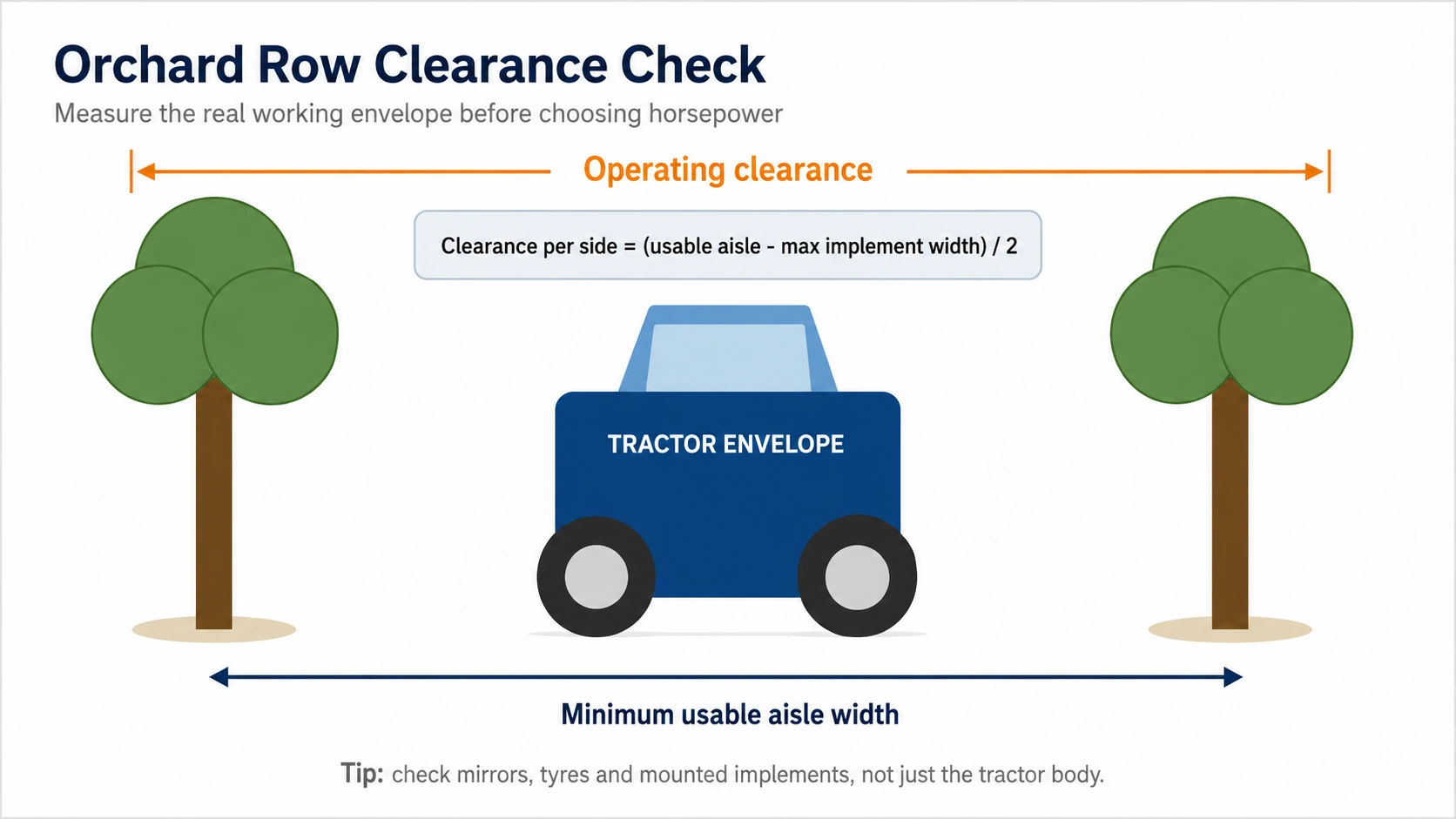
Figure 1. Orchard tractor selection starts with the real working envelope, not nominal row spacing.
II. Why Orchard Size Alone Cannot Determine Horsepower
A 20-hectare orchard does not automatically require the same tractor as another 20-hectare orchard. The area may be identical while the machine requirements are completely different.
Consider two examples. Orchard A has wide rows, generous headlands and frequent transport work. Orchard B uses denser planting, has lower canopy clearance and depends heavily on a trailed air-blast sprayer. Orchard A may benefit from a larger utility tractor. Orchard B may be unable to use that same chassis efficiently even if it needs comparable PTO power.
This is why using hectares as the primary horsepower rule often causes either undersizing or oversizing.
What orchard area actually tells you
Area matters mainly because it changes the productivity target. A tractor that can technically finish the work may still be too slow when spraying, mowing or soil preparation must be completed inside a short weather or crop-management window.
For a five-hectare orchard, an extra hour may not matter. For a much larger commercial operation, repeated low working speed or frequent headland manoeuvres can turn into many lost hours over a season. That is where additional horsepower, a broader implement, more transmission ratios or a different tractor platform can become commercially justified.
The hidden cost of oversizing
Oversizing is less obvious because the machine still works. The buyer simply carries the cost every day: a larger turning envelope, more weight on orchard soils, more difficult access, higher transport mass, potentially higher fuel consumption and a chassis that may be larger than the existing implement fleet requires.
The objective is not to buy the highest horsepower available within the budget. The objective is to buy enough capacity to complete the real work reliably, while keeping the machine envelope compatible with the orchard.
III. Measure Row Width, Canopy Clearance and Turning Space Before You Compare Models
The most common dimensional mistake is to quote the nominal row spacing and assume that the tractor has the entire distance available. It does not.
Branches grow into the row. Fruit weight can lower branches. Ground level changes. The operator must correct the steering line. Mirrors, mudguards, tyres and the implement can extend beyond the body. On sloping ground, the tractor can also move closer to the canopy on the downhill side.
Use the minimum usable aisle, not the average row spacing
Measure the tightest normal operating section of the orchard. If the theoretical row spacing is 3.0 m but the canopy leaves only 2.6 m of reliable working width, 2.6 m is the more useful engineering number.
A simple first-pass calculation is:
Clearance per side = (minimum usable aisle width − maximum equipment width) ÷ 2
The “maximum equipment width” should mean the widest part of the operating combination, not just the bare tractor. A sprayer, flail mower or other attachment may be the part that defines the true envelope.
Headland space affects hourly productivity
A tractor that fits perfectly between trees may still be inefficient if the tractor-and-implement combination cannot turn cleanly at the end of the row. Extra reversing and steering corrections create non-productive time, increase operator fatigue and raise the chance of contacting trees, posts or irrigation equipment.
For this reason, OXPLO recommends that buyers provide not only row width, but also canopy height, gate width and headland dimensions when requesting an orchard tractor configuration.
IV. Match Horsepower to PTO and Implement Load—Not to a Marketing Number
Once the machine can physically operate in the orchard, the next question is power. Here, the highest-demand recurring implement should drive the decision.
Typical orchard implements include flail mowers, rotary tillers, fertilizer spreaders, trailers and air-blast sprayers. Each places a different demand on the tractor. Some are limited mainly by drawbar traction; others are dominated by PTO demand; mounted equipment also introduces lift-capacity and stability questions.
Engine horsepower is not PTO horsepower
This distinction is one of the most important points in orchard tractor selection. A tractor advertised as 40 HP or 50 HP is normally describing rated engine output. An implement manual may specify minimum PTO horsepower. Those values are not interchangeable.
Power is lost through the driveline, and the tractor must still maintain the required PTO speed under real load. Therefore, a 40 HP engine tractor should not automatically be selected for an implement that demands 40 PTO HP.
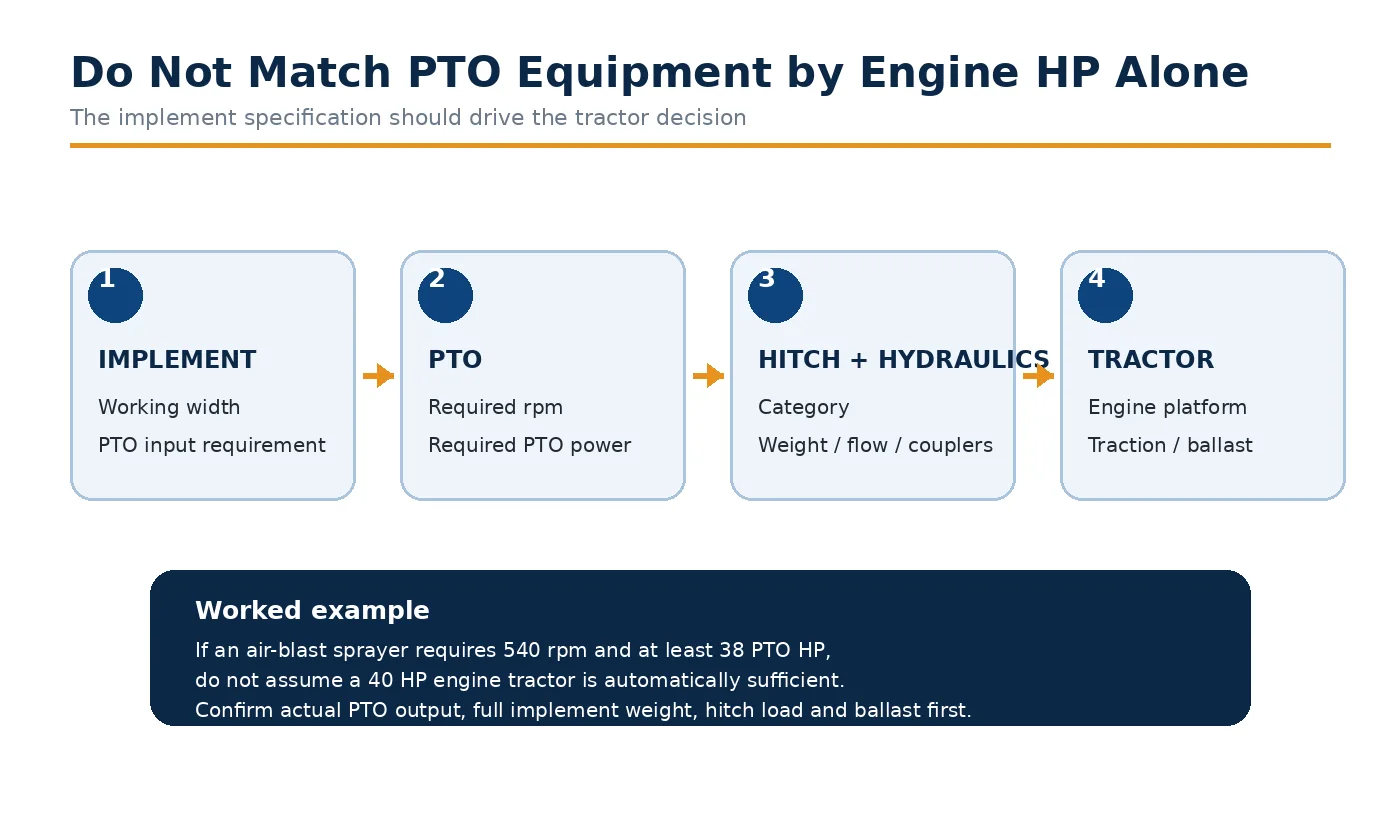
Figure 2. Start with the implement requirement, then confirm PTO, linkage, hydraulics and the tractor platform.
A practical sprayer example
Assume an orchard uses an air-blast sprayer whose manufacturer specifies 540 rpm PTO speed and a minimum of 38 PTO HP. The sprayer weighs 1,100 kg at full operating load.
A buyer who purchases a 40 HP engine tractor simply because the numbers look similar is skipping several checks. The correct questions are: What is the tractor’s actual PTO output? Can it hold 540 rpm under load? Is the sprayer mounted or trailed? What is the hitch or drawbar load? How does the full liquid load affect stability? Is additional ballast required?
That is the difference between selecting a tractor by brochure horsepower and engineering a workable tractor–implement system.
Do not ignore full operating weight
Liquid loads are especially important in orchards. A 1,000 L tank carries roughly one tonne of liquid before the structure, pump, fan, frame and plumbing are added. Even if PTO power is adequate, the complete operating mass can expose weaknesses in traction, braking, ballast and stability.
For mounted equipment, buyers should also confirm rear-linkage category and lift requirements. For hydraulically assisted implements, flow, pressure and coupler configuration need to be checked before the order is finalized.
V. 4WD, Tyres and Stability: Why More Engine Power Does Not Fix Poor Traction
European orchards frequently operate on damp grass, loose soil, uneven tracks or rolling terrain. Under these conditions, the limiting factor may be tyre grip rather than engine output.
Once wheel slip becomes excessive, adding more horsepower does not automatically improve productivity. That is why a 4WD orchard tractor is usually the more practical starting point for variable ground conditions.
Where 4WD adds value
- Wet grass between rows
- Loose or soft soil after rain
- Sloping orchard blocks
- Trailer movement on farm tracks
- Repeated work with heavier implements
All current OXPLO OXT tractor models from 25 to 70 HP are listed as 4WD, which gives buyers a consistent traction platform across the range. However, 4WD is only one part of the stability equation.
Slope safety is a system issue
Tyre choice, wheel track, ballast, implement position, travel direction, speed, braking and operator protection all matter on slopes. A partly filled sprayer tank also introduces moving liquid mass, so a tractor that feels stable with an empty implement may behave differently at operating weight.
For a sloping orchard, OXPLO should therefore be given the terrain description and primary implement—not just the required horsepower. The safer and more productive configuration is often achieved by matching traction, tyres, ballast and machine size together.
VI. Five Orchard Tractor Buying Mistakes That Increase TCO
1. Selecting horsepower from hectares alone
This ignores row geometry, PTO demand and seasonal working windows. Area matters, but it is a productivity variable rather than a complete equipment specification.
2. Assuming “10 more HP cannot hurt”
A power increase can also mean a wider chassis, longer wheelbase, larger tyres and a different hitch category. The extra power only creates value if the orchard can still use the machine efficiently.
3. Buying the largest tractor for future flexibility
Future-proofing can become permanent overcapacity. The owner pays for a larger machine while accepting more turning space, more weight and potentially unnecessary ownership cost during the 70–80% of hours spent on lighter tasks.
4. Assuming existing implements will fit
Before importing, confirm Category I or II linkage, PTO speed, spline, hydraulic connections, implement weight and power requirement. A tractor that arrives in Europe but cannot connect to the existing implement fleet creates immediate retrofit or replacement cost.
5. Treating European compliance as a single checkbox
European buyers should confirm the exact model, engine/emissions configuration, operator protection, lighting/braking needs, road-use requirements and model-specific conformity documents for the destination country before production and shipment.
OXPLO’s support page specifically notes that Stage V engine availability depends on model and engine supplier, and that destination-market configuration and documents should be confirmed during quotation. This is the correct way to handle European orders: model-specific confirmation rather than broad assumptions.
VII. 25 vs 30 vs 40 vs 50 vs 60–70 HP: How OXPLO Fits Different Orchard Workloads
Once the orchard envelope, implement requirements and workload are known, the OXPLO range becomes easier to interpret. The important point is that OXPLO does not simply offer six horsepower labels; it provides two distinct tractor platforms that solve different problems.
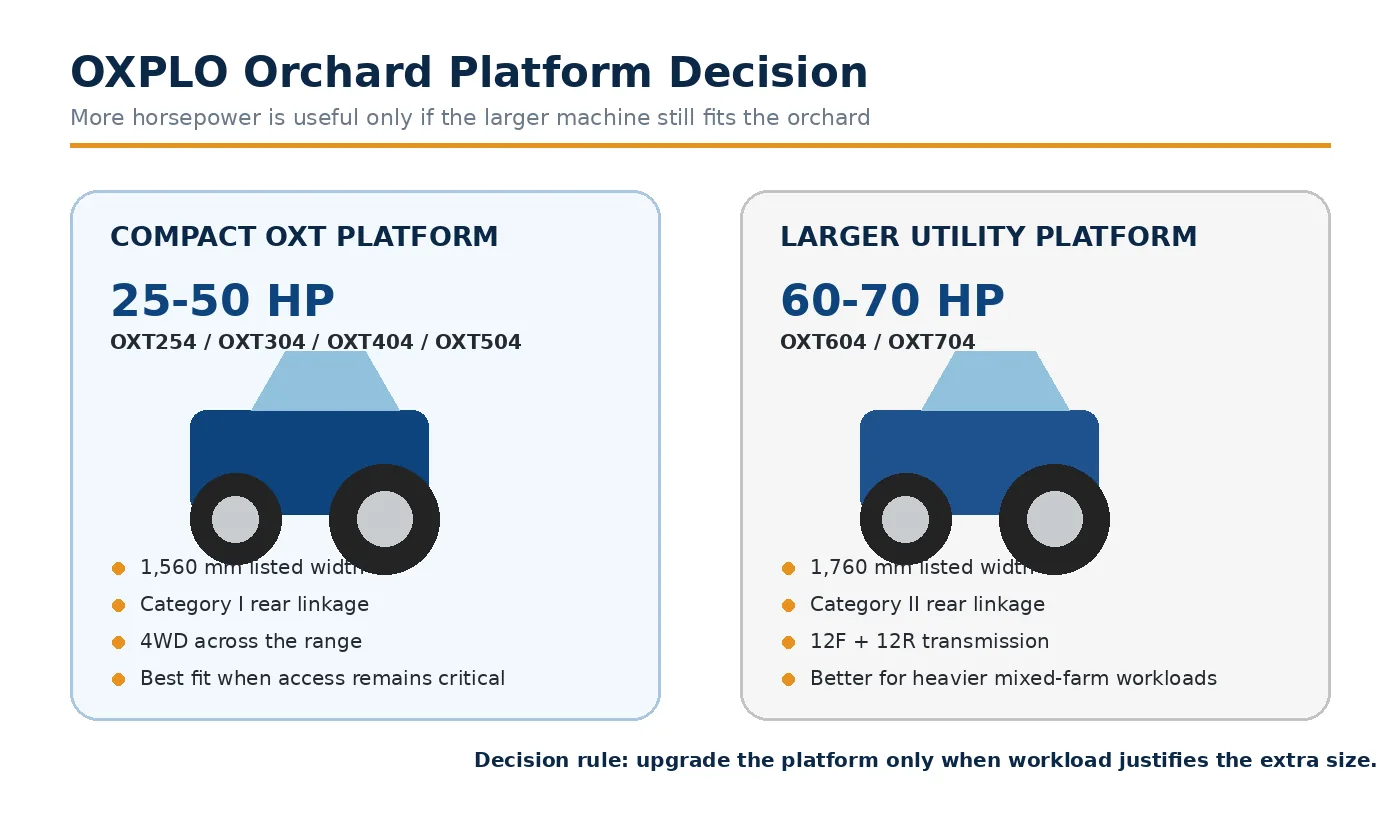
Figure 3. The major OXPLO decision is often compact Category I platform versus larger Category II utility platform—not simply 50 HP versus 60 HP.
OXPLO OXT254 / OXT304: access-first orchard work
OXPLO OXT254 and OXPLO OXT304 are the 25 HP and 30 HP entry points in the compact OXT platform. Both are listed at 3,180 × 1,560 × 2,600 mm, with an 1,800 mm wheelbase, 4WD and Category I rear linkage.
For wider-row orchards with mowing, spreading, light trailer work and routine floor maintenance, the business case is straightforward: there is little reason to pay for a larger platform if access and light-duty versatility are the dominant requirements.
The important boundary is implement demand. If the operation depends on heavy PTO loads or high daily output during narrow seasonal windows, moving up within the compact range may be more sensible than forcing a 25–30 HP tractor to work continuously near its limit.
OXPLO OXT404: more working reserve without increasing listed width
OXPLO OXT404 increases rated output to 40 HP while retaining the same listed 1,560 mm width and Category I platform. That makes it relevant for orchard operators who still need compact access but perform more frequent flail mowing, tilling, transport or other PTO-driven work.
The value is not simply “10 more horsepower.” It is additional working reserve without immediately moving to a wider utility chassis.
OXPLO OXT504: the strongest compact-platform option
OXPLO OXT504 is rated at 50 HP and remains listed at 1,560 mm wide. It is the highest-powered model in OXPLO’s compact OXT chassis group and is particularly relevant where the customer needs more output but cannot accept the wider 60–70 HP platform.
This solves a very specific orchard problem: “I need more power, but I cannot afford a larger working envelope.” For buyers with adequate row clearance, heavier recurring workloads and existing Category I implements, that combination can be more valuable than simply choosing a physically larger tractor.
For sprayer-driven decisions, the same warning still applies: 50 engine HP does not automatically equal the PTO power required by a specific sprayer. OXPLO should confirm the final PTO configuration and implement data on the quotation.
OXPLO OXT604 / OXT704: when the orchard is only part of the workload
OXPLO OXT604 and OXPLO OXT704 move to the larger utility platform. The OXT604 is listed at 60 HP, 3,980 × 1,760 × 2,800 mm, 2,010 mm wheelbase, 12F + 12R transmission and Category II linkage; the OXT704 raises rated output to 70 HP on the same class of larger chassis.
For a wider-row orchard that also handles field cultivation, heavy transport, loader work or larger Category II implements, that additional platform capacity can be useful. But a buyer should recognize that the step from OXT504 to OXT604 is more than a 10 HP increase. The listed width grows from 1,560 mm to 1,760 mm and the implement platform changes from Category I to Category II.
That trade-off can be exactly right for mixed farms—and exactly wrong for a tight orchard. OXPLO’s recommendation should therefore start with the work, not with a push toward the highest horsepower.
VIII. What European Buyers Should Confirm Before Importing an Orchard Tractor
For European buyers, a technically correct tractor recommendation is only half the job. The commercial risk continues through configuration confirmation, documents, shipping and compatibility with the equipment already on the farm.
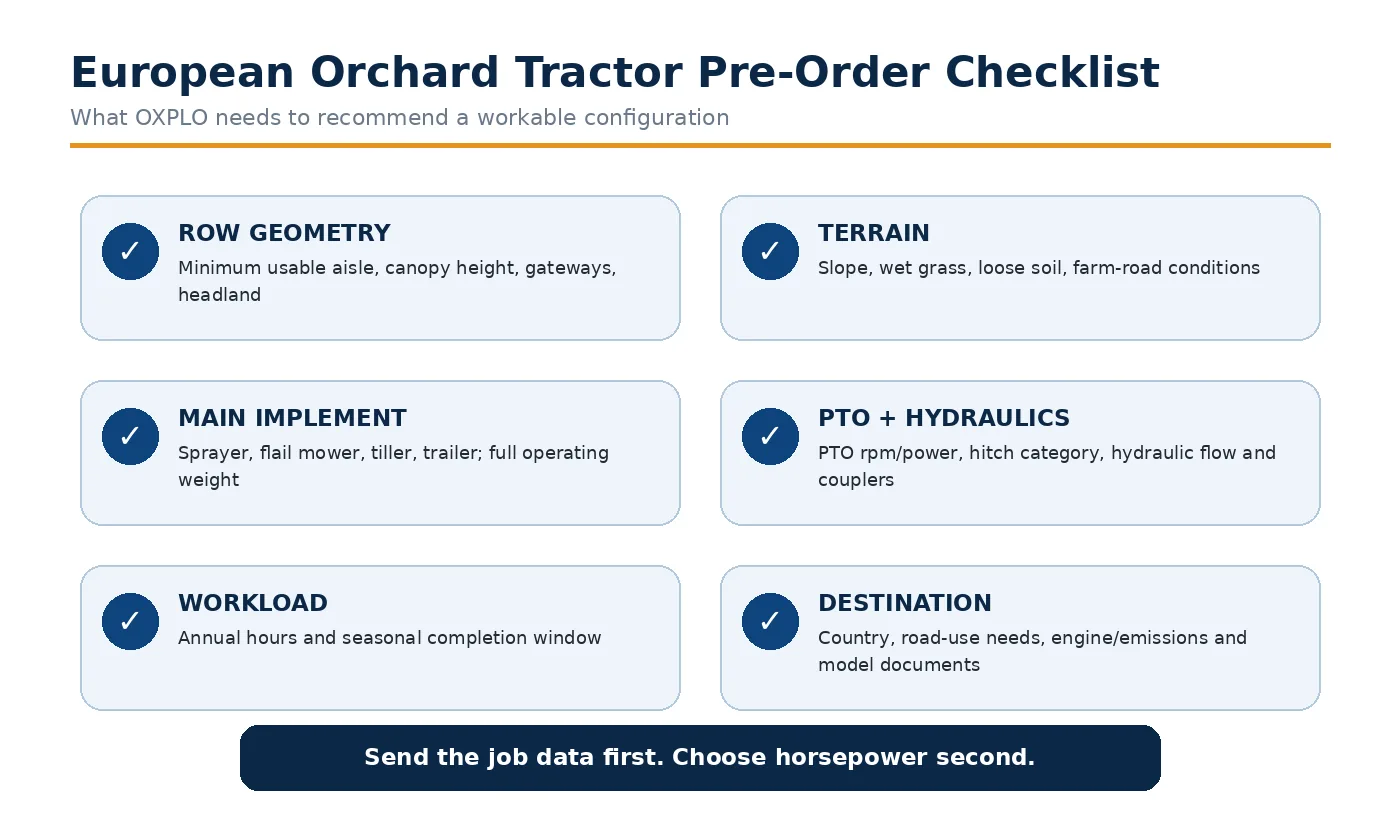
Figure 4. The information OXPLO needs before recommending an orchard tractor configuration for a European customer.
1. Exact destination and intended use
Tell OXPLO the destination country and whether the tractor will remain on private agricultural land or may require road use. Lighting, braking, tyres, engine/emissions configuration and documentation needs should be confirmed against the supplied model and destination.
2. Model-specific documentation
OXPLO states that model-specific CE documents can be confirmed according to the selected tractor and destination, while Stage V engine configurations may be available for applicable European-market diesel tractors depending on model and engine supplier. Buyers should request the exact documentation package on the quotation rather than assuming every engine and every model uses the same configuration. See OXPLO Tractor Customization and OXPLO Support.
3. Existing implement compatibility
Send photographs, nameplates or manuals for the key implements if possible. Confirm PTO speed, PTO power requirement, hitch category, implement weight, hydraulic flow and connector type. OXPLO lists up to 48 attachment options, but even when using an OXPLO attachment, the final combination should be reviewed by horsepower, PTO, linkage, hydraulics and operating weight.
4. Seasonal output requirement
Tell the supplier how many hours per year the tractor is expected to work and which jobs have tight completion windows. A machine that can technically run the implement may still be undersized for a commercial orchard if it cannot finish the work within the available time.
5. Pre-shipment verification
For an international B2B order, specifications should be frozen before shipment. OXPLO’s tractor-order process includes configuration confirmation and can provide pre-shipment photos or video of the tractor, attachments and packing. This reduces the chance that a mismatch is discovered only after the machine arrives in Europe.
IX. The Orchard Tractor Specification Sheet You Should Send With a Quotation Request
A useful enquiry should make it possible for the supplier to eliminate unsuitable models before discussing price. The following information is more valuable than simply asking for a “50 HP orchard tractor.”
Information to Provide | Example | Why It Matters |
Orchard type | Apple orchard | Defines dominant operations |
Minimum row spacing | 3.0 m | Initial width check |
Minimum usable aisle | 2.6 m | More realistic than nominal row spacing |
Lowest canopy clearance | 2.4 m | Checks tractor/ROPS/cab height |
Headland dimensions | 5 m usable depth | Checks turning envelope |
Terrain | Rolling, wet in spring | Traction and stability |
Main implement | 800 L air-blast sprayer | Defines key workload |
PTO requirement | 540 rpm / 35 PTO HP | Determines minimum PTO capability |
Full implement weight | 950 kg | Stability, hitch/drawbar and ballast |
Other implements | Flail mower, rotary tiller | Checks compatibility and power range |
Annual use | 500 h/year | Sets productivity target |
Destination | Poland | Market configuration and documentation |
Road use | Occasional | Lighting/braking/registration-related checks |
Send this information through the OXPLO contact page or use the quotation form on the OXPLO tractor configuration page. The objective is to receive a model-and-attachment recommendation based on the orchard, not a generic horsepower quote.
X. FAQ: Orchard Tractor Buying Questions
What horsepower tractor is best for an orchard?
There is no universal number. Light orchard maintenance may begin around 25–30 HP, more frequent PTO and transport work often justifies evaluating 40–50 HP, and 60–70 HP makes more sense when rows are wide enough and the tractor also handles heavier mixed-farm work. The final threshold should be checked against the highest-demand implement.
Is a 25 HP tractor enough for an orchard?
Yes, in the right application. A 25 HP compact 4WD tractor can be appropriate for wider-row orchards focused on mowing, spreading, light trailer work and routine maintenance. It becomes a poor choice when the core implement requires more PTO power or the commercial workload demands higher daily output.
Is a 50 HP tractor too large for an orchard?
Not necessarily. Physical dimensions matter more than the number on the bonnet. The OXPLO OXT504 is rated at 50 HP but retains the compact OXT platform’s listed 1,560 mm width, so it can be relevant where the orchard needs more power without moving to the wider 60–70 HP chassis.
Do I need 4WD for an orchard tractor?
For wet grass, soft ground, slopes and trailer work, 4WD is generally valuable because traction may become the limiting factor before engine power. All current OXPLO OXT tractors are listed as 4WD. Tyres, ballast and safe slope operation still need separate consideration.
How narrow should an orchard tractor be?
Do not use a universal target. Measure the minimum usable aisle after canopy intrusion, then compare it with the widest part of the tractor-and-implement combination and leave working clearance for steering error and terrain.
What is more important: engine HP or PTO HP?
For PTO-driven orchard implements, the implement’s required PTO power is often the more important number. Engine rated horsepower and PTO horsepower are not the same. Always confirm actual PTO configuration and output before ordering.
What should a European buyer check before ordering an OXPLO tractor?
Confirm the exact model, engine/emissions configuration, available model-specific CE documents, operator protection, tyres, lighting and braking configuration, road-use requirements, PTO and hitch compatibility, manuals and destination-country requirements before production and shipment.
XI. Conclusion: The Best Orchard Tractor Is the One That Fits the Whole Working System
The best orchard tractor is not automatically the smallest tractor, the largest tractor or the model with the highest horsepower. It is the machine that can move through the orchard efficiently, operate the key implements at the required PTO and hydraulic conditions, maintain useful traction on the real terrain, and complete seasonal work inside the available time window.
Space decides whether the tractor can enter. PTO and implement demand decide whether it can do the work. Terrain decides whether the power reaches the ground. Area and annual hours decide how productive the system must be.
That logic is also why OXPLO’s 25–50 HP compact platform deserves attention from orchard buyers. OXT254, OXT304, OXT404 and OXT504 let buyers evaluate different power levels while retaining a listed 1,560 mm width and Category I platform. When the farm genuinely needs a larger chassis, Category II implements, more transmission ratios or heavier mixed-farm capability, the OXT604 and OXT704 provide the next step.
OXPLO’s role should therefore be to match the machine to the working system—not to push every customer toward more horsepower. A buyer who sends row dimensions, canopy clearance, terrain, implement specifications, PTO requirements, annual working hours and destination country gives OXPLO the information needed to make a far more useful recommendation.
Before requesting a price, review the OXPLO tractor range and the 25–70 HP OXPLO tractor configuration guide. Then send OXPLO the orchard data and key implement specifications. The result should be a complete tractor + PTO + hitch + tyre + attachment configuration—not just a horsepower number.
OXPLO Orchard Tractor Selection Rule Measure first. Match the implement second. Choose horsepower third. |