
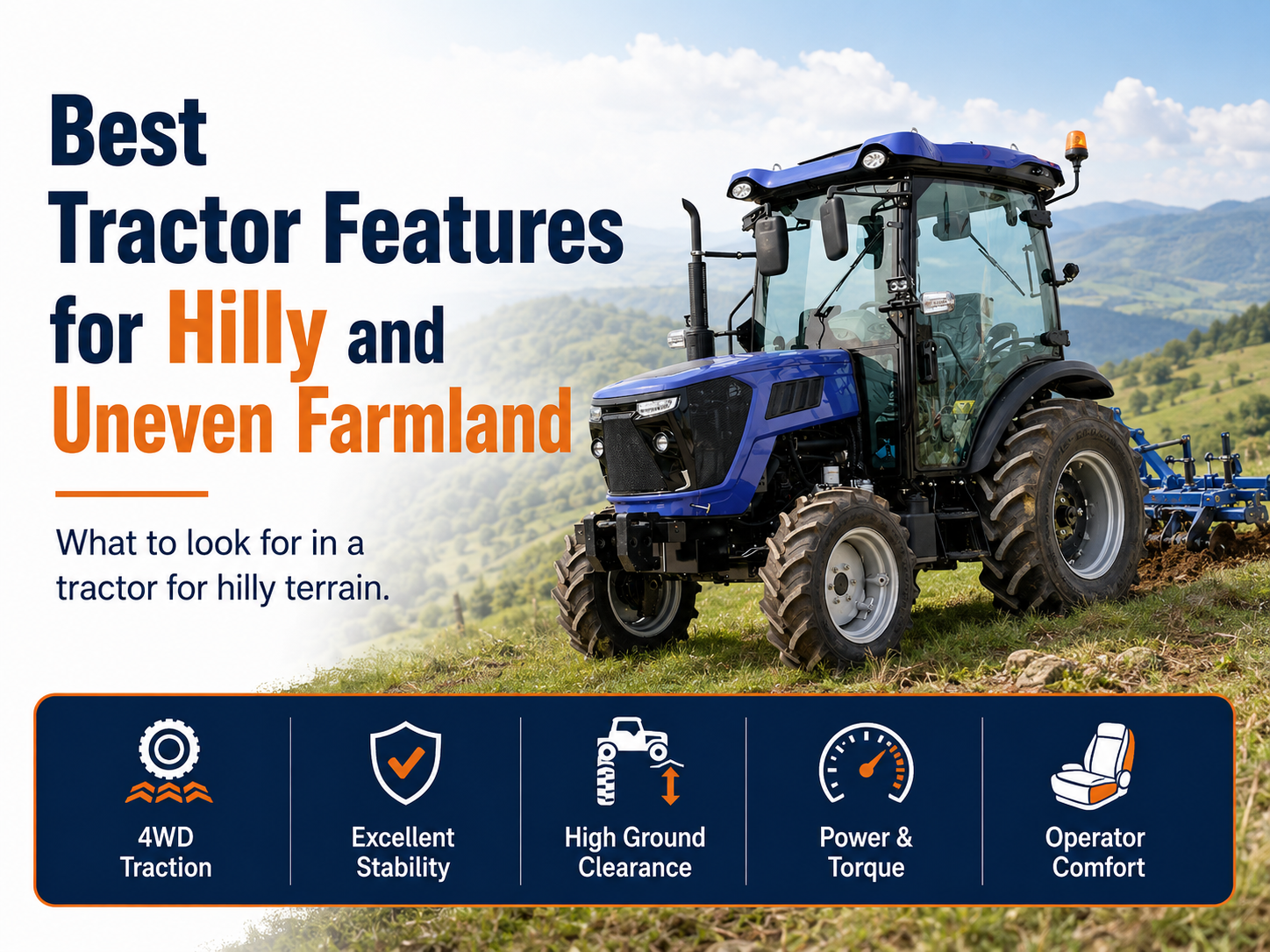
On flat farmland, tractor selection often starts with horsepower, PTO output, implement compatibility and farm size. On slopes and irregular ground, however, the decision becomes more complex. A tractor can have ample engine power and still perform poorly if its tyres cannot generate grip, its gearing is difficult to control at low speed, or its weight distribution changes too sharply when an implement is attached.
For buyers comparing a tractor for hilly terrain, the most useful question is not simply “How much horsepower do I need?” It is “Which combination of traction, stability, gearing, tyres, braking and implement compatibility fits the actual terrain?” That approach is especially important for European mixed farms, where one machine may move between grassland, farm tracks, cultivation, transport, livestock support and seasonal maintenance in the same working day.
OXPLO develops a tractor range from compact 25–40 HP machines through 50–60 HP mid-range tractors to 70–75 HP utility models. This article uses that range as a practical reference, while keeping the core principle clear: no 4WD tractor should be judged for slope work by horsepower or drive type alone.
I. Why Hilly Farmland Changes the Tractor-Buying Decision
A hillside does not simply increase the amount of power required to move a tractor. It changes how weight is transferred through the machine. On an uphill climb, rear axle loading can increase. On a descent, more weight transfers forward. When crossing a slope, one side of the tractor may carry more of the load. Add a rear mower, front loader, trailer or mounted cultivator and the tractor’s centre of gravity and axle loading change again.
Traction and Stability Are Different Problems
Traction determines whether the tyres can transmit useful pulling force to the ground. Stability determines whether the machine remains controllable and resists excessive roll or pitch. These two issues are related, but they are not interchangeable. A tractor may have excellent traction and still be operated in an unsafe configuration if the slope, speed, load or implement position is unsuitable.
Evaluate the Whole Working System
The tractor, implement, load, tyre setup and terrain should be treated as one working system. For a hillside tractor, the same base machine can behave very differently when it is mowing with a rear implement, pulling a loaded trailer or travelling with a loader attachment. OXPLO buyers should therefore define the jobs the tractor will actually perform before selecting a model solely from an HP category.
II. 4WD Should Be a Priority for a Tractor for Hilly Terrain
Four-wheel drive is one of the most valuable features for farms that regularly operate on grass, loose soil, wet ground, gravel tracks or uneven fields. By allowing both axles to contribute to tractive effort, a 4WD tractor generally has more opportunities to maintain grip when one axle begins to lose adhesion.
Where 4WD Adds the Most Value
- Wet grassland and pasture after rain
- Loose cultivated soil and headlands
- Muddy or rutted farm access roads
- Gravel tracks and mixed hard/soft surfaces
- Uphill starts with correctly matched implements or trailers
Within the OXPLO range, the OXT404, OXT504, OXT604 and OXT704 are all listed as 4WD models. That makes four-wheel drive part of the baseline configuration across these representative 40–70 HP OXPLO tractors rather than an afterthought.
4WD Does Not Replace Safe Slope Management
Four-wheel drive can improve usable traction, but it does not create a universal safe slope angle. Tyres, soil moisture, machine width, implement position, ballast, braking, travel direction and operator technique still matter. A buyer should never interpret “4WD” as a guarantee that the tractor can safely cross or descend any particular gradient.
III. Tractor Traction Depends on Tyres, Weight and Ballast
When farmers talk about tractor traction, the discussion often stops at 4WD. In practice, tyre condition, tread design, inflation, machine weight and ballast can be just as important. The engine only produces torque; the tyres have to transfer it to the ground.
Agricultural Tyres and Ground Contact
Deep agricultural tread can provide better bite in soil and grass than road-oriented patterns, but the correct tyre choice still depends on the farm. A tractor that spends most of its time on wet pasture has different priorities from one that performs frequent road transport. Tyre width, pressure and load rating should be matched to both the tractor and the implement configuration.
Weight: Enough for Grip, Not More Than Necessary
Additional mass can increase the normal load on the tyres and help them develop tractive force, but excessive weight has costs. It can increase soil compaction, deepen ruts in wet conditions and create more momentum to control on descents. The best farm tractor for uneven ground is therefore not automatically the heaviest tractor available.
Ballast Is About Balance
Ballast should be used to improve axle loading and machine balance for the specific job, not simply to make the tractor heavier. A front loader may require rear counterweight; a heavy rear implement can reduce useful front axle load. OXPLO customers planning loader work or heavier attachments should confirm the full operating configuration, including counterweight and hydraulic requirements, before purchase.
IV. Low-Speed Control Matters More Than Peak Horsepower
Slope work rewards control. Mowing, cultivation, manoeuvring through narrow gateways and starting with a trailer often require the operator to hold a predictable low travel speed while the engine and PTO remain in a useful working range. This is why transmission ratios can matter as much as headline horsepower.
More Ratios Give the Operator More Choices
The OXT404 and OXT504 use an 8 forward + 8 reverse transmission configuration, while the OXT604 and OXT704 are listed with 12 forward + 12 reverse ratios. The larger ratio range can be useful when a mixed farm needs to shift between field work, transport and lower-speed implement operations.
Do Not Use Horsepower to Compensate for Poor Gear Matching
A higher-power tractor operating in the wrong gear can still spin its tyres, surge on a slope or place unnecessary load on the drivetrain. For a tractor for slopes, the operator should be able to select a gear that keeps speed, engine load and implement demand under control rather than relying on excess power to force the machine through the job.
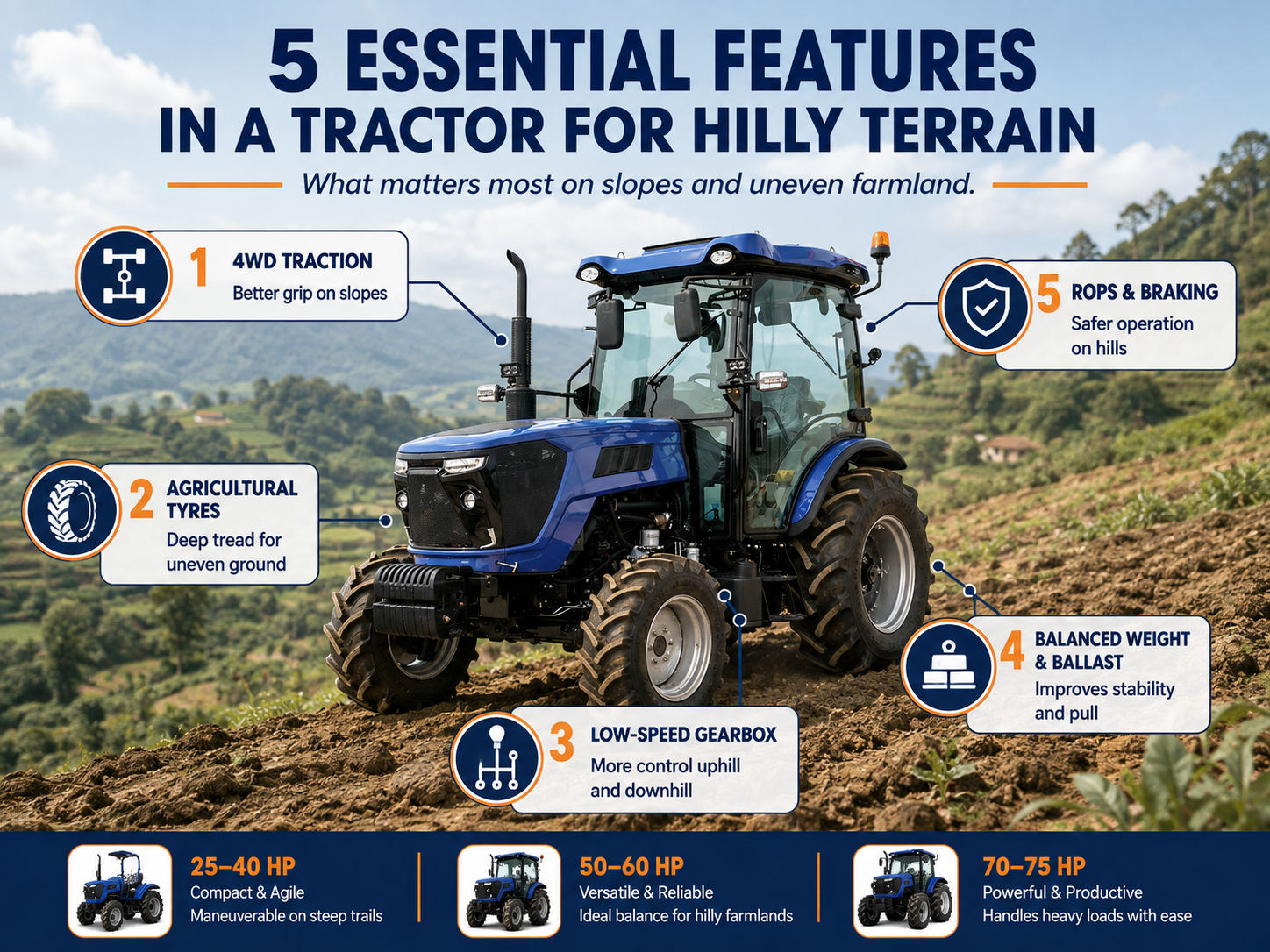
Figure 2. Five tractor features that strongly influence control and performance on hilly terrain.
V. Centre of Gravity, ROPS and Braking Need Equal Attention
The consequences of poor traction are usually lost productivity or wheel slip. The consequences of poor stability can be much more serious. That is why a tractor intended for sloping land should be evaluated for rollover protection, restraint, braking and load position as carefully as it is evaluated for engine output.
Implements Change the Centre of Gravity
A tractor’s centre of gravity is not fixed in practical operation. Raising a loader, carrying a dense load, mounting a heavy rear implement or towing a trailer changes the combined system. Even a tractor that feels stable when travelling empty can behave differently once a tool or load is attached.
Keep Loader Loads Low During Travel
Front-loader work is a common mixed-farm task, but raising the bucket increases both height and forward load transfer. When travelling on uneven ground, keeping the load low and following the loader and tractor manufacturer’s operating instructions helps reduce unnecessary changes in the centre of gravity.
ROPS, Cab Protection and Seat Restraints
ROPS or an appropriately designed cab, together with a functioning seat restraint, should be treated as core safety equipment on farms where rollover risk exists. Braking performance, steering condition and tyre condition also deserve routine attention before working on slopes. OXPLO customers should confirm the final safety configuration and market-specific documentation for the destination country rather than assuming every configuration is identical.
VI. Ground Clearance and Tractor Footprint Must Match Uneven Land
Uneven farmland is rarely a single continuous hill. It may include drainage channels, ruts, raised headlands, old farm tracks, stone entrances, narrow gates, livestock yards and older buildings. Ground clearance matters because the tractor needs to pass over irregularities without frequent contact underneath, but overall dimensions matter just as much.
Compact Width Can Be a Working Advantage
The OXPLO OXT404 is listed at approximately 1,560 mm wide with a 1,800 mm wheelbase, making it representative of OXPLO’s compact platform. The OXT504 retains the same compact overall width while increasing rated power to 50 HP. For farms with old gateways, smaller paddocks or restricted yard access, those dimensions can be as important as engine output.
Larger Utility Platforms Suit Heavier Workloads
The OXPLO OXT604 and OXT704 use a larger utility platform and Category II rear linkage. That can make them better candidates for farms that need larger implements, more frequent trailer work or higher annual utilisation. The trade-off is that the buyer should check access width, turning space and building clearance before moving up in tractor size.
VII. Implements Can Change How a Hillside Tractor Behaves
A tractor is rarely purchased to operate without an implement. Mowers, flail mowers, rotary tillers, cultivators, trailers, sprayers, spreaders, loaders and blades all change the working system. On slopes, their mass and mounting position can affect traction, steering response and stability.
Match Tractor and Implement Before Ordering
A useful buying process starts by listing the implements the farm already owns or plans to purchase. Record working width, operating weight, PTO requirement, linkage category and hydraulic demand. Then compare those requirements against the tractor. This avoids the common mistake of selecting horsepower first and only later discovering that the hitch, PTO or hydraulic system is not the right match.
OXPLO offers a broad tractor attachment range for different farm tasks. Buyers can also review the Agricultural Handling solution for examples of how tractors and attachments can support feed, hay, farm supplies and general material handling.
PTO and Linkage Compatibility
- Confirm the PTO speed required by the implement.
- Check whether the rear linkage is Category I or Category II.
- Compare implement weight with the tractor and linkage capacity.
- Confirm hydraulic connections and flow requirements.
- Plan ballast or counterweight where the implement changes axle loading.
OXPLO selection principle Choose the tractor around the real annual workload: terrain + implements + access + transport + safety requirements. Horsepower should confirm the decision, not start and end it. |
VIII. Which OXPLO Tractor Size Fits Different Hilly Farm Applications?
The OXPLO range can be divided into three practical size bands for this type of buying decision. These bands are not “safe slope ratings”. They are workload and tractor-size references that help a buyer narrow the shortlist before checking the actual site conditions and final configuration.
Compact 25–40 HP: Access, Manoeuvrability and Lighter Work
OXPLO compact tractors in the 25–40 HP class are a logical starting point for smaller mixed farms, pasture maintenance, orchard or estate work, light cultivation and sites where access is restrictive. The OXT404 40 HP tractor provides a useful upper-end reference for this compact class, with 4WD, an 8F+8R transmission and Category I linkage.
Mid-Range 50–60 HP: Balanced Mixed-Farm Capability
The OXT504 50 HP tractor and OXT604 60 HP tractor sit on either side of an important transition. The OXT504 keeps a compact footprint with more power, while the OXT604 moves to a larger utility chassis, 12F+12R transmission and Category II linkage. That gives OXPLO buyers two distinct ways to reach the 50–60 HP range depending on whether compact access or heavier implement compatibility matters more.
Utility 70–75 HP: Larger Implements and Higher Annual Workload
For farms that use larger implements, perform regular trailer work or expect higher annual utilisation, the OXT704 70 HP 4WD tractor is the main OXPLO reference in the 70 HP utility class. Its value is not simply the additional horsepower: the larger platform, transmission range and Category II implement compatibility are central to the step up.
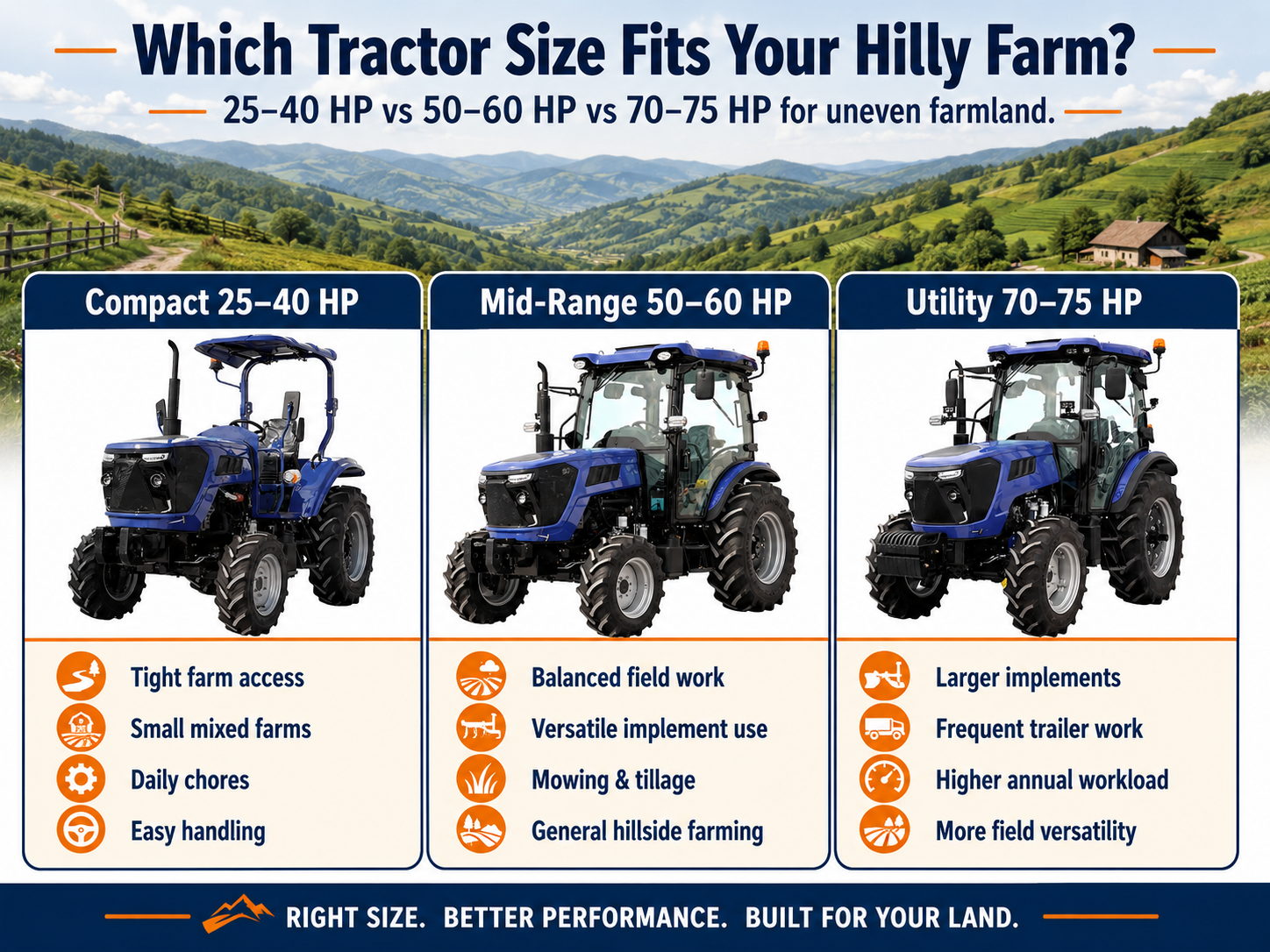
Figure 3. OXPLO-style tractor size comparison for hilly farms: compact 25–40 HP, mid-range 50–60 HP and utility 70–75 HP.
IX. A Practical Checklist Before Buying a Tractor for Slopes
Before requesting a quotation, gather information about the farm. A supplier can make a much better recommendation when the enquiry describes the terrain and workload instead of stating only a target horsepower.
Step 1 — Check Your Terrain
Identify where the tractor will operate: flat fields, gentle slopes, cross-slope sections, wet pasture, loose cultivated ground, gravel tracks or rutted access roads. Note where traction problems usually occur after rain and which areas have restricted turning space.
Step 2 — List the Yearly Tasks
Record the jobs the tractor will perform across the year and which ones dominate operating hours. Mowing, tillage, feed support, spreading, transport and loader work create different power, transmission and hydraulic priorities.
Step 3 — Match the Implements
List the existing or planned implements and confirm PTO speed, hitch category, operating weight and hydraulic requirements. OXPLO can then compare the requirement with the appropriate compact, mid-range or utility platform.
Step 4 — Measure Farm Access
Measure gates, barn doors, narrow lanes, orchard rows and turning areas. Buyers often focus on field capacity and forget that a tractor has to reach the field first. Transport height and overall width can eliminate otherwise attractive models.
Step 5 — Confirm the Safety Setup
Confirm ROPS or cab configuration, seat restraint, tyres, lighting, braking, ballast and any market-specific requirements. For slope work, the final operating configuration matters more than brochure specifications viewed in isolation.
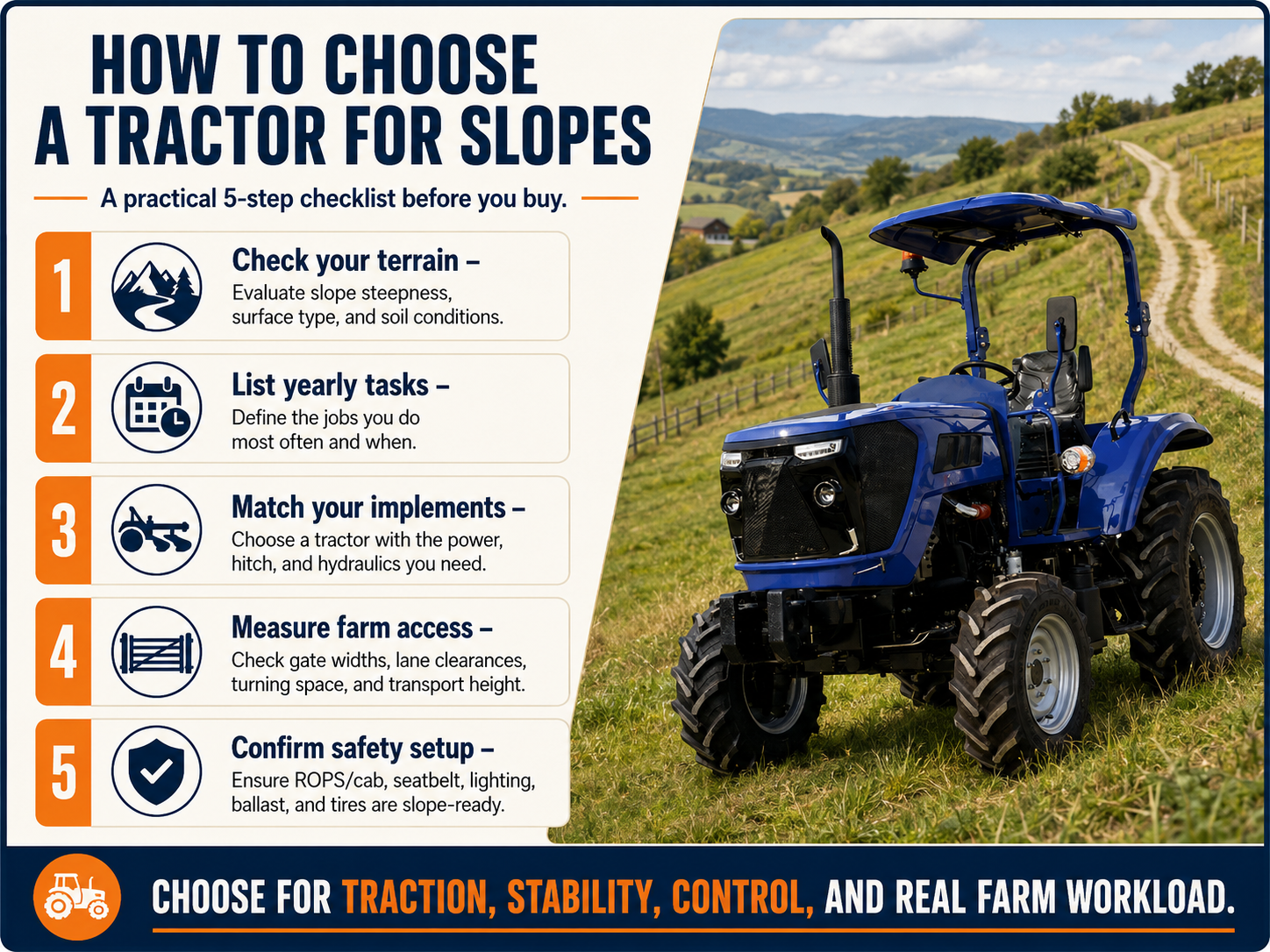
Figure 4. Five-step buying checklist for selecting a tractor for slopes and uneven farm access.
X. How to Compare Two Tractors That Have Similar Horsepower
Two tractors with the same HP figure can be very different machines. One may use a compact chassis and Category I linkage; another may have a longer wheelbase, larger tyres, more transmission ratios and Category II linkage. On hilly and uneven farmland, those differences may have a greater impact on daily usability than a small difference in engine output.
Compare the Configuration, Not Just the Specification Sheet
- Drive type and differential/traction features
- Tyre sizes and available tyre options
- Transmission ratios and practical low-speed control
- Overall width, wheelbase and ground clearance
- Listed machine weight and ballast options
- PTO speed and rear-linkage category
- Hydraulic connections for planned attachments
- ROPS/cab, braking and market-specific compliance
A useful starting point is the complete OXPLO tractor range rather than a single product page. Comparing the models side by side makes it easier to see where OXPLO changes chassis size, linkage category and transmission range as horsepower increases.
XI. Frequently Asked Questions
Is 4WD necessary for a tractor on hilly farmland?
For farms that regularly work on slopes, wet grass, loose soil or uneven access roads, 4WD is usually a strong priority because it allows both axles to contribute to traction. However, 4WD does not remove rollover risk or make every gradient suitable for tractor operation.
What horsepower is best for hilly farmland?
There is no universal horsepower figure. A 25–40 HP OXPLO compact tractor may be better for tight access and lighter maintenance, a 50–60 HP model may balance mixed-farm jobs, and a 70–75 HP utility tractor may better support larger implements and higher annual workload. Terrain alone does not determine horsepower; the implements and workload do.
What tyres are best for a tractor for slopes?
The correct tyre depends on soil, moisture, grassland percentage, road use and load. Deep agricultural tread can help on soft ground, but tyre size, pressure, load rating and condition must all be considered. OXPLO buyers should discuss the operating surface rather than accepting a default tyre choice without review.
Can a front loader be used on hilly farmland?
A loader can be valuable for mixed-farm work, but it changes the tractor’s weight distribution and raises the centre of gravity when the boom is elevated. Loader capacity, counterweight, hydraulic setup and safe travel practice should be confirmed for the complete tractor-loader combination.
Which OXPLO model should I consider for uneven farmland?
For compact access and moderate workloads, compare the OXT404 and OXT504. For larger implements, Category II linkage and a broader transmission range, compare the OXT604 and OXT704. The final choice should be based on terrain, implements, access and annual workload rather than horsepower alone.
XII. Conclusion: The Best Tractor for Hilly Terrain Is a Balanced Tractor
The biggest mistake when choosing a tractor for hilly terrain is reducing the decision to horsepower. On uneven farmland, useful performance comes from a combination of traction, stability, low-speed control, tyre selection, weight distribution, braking, implement compatibility and a tractor footprint that fits the farm.
4WD can improve grip. Agricultural tyres help transfer power into the ground. Correct ballast can improve axle balance. A suitable transmission helps the operator control speed. ROPS or cab protection, seat restraint and sound braking remain essential safety considerations. None of these features should be viewed in isolation.
For European farms comparing 25–75 HP machines, OXPLO offers compact, mid-range and utility options that can be matched to different workloads. Explore the full tractor range and attachments and implements before requesting a configuration. The right hillside tractor is not necessarily the largest or most powerful; it is the machine whose traction, stability, control, dimensions and implement system match the land you actually farm.