
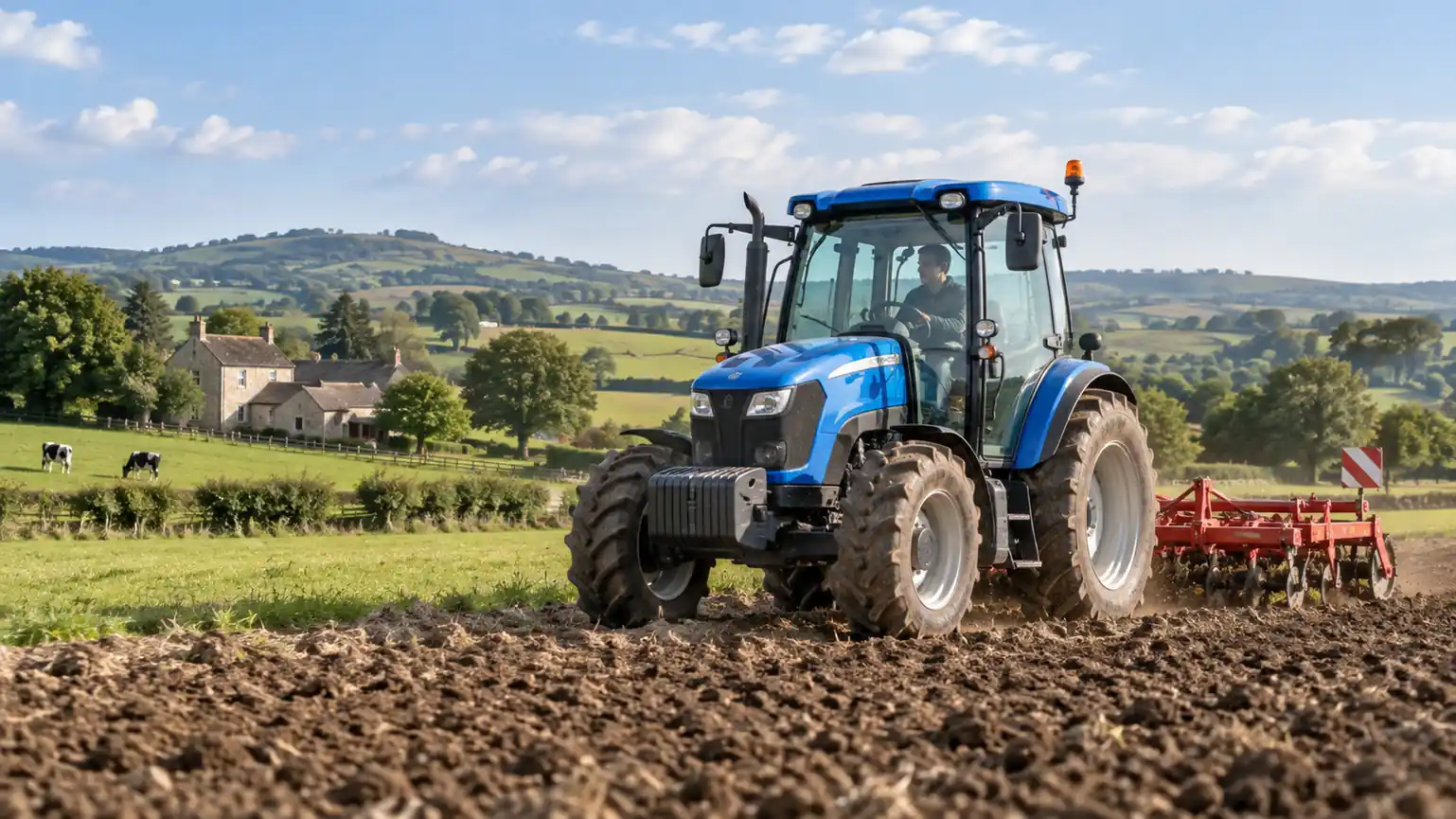
A European buyer searching for a Chinese tractor Europe supplier is rarely asking only whether tractors made in China are inexpensive. The real question is more practical: will this exact machine arrive with the right documents, connect to the implements already on the farm, work efficiently in local conditions, and remain serviceable when the first wear part or fault appears?
That distinction matters. A tractor can look attractive on a quotation and still become expensive after delivery. A mismatched PTO speed can make an existing mower unusable. A linkage category can force an implement change. A loader fitted without the right hydraulic and ballast plan can overload the front axle. A missing approval document can delay registration. And a €3,000 purchase saving can disappear quickly if a critical part keeps the tractor idle during a short weather window.
This guide treats the purchase as an engineering and operating decision rather than a country-of-origin debate. The objective is not to argue that every Chinese farm tractor or every farm tractor for Europe is automatically suitable. It is to show how a farm manager, dealer or procurement team can identify the configurations that are suitable — and reject the ones that are not — before money is committed.
Core principle: Buy the working system, not the horsepower number. Start with the farm, implements and legal use case; then work backwards to the tractor specification. |
I. The Real Buying Problem: A Low Quotation Can Hide a High Operating Risk
The market for an imported tractor Europe project is unusually easy to oversimplify. Two suppliers can both quote a “50 HP 4WD tractor” while offering machines with materially different engine configurations, transmissions, PTO arrangements, hydraulic circuits, rear linkages, tyre packages, road equipment and documentation.
For the buyer, the useful framework is therefore not “China versus Europe.” It is three separate tests: legal usability, working compatibility and lifecycle support. If any one of those fails, the purchase can underperform even when the tractor itself starts, drives and produces the advertised engine power.
The most costly mistakes usually occur because the buyer compares visible specifications — horsepower, cabin, 4WD and price — while the less visible interfaces are left for later. Experienced procurement works in the opposite direction. It confirms the interfaces first and treats the price as meaningful only after the configuration has been frozen.
II. Check 1 — Confirm the European Approval and Registration Path Before Production
Do not stop at “Does it have CE?”
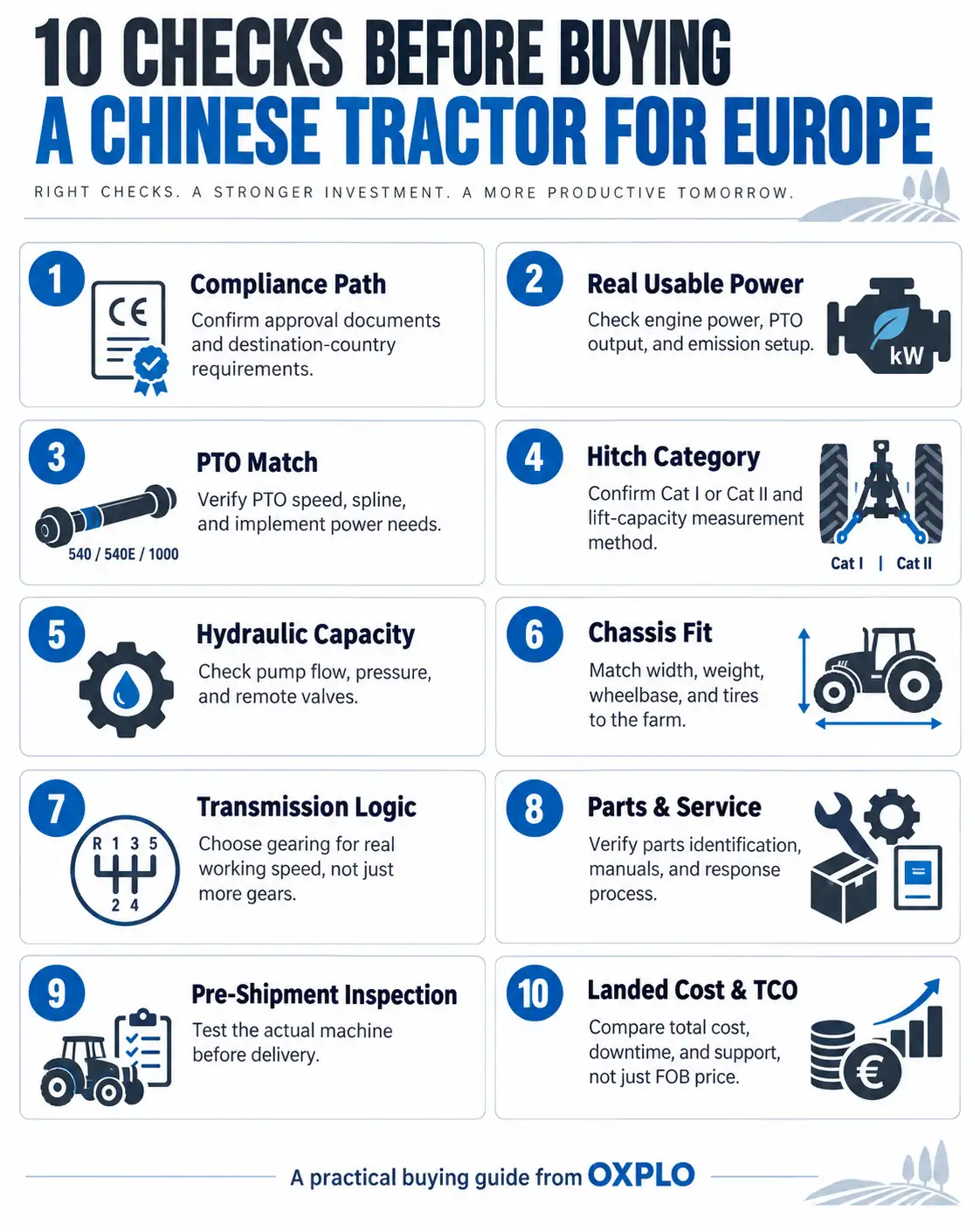
Agricultural and forestry tractors sit within a specific European vehicle-approval framework. Regulation (EU) No 167/2013 covers the type-approval and market surveillance of agricultural and forestry vehicles, including tractor categories T and C. For a buyer, that means a generic statement such as “European standard” or “CE available” is not a complete compliance answer.
The correct question is configuration-specific: what documents and approvals apply to this exact tractor, in this destination country, for this intended use? A machine used only on private land can face a different practical registration path from a tractor that will travel on public roads with a trailer. Lighting, braking, operator protection, engine emissions, vehicle identification and national registration procedures all need to be considered in the final supplied configuration.
Before a deposit is paid, ask the supplier to identify the final model, engine configuration, vehicle identification information, available conformity documents and any destination-market equipment that will be fitted. If road registration is required, verify the documentation route with the local authority or importer before production rather than after the tractor reaches the port.
Official reference: Regulation (EU) No 167/2013 on agricultural and forestry vehicle approval
Decision rule: Destination country → intended use → required approval/registration path → final tractor configuration → production. Do not reverse that sequence. |
III. Check 2 — Separate Engine Horsepower from Usable Working Power
Horsepower is useful, but it is only the first line of the calculation. A farm does not buy engine power in isolation; it buys the ability to maintain ground speed, PTO speed, hydraulic function and traction under a specific load.
A rotary tiller, flail mower or baler may be constrained by PTO power rather than rated engine horsepower. A loader may be constrained by hydraulic flow and ballast rather than engine output. A tractor pulling on wet soil may be constrained by tyre grip and operating mass before the engine reaches its limit.
When comparing a Chinese farm tractor with another machine, request rated power in kW/HP at rated rpm, the final engine model and emissions configuration, and any available information relevant to PTO output. Then compare that with the implement manufacturer’s requirement. Be careful with wording: “minimum tractor HP” and “minimum PTO HP” are not interchangeable.
IV. Check 3 — Audit the PTO as an Interface, Not a Feature
For many European farms, the PTO is one of the highest-value interfaces on the tractor. Mowers, rotary tillers, spreaders, sprayers, chippers and other implements depend on a correct combination of speed, spline, engagement method and available power.
A brochure that says “dual-speed PTO” is not enough. Confirm the exact PTO speeds in the final quotation, the shaft spline, whether the required speed is achieved at a practical engine rpm, and whether the tractor can maintain that speed when the implement enters a heavier load. Where the supplier offers different market or model configurations, insist that the supplied PTO arrangement is written into the specification sheet.
A common buying error is to choose a tractor with more engine HP to solve an implement problem that is actually caused by the wrong PTO interface. More horsepower does not correct the wrong speed or spline.
V. Check 4 — Make the Existing Implement Fleet Part of the Tractor Specification
Category I versus Category II is a commercial decision, not just a technical label
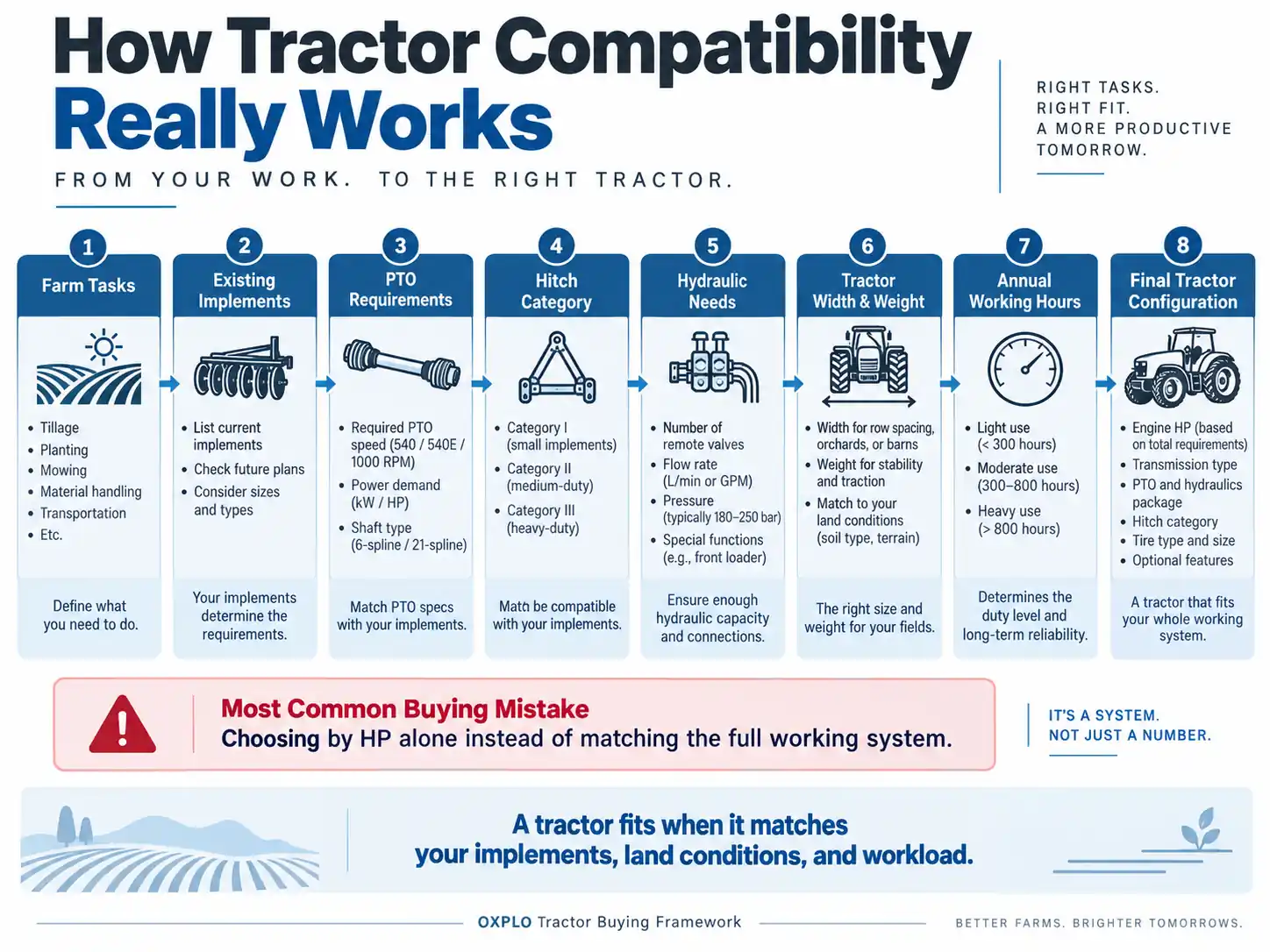
If the farm already owns a flail mower, rotary tiller, fertiliser spreader and transport equipment, those assets should be listed before the tractor is selected. The three-point linkage category, geometry, implement weight and centre of gravity can determine whether an apparently attractive tractor creates additional conversion or replacement cost.
This is where oversizing can become expensive. Moving from a compact Category I-oriented platform to a larger Category II platform may provide more capacity, but it can also change implement fit, overall width, turning space, tyre size, soil pressure and ownership cost. If the farm’s limiting work does not require the larger platform, the extra capacity may remain unused.
Also ask where hydraulic lift capacity is measured. A figure measured at the link ends is not directly comparable with a figure measured farther behind the hitch, where the leverage from a real implement is greater. For long or heavy mounted equipment, the centre of gravity matters as much as the catalogue lift number.
VI. Check 5 — Treat Hydraulics, Loader Work and Ballast as One System
“Can it take a front loader?” is not a sufficient engineering question. A useful loader specification has to consider hydraulic flow, system pressure, valve arrangement, loader frame, front-axle loading, tyre capacity and counterweight.
Ask for total hydraulic flow and, where possible, the flow available to the working circuit. Confirm the number and type of rear remotes if the farm uses hydraulic cylinders. For frequent loader cycles, hydraulic response and directional work can matter more to daily productivity than an additional few engine horsepower.
Ballast is equally important. A loader shifts mass toward the front axle. Without a suitable rear ballast or implement plan, the tractor can lose rear-axle traction while increasing stress on the front axle and tyres. Four-wheel drive improves traction; it does not make poor weight distribution disappear.
VII. Check 6 — Match the Chassis to European Farm Access, Soil and Terrain
European farms are not one operating environment. A Polish mixed farm with broad fields, a British grassland farm working in wet conditions, and a vineyard with narrow rows impose different constraints even when the annual hours are similar.
Measure the narrowest gate or row before choosing overall tractor width. Consider wheelbase and turning space around buildings. On soft soil, tyre footprint and operating mass affect rutting and compaction. On slopes or uneven ground, stability, tyre choice and operator protection become more important. Ground clearance can be relevant for ridged crops or uneven tracks.
A useful inquiry therefore describes the ground as carefully as the horsepower requirement. “50 HP tractor” is weak input. “50 HP class, wet spring soil, 1.8 m gate, flail mower, 3-ton trailer and occasional loader work” gives an engineer enough information to identify trade-offs.
VIII. Check 7 — Compare Working Speeds, Not Just the Number of Gears
An 8F+8R or 12F+12R transmission tells you how many selectable ratios exist. It does not tell you whether the tractor has the right speed for a particular job.
PTO-driven field work can require the engine to stay near the rpm needed for the implement while the tractor moves slowly enough to achieve the required cut, cultivation depth or application rate. If the lowest practical ground speed is still too high, the work quality can be poor even though the engine and PTO specifications look correct.
For repeated loader work, reverse ratios and direction changes matter. For transport, road speed and braking configuration matter. For tillage, low working speed under load matters. Ask the supplier about the intended work cycle rather than assuming that more gears automatically means a more suitable transmission.
IX. Check 8 — Judge After-Sales Support by Time-to-Recovery, Not Warranty Length
Warranty duration is easy to compare. Downtime recovery is harder — and usually more important. A two-year warranty has limited value if the supplier cannot identify the correct part from a serial number, provide a diagram, diagnose the fault or ship a critical item quickly.
Ask how common filters, belts, seals, clutch components, sensors and hydraulic parts are identified. Request a parts catalogue, maintenance schedule, operator manual and, where available, electrical or hydraulic diagrams. For routine consumables, cross-reference information can reduce dependence on international shipping.
A professional fault workflow should begin with machine serial number, operating hours, symptoms, photos/video, fault codes and maintenance history. That data should lead to diagnosis and part confirmation before anything is shipped. The objective is not simply to send a replacement part; it is to restore the tractor with the fewest diagnostic cycles.
X. Check 9 — Make Pre-Shipment Inspection Part of the Purchase Contract
Many import disputes do not begin with the tractor design. They begin with final assembly, adjustment, missing accessories, incorrect attachments or inadequate packing. A structured pre-shipment inspection reduces those avoidable failures.
For a first order, ask for a cold-start video, engine and dashboard check, forward/reverse gear test, 4WD and differential-lock confirmation, PTO operation, three-point lift/hold test, rear hydraulic test, steering and braking check, lights, identification plates and the ordered attachment connection. The tractor model, serial number and engine identification should match the commercial documents.
If an attachment is part of the order, connecting it at the factory is especially valuable. A tractor and an implement can each be correct individually while the combined system still has a PTO, pin, hose, geometry or clearance mismatch.
XI. Check 10 — Compare Landed Cost and TCO, Not the FOB Number
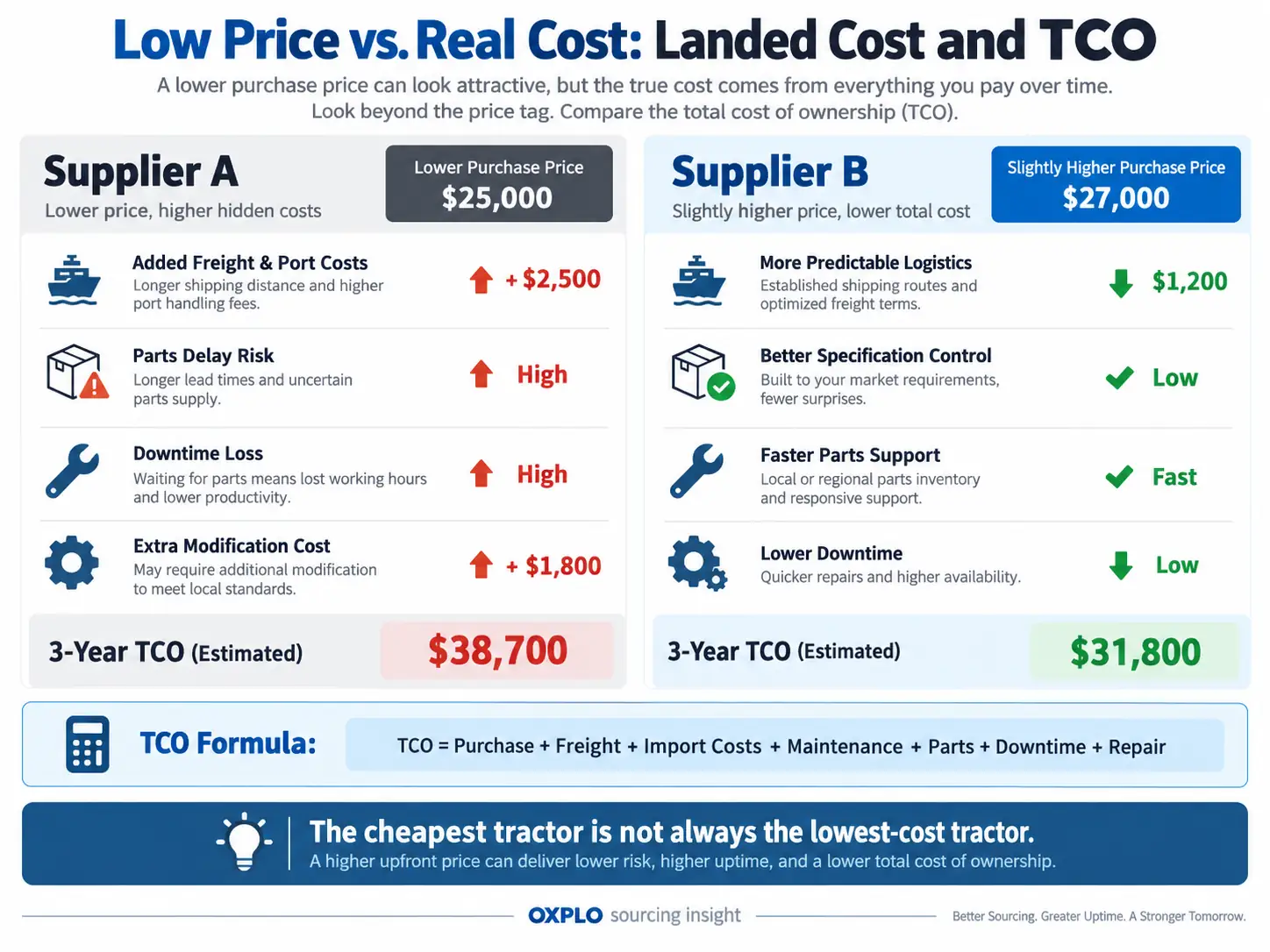
A low FOB price is only one line in the ownership equation. The useful comparison is landed cost first, then total cost of ownership over the period in which the tractor will be used.
Landed cost typically includes machine price, freight, insurance, import charges, port handling, inland transport, commissioning and any registration or compliance expense. TCO then adds maintenance, parts, fuel, financing, repair and downtime, while residual value can reduce the net cost.
Consider an illustrative case. Supplier A saves €3,000 on the initial tractor price, but the buyer later pays for two emergency air-freight parts shipments, six extra downtime days and a local PTO/hydraulic interface change. That one sequence can remove the entire purchase-price advantage. The numbers will differ by farm, but the logic is universal: specification errors and slow parts recovery are ownership costs.
XII. Apply the Checks to Real European Farm Scenarios
Orchard or Vineyard
Row width, gate width, turning radius, canopy clearance, PTO mower/sprayer compatibility and soil compaction usually matter more than maximum horsepower. A compact machine with the correct implements can outperform a larger tractor that spends its life manoeuvring.
Mixed Farm
The decision often turns on the existing implement fleet, trailer work, seasonal cultivation and the number of jobs expected from one machine. Here, a balanced compact utility platform can be more valuable than either an undersized compact tractor or an unnecessarily heavy machine.
Livestock and Grassland
Loader cycle frequency, feed movement, mowing, transport and wet-ground traction push the decision toward hydraulics, ballast, tyres and directional work. “4WD + loader” should be treated as a system specification, not a feature list.
Agricultural Contractor
Downtime has a direct revenue cost. A contractor should place more weight on parts identification, diagnostic response, broader implement compatibility and a transmission/chassis that can handle repeated multi-job use across the season.
XIII. Where OXPLO Fits: Select the Platform Around the Workload
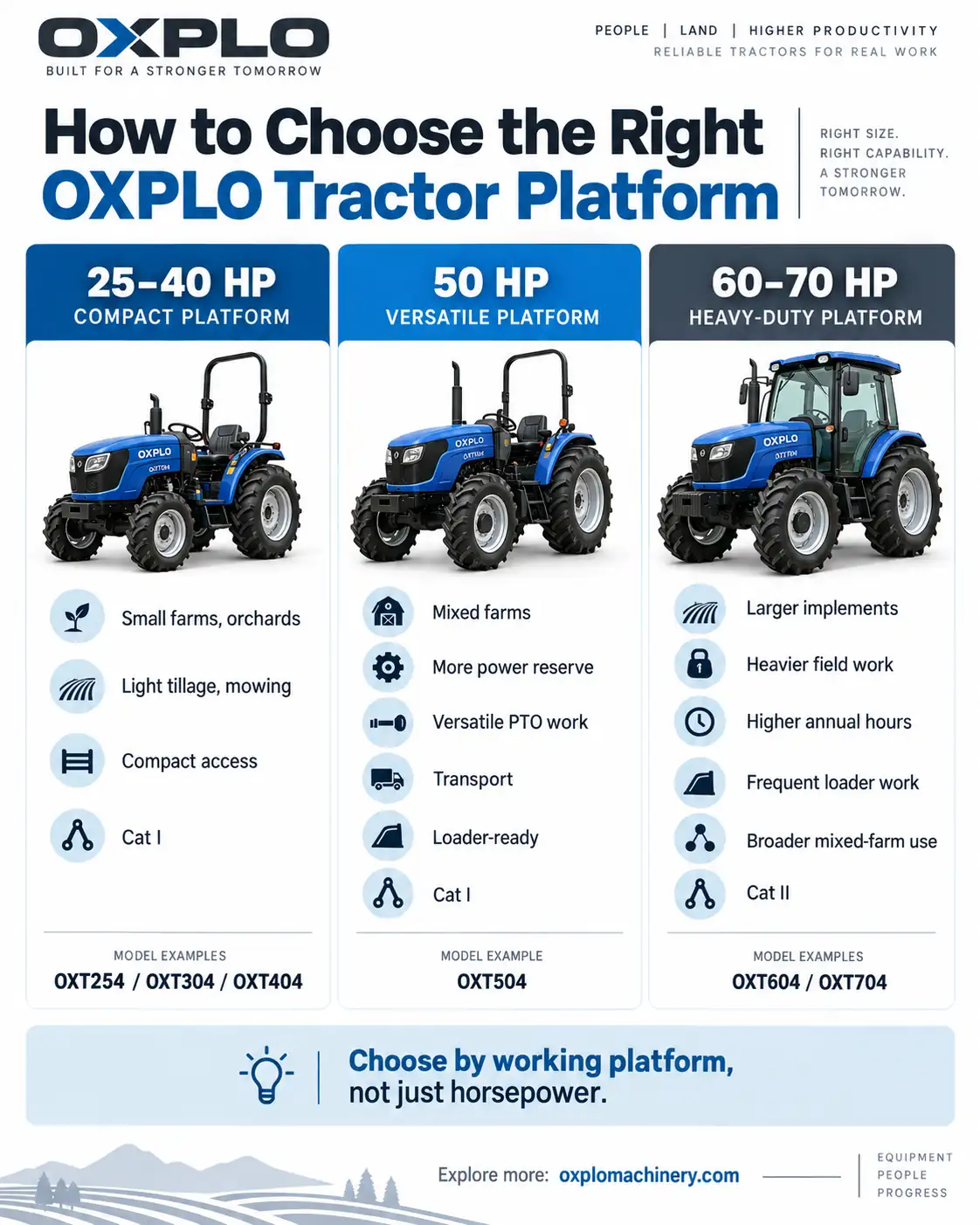
This is the point where a brand comparison becomes useful. OXPLO’s current European-facing tractor range covers six power classes from 25 to 70 HP. More importantly, the range is structured around different working envelopes rather than treating horsepower as the only selection variable.
On the OXPLO tractor configuration page, OXT254 and OXT304 sit in the 25–35 HP compact group for vineyards, orchards, mowing and light transport. OXT404 and OXT504 form the 40–50 HP utility group for recurring tillage, mowing, farm transport and light loading. OXT604 and OXT704 move into the 60–70 HP class for heavier implements, loader work and more demanding mixed-farm use.
That distinction matters because an OXPLO recommendation should start from the job. A buyer who already owns Category I equipment and needs more PTO reserve may be better served by staying in the compact platform rather than automatically jumping to a larger tractor. Conversely, a buyer whose limiting job requires Category II implements, a heavier chassis and more transmission flexibility should not try to solve that requirement with engine horsepower alone.
The OXPLO OXT504 illustrates the first case. Its current product page lists 50 HP, 4WD, an 8F+8R transmission and Category I rear linkage within the compact OXT chassis group. OXPLO positions it for buyers who want more working reserve while retaining a compact footprint and Category I-oriented implement use. The exact PTO configuration should still be confirmed on the quotation because OXPLO’s site explicitly advises buyers to confirm final model configuration.
The OXPLO OXT704 illustrates the second case. Its current page lists 70 HP, 4WD, a 12F+12R transmission, Category II linkage and a larger utility platform aimed at heavier mixed-farm work, transport, loader applications and broader Category II implement use. That is not simply “20 HP more” than the OXT504. It is a different working platform with different trade-offs in size, weight, implement class and operating envelope.
This is also why OXPLO’s configuration process asks for farm type, implements and working conditions before finalising the machine. For a Chinese tractor Europe project, that workflow is more useful than asking the customer to choose a horsepower figure from a catalogue without context.
Explore OXPLO resources: OXPLO tractor configuration guide | OXPLO tractor range | OXT504 50 HP tractor | OXT704 70 HP tractor
XIV. A Supplier Comparison Matrix You Can Actually Use
Before choosing any tractor manufacturer China supplier, score the evidence rather than the promise. A Chinese tractor Europe sourcing decision should be based on model-specific evidence, not a generic country-of-origin assumption. The table below can be copied into a procurement sheet and completed for each shortlisted supplier.
Check | Evidence to Request | Red Flag |
Approval path | Exact model/configuration documents for destination country | “European standard” without model-specific evidence |
Engine | Rated output, engine model, emissions configuration | Brand/HP only |
PTO | Speed, spline, engagement, final configuration on quotation | “Dual PTO” with no exact data |
3-point linkage | Category, geometry, lift point and implement check | Lift kg only |
Hydraulics | Flow, pressure, remotes, loader plan | “Loader available” |
Farm fit | Width, wheelbase, weight, tyres, clearance | Generic application photos |
Transmission | Ratios suited to field/loader/transport work | Gear count only |
Parts support | Serial-number parts lookup, manuals, stock/lead time | “Parts no problem” |
Inspection | Cold start + functional tests + attachment fit | Beauty video only |
Commercial cost | Landed cost + downtime/TCO assumptions | FOB price only |
XV. Send a Better Inquiry and You Will Get a Better Tractor Recommendation
A supplier cannot engineer a useful configuration from “Please quote 50 HP tractor.” A stronger request describes the work, the interfaces and the constraints.
For an OXPLO inquiry, include the destination country, farm type and area, main jobs, existing implements, PTO requirement, linkage category if known, maximum gate/row width, ground conditions, annual operating hours, loader requirement and whether public-road transport is expected. OXPLO can then use that information to confirm a more appropriate model class and the final configuration items that need to appear on the quotation.
Example inquiry: Country: Poland | Farm: 42 ha mixed farm | Main jobs: mowing, tillage, spreading and trailer work | Existing implements: Category I, 540 rpm PTO | Maximum gate: 1.8 m | Ground: soft in spring | Annual use: about 500 h | Loader: occasional | Road transport: required. |
For configuration support, visit OXPLO and send the working conditions before requesting the final price.
XVI. Frequently Asked Questions
Are Chinese tractors a good choice for European farms?
They can be, provided the exact machine is matched to the farm’s implements, terrain, workload, service expectations and destination-country requirements. Country of manufacture alone does not determine suitability.
Is a lower-priced Chinese farm tractor always cheaper to own?
No. Compare landed cost and TCO. Freight, commissioning, parts availability, downtime, maintenance and local modifications can outweigh an initial price saving.
What should I check first on an imported tractor Europe project?
Start with destination-country approval/registration requirements and your existing implement interfaces. Those two items can disqualify a configuration before price becomes relevant.
Should I buy more horsepower for future work?
Only when the future workload justifies the larger platform. Oversizing can increase purchase cost, weight, turning envelope and soil compaction while creating linkage or implement changes.
How does OXPLO recommend a tractor?
OXPLO’s current selection workflow starts from farm type, implements and working conditions, then narrows the 25–70 HP range and confirms PTO, linkage, tyres, hydraulic requirements, attachments and available destination-market documentation before the final order.
Which OXPLO model is suitable for a European farm?
There is no single model for “Europe.” OXPLO’s compact 25–35 HP class, 40–50 HP utility class and 60–70 HP larger utility class address different access, implement and workload needs. The correct model depends on the limiting job and the interfaces already on the farm.
XVII. Conclusion: A Good Chinese Tractor Is the One That Fits the Farm Before It Leaves the Factory
The useful answer to “Are Chinese tractors a good choice for European farms?” is not a blanket yes or no. A Chinese tractor Europe purchase works when the buyer controls the specification before production: approval path, engine and PTO, linkage, hydraulics, farm access, tyres, transmission, parts support, inspection and ownership cost.
The biggest risk is not that the tractor was manufactured in China. The biggest risk is buying a generic configuration for a non-generic farm. A farm tractor for Europe has to be specified for the destination, implement fleet and operating conditions, not merely labelled as an export model.
OXPLO’s 25–70 HP range gives European buyers several working platforms, but the model name should be treated as the start of the discussion rather than the final answer. OXPLO recommends confirming the destination country, farm workload, existing implements, working conditions and required attachments before the quotation is frozen. That approach makes it possible to choose an OXPLO tractor around the work it must actually perform — not around the largest horsepower number available.
If you are comparing a tractor manufacturer China supplier or planning an imported tractor Europe order, prepare your farm and implement data first. Then ask OXPLO to review the configuration. A ten-minute technical discussion before production can prevent weeks of modification, parts searching or downtime after delivery.