
A practical farm tractor buying guide for European farms, dealers and B2B equipment buyers
OXPLO Farm Tractors | 25–70 HP Tractor Configuration
A tractor can be powerful enough on paper and still be wrong for the farm. That is the problem many buyers discover only after the machine has arrived: the PTO does not match the main implement, the hydraulic system is too limited for regular loader work, the tractor is too wide for a vineyard entrance, or the larger chassis adds weight and turning difficulty without creating useful productivity.
For European farmers, agricultural contractors, distributors and procurement managers, buying a tractor is therefore not a horsepower-shopping exercise. It is a system-design decision. The tractor, implements, terrain, access, operating cycle, documentation and support plan have to work together.
This OXPLO farm tractor buying guide follows one rule throughout: start with the work and the constraint, then choose the tractor. The useful decision sequence is Workload → Implements → Usable Power → Tractor Platform → PTO & Hydraulics → Farm Access → European Requirements → Total Cost of Ownership.
Core buying principle |
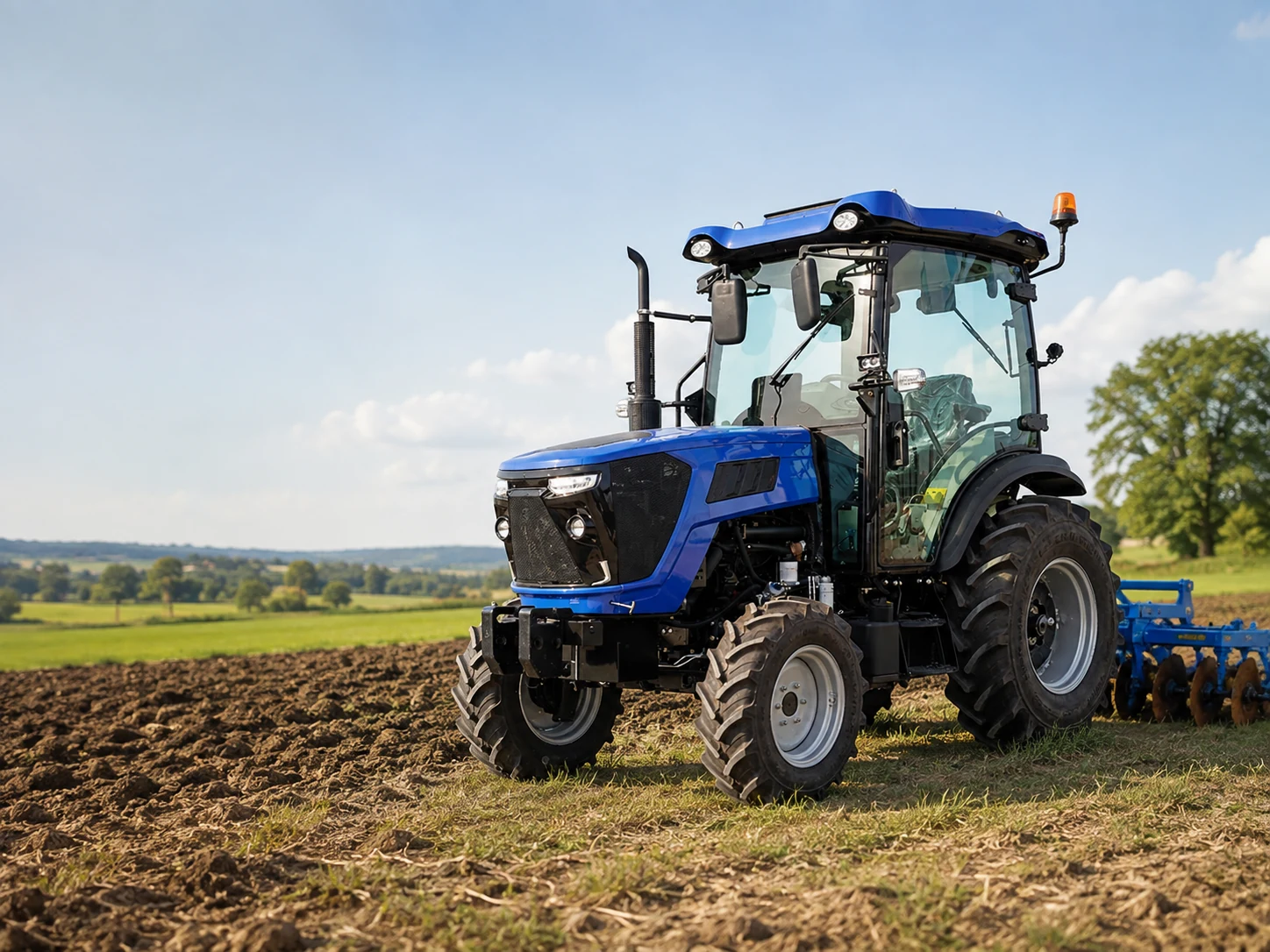
OXPLO tractor application reference: vineyard transport and agricultural handling. Explore OXPLO tractor configurations
I. Check the Workload Before You Check the Horsepower
The most common selection error happens before the buyer sees a specification sheet. A customer asks for “a 50 HP tractor,” the supplier quotes a 50 HP model, and both sides behave as though the technical decision has already been made. It has not.
A farm tractor may mow pasture, run a rotary tiller, pull a trailer, handle bales, move fertiliser, cultivate soil and operate a front loader. Those jobs load different systems. A mower is strongly influenced by PTO demand; ploughing is a traction and drawbar problem; loader work is a hydraulic, axle-load and stability problem; and trailer work adds braking, tyre and road-use considerations.
Build the implement list first
Before buying a tractor, write down every implement the machine must operate now and every implement the farm is likely to add during the next three to five years. For each item, confirm the power, linkage and hydraulic requirements rather than relying on a broad “suitable for 40–60 HP” label.
Parameter to Confirm | Why It Changes the Tractor Decision |
Recommended tractor / PTO power | Shows whether the implement is power-limited. |
PTO speed and shaft specification | Prevents driveline mismatch and incorrect implement speed. |
Implement weight and centre of gravity | Affects hitch loading, steering and ballast. |
Hitch category | Determines physical linkage compatibility. |
Hydraulic flow / pressure / outlets | Critical for loaders, tipping trailers and hydraulic implements. |
Working width and target speed | Determines field capacity and whether the tractor can meet seasonal deadlines. |
Size for the hardest recurring job — not the biggest imaginary job
A buyer should not size the tractor around a task that happens for two hours every five years. But sizing around the easiest daily job is equally risky. The correct target is the highest recurring load that materially affects the farm’s schedule, labour use or operating cost.
For example, if a mixed farm mows frequently, moves feed every week, tows a trailer daily and ploughs a small plot once a year, the tractor should be selected around the recurring mowing, handling and transport cycle. That is the real operating system the machine must support.
OXPLO uses the same logic when discussing tractor configuration: destination country, farm type, terrain, main tasks and intended attachments should be confirmed before the horsepower range is finalised. That turns a price request into a workable machine specification. In a serious farm tractor buying guide, workload definition must come before model selection because every later decision depends on it.
II. Check Usable Power, Tractor Weight and Traction Together
Engine horsepower is useful, but it is not the same as productive output. The engine creates power; the driveline, tyres, tractor mass and implement interface determine how much of that power becomes useful work.
Engine HP, PTO demand and draft load are different
A PTO-driven mower can run short of usable PTO reserve even when the engine rating looks adequate. A ploughing tractor may have plenty of engine output but waste it through wheel slip. A front-loader tractor may have enough horsepower but still cycle slowly if the hydraulic configuration is poorly matched.
This is why “how much horsepower does the tractor have?” should be followed by questions about PTO configuration, transmission ratios, four-wheel drive, tyres, ballast and the mass of the tractor platform. This is the core of how to choose a tractor for mixed agricultural work: match usable output to the actual duty cycle, not to a marketing class.
Undersizing has obvious costs; oversizing has quieter costs
An undersized tractor usually reveals itself quickly: falling PTO speed, frequent downshifts, low field speed, excessive wheel slip and long working days near maximum load. The hidden commercial problem is the weather window. If the tractor needs four days to finish work that the soil and forecast allow for only three, the horsepower decision becomes a crop-timing problem.
Oversizing is less dramatic but can be equally expensive. The buyer pays for capacity that may rarely be used and accepts extra machine weight, larger turning space, potentially greater soil compaction, higher tyre cost and reduced access. On a large arable operation this trade-off may be acceptable. In a vineyard, orchard or fragmented mixed farm it may not be.
Practical rule |
III. Check PTO, Hydraulics and the 3-Point Hitch as One System
A tractor can have enough engine horsepower for an implement and still be technically unsuitable. The reason is simple: tractor–implement compatibility is defined by several interfaces at the same time.
PTO compatibility is not just a shaft that fits
For PTO-driven equipment, confirm the PTO speed, shaft specification, rated operating condition and the implement manufacturer’s required input. A mower, tiller, spreader or pump must be able to run at the correct PTO speed without forcing the tractor into an unsuitable ground speed or engine operating range.
If a quotation lists engine horsepower but omits the PTO configuration, the quotation is not yet complete enough to approve an implement package.
Category I versus Category II can change the whole platform decision
The three-point hitch is more than a convenience feature. It defines the physical implement ecosystem around the tractor. Compact tractors commonly operate with Category I implements, while larger utility tractors may move to Category II. A farm that already owns heavier Category II equipment may be better served by moving to the larger tractor platform even if the nominal horsepower calculation looks modest.
This is one reason the jump from a 50 HP compact tractor to a 60 HP utility tractor can be commercially significant. The real change may be linkage category, chassis mass, tyre size, wheelbase and transmission range — not merely ten additional horsepower.
Hydraulic capacity is a productivity variable
Loader buyers should pay particular attention here. A front loader repeatedly moves through approach, lift, crowd, travel, dump, lower and reverse cycles. Small differences in hydraulic response accumulate over hundreds of cycles. Hydraulic flow, pressure, number of outlets and compatibility with the selected valve and attachment package can therefore affect hourly output.
OXPLO currently offers up to 48 tractor attachment options and states that horsepower, PTO, linkage and hydraulic compatibility can be checked before the order is confirmed. This is the correct process: the attachment should be matched to the exact tractor configuration, not selected from a catalogue image.
See the current OXPLO tractor attachment and configuration range for available applications and order-confirmation steps.
IV. Check Whether the Tractor Fits the European Farm — Literally
European agriculture creates a particular selection problem: many machines must work efficiently in places that were not designed around large modern tractors. Vineyards, orchards, livestock yards, old barn entrances, village roads and fragmented plots can make physical access just as important as engine output.
Measure the farm before you order the tractor
- Narrowest gate and farm entrance
- Vineyard or orchard row spacing
- Barn-door width and height
- Headland turning space
- Ground-clearance requirement
- Farm-road width and trailer turning area
- Canopy clearance where the tractor works below trees
Compare those measurements with the complete working configuration, not only the bare tractor. A loader, wider tyres or rear implement changes the machine envelope.
More horsepower can reduce productivity in confined work
A 70 HP tractor may dominate a 40 HP tractor in an open field, but the calculation can reverse when the larger machine spends more time reversing, correcting its line and entering narrow rows. Effective productivity depends on working width, travel speed and field efficiency — including turning, overlap and repositioning.
A simple theoretical field-capacity formula is Working Width (m) × Speed (km/h) ÷ 10. A 1.8 m mower at 6 km/h has a theoretical capacity of 1.08 ha/h. If real field efficiency is only 75%, effective capacity falls to about 0.81 ha/h. That is why manoeuvrability is a production parameter, not merely an operator preference.
Traction must match wet grass, slopes and changing surfaces
Four-wheel drive is valuable on soft cultivated soil, damp grass, uneven tracks, slopes and loader applications. But 4WD does not replace correct tyres, tyre pressure, ballast and weight distribution. Excessive wheel slip converts diesel into heat and tyre wear instead of field work.
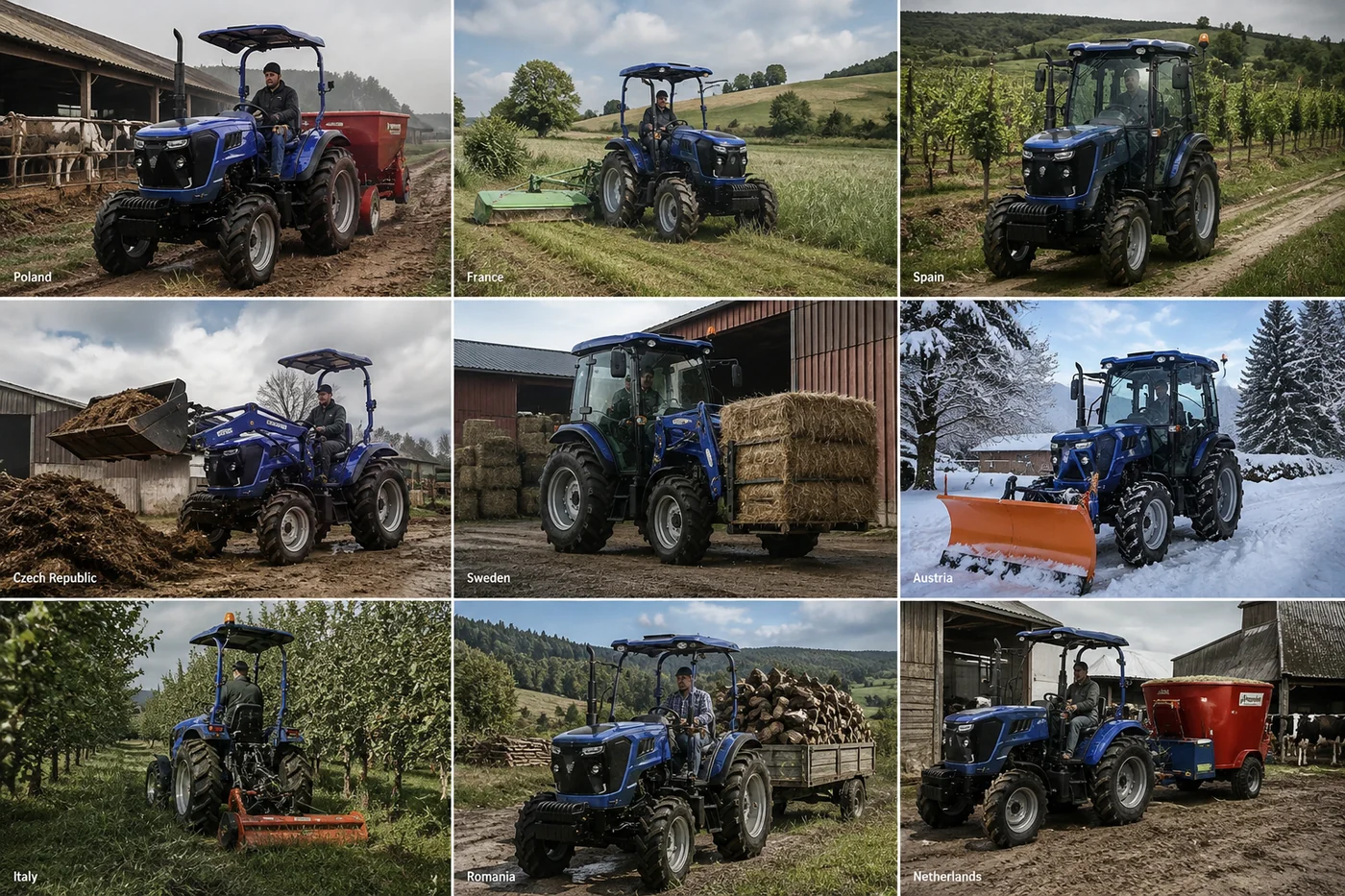
OXPLO visual application references across European farm scenarios: mowing, orchard work, loader handling, transport, livestock support and winter maintenance. View OXPLO farm applications
V. Check the Transmission and Loader Configuration Against the Duty Cycle
Gear count is often treated as a quality score: twelve gears must be better than eight. That is not a useful buying rule. The valuable question is whether the transmission provides the ground speeds the farm actually needs while the engine and PTO remain in an efficient operating range.
Working speed matters more than the number on the brochure
Rotary tilling is a good example. The PTO must run at the required speed while the tractor travels slowly enough for the implement to process the soil. If one gear is too slow and the next is too fast, the operator is forced into a compromise. Additional ratios become valuable when soil conditions change frequently, precise working speed matters, loader cycles involve repeated direction changes, or transport is a meaningful part of the operating day.
For simpler seasonal work, a straightforward transmission can be an advantage because the operator spends less time managing features that do not create additional output. Tractor features only have commercial value when they solve a real operating constraint.
Loader buyers need a separate specification checklist
If a front loader is part of the real duty cycle, do not select the tractor first and “add a loader later.” Confirm the loader and tractor as a system. Ask for rated capacity, where that capacity is measured, full-height capacity, maximum lift height, breakout force, hydraulic requirements, attachment interface, front-axle limits and rear-ballast recommendation.
Quotation red flag |
OXPLO can discuss front-loader configurations on suitable models, but the final package should still be confirmed around the intended material, typical load weight, attachment type, hydraulic connections and counterweight needs. That protects both productivity and the tractor’s operating balance.
VI. Check European Documentation and Quote Completeness Before Paying the Deposit
For international buyers, documentation is part of the machine specification. It should not be treated as an after-shipment administrative task. European customers may need to consider conformity documentation, engine-emissions requirements, operator protection, lighting, braking and country-specific road-registration conditions depending on the exact tractor and intended use. For European buyers using this farm tractor buying guide to compare imported machines, document completeness should be checked at the same time as the technical specification.
“CE available” is not a complete procurement answer
The buyer should ask which model-specific documents will be supplied for the exact tractor, engine and destination country. Where EU engine-emissions requirements such as Stage V are relevant, the engine configuration should be confirmed specifically. If the tractor will regularly use public roads, the buyer should also check national registration and road-use requirements before production.
OXPLO’s current European tractor configuration page states that model-specific CE documentation can be confirmed according to the selected tractor model and destination. It also provides for configuration confirmation, pre-shipment photos or video, and packing and shipping coordination. These steps are valuable because they move compliance and configuration checks forward — before the machine leaves the factory.
Review the OXPLO tractor configuration and international order process before comparing final quotations.
Five red flags when comparing tractor quotations
- The quote shows engine horsepower but omits PTO, transmission, hitch or hydraulic information.
- “CE available” is written in the offer, but the exact document set for the model and destination cannot be identified.
- Attachments are recommended by appearance or nominal horsepower only, without checking PTO, linkage, weight and hydraulics.
- Loader capacity is quoted without the measurement condition.
- The export price is clear, but tyres, lighting, operator station, hydraulic outlets, loader preparation, documents or delivery terms remain undefined.
A B2B procurement comparison should convert every offer into the same configuration and the same delivery basis. Otherwise, the lowest headline price may simply be the least complete quotation.
VII. Check Total Cost of Ownership, Parts Support and Future Expansion
Purchase price is visible. Downtime is not. A useful tractor comparison therefore looks at the cost per productive hour rather than price per horsepower.
Use a TCO model, not an invoice comparison
A simplified tractor total-cost model is Purchase + Freight + Finance + Fuel + Maintenance + Parts + Labour + Downtime − Residual Value. The result becomes more useful when divided by productive working hours.
Consider an illustrative example. Tractor A costs €2,000 less but is poorly matched to the farm’s transmission and implement requirements. If it requires only 70 additional operating hours per year, and combined labour, fuel and routine maintenance are estimated at €25 per hour, the extra annual operating cost is €1,750. In a little over one year, much of the original purchase-price advantage has disappeared.
Seasonal downtime has a different value
One day of downtime in a quiet winter period and one day of downtime during a narrow mowing, planting or harvest window do not have the same business cost. Before buying a tractor, ask how filters, wearing parts and critical components are identified, how the warranty process works and what technical information is available to the owner or dealer.
OXPLO’s support section covers attachments, spare-parts enquiries, warranty support and technical guidance. For European dealers and fleet buyers, that support structure matters because one machine problem can affect several end users, not only one farm.
See OXPLO Parts, Attachments & Support for the current support structure.
Plan for the next implement, not only today’s job
A farm may currently use a small mower, light tiller and trailer but plan to add a front loader, wider mower, bale handling or heavier cultivator. Buying too close to today’s minimum requirement can make the next attachment purchase unexpectedly expensive. Buying far beyond the likely future requirement ties up capital and adds weight the farm may not need.
How OXPLO’s 25–70 HP range maps to these decisions
OXPLO currently offers six tractor power options from 25 to 70 HP. The important distinction is not only the engine rating. The range moves from compact Category I platforms toward larger Category II utility platforms, giving European buyers a clearer path between access-oriented machines and higher-capacity mixed-farm tractors. If you are deciding how to choose a tractor between adjacent power classes, compare the whole platform first: linkage, wheelbase, machine mass, tyres, transmission and attachment ecosystem.
Buyer Need | Initial OXPLO Range | Models to Evaluate | Decision Logic |
Vineyards, orchards, confined access | 25–50 HP | OXT254 / OXT304 / OXT404 / OXT504 | Compact dimensions and Category I implement compatibility remain important. |
General mixed farming | 40–60 HP | OXT404 / OXT504 / OXT604 | Balance field work, transport, PTO jobs and future attachment plans. |
Regular material handling | 50–70 HP | OXT504 / OXT604 / OXT704 | Evaluate loader, hydraulic demand, ballast and chassis capacity. |
Larger Category II implements | 60–70 HP | OXT604 / OXT704 | The platform change may matter more than the extra horsepower. |
Higher recurring workload / contracting | 60–70 HP | OXT604 / OXT704 | More transmission ratios, larger utility platform and capacity reserve. |
The OXPLO OXT504 is a useful example of a buyer who wants more power without immediately leaving the compact platform. The current OXPLO specification lists 50 HP, 4WD, an 8F + 8R transmission, Category I linkage and a published overall width of 1,560 mm. That makes it relevant to mixed farms, livestock and grassland work where compact access still matters.
Read the current OXPLO OXT504 50 HP tractor specifications.
The OXPLO OXT604 changes the decision more substantially: 60 HP, 12F + 12R, Category II linkage and a larger utility platform. For a buyer who already owns Category II implements or expects a higher recurring workload, that platform change can be more important than the ten-horsepower increase itself.
Compare the OXPLO OXT604 60 HP utility tractor.
At 70 HP, the OXPLO OXT704 continues the larger Category II utility-platform logic. OXPLO lists the OXT704 with 4WD, a 12F + 12R transmission, Category II linkage and 540/760 rpm PTO, aimed at mixed farms, livestock operations, wider-row orchards, contractors and more demanding material-handling or transport work.
View the OXPLO OXT704 70 HP tractor.
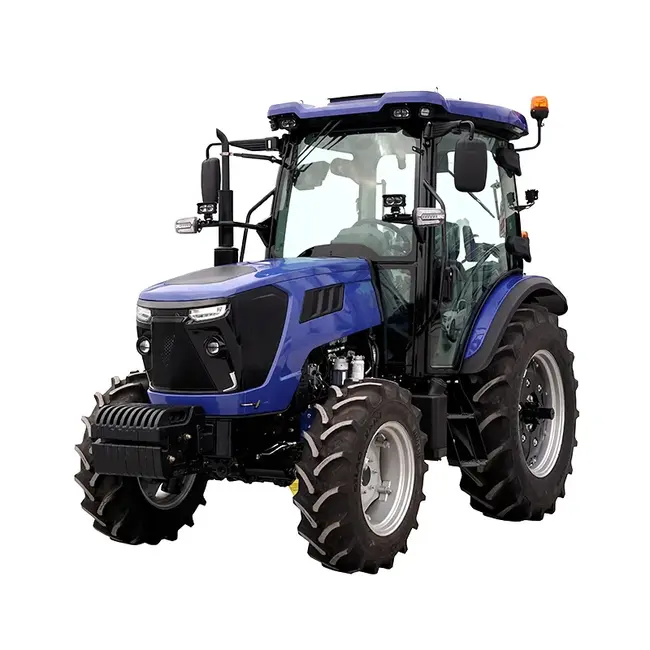
OXPLO OXT704: a 70 HP 4WD Category II utility tractor platform. OXT704 product page
What to send OXPLO before asking for a final quote
A useful enquiry gives the supplier enough information to make a technical recommendation. Instead of sending only “price for 50 HP tractor,” provide the following:
- Destination country and whether regular public-road use is expected
- Farm type: vineyard, orchard, livestock, mixed farm, grassland, estate or contracting
- Main recurring jobs and estimated annual operating hours
- Existing implements: width, weight, PTO speed, hitch category and hydraulic requirement
- Terrain: flat, hilly, wet, soft soil, hard ground or mixed conditions
- Narrowest gate, row, building entrance and height restriction
- Loader requirement: material type and approximate typical load
- Preferred operator station, tyres and any destination-specific equipment needs
With that information, OXPLO can narrow the horsepower range, compare the compact and utility platforms, check attachment compatibility and prepare a quotation around the actual duty cycle rather than an arbitrary horsepower request.
VIII. Conclusion: Buy the Tractor Around the Bottleneck, Not the Brochure
A farm tractor buying guide is useful only if it changes the way the buyer makes the decision. A practical farm tractor buying guide should turn specifications into operating decisions, not simply repeat a brochure. The right question is not “What is the biggest tractor I can afford?” It is “What is currently limiting the farm, and which tractor configuration removes that limit without creating a new one?”
For one buyer the bottleneck is PTO reserve. For another it is traction. For a vineyard it may be overall width. For a livestock farm it may be loader cycle time and ballast. For a dealer it may be attachment compatibility and parts support. For a European importer it may be configuration certainty and model-specific documentation before shipment.
The seven checks are therefore a sequence, not a list of unrelated tractor features: define the real workload; match usable power to the recurring job; confirm PTO, hydraulics and hitch compatibility; verify physical access and traction; match transmission and loader specification to the duty cycle; confirm European documentation and quote completeness; and compare TCO, support and future expansion.
OXPLO’s 25–70 HP tractor range is most useful when approached through this same decision framework. OXPLO can help compare compact Category I models with the larger Category II utility platform, match available attachments, confirm the selected configuration before shipment and discuss the documentation available for the destination market.
Start with the farm and the work: request an OXPLO tractor configuration based on your country, terrain, implements, access dimensions and expected operating cycle.
The goal is not more horsepower. It is more productive hours from the tractor the farm actually needs.