
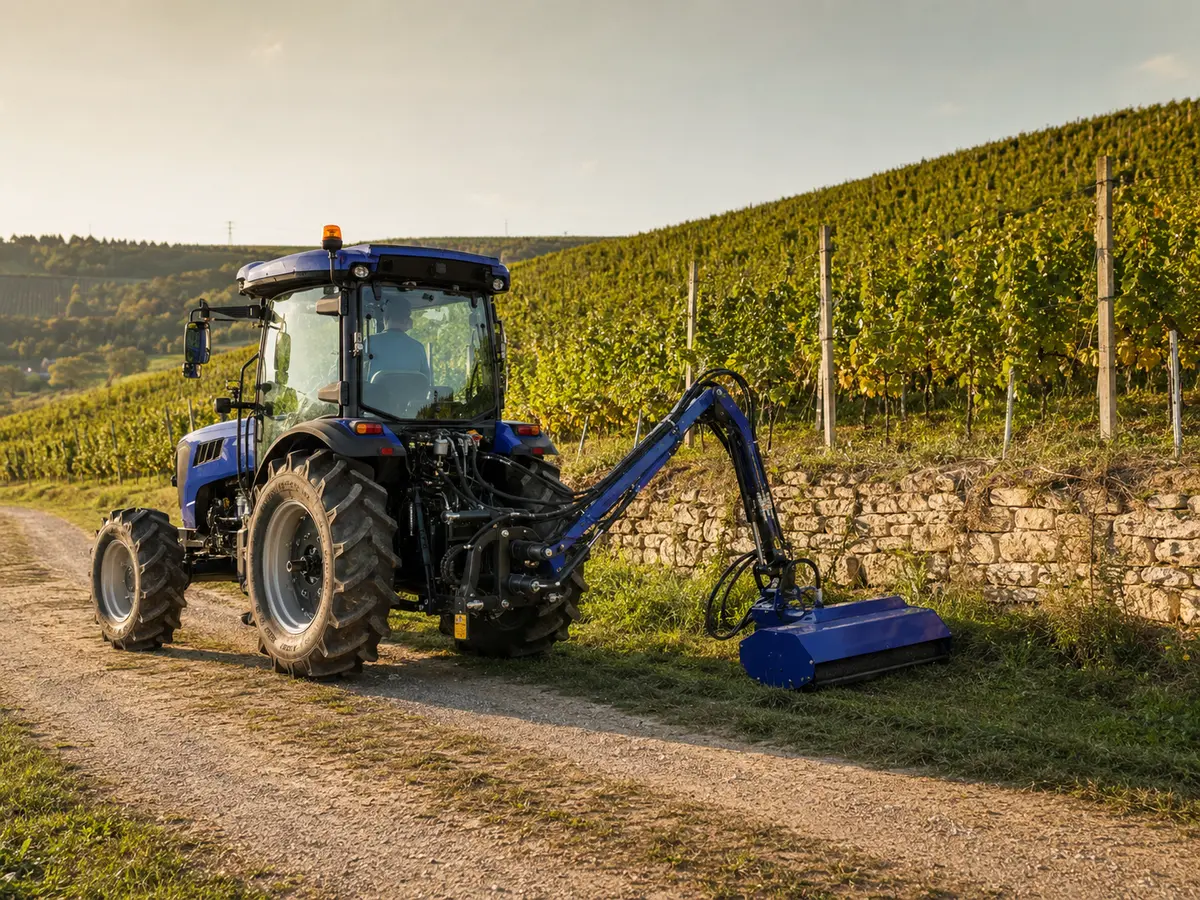
A practical framework for matching tractor horsepower, implements, field conditions, operating windows, and total cost of ownership.
When buying a tractor, many farm owners and equipment buyers begin with a simple question: Is 50 HP enough, or is it safer to move directly to 70 HP?
The question sounds straightforward, but it often leads buyers in the wrong direction. A tractor’s real working capability is determined by much more than the horsepower printed on the engine cover. PTO output, operating weight, tires and ballast, three-point hitch category, transmission ratios, implement width, soil resistance, slope, and the time available to finish each job all matter.
An undersized tractor may fail to maintain speed during tillage, mowing, or transport. An oversized tractor can raise acquisition cost, fuel use, tire expense, soil compaction, and access problems in narrow yards or orchard rows.
The correct way to compare a 50 hp tractor with a 70 hp tractor is therefore not to focus on the 20 HP difference. The real decision is which complete machine platform can finish the farm’s essential work at an acceptable total cost of ownership.
I. Quick Decision: When to Choose 50 HP and When to Choose 70 HP
If the farm mainly handles mowing, fertilizing, spraying, light-to-medium tillage, yard transport, and livestock support – and the tractor must pass through narrow roads, gates, orchards, or farm buildings – a compact 50 hp tractor is usually easier to manage.
If the farm performs more frequent soil work, uses wider or heavier implements, pulls larger trailers, or must cover more hectares within a short weather window, a 70 hp tractor normally provides a more dependable operating margin.
Use the following comparison as an initial filter:
Decision factor | 50 HP is usually the better fit | 70 HP is usually the better fit |
Primary work | Mowing, fertilizing, spraying, moderate tillage, daily transport | Higher-draft tillage, wider implements, heavier transport, longer duty cycles |
Implement system | Mainly Category I implements | Category II or heavier implements |
Site conditions | Narrow lanes, orchards, buildings, smaller plots | Open fields, grassland, mixed farms |
Annual workload | Seasonal or moderate use | Frequent, long-hour, or contracting use |
Buying priority | Maneuverability and lower fixed cost | Capacity, shorter job windows, and future expansion |
Main risk | Insufficient reserve for oversized implements | Low utilization, more compaction, and higher fixed cost |
This is only the first layer of the decision. Power delivery, traction, hydraulic capacity, and implement compatibility must still be checked before a final model is selected.
II. Why Engine Horsepower Alone Is Not Enough
Engine HP Is Not the Power Available at the Implement
Product pages usually lead with rated engine power. However, that output must pass through the transmission, driveline, and PTO system before it reaches the wheels or an attached implement.
For PTO-driven equipment such as rotary tillers, mowers, balers, and spreaders, confirm:
- Rated PTO horsepower, not only engine horsepower.
- Available PTO speed and the engine speed required to maintain it.
- Spline specification and direction of rotation.
- The implement manufacturer’s minimum and recommended PTO power.
- Whether the engine can hold the target PTO speed under sustained load.
For plows, harrows, cultivators, and trailers, the more important checks include operating weight, four-wheel drive, tire size and construction, ballast distribution, soil condition, and actual wheel slip.
Two tractors with similar engine ratings can therefore produce very different field results if their weight, tires, gearing, and driveline design are different.
50 HP and 70 HP Often Represent Different Tractor Platforms
Moving from 50 HP to 70 HP often changes more than the engine. The higher-horsepower model may also have a longer wheelbase, greater operating weight, larger tires, a higher hitch category, more working gears, and a chassis designed for heavier implements.
This is the most easily overlooked part of the decision. Buyers may think they are choosing between two engines, but they are often choosing between two implement ecosystems and two levels of sustained field capability.
Hitch Category Can Matter More Than the Extra 20 HP
If the farm already owns mostly Category I three-point implements, a compact 50 hp tractor may connect more naturally to the existing equipment fleet.
If future work depends on Category II implements, a tractor designed around that hitch category should be considered first. Bushings and adapters may allow an implement to connect physically, but they do not prove that lift capacity, implement weight, geometry, transport stability, and PTO requirements are suitable.
Being able to attach an implement is not the same as being able to operate it safely and productively.
Hydraulic Capacity Can Become the Real Bottleneck
Front loaders, hydraulic reversible plows, and more complex attachments create requirements for hydraulic flow, pressure, valve count, couplers, and return-line configuration. More engine power cannot compensate for a hydraulic system that does not match the implement.
Before purchase, confirm pump flow and pressure, rear remote valves, three-point lift capacity, loader ratings, ballast requirements, and front-to-rear axle loading with the implement raised into transport position.
III. Four Common Buying Mistakes and Their Hidden Costs
Mistake 1: Assuming More Horsepower Always Means More Productivity
A 70 hp tractor can provide more operating reserve, but only if the farm can use it. If the tractor spends most of its life on light transport, small-area mowing, and low-power PTO work, the higher purchase price, insurance, tires, and maintenance may not be recovered through greater output.
A larger frame can also make turning, storage, and access to farm buildings more difficult. On small or fragmented plots, maneuverability may create more value than additional horsepower.
Mistake 2: Buying the Lowest Horsepower That Works in Ideal Conditions
The opposite error is to size the tractor around dry, level ground and a lightly loaded implement. Wet clay, slopes, heavy crop residue, and deeper working depth can increase draft demand substantially.
When a tractor runs continuously near its limit, the operator generally has only three choices:
- Reduce forward speed.
- Reduce working depth.
- Reduce effective implement width or repeat the pass.
The purchase price may be lower, but labor hours, fuel, operator fatigue, and weather-delay risk all rise. If the farm’s critical work already sits near the upper boundary of a 50 HP platform, the reserve offered by a 70 hp tractor may be worth more than the initial price difference.
Mistake 3: Buying the Tractor Before Mapping the Implements
The correct sequence is the reverse: list the implements that must be operated, then select the tractor. Build an implement compatibility matrix before comparing quotations.
Implement parameter | What must be verified |
Power demand | Minimum and recommended PTO HP or drawbar power |
Hitch interface | Category I or Category II |
PTO system | Speed, spline, and rotation |
Implement weight | Lift capacity and front-axle stability |
Hydraulic demand | Flow, pressure, valves, and couplers |
Working width | Fit with field area and the available operating window |
Transport size | Clearance through roads, gates, buildings, and field entrances |
If existing implements do not fit the new tractor platform, replacement or modification costs can easily eliminate the saving achieved through a lower tractor price.
Mistake 4: Ignoring Tires, Ballast, and Ground Conditions
On loose or wet ground, the engine can only create useful work if the tires transfer power to the soil. A tractor that is too light or poorly ballasted may turn additional horsepower into wheel slip instead of forward movement.
Excessive slip increases fuel use, accelerates tire wear, lowers field speed, disturbs the topsoil, and raises the time required per hectare. Yet more ballast is not always better: excessive weight increases rolling resistance, soil compaction, and driveline stress. The correct 50 HP or 70 HP choice must be evaluated with the actual soil and traction conditions in mind.
IV. Comparing 50 HP and 70 HP by Real Farm Task
Mowing and Grassland Maintenance
For routine mowing, orchard-row maintenance, estate work, and medium-width cutters, a 50 hp tractor often offers a useful balance of PTO power and maneuverability. It needs less space to turn and is easier to position around fences and buildings.
For larger grassland areas, wider mowers, or dense and wet vegetation, a 70 hp tractor is better able to hold PTO speed and ground speed under changing load. The decisive variable is not only the total field area; it is how quickly mowing must be completed.
Rotary Tilling, Plowing, and Seedbed Preparation
Soil work exposes inadequate tractor sizing quickly. Working depth, moisture, clay content, residue, implement width, and forward speed all affect draft demand.
Light-to-medium rotary tilling, shallow cultivation, and smaller plots can suit a 50 HP platform. Wider implements, deeper work, resistant soils, and tighter schedules generally favor the additional power, weight, and Category II platform of a 70 hp tractor.
Rules of thumb such as horsepower per meter of implement width are useful only for screening. The implement manufacturer’s specified power range should guide the final decision.
Livestock and Mixed Farms
A livestock tractor rarely performs one job. It may mow, carry feed, tow trailers, maintain yards, clear snow, and operate a front loader.
Where buildings and lanes are tight and loader work involves lighter materials, 50 HP may be sufficient. Where the tractor frequently handles bales, heavier trailers, or long daily loading and transport cycles, the weight, wheelbase, and gear range of a 70 HP platform generally support more stable work.
Loader capability must still be checked separately. Engine horsepower does not determine loader rating; hydraulic capacity, front axle load, tires, loader geometry, and rear ballast all need confirmation.
Orchards and Vineyards
In orchards, machine width, height, and turning space can become limiting factors before horsepower does. A 70 HP machine has little practical value if it cannot pass safely between rows, through a gate, or below the canopy.
For narrow rows dominated by spraying and mowing, a compact 50 hp tractor is often easier to use. A 70 HP tractor may suit wider orchards, slopes, or heavier sprayers and trailers, but buyers should measure the narrowest clearance rather than rely on the average row spacing.
Trailer Transport
Transport capacity cannot be calculated from engine horsepower alone. Trailer gross weight, road gradient, braking system, hitch rating, tire and axle loads, local road rules, and tractor-trailer brake compatibility must all be checked.
For frequent uphill transport or heavier loads, 70 HP generally provides more power reserve. However, higher horsepower cannot make an underspecified hitch, unbraked trailer, or non-compliant road configuration safe.
V. Use Work Capacity and TCO, Not Guesswork
Calculate Effective Field Capacity
A useful planning formula is:
Effective field capacity (ha/h) = implement width (m) x speed (km/h) x field efficiency / 10
Field efficiency accounts for turning, overlap, refilling, adjustment, and minor stops. Width, speed, and field efficiency together determine real productivity.
Reference: Farm Machinery Cost Calculations – Mississippi State University Extension
Assume a seasonal job covers 30 hectares and two technically feasible configurations are available:
- Configuration A: 2.0 m implement, 6 km/h, 75% field efficiency.
- Configuration B: 2.5 m implement, 7 km/h, 75% field efficiency.
Configuration A delivers 0.90 ha/h. Configuration B delivers approximately 1.31 ha/h. Completing 30 hectares takes about 33.3 hours with A and 22.9 hours with B – a difference of roughly 10.4 hours for one operation.
This example does not prove that every 70 HP tractor can use Configuration B or that every 50 HP tractor is limited to Configuration A. It shows how additional capability should be valued: through sustainable implement width, working speed, and completion time.
Put the Weather Window Into the Cost Model
Tillage, planting, fertilizing, and forage work often need to be completed within a limited period. If insufficient power reduces daily output, the cost is more than extra driving time.
- Missing the preferred soil-moisture condition.
- Lower forage or harvest quality.
- Delayed planting.
- Emergency equipment rental.
- Contractor fees.
- Additional field passes and soil compaction.
Where the farm repeatedly faces tight operating windows, the extra capacity of a 70 hp tractor can have measurable value. Where the area is small and schedules are flexible, the lower fixed cost of a 50 hp tractor may remain the more rational choice.
Build an Annual Total Cost of Ownership Model
A practical annual TCO model should include depreciation or finance, fuel, maintenance, tires, labor, implement conversion, and delay costs.
Cost per hectare = total operating cost per hour / effective hectares per hour
A 70 HP machine may cost more per hour but can still cost less per hectare if it safely operates a wider implement or maintains higher field speed. Calculate the break-even point instead of comparing fuel consumption alone.
For example, if the 70 HP option adds EUR 2,400 in annual fixed cost but saves labor, fuel, rental, and delay value worth EUR 35 per hour, it must save about 69 hours per year to recover that difference. Use the farm’s own quotes, wages, fuel prices, and job records rather than copying an industry average.
VI. A Practical Tractor Selection Workflow
Step 1: List the Full-Year Workload
Do not size the tractor around only the heaviest job. Divide the annual workload into three groups:
- High-frequency daily work, such as transport, feeding, mowing, and yard maintenance.
- Seasonal critical work, such as tillage, planting, fertilizing, and forage production.
- Occasional high-load work, such as deep tillage, heavy transport, or construction support.
If the heaviest job occurs only a few days per year, hiring a contractor may be more economical than buying a larger tractor. If high-load work appears across several seasons, the larger platform has a better chance of earning its fixed cost.
Step 2: Build an Implement Compatibility Matrix
Record PTO horsepower, PTO speed, hitch category, implement weight, hydraulic demand, and the recommended tractor range for every attachment. One incompatible factor is enough to stop a proposed pairing, even when engine horsepower looks adequate.
Step 3: Measure the Smallest Access Point
Measure the narrowest gate, orchard row, farm lane, low building, tree canopy, headland, and storage space. Use the tractor’s complete working dimensions with tires, cab, mirrors, ballast, and implement – not the bare-machine width.
Step 4: Evaluate the Worst Operating Condition
Do not select from the best dry and level field. Evaluate the wettest soil, steepest gradient, fully loaded implement, maximum trailer weight, tightest seasonal window, and longest continuous shift. A configuration that maintains safe and reasonable output in the difficult condition provides a more dependable production plan.
Step 5: Confirm the Complete Specification Before Comparing Price
- Rated engine output and emissions configuration.
- PTO output, speed, and spline.
- Transmission and working gear range.
- Three-point hitch category and lift capacity.
- Hydraulic flow, pressure, valves, and couplers.
- Dimensions, operating weight, and tire options.
- Loader and ballast package.
- Brakes, lighting, and road-use configuration.
- Destination-country conformity documents.
- Spare-parts and technical-support process.
Price should be compared only after these items are aligned. Otherwise, two quotations may describe machines with materially different capabilities and compliance scope.
VII. OXPLO OXT504 and OXT704: The Platform Difference in Practice
The difference becomes clearer when comparing two machines in the OXPLO range: the OXPLO OXT504 50 HP Tractor and the OXPLO OXT704 70 HP Tractor. The two OXPLO models do not differ only in engine rating; they are built around different implement and operating platforms.
Technical item | OXPLO OXT504 | OXPLO OXT704 |
Rated power | 37 kW / 50 HP | 51.5 kW / 70 HP |
Drive | 4WD | 4WD |
Transmission | 8F + 8R | 12F + 12R |
Three-point hitch | Category I | Category II |
PTO speed | 540 / 720 rpm | 540 / 760 rpm |
Overall dimensions | 3,180 x 1,560 x 2,600 mm | 3,980 x 1,760 x 2,800 mm |
Wheelbase | 1,800 mm | 2,010 mm |
Minimum ground clearance | 308 mm | 308 mm |
Published weight | Approx. 2,200 kg | Approx. 2,500 kg |
Front tires | 6.5-16 | 8.3-20 |
Rear tires | 11.2-24 | 12.4-28 |
OXPLO OXT504: Compact Access With 50 HP Output
The OXPLO OXT504 combines a published 1,560 mm overall width with a Category I three-point hitch. It is a practical candidate for customers who already own Category I implements and need one tractor for grassland maintenance, livestock support, light-to-medium soil work, fertilizing, and farm transport.
The commercial value of this OXPLO 50 hp tractor lies in its balance: useful output on a more compact platform, with less pressure when entering narrow lanes, working around buildings, or operating in some orchard environments.
Its boundary is equally important. If the farm intends to operate wider, heavier Category II implements for sustained periods, adding ballast and adapting attachments to the OXPLO OXT504 may not be the most economical long-term route.
OXPLO OXT704: A More Complete 70 HP Utility Platform
The OXPLO OXT704 is not simply an OXT504 with 20 additional horsepower. Its wheelbase, weight, tires, hitch category, and transmission are all different.
The 12F + 12R transmission gives the OXPLO OXT704 a finer range of working speeds. Its Category II hitch opens access to a different implement class, while the larger tires and approximately 2,500 kg published weight support the needs of mixed farms, grassland, broader tillage programs, agricultural contracting, and more frequent trailer work.
The trade-off is clear: the OXPLO OXT704 has a published width of 1,760 mm, requires more turning and storage space, and carries a higher fixed-cost base. For narrow orchards or low-hour light-duty work, that capability may remain underused.
How to Choose Between the Two OXPLO Models
The OXPLO OXT504 deserves priority when:
- The current implement fleet is mainly Category I.
- A 1,560 mm published width creates real access value.
- Most work consists of mowing, fertilizing, moderate tillage, and transport.
- Annual use is moderate.
- Heavy Category II equipment will not be a recurring requirement.
The OXPLO OXT704 deserves priority when:
- Category II implements are part of the planned equipment system.
- The farm needs the finer working-speed selection of a 12F + 12R transmission.
- Tillage, draft, and transport loads occur frequently.
- More hectares must be completed inside a short operating window.
- The farm may expand implement width or take on outside contracting work.
For a meaningful OXPLO recommendation, buyers should provide destination country, field area, soil type, gradient, current implements, expected annual hours, and the narrowest access dimension. OXPLO can then help verify the tire, PTO, hitch, cab, loader, and market-compliance configuration against the real job instead of matching a buyer to a horsepower number alone.
VIII. Frequently Asked Questions
Q1. Is a 50 hp tractor enough for a small farm?
Farm size is not the only variable. If the work mainly includes mowing, fertilizing, spraying, moderate tillage, and yard transport with compatible Category I implements, a 50 hp tractor can cover many daily tasks. Heavy clay, steep slopes, large bales, or a very short job window can still justify a larger platform on a small farm.
Q2. How much more work can a 70 hp tractor complete?
Productivity cannot be calculated from the extra 20 HP alone. The gain depends on whether the 70 hp tractor can safely operate a wider implement, maintain speed under load, and reduce hours per hectare. Use implement width x actual speed x field efficiency to compare feasible configurations.
Q3. Is a 70 hp tractor too large for an orchard?
Not automatically. Compare complete width, height, turning space, slope stability, and implement dimensions with the orchard layout. A compact 50 HP platform is often easier in narrow rows, while a 70 HP machine can work in wider orchards when clearance and stability are adequate.
Q4. Can a 50 hp tractor operate Category II implements?
Some implements may connect through adapters, but physical connection does not prove that lift capacity, implement weight, PTO demand, or tractor stability is adequate. If Category II equipment will be used routinely, a native Category II platform is normally the more robust choice.
Q5. Does a 70 hp tractor always use more fuel?
A larger engine may be underutilized during light work. Under heavy load, however, a 70 hp tractor may operate a wider implement, maintain speed, and finish in fewer hours. Its fuel cost per hectare may therefore be competitive even when fuel use per hour is higher.
Q6. What information should I send OXPLO when requesting a quotation?
Send OXPLO the field area, crop or farm type, soil, slope, current implements, PTO needs, maximum trailer weight, loader requirement, expected annual hours, narrowest access point, destination country, and road-use requirement. The more complete the input, the easier it is for OXPLO to identify incompatible options before an order is placed.
Q7. Are European configurations available for OXPLO tractors?
Engine, lighting, braking, operator-protection, and conformity requirements must be confirmed for the exact OXPLO model, final configuration, and destination country. Buyers should request the final OXPLO specification sheet and verify the required emissions and compliance documents before placing the order.
IX. Conclusion: Buy for the Work, Not for the Horsepower Number
There is no universal winner between 50 HP and 70 HP.
If the farm relies on Category I implements, has narrow access, operates a moderate annual workload, and mainly performs mowing, fertilizing, maintenance, transport, and light-to-medium tillage, the compact OXPLO OXT504 50 hp tractor may provide the more rational combination of utilization and fixed cost.
If the farm requires Category II implements, greater draft reserve, finer working gears, or more hectares completed within a short window, the OXPLO OXT704 70 hp tractor offers the stronger operating platform.
A professional decision checks implements, PTO, hitch, hydraulic capacity, weight, tires, access dimensions, and annual operating windows before comparing price. OXPLO uses the same task-first logic when helping customers compare tractor configurations.
To compare the OXT504 and OXT704 against your own implements and farm conditions, explore the OXPLO tractor range or submit your destination country, job profile, implement list, and expected annual hours to OXPLO. OXPLO can then help verify model configuration and implement compatibility rather than giving a generic recommendation based only on engine horsepower.