
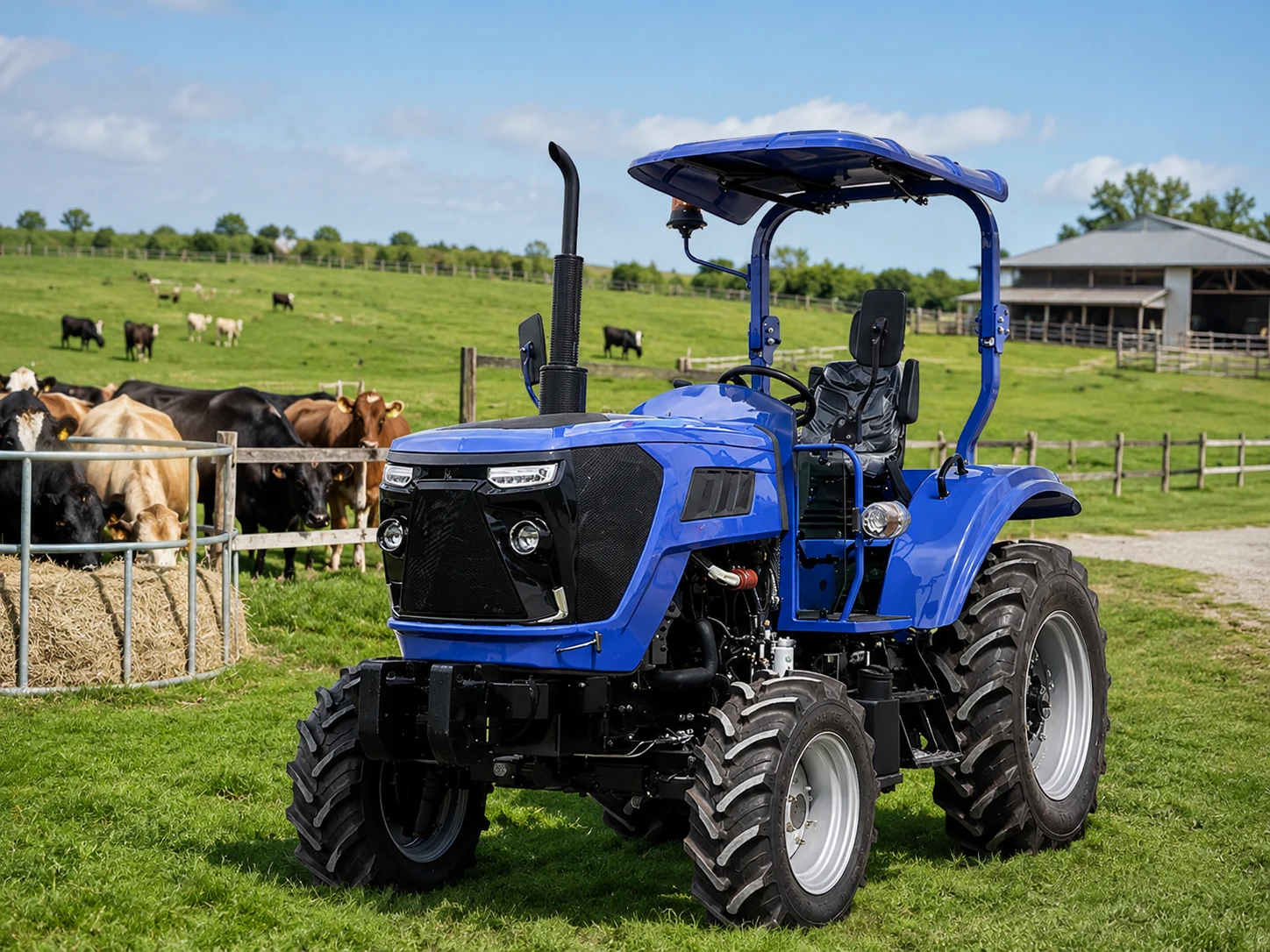
A practical European tractor-sizing guide for buyers who need to match horsepower, implements, traction, access and total cost of ownership.
Buying a tractor is rarely difficult because the engine number is hard to understand. It is difficult because horsepower is only one part of the working system. A tractor can have enough engine output and still be the wrong machine for the implements, soil, loader workload, farm buildings or compliance requirements around it.
That is why a 50 HP tractor, 60 HP tractor and 70 HP tractor should not be treated as three versions of the same machine. In many product ranges, moving from 50 HP to 60 HP also changes the chassis, wheelbase, machine mass, tyre package, transmission and three-point hitch category. Moving from 60 HP to 70 HP may then be more about additional power reserve on an already larger utility platform.
For European farms, the decision is even more practical. Narrow gateways, older barns, existing Category I or Category II implements, wet grassland, clay soil, slopes, road-use requirements and model-specific documentation can all matter as much as tractor horsepower.
30-second decision rule: Choose 50 HP when compact access and Category I implement compatibility remain central. Consider 60 HP when you need to step into a larger Category II utility platform. Choose 70 HP when you already need that larger platform and your recurring work can genuinely use the extra power reserve. |
Quick Answer: 50 HP vs 60 HP vs 70 HP at a Glance
Main requirement | 50 HP tractor | 60 HP tractor | 70 HP tractor |
Tight gates / compact farmyards | Strong fit | Check dimensions | Check dimensions |
Existing Category I implements | Strong fit | Usually a platform change | Usually a platform change |
Category II implement requirement | Not the natural fit | Strong fit | Strong fit |
Routine mowing, tillage and spreading | Strong fit | More reserve | May be oversized |
Frequent mixed-farm work | Capable | Strong fit | Strong fit |
Recurring heavy PTO work | Check reserve carefully | Good reserve | Best reserve of the three |
High annual utilisation / contracting | May become limiting | Strong fit | Strong fit with more reserve |
Priority: manoeuvrability | Strongest advantage | Larger footprint | Larger footprint |
Priority: maximum power reserve | Moderate | High | Highest |
I. The Real Industry Problem: “Enough Horsepower” Does Not Mean the Tractor Is Correct
A common enquiry starts with a single sentence: “I need a 60 HP tractor.” That sounds specific, but it is not enough to select a machine. Two buyers asking for the same 60 HP tractor may have completely different operating limits.
One may mow flat grassland, pull a moderate trailer and use the tractor only during a few seasonal windows. Another may cultivate sticky clay, work on slopes, run PTO implements for long hours and add a front loader for feed, fertiliser and bale handling. The engine rating can be identical while the correct tractor configuration is very different.
The cost of undersizing
An undersized tractor usually announces itself during work rather than on the specification sheet. PTO speed drops when crop density rises. The operator repeatedly downshifts when soil resistance increases. Tyres slip on wet ground. Field speed falls. A seasonal task that should be finished inside a narrow weather window takes longer than planned.
The tractor still works, which is why undersizing can be deceptive. The hidden cost is reduced productive output per hour and more time spent near the machine’s operating limits.
The cost of oversizing
Oversizing is quieter but can be just as expensive. Buying a 70 HP tractor because “more horsepower is safer” may increase acquisition cost, tyre and service cost, fuel use, machine mass, turning space and soil compaction without increasing field capacity. If the same implement is used at the same working width and speed, the extra horsepower may sit idle for most of the year.
The objective is therefore not to buy the largest tractor within budget. It is to identify the smallest platform that can complete the heaviest recurring work with a sensible operating reserve.
II. Before Comparing Tractor Horsepower, Find the Real Bottleneck
Before choosing between a 50 HP tractor, 60 HP tractor and 70 HP tractor, identify what actually limits the work. In practice, most wrong purchases come from one of four bottlenecks: PTO demand, traction, implement/hydraulic compatibility or physical access.
1. PTO power: “It can turn the implement” is not the same as “it can run it productively”
Engine horsepower is not the same as PTO horsepower. Mowers, rotary tillers, flail mowers, chippers, balers and PTO-driven pumps consume power at the PTO shaft after drivetrain and auxiliary losses. The correct starting point is therefore the implement manufacturer’s PTO requirement, not only the tractor’s rated engine horsepower.
Load also changes in the field. A mower that runs comfortably in dry, light material may require much more power in dense or wet grass. A tiller can behave very differently in light soil and sticky clay. The right question is not “Can the tractor operate this implement?” but “Can it hold the required PTO speed at a productive ground speed in my normal working conditions?”
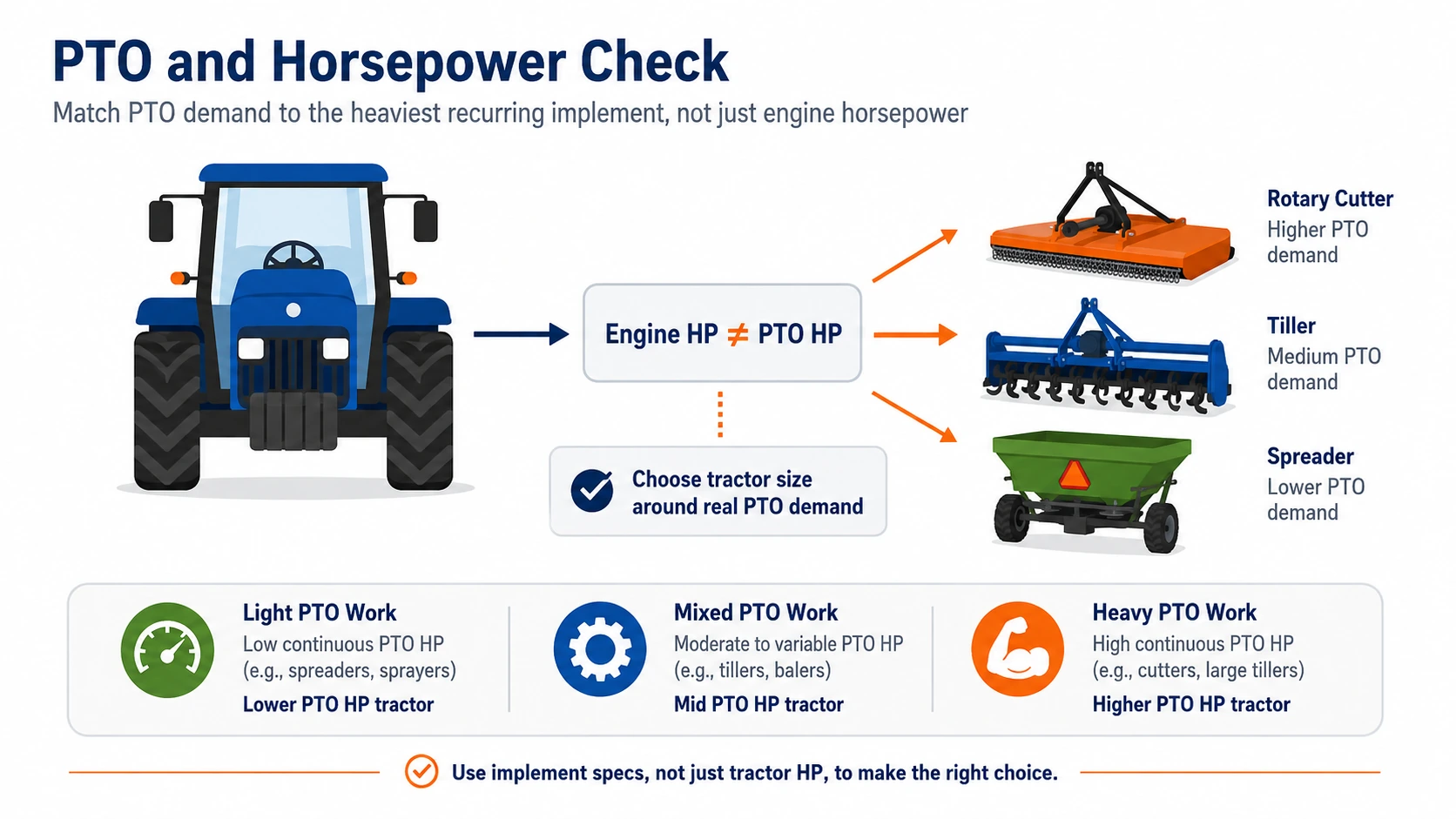
Figure: Match PTO demand to the heaviest recurring implement instead of comparing engine horsepower alone.
2. Traction: engine power is useless if it cannot reach the ground
Ploughing, disc work and loaded trailer movement are often traction-limited. Four-wheel drive, machine weight, tyre size, ballast, soil moisture and slope determine how much engine output becomes usable drawbar work. This is especially relevant to European livestock and mixed farms where tractors may move between grassland, field entrances, farm tracks and wet yards in the same day.
A higher horsepower number cannot compensate for uncontrolled wheel slip. That is why OXPLO evaluates tyre configuration, working surface and 4WD requirements together with power when discussing a tractor configuration.
3. Hitch and hydraulics: many “horsepower problems” are actually compatibility problems
If the farm already owns a rotary tiller, mower, cultivator, spreader, bale attachment or other implement, record its hitch category, weight, PTO speed, driveline requirements and hydraulic demand before selecting the tractor. Category I and Category II are not cosmetic labels. They affect the geometry and compatibility of the working system.
Hydraulic flow, pressure, remote valves, loader connections and lift capacity also need to be checked whenever an implement depends on hydraulic power or when a front loader is required. OXPLO does not recommend estimating unpublished hydraulic or loader figures from engine horsepower; the final quotation and specification sheet should confirm the selected configuration.
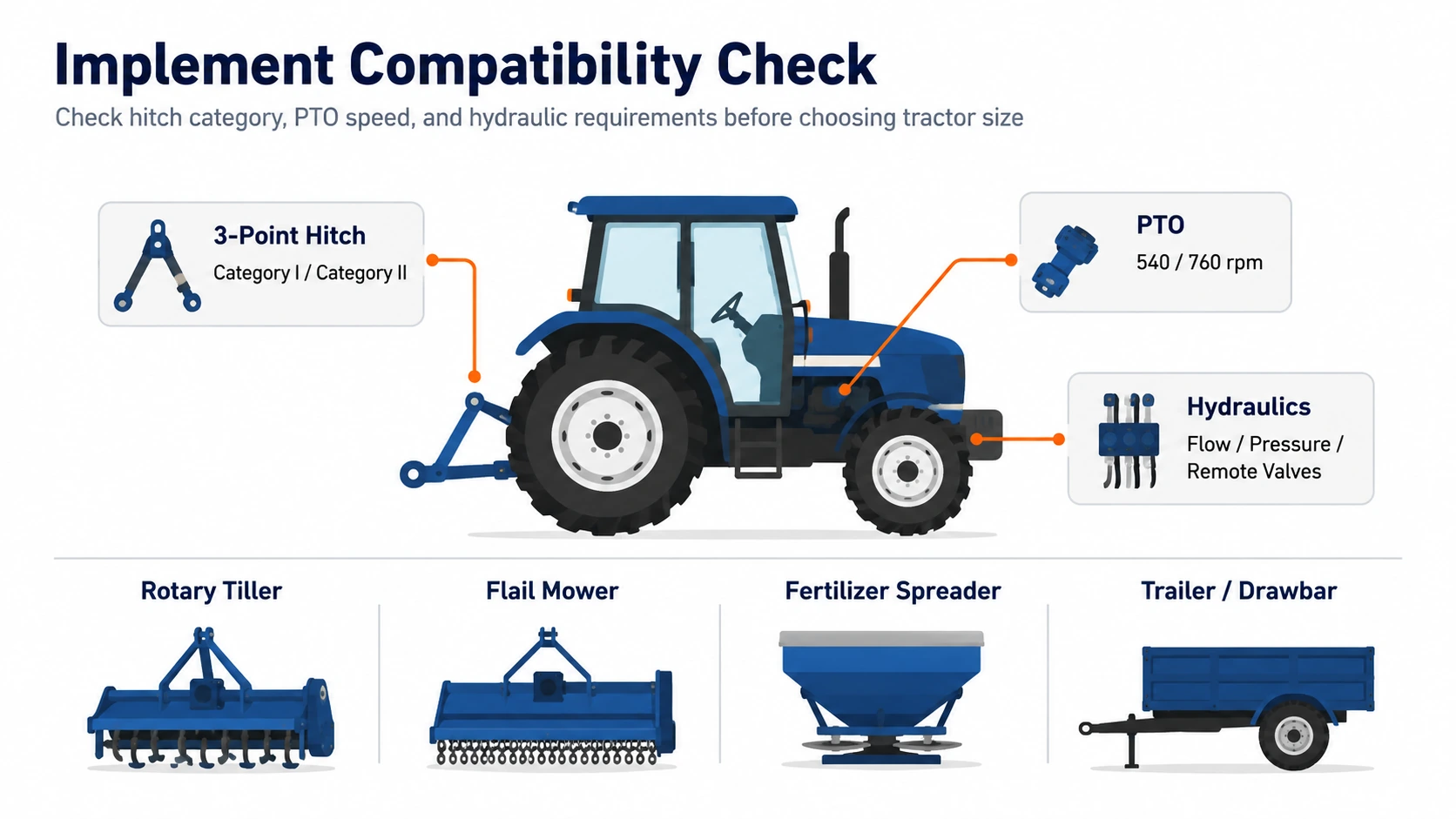
Figure: Check implement compatibility around hitch category, PTO speed and hydraulic requirements before choosing tractor size.
4. Physical size: the farm gate can matter more than another 10 HP
A tractor does not work only in open fields. It must pass through farm gates, barns, livestock buildings, orchard rows, headlands, storage areas and narrow internal roads. An extra 200 mm of width can be more important than another 10 HP when the machine is used around older European farm infrastructure.
Measure the narrowest gateway, building entrance height, row spacing and normal turning area before ordering. A more powerful tractor that creates access problems every day may produce less real-world efficiency than a smaller platform that moves freely around the farm.
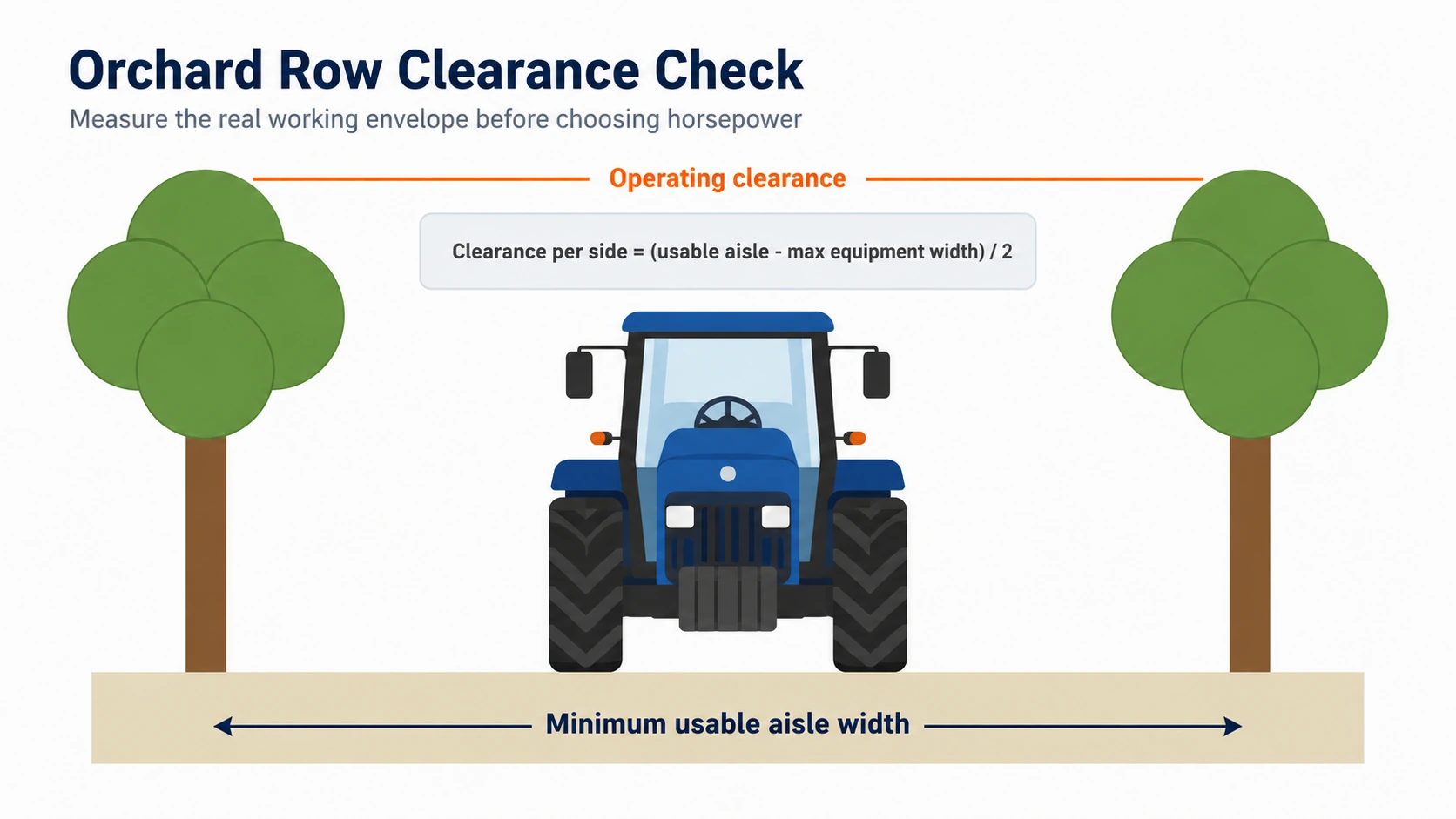
Figure: Orchard rows, barn access and operating clearance should be measured before choosing tractor horsepower.
III. When a 50 HP Tractor Is the Smarter Choice
A 50 HP tractor should not be treated as the “budget alternative” to a 60 HP or 70 HP machine. For many mixed farms, livestock operations and professional land-maintenance users, 50 HP is the correct choice when the farm still benefits from a compact Category I platform.
A 50 HP tractor makes particular sense when the buyer already owns Category I implements, works through restricted entrances, performs mowing, routine tillage, spreading and farm transport, and needs more engine reserve without moving into a physically larger tractor class.
The problem a 50 HP tractor solves
Many customers do not actually need a larger tractor. Their real problem is that a smaller compact tractor has reached its limit as grassland area, PTO workload, transport frequency or seasonal hours have increased. If the existing implements and farm access still suit Category I equipment, moving to a larger chassis may create unnecessary cost and access compromises.
The OXPLO OXT504 addresses exactly this situation. It is the 50 HP model at the top of OXPLO’s compact OXT chassis group, with 4WD, an 8F + 8R transmission, Category I rear linkage and a published overall width of 1,560 mm. For a buyer who needs additional output but still values compact access, that platform distinction matters more than simply saying “50 HP.”
View the OXPLO OXT504 50 HP tractor specifications and current configuration notes.
When 50 HP starts to become the wrong platform
The warning signs are not only higher workload. They include a growing list of Category II implements, heavier rear-mounted equipment, frequent loader work, recurring high-load PTO operation and the need for a broader transmission range. At that point, the question changes from “Do I need another 10 HP?” to “Have I outgrown the compact tractor platform?”
IV. Why 60 HP Is Often the Real Decision Point
This is the most important part of the comparison. Buyers often assume that 50 HP to 60 HP is a small step and 60 HP to 70 HP is another equal step. In reality, the first step may involve a much larger structural change.
On OXPLO’s current tractor range, the OXT604 does not simply add 10 HP over the OXT504. It moves into a larger utility platform with a 2,010 mm wheelbase, 2,500 kg listed weight, larger tyres, a 12F + 12R transmission and Category II rear linkage. That changes implement compatibility, speed selection, machine stability and the type of recurring work the tractor is intended to handle.
When should a European buyer seriously consider 60 HP?
The first signal is implement compatibility. If the farm already owns Category II equipment, purchasing a smaller Category I tractor can create adapter costs, replacement costs or underused assets. Existing implements are capital equipment; preserving compatibility can be more valuable than saving money on the tractor itself.
The second signal is task diversity. If one tractor must cultivate in spring, mow and manage grassland in summer, handle trailers and material in autumn, and perform loader or estate work during the rest of the year, the buyer is no longer choosing a machine for one job. A utility platform with more usable ratios and broader implement compatibility becomes more valuable.
The third signal is speed matching. Tillage, PTO mowing, loader work, farmyard manoeuvring and transport do not need the same ground speed. More forward and reverse ratios give the operator more opportunities to match engine load, PTO operation and travel speed rather than forcing the machine to work between unsuitable gears.
See the OXPLO OXT604 60 HP utility tractor for the current published platform and PTO specifications.
V. When Moving From a 60 HP Tractor to a 70 HP Tractor Actually Pays
Once the buyer has already moved into a Category II utility platform, the decision changes again. The central question is no longer “Do I need a larger chassis?” It becomes “How often will I use the extra 10 HP?”
If most work consists of light mowing, spreading, modest transport and occasional land maintenance, a 70 HP tractor may not materially reduce working time. But if the tractor repeatedly performs heavy PTO work, cultivation, demanding transport, mixed-farm duties or agricultural contracting, the additional power reserve becomes easier to justify.
Calculate productivity, not just horsepower
A useful way to think about the business case is effective field capacity. As an illustrative example, a 2.0 m implement operating at 6 km/h with 75% field efficiency produces roughly 0.90 ha/h. If a larger tractor-platform combination genuinely allows a 2.5 m implement to maintain the same speed and efficiency, theoretical capacity rises to about 1.125 ha/h – roughly 25% more.
This is an example of the calculation method, not a guaranteed OXPLO performance claim. The point is that more tractor horsepower pays when it enables a larger implement, preserves working speed under load or reduces total passes and working time. If implement width and working speed remain unchanged, additional horsepower does not automatically produce proportional productivity.
The OXPLO OXT704 is therefore most logical when the buyer already needs the larger Category II platform and wants additional reserve for recurring work. Its published platform closely follows the OXT604 in wheelbase, listed weight, transmission, linkage and tyre size, while rated power increases to 70 HP.
View the OXPLO OXT704 70 HP tractor for the current product details and European-order notes.
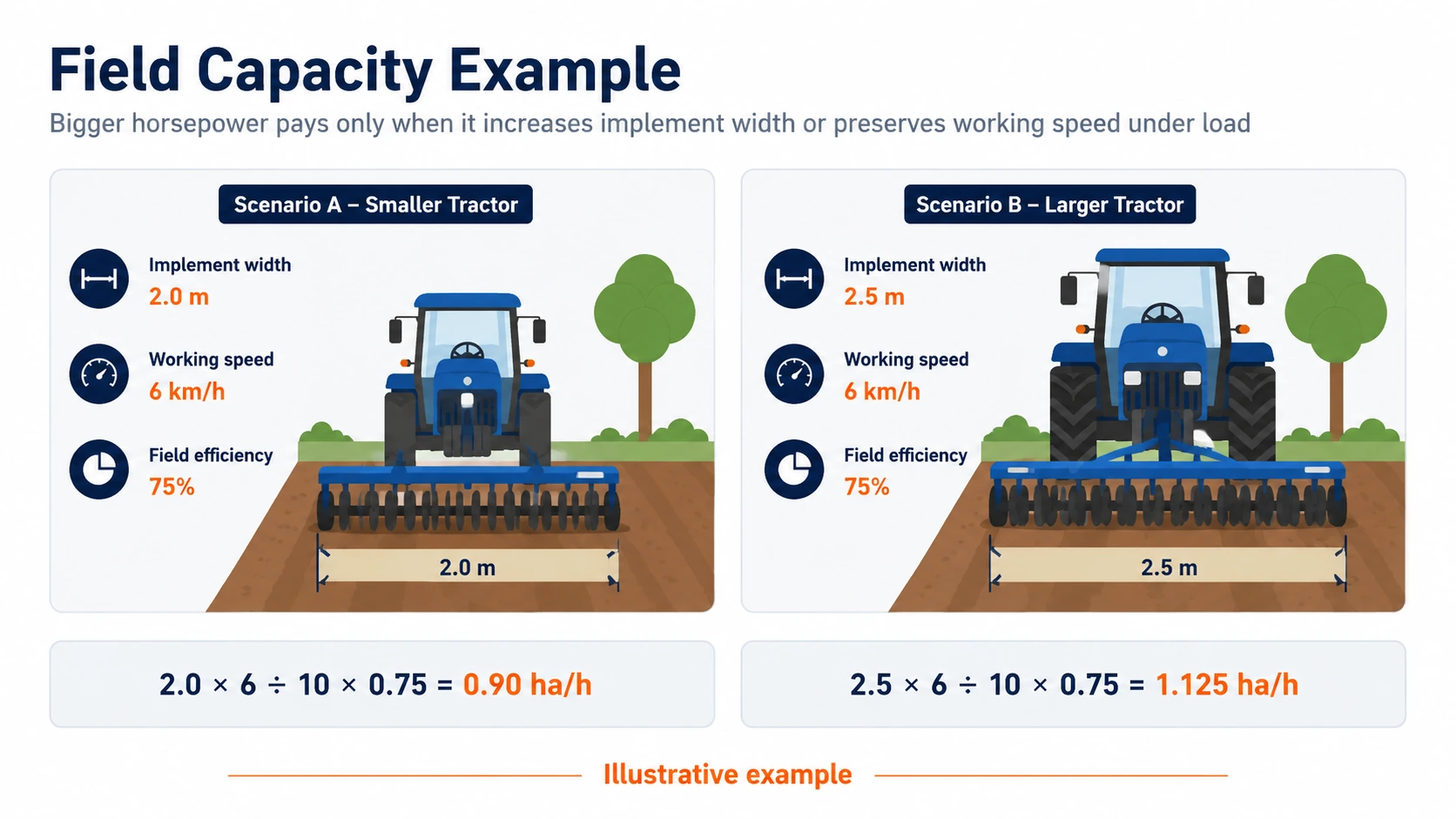
Figure: Bigger horsepower pays when it increases implement width or preserves working speed under load.
VI. What European Tractor Buyers Should Confirm Before Ordering
A European tractor purchase should not stop at the product-page horsepower figure. OXPLO recommends confirming the destination country, tractor model, engine configuration, tyres, attachments, hydraulic requirements and available model-specific documents before production or shipment. The exact documentation and equipment can vary by selected model and market.
1. Destination-market configuration
Ask what is supplied for the destination country, including applicable engine/emissions configuration, operator protection, braking, lighting, tyres, road equipment and conformity documentation. Do not assume that a general “European” description means every model is delivered with identical documents or road-use equipment in every country.
2. Existing implement compatibility
Send OXPLO the implement brand/model where available, working width, weight, hitch category, PTO requirement and hydraulic demand. This allows the tractor to be checked around the equipment the farm already owns rather than selecting horsepower first and discovering a mismatch later.
3. Soil, slope and working surface
Tell the supplier whether the tractor will work on dry arable ground, wet grassland, clay soil, slopes, farm roads or mixed surfaces. These variables influence tyre choice, traction expectations, ballast and the value of moving to a heavier platform.
4. Front-loader requirement
Do not ask only whether a loader can be installed. Confirm the loader model, rated capacity at the stated lift point, lifting height, hydraulic connection, bucket or fork type, required ballast and any front-axle limits. A loader and tractor should be configured as one system.
5. Documents before shipment
The final order review should cover the tractor, engine, tyres, PTO, rear linkage, attachments, optional loader, market-specific equipment and available documentation. OXPLO’s tractor configuration page states that model-specific CE documents can be confirmed according to the selected model and destination, and that the machine configuration should be checked before production or shipment.
Use the OXPLO 25-70 HP tractor configuration page to review power ranges, attachment options and the international order-confirmation process.
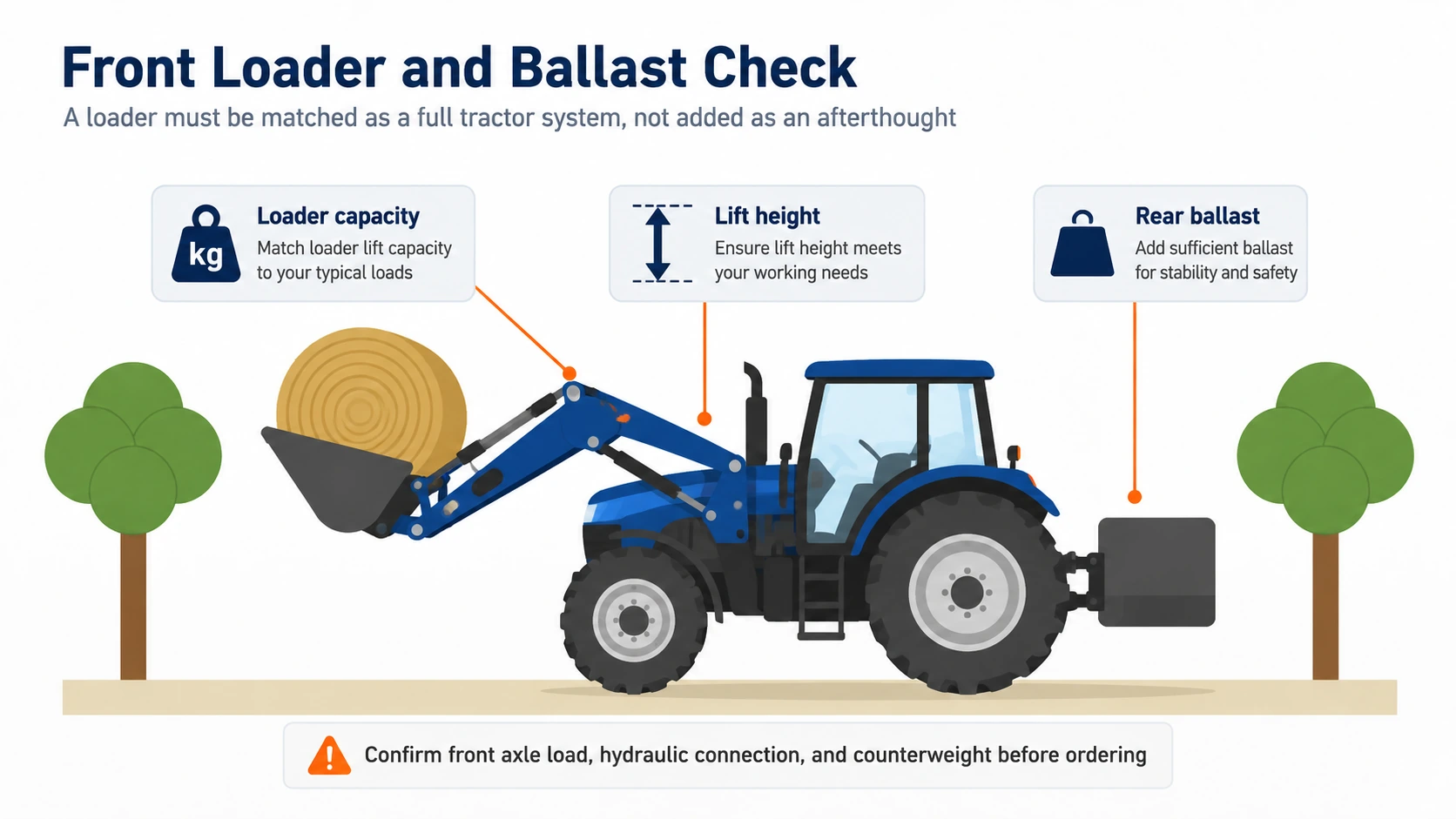
Figure: Specify a front loader as a complete tractor system, including capacity, lift height and rear ballast.
VII. OXPLO OXT504 vs OXT604 vs OXT704: The Platform Difference That Matters
The OXPLO range makes the platform transition especially clear. The table below uses OXPLO’s current published product information. Final order specifications should still be confirmed on the quotation and specification sheet.
Specification | OXT504 | OXT604 | OXT704 | What it means in practice |
Rated power | 50 HP / 37 kW | 60 HP / 44.1 kW | 70 HP / 51.5 kW | Different continuous-load and power reserve |
Drive | 4WD | 4WD | 4WD | Traction support on changing surfaces |
Transmission | 8F + 8R | 12F + 12R | 12F + 12R | More speed choices on the 60/70 HP platform |
Rear linkage | Category I | Category II | Category II | Directly affects implement-platform compatibility |
PTO | 540/720 rpm | 540/760 rpm | 540/760 rpm | Must match implement requirement |
Wheelbase | 1,800 mm | 2,010 mm | 2,010 mm | Manoeuvrability vs platform stability |
Listed weight | 2,200 kg | 2,500 kg | 2,500 kg | Influences traction and working stability |
Overall width | 1,560 mm | 1,760 mm | 1,760 mm | Important for gates, barns and rows |
Front / rear tyres | 6.5-16 / 11.2-24 | 8.3-20 / 12.4-28 | 8.3-20 / 12.4-28 | 60/70 HP move to a larger tyre package |
OXPLO OXT504: compact Category I + 50 HP
The OXT504 is designed for buyers who need more output but still want the access advantages and Category I compatibility of OXPLO’s compact chassis group. It solves a common problem: the farm has outgrown lower horsepower, but it has not outgrown compact infrastructure or its existing implements.
OXPLO OXT604: larger Category II utility platform + 60 HP
The OXT604 is the key platform transition. The larger chassis, longer wheelbase, larger tyres, 12F + 12R transmission and Category II linkage make it more suitable for broader implement compatibility and recurring mixed-farm work. For many buyers, this is a bigger operational change than the 10 HP figure suggests.
OXPLO OXT704: the same utility-class direction + more power reserve at 70 HP
The OXT704 makes sense when the customer already needs the larger OXPLO utility platform and can use the additional power in heavier recurring PTO work, cultivation, transport, contracting or high-utilisation mixed-farm operations. It is not automatically the right answer for every farm simply because it has the highest horsepower.
VIII. A Better Tractor Buying Workflow: Do This Before Asking for a Price
The fastest way to get an accurate OXPLO recommendation is not to begin with a horsepower target. Begin with the work. The following process reduces the chance of buying either too little tractor or unused capacity.
Step 1 – Identify the heaviest recurring job
Start with the task that repeatedly places the greatest demand on the machine: the largest mower, heaviest tillage operation, loaded trailer, most frequent loader work or heaviest rear implement. An occasional exceptional job should not necessarily size the entire tractor fleet, but a recurring high-load task should.
Step 2 – Build an implement sheet
Information to record | Why it matters |
Implement type | Defines the work system |
Working width | Affects field capacity and power demand |
Implement weight | Affects lift and stability requirements |
PTO requirement | Determines usable powered-implement compatibility |
Hitch category | Prevents Category I / II mismatch |
Hydraulic demand | Required for hydraulic implements and loader functions |
Recommended working speed | Helps evaluate transmission ratios |
Step 3 – Measure the farm
Record the narrowest gate, barn entrance, row spacing, turning area, slopes and normal road or track conditions. These measurements help determine whether the compact advantage of a 50 HP tractor is operationally valuable or whether the larger 60/70 HP platform can be used without creating access problems.
Step 4 – Estimate annual workload
A job performed twice a year and the same job performed every week should lead to different purchasing decisions. High recurring workload increases the value of production reserve, speed choice, operator convenience and platform stability.
Step 5 – Then choose 50, 60 or 70 HP
Only after the implement, terrain, access and workload are known should the horsepower decision be finalised. OXPLO can then compare the OXT504, OXT604 and OXT704 as working systems rather than three engine numbers.
IX. Frequently Asked Questions
Is a 50 HP tractor enough for a mixed farm?
Often, yes. If the main implements are Category I, the farm needs compact access, and the recurring work includes mowing, routine tillage, spreading, grassland maintenance and moderate transport, a 50 HP tractor can be a very capable working platform. The final decision should still check PTO demand, implement weight, hydraulics, soil and annual workload.
What is the biggest difference between a 50 HP tractor and a 60 HP tractor?
It may be much more than 10 HP. In the OXPLO range, the OXT504 is a compact Category I tractor with an 8F + 8R transmission and 1,800 mm wheelbase, while the OXT604 moves to Category II, 12F + 12R and a 2,010 mm wheelbase. The change affects implement compatibility, machine size and the overall working platform.
Is a 70 HP tractor always better than a 60 HP tractor?
No. If both tractors are on a similar utility platform and the farm does not repeatedly use the extra engine output, a 70 HP tractor may not produce enough additional productivity to justify the extra capacity. The 70 HP choice is strongest when recurring heavy work can use the added reserve.
Should I buy a larger tractor for future expansion?
Leave a sensible reserve, but do not buy undefined future capacity. List the land area, implement sizes, loader work, contracting work and transport demand you reasonably expect over the next three to five years. If those plans require a different hitch or chassis platform, early upgrading can make sense.
Is tractor weight as important as tractor horsepower?
For many tasks, yes. Drawbar work, loader work, heavy rear implements and trailer movement depend on traction and stability. Weight, tyres, 4WD and ballast can be as important as engine output.
What should I send OXPLO before requesting a quotation?
Provide the destination country, primary farm applications, existing implement models and working widths, implement weight where available, soil and slope conditions, narrowest access dimensions, approximate annual working hours and whether a front loader is required. OXPLO can then match horsepower, platform, tyres, attachments and available destination-market documentation more accurately.
X. Conclusion: Choose the Working System, Not the Number on the Hood
There is no universally “best” choice between a 50 HP tractor, 60 HP tractor and 70 HP tractor. The right size depends on what is limiting the customer’s work.
If the problem is restricted access, Category I implement compatibility and the need for more PTO reserve without a much larger machine, the OXPLO OXT504 50 HP tractor can be the smarter fit.
If the compact platform itself has become the limitation – because the farm needs Category II implements, a larger tyre and chassis package, more transmission ratios and higher recurring mixed-farm capability – the OXPLO OXT604 60 HP tractor represents a much more meaningful step than the 10 HP increase suggests.
If the larger utility platform is already correct and the farm repeatedly performs heavier PTO work, cultivation, transport, contracting or high-hour seasonal work, the OXPLO OXT704 70 HP tractor adds power reserve that can be used productively.
This is why OXPLO approaches tractor selection around the farm application rather than a horsepower number alone. The correct configuration combines engine output, PTO, hitch category, tyres, transmission, hydraulics, implements, access dimensions, terrain and destination-market requirements.
Before requesting a quotation from OXPLO, prepare these eight inputs: |
Start with the work, then select the tractor: OXPLO Machinery | 25-70 HP Tractor Configuration