
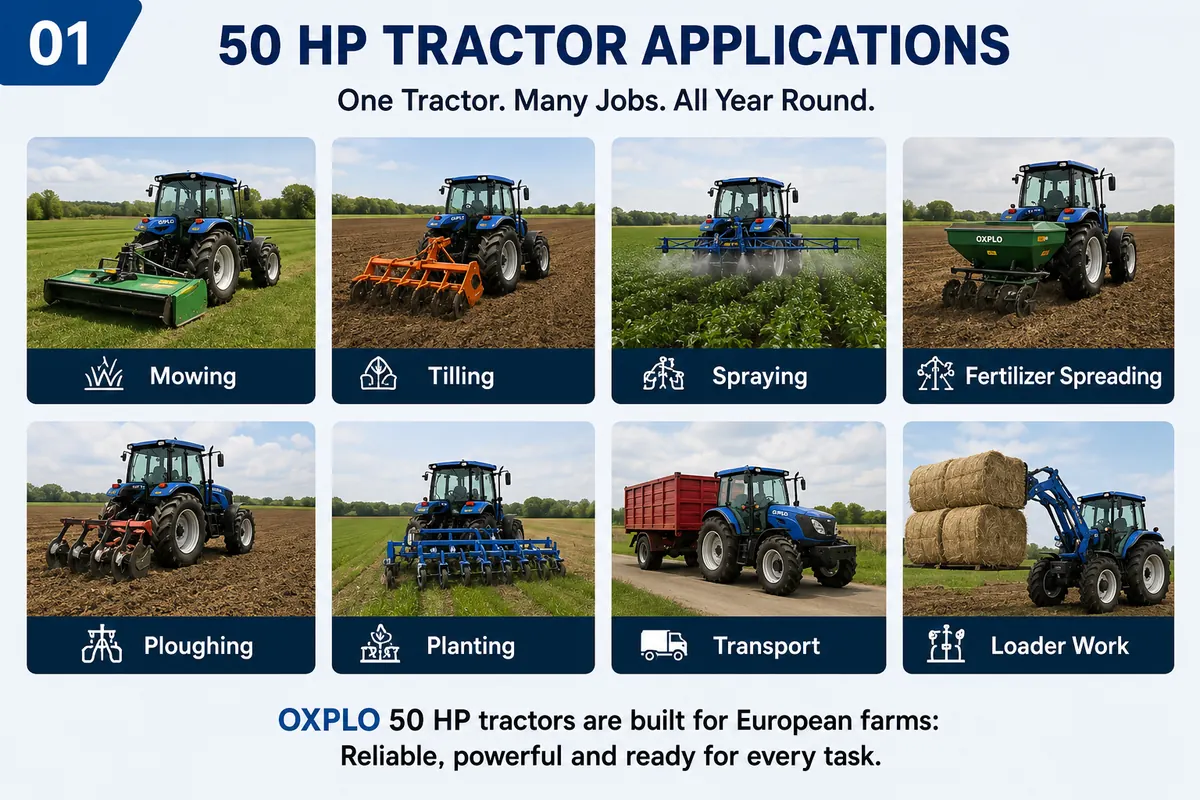
A 50 HP tractor sits in one of the most useful—and most misunderstood—power classes in farm machinery. It is large enough to handle regular PTO work, transport and moderate tillage, yet compact enough for many mixed farms, livestock operations, grassland jobs and properties where a larger utility tractor would be cumbersome.
The mistake is to treat “50 HP” as a complete specification. It is not. Two tractors with the same rated engine power can behave very differently once a rotary tiller, mower, trailer or front loader is attached. PTO output, linkage category, transmission ratios, tractor mass, tyres, ballast and hydraulic demand all change what the machine can do comfortably.
A useful buying process therefore starts with the work, not with the horsepower badge. List the jobs that matter, identify the implements that create the highest load, then select the tractor platform that can run those implements without spending its working life at the edge of its capability.
I. What a 50 HP Tractor Is Actually Good At
The 50 HP class works well when one tractor has to cover several medium-duty jobs instead of specialising in one heavy task. That is common on mixed farms and livestock farms, where the same machine may be mowing in June, moving a trailer in August and running a rotary tiller or spreader at another point in the season.
Typical applications for a 50 HP tractor
Application | 50 HP Fit | What to Check |
Mowing and grassland maintenance | Strong fit | PTO demand, vegetation density, mower width |
Rotary tilling | Strong fit | PTO speed, soil condition, tilling depth |
Fertiliser spreading / spraying | Strong fit | PTO, hydraulics, implement mass |
Light seeding and cultivation | Usually suitable | Linkage, implement width, soil resistance |
Farm trailer transport | Usually suitable | Trailer mass, gradients, braking, tyres |
Light-to-medium ploughing | Application-dependent | Soil type, draft load, ballast, traction |
Front-loader work | Must be checked separately | Hydraulics, axle loading, rear ballast |
Heavy clay / deep tillage | May be marginal | Draft force, working depth, time window |
Long-duration heavy field work | Compare 60–70 HP | Hours/year, implement width, productivity |
Farm size alone is a poor horsepower calculator
A 20-hectare farm with heavy clay and regular primary tillage can place a harder demand on a tractor than a 40-hectare grassland operation that mainly mows, spreads fertiliser and moves trailers. Acreage matters, but it does not describe the load. Soil, working depth, gradients, access width and implement choice often matter more.
Mixed farms are the classic 50 HP use case
For a mixed farm, the attraction of a 50 HP tractor is not that it is exceptionally powerful. It is that the tractor can often cover mowing, spreading, rotary tilling, light cultivation, transport and property maintenance without keeping a second machine idle for most of the year.
There is one condition: the heaviest job should not force the tractor to run near maximum load for hours every week. An occasional difficult pass is one thing. Repeatedly asking a tractor to operate at its limit is a different ownership model—and usually an expensive one.
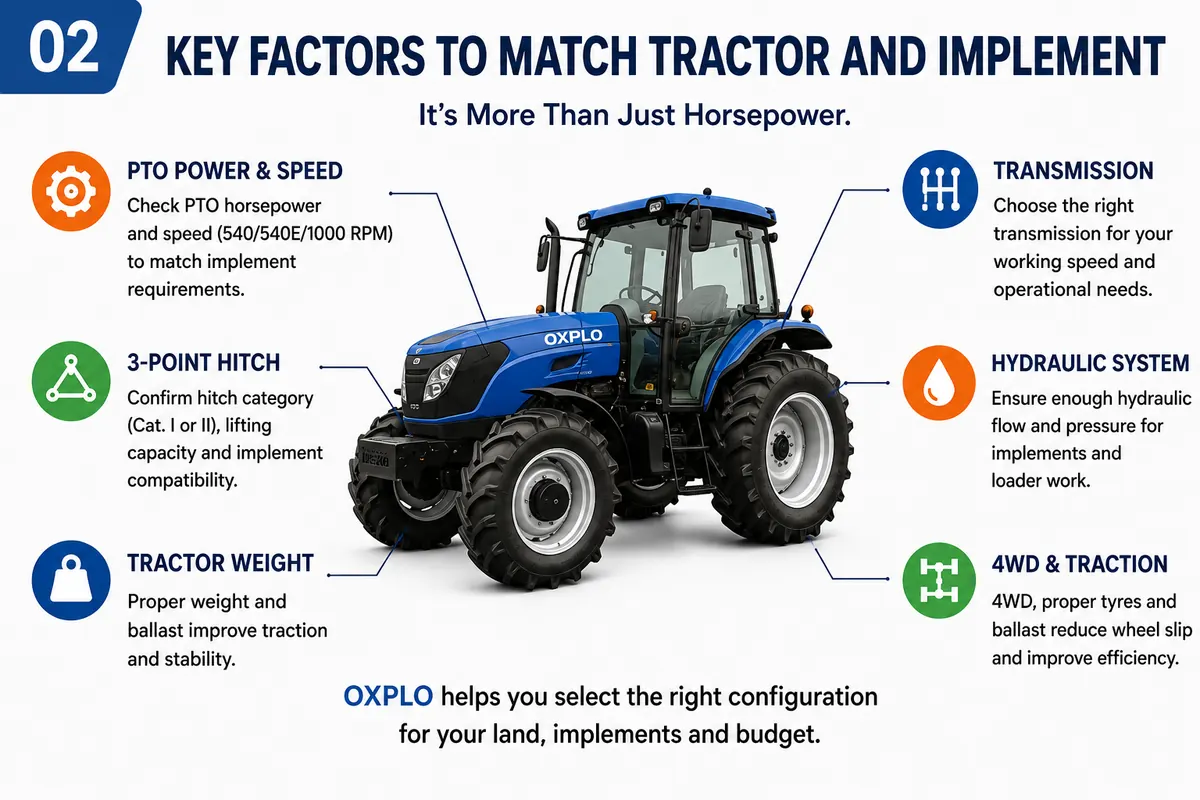
II. Six Specifications That Matter More Than the Horsepower Number
1. PTO output: engine horsepower is not PTO horsepower
For rotary tillers, mowers, spreaders and other PTO-driven implements, rated engine power is only the first screening number. Mechanical losses occur between the engine and the PTO shaft, so a tractor rated at 50 HP does not deliver the full 50 HP at the implement.
This matters most with continuous-load implements. A mower that briefly meets dense material is different from a rotary tiller working hard soil for several hours. If the implement is sized too close to the tractor’s practical PTO limit, the usual symptom is not immediate failure. The tractor simply starts losing PTO speed, ground speed drops and the operator compensates by taking a shallower or slower pass.
That is why an implement labelled “40–50 HP required” still deserves a closer look. Check whether the rating refers to engine HP or PTO HP, and whether it assumes light or heavy working conditions.
2. PTO speed and shaft compatibility
PTO speed is a basic compatibility check that is surprisingly easy to leave until the end. Confirm the implement’s required PTO rpm, the tractor’s available PTO settings and the shaft/spline arrangement before the machine ships.
If you already own the implement, send the supplier a photo of its nameplate, driveline and connection points. A five-minute compatibility check before ordering is cheaper than discovering on site that the tractor and attachment are only “almost” compatible.
3. Three-point linkage category
The same logic applies to the rear linkage. A buyer may ask, “Can this 50 HP tractor use my plough?” and receive the answer, “The horsepower is enough.” That answer is incomplete. Linkage category, pin dimensions, implement weight, lift capacity and centre of gravity still need to match.
This becomes especially important when comparing compact Category I tractors with larger Category II utility platforms. The change in linkage category is often a more meaningful boundary than a 10 HP difference on the engine specification sheet.
4. Transmission and usable working speeds
More gears are not automatically better. The real question is whether the gearbox gives you the speeds you need under load. Rotary tilling is a good example: one gear may be too slow, while the next pushes the engine harder than you want. The operator then spends the day adjusting throttle or reducing working depth.
For field work, check low-speed coverage. For frequent loader or yard work, consider how often the operator reverses direction. For transport, look at road-speed suitability and braking requirements. Transmission design should follow the work cycle, not the brochure comparison.
5. 4WD, tyres and ballast have to be considered together
Four-wheel drive is valuable on grass, loose soil, slopes and wet ground, but 4WD does not cancel poor tyre choice or poor ballast. A tractor with high tyre pressure, inadequate rear weight or the wrong tread can still waste a surprising amount of engine power in wheel slip.
When traction is the limiting factor, adding throttle rarely fixes the underlying problem. First look at the soil, tyre type, inflation pressure, front/rear weight distribution and whether the machine is ballasted for the implement actually being used.
6. Tractor weight: enough for traction, not so much that it becomes a liability
A light tractor may struggle to turn engine power into drawbar pull. A tractor that is heavier than the job requires can increase soil compaction, tyre load and transport fuel use. What you want is not maximum mass but appropriate mass distribution.
Loader work makes this particularly obvious. As load moves forward, front-axle loading rises and the rear axle loses useful weight. Rear ballast, tyre configuration and loader capacity therefore belong in the same calculation.
III. Match the Attachment by the Type of Load It Creates
One reason generic “50 HP attachment size” charts are unreliable is that different implements consume tractor capacity in different ways. A cleaner approach is to separate attachments into PTO-dominated, draft-dominated and weight/hydraulic-dominated groups.
PTO-dominated implements
- Rotary tiller
- Rotary mower
- Flail mower
- Fertiliser spreader
- Post-hole digger
Start with PTO horsepower and PTO speed, then add working width and field conditions. The widest implement a tractor can turn is not necessarily the implement it should run all season. If a rotary tiller only works acceptably at shallow depth and very low ground speed, the advertised compatibility has little operational value.
Check Before Ordering | Why It Matters |
Minimum PTO horsepower | Prevents chronic overload and rpm loss |
PTO speed | Confirms mechanical operating compatibility |
Working width | Directly affects sustained load and hectares/hour |
Material / soil condition | Wet grass or hard soil can change load sharply |
Implement weight | Affects lift, stability and transport behaviour |
Draft-dominated implements
- Mouldboard or disc plough
- Cultivator
- Disc harrow
- Other high-draft soil-working implements
Here the critical system is soil resistance + working depth + implement width + tyre grip + ballast + tractor mass + 4WD. This is why a simple “HP per furrow” rule can go wrong. Dry loam and wet clay are not the same job, even when the implement is identical.
If the tractor reaches its traction limit before its engine limit, buying a few more horsepower will not automatically increase productivity. The extra engine output still has to reach the ground.
Weight- and hydraulic-dominated implements
- Front loader and bucket
- Bale handling attachments
- Hydraulically operated implements
- Heavy rear-mounted equipment
For these jobs, engine horsepower may not be the first constraint at all. Check hydraulic flow and pressure, loader or linkage capacity, axle loading, implement centre of gravity, tyre rating and counterweight. A 50 HP engine rating does not tell you how much a loader can safely lift.
A practical attachment question to ask
Instead of asking a supplier, “What is the biggest implement this tractor can use?”, ask: “What implement size can this tractor run at normal working depth and speed in my soil or crop conditions, with a reasonable power reserve?” The second question produces a much more useful answer.
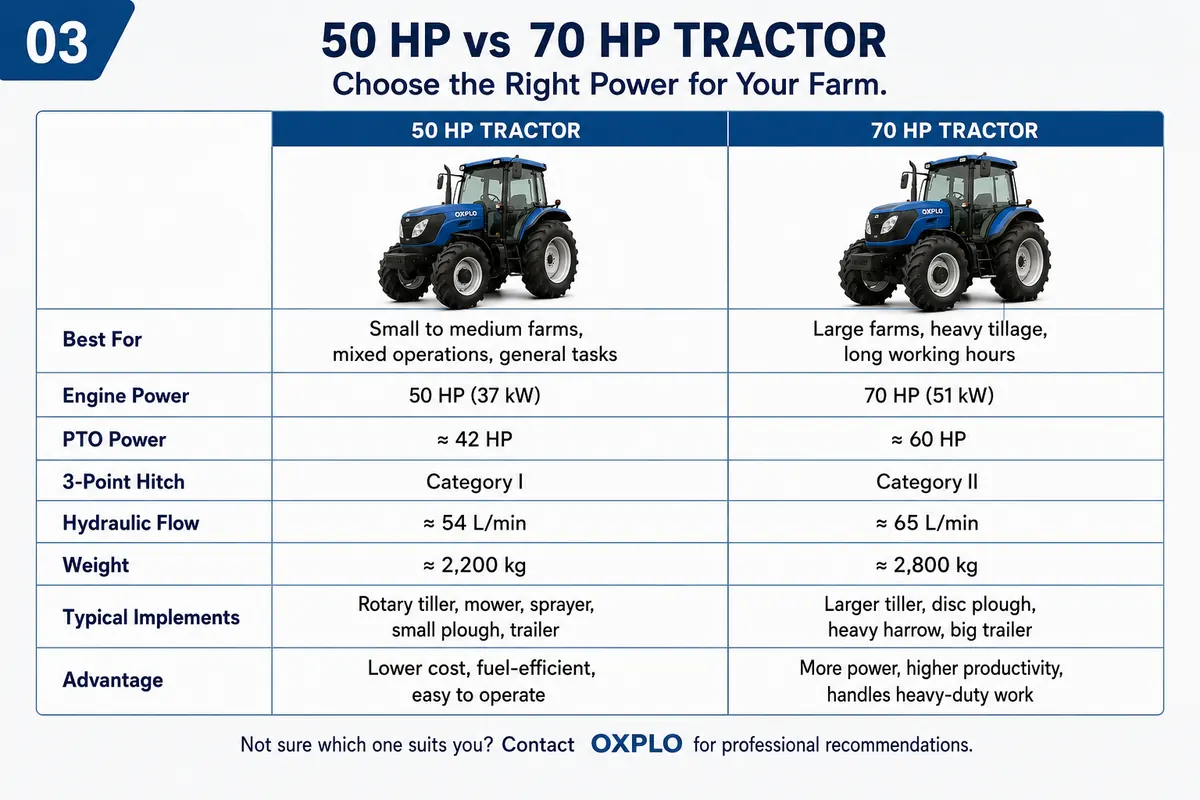
IV. 40 HP vs 50 HP vs 60–70 HP: Where the Real Boundaries Sit
Buyers often move from 40 HP to 50 HP—or from 50 HP to 60 HP—simply to “leave some room.” Extra margin can be sensible, but only when it solves a real bottleneck. Otherwise you pay for capacity that rarely reaches the field.
Power Class | Typical Strength | Why Buyers Choose It | When It May Be Wrong |
40 HP | Mowing, spraying, spreading, light tillage, light transport | Compact access and lower purchase cost | Frequent heavy soil work, larger implements |
50 HP | Mixed farming, PTO work, grassland, transport, moderate tillage | Broad job coverage without moving straight to a larger utility platform | Heavy draft work or high-hour heavy loading |
60–70 HP | Heavier implements, larger trailers, longer seasonal workloads, larger utility jobs | More reserve, larger linkage/tyre/platform options | Tight access, low annual workload, mainly light jobs |
When 40 HP is enough
If the main jobs are mowing, spraying, fertiliser spreading, lighter rotary tilling and transport—and access is tight—a 40 HP tractor can be the more efficient purchase. On small plots with frequent turning, a smaller machine can save more time than another 10 HP adds.
Why 50 HP is often the working compromise
A 50 HP tractor usually makes sense when the farm has a genuinely mixed workload. The extra output over a smaller compact tractor creates more comfortable headroom for PTO work, transport and moderate tillage, but the buyer may still retain a relatively compact chassis and Category I implement ecosystem.
When to move to 60–70 HP
If heavy tillage, larger trailers, wider implements, Category II equipment, frequent loader work or long high-load seasons are routine rather than occasional, a larger platform deserves serious consideration. At that point, trying to save money by keeping every job on a 50 HP machine can cost more in labour time and missed weather windows than the initial purchase saving.
V. Total Cost of Ownership: Count Hours, Not Just Fuel
A tractor quote is easy to compare because the number is visible. Lost field time is harder to see, which is why it is often ignored.
Suppose the smaller tractor can technically run an implement but has to work narrower, slower or shallower to stay comfortable. The extra cost is not just a few litres of diesel. It is additional operator hours, maintenance hours, depreciation hours and—during a short planting, mowing or cultivation window—the risk that the job is not finished before the weather changes.
What belongs in a sensible TCO comparison
- Purchase price and financing cost
- Fuel use under real working load
- Operator hours
- Routine maintenance and wear parts
- Tyres and ballast requirements
- Attachment compatibility and future attachment upgrades
- Downtime and parts availability
- Resale value and expected useful life
- The cost of missing a seasonal working window
There is a reverse side to the calculation. If your tractor only performs heavy work for a few dozen hours a year, buying a much larger machine for those rare events can be poor capital allocation. You are paying all year for capacity that sits unused.
The better question
Ask whether the tractor will spend most of its working life in a comfortable operating range while still covering the few heavy jobs that matter. That is a better ownership test than asking for the largest implement or load the machine can handle once.
VI. Where the OXPLO OXT504 Fits in the 50 HP Class
Once the workload and attachments are clear, a specific machine becomes easier to judge. The OXPLO OXT504 50 HP 4WD Farm Tractor is positioned as the highest-powered model in OXPLO’s compact OXT chassis group. It is aimed at buyers who want more working reserve than a 25–40 HP compact tractor without immediately moving to the larger OXT604 utility platform.
Current OXPLO OXT504 specification
Specification | OXPLO OXT504 |
Rated Power | 37 kW / 50 HP |
Drive Type | 4WD |
Rated Engine Speed | 2,400 rpm |
Transmission | 8 Forward + 8 Reverse |
Rear Linkage | Category I |
PTO Shaft | 6 splines |
Published PTO Speed | 540 / 720 rpm |
Wheelbase | 1,800 mm |
Minimum Ground Clearance | 308 mm |
Overall Dimensions | 3,180 × 1,560 × 2,600 mm |
Listed Total Weight | 2,200 kg |
Front / Rear Tyres | 6.5-16 / 11.2-24 |
The useful part of this specification is not the 50 HP figure on its own. It is the combination: 50 HP + 4WD + 8F/8R + Category I linkage + a listed 1,560 mm overall width. In practice, that puts the OXPLO OXT504 in a specific niche: more output on a compact platform for farms that still rely on Category I implements and value access.
Who should look closely at the OXPLO OXT504?
The OXPLO OXT504 is most relevant when the farm has outgrown lighter compact-tractor work but has not moved into routine heavy utility work. Typical examples include mixed farms, livestock farms, grassland maintenance, regular mowing and rotary tilling, spreading, farm transport and moderate soil preparation.
OXPLO does not recommend treating the OXT504 as a universal answer simply because the engine is rated at 50 HP. Attachment matching still comes first. The published product page lists Category I linkage and 540/720 rpm PTO; OXPLO also notes that the final PTO configuration and destination-market specification should be confirmed on the quotation before purchase.
The OXT504 is not a substitute for the OXT604
This boundary matters. When a buyer needs Category II implement compatibility, a larger utility chassis, larger tyres, a longer wheelbase or a wider transmission ratio range, OXPLO’s larger tractor platform should be compared instead. You can review the full OXPLO tractor range from 25–70 HP rather than forcing every application onto a 50 HP chassis.
Attachments should be configured around the job
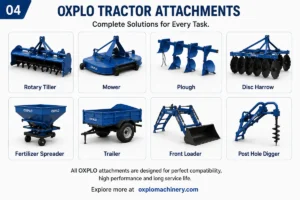
OXPLO supports a broad range of tractor implements for soil preparation, mowing, transport and farm maintenance. The important part is compatibility. On the OXPLO attachments and support page, buyers can review available implement types, but the final choice should still be checked against PTO, linkage, hydraulic demand, implement weight and working width.
VII. What to Send OXPLO Before You Ask for a Quote
A one-line inquiry—“Please quote your 50 HP tractor”—can only produce a price. It cannot produce a useful configuration recommendation. OXPLO can give a much more specific answer when the inquiry describes the work.
1. Farm and site information
- Destination country
- Farm size and typical field size
- Flat, rolling or hilly terrain
- Soil type and wet-ground conditions
- Narrowest gate, building entrance or row width
2. The five jobs that matter most
- Mowing
- Rotary tilling
- Ploughing / cultivation
- Trailer transport
- Loader work
- Spraying or fertiliser spreading
- Any specialised seasonal job
3. Existing or planned attachments
For each implement, give OXPLO the working width, weight, required PTO speed, linkage category and hydraulic requirement if known. If the equipment is already on the farm, photos of the nameplate and connection points are even better.
4. Annual workload
A tractor working 100 hours per year is a different purchasing decision from one expected to work 800 hours. Tell OXPLO the likely annual hours, peak season and longest continuous work cycle. This helps separate a machine that can perform the job from one that is genuinely sized for the job.
5. Loader requirements need their own conversation
If a front loader is required, specify the material to be handled, approximate load, lift height and attachment type. OXPLO can then check loader specification, hydraulic requirements, tyre and ballast configuration rather than relying on the 50 HP engine rating as a proxy for loader capacity.
6. Confirm the destination-market configuration in writing
For European orders in particular, confirm engine/emissions configuration, operator protection, braking, lighting, tyres, road-use requirements and applicable conformity documentation. Final production specifications can vary by destination and option package.
If you already know the application but are unsure which horsepower level or attachment package is appropriate, the OXPLO Tractor Customization page is the most useful place to start. OXPLO can work from the actual farm conditions instead of quoting a tractor from horsepower alone.
VIII. FAQ: Common Questions About 50 HP Tractors
Q1. Is a 50 HP tractor enough for a small farm?
Often, yes. A 50 HP tractor can cover mowing, rotary tilling, spreading, transport and general property work on many small and medium farms. Heavy clay, steep ground or larger implements, however, can push the requirement higher.
Q2. Is a 50 HP tractor a good choice for a mixed farm?
Yes, this is one of the strongest use cases. A 50 HP tractor can move between PTO work, transport, grassland maintenance and moderate cultivation, provided the heaviest recurring job still leaves some operating margin.
Q3. Do I need 4WD on a 50 HP tractor?
If the tractor regularly works on soil, grass, wet ground or slopes, 4WD is usually worthwhile. It improves traction, but correct tyres, tyre pressure and ballast still matter.
Q4. What attachments can a 50 HP tractor use?
Common choices include rotary tillers, mowers, ploughs, harrows, spreaders, trailers and selected loader attachments. Final sizing still depends on PTO demand, linkage, hydraulics, implement mass and field conditions.
Q5. Is 50 HP enough for a front loader?
Not by horsepower alone. Loader capacity depends on the loader structure, hydraulics, front-axle loading, tyres, counterweight and stability, so check the loader specification separately.
Q6. Should I buy a 50 HP or 60 HP tractor?
Choose by annual workload and implement requirement. If 50 HP comfortably covers almost all jobs, moving up may add cost without much benefit. If heavy cultivation, larger trailers, Category II implements or high-hour loader work are routine, compare a larger utility platform.
Q7. What should I confirm before ordering an OXPLO OXT504?
Confirm the destination-market engine configuration, PTO speed, linkage, tyres, operator station, attachments and any loader package on the quotation/specification sheet. OXPLO product information is a starting point; the order document should be the final reference.
IX. Conclusion: Choose the Work First, Then Decide Whether 50 HP Is Right
The expensive mistake is choosing the tractor before defining the work—not simply being a few horsepower above or below the ideal.
Start with the implements. Check PTO, linkage and hydraulics, then soil and terrain. Ask whether a 50 HP tractor can do the recurring jobs at normal working speed with some reserve—not whether it can perform them once under ideal conditions.
When the answer is yes, the 50 HP class can cover a broad annual workload without automatically bringing the size and cost of a larger utility tractor.
For buyers comparing models in this range, OXPLO offers 25–70 HP farm tractors, including the OXPLO OXT504 50 HP 4WD tractor, plus compatible attachment options. Send OXPLO your land conditions, main jobs, existing implements and destination country for a configuration recommendation.