
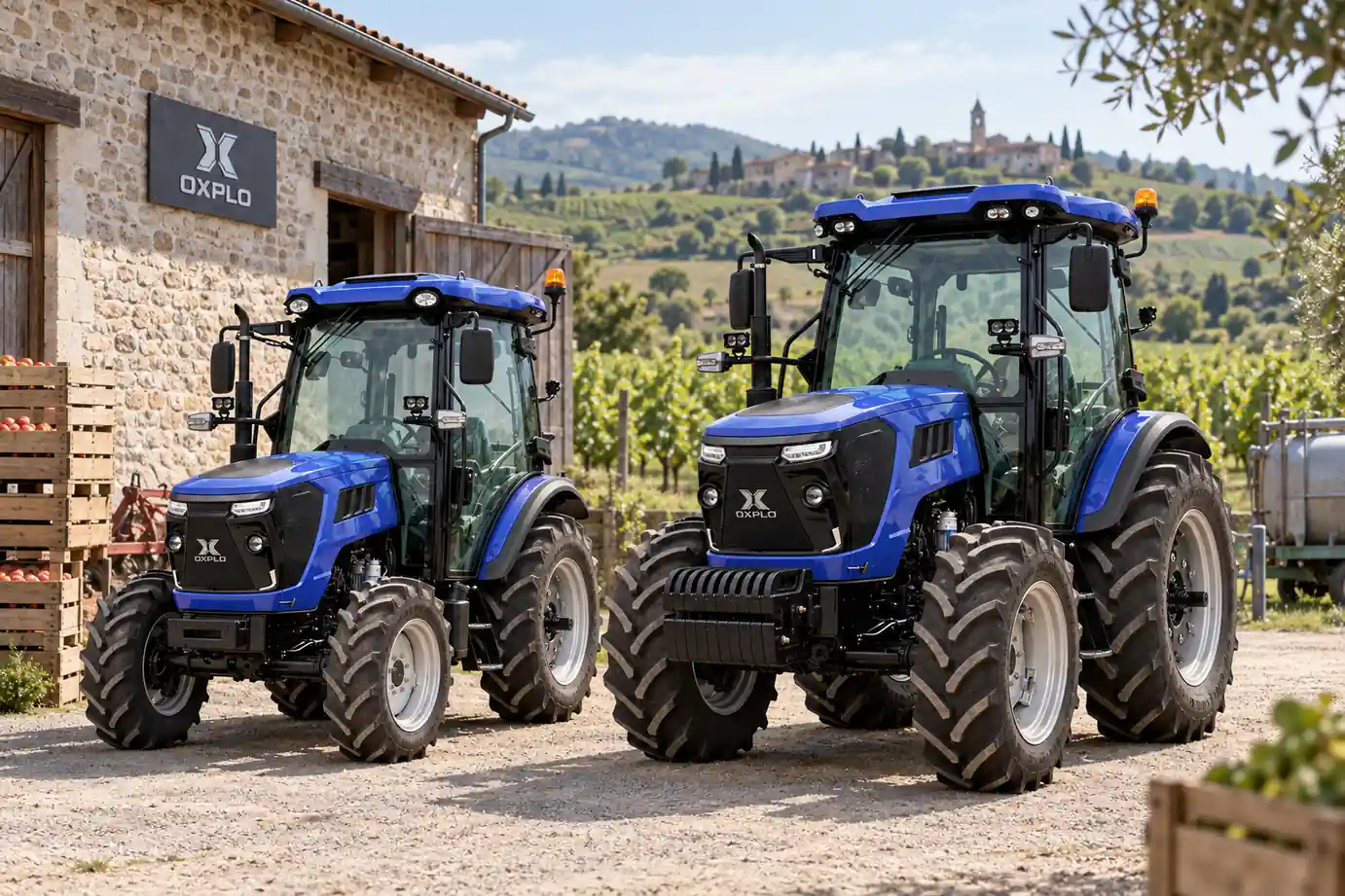
A practical buying guide for traction, soil conditions, implements, TCO and European farm applications
A farmer can own a tractor with enough engine horsepower and still lose an afternoon because the machine cannot put that power into the ground. This is the part of the 2WD vs 4WD tractor debate that specification sheets often hide. Horsepower describes what the engine can produce; field productivity depends on how effectively that power reaches the soil, the implement and the job.
For European farms, the difference matters because working conditions rarely stay constant. One agricultural tractor may spend Monday mowing dry grass, Tuesday moving feed around a wet livestock yard, and Friday pulling a cultivator through heavier soil. Add narrow gateways, sloping fields, short weather windows and road transport between parcels, and the cheapest drivetrain on the quotation can become the most expensive choice in operation.
The right question is therefore not simply, “Is a 4WD tractor better than a 2WD tractor?” The useful question is: “Which drivetrain gives my farm enough usable traction without adding unnecessary weight, complexity or cost?” This guide explains how to answer that question from the work backwards.
I. Start with the Real Constraint: Usable Traction, Not Engine Horsepower
Every tractor converts engine output through the transmission, axles and tyres before the ground can generate usable drawbar pull. If the tyre-soil interface becomes the bottleneck, more engine power does not automatically mean more work completed per hour.
Why a 2WD tractor can feel powerful on the road but weak in the field
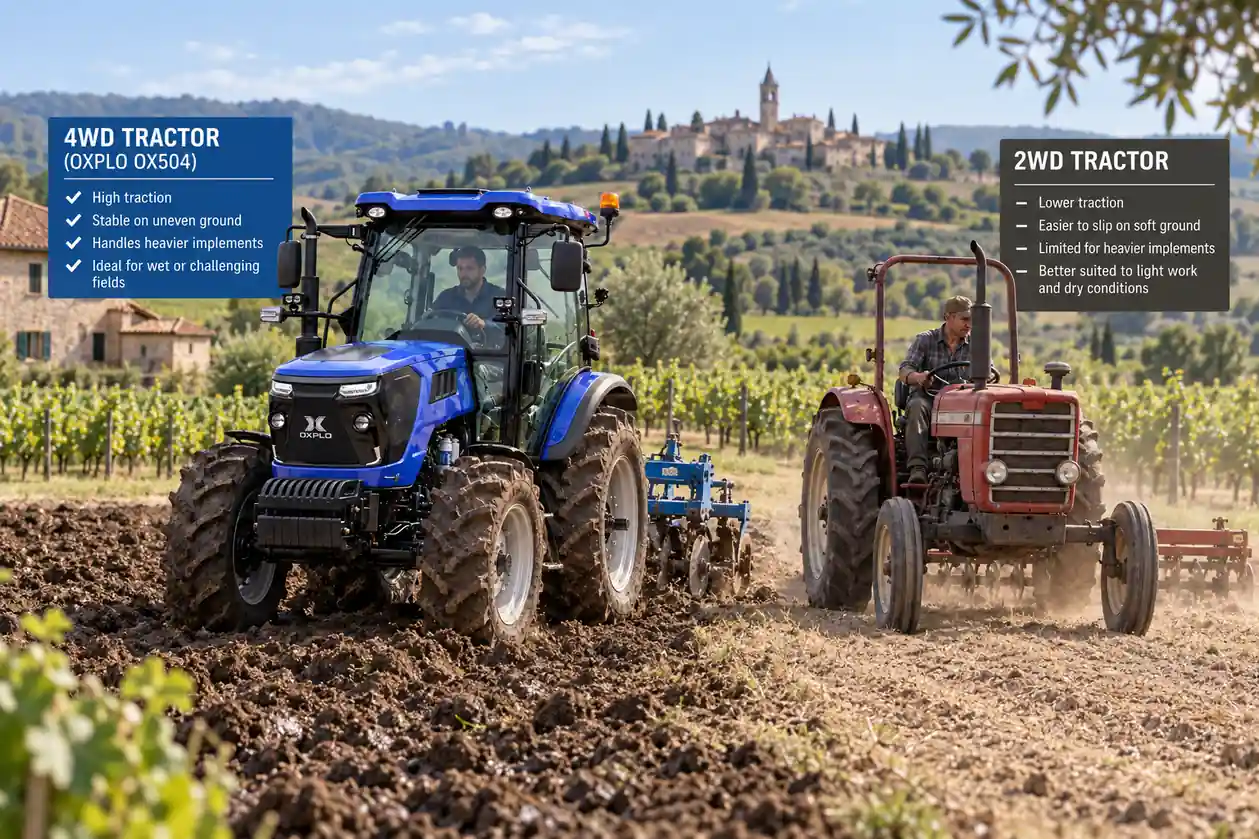
A conventional 2WD tractor normally relies on the rear axle for propulsion while the front axle primarily steers. On firm, dry ground, this can be efficient and entirely adequate. PTO-driven mowing, spraying, light trailer work and routine transport may not require high drawbar pull, so a simple 2WD platform can make economic sense.
The limitation appears when draft demand rises or ground strength falls. Wet clay, loose cultivated soil, grassland after rain and an uphill pull all reduce the margin between available traction and required traction. When rear-wheel slip increases, the engine may still have reserve power, but the tractor is no longer converting it into useful forward work. The operator sees lower ground speed, deeper ruts and more time per hectare.
What a 4 wheel drive tractor actually changes
A 4 wheel drive tractor allows both axles to contribute to propulsion. The benefit is not that four driven wheels magically create horsepower. The benefit is that tractive effort is shared across more tyre contact area and more of the machine’s weight can contribute to propulsion. In variable field conditions, this usually gives the operator more margin before excessive wheel slip becomes the limiting factor.
That margin is especially valuable when the tractor must keep moving with a mounted implement, pull through soft patches, work on gradients or handle recurring loader tasks. But 4WD is still only one part of the system. Tyres, ballast, inflation pressure, implement weight and soil moisture can erase much of the advantage if they are wrong.
II. When 2WD Is Still the Rational Choice
A serious buying guide should say this clearly: not every European farm needs a four wheel drive farm tractor. Buying 4WD only because it sounds more capable can create unnecessary acquisition cost and maintenance complexity, particularly when traction is rarely the farm’s limiting factor.
2WD works well when draft demand is low and surfaces are predictable
A 2WD tractor remains a practical choice where most working hours are spent on firm, level ground and where the tractor mainly powers implements through the PTO rather than pulling them through high-resistance soil. Typical examples include light mowing, spraying, yard transport, stationary PTO work and trailer movement on hard surfaces.
For a farm with limited annual tractor hours, predictable dry-season work and modest implements, the lower mechanical complexity of 2WD can be a genuine advantage. There is little value in paying for additional traction that is almost never used.
Do not confuse low purchase price with low total cost
The mistake occurs when buyers evaluate only the invoice. A 2WD machine may be cheaper to purchase but more expensive to operate if it repeatedly loses productive hours during wet periods, cannot safely handle the planned implement combination, or needs extra passes because wheel slip reduces field efficiency.
The decision should therefore consider annual workload. A tractor used 150 hours per year for light duties and one used 800 hours across cultivation, livestock work and transport should not be evaluated with the same logic, even if both have the same rated horsepower.
III. Where a 4WD Tractor Changes the Economics of Farm Work
The value of 4WD rises quickly when the farm combines changing soil conditions, heavier implements and short operating windows. In these situations, the drivetrain affects not only traction but whether the work can be completed at the right time.
Wet grassland and clay soils: traction is only half of the problem
After rain, the first symptom is often wheel slip. A 4WD tractor normally maintains useful motion longer than a comparable 2WD machine because traction is shared between the axles. That can be important for livestock farms, grassland maintenance and mixed farms where work cannot always wait for perfectly dry conditions.
However, this creates a second risk: just because the tractor can enter a wet field does not mean the field should be worked. Soil compaction can reduce infiltration, restrict root growth and create longer-term yield penalties. Four-wheel drive should be used to improve controlled traction, not as permission to operate on soil that cannot carry the machine.
Slopes, orchards and vineyards: traction must be evaluated together with stability
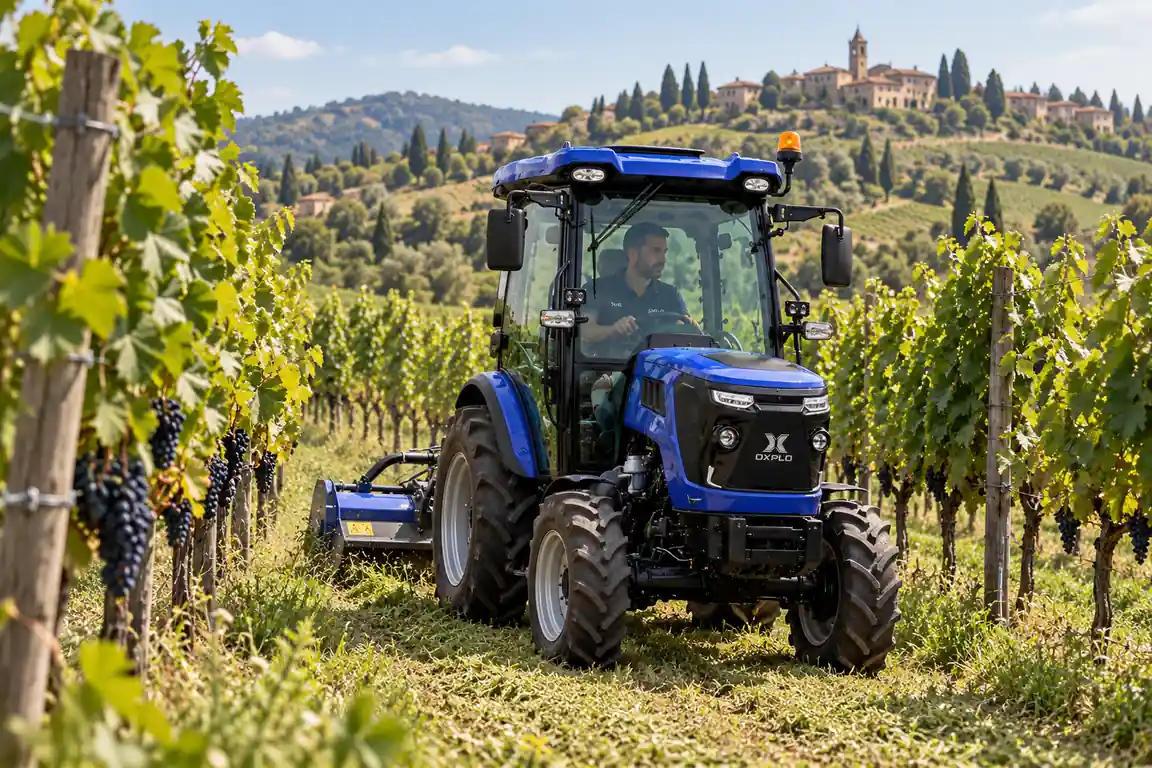
On sloping ground, drivetrain choice becomes part of a wider stability and control problem. A compact 4WD tractor can provide more consistent traction during uphill work and on grassed rows, but buyers still need to assess overall width, wheel track, centre of gravity, tyre specification, braking, rollover protection and the weight of any mounted implement.
This is particularly relevant in orchards and vineyards where the machine may need to remain narrow enough for rows while carrying a mower, sprayer or transport attachment. A compact tractor that fits the row but becomes unstable with the planned implement is not a correct match. Access dimensions and working stability must be checked together.
Loader work: the front axle is no longer just steering
Front-loader applications change axle loading dramatically. During material handling, more weight transfers toward the front axle, while repeated forward-reverse cycles and uneven yard surfaces demand controlled low-speed traction. In this use case, 4WD often provides a more useful working platform than 2WD, but only when loader capacity, hydraulic connections, front-axle limits and rear counterweight are treated as one configuration.
Short weather windows: downtime has a real cost
A European buyer should also price the cost of missing a weather window. If mowing, soil preparation or seeding must be completed within a few days, a tractor that loses half a day to marginal traction may create a larger business cost than the original drivetrain price difference. This is why 2WD vs 4WD tractor selection should be connected to the farm calendar, not only to a dealer quotation.
IV. The Hidden Costs: Five Ways Buyers Waste Money Even After Choosing 4WD
Four-wheel drive does not correct a badly matched tractor. Many expensive ownership problems begin after the buyer has already made the “right” drivetrain decision but ignores tyres, ballast, implements or operating conditions.
1. Using ballast as the first answer to wheel slip
Extra weight can increase available traction, but more weight also increases soil loading, rolling resistance and stress on tyres and driveline components. The objective is not to make the tractor as heavy as possible. The objective is to achieve enough traction with the minimum sensible operating weight and correct front-to-rear balance for the job.
2. Treating tyre pressure as a minor maintenance setting
Tyre pressure changes the size and shape of the contact patch. An overinflated field tyre can reduce the tractor’s ability to use available weight effectively, while an underinflated tyre can create heat, casing damage or instability. Buyers should distinguish field pressure requirements from road transport requirements and follow tyre-manufacturer load tables rather than using one pressure for every task.
3. Changing 4WD tyre sizes without checking front-rear rolling relationship
Mechanical four-wheel-drive systems depend on a designed relationship between front and rear rolling circumference. Replacing only one axle with an apparently similar tyre size can alter that relationship. The result can be tyre scrub, abnormal wear, steering resistance or driveline wind-up on firm surfaces. Front and rear tyre packages should be treated as a matched set, not as independent purchases.
4. Comparing tractors by HP while ignoring the implement interface
Two 50 HP tractors can have very different practical capabilities. Linkage category, PTO configuration, hydraulic demand, machine weight, wheelbase, tyre size and implement geometry determine what the tractor can actually operate. A buyer who already owns Category II implements should not select a Category I tractor just because the engine horsepower appears sufficient.
5. Ignoring road-use and destination-market requirements
European tractor procurement does not end with field performance. The EU has a regulatory framework for the approval and market surveillance of agricultural and forestry vehicles, while registration and road-use details can still vary by destination and vehicle configuration. Buyers should confirm braking, lighting, mirrors, operator protection, tyres, emissions-related requirements and the available conformity or approval documentation before shipment. A mechanically suitable tractor can still be the wrong commercial choice if the destination-country requirements are not confirmed early.
V. A Practical 2WD vs 4WD Tractor Selection Framework
Before asking for price, classify the work. This prevents the common mistake of choosing a tractor first and trying to force the farm around it later.
Working Condition | 2WD Logic | 4WD Logic | What to Verify |
Dry, level land; light PTO work | Often sufficient and cost-efficient | Useful but may be unnecessary | PTO, implement weight, annual hours |
Wet grassland or clay soil | Traction can become the bottleneck | Usually gives more usable traction margin | Tyres, pressure, soil carrying condition |
Hilly or sloping fields | Requires careful traction and braking assessment | Often more suitable, but not a substitute for stability | Width, track, ROPS/cab, brakes, implement weight |
Frequent loader work | Can be limiting in soft yards or with front axle loading | Usually better matched to repeated handling work | Loader, hydraulics, axle limits, rear ballast |
Road transport dominates | May offer lower complexity | Useful if field work also requires traction | Road equipment, braking, tyres, registration requirements |
Mixed farming / multiple implements | Suitable if draft demand stays moderate | Higher versatility when conditions vary | Linkage category, PTO, hydraulics, gearbox |
The eight questions to answer before comparing quotations
- What are the three jobs that will consume the most tractor hours each year?
- Is the ground normally firm, loose, wet, clay-heavy, sloping, or a combination of these?
- What is the heaviest or highest-draft implement you plan to use?
- Is your current implement fleet Category I or Category II?
- Which PTO speed, shaft type and hydraulic flow do the key implements require?
- What is the narrowest gate, building entrance, orchard row or vineyard spacing the tractor must pass?
- How much road transport will the tractor perform, and what local road-use requirements apply?
- How many hours per year will the machine work, and how costly is a one-day delay during your busiest season?
If several of these questions are unanswered, comparing tractor prices is premature. The correct quotation is not the cheapest machine with the required horsepower; it is the configuration that matches the farm’s highest-cost constraints.
VI. Matching European Farm Work to the OXPLO 4WD Tractor Range
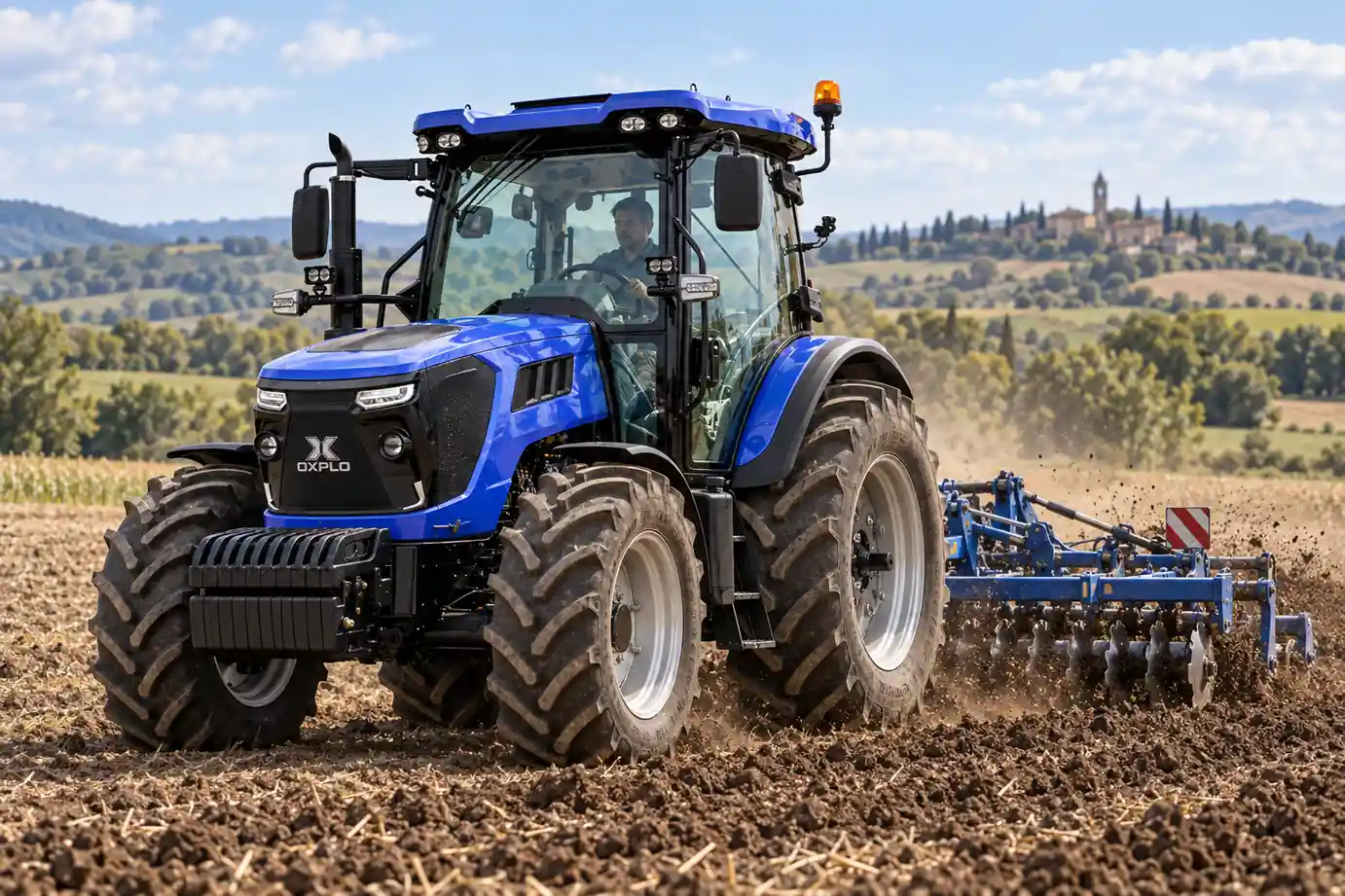
This is where the drivetrain discussion becomes a product-selection problem. OXPLO currently offers a 25–70 HP tractor range built around 4WD, allowing buyers to move from compact Category I machines to larger Category II utility platforms without treating horsepower as the only decision variable. Buyers can review the full OXPLO tractor range or use the tractor selection and customization page to compare working requirements before requesting a configuration.
25–50 HP OXPLO: compact 4WD tractor logic
The OXPLO 25–50 HP range is intended for buyers who need four-wheel-drive traction but still care strongly about access, manoeuvrability and Category I implement compatibility. This is the part of the market where “bigger” can easily become a disadvantage: a larger agricultural tractor may offer more mass and capacity but may not fit the gate, row spacing, building or working pattern.
For example, the OXPLO OXT404 40 HP 4WD tractor is published with an 8F+8R transmission, Category I rear linkage and a listed 1,560 mm overall width. It is therefore relevant to mixed farms, grassland work and wider-row orchard applications where compact access remains important but lower-powered machines no longer provide enough working reserve.
The OXPLO OXT504 50 HP 4WD tractor stays in the compact platform while increasing rated output to 50 HP. That distinction matters for buyers who want more capacity for recurring PTO work, livestock support, transport and seasonal soil preparation without automatically moving to the larger Category II chassis.
For European customers, the commercial value of this OXPLO compact 4WD tractor group is not simply that every model has four driven wheels. The value is the ability to keep a relatively compact footprint while adding traction for variable surfaces. It suits farms where access and manoeuvrability are as important as raw drawbar capability.
60–70 HP OXPLO: a larger Category II utility platform
When the farm moves into heavier implements, more frequent loader work, higher annual hours or broader mixed-farm duties, the required change is often larger than another 10 HP. Linkage category, wheelbase, tyres, machine mass and gear range start to matter more.
The OXPLO OXT604 60 HP 4WD utility tractor is the entry point to OXPLO’s larger platform. Its published configuration includes a 12F+12R transmission, Category II linkage, 2,010 mm wheelbase and approximately 2,500 kg listed weight. This makes it relevant where the customer needs broader implement compatibility and a chassis designed around higher recurring workloads.
The OXPLO OXT704 70 HP 4WD tractor uses the same larger Category II concept with additional engine reserve for mixed farming, livestock operations, transport, cultivation and compatible front-loader applications. For a buyer deciding between an OXPLO compact tractor and the 60–70 HP range, the question should be whether the farm needs the larger platform—not whether 70 HP simply looks better on a specification sheet.
OXPLO Platform | Published Configuration Logic | Best Buying Question |
25–50 HP compact 4WD | Cat. I; compact access; suitable for lighter-to-medium mixed duties | Do I need more traction and usable power while keeping compact dimensions? |
60–70 HP utility 4WD | Cat. II; larger chassis; broader implement range; higher recurring workload | Have my implements, loader work or annual hours outgrown a compact Cat. I platform? |
What OXPLO should confirm before an order
OXPLO tractors can be configured around different farm applications, but the correct B2B process is to confirm the working environment before finalizing the machine. European customers should provide destination country, farm type, main jobs, existing implements, PTO requirements, linkage category, working width constraints, expected annual hours and any front-loader requirement.
OXPLO should then confirm the supplied tyres, transmission, PTO configuration, linkage, operator-station equipment, lighting, braking-related equipment, loader interface and available destination-market documentation on the quotation or confirmed specification sheet. This is particularly important because specifications can vary by model and market configuration. The quotation should be treated as the final technical reference rather than assuming every website value applies to every supplied machine.
VII. Frequently Asked Questions About 4WD Tractors for European Farms
Is a 4WD tractor always better than a 2WD tractor?
No. A 4WD tractor generally provides more traction margin in soft soil, wet grass, slopes and higher-draft work, but a 2WD tractor can still be the more economical choice for light PTO work, firm surfaces and low annual hours. The answer depends on where the tractor loses productivity today.
Does 4WD reduce fuel consumption?
Not automatically. If 4WD reduces excessive wheel slip and allows the machine to complete the same work in less time, fuel used per hectare or per completed job may improve. But a heavier or badly ballasted 4WD tractor can also waste energy. Evaluate fuel in relation to completed work, not litres per hour alone.
Should I choose a compact 4WD tractor for an orchard or vineyard?
Often, but dimensions must be checked before horsepower. Compare overall width, row spacing, turning area, canopy clearance, slope, tyre options and the weight of the mower or sprayer. A compact 4WD tractor is useful only if the complete tractor-implement combination fits and remains stable in the actual rows.
When should I move from Category I to Category II?
Move to Category II when the implement fleet, implement weight, working width and recurring workload require the larger interface and chassis. This is one reason OXPLO separates its compact 25–50 HP range from the larger 60–70 HP platform rather than presenting horsepower as the only progression.
What information should I send OXPLO before asking for a price?
Send the destination country, farm type, field conditions, slopes, three main jobs, current implements, linkage category, PTO requirement, narrowest access width, annual working hours and any front-loader requirement. OXPLO can then discuss a configuration that is technically relevant before preparing the final quotation.
VIII. Conclusion: Choose the Tractor Around the Farm, Not the Drivetrain Label
The 2WD vs 4WD tractor decision becomes much easier once the buyer stops asking which drivetrain is “better” in isolation. A 2WD agricultural tractor can still be a sound investment on firm, level ground with light draft demand. A 4WD tractor earns its additional cost when wet ground, slopes, loader work, heavier implements or short weather windows regularly make traction a business constraint.
The most expensive mistake is not choosing 2WD instead of 4WD. It is buying a tractor whose tyres, weight, linkage, PTO, dimensions or compliance package do not match the jobs it must perform.
For buyers evaluating an OXPLO 4WD tractor, the practical next step is to define the work before requesting a quote. Share your destination country, field conditions, slopes, main implements, access limits and annual workload. OXPLO can then compare the compact 25–50 HP Category I range with the 60–70 HP Category II platform and confirm a specification around the actual farm application rather than simply recommending the highest available horsepower.
Specification note: Published tractor specifications and destination-market equipment may vary by model and configuration. Confirm the final transmission, PTO, tyres, linkage, operator-protection equipment, road-use equipment and available documentation on the quotation and confirmed specification sheet before ordering.