
An application-led buying guide for Italian farms, rural contractors and small construction teams.
A blocked drainage outlet, a damaged farm track and a delivery of aggregate may seem like three unrelated jobs. For a small Italian farm or contractor, however, they can create the same problem: too many short tasks that require different machinery, transport arrangements and operator time.
A wheel loader can move bulk materials efficiently, but it cannot perform conventional trench excavation. A backhoe loader combines front loading with rear digging, although its loading and excavation capacities may be lower than those of dedicated machines. The right choice is not the machine with the most functions. It is the machine that removes the most expensive bottleneck from your workload.
This backhoe loader vs wheel loader Italy guide explains the technical trade-offs, common purchase mistakes and total-cost considerations. It also identifies where the OXPLO OX15-20 is a credible candidate for mixed farm and site work—and where OXPLO should recommend a different equipment approach.
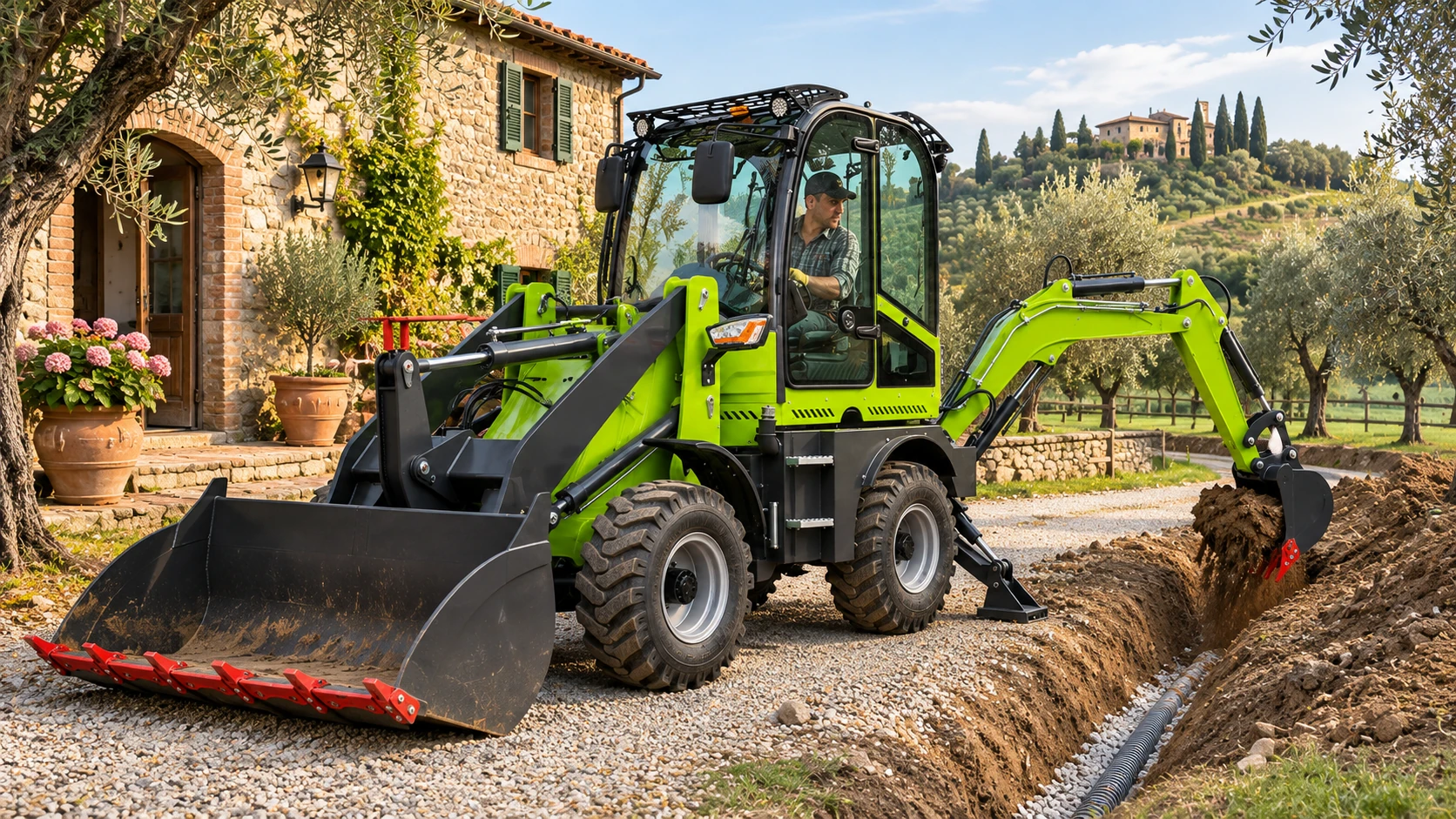
Figure 1. Illustration of the green OXPLO OX15-20-style backhoe loader supporting rural drainage work in Italy. No additional machinery is shown.
I. Start With the Jobs That Actually Cost You Money
Small Repairs Often Cost More to Organize Than to Perform
Consider a mixed farm that occasionally repairs irrigation pipes, clears drainage ditches, renews a gravel entrance and loads spoil into trailers. The excavating portion of each job may be short, but hiring an excavator and a loader separately can involve two transport charges, minimum hire periods and scheduling delays. If one qualified operator performs the tasks in sequence, a suitable backhoe loader may reduce these hand-offs.
That is the real value of combined loading and digging farm equipment: not a promise of higher output in every operation, but the ability to finish varied, small jobs with fewer machine changes. The benefit is strongest when excavation and loading are intermittent, the site is accessible, and the equipment remains within its approved working limits.
High-Volume Loading Changes the Economics
A materials supplier or aggregate yard has a different operating problem. Its customers may need trucks loaded repeatedly, and delays accumulate throughout the day. In that setting, paying for a rear excavator that is rarely used offers little value. A dedicated wheel loader with suitable payload, bucket geometry and travel-cycle performance is usually a stronger candidate.
Before requesting quotations, estimate what percentage of paid machine hours involves excavation, loading and travel or setup. Also ask whether the jobs happen in sequence or simultaneously. One backhoe loader cannot dig at one location while loading trucks at another. If both operations must run continuously, two specialized machines may be economically justified.
II. Technical Trade-Offs: Digging Ability vs Loading Output
What a Backhoe Loader Can—and Cannot—Replace
A wheeled backhoe loader has two distinct work systems. The front loader handles loose material, surface clean-up and backfilling; the rear boom, dipper and bucket can excavate below ground level. This makes it useful for drainage repairs, service trenches and small projects in which digging and material handling alternate.
The limitations are equally important. Excavation requires correct positioning and stabilizer procedures; a long trench may demand frequent repositioning. A backhoe loader does not inherently match the reach or sustained digging rate of a dedicated excavator. Nor should its front bucket be assumed to match a purpose-built wheel loader for continuous aggregate work.
Why Wheel Loader Bucket Efficiency Depends on the Whole Cycle
Wheel loader productivity is governed by effective bucket volume, fill factor, permissible payload, travel distance, ground traction, operator technique and the receiving vehicle. A larger bucket cannot be used at full volume if dense material would exceed the machine’s safe loading limit. Equally, a fast loader can still underperform when a cramped yard forces long reversing movements or repeated repositioning.
Customer’s main job | Backhoe loader | Wheel loader |
Short drainage or utility trench | Suitable if digging depth, reach and clearance are adequate | Requires separate excavation equipment |
Dig, load spoil and backfill in one visit | Often useful for sequential mixed work | Needs an excavator for the digging stage |
Repeated sand, soil or gravel loading | Can become cycle-limited | Usually the stronger loading option |
Farm-road repair and small yard maintenance | Supports several project stages | Strong when material movement dominates |
Palletized building products | Not usually the first choice | A rated forklift may be more appropriate |
Two crews excavating and loading simultaneously | One unit cannot do both at once | Can operate alongside a dedicated excavator |
III. Italian Worksites: Where the Wrong Machine Becomes Expensive
Vineyards and Olive Groves: Access Is More Than Machine Width
A machine may fit through a vineyard gate yet have insufficient room to work. Row ends, terraces, irrigation lines, roots and existing walls all affect equipment positioning. A backhoe requires clearance for the rear boom, spoil placement, and the prescribed stabilizer footprint. Ground conditions after rain can further restrict safe access.
For OXPLO buyers this is a particularly useful check. The published OX15-20 overall width is 1,680 mm, but its front loader bucket is 1,800 mm wide. A gate that clears the machine body may not clear its bucket. Buyers should measure the narrowest passage, allow additional safety clearance and check the full working envelope—not simply compare the gate with the advertised chassis width.
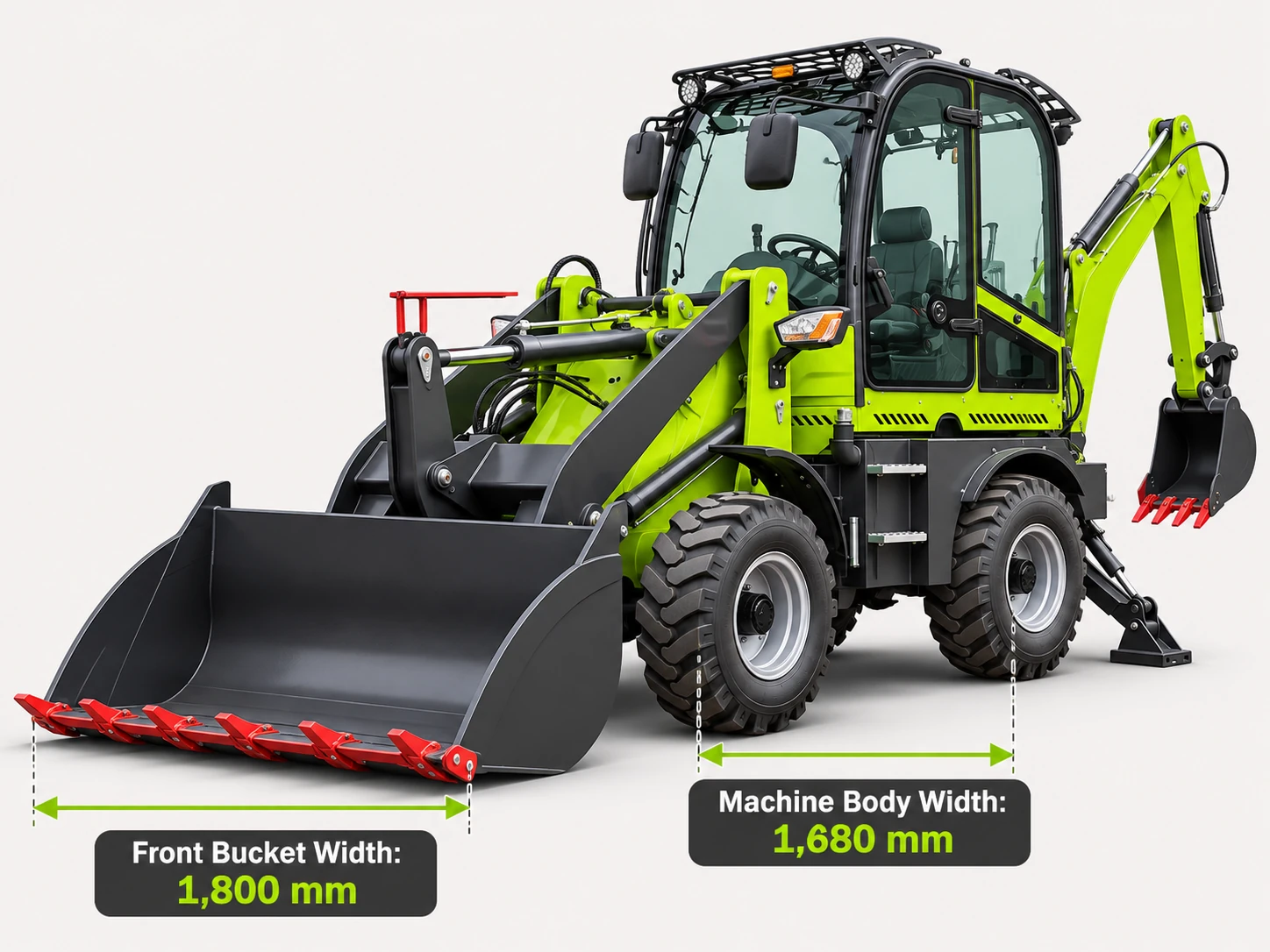
Figure 2. OX15-20 access check: published body width 1,680 mm and front bucket width 1,800 mm. Check full working clearances separately.
Farm Drainage: Diagnose the Water Problem Before Digging
A blocked outlet, sediment, a failed pipe and poor surface grading require different remedies. Excavating more deeply without understanding the fault may leave the drainage problem unchanged or damage buried services. A compact backhoe loader can support localized excavation, removal of spoil and subsequent backfilling, but the trench design and ground safety requirements must be established first.
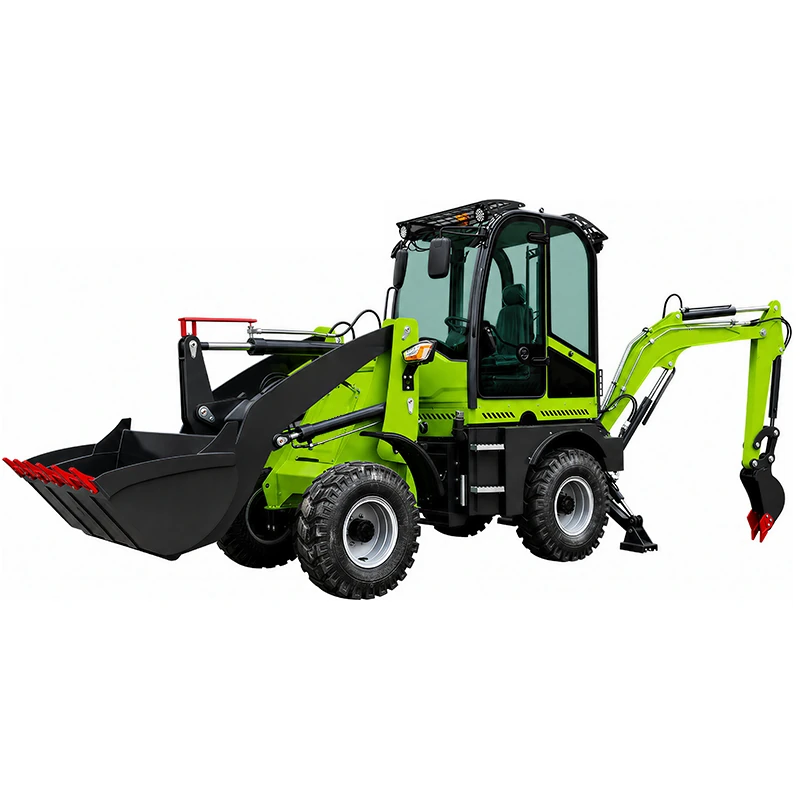
Figure 3. Customer-supplied OXPLO OX15-20 product photo showing front bucket, rear excavator, and the machine operating geometry.
For planning steps beyond the machine choice, OXPLO has a separate farm-drainage and yard-repair checklist. Longer trenches, difficult soil or extensive excavation may justify a dedicated excavator instead of a multifunctional loader.
Rural Building Renovations: Task Sequencing Matters
A small renovation contractor might expose a water line in the morning, remove excavated soil and place backfill later that afternoon. The contractor’s expense is often repeated mobilization, not a lack of bucket size. A single backhoe loader can support the sequence if the operator, equipment and job site are suitable. But if excavation continues all day while another crew removes spoil, a separate excavator-and-loader arrangement is more productive.
Open Material Yards: Do Not Buy Excavating Capacity You Never Use
A gravel yard with repeated truck movements should prioritize safe payload, bucket fill and loading cycle time. If the business frequently handles palletized bags, timber or packaged materials, neither bucket-equipped machine may be the best tool: a correctly rated forklift can provide better load control. OXPLO addresses these other workflows in its Building Materials and Outdoor Yards solution.
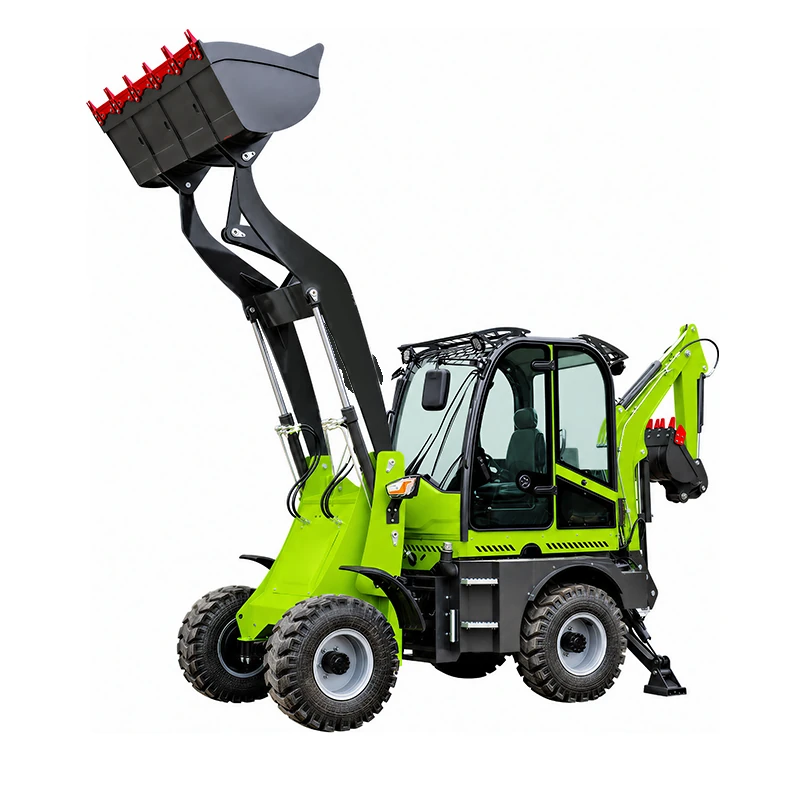
Figure 4. Customer-supplied OXPLO OX15-20 product photo showing the front bucket raised. This model is a mixed-duty backhoe loader, not a dedicated high-volume wheel loader.
IV. How the OXPLO OX15-20 Addresses Mixed-Duty Work
Product Features Linked to Actual Customer Needs
The OXPLO OX15-20 wheeled backhoe loader combines a front bucket and rear excavator on a compact wheeled chassis. The specifications below are taken from OXPLO’s published product page. They are useful for initial screening, not a substitute for the manufacturer’s full load chart, digging envelope or destination-specific compliance documents.
Published OXPLO OX15-20 specification | What the customer should verify |
Front bucket: 0.6 m³ | Bulk density, permissible loading mass, truck geometry |
Rear bucket: 0.12 m³ | Trench width, excavated soil volume, attachment suitability |
Maximum digging depth: 2,350 mm | Actual reach at the desired depth; safe position |
Maximum digging radius: 3,500 mm | Required standoff distance and excavating envelope |
Maximum dumping height: 3,200 mm | Real trailer/truck clearance and discharge geometry |
Overall width: 1,680 mm; front bucket: 1,800 mm | Gate width plus safe access and manoeuvring margin |
4WD; articulated hydraulic steering | Traction and turning on the actual ground surface |
Where One OXPLO Machine Can Reduce Hand-Offs
The strongest application for the OXPLO OX15-20 is a series of short, mixed tasks: open a service trench, move the spoil, bring in aggregate and complete the backfill. For a farm-maintenance business or rural property operator, the benefit may be fewer separate machine bookings and less idle time between steps. This is a reasonable equipment-consolidation argument—not a guarantee of faster loading than a wheel loader or faster digging than a purpose-built excavator.
Avoid Overpromising on Slopes and Attachments
OXPLO lists four-wheel drive and articulated steering, which are relevant to manoeuvrability on suitable prepared or unpaved surfaces. They do not eliminate the risks of soft ground, unstable trench edges or slopes. A published travel gradeability figure must never be interpreted as the safe operating slope for digging or lifting.
OXPLO’s parts and attachments catalogue includes backhoe-related options such as augers, hydraulic breakers, quick couplers and multifunction buckets. Their availability on the catalogue does not prove compatibility with every OX15-20 configuration. Confirm mounting geometry, hydraulic flow and pressure, attachment mass, controls and the effect on stability before including accessories in an order.
When OXPLO Should Recommend a Different Machine
The OX15-20 is not suited to every job. Continuous aggregate loading may warrant a wheel loader, extended trenching a dedicated excavator, and pallet work a forklift. Compare those needs with OXPLO’s broader equipment range.
V. Test Productivity and Total Job Cost Before Buying
A Transparent Bucket-Cycle Example
Suppose a customer needs to load 30 m³ of loose material. Using the OX15-20’s published 0.6 m³ front bucket and a hypothetical 80% fill factor, the effective volume is 0.6 × 0.80 = 0.48 m³ per cycle. The job would require approximately 63 theoretical cycles. A hypothetical wheel loader with a 1.2 m³ bucket and an 85% fill factor would require about 30 cycles.
These numbers illustrate the effect of bucket volume; they are not measured productivity or evidence that the OX15-20 can safely carry a particular material mass. Before applying the calculation, confirm density, permissible load, site geometry, actual cycle time and machine utilization.
The Savings May Come From Avoided Mobilization
For mixed work, compare the full cost of completing the job: machine ownership or hire, operator hours, fuel, transport, attachment changes, setup, maintenance and avoidable delays. A multifunctional machine may save money when it prevents a second mobilization. A specialized loader may save more when large material volumes are moved every day.
A practical break-even test is to compare the annual cost of obtaining separate excavation equipment with the value of faster loading from a dedicated wheel loader. Calculate using real yearly work records rather than fabricated percentages or headline machine prices. The important output is cost per completed job—or cost per tonne or cubic metre for a genuinely loading-focused business.
VI. Italy Procurement Checklist: Compliance, Support and a Useful Quote
Check the Exact EU-Market Configuration
Italian customers should not infer conformity from a general equipment catalogue. The European Commission machinery guidance explains that machinery first placed on the EU market before 20 January 2027 must comply with Directive 2006/42/EC; the new Machinery Regulation (EU) 2023/1230 becomes generally applicable from that date. The applicable non-road mobile machinery emissions rules also need to be checked for the actual engine and placing-on-the-market circumstances.
The OXPLO OX15-20 product page identifies a Yunnei 490 engine rated at 42 kW, but those details alone do not confirm a particular machine is Stage V-compliant or accompanied by the required EU conformity documents. Ask OXPLO to verify the exact engine version, applicable approvals, declaration of conformity, identification marking and operating instructions for the Italian destination before ordering.
Professional operators must also meet applicable local safety and training obligations. Italy’s 2025 State–Regions training agreement is a relevant official source; public-road use may involve additional requirements that should be checked separately.
Ask About Spare Parts Before a Breakdown
For small contractors, one machine out of service can interrupt several job types at once. Confirm the source of filters, seals, hoses, pins, bushes and other service items; model and serial-number identification; realistic supply arrangements; and written warranty conditions. OXPLO describes its parts and technical support processes on the official support page, but parts availability and coverage should be verified for the actual machine and order.
Send Operating Data, Not Just “Best Price?”
A meaningful OXPLO quotation should start with the actual job. Tell the supplier the country and delivery point, the intended tasks and their frequency, maximum trench dimensions, materials and approximate densities, loading truck dimensions, narrowest access and ground conditions, yearly operating hours, and required attachments.
Request the complete machine configuration, confirmed capability for the application, compatible accessories, destination-market documents, spare-parts proposal, lead time and agreed Incoterms. OXPLO’s backhoe loader articles and purchasing guides and contact page provide the next steps for a specification-led enquiry.
FAQ: Backhoe Loader vs Wheel Loader in Italy
1. Is a Backhoe Loader Better Than a Wheel Loader for a Small Italian Farm?
It may be better when excavation, drainage repair, backfilling and moderate loading recur throughout the year. A wheel loader is generally more appropriate when sustained bulk loading is the main requirement. Compare hours spent on each task, site access and the cost of obtaining excavation separately.
2. Can a Wheel Loader Dig Irrigation Trenches?
A conventional wheel loader is not a substitute for controlled narrow-trench excavation. Its front bucket can move surface material, but a backhoe or suitable excavator is generally needed for trenches. Confirm dimensions, utilities, ground stability and excavation safety before work.
3. Will the OXPLO OX15-20 Fit Through a Narrow Farm Entrance?
Check the narrowest complete-machine dimension, including attachments. OXPLO lists a 1,680 mm overall machine width but a 1,800 mm front bucket width. A safe operating margin and enough room to position the machine and its rear equipment are also necessary.
4. Can the OXPLO OX15-20 Replace a Mini Excavator?
For some suitable localized excavations it can provide an alternative while also offering front loading. It may be less suitable for very confined sites or sustained specialist excavation. The required digging envelope and ground conditions decide the outcome.
5. What Documents Should an Italian Buyer Request?
Ask for conformity documentation appropriate to the specific machine, supporting engine-emissions records, identification details, relevant operating instructions, attachment approvals, warranty terms and service information. Verify requirements applicable to the purchase date and intended use.
6. What Makes an OXPLO Enquiry Easier to Evaluate?
Provide photographs, site measurements, material type, expected operating hours, trench depth, receiving vehicle dimensions, attachment needs and delivery destination. Those details allow OXPLO to evaluate application suitability rather than issue a generic price-only quotation.
Conclusion: Buy the Machine That Removes Your Main Bottleneck
For an Italian agricultural business or small contractor, the choice is not simply between two machine names. It is between flexibility across short, mixed tasks and productivity in repeated loading. The backhoe loader has a stronger case when digging, handling and backfilling must be completed sequentially with limited equipment changes. The wheel loader has a stronger case when bulk material movement dominates the working day.
The OXPLO OX15-20 provides a tangible starting point for mixed-duty evaluation through its front loader, rear excavator and documented dimensions. Yet the best recommendation depends on access, excavation geometry, actual loading mass, ground stability, operating hours and the confirmed Italian-market configuration. To assess the right approach, send OXPLO your site details and work requirements through the official enquiry form.