
A practical procurement and risk-control guide for European agricultural machinery dealers
A tractor dealer trial order should answer a precise business question: can the dealership sell, register where required, service and profitably replenish these tractors in its local market? The answer is not established by a factory price list or a video of a tractor driving across a yard.
An overseas shipment can arrive in good mechanical condition and still become expensive stock. The wrong three-point linkage may not accept a customer’s implements. A high-horsepower demo unit may be too wide for orchard gateways. Missing vehicle approval evidence may stop a road-registration-dependent sale. None of these problems is solved by negotiating another two percent off the purchase price.
The safer approach is to treat the first shipment as a controlled commercial and technical test. Select a narrow model mix, freeze specifications, check market-entry documents before payment, test the demo tractor under realistic loads and calculate the true sale-ready cost. Only then decide whether the supplier and product are ready for a wholesale programme.
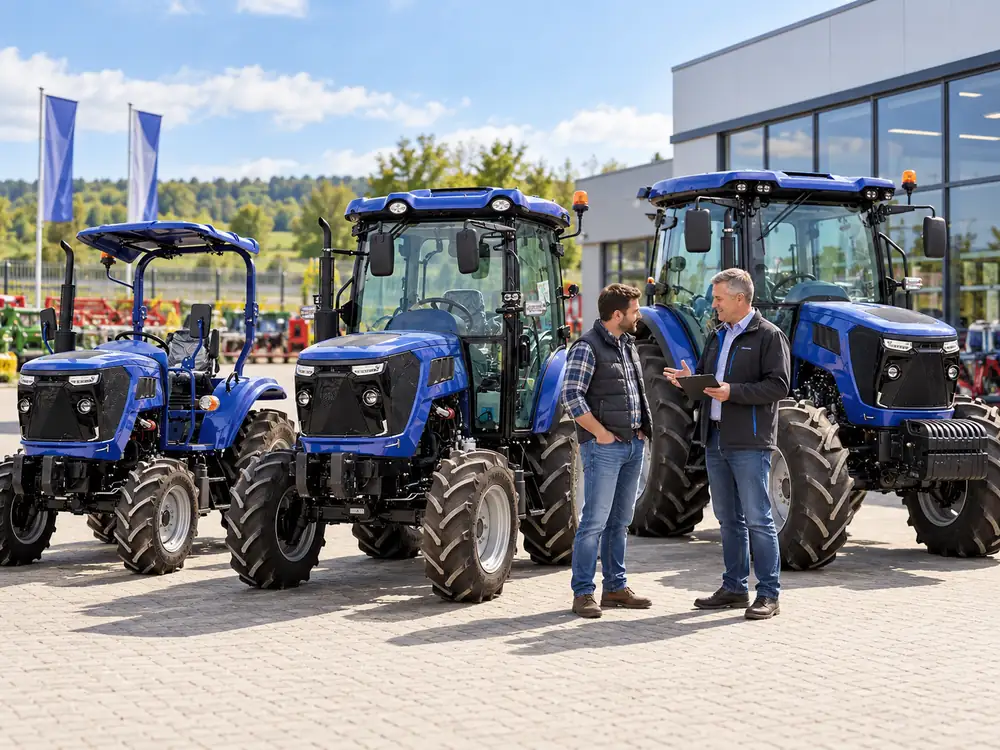
Illustration 1. European dealer discussion around an initial tractor trial order.
I. Why a First Dealer Order Fails Before the Tractor Reaches the Customer
The three risks dealers routinely underestimate
The first is inventory mismatch. A dealer assumes that 70 HP will be easier to sell because it offers more power, yet most enquiries concern orchard mowing or smaller Category I implements. The machines may be sound, but working capital becomes tied to the wrong customer segment.
The second is configuration mismatch. A buyer sees “4WD, PTO, front loader available” and treats those words as proof of compatibility. In practice, PTO speeds and splines, hitch category, hydraulic flow, loader geometry, tyre choice and vehicle dimensions determine whether a tractor can perform the assigned job. The cost of a retrofit can erase the margin on a trial unit.
The third is regulatory and service exposure. Import clearance is not a substitute for lawful market placement or registration. A tractor may also become unsaleable at an acceptable price if the dealer cannot source common service parts or explain warranty responsibilities to the end customer.
Define success before asking for the quote
A useful trial must produce five answers: which customers will buy; which specifications fit their implements; which compliance route applies; what the actual landed-and-prepared cost is; and whether the supplier can support the installed fleet. If any answer remains unknown, ordering more units multiplies the uncertainty instead of reducing it.
For this reason, the first purchasing document should be an application brief containing the intended country, customer jobs, site access dimensions, owned implements, seasonal workload, annual operating hours and required road use. A tractor dealer sample order without this brief is largely a guess.
II. Select the Model Mix From Local Demand, Not the Manufacturer’s Catalogue
Build a demand map from qualified enquiries
Review the last 15–30 relevant buyer conversations, distinguishing budget-only enquiries from leads that have a defined application and purchase window. Record horsepower range, implement ownership, cab or ROPS preference, field conditions and likely delivery date. This produces a rough demand map—useful for selecting a test mix, not a statistically robust market forecast.
Consider a hypothetical dealer with 20 qualified discussions: five concern 25–30 HP compact utility work, eleven concern 40–50 HP mixed-farm tasks and four concern 60–70 HP livestock and heavier field work. A tentative four-unit 25 to 70 HP tractor dealer order could contain one compact model, two mid-range machines and one larger model. However, pre-sold units and available capital should take priority over matching percentages mechanically.
Separate farm type from tractor horsepower
In an Italian vineyard, the limiting dimensions may be row spacing, canopy height, turning radius and access through narrow gateways. In a French mixed-farm application, existing mower PTO requirements and required field speed may matter more. A dealer serving Polish livestock operations might need to demonstrate loader operation and plan a winter service-parts stock. These are illustrative buying scenarios, not claims about national demand or actual customer orders.
For orchard work, measure the full usable opening, not only the nominal row width. Account for mirrors, tyres, cab or ROPS height, slope and safe turning clearance. Even a tractor listed at 1,560 mm wide is not necessarily suitable for every narrow-row vineyard.
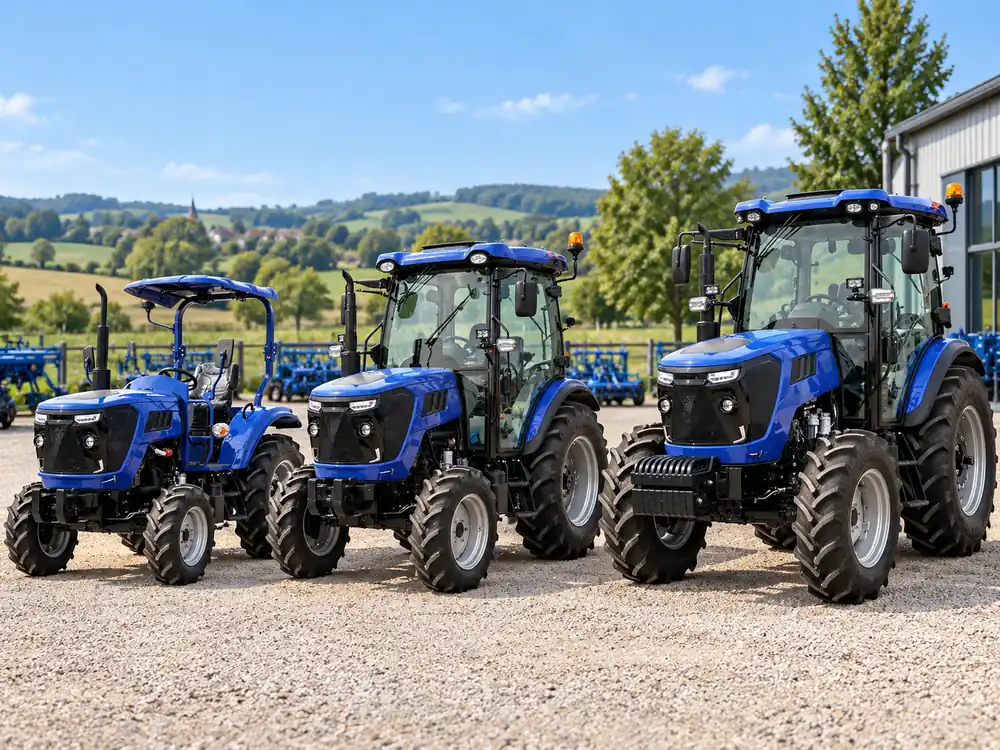
Illustration 2. Compact, mid-range and larger tractor configurations for a focused model mix.
Do not confuse a showroom machine with saleable stock
A single dedicated demo tractor may be sufficient when the first goal is operator evaluation. If confirmed buyers already exist, a second tractor can remain in its agreed retail configuration rather than accumulating demo hours. A larger mixed trial is justified only when the dealership can explain who each machine is for and how long it expects to carry the inventory.
Budget separately for demonstrations: transportation to farms, insurance, fuel, operator time, wear and a possible resale discount. The demo unit should be chosen for the job it can prove—not merely because its specification looks impressive in a brochure.
III. Make Demo Testing About Implement Fit, Not a Factory Show
Start with an implement compatibility worksheet
Before production, ask the potential end customer for the implement make and model, required PTO rpm and spline, hitch category, implement mass, hydraulic connection type, flow and pressure needs, working width, and any specific ballast or tyre restrictions. Check both tractor and implement manuals; engine HP is not a proxy for PTO output or hydraulic performance.
For example, a tractor specified with a Category II linkage should not be sold as plug-and-play for every existing Category I implement. Adapters, geometry and allowable loads need explicit assessment. Likewise, a 540 rpm implement must not be driven at an incompatible PTO shaft speed. Confirm the delivered PTO configuration, even when the public product page lists several possible speeds.
A factory acceptance test needs evidence against the signed build
For tractor demo unit inspection, insist on a serial-number-linked checklist rather than only attractive photos. The factory acceptance test (FAT) should capture the model and VIN/identification plate, engine identity, transmission, PTO, linkage, installed tyres, hydraulic outlets, operator protection, lighting, attachments and any destination-specific equipment.
The functional test should include safe checks of cold starting, clutch and shuttle engagement, steering, braking, 4WD engagement, linkage travel, leaks and PTO control. Hydraulic performance should be measured with appropriate calibrated equipment where an agreed quantitative result is required. A loader-equipped tractor should be evaluated using the approved attachment and ballast configuration; never infer safe lifting capacity from engine power alone.
Ask the supplier to provide a short defect log showing the observation, responsible person, corrective action and closure evidence. Where an unfamiliar machine or high order value warrants it, commission independent pre-shipment inspection. Critical safety or compliance defects are shipment holds, not punch-list items to resolve after arrival.
Repeat the inspection after international transport
The local pre-delivery inspection (PDI) should verify shipping damage, fluid leaks, battery condition, tyre pressure, loosened parts, transport-disassembled items and function after reassembly. Record carrier damage before repair and within the required claim window. Only after the PDI should the dealer carry out a customer trial using a compatible mower, tiller, trailer or approved loader setup under representative conditions.
Measure outcomes the customer understands: hectares or area completed per hour where appropriate, implement handling, turning space, operator workload, stability under approved conditions and any service problems. A video of empty-yard manoeuvring is not proof of field productivity.
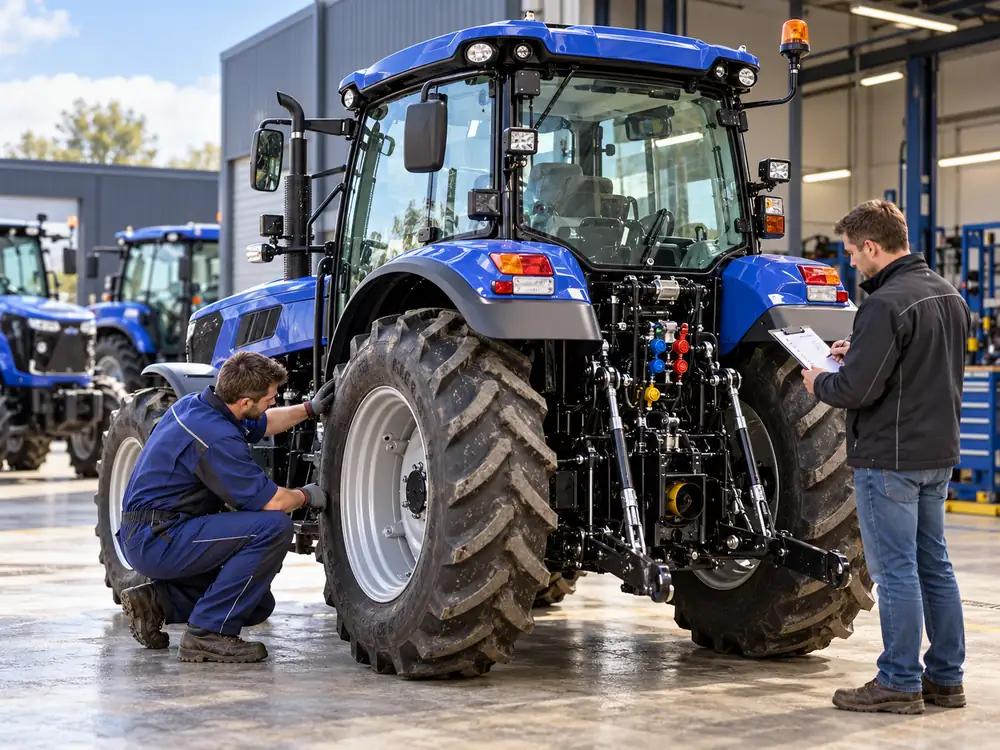
Illustration 3. Pre-delivery checks should cover tyres, linkages, hydraulic connections and inspection records.
IV. Verify EU Registration and Import Documents Before Releasing the Deposit
CE paperwork, Stage V evidence and a tractor CoC solve different problems
For relevant agricultural and forestry vehicle categories, Regulation (EU) No 167/2013 establishes the EU vehicle type-approval framework. Depending on the vehicle category and applicable pathway, evidence of whole-vehicle approval and an appropriate Certificate of Conformity (CoC) may be central to market placement and registration. National routes can exist in defined circumstances; they must not be assumed to be interchangeable across Member States.
Engine emissions are a separate technical layer. Commission Delegated Regulation (EU) 2018/985 addresses environmental and propulsion performance for agricultural and forestry vehicles and integrates relevant Stage V requirements. An available Stage V engine option does not automatically prove that the complete tractor has valid whole-vehicle approval or can be registered for the proposed use.
Likewise, generic CE-related machinery documents cannot be treated as a substitute for an applicable vehicle CoC. The purchasing decision must be linked to the exact model, variant/version, approved configuration, destination and intended use. If registration is necessary, verify the route with the relevant national registration or approval authority or a qualified homologation adviser before making a non-refundable commitment.
Request a document matrix tied to every ordered unit
Document set | Evidence to request | Purchasing decision |
Market eligibility | Applicable vehicle category, EU/national approval route, approval number and CoC where required | Can this precise configuration legally be sold and registered for its intended use? |
Engine | Installed engine identity; applicable emissions and approval evidence | Is the supplied engine configuration covered by the required evidence? |
Vehicle identity | VIN/serial-number evidence, identification plate and order/build record | Will plates, certificates, invoice and actual tractor match? |
Customs | Invoice, packing list, origin support as needed, transport records and tariff classification | Can the importer make a correct declaration and substantiate value/origin? |
Retail handover | Operator manual, maintenance schedule, parts references, warranty and safety information | Can the dealer prepare, deliver and support the machine? |
For tractor import documents for dealers, also record the importer of record, EORI arrangements, customs broker, tariff classification, VAT cash-flow treatment, Incoterms rule and named delivery place. “Door to door” is not a sufficient contract term unless the parties identify who bears import clearance, duties, terminal handling, unloading and inland delivery.
Set a hard stop: if a supplied certificate covers a different engine, tractor variant or VIN, request corrected evidence and pause shipment or payment. A compliance issue discovered after port arrival is usually much harder to resolve than one uncovered during document review.
Illustration 4. Verify vehicle records, commercial documents and shipment arrangements before release.
V. Compare Sale-Ready Economics, Not Just Unit Price
Use one cost model for every shortlisted tractor
The meaningful comparison is the sale-ready cost, not the EXW or FOB purchase figure. Combine purchase price, allocated freight, insurance, duty, handling, inland movement, PDI, initial service-parts allocation and expected warranty exposure. Keep recoverable import VAT and financing/carrying cost as separate lines so the dealership can distinguish accounting margin from short-term cash needs.
The table below uses hypothetical amounts in euros. The import duty entry is a modelling assumption, not a statement of the tariff rate for any particular tractor or origin.
Illustrative cost item | EUR |
Tractor purchase price | 9,800 |
Allocated international freight | 920 |
Freight insurance | 70 |
Assumed import duty | 350 |
Clearance and terminal handling | 250 |
Inland delivery | 310 |
PDI and preparation | 140 |
Initial parts provision | 180 |
Warranty-cost reserve | 300 |
Total sale-ready cost | 12,320 |
At a selling price of €14,900 excluding VAT, the apparent contribution before overhead and financing is €2,580, or 17.3% of selling price. If the tractor becomes a demonstration unit and is ultimately discounted by 10% to €13,410, the same cost basis leaves €1,090, or approximately 8.1%. That is before additional demonstration expenses.
Now assume an annual inventory carrying rate of 18% as an internal budgeting assumption. Holding €12,320 of inventory for 90 days adds roughly €547 of carrying cost. This is why a unit that sells eventually can still be a poor use of dealer capital.
Build two price cases: retail stock and demo resale
For each tractor dealer trial shipment, calculate both a normal retail scenario and a demo-resale scenario. Stress-test a later-than-planned sale, extra inland delivery, a warranty repair and slower spare-parts replenishment. A model that needs every assumption to be favourable is not a sensible opening inventory choice.
VI. Design the Service Plan and Reorder Gates Before Shipment
Seasonal downtime is part of dealer economics
A tractor that needs a seal or hydraulic hose during haymaking or planting can disrupt the farmer’s schedule even when the replacement part itself is inexpensive. A free part shipped internationally may still create transport, workshop and customer-retention costs. Therefore, ask the supplier for parts diagrams, part numbers, common filters and seals, fault-reporting requirements, warranty exclusions, labour reimbursement rules and realistic replenishment arrangements.
Choose an initial parts package using expected fleet size and service schedules—not a fixed box of components that does not match the selected tractor model. Define how the customer reports machine hours, serial number, issue symptoms and photos. This is also the information needed to distinguish an actual component fault from incorrect setup or implement overload.
Apply five purchasing gates instead of one approval
Gate 1 — Market brief: identify the customer application and candidate model. Gate 2 — Technical freeze: approve exact engine, transmission, PTO, linkage, hydraulics, tyres and attachment configuration. Gate 3 — Legal readiness: independently verify the market-entry and registration pathway. Gate 4 — FAT and logistics: close critical defects, agree inspection evidence, documents and Incoterms responsibilities. Gate 5 — Local PDI and trial: verify the arrived machine and log customer feedback before expanding inventory.
Decide on the second order using real evidence
For a wholesale tractor order checklist, track qualified demonstrations, demo-to-order conversions, time to sale, realised contribution margin, unresolved defects, parts lead times and customer implement-fit problems. A sample of two or four units cannot establish statistically meaningful reliability rates, but a critical safety failure or missing approval document is still enough to stop a reorder.
A sensible repeat order is based on confirmed enquiries, acceptable operating results, closed defects, predictable support and positive unit economics. It is not triggered simply because the first unit happened to sell quickly.
VII. How OXPLO Can Help Structure a Lower-Risk European Dealer Trial Order
Start with the OXPLO model platform, then choose the horsepower
The OXPLO 25–70 HP tractor range offers six 4WD models across 25, 30, 40, 50, 60 and 70 HP. For a European dealer, the useful distinction is not only price or rated power. The current published OXPLO specification places the 25–50 HP models in the compact Category I group and the OXT604/OXT704 in a larger Category II group. That transition changes implement decisions, footprint and the type of customers worth targeting.
OXPLO models | Power | Potential dealer-trial role | Key verification |
OXT254 / OXT304 | 25 / 30 HP | Compact farm maintenance, estates and appropriately sized orchard work | Verify access measurements and exact transmission/PTO specification |
OXT404 | 40 HP | Compact mixed-farm tillage, mowing and transport | Published Cat. I and 8F+8R; verify implement load |
OXT504 | 50 HP | More engine reserve while retaining compact Cat. I platform | Do not assume that more HP means Cat. II compatibility |
OXT604 | 60 HP | Larger-platform mixed farms, livestock and compatible loader work | Published Cat. II and 12F+12R; verify loader/ballast |
OXT704 | 70 HP | Higher-power use with Cat. II implements | Verify field space, PTO, road documents and working load |
OXT504 versus OXT604: why the extra 10 HP changes the sales conversation
The OXPLO OXT504 50 HP tractor is currently listed with a 1,560 mm overall width, 8F+8R gearbox and Category I linkage. The OXPLO OXT604 60 HP tractor moves to 1,760 mm listed width, 12F+12R transmission and Category II linkage. The 200 mm difference in published width and the hitch-category change may be more important than the 10 HP power increase.
If a dealer’s Italian customer already owns compact Category I mowers and has a narrow entrance, the OXPLO OXT504 may be the more relevant demonstration candidate—provided actual dimensions and power requirements match. If a French livestock customer needs larger compatible implements and frequent forward/reverse yard operations, the OXPLO OXT604 may be the stronger evaluation platform. The right outcome is not automatically the higher-priced tractor.
For the middle segment, the OXPLO OXT404 40 HP tractor provides another Category I option. At the upper end, the OXPLO OXT704 70 HP tractor extends the larger Category II family. In every case, the order must specify the final PTO arrangement, hydraulics, tyres, operator station and destination-market configuration rather than relying on abbreviated web specifications.
Match attachments before placing an OXPLO dealer sample order
The OXPLO tractor configuration and attachment page presents up to 48 attachment options. This is a selection catalogue, not a claim that every attachment fits every tractor. OXPLO can discuss mower, tiller, plough, harrow, trailer, bale-handling or loader configurations using the tractor model, hitch/PTO details and the dealer’s intended task.
A European dealer should send OXPLO photographs or specification sheets of its customers’ existing implements. Request a written compatibility answer, and identify any adaptations or exclusions in the pro forma invoice. That prevents a seemingly attractive trial tractor from requiring an unplanned implement replacement after delivery.
Ask OXPLO to make inspection, documents and parts support explicit
OXPLO states that model-specific CE-related documents, selected Stage V engine configurations, pre-shipment photos/videos and shipping coordination can be discussed according to model and destination. These are useful steps in an organised order process, but they must not be presented as proof that every OXPLO tractor already has EU whole-vehicle approval, a CoC or universal registration eligibility. The dealer must request the exact evidence and verify the approval pathway independently.
The OXPLO support and parts page also describes parts enquiries, maintenance guidance, technical assistance and warranty-claim information. For a trial shipment, dealers should ask OXPLO to confirm service-part references, expected availability, warranty coverage, claims procedure and responsibility for replacement-part freight and workshop labour in writing.
This is where a tractor dealer trial order becomes a real business test: OXPLO’s breadth of tractor models supports a focused product shortlist; implement matching helps reduce configuration errors; pre-shipment evidence supports acceptance; and defined parts and documentation requests give the dealership a clearer basis for evaluating repeat orders.
Send a better enquiry to OXPLO
Instead of asking only “price for four tractors”, give OXPLO the destination country; proposed models and quantities; ROPS/cab preference; existing implement details; estimated annual hours; registration requirements; intended shipping term; and expected dealer service capability. Ask for a configuration-specific quotation with document status, FAT evidence, initial parts proposal and lead time. The OXPLO dealer enquiry and contact page is the practical next step once those requirements have been prepared.
Frequently Asked Questions
How many units are appropriate for a first European dealer order?
One inspected tractor can be sufficient for technical evaluation. A mixed shipment of two to four units may be useful when qualified demand exists across different segments. Inventory quantity should follow realistic customer opportunities, working capital and the verified approval status of each configuration.
Should a dealer choose the OXPLO OXT504 or OXT604 for mixed farming?
Choose by access dimensions, hitch category, transmission, implement load and working cycle—not just horsepower. OXPLO publishes the OXT504 on a compact Category I platform and the OXT604 on a larger Category II platform. Check the final configuration and customer implements before ordering.
Does a Stage V engine or a CE document automatically permit EU road registration?
No. Relevant emissions evidence and CE-related documents do not replace the applicable whole-vehicle approval and CoC or other lawful national approval route where required. Confirm the exact tractor configuration and destination-country procedure before paying a deposit.
What documents must arrive with a tractor dealer trial shipment?
The package typically includes the commercial and transport records needed for customs, serial-number-linked vehicle records, applicable market-approval evidence, manuals, maintenance information and the agreed warranty documents. The precise list depends on the vehicle and import route.
Can OXPLO arrange mixed models and compatible attachments?
OXPLO welcomes dealer and multi-unit enquiries and can discuss model combinations and attachment matching. Trial quantities, compatible attachments, available configuration options, lead times and documents are subject to confirmation in the specific quotation.
How should a European dealer prepare for the first warranty claim?
Agree the diagnostic workflow, photos/video requirements, serial-number and operating-hour records, labour responsibility and parts shipping responsibilities in advance. OXPLO’s support information outlines the relevant request details, but the actual commercial coverage should be written into the agreement.
What result justifies a second wholesale order?
A second order should follow verified customer demand, acceptable gross contribution, working implement compatibility, complete applicable documents and an after-sales plan that the local dealer can deliver. An unresolved critical defect or market-eligibility question is a reason to pause, even when early enquiries look positive.
Conclusion: Use the First Shipment to Remove Uncertainty
The right first order is not the largest selection a supplier can load into a container. It is the smallest meaningful test that can establish product-market fit, technical compatibility, legal readiness and service economics.
For European dealers, the decision sequence is clear: qualify demand, select the right platform, verify implements, freeze the vehicle specification, independently check approval requirements, inspect before and after shipment, and calculate margin with demo and service costs included. These steps make the next order more predictable and reduce the risk of filling the yard with difficult-to-sell equipment.
OXPLO’s 25–70 HP tractor range can be evaluated through this same disciplined process. Before requesting an OXPLO quotation, prepare the target country, model shortlist, implement list and mandatory documentation requirements. That gives OXPLO and the dealer a concrete basis for discussing a trial order that can lead to sustainable repeat business.