
A Practical Procurement Guide for European Industrial Buyers
Buying a 5 ton electric forklift looks simple when the RFQ contains only one line: “5,000 kg capacity, lithium battery, 3 m mast.” In practice, that is where many specification mistakes begin.
A forklift can be rated for 5,000 kg and still be unsuitable for the actual job once the load becomes longer, the load center moves forward, the mast is raised, or a side shifter, fork positioner, clamp or extended forks are installed. The critical purchasing question is therefore not simply whether the truck is labelled 5 ton. It is whether the truck still has enough residual capacity in the buyer’s real operating configuration.
This matters particularly in European manufacturing plants, steel and machinery workshops, building-material warehouses and industrial logistics sites. These applications rarely handle a perfect test pallet all day. Loads may be long, dense, irregular, expensive, or repeatedly moved over ramps and through constrained aisles. A correct purchase must connect load physics, site geometry, battery duty cycle, attachments, compliance documentation and total cost of ownership.
This guide explains how to evaluate a 5 ton electric forklift from that operating perspective, how to compare supplier quotations on a like-for-like basis, and where a machine such as the OXPLO CPD50 fits once the application has been properly defined.
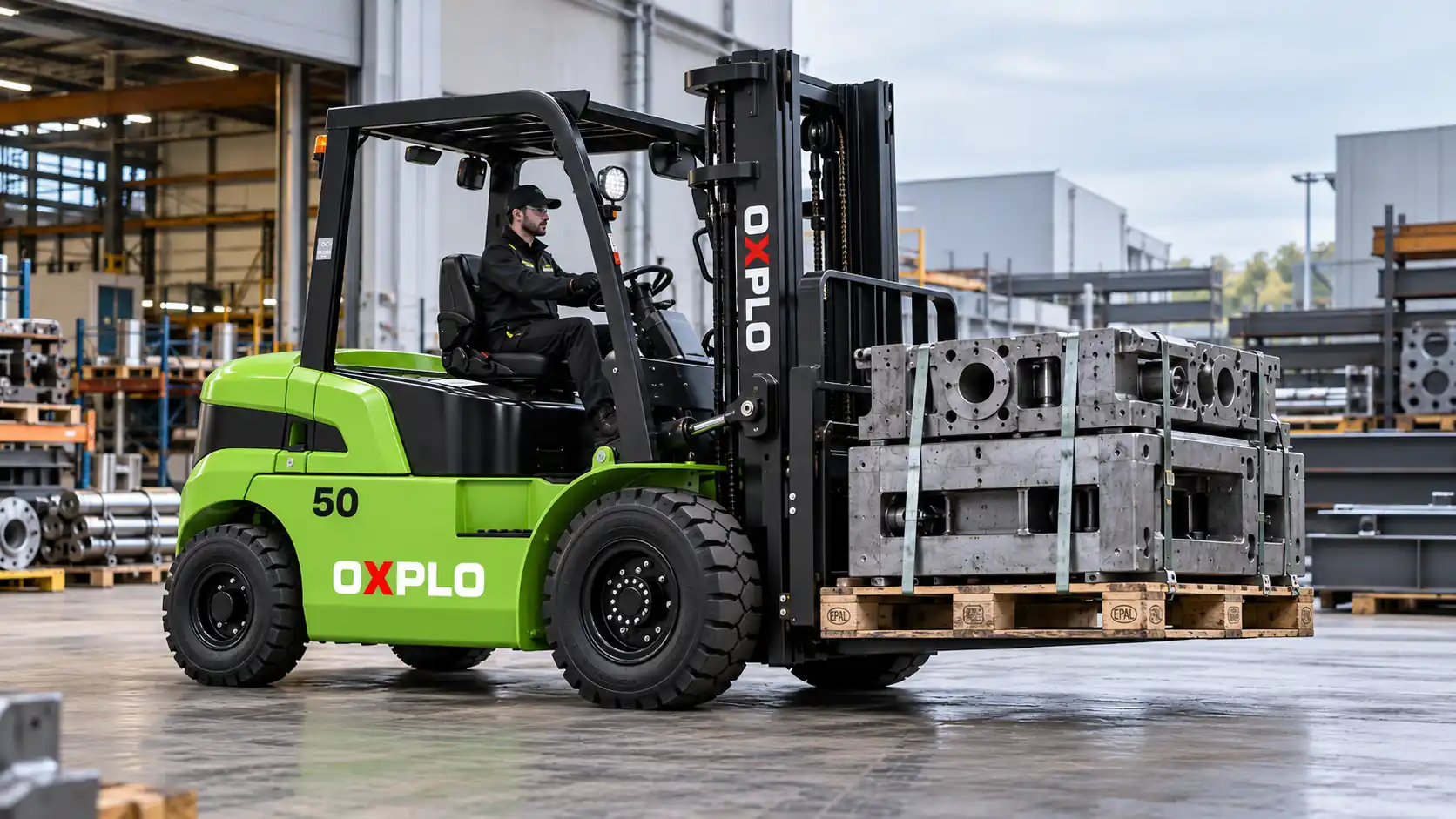
Figure 1. OXPLO 5 ton electric forklift handling heavy industrial loads in a manufacturing environment.
I. Why Heavy Industrial Loads Are Different From Standard Pallet Handling
The load is rarely just “5,000 kg”
In heavy industry, weight is only the first variable. A 4,500 kg compact mold and a 4,500 kg long steel component may create very different overturning moments because their centers of gravity sit at different distances from the fork face. The farther the effective load center moves forward, the more demanding the load becomes for the truck.
Four applications create four different engineering problems
Steel and metal fabrication often involves long or uneven loads. Machinery and mold handling requires controlled positioning and stable low-speed movement. Building materials combine high mass with rougher paved yards, variable pallet dimensions and frequent starts and stops. Industrial logistics adds another constraint: the forklift may repeat the same heavy cycle throughout an entire shift. A useful specification must reflect the actual problem, not just the rated tonnage.
The hidden business cost of getting this wrong
An underspecified truck does not always fail dramatically. More often it creates slower cycles, unnecessary battery stress, excessive tire wear, restricted lift height, attachment limitations, operator hesitation and repeated downtime. Those losses accumulate quietly in throughput and maintenance cost. For a production facility, a forklift that is technically usable but operationally constrained can be more expensive than a correctly sized truck with a higher purchase price.
II. Start With the Load Envelope, Not the Forklift Catalogue
Maximum and normal load weight
Provide both. A site that normally handles 3,800 kg but occasionally lifts 4,900 kg has a different duty profile from a site moving 4,800 kg on every cycle. Suppliers need to understand how often the truck approaches rated capacity.
Load dimensions and center of gravity
Do not send weight alone. Send length, width, height and, where possible, the approximate center-of-gravity position. Long loads can move the effective load center beyond the standard rating point. That can reduce available capacity even when gross weight remains below 5,000 kg.
Required lift height and mast restrictions
Specify the highest working position, the normal stacking height, door height and any overhead restrictions. A truck may satisfy the load requirement at low lift but require a different mast or capacity assessment at higher lift.
Attachments must be part of the original calculation
A side shifter, fork positioner, clamp or longer fork set adds weight and can move the load forward. OSHA guidance notes that attachments generally lower forklift capacity and that load size, position and weight distribution all affect usable capacity. Buyers should therefore request capacity confirmation for the final truck-and-attachment configuration, not the base chassis alone.
III. Rated Capacity vs. Residual Capacity: Where Buyers Make Expensive Mistakes
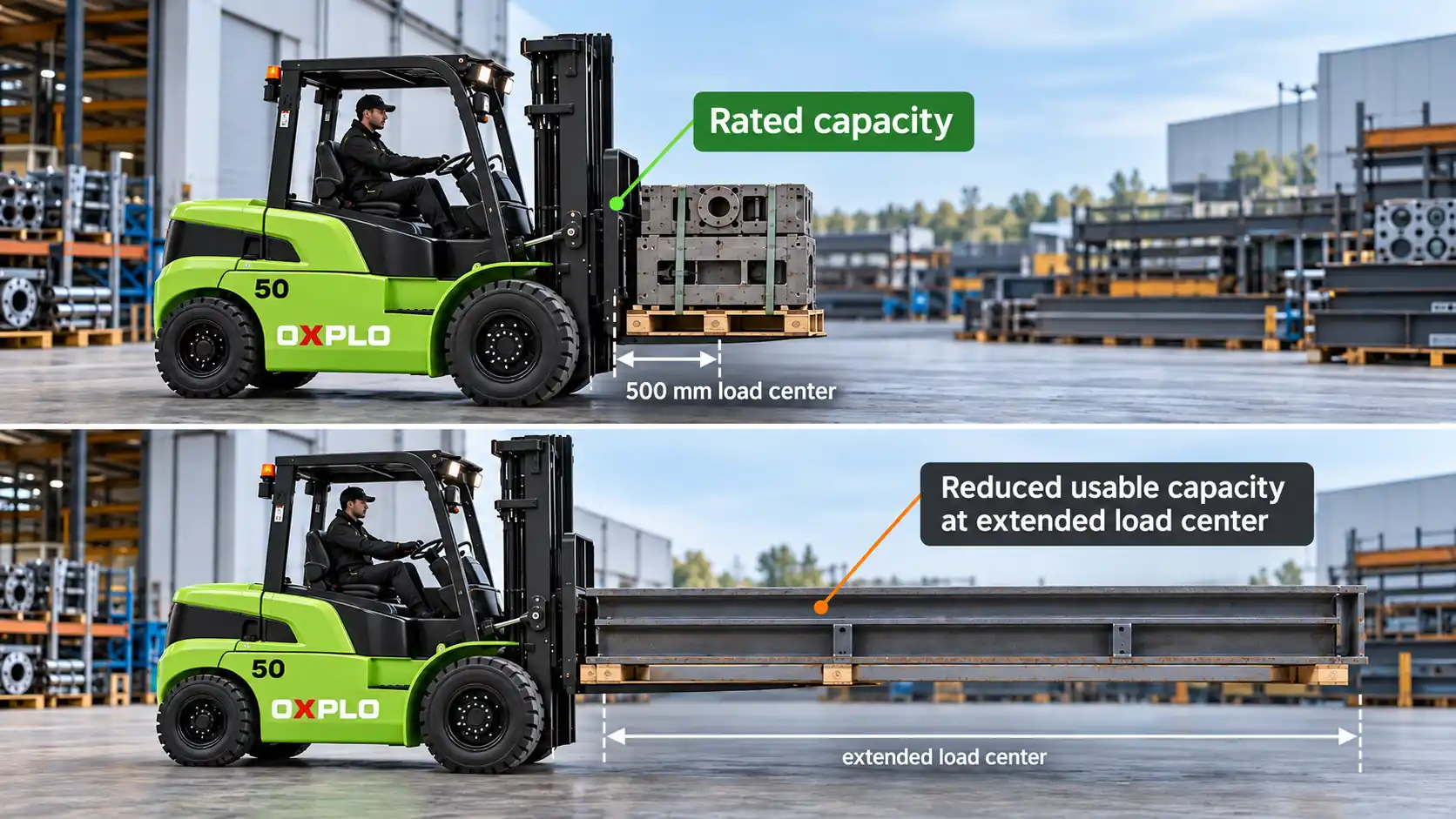
Figure 2. Rated capacity versus usable capacity: a longer load center can reduce practical lifting capability.
Rated capacity is only the baseline
A rating such as 5,000 kg at a 500 mm load center describes a defined reference condition. It is useful for identifying the forklift class, but it is not a promise that every 5,000 kg load can be lifted to every height with every attachment.
Residual capacity is the number that matters on site
Residual capacity is the remaining lifting capability after real configuration variables are considered. Higher masts, longer forks, forward load centers and heavy attachments can all reduce it. When loads routinely approach the nominal limit, the buyer should request a residual-capacity confirmation rather than assuming the nameplate figure will remain unchanged.
A better RFQ sentence
Instead of writing, “Please quote a 5 ton forklift,” write: “Maximum load 4,700 kg; load dimensions 1,800 x 1,200 mm; required lift 4.5 m; fork positioner required; please confirm residual capacity at the stated load center and lift height.” That sentence forces the quotation to address the application rather than the catalogue label.
IV. Why Some 5 Ton Forklift Projects Fail After Delivery
Mistake 1: Weight was supplied, dimensions were not
A supplier can only evaluate the stated load center if the buyer provides enough information. Long machinery components, timber, stone slabs and fabricated steel can shift the load center far beyond the standard condition.
Mistake 2: Attachments were added after the original quotation
A quotation may have been calculated for standard forks, while the final machine receives a side shifter, fork positioner and 1,800 mm forks. If the capacity discussion is not updated, the delivered configuration may no longer match the original assumption.
Mistake 3: The buyer asked “How many hours does the battery last?”
Battery runtime is not a fixed product characteristic. Heavy loads, lift frequency, travel distance, ramps, temperature, operator behavior and charger strategy all change energy demand. An eight-hour shift can be light-duty or extremely intensive.
Mistake 4: The forklift fits through the door, but cannot work in the aisle
Overall width is not the same as usable warehouse fit. Turning radius, right-angle stacking aisle, pallet length, fork length and clearance around racks all matter. The truck may physically enter the building and still be inefficient or unsafe at the actual pick face.
V. Battery and Duty Cycle: How to Size a Lithium Forklift for Real Shifts
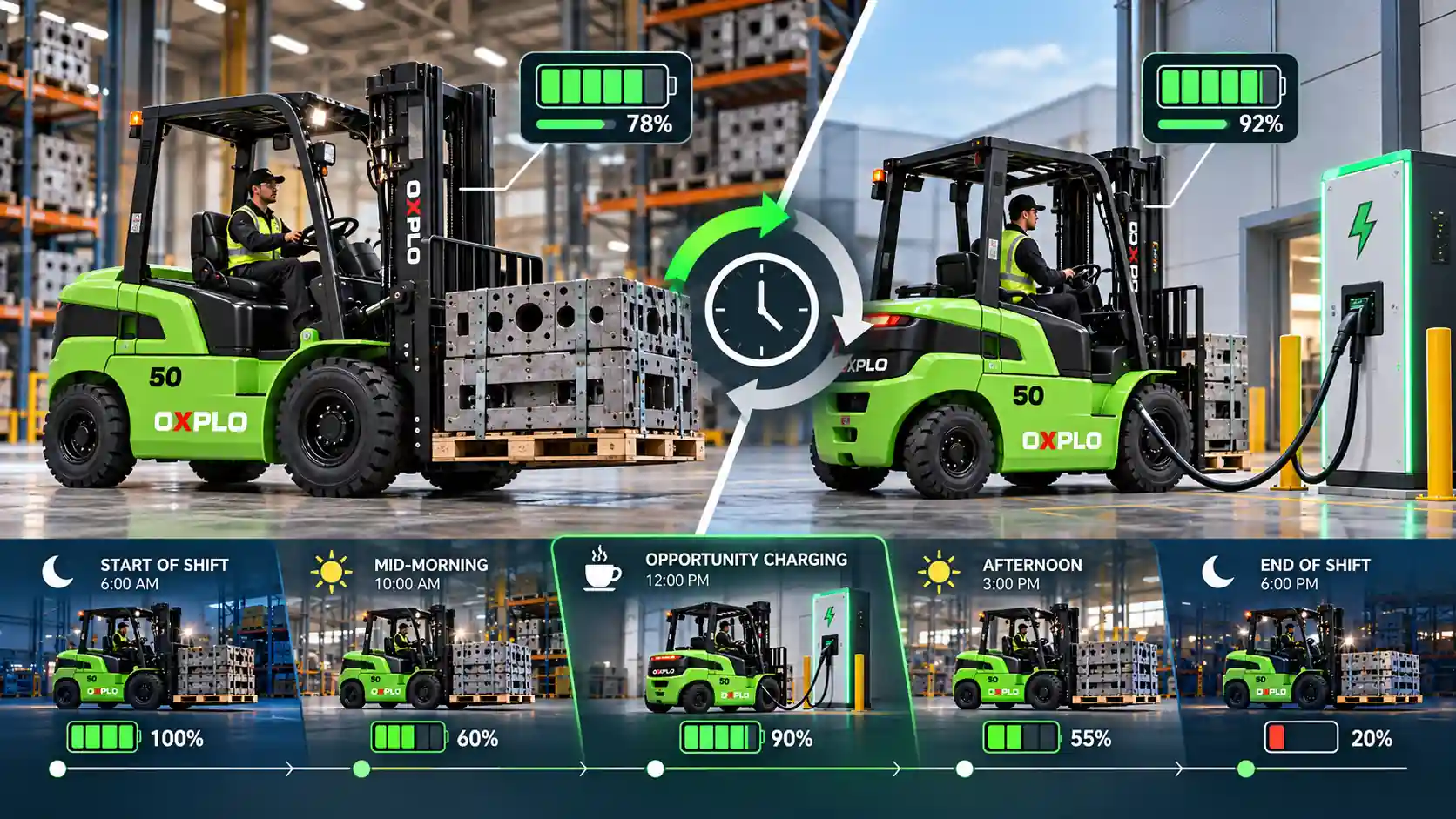
Figure 3. Lithium forklift duty-cycle planning: shift operation, opportunity charging and battery state across the workday.
Start with energy, then model the duty cycle
Battery energy can be approximated from voltage and amp-hour capacity. For example, an 80V / 410Ah battery is approximately 32.8 kWh nominal. That is a useful engineering reference, but it does not translate directly into a guaranteed number of operating hours.
What actually drives battery demand
The important variables are average load, lift frequency, lift height, travel distance, ramp use, attachment operation, ambient temperature and idle time. A truck that repeatedly lifts 4-5 tonnes will consume energy differently from one that spends much of the shift travelling empty.
Opportunity charging can change the economics
Lithium systems can support partial charging during scheduled breaks, but this only works if the charger, electrical supply and production schedule support the plan. A larger battery is not automatically the best solution. The objective is to match usable energy and charging windows to the shift profile with adequate margin.
VI. Warehouse Geometry, Ramps and Floor Loading
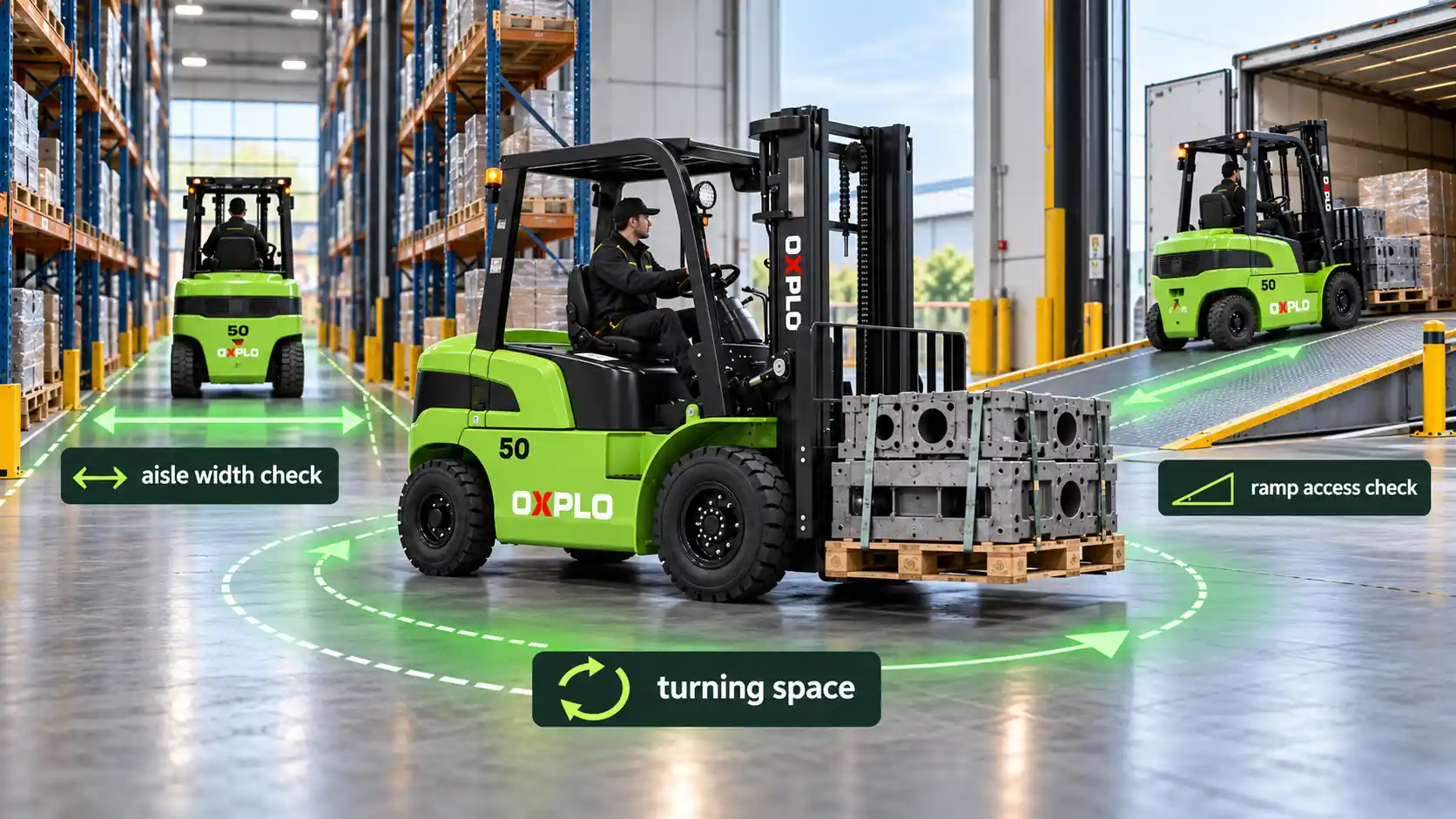
Figure 4. Site-fit checks for a 5 ton electric forklift: aisle width, turning space and ramp access.
Aisle width must be measured as an operating envelope
Check the narrowest aisle, 90-degree intersections, rack approach, loading bays and doors. Compare them with truck width, turning radius, fork length and pallet dimensions. Always include a realistic safety margin rather than designing around the absolute minimum dimension.
Heavy electric forklifts impose significant floor loads
A heavy industrial forklift can weigh more than six tonnes before carrying cargo. With a heavy load, the combined moving mass can exceed ten tonnes. Buyers should therefore review warehouse slabs, dock plates, ramps and freight elevators where relevant. Wheel point loads may matter as much as total mass.
Ramp capability needs context
A published gradeability figure is a test reference, not a recommendation to operate continuously at that limit. Ramp length, surface grip, turning on the slope, braking distance and load stability all affect real suitability.
Outdoor use does not mean rough-terrain use
A counterbalance electric forklift can work effectively in paved yards and loading areas, but deep gravel, mud, severe potholes or agricultural terrain may require a dedicated rough-terrain machine. Selecting the wrong chassis for the ground condition creates tire, traction and stability problems that battery capacity cannot solve.
VII. What European Buyers Need to Check Before Importing
Treat documentation as part of the machine specification
European buyers should confirm the applicable conformity framework, declaration documentation, machine identification, operating manual language, electrical documentation, battery and charger documentation, and the final capacity plate before shipment. These items should be discussed during the quotation stage, not after the machine arrives.
The regulatory transition date matters
Regulation (EU) 2023/1230 on machinery applies from 20 January 2027. Projects placed on the EU market around this transition should confirm which framework applies to the actual placing-on-market date and final configuration.
Configuration changes must remain traceable
If the buyer changes the mast, adds attachments or materially changes the delivered configuration, documentation and capacity information should be reviewed accordingly. A standard-fork machine and a machine fitted with a heavy clamp are not the same operating configuration.
Do not assume certification from marketing language
Procurement teams should ask the supplier to provide the specific documents applicable to the destination market and delivered configuration. This is more reliable than treating general website wording as proof of compliance.
VIII. How to Compare Three 5 Ton Electric Forklift Quotations
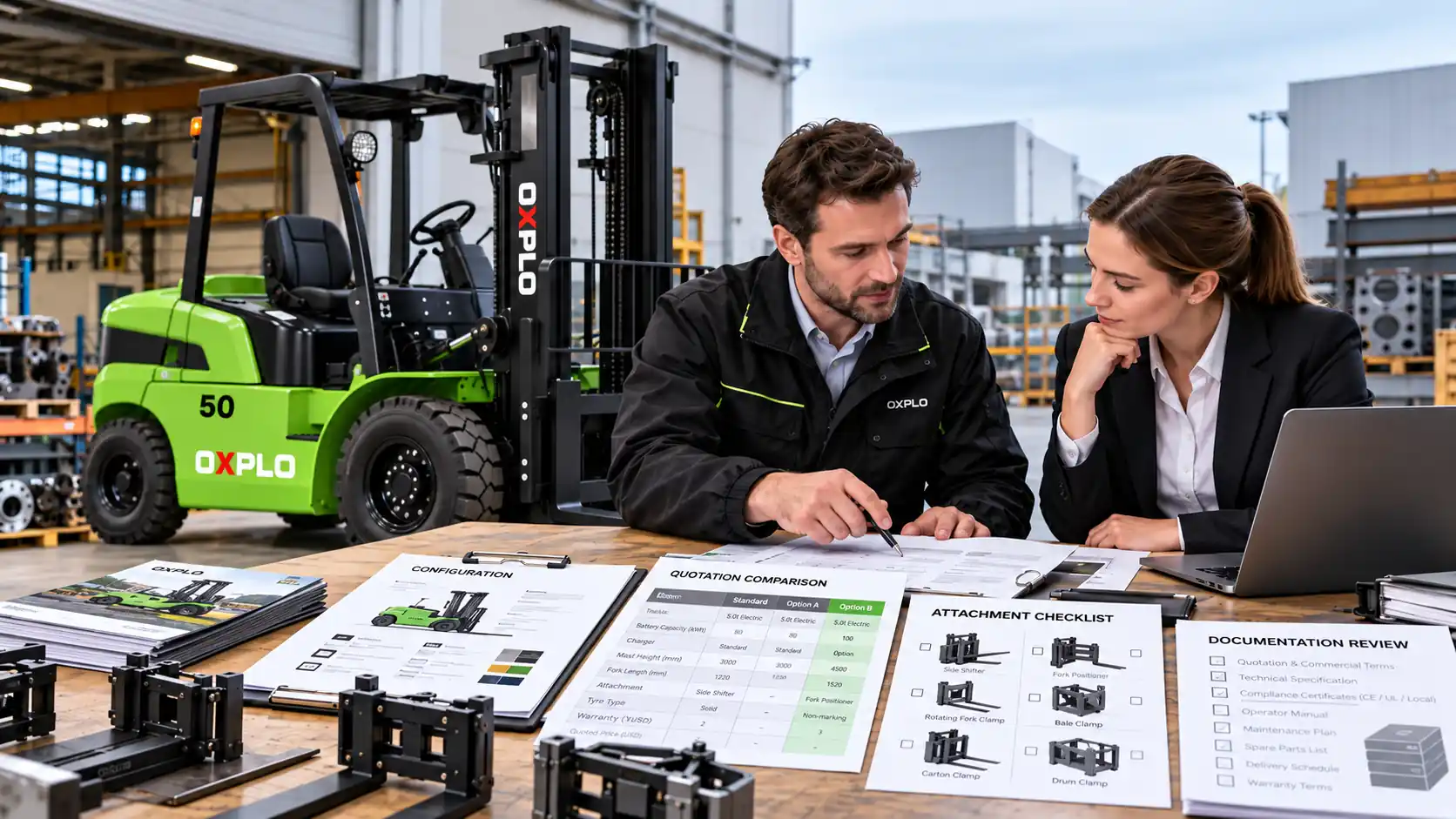
Figure 5. Supplier quotation and configuration review: compare attachments, documentation and technical scope before comparing price.
Compare scope before comparing price
If Supplier A includes a charger, side shifter and long forks while Supplier B quotes only the base truck, the prices are not directly comparable. Normalize the technical scope first.
A useful quotation matrix
Compare rated capacity and load center, residual capacity at required lift height, mast, forks, attachments, battery voltage and capacity, charger specification, turning radius, aisle requirement, gradeability, documentation, spare-parts package, warranty scope, lead time and after-sales support. If only the price column can be compared, the RFQ is not yet detailed enough.
Ask what is excluded
Exclusions often create the surprise cost: local charging cable requirements, special forks, additional hydraulic lines, destination-specific documentation, spare parts or commissioning support. A lower headline quotation can become a higher delivered project cost once these are added.
IX. Where the OXPLO CPD50 Fits – and Where It Does Not
A 5,000 kg baseline for heavy industrial handling
The OXPLO CPD50 is rated for 5,000 kg at a 500 mm load center. That gives buyers a clear baseline for evaluating heavy pallets, machinery components, building materials and other industrial loads. It should still be checked against actual load dimensions and required lift height.
80V / 410Ah lithium system
The OXPLO CPD50 uses an 80V / 410Ah lithium-ion battery system. OXPLO treats this as a starting point for duty-cycle planning rather than claiming one universal runtime. Shift length, lifting frequency, travel distance, gradients, temperature and charging windows should be supplied before the final charging arrangement is selected.
Industrial geometry that must be checked against the site
The CPD50 has a minimum outer turning radius of 2,930 mm, an overall width of 1,480 mm and a listed minimum right-angle stacking aisle width of 3,000 mm. These figures are useful preliminary references, but pallet size, fork length, attachments and safety clearance can increase real working-space requirements.
Heavy chassis and yard-oriented details
The truck weighs approximately 6,160 kg, uses 300-15 front tires and 7.00-12 rear tires, and has 175 mm minimum ground clearance at the mast. These characteristics make the machine relevant to paved industrial environments, but they also mean buyers should verify floor loading and should not treat the CPD50 as a rough-terrain forklift.
Where OXPLO would recommend further engineering confirmation
If the project includes very long loads, high lift heights, clamps, extended forks, fork positioners, irregular centers of gravity or loads that frequently approach 5,000 kg, OXPLO should review the final configuration before order confirmation. The goal is to verify the working envelope, not to force every application into the standard specification.
X. How OXPLO Configures a CPD50 Around the Application
Step 1: Define the load
OXPLO should receive the maximum and normal load weight, dimensions, pallet type, center-of-gravity information and whether the load is regular or irregular.
Step 2: Define the handling route
Provide lift height, aisle width, doors, ramp conditions, floor type, indoor/outdoor use and the longest travel route. These details help determine whether the chassis, mast and maneuvering envelope fit the site.
Step 3: Define the shift
Daily hours, number of shifts, average cycles, charging windows and the percentage of loads near rated capacity are needed to evaluate the battery and charger arrangement.
Step 4: Freeze attachments before final capacity confirmation
Side shifters, fork positioners, clamps, special forks and additional hydraulic functions should be specified before the final technical confirmation. OXPLO can then review the requested configuration against the working conditions instead of quoting a generic 5 ton forklift.
Step 5: Confirm documents and spare-parts plan
Before shipment, the buyer and OXPLO should align on the required technical documentation, operating information, recommended spare parts and destination requirements. For international buyers, this is part of commissioning risk control, not administrative paperwork.
XI. Five-Year TCO: Purchase Price Is Only One Line
Use a simple ownership equation
A practical comparison is: TCO = Purchase Price + Energy + Planned Maintenance + Tires + Spare Parts + Downtime Cost. The exact inputs vary by facility, but the structure prevents procurement teams from focusing only on CAPEX.
Downtime can dominate the difference
A forklift that is slightly cheaper to buy can become more expensive if critical parts are difficult to identify, technical support is slow or the battery/charger combination is poorly matched to the shift. In a production environment, one lost operating day can matter more than a small difference in purchase price.
Electric does not mean maintenance-free
The lithium powertrain removes several routine combustion-engine service items, but the battery, charger, hydraulic system, mast rollers, lift chains, tires, steering, brakes and electrical connections still require inspection. A realistic TCO model includes these items rather than assuming an electric forklift has zero maintenance cost.
XII. Buyer RFQ Checklist
Load data
Maximum load; normal load; dimensions; center of gravity or load center; pallet type; irregular or symmetrical load.
Lift and mast data
Maximum lift height; normal working height; free-lift requirement; door and ceiling restrictions; preferred mast type if already known.
Site data
Minimum aisle width; door dimensions; indoor/outdoor operation; floor type; ramp gradient and length; longest travel distance.
Duty-cycle data
Operating hours per day; number of shifts; estimated cycles per hour; percentage of heavy cycles; available charging breaks.
Configuration data
Side shifter; fork positioner; long forks; clamp; special tires; cameras, warning lights or other safety equipment.
Commercial and destination data
Destination country; delivery target; required documentation; preferred trade term; local electrical supply for the charger.
XIII. FAQ
Q1. Is a 5 ton electric forklift suitable for a load that regularly weighs exactly 5,000 kg?
Not automatically. If the normal load is already at the rated maximum, load center, lift height and attachments become critical. A capacity margin or a different truck class may be more appropriate depending on the application.
Q2. Can a 5000 kg forklift handle long steel, timber or machinery components?
Potentially, but gross weight is not enough to decide. Long loads move the effective center of gravity forward and can reduce residual capacity. Provide the full load dimensions and required lift height before selection.
Q3. Is a lithium forklift suitable for multi-shift operation?
It can be, provided battery capacity, charger power and charging windows are matched to the actual duty cycle. Continuous heavy lifting and ramp use can materially increase energy demand.
Q4. Can the OXPLO CPD50 work outdoors?
Yes, on suitable paved and stable industrial surfaces when weather and operating conditions permit. For mud, deep gravel, severe potholes or highly uneven terrain, a dedicated rough-terrain forklift is generally more suitable.
Q5. Does adding a fork positioner or long forks affect capacity?
It can. Attachment weight and forward load-center shift can reduce usable capacity. OXPLO recommends confirming residual capacity for the final attachment and mast combination before ordering.
Q6. What battery does the OXPLO CPD50 use?
The standard published CPD50 specification lists an 80V / 410Ah lithium-ion battery. Actual working time depends on load intensity, lifting frequency, travel distance, gradients, temperature, operator behavior and charger configuration.
Q7. What should I send OXPLO for an accurate quotation?
Send the maximum and normal load weight, load dimensions, lift height, aisle width, working surface, daily operating hours, ramps, attachments, destination country and any documentation requirements. That allows OXPLO to evaluate the application instead of quoting only a standard catalogue configuration.
XIV. Conclusion: Buy the Real Operating Capacity, Not the 5 Ton Label
The engineering conclusion
A 5 ton electric forklift should be selected as a complete operating system. Load weight, load center, lift height, mast, attachments, aisle geometry, floor conditions, battery strategy and documentation all interact. Ignoring any one of them can turn a technically correct catalogue specification into a weak real-world purchase.
Where OXPLO adds value
For buyers considering the OXPLO CPD50, the most useful next step is not simply asking for the lowest price. It is sending OXPLO the real operating conditions so the truck, mast, forks, lithium battery, charger and attachments can be reviewed as one configuration. That makes the quotation more accurate and reduces the risk of discovering limitations after delivery.
Next step
Review the OXPLO CPD50 product page for the published baseline specifications, then send your working conditions to OXPLO for configuration discussion. The objective is straightforward: buy a forklift that repeatedly handles the real load, in the real facility, throughout the real working day.
OXPLO CPD50 – Buyer Interpretation Table
Published CPD50 Data | What It Means | What the Buyer Should Verify |
5,000 kg @ 500 mm | Capacity baseline | Actual load center, lift height and attachments |
80V / 410Ah lithium | Battery baseline | Daily duty cycle and charging windows |
2,930 mm turning radius | Maneuverability reference | Aisle, pallet and clearance envelope |
3,000 mm right-angle stacking aisle | Preliminary layout reference | Real pallet/fork/attachment combination |
19% full-load gradeability | Ramp capability reference | Ramp length, surface, braking and stability |
6,160 kg truck weight | Heavy chassis platform | Floor, dock plate and elevator loading |
1,220 mm forks | Standard fork baseline | Whether long or special forks are needed |
175 mm mast ground clearance | Useful on paved industrial yards | Not a substitute for rough-terrain capability |
Useful OXPLO Links
OXPLO CPD50 5 Ton Electric Forklift