
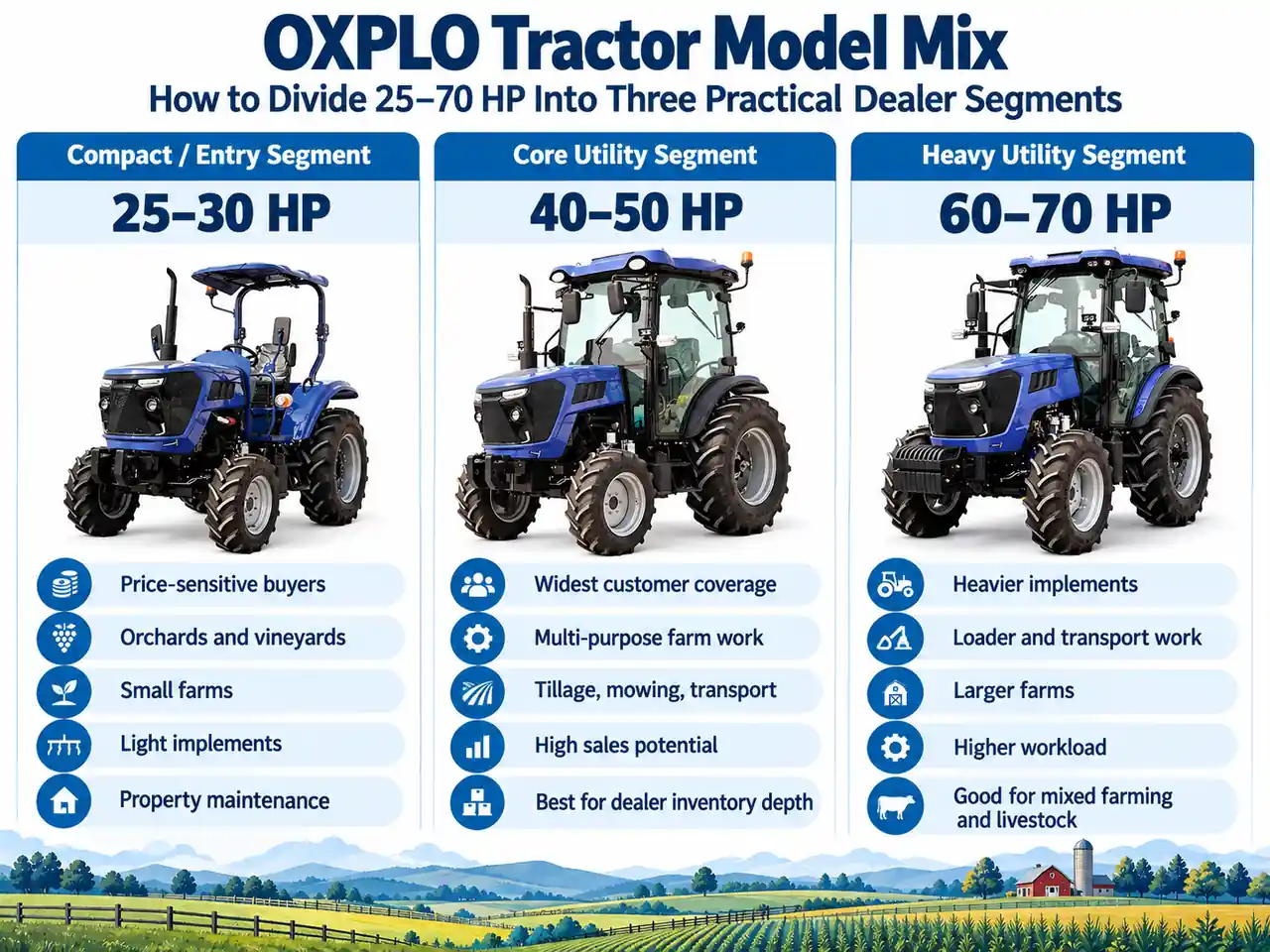
Buying wholesale tractors is not mainly a horsepower-selection problem. For a tractor dealer or tractor distributor, the harder problem is deciding how much working capital to place behind each model before local demand has been proven. A catalogue can look complete while the warehouse quietly becomes unbalanced: too many low-turnover units, the wrong operator-station configuration, too little spare-parts coverage, or a tractor that is mechanically suitable but difficult to register or support in the intended market.
The right question is therefore not “Which six tractors should I import?” It is “Which customer jobs must I cover immediately, which models deserve inventory depth, and which configurations should remain order-based until demand is verified?”
This guide explains how European dealers can build a 25–70 HP model mix around real applications, inventory turnover, implement compatibility, compliance checks and after-sales capacity. OXPLO is introduced later as a practical example of how a six-model range can be organised into compact, core utility and heavier utility segments rather than treated as six equal SKUs.
I. Why a “Complete” 25–70 HP Line Can Still Be a Bad Dealer Investment
For a new tractor dealer, stocking 25, 30, 40, 50, 60 and 70 HP in equal quantities can feel conservative. It gives sales staff something to show every customer and avoids the fear of “missing” a horsepower request. Commercially, however, equal stocking is often the opposite of conservative because each unit ties up cash at a different rate and for a different length of time.
An unsold tractor carries more than its invoice value. The dealer has already paid, or committed to pay, freight, import costs, handling, PDI, storage and financing. If the specification is wrong for local buyers—cab versus open station, tyre package, linkage class, loader preparation or road equipment—the unit may eventually require discounting even though there is nothing mechanically wrong with it.
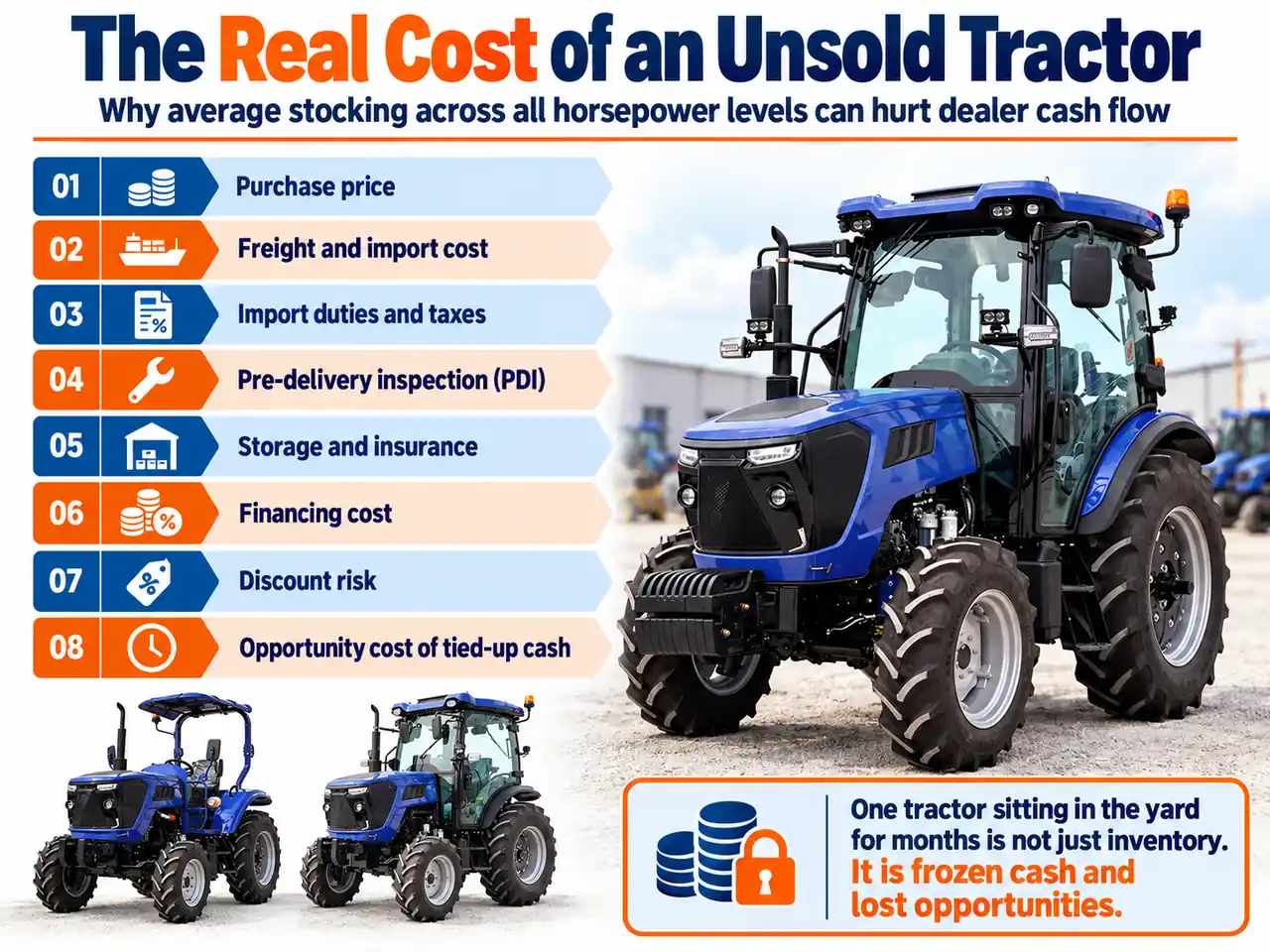
Figure 1. The hidden cost stack behind a slow-moving tractor.
CEMA reported roughly 144,400 agricultural tractor registrations in Europe in 2024, down 8.1% year over year and at the lowest level in at least a decade. That does not mean every local market behaves the same way, but it reinforces a basic dealer lesson: when demand is uneven, catalogue completeness is not a substitute for disciplined inventory management.
The dealer objective: customer coverage with the lowest practical inventory complexity
A useful inventory plan balances four variables: customer coverage, stock turn, configuration complexity and dealer margin. If two horsepower levels serve almost the same customer jobs, they should not automatically receive the same stock depth. One can be a core inventory model while the other remains a display, demonstration or order-based option.
II. Europe Is Not One Tractor Market
“European tractor demand” is too broad to be a stocking strategy. Farm structure, crops, terrain, labour patterns, road use, existing implement fleets and dealer-service radius can vary substantially between countries and even between regions inside one country. A model mix built for narrow-row orchards should not be copied into an area dominated by mixed livestock farms simply because both markets buy tractors under 70 HP.
Start with farm structure and the work calendar
A distributor should map the work customers actually complete during the year: mowing, spraying, rotary tillage, soil preparation, transport, loader work, feeding support, estate maintenance, snow work or municipal tasks. The same nominal horsepower can have very different value depending on how many of these jobs must be completed, how quickly they must be completed and what implements the customer already owns.
Measure physical constraints before horsepower
- Row spacing, gate width and headland space for orchards and vineyards.
- Slope, soil moisture and traction conditions that influence the value of 4WD, tyre selection and machine weight.
- Typical implement width, hitch category, PTO speed and implement mass.
- Frequency of trailer transport or front-loader work.
- Distance from the dealer to the customer and the practical cost of field service.
This is why a compact 30–40 HP tractor can be commercially stronger than a larger model in a narrow-access region, while a livestock or mixed-farming dealer may need proportionally deeper 50–70 HP inventory. The stocking decision is local even when the supplier catalogue is global.
III. Build the Model Mix Around Jobs, Not Horsepower
Farmers do not buy a 50 HP tractor because “50 HP” is an attractive number. They buy it to complete work. For the dealer, that means the cleanest way to build a wholesale tractors portfolio is to start with customer jobs and work backwards into the tractor specification.
Build a customer-job matrix
Customer segment | Typical jobs | What usually drives the decision |
Orchard / vineyard | Mowing, spraying, light transport, row maintenance | Width, manoeuvrability, canopy clearance, tyre choice |
Small mixed farm | Tillage, mowing, spreading, transport | Multi-purpose use, PTO, linkage, traction |
Livestock / grassland | Mowing, feeding support, trailer and loader work | Hydraulics, stability, tyre package, repeated daily work |
Larger mixed farm | Heavier soil work, transport, broader implement fleet | Category II compatibility, chassis, ratio range, workload capacity |
The matrix forces the sales team to ask better questions. Instead of “Do you want 40 or 50 HP?”, ask what implement the customer already owns, how wide it is, how often it will run, whether loader work is required, and what conditions the tractor must handle. Horsepower becomes an output of the selection process rather than the first input.
IV. Divide 25–70 HP Into Compact, Core and Heavy Utility Segments
For inventory planning, six individual horsepower numbers are easier to manage when they are grouped into three commercial roles. The exact boundaries are not universal, but the following structure is practical for a dealer selling 25–70 HP tractors.
Compact / Entry: 25–30 HP
This band is useful where access, budget and lighter implements dominate. Typical buyers include orchards, vineyards, property-maintenance contractors and smaller farms. The main dealer risk is overstocking two models that solve almost the same jobs. Unless local demand clearly differentiates 25 HP from 30 HP, one can carry the deeper inventory while the other remains available by order.
Core Utility: 40–50 HP
This is often the broadest multi-purpose band in a 25–70 HP range because mowing, cultivation, spreading, PTO work and transport can overlap in the same customer. Here the dealer should compare more than engine output: PTO options, transmission, overall dimensions, linkage, hydraulic requirements, tyres and loader compatibility can determine whether the tractor genuinely covers more customer jobs.
Heavy Utility: 60–70 HP
At 60–70 HP, the commercial proposition often changes from “more power in the same type of machine” to “a larger utility platform for heavier recurring work.” Customers may be moving to larger implements, Category II equipment, more transport, loader work or longer annual operating hours. That makes this segment important, but not automatically a high-volume stock category in every territory.
V. Inventory Depth Matters More Than SKU Count
A dealer can advertise a wide range without holding equal quantities of every configuration. This distinction is central to managing wholesale farm tractors profitably.
Use three inventory roles
- Core stock: models with proven inquiry volume, conversion and repeated application coverage. These deserve the deepest inventory.
- Support stock: complementary horsepower levels that close gaps in the range but do not justify the same quantity as core models.
- Order-based configurations: special cab, tyre, loader, hydraulic or attachment combinations that carry higher mismatch risk if stocked speculatively.
Track dealer metrics instead of relying on intuition
After each delivery cycle, review sell-through rate, days to sale, quote-to-order rate and attachment attach rate. A high-inquiry model with weak conversion may have a pricing, specification or positioning problem. A lower-inquiry model with strong conversion may deserve one or two units but not deep inventory. These metrics are more useful than copying another dealer’s stock plan.
VI. Implements, Spare Parts and After-Sales Can Change the Best Model Mix
A tractor dealer is not selling an engine on four wheels. The customer is buying an operating system: tractor + implement + parts + service. The model mix should therefore be evaluated as a support ecosystem.
Implement compatibility can make a smaller range more valuable
A dealer should map each tractor against common local implements: mower, rotary tiller, flail mower, trailer, front loader, bale equipment and other frequently requested attachments. The important variables include PTO requirement, three-point category, implement weight, hydraulic demand, working width, ballast and tractor stability. A model that matches more of the installed implement base may deserve more inventory even if another model has a higher headline horsepower.
Parts commonality reduces support complexity
Every additional platform can increase the number of filters, seals, hydraulic components, electrical parts and driveline items a dealer must understand and stock. Before expanding the model mix, ask the supplier which wear parts and service items are shared between models, what should be included in an initial spare-parts package, how warranty claims are documented and what technical manuals are available.
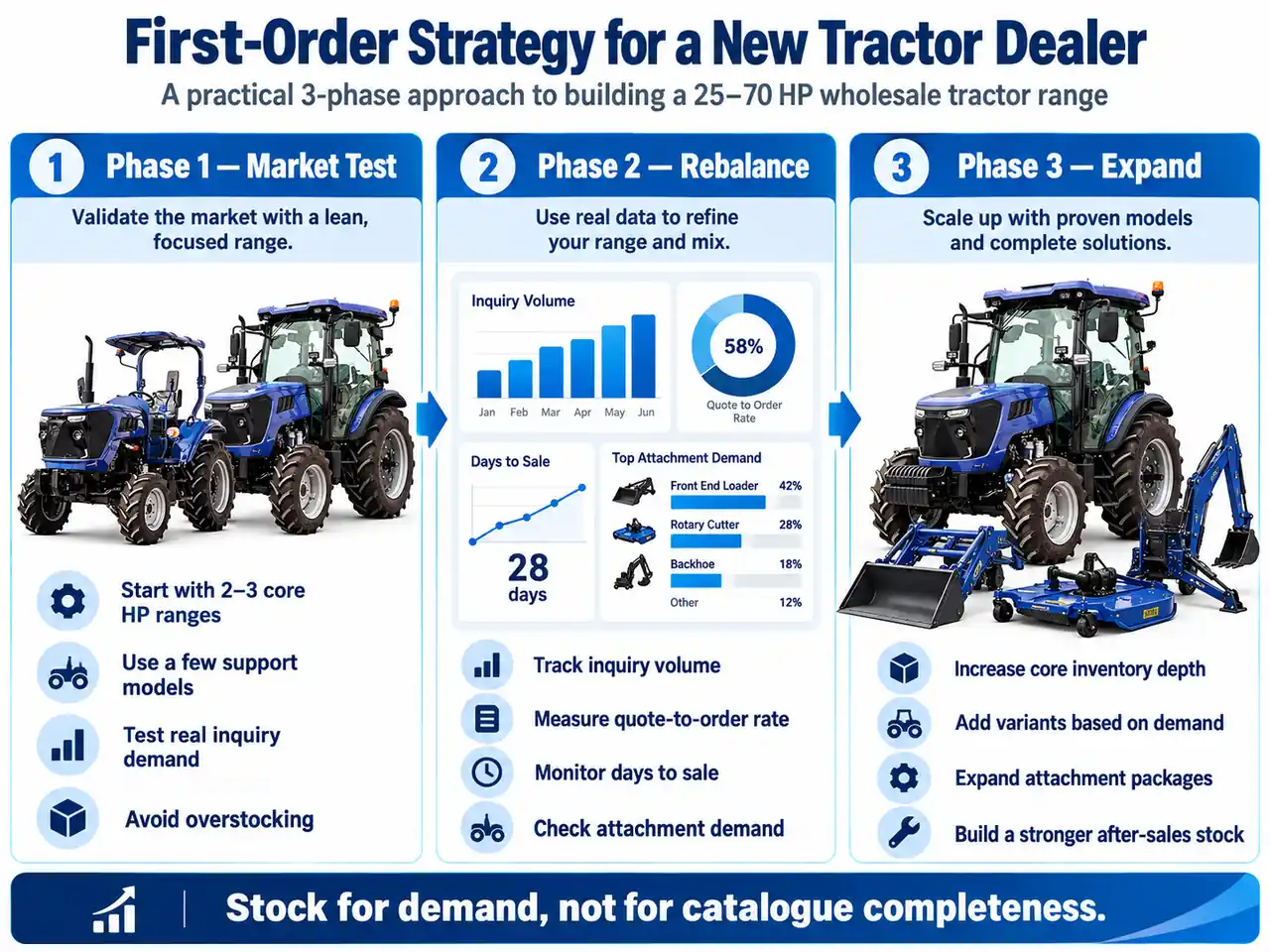
Figure 2. Dealer profitability depends on the customer lifecycle, not only unit margin.
VII. European Compliance Checks Before You Place a Wholesale Order
A tractor can fit the farm technically and still be unsuitable for a dealer if the documentation does not support the intended market, registration route or use case. European agricultural and forestry vehicles operate under a dedicated EU type-approval and market-surveillance framework, including Regulation (EU) No 167/2013 and its related implementing and delegated acts.
Before placing an order, review the EU agricultural and forestry vehicle framework and confirm the actual requirements for the destination country and vehicle configuration. Do not assume that a generic certificate, a component-level mark or documentation for one configuration automatically covers another model or national registration process.
Dealer compliance checklist
- Destination country and intended vehicle category.
- Whether on-road registration is required for the customer use case.
- Available type-approval / conformity documentation for the exact model and configuration.
- Engine and emissions documentation applicable to the destination and production date.
- Road equipment: lighting, mirrors, braking, tyres, speed-related equipment and protective structures where required.
- Importer / distributor documentation responsibilities and retention of technical records.
- Any local requirements that sit on top of the EU framework.
For a dealer, this check belongs before inventory commitment, not after the tractors arrive. If documentation is unclear, the safer commercial choice is to resolve it before allocating stock depth to that model.
VIII. Use a 90–180 Day First-Order Strategy Instead of Guessing
A new tractor distributor does not need to predict the perfect six-model mix on day one. A safer approach is to treat the first order as a controlled market test and then rebalance based on evidence.
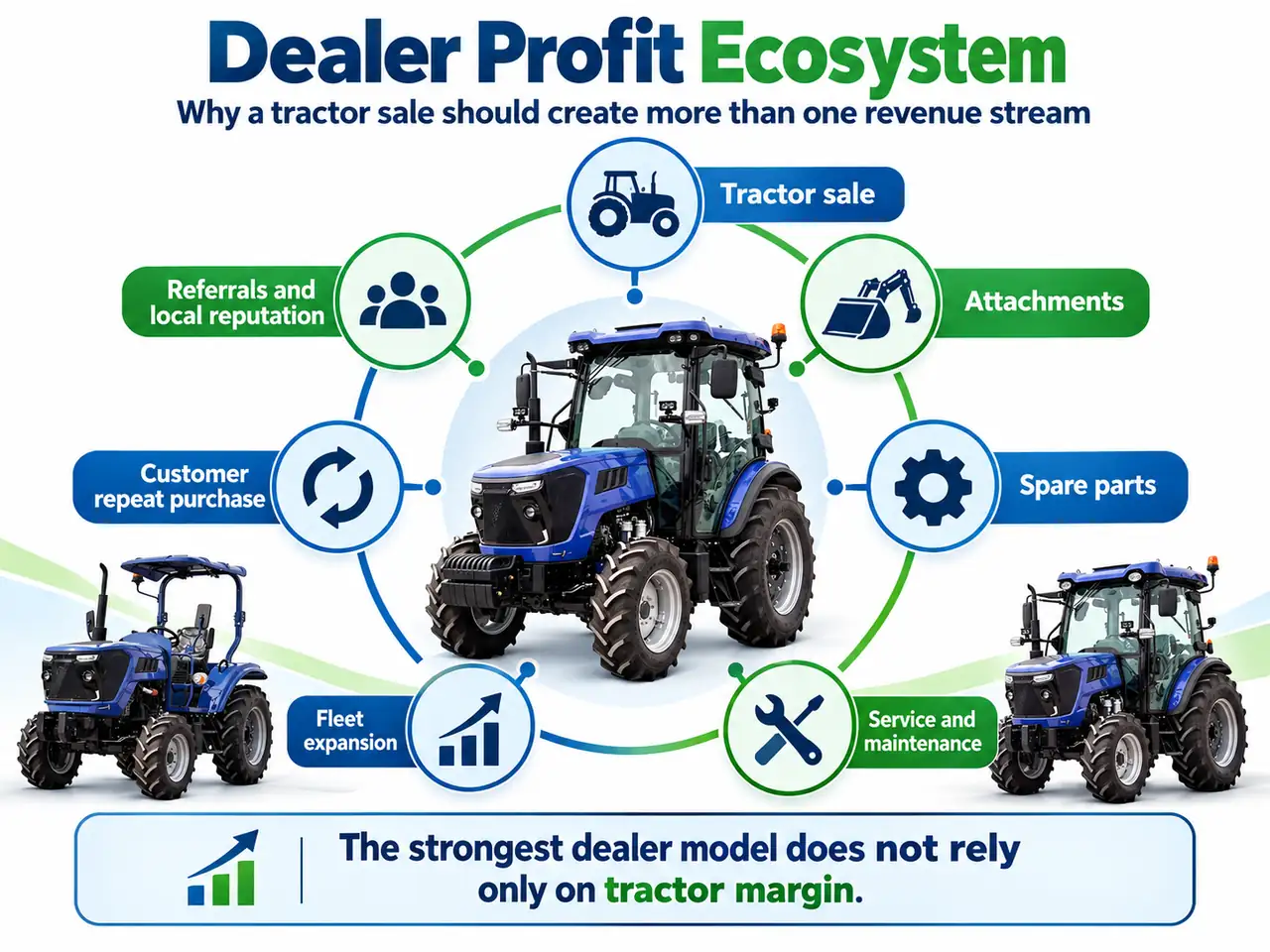
Figure 3. A practical first-order and replenishment loop for new dealers.
Phase 1: launch with a focused range
Choose two or three horsepower bands that match the strongest known applications. Keep overlapping or special configurations available but order-based. The purpose is to collect clean market data without freezing too much working capital.
Phase 2: measure the objections, not just the inquiries
Record why quotations are lost: price, horsepower, width, cab, tyre package, loader availability, lead time, documentation, finance or competitor trade-in. This creates a much better replenishment signal than raw inquiry volume.
Phase 3: expand only where demand is proven
Once a horsepower band demonstrates acceptable sell-through and support demand, increase inventory depth and add the configurations customers repeatedly request. Keep slow-moving options order-based until there is enough evidence to justify stock.
IX. How the OXPLO 25–70 HP Range Can Be Structured for Dealer Inventory
The commercial value of OXPLO’s 25–70 HP range is not simply that six horsepower labels appear in one catalogue. For a dealer, the more useful question is whether the range can be organised into clear customer roles while remaining inside one supplier ecosystem for product selection, attachments, spare parts and support.
The OXPLO tractor range currently covers OXT254 (25 HP), OXT304 (30 HP), OXT404 (40 HP), OXT504 (50 HP), OXT604 (60 HP) and OXT704 (70 HP). A dealer can use the range as three commercial layers rather than six equal stock commitments.
OXT254 / OXT304: compact entry coverage
These models can cover buyers whose first constraints are access, manoeuvrability, lighter work and budget. For orchard, vineyard and property-maintenance territories, OXPLO dealers can decide which of the two should carry deeper stock based on local row spacing, implement sizes and price sensitivity, while keeping the other available to close specific gaps.
OXT404 / OXT504: core utility coverage
OXPLO OXT404 is listed at 40 HP with 4WD, an 8F + 8R transmission and Category I linkage. OXPLO OXT504 raises output to 50 HP while remaining in the compact OXT platform. For a tractor dealer, this pair is useful where customers need more frequent mowing, soil preparation, PTO work and transport without automatically stepping into the larger Category II chassis.
OXT604 / OXT704: larger Category II utility coverage
OXPLO OXT604 is listed at 60 HP with a 12F + 12R transmission, Category II rear linkage, a longer wheelbase and a larger tyre package than the compact range. OXPLO OXT704 extends that larger utility platform to 70 HP. For dealers, this pair is relevant where heavier implements, loader work, transport and longer recurring workloads justify a larger platform.
Dealers can also review the OXPLO tractor configuration page and OXPLO support resources when comparing attachment needs, parts planning and model-specific documentation. Exact configuration and destination-market documentation should be confirmed before ordering.
X. Questions to Ask Before Choosing a Wholesale Tractor Supplier
Price is necessary, but it is not a complete distributor decision. A low tractor price does not compensate for a model mix that is difficult to support, cannot match the customer’s implements or arrives without the documentation needed for the intended market.
- Which models share common service and wear parts?
- What first-order spare-parts package is recommended?
- Which tractors and attachments are compatible as complete working combinations?
- How are PDI, warranty claims and technical support handled?
- What manuals, parts books and diagnostic information are available?
- What is the normal lead time for tractors, attachments and spare parts?
- Which documents are available for the exact model, configuration and destination market?
- Can the supplier help build a model mix around local customer jobs instead of simply quoting the full catalogue?
What to send a supplier for a useful dealer quotation
A dealer will usually receive a better proposal when the RFQ contains market information, not just “send your best tractor price.” A practical RFQ should include:
- Target country / region and whether road registration is expected.
- Main customer type: orchard, vineyard, mixed farm, livestock, property maintenance or contractor.
- Target horsepower bands and the reason each band is needed.
- Expected first-order quantity and preferred inventory role for each model.
- Common implements and required linkage / PTO information.
- Open-station or cab demand, tyre requirements and loader requirements.
- Requested spare-parts starter package and warranty process.
- Required documentation for the intended market.
XI. FAQ for Tractor Dealers and Distributors
Q1. Should a new dealer stock every 25–70 HP model?
Not necessarily. A new dealer should first identify the two or three horsepower bands that match the strongest local applications, then keep overlapping or special configurations order-based until demand is proven. The objective is not to show the deepest catalogue; it is to maintain useful customer coverage without creating slow-moving stock.
Q2. Which horsepower range should carry the most inventory?
The core range should be determined by local inquiries, conversion, days-to-sale and implement demand. In many markets, a 40–50 HP utility band can cover a broad mix of farm work, but a dealer should validate this against its own territory rather than treating it as a universal rule.
Q3. Why do implements matter so much when buying wholesale tractors?
Because the tractor must power, lift, tow and physically fit the implements customers use. PTO requirement, linkage category, implement mass, hydraulics, width and ballast can make a nominally suitable horsepower model the wrong commercial fit.
Q4. What is the practical difference between OXPLO’s 50 HP and 60 HP platforms?
OXPLO lists the OXT504 as a 50 HP compact-platform tractor with 8F + 8R transmission and Category I linkage. The OXT604 moves to a larger utility platform with 12F + 12R transmission and Category II linkage, so the step is not only ten additional horsepower; it also changes implement compatibility and working platform.
Q5. How should a European dealer check compliance before ordering?
Confirm the exact destination country, intended vehicle category, registration needs, engine/emissions documentation and type-approval or conformity documents for the exact configuration. Requirements can vary by model and national use case, so dealers should resolve the documentation route before committing inventory.
Q6. How can OXPLO support a distributor building a model mix?
OXPLO offers a 25–70 HP range spanning compact and larger utility platforms, plus attachment, parts and support resources. A distributor can use this breadth to build a focused local mix while sourcing multiple horsepower bands from one supplier. Exact stock strategy should still be based on local demand and verified model documentation.
Q7. What should be reviewed after the first 90–180 days?
Review sell-through rate, days to sale, quote-to-order rate, lost-order reasons, attachment attach rate, support requests and which configurations customers repeatedly ask for. Use these results to increase depth in proven models and keep uncertain variants order-based.
XII. Conclusion: Stock for Demand, Not Catalogue Completeness
A profitable 25–70 HP portfolio is not a staircase where every horsepower level receives equal stock. It is a demand map. Compact models cover access-sensitive and lighter work; core utility tractors cover the widest overlap of everyday farm jobs; larger utility tractors support heavier implements and recurring workloads. The dealer’s job is to assign inventory depth according to evidence.
That evidence should include customer jobs, implement fleets, compliance requirements, sell-through, days to sale, attachment demand and after-sales complexity. When these variables are measured, a tractor distributor can carry fewer speculative units while giving customers better recommendations and faster access to the configurations that actually sell.
For distributors evaluating OXPLO as a wholesale tractors supplier, the 25–70 HP range can be structured around compact, core utility and heavier utility demand rather than purchased as a one-size-fits-all bundle. Share your target country, customer profile, common implements and first-order plan so the model mix can be evaluated around real market requirements.