
When an overseas tractor stops in the middle of a seasonal job, the price of the failed component is often the smallest part of the problem. A €20 filter, belt, seal, relay, connector, sensor or hose can immobilise a machine whose daily working value is far higher. The difficult part is the supply chain that follows: identify the exact part, confirm the machine configuration, arrange international freight, clear customs, deliver it to the farm, and then install it correctly.
For European buyers importing their first machine, that risk changes how tractor spare parts should be planned. The goal is not to buy every component that might fail. That ties up capital and creates shelves of slow-moving inventory. The goal is to identify the small group of parts whose absence could create disproportionate downtime during mowing, tillage, transport, loader work, orchard maintenance or another time-sensitive operation.
This guide explains how to build that first spare parts kit logically: by workload, failure exposure, local availability, replenishment lead time and the practical consequences of a stopped tractor. The same method can be used whether you are a farm owner, agricultural contractor, machinery importer or dealer building a new installed base in Europe.
The core principle A good spare parts kit is not a box of random parts. It is a planned buffer against the failures most likely to stop your tractor when replacement lead time is longest. |
I. Why a Small Tractor Part Can Become a Large Business Problem
A local tractor buyer and an overseas tractor buyer do not face the same repair economics. A locally distributed machine may be supported by a nearby dealer, regional warehouse or next-day courier. An imported machine may depend on a manufacturer several time zones away, followed by international shipping and customs clearance. The component does not become more expensive because it crossed a border; the downtime does.
The real cost is the missed working window
Agricultural work is seasonal. A tractor that is unavailable for four days during a quiet winter period creates inconvenience. The same four days during mowing, seedbed preparation, spraying support, hay work or a short harvest-support window can force the farm to hire another machine, delay an operation, rearrange labour or accept lower utilisation of other equipment.
This is why experienced buyers do not rank tractor spare parts by price alone. They rank them by the business consequence of not having the part when it is needed.
A practical downtime equation
A simple way to think about the exposure is:
Downtime Cost = Lost machine value per day + labour disruption + alternative equipment cost + delayed-work cost + emergency freight and handling |
The equation does not need perfect accounting precision. Its purpose is to change the purchasing question from “How much does this spare part cost?” to “What does it cost us if this part is unavailable?”
II. Why Tractor Parts Planning Is More Complex for European Imports
The difficult part is not simply identifying a list of common farm tractor parts. European buyers operate across very different farm structures, workloads, climates, transport networks and service environments. A compact tractor in a vineyard has a different risk profile from a 70 HP utility tractor doing frequent loader and transport work.
The same horsepower does not guarantee the same parts
Two 50 HP tractors can use different engines, belts, filters, PTO configurations, hydraulic connections, electrical components and linkage arrangements. Even within one brand, a higher-power platform may use a different chassis, transmission or linkage category. Spare parts therefore need to follow the exact machine model and supplied configuration, not a generic “50 HP tractor parts” list.
OXPLO currently offers a 25–70 HP tractor range for European farm applications, with compact 25–35 HP models, 40–50 HP utility tractors and 60–70 HP machines for larger farms and heavier work. That range itself shows why model-specific parts planning matters.
Local sourcing is useful—but only when interchangeability is verified
Europe has strong local parts availability for many standard items. That is an advantage. But “available locally” and “safe to substitute” are not the same statement. A filter that screws on can still have the wrong filtration specification. A hydraulic hose can have the correct length but the wrong pressure rating or fitting. A relay can look identical while having different electrical characteristics.
Use local sourcing where dimensions, ratings and compatibility are confirmed. For model-specific engine, electrical, hydraulic, steering, braking or control components, verification against the exact machine is the more conservative approach.
III. The Three Spare-Parts Mistakes That Create Expensive Downtime
Mistake 1: Ordering “one of everything”
This feels safe but usually produces the wrong inventory. Expensive low-probability assemblies consume budget while small high-impact parts remain uncovered. A first-time owner does not need to recreate a dealer warehouse.
Mistake 2: Waiting until the first failure to identify parts
When a machine is already down, every identification step becomes urgent. If the operator cannot provide the machine model, serial number, part label or a clear photo of where the part is installed, the supplier may spend additional time confirming what is actually needed. Wrong-part shipments are especially expensive when the buyer is overseas.
Mistake 3: Treating every farm application the same
A tractor used for mowing and PTO work does not create the same wear pattern as a tractor doing frequent loader cycles. A dealer supporting ten machines should not hold inventory in the same way as an owner with one lightly used tractor. The kit must follow the workload.
IV. Build the First Spare Parts Kit With a Criticality Matrix
The most useful planning tool is a criticality matrix. For every candidate part, score four questions:
- Failure exposure: How likely is the part to clog, wear, loosen, leak or fail under the expected operating conditions?
- Downtime impact: Can the tractor continue working safely if the part fails?
- Replenishment difficulty: How long would it realistically take to identify, ship and receive a replacement from overseas?
- Local substitutability: Is a verified equivalent readily available in the destination market?
A useful priority model Spare-Part Priority = Failure Exposure × Downtime Impact × Replenishment Difficulty. Reduce the priority where a properly verified local equivalent is easy to obtain. |
The model deliberately gives weight to downtime and logistics, not just component value. That is why a modestly priced seal or sensor can deserve shelf space while a large major assembly does not.
Candidate Part | Typical Exposure | If It Fails | Local Availability | First-Order Decision |
Routine filters | Planned service item | Maintenance delayed / engine protection compromised | Often possible, but verify specification | Usually stock |
Drive belt | Moderate wear / age / contamination | Can stop operation | Varies by dimensions and profile | Often stock if model-specific |
Selected fuse / relay / switch | Low unit cost | May disable a function or machine | Often available only if exact spec is known | Stock selected items |
Hydraulic hose / coupler | Application dependent | Loader / hydraulic work may stop | Can be strong if fittings and pressure are known | Stock or source locally by specification |
Major gearbox assembly | Low early-life probability | High impact | Rarely local | Usually order when required |
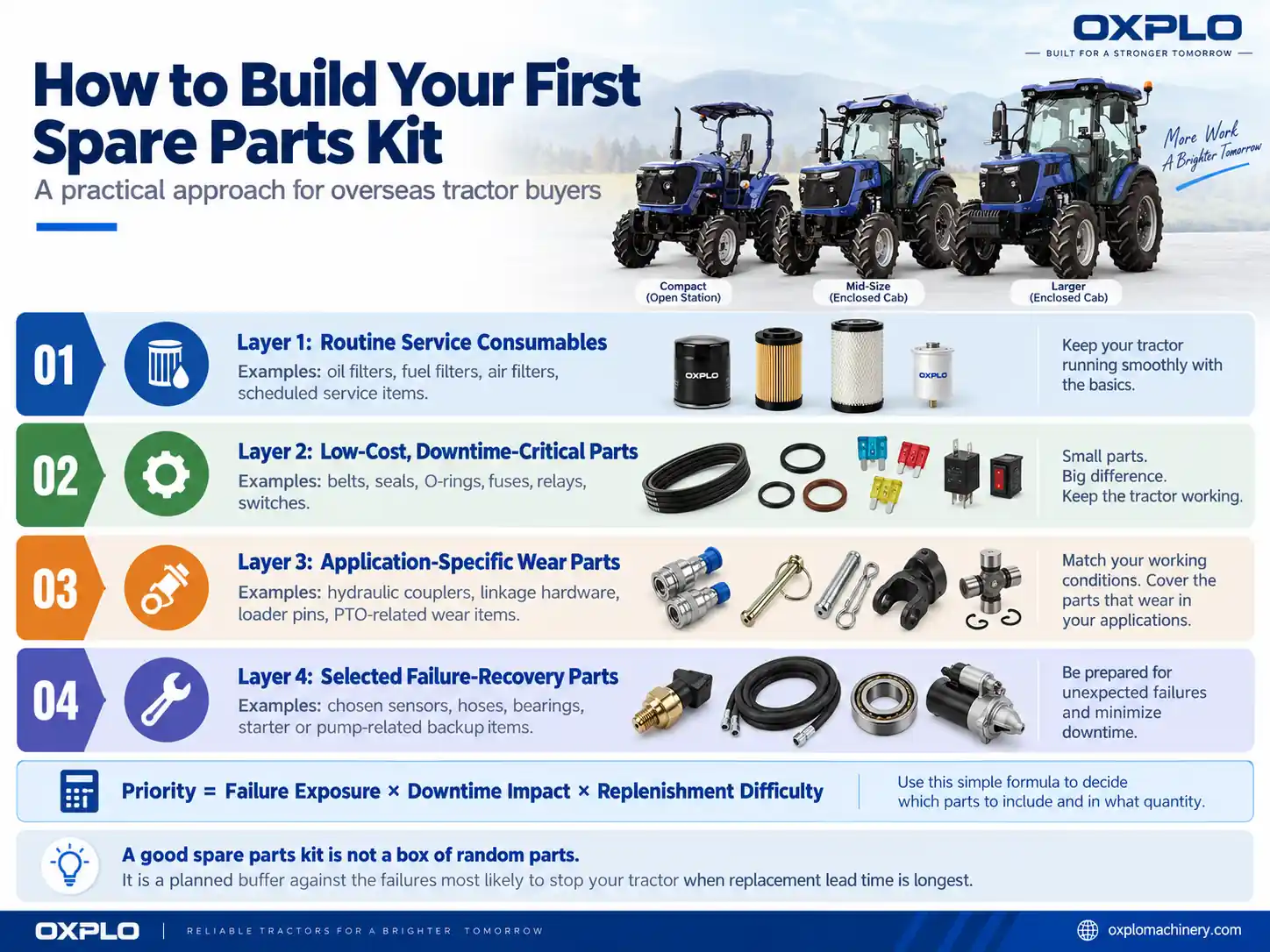
Four-layer first spare parts kit: planned consumables, downtime-critical low-cost parts, application-specific wear parts, and selected recovery components.
V. What to Order With the First Tractor
Layer 1: Routine service consumables
These are the easiest parts to justify because their use is expected. Typical categories include engine-oil filters, fuel filters, air-filter elements and other model-specific service items. The correct quantity should be calculated from the service schedule and expected annual operating hours—not from a generic rule such as “buy three of each.”
A lightly used estate tractor and a machine operating hundreds of hours per year should not receive the same service-parts quantity. The maintenance horizon matters more than the number of boxes.
Layer 2: Low-cost parts with high downtime impact
This is where a well-designed kit often creates the best return. Depending on the exact tractor, candidates can include belts, selected seals and O-rings, fuses, relays, switches, bulbs, connectors and selected sensors. The purpose is not to predict every failure. It is to cover inexpensive items that would be frustrating to wait for internationally.
Layer 3: Application-specific wear and connection parts
Workload determines this layer. Frequent PTO implement changes increase attention on linkage pins, retaining hardware and PTO connection items. Loader work increases exposure around hydraulic hoses, couplers, pins and bushes. Orchard and grounds-care work may place more emphasis on service filters, belts and electrical items because uptime and compact access matter.
Layer 4: Selected failure-recovery components
These are parts that can reduce a long stop but should be selected carefully. Examples can include chosen sensors, hoses, bearings or starter/pump-related backup components where the expected workload, service environment and local availability justify them. Do not turn this layer into a shopping list of expensive assemblies.
VI. Plan Spare Parts by Application, Not by a Generic Checklist
This is the most important adjustment for a European buyer. The same tractor family can be used in vineyards, orchards, mixed farms, livestock operations, transport or loader work. The risk profile changes with the job.
Application | Main Spare-Parts Priority | Why |
Vineyard & orchard | Routine filters, belts, electrical items, linkage hardware | Compact machines often work in tight spaces and seasonal windows; small stoppages are disruptive. |
Mowing & PTO work | Filters, PTO connection parts, belts, wear items | Repeated PTO use and implement changes increase attention on connection and wear points. |
Mixed farming | Service consumables, selected hydraulic backup parts, linkage parts | The tractor changes jobs frequently, so the kit must cover several systems without becoming excessive. |
Frequent loader work | Hydraulic hoses, couplers, pins, bushes, service parts | Repeated hydraulic cycles and material handling create a different wear pattern. |
Dealer / fleet | Shared inventory, deeper quantities, repeated-failure parts | One stocked part can support several machines, making broader inventory economically rational. |
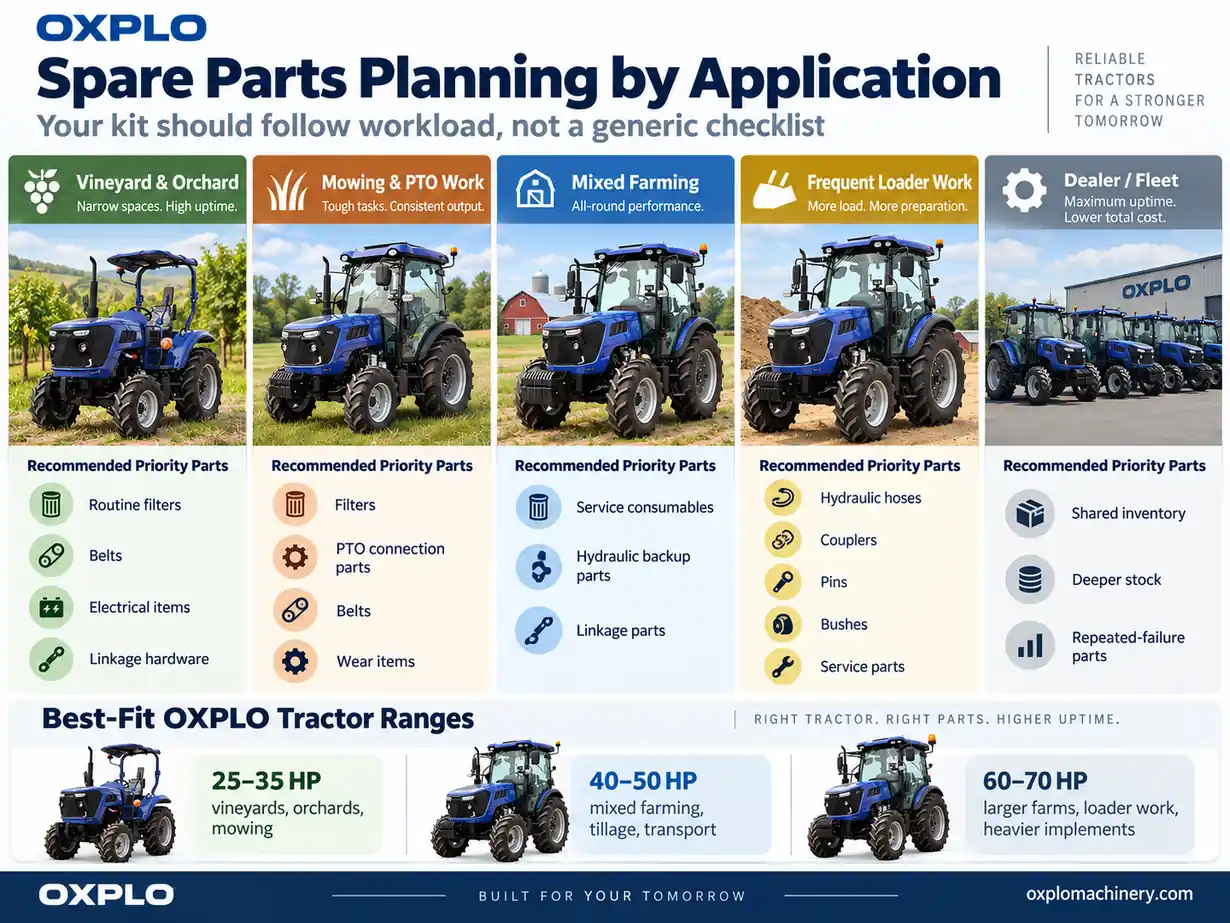
Spare-parts planning changes with the application: orchard work, PTO work, mixed farming, loader duty and fleet support create different priorities.
OXPLO maps its tractor range to different farm workloads: OXT254 25 HP compact tractor for lighter compact work, OXT504 50 HP tractor for higher-frequency mixed-farm and PTO work, and OXT704 70 HP tractor for larger-farm, transport and heavier-implement applications. The spare-parts strategy should change with those operating profiles.
VII. Decide What to Stock, What to Buy Locally, and What to Order Only When Needed
A disciplined buyer separates parts into three decisions rather than simply “buy” or “do not buy.”
Stock with the tractor
- Low cost relative to the machine.
- Failure would stop or materially limit work.
- Model-specific or difficult to identify locally.
- International replenishment would create unacceptable delay.
Source locally
- The component is standardised and its specification is fully known.
- A verified equivalent is available from a reliable European supplier.
- Local fabrication or hose service can reproduce the required pressure, fitting and dimensional specification safely.
Order when required
- The part is expensive and has a low probability of early-life replacement.
- The tractor can continue operating safely without it, or downtime exposure is acceptable.
- Installation requires specialist diagnosis, equipment or workshop capability that the owner does not maintain on site.
VIII. Build the Kit Around Annual Operating Hours
One of the most useful questions to answer before shipment is: how many hours will this tractor realistically work in the first twelve months? “Regular use” is too vague. A machine working 150 hours a year and one working 900 hours a year need different service-parts depth and different exposure to wear.
Operating Profile | Planning Logic |
Low annual utilisation | Cover the first maintenance horizon and a small set of downtime-critical items. |
Moderate seasonal utilisation | Cover planned services plus selected wear and connection parts tied to the main implements. |
High professional utilisation | Deeper service inventory and a broader review of wear, hydraulic and electrical risk. |
Dealer or fleet operation | Shared stock based on installed population, repeated failures and actual consumption data. |
The rule is simple: do not ask only “How many spare parts should I buy?” Ask “What period of operation do I want this inventory to protect?”
IX. The Hidden Failure Point: Incorrect Parts Identification
A tractor can remain stopped even when replacement stock exists if the wrong component is identified. Messages such as “I need a fuel filter” or “the hydraulic part is broken” are not enough for reliable international support. Variants can change by engine, production configuration, attachment or supplier revision.
What a useful parts request should contain
- Machine model.
- Serial number or identification plate.
- Current operating hours.
- A concise description of the fault symptom.
- A full-machine photo to establish the configuration.
- A component-location photo showing where the part sits on the tractor.
- A close-up of the damaged part and any label or part number.
- A short video where the problem involves movement, noise, hydraulics or intermittent behaviour.
- Dashboard fault code where applicable.
This information reduces ambiguity before a component is packed and shipped. For international buyers, preventing one incorrect shipment can save more time than accelerating the courier by a day.
OXPLO’s Support page is structured around parts, warranty and technical help, and its support process asks customers to provide machine information and operating details so the issue can be identified more accurately.
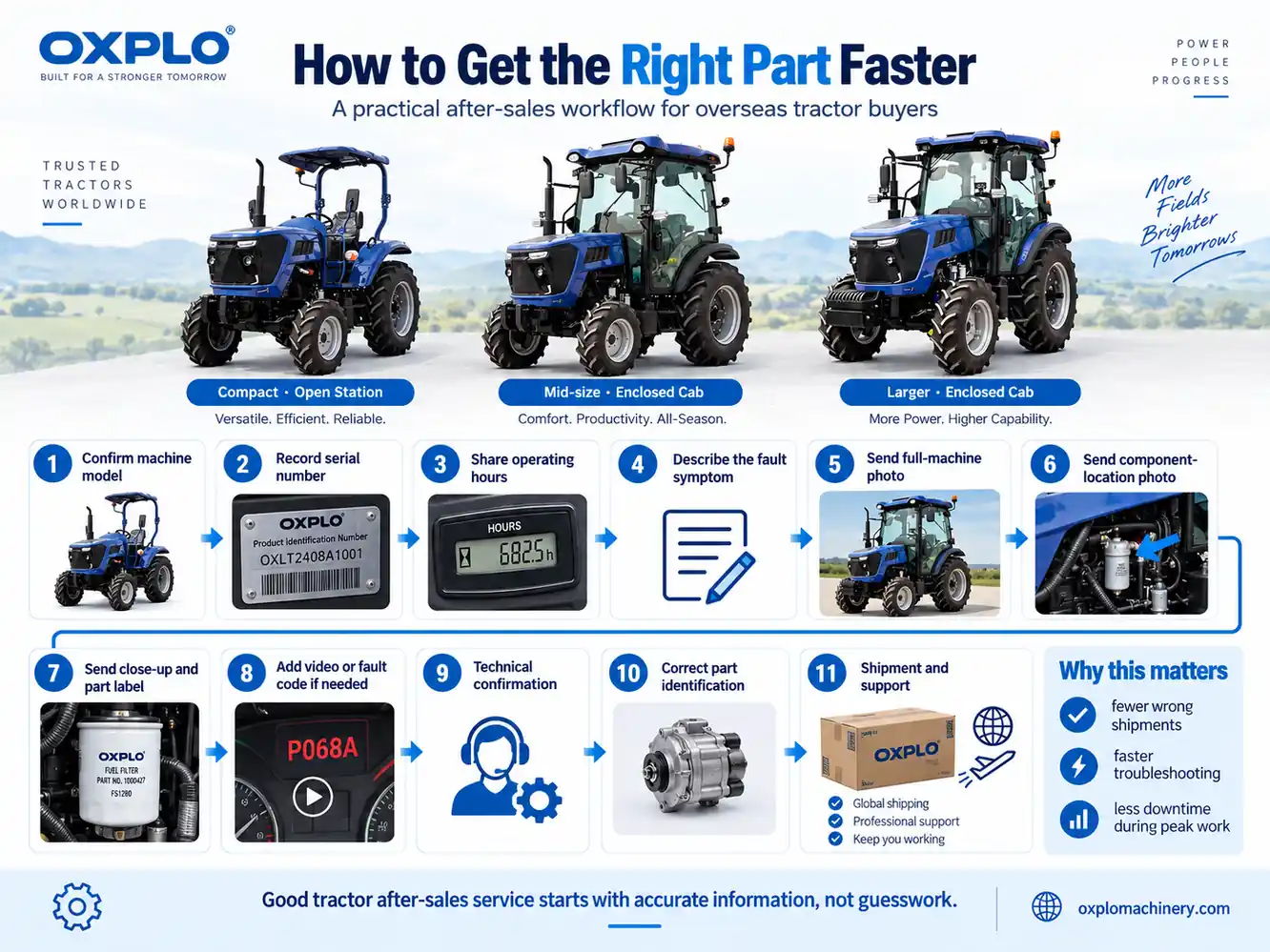
A practical overseas parts-request workflow: accurate machine information first, correct part identification second, shipment third.
X. Evaluate Tractor After-Sales Service Before You Buy the Tractor
A supplier should not be judged only on whether it says “spare parts available.” That statement is too broad. The useful question is whether the supplier has a repeatable process for identifying, confirming and supplying the right component after the machine is operating overseas.
Questions European buyers should ask before shipment
- Which routine service parts should be included for the first planned maintenance horizon?
- Which low-cost, model-specific items do you recommend keeping on hand?
- How do you identify a replacement part when the customer does not know the part number?
- What machine information, photos or video should the customer provide?
- Which items can reasonably be sourced locally by specification?
- Which components should not be substituted without confirmation?
- What manuals or parts information will be supplied with the machine?
- How are warranty and non-warranty technical requests handled?
- Can parts be consolidated with the original tractor shipment to reduce later freight cost?
The quality of these answers often tells you more about the future ownership experience than a broad promise of “good after-sales service.”
XI. How OXPLO Connects Tractor Configuration With Parts Support
OXPLO’s tractor range covers six power levels from 25 HP to 70 HP for vineyards, orchards, mixed farms, livestock operations, tillage, mowing, transport and material-handling work. The important point for spare-parts planning is not the number of models. It is that different workloads and tractor platforms create different parts priorities.
On the OXPLO 25–70 HP tractor selection page, buyers can compare the six models and discuss PTO matching, attachments, destination-market documents, pre-shipment configuration checks and parts support after delivery.
For example, compact 25–50 HP tractors use Category I rear-linkage platforms, while the 60–70 HP machines move to Category II. That difference affects implement compatibility and reinforces a wider principle: do not assume that a component or connection is interchangeable simply because two tractors carry the same brand name.
OXPLO also separates parts, attachments, warranty support and technical help within its support structure. For an overseas buyer, this matters because the practical objective is not merely to purchase a spare component—it is to identify the right component quickly and return the tractor to work.
What OXPLO can solve in the first-order planning stage
- Match the spare-parts discussion to the exact OXPLO tractor model and supplied configuration.
- Review the intended workload, implements and expected annual operating hours before recommending a kit.
- Add selected service consumables and downtime-critical parts to the original shipment where appropriate.
- Use model, serial number, operating details, photos and labels to support later parts identification.
- Separate parts that are sensible to stock from parts that can be sourced locally or ordered only when required.
XII. First-Machine Spare Parts Decision Sheet
Before confirming the order, use a simple decision sheet. The point is to force every proposed item to earn its place in the kit.
Field | Question to Record |
Part / system | What exactly is the component or service item? |
Machine configuration | Which model, engine or attachment does it belong to? |
Unit price | Is the part cheap enough that holding it is economically easy? |
Failure exposure | How likely is wear, clogging, leakage or damage in this application? |
Downtime impact | Will the tractor stop or lose a critical function? |
Local availability | Can a verified equivalent be sourced in the destination market? |
International lead time | How long would identification, shipping and customs realistically take? |
Installation capability | Can the farm or local workshop fit it safely? |
Decision | Stock / source locally / order when required |
XIII. What Not to Put in the First Spare Parts Kit
A first-order kit should not become a miniature warehouse. Complete engines, complete gearboxes, axle assemblies, large hydraulic assemblies and major structural components generally need a stronger business case before they are stocked for a single machine.
There are exceptions. A distributor supporting a regional fleet may rationally stock broader and deeper inventory because one part can support several machines. A single farm with one tractor usually gets better value by concentrating on service consumables and low-cost downtime-critical items.
Storage conditions also matter. Rubber ages, electrical components dislike moisture, seals can deform and packaging can deteriorate. Inventory that is never inspected or rotated is not the same as resilience.
XIV. A Pre-Shipment Checklist for European Buyers
- Confirm the exact tractor model and final supplied configuration.
- Confirm the main implements, PTO requirements, rear-linkage category and hydraulic connections.
- Estimate first-year operating hours and the most time-sensitive seasonal jobs.
- Ask for the scheduled-service parts needed for that operating horizon.
- Identify low-cost model-specific components that could stop work if unavailable.
- Identify parts that can be safely sourced locally by verified specification.
- Avoid buying expensive major assemblies without a clear risk or fleet-based business case.
- Record the machine model, serial-number process and parts-identification workflow.
- Confirm what photos, videos and fault information should be supplied for technical support.
- Consolidate sensible tractor spare parts with the original shipment where this reduces future logistics exposure.
For buyers still selecting a machine, the OXPLO tractor range and application guide can be used to match horsepower, attachments and working conditions before the parts kit is finalised.
XV. Frequently Asked Questions
Should I order tractor spare parts with a brand-new tractor?
For an imported tractor, selected service consumables and downtime-critical low-cost components can be sensible even when the machine is new. The objective is not to prepare for major failure; it is to avoid preventable waiting time for routine maintenance items or model-specific small parts.
What belongs in a basic spare parts kit?
Start with the exact machine and workload. Routine filters and service items come first, followed by selected belts, seals, electrical items, hydraulic or linkage components where the application and local availability justify them.
How many filters should I order?
Use the confirmed maintenance schedule and realistic annual operating hours. Quantities should cover a planned maintenance horizon rather than an arbitrary number of replacements.
Can tractor parts Europe buyers source locally?
Yes, many parts can be sourced locally when dimensions, ratings and interchangeability are fully verified. Model-specific engine, electrical, hydraulic or safety-related components should not be substituted on appearance alone.
Are farm tractor parts interchangeable between different horsepower models?
Not necessarily. Engine, transmission, linkage, PTO, hydraulic and electrical platforms can change across a product range. Confirm compatibility using the exact model and component information.
What information should I send when I need a replacement part?
Send the machine model, serial number, operating hours, fault description, full-machine photo, component-location photo, close-up and part label. Add video or a fault code when the issue is dynamic or electronic.
Why does tractor after-sales service matter more for overseas buyers?
Because every identification error or missing item can become an international logistics event. A structured support process reduces the chance of wrong shipments and helps the buyer recover uptime faster.
Should a dealer keep more parts than a single farm?
Usually yes. A dealer or fleet operator can spread inventory cost across several machines and can use actual consumption and repeat-failure data to build a regional stock profile.
Conclusion: Buy Uptime, Not a Box of Random Parts
The purpose of ordering tractor spare parts with the first overseas machine is not to predict every failure. That is impossible. The purpose is to remove avoidable downtime from the ownership model.
Start with the exact tractor configuration. Estimate annual operating hours. Identify the service items that will certainly be used. Then rank low-cost components by failure exposure, downtime impact, replenishment difficulty and local availability. Adjust the kit for the application—orchard work, PTO duty, mixed farming, loader work or fleet support. Finally, make sure the supplier has a clear parts-identification and technical-support workflow.
For OXPLO buyers, the most useful time to complete this planning is before shipment. Tell the team the tractor model you are considering, destination country, expected annual working hours and main implements. OXPLO can then discuss which service parts and replacement components are worth adding to the first shipment—and which expensive parts you probably do not need to stock yet.
Explore OXPLO tractors and application matching, review OXPLO parts and technical support, or visit the OXPLO homepage for current product information.