
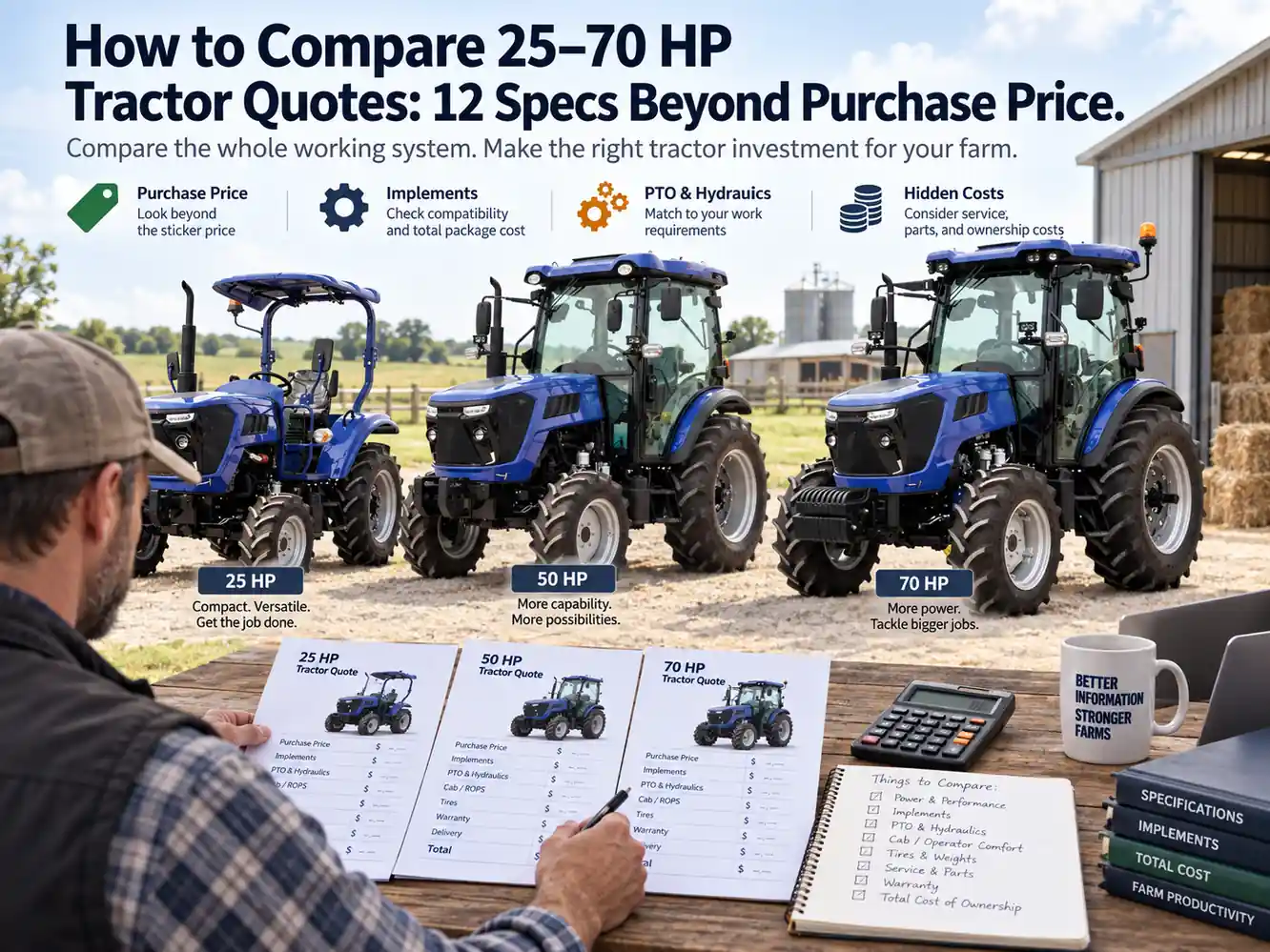
A tractor can be EUR 1,500 cheaper on the quotation and still become the more expensive machine before it completes its first working season.
That is the central problem behind many tractor price Europe searches. Buyers see 25 HP, 40 HP, 50 HP or 70 HP beside a price and assume they are comparing equivalent machines. In reality, one tractor quotation may include the PTO configuration, hydraulic remotes, tyres, ballast, road-lighting package and documentation you need, while another may be a base machine that requires changes after the order is placed.
For a European farm, contractor, distributor or equipment importer, the most expensive mistakes are rarely caused by choosing a tractor that is a few hundred euros too expensive. They come from buying the wrong working platform: a tractor that does not match existing implements, cannot produce the required hydraulic function, is unnecessarily large for the farm’s access constraints, or arrives with a configuration and documentation package that was never confirmed for the destination market.
This guide provides a structured way to compare 25–70 HP tractor quotations. The goal is not to find the cheapest tractor. It is to determine which offer gives you the lowest operational risk and the most appropriate tractor cost of ownership for the work you actually need to complete.
Core procurement rule Freeze the work requirement and technical configuration first. Compare prices only after every supplier is quoting against the same requirement. |
I. Why the Lowest Tractor Quote Often Is Not the Lowest-Cost Tractor
A farm tractor is not a standalone engine. It is a power-transfer platform that has to connect the engine to the ground and to the implement. That means engine output, transmission ratios, PTO, hydraulic flow, three-point linkage, tyres, machine mass and implement geometry all interact.
Two 50 HP tractors can therefore have very different working value. One may be ideal for mowing, light transport and Category I implements. Another may have a heavier chassis, different transmission, hydraulic package and linkage designed for a different workload. If those differences are not visible in the quotation, the lower number creates a false sense of savings.
The same logic applies commercially. EXW, FOB and CIF offers are not comparable until transport, port handling, insurance, import costs, inland delivery and required options are placed on the same boundary. A base-machine quote and a delivered, configured quote are not competing prices; they are different scopes.
The five hidden costs that usually sit behind a headline farm tractor price:
Configuration gap: The quoted tractor omits items that become mandatory once the buyer confirms the actual work: additional hydraulic valves, tyres, ballast, loader controls, lighting, cab or operator-protection equipment.
Implement compatibility cost: The tractor does not match the buyer’s PTO speed, three-point hitch category, hydraulic requirement, implement weight or drawbar requirement. Adapters and replacement implements can erase the apparent price advantage.
Compliance and documentation cost: A supplier says “European version” or “CE available” without defining the exact document set, engine configuration, destination-country requirement or road-use equipment.
Logistics and commissioning cost: A low factory price looks attractive until freight, destination handling, assembly, fluids, setup and local delivery are added.
Downtime cost: A minor part fails in peak season, but the buyer has no illustrated parts catalogue, no part number and no stocked service items. The cost of the part is small; the lost working window is not.
II. Normalise the Tractor Quotation Before Comparing Tractor Price Europe
Before evaluating any tractor price Europe offer, create one comparison boundary. Every supplier should be asked to quote the same technical scope and the same commercial scope.
A useful internal formula is: Normalised Acquisition Cost = Base Tractor + Mandatory Options + Required Attachments or Adapters + Logistics + Import/Handling + Setup + Compliance/Documentation Costs.
The purpose is not to predict every future expense. It is to stop missing items from masquerading as a competitive price.
Commercial scope to standardise
- Incoterm and named place/port
- Packaging and export preparation
- Freight and insurance scope
- Destination charges and inland transport responsibility
- Assembly, fluids, commissioning and pre-delivery inspection
- Warranty scope, duration and exclusions
- Spare-parts package and documentation included
- Quotation validity and production lead time
Technical scope to standardise
- Engine rating and exact engine model
- 4WD configuration and differential lock
- Transmission and usable speed range
- PTO speed, shaft and engagement
- Hydraulic flow, pressure and remotes
- Three-point linkage category and lift capacity
- Tyres, track width and ballast
- Cab/ROPS, lighting, brakes and road-use equipment
- Front-loader preparation if required
- Destination-market documentation to be supplied
III. Audit Existing Implements Before You Choose Horsepower
Many European farms are not buying their first tractor. They already own a mower, rotary tiller, plough, spreader, trailer, sprayer, harrow or loader attachment. Those implements are often the most useful starting point for a tractor quotation.
If the farm already owns three Category I implements and several 540 rpm PTO implements, moving to a larger platform simply because the engine has more horsepower can create avoidable adaptation cost. On the other hand, if the farm plans to move into heavier Category II implements during the next two or three years, choosing the smallest tractor that works today can create another replacement cycle too soon.
This is the trade-off buyers should make explicit: preserve compatibility with today’s implement fleet, or deliberately buy enough platform capacity for the next stage of the farm.
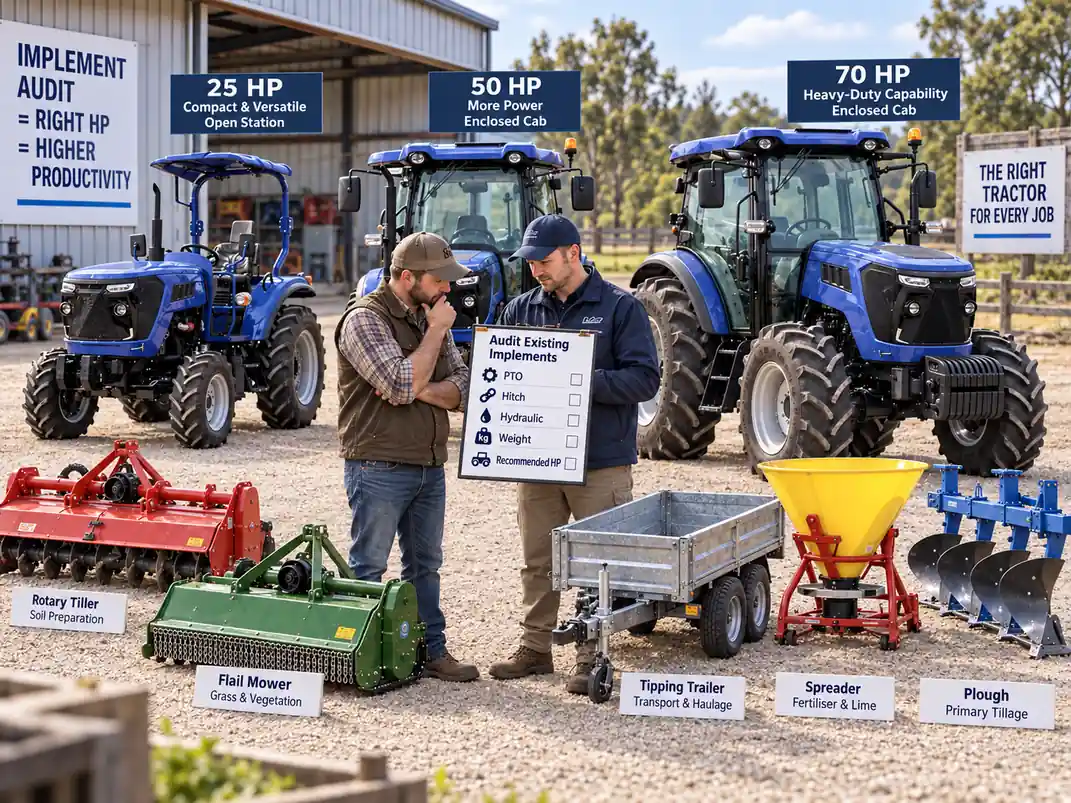
Figure 1. Audit PTO, hitch, hydraulics, implement weight and required horsepower before choosing the tractor.
Existing Implement | PTO | Hitch | Hydraulic Need | Weight | Recommended HP |
Rotary tiller | 540 rpm | Cat. I / II | Usually low | ___ kg | ___ HP |
Flail mower | 540 rpm | Cat. I / II | Depends on model | ___ kg | ___ HP |
Tipping trailer | — | Drawbar | 1–2 remotes | ___ kg | ___ HP |
Fertiliser spreader | 540 rpm | Cat. I / II | Usually low | ___ kg | ___ HP |
Front loader | — | Loader subframe | Flow + valve required | Attachment-dependent | Platform-dependent |
IV. The 12 Tractor Specifications That Make Quotations Comparable
1. Engine Power and Engine Identity
What to compare: Rated kW/HP, rated rpm, engine manufacturer/model, cylinder configuration, fuel system and emissions configuration.
Why buyers get this wrong: “50 HP” is treated as a complete machine specification, even though it says nothing about PTO output, gearing, mass or implement interfaces.
For European procurement, vague statements such as “EU engine” are not enough. The final specification sheet should identify the supplied engine and applicable documentation. Regulation (EU) No 167/2013 provides the type-approval framework for agricultural and forestry vehicles; the correct approval route and technical requirements depend on the vehicle category and supplied configuration.
What to ask in the tractor quotation: “Please confirm rated power in kW and HP, rated engine speed, exact engine model and the emissions configuration/documentation for the destination market.”
2. PTO Power, Speed and Shaft Configuration
What to compare: PTO speed, spline/shaft type, engagement method, rated PTO output where available and compatibility with every powered implement.
Why buyers get this wrong: Engine HP is assumed to be the same as usable PTO HP. A buyer discovers the mismatch only when a mower, tiller, pump or baler is connected.
PTO is one of the most important working interfaces on a farm tractor. If a tractor quotation does not state the PTO configuration clearly, it is incomplete for any buyer using powered implements.
What to ask in the tractor quotation: “Please confirm PTO speed(s), shaft specification, engagement method and available PTO power at rated operating conditions.”
3. Transmission and Working-Speed Range
What to compare: Forward/reverse ratios, shuttle arrangement if applicable and usable speeds for tillage, mowing, spraying, loader work and transport.
Why buyers get this wrong: Buyers compare only the number of gears. The real issue is whether the tractor can hold the required ground speed while the engine and PTO remain in a productive range.
A 12F+12R transmission is not automatically better than an 8F+8R unit for every farm. More ratios are valuable when they help the operator maintain the required speed under changing loads. The benefit is application-specific.
What to ask in the tractor quotation: “Please provide the transmission arrangement and ground-speed range so we can check field, PTO and transport work.”
4. Hydraulic Flow, Pressure and Remote Valves
What to compare: Pump flow, available implement flow, operating pressure, number and type of rear remotes, loader valve and hydraulic connection type.
Why buyers get this wrong: A quote says “hydraulic outlet included,” but the buyer does not know whether there is sufficient flow or the correct number of valves for the implement.
Hydraulic capability becomes critical for tipping trailers, loaders, cylinders and hydraulic-motor attachments. A tractor can have enough engine power and still operate an attachment poorly because the hydraulic system is the bottleneck.
What to ask in the tractor quotation: “Please confirm pump flow, available implement flow, operating pressure, number of rear hydraulic remotes, valve type and loader-valve configuration.”
5. Three-Point Linkage Category and Lift Capacity
What to compare: Hitch category, lift capacity, measurement reference, stabilisers, control type and compatibility with the buyer’s implements.
Why buyers get this wrong: Buyers see a high lift-capacity number but do not check hitch category or implement geometry.
Category I and Category II are not interchangeable procurement labels. Moving to a larger tractor platform can also mean moving into a different implement ecosystem. Existing implements should be audited before the model is chosen.
What to ask in the tractor quotation: “Please confirm three-point linkage category, lift capacity and the reference point used for the rating.”
6. Machine Weight, Wheelbase and Axle Capability
What to compare: Listed/operating weight, wheelbase, axle capability, permissible ballast and loader limitations.
Why buyers get this wrong: Horsepower is treated as traction. In reality, usable traction and loader stability depend heavily on mass distribution, tyres, ballast and axle capacity.
Heavier is not always better. Additional mass can improve traction and stability, but excessive mass can increase compaction, rolling resistance and manoeuvring difficulty. Weight should solve a defined problem.
What to ask in the tractor quotation: “Please confirm tractor weight, wheelbase, front/rear axle information, permissible ballast and loader operating limitations.”
7. Tyres, Track Width and Ballast
What to compare: Front/rear tyre size, tread pattern, track adjustment, wheel arrangement and front/rear ballast.
Why buyers get this wrong: “Agricultural tyres” is accepted as a complete specification, even though tyre size and ballast directly affect traction, access, stability and road behaviour.
The correct tyre and ballast package should be specified before shipment. Replacing tyres or adding unsuitable ballast after delivery is usually more expensive than solving the requirement during quotation.
What to ask in the tractor quotation: “Please confirm exact tyre sizes, tread option, adjustable track range and the ballast package included in the price.”
8. 4WD, Differential Lock and Traction System
What to compare: Drive configuration, front axle, differential lock, engagement method and tyre matching.
Why buyers get this wrong: Buyers assume 4WD automatically solves traction problems. It does not compensate for unsuitable tyres, incorrect ballast or excessive wheel slip.
Traction is a system: engine output → transmission → axles → tyres → soil. If the tyres cannot transmit the available power, more horsepower can simply produce more wheel slip.
What to ask in the tractor quotation: “Please confirm 4WD configuration, differential-lock function and the tyre/ballast recommendation for our soil and slope conditions.”
9. Dimensions, Ground Clearance and Turning Space
What to compare: Overall length, width, height, wheelbase, minimum ground clearance and turning information.
Why buyers get this wrong: Buyers choose a tractor that meets the power target but cannot enter a barn, orchard row, vineyard, greenhouse or narrow gate.
For compact European farms, access can be a more important productivity constraint than engine power. A smaller tractor that fits the working environment can deliver higher annual utilisation than a larger machine that cannot reach the work.
What to ask in the tractor quotation: “Please confirm dimensions with the selected tyre and cab/ROPS configuration, including overall width and height.”
10. Brakes, Lighting, Operator Protection and Documentation
What to compare: Braking, trailer-brake connections where relevant, lights, mirrors, ROPS/cab, seat belt, guarding and the exact conformity/type-approval documentation supplied.
Why buyers get this wrong: Every European requirement is reduced to one question: “Does it have CE?” That is too vague for an agricultural tractor procurement decision.
European agricultural tractor compliance is more specific than a generic CE claim. Ask for document names, scope and the configuration they cover. If road use or registration is expected, confirm that requirement before the order, not after the tractor arrives.
What to ask in the tractor quotation: “Please list the exact documents supplied with this configuration, the engine/emissions documentation, operator-protection equipment, lighting/braking configuration and any destination-specific limitations.”
11. Front Loader Compatibility and Stability
What to compare: Loader model, rated capacity at a stated point, lift height, subframe, hydraulic valve, quick coupler, front-axle suitability, rear ballast and tyre package.
Why buyers get this wrong: A brochure lift figure is treated as a complete loader specification. It does not explain the position, height, counterweight or stability conditions behind the number.
If loader work is a major daily task, the tractor platform should be selected around loader duty from the start. Retrofitting a loader to the smallest possible tractor is not always the lowest-cost solution.
What to ask in the tractor quotation: “Please confirm loader geometry, rated capacity and measurement point, recommended rear ballast, hydraulic requirements and front-axle limitations.”
12. Serviceability, Spare Parts and Maintenance Architecture
What to compare: Service intervals, filters, oils, belts, seals, wear parts, manuals, parts catalogue, diagnostic support and recommended initial spare package.
Why buyers get this wrong: The buyer compares acquisition price but does not price the operational cost of waiting for basic service parts during peak season.
Downtime belongs inside tractor cost of ownership. The objective is not to stock every component; it is to prevent predictable service items from stopping the tractor during the farm’s most valuable working window.
What to ask in the tractor quotation: “Please provide the maintenance schedule, service consumables, illustrated parts information, warranty process and recommended initial spare-parts list.”
V. Buying Too Small Is Expensive. Buying Too Large Can Be Expensive Too.
Procurement advice often focuses on avoiding an undersized tractor. That is only half of the decision.
An undersized tractor can spend too many hours near maximum load, restrict implement width, slow field operations and push the buyer into an early upgrade. An oversized tractor can increase purchase price, fuel use, tyre cost, turning space and soil compaction while leaving much of its capacity unused.
The objective is not to buy the most tractor the budget allows. It is to buy the least tractor that can reliably complete the farm’s limiting jobs without creating the next bottleneck.
Decision Risk | Typical Symptoms | Business Effect |
Too small | Repeated high-load operation; implement width limited; slow transport or tillage; insufficient hydraulic/loader capacity | More operating hours, lower field capacity, early replacement pressure |
Too large | Low annual utilisation; unnecessary mass; access constraints; larger tyres and service items | Higher fixed cost, compaction risk, underused capacity |
Right-sized | Limiting jobs completed with reserve; implements match; access retained; utilisation justified | Balanced acquisition cost, productivity and long-term TCO |
VI. When 10 More HP Actually Means a Different Tractor Platform
One of the most useful questions in the 25–70 HP segment is not “How much does another 10 HP cost?” It is “Does another 10 HP move me into a different chassis, implement and workload class?”
That transition is often where farm tractor price comparisons become misleading. A buyer may believe two models differ mainly in engine output when the real change is a larger frame, different hitch category, more transmission ratios, larger tyres and greater machine mass.
This is why the specification sheet should be read horizontally as a system, not vertically as a horsepower ladder.
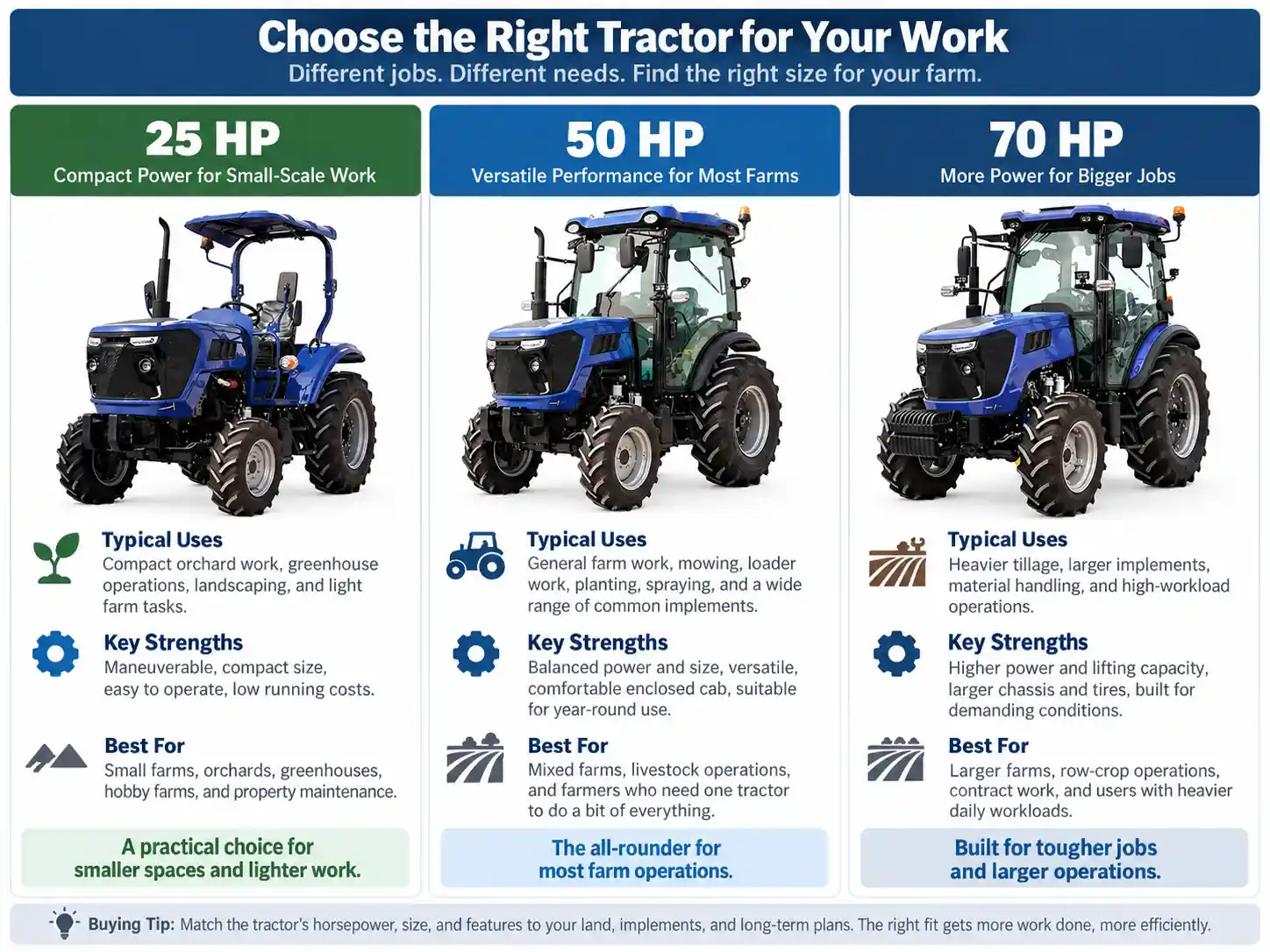
Figure 2. A 50-to-60 HP step can represent a platform change, not just 10 additional horsepower.
VII. Calculate Tractor Cost of Ownership, Not Just Purchase Price
Once the quotations are technically normalised, compare tractor cost of ownership. A simple model is better than a precise-looking model built on unsupported assumptions.
A practical five-year structure is: TCO = Acquisition Cost + Financing + Fuel + Scheduled Maintenance + Wear Parts + Repairs + Downtime Exposure + Compliance/Registration Costs − Residual Value.
Fuel, repairs and residual value are estimates. Use ranges rather than pretending to know them exactly. Run the comparison at different annual utilisation levels—for example 300, 600 and 1,000 hours per year. A higher-specification tractor can make little financial sense at low utilisation and become economically rational when it replaces labour hours or increases seasonal field capacity at higher utilisation.
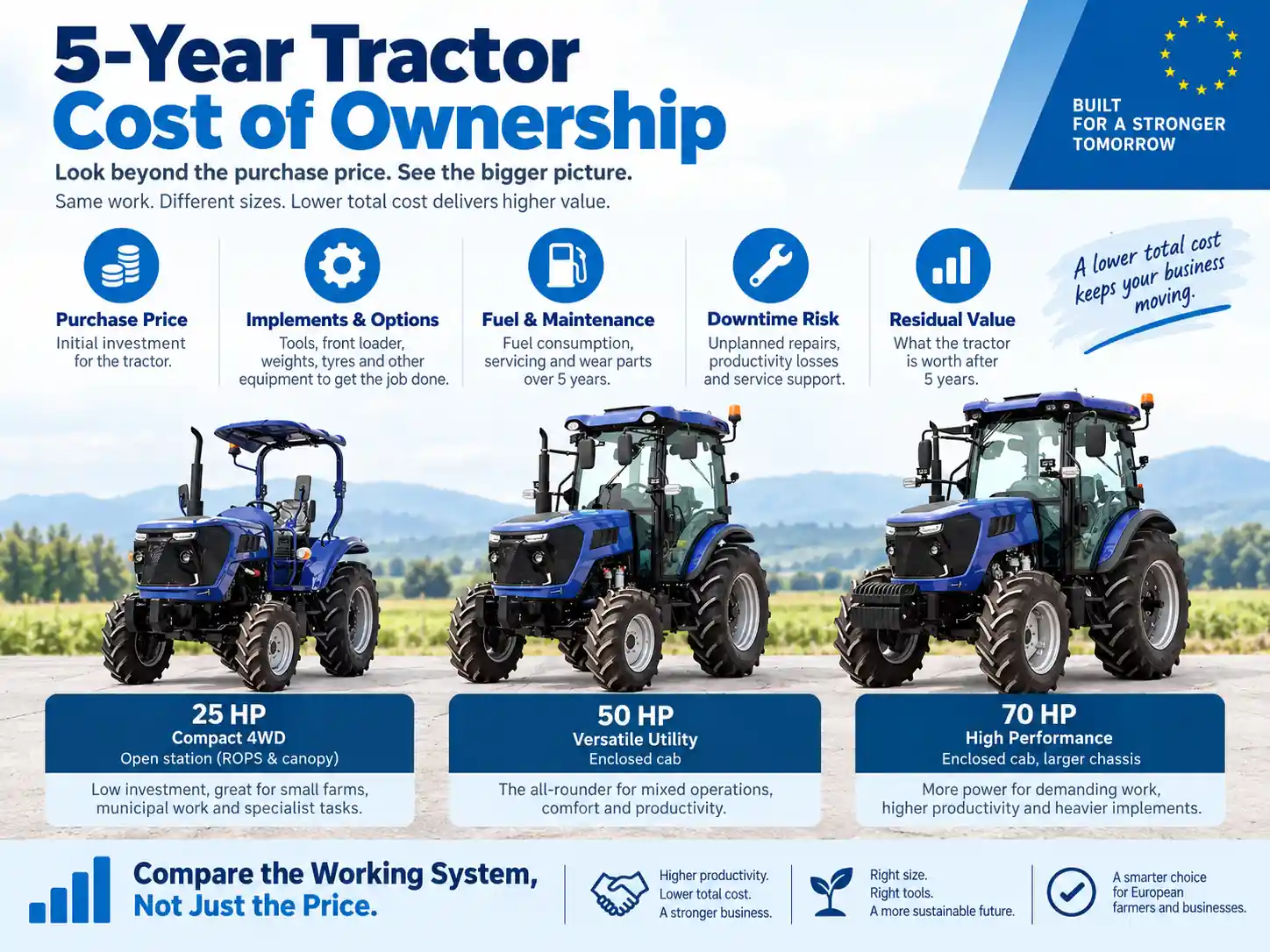
Figure 3. Five-year tractor cost of ownership should include operation, maintenance, downtime exposure and residual value—not only purchase price.
Cost Item | Quote A | Quote B | Quote C |
Base tractor | € ______ | € ______ | € ______ |
Mandatory options | € ______ | € ______ | € ______ |
Freight/logistics | € ______ | € ______ | € ______ |
Import/handling | € ______ | € ______ | € ______ |
Setup/commissioning | € ______ | € ______ | € ______ |
Adapters or replacement implements | € ______ | € ______ | € ______ |
Scheduled service | € ______ | € ______ | € ______ |
Wear parts | € ______ | € ______ | € ______ |
Estimated fuel | € ______ | € ______ | € ______ |
Downtime allowance | € ______ | € ______ | € ______ |
Estimated residual value | € ______ | € ______ | € ______ |
5-Year TCO | € ______ | € ______ | € ______ |
VIII. Turn the Farm Requirement Into a Supplier RFQ
The fastest way to receive poor quotations is to send a supplier one sentence: “Please quote your 50 HP tractor.” The supplier then has to guess the configuration, and every supplier guesses differently.
A strong RFQ reduces ambiguity before price calculation. It also makes suppliers easier to compare because they are answering the same technical question.
Farm and workload information
- Destination country and delivery location
- Farm type and approximate working area
- Main jobs and limiting/heaviest job
- Annual operating hours
- Soil, slope and seasonal ground conditions
- Narrowest gate, row or building access
- Road-transport requirement and trailer use
Implement information
- Implement type and working width
- Implement weight and centre-of-gravity concerns
- Required PTO speed and power
- Three-point linkage category
- Hydraulic flow and number of circuits
- Drawbar/trailer requirement
- Loader and attachment requirement
Quotation confirmation
- Exact supplied tractor specification
- Mandatory and optional equipment separated
- Incoterm and shipping scope
- Documentation included
- Warranty and parts support
- Production lead time
- Pre-shipment inspection evidence
A good RFQ question “Please recommend the smallest tractor platform that can reliably operate the listed implements under these conditions, and identify any item that would require us to move to the next platform.” |
IX. How OXPLO Applies This Logic Across the 25–70 HP Range
OXPLO’s current tractor range covers six power classes from 25 to 70 HP: OXT254, OXT304, OXT404, OXT504, OXT604 and OXT704. The important point for a buyer is that OXPLO does not have to treat those models as a simple horsepower ladder. The range can be used as a platform-selection process: start with the job, then confirm the implement interface, access, workload and destination requirements.
For compact farms, orchards, vineyards, grounds maintenance and mixed light-to-medium work, OXPLO’s 25–50 HP models occupy the more compact side of the range. The OXPLO OXT404 is currently published as a 40 HP, 4WD, 8F+8R, Category I tractor. The OXPLO OXT504 is published as 50 HP, 4WD, 8F+8R and Category I, retaining a compact 1,560 mm listed width while providing more engine reserve for PTO work and recurring mixed-farm tasks.
The shift from OXPLO OXT504 to OXPLO OXT604 is particularly useful for explaining why tractor quotation comparison cannot stop at horsepower. OXPLO publishes the OXT604 as a 60 HP 4WD utility tractor with a 12F+12R transmission, Category II linkage, 540/760 rpm PTO, a 2,010 mm wheelbase, approximately 2,500 kg listed weight and larger tyres. That is a platform change: different implement category, different chassis scale and a different workload envelope—not merely 10 more horsepower.
The OXPLO OXT704 extends that utility-platform approach to 70 HP. It is currently listed with 4WD, 12F+12R transmission, Category II linkage and dual-speed PTO for mixed farms, heavier transport and more demanding implement work.
For buyers searching tractor price Europe, this is the useful way to compare OXPLO models: decide whether the farm is still power-limited on a compact Category I platform or whether it has actually outgrown that platform and now needs Category II implement compatibility, a larger chassis and a heavier-duty working system.
Explore the OXPLO 25–70 HP tractor range: OXPLO Tractors
Compare configurable tractor options and attachments: OXPLO Tractor Customisation
X. What OXPLO Can Help a European Buyer Confirm Before the Final Quotation
The most useful role of a supplier is not to send a price list. It is to reduce uncertainty before the buyer commits to a machine.
OXPLO currently presents 48 tractor attachment options across its customisation/support content and asks buyers to provide equipment model, horsepower, connection dimensions, hydraulic requirements and intended application when checking compatibility. For European-market configurations, OXPLO’s support information also states that CE-related documentation depends on the eligible model/configuration and that Stage V engine configurations may be available depending on the tractor model and engine supplier. That wording matters: the exact configuration and documentation should be confirmed before order placement rather than assumed from a generic market label.
In practical terms, an OXPLO tractor quotation should therefore be built around five questions: What work must the tractor do? Which implements must it operate? What physical access limits exist? What workload will it carry each year? What destination-market documents and equipment must be confirmed?
Buyer Problem | How the OXPLO Quotation Process Should Address It |
“I do not know whether I need 40, 50 or 60 HP.” | Start from the limiting job, implement width/weight, annual hours, terrain and access; then choose the platform. |
“I already own several implements.” | Check PTO, three-point category, hydraulic requirement, implement weight and connection dimensions before recommending a model. |
“I need a tractor for Europe.” | Confirm the exact engine, destination market, operator-protection/lighting/braking configuration and the document set available for that model. |
“I want a loader now or later.” | Check chassis, loader subframe, hydraulic valve, tyre/ballast and axle requirements before finalising the tractor. |
“I am comparing three overseas suppliers.” | Issue a confirmed specification sheet so the OXPLO tractor quotation can be compared line by line against the other offers. |
OXPLO support and attachment information: Attachments, Parts & Support
OXPLO OXT504 50 HP product details: OXT504
OXPLO OXT604 60 HP product details: OXT604
OXPLO OXT704 70 HP product details: OXT704
XI. OXPLO Quote-Preparation Checklist for European Buyers
A buyer does not need to know every tractor specification before contacting OXPLO. The objective of the first enquiry is to provide enough operational information for OXPLO to identify what must be checked.
For a useful first-pass tractor quotation, send the following information:
- Destination country and delivery term you want quoted.
- Main farm type: arable, livestock, orchard, vineyard, mixed farm, property maintenance or contracting.
- Current tractor model, if replacing an existing machine.
- Existing implements, including PTO speed, hitch category and approximate weight where known.
- Largest or most demanding job the tractor must complete.
- Approximate annual operating hours.
- Narrowest gate/row/building width and any height constraint.
- Terrain: flat, rolling, steep, soft ground, wet grassland or mixed surfaces.
- Front-loader, trailer, cab/ROPS, tyre and hydraulic requirements.
- Road-use, registration or destination-specific documentation requirements.
Send these requirements through the OXPLO website or use the tractor customisation page to request a configuration review before the final price is fixed.
XII. Conclusion: Compare the Working System, Not the HP Badge
A reliable tractor quotation should describe a complete working system—not just an engine, horsepower number and purchase price.
For any 25–70 HP purchase, the buyer should be able to explain why the selected tractor fits the farm’s PTO demand, hydraulic requirement, hitch category, implement weight, traction conditions, access limits, loader duty, annual workload and destination-market requirements. If that logic is missing, the purchase price is being compared too early.
This is the most useful way to approach tractor price Europe research. First normalise the quotation. Then audit the implements. Compare the 12 technical specifications. Model tractor cost of ownership. Only after technically equivalent configurations are established should the lower price become decisive.
OXPLO’s 25–70 HP range gives European buyers several platform choices instead of forcing every job into one tractor size. The value of that range is not simply that OXPLO offers six horsepower levels. It is that an OXPLO quotation can be built around the buyer’s actual farm work, existing implements and growth plan—so the final tractor is specified for the working season rather than selected from a price column.
If you are comparing multiple tractor quotations, send OXPLO your destination country, current tractor or implement list, main farm tasks and annual workload. OXPLO can help check whether your initial horsepower choice matches the PTO, linkage, hydraulic and chassis requirements before preparing the final quotation.
Reference note: European vehicle-approval context referenced in this guide is based on Regulation (EU) No 167/2013. OXPLO model data and support statements were checked against the current OXPLO website; the final quotation and confirmed specification sheet should govern the supplied configuration.