
A tractor can be compatible with a rotary tiller on paper and still be a poor working combination in the field.
That is the problem many buyers discover only after delivery. The three-point linkage fits, the PTO shaft connects, and the tractor can turn the rotor in a yard demonstration. Then the machine enters heavier soil, the operator increases tillage depth, or the weather leaves the field slightly wetter than expected. PTO speed falls, travel speed drops, fuel consumed per hectare rises, and a combination that looked acceptable on a specification sheet begins to lose productivity.
Choosing a tractor for rotary tiller work therefore requires more than matching one horsepower number to one implement width. The buyer must evaluate the complete working system: soil resistance, tillage depth, PTO power, implement weight, hitch category, tractor mass, gearing, traction, annual workload and the time window available to finish field work.
This guide explains that process from a buyer’s perspective. It is designed for farmers, agricultural contractors, importers and equipment buyers who want a tractor-tiller combination that remains productive after the easy demonstration conditions disappear.
I. Why a Tractor Can Match a Rotary Tiller on Paper but Fail in the Field
For anyone choosing a tractor for rotary tiller work, rotary tillage should be treated as a continuous power-demand application. Unlike a light transport task, the tractor is not simply moving its own mass. It must continuously drive blades into soil, fracture and mix that soil, maintain rotor speed and move forward at a useful field speed at the same time.
That is why the question “What tractor HP for rotavator work do I need?” is useful only as a starting point. The more important question is: can the tractor maintain the implement’s required PTO speed at the intended depth and travel speed under the farm’s recurring soil conditions?
The easiest field is the wrong place to size the system
A tractor tiller combination that works comfortably in dry, previously cultivated loam may behave very differently in compacted ground, moist clay or a field with heavy residue. Soil condition changes the torque required at the rotor. Tillage depth changes how much soil each blade must disturb. Travel speed changes how quickly new soil enters the rotor path.
A buyer should therefore size the system around the difficult condition that occurs regularly, not around the easiest field used for a sales demonstration. If 70% of the work is light seedbed finishing but 30% is heavier first-pass cultivation, that 30% can become the operating bottleneck.
European farms add a second constraint: access and versatility
For many European buyers, simply moving to a larger tractor is not automatically the best answer. Vineyards, orchards, livestock yards and older farm properties can have narrow gateways, restricted turning areas and limited building access. A larger chassis may provide more power reserve but reduce manoeuvrability or no longer fit existing work areas.
The decision is therefore a trade-off between power reserve and physical access. This is especially important when the same tractor must handle mowing, spraying support, trailer work, loader tasks and rotary tillage across the year.
Decision rule: Do not ask only whether the tractor can turn the rotary tiller. Ask whether it can hold PTO speed, maintain useful forward speed and remain controllable in the hardest recurring condition.
II. Start With Soil, Working Depth and the Job — Not Tractor Horsepower
When choosing a tractor for rotary tiller work, selection should begin with the agronomic job. Before comparing tractors, define what the implement must actually do.
1. Soil texture and moisture determine resistance
Light sandy soil usually requires less rotor torque than dense clay at the same width and depth. Moisture can change this again. Soil that is too wet may smear and clod rather than fracture cleanly, while heavy sticky soil can increase drag and reduce effective working speed. Stony ground adds impact loading and can increase driveline stress.
For purchasing purposes, describe soil in practical terms: light or heavy, previously cultivated or compacted, normally dry or frequently moist, clean or stone-prone. “Farm soil” is not enough information for a reliable tractor recommendation.
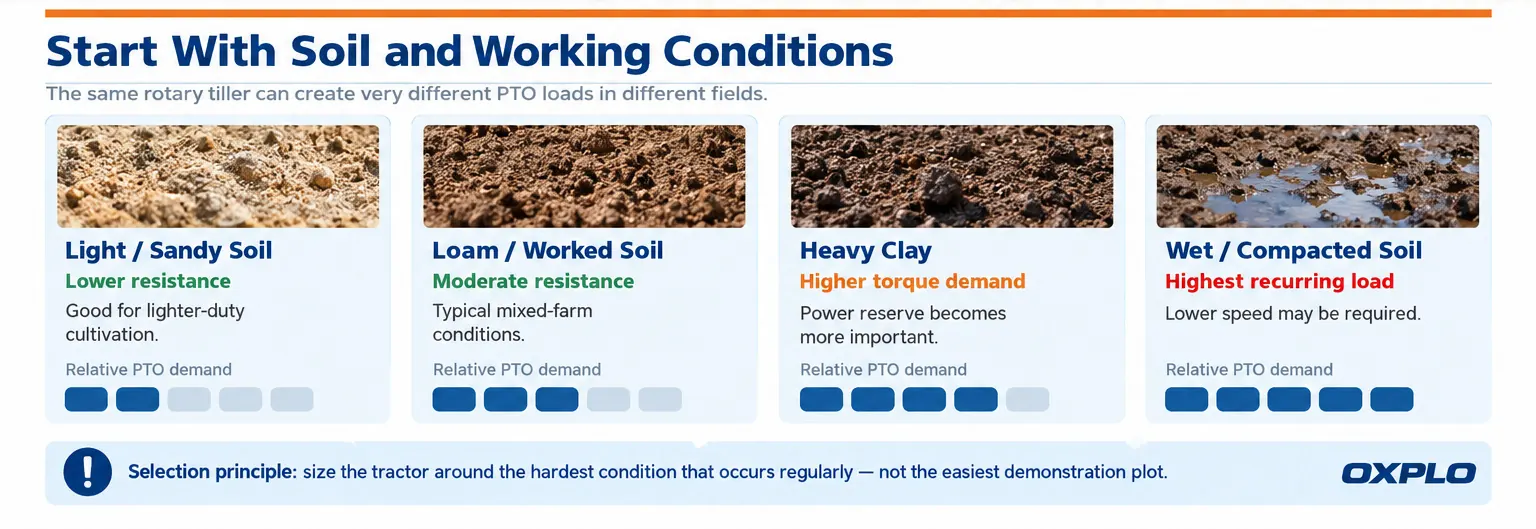
Soil texture, moisture, compaction and working depth can materially change PTO demand.
2. Working depth can change the power requirement more than buyers expect
A rotary tiller working shallowly for seedbed finishing is processing a smaller soil volume than the same machine used for deeper cultivation. Increasing depth means more blade penetration, more material movement and greater resistance through the rotor. A combination with little power reserve can therefore feel comfortable at one depth and overloaded after only a modest adjustment.
This is one reason fixed rules such as “X horsepower per metre of tiller width” should be treated as screening estimates, not final engineering decisions.
3. First-pass cultivation and finishing are different jobs
Previously worked ground is generally easier than a first pass into compacted or uncultivated soil. A buyer who needs both operations should select for the demanding recurring task or accept a slower speed and potentially multiple passes during heavier work.
For commercial operators, this choice has a direct business impact: a machine that requires an extra pass may consume more fuel, operator time and seasonal working hours than a slightly higher-capacity tractor-implement combination.
4. Crop residue changes the operating problem
Heavy residue can increase the load on the rotor and can also affect soil flow through the tiller housing. The problem is not always solved by more horsepower. Blade type, rotor speed, residue condition, working depth and travel speed all interact. Buyers should therefore tell the supplier whether the rotary tiller will mainly prepare clean cultivated soil, incorporate residues or work after high-biomass crops.
III. How Much Tractor HP Does a Rotary Tiller Really Need?
The correct tractor HP for rotavator work comes from the implement specification first and the tractor specification second. A reliable tractor for rotary tiller work is sized around usable PTO demand rather than engine horsepower alone.
Engine horsepower and PTO horsepower are not the same number
A tractor’s rated engine horsepower is not the same as the power delivered at the PTO shaft. Mechanical and hydraulic systems consume part of the engine output before power reaches the implement. If the rotary tiller manufacturer publishes a PTO horsepower requirement, compare it with the tractor’s verified PTO output rather than assuming the engine rating is fully available at the shaft.
If published PTO output is unavailable for the exact tractor configuration, ask for confirmation. Do not invent a fixed percentage conversion and treat it as a guaranteed specification.
Minimum power is not the same as comfortable working power
A tiller may list a minimum tractor power that allows the implement to operate. That figure does not necessarily mean the tractor will maintain the desired field speed in heavy soil for long daily shifts. A professional operator normally needs some reserve above the recurring demand so that moderate changes in moisture, depth, residue and blade wear do not immediately force a speed reduction.
The correct reserve depends on how demanding and variable the work is. Light seasonal work on previously cultivated soil may justify a tighter match. Frequent commercial tillage in variable ground usually benefits from more margin.
Too much tractor can also be a mismatch
Oversizing is not automatically safer. A light-duty rotary tiller has a maximum permissible input and driveline capacity. A much larger tractor can exceed what the gearbox, PTO shaft, clutch or frame was designed to handle, particularly if the operator assumes extra engine power allows more depth or speed.
The system must therefore satisfy both sides: the tractor must be capable of the tiller, and the tiller must be rated for the tractor.
Use field capacity to translate horsepower into business impact
Buyers often compare tractors by purchase price, but the more useful operational metric is hectares completed per hour under acceptable soil conditions. The theoretical field-capacity relationship is straightforward:
Theoretical field capacity (ha/h) = Working width (m) × Travel speed (km/h) ÷ 10
A 1.8 m tiller travelling at 4.0 km/h has a theoretical capacity of 0.72 ha/h. If an underpowered tractor forces the operator down to 2.8 km/h, theoretical capacity falls to about 0.50 ha/h — roughly 30% lower before accounting for headland turns, overlap and field obstacles.
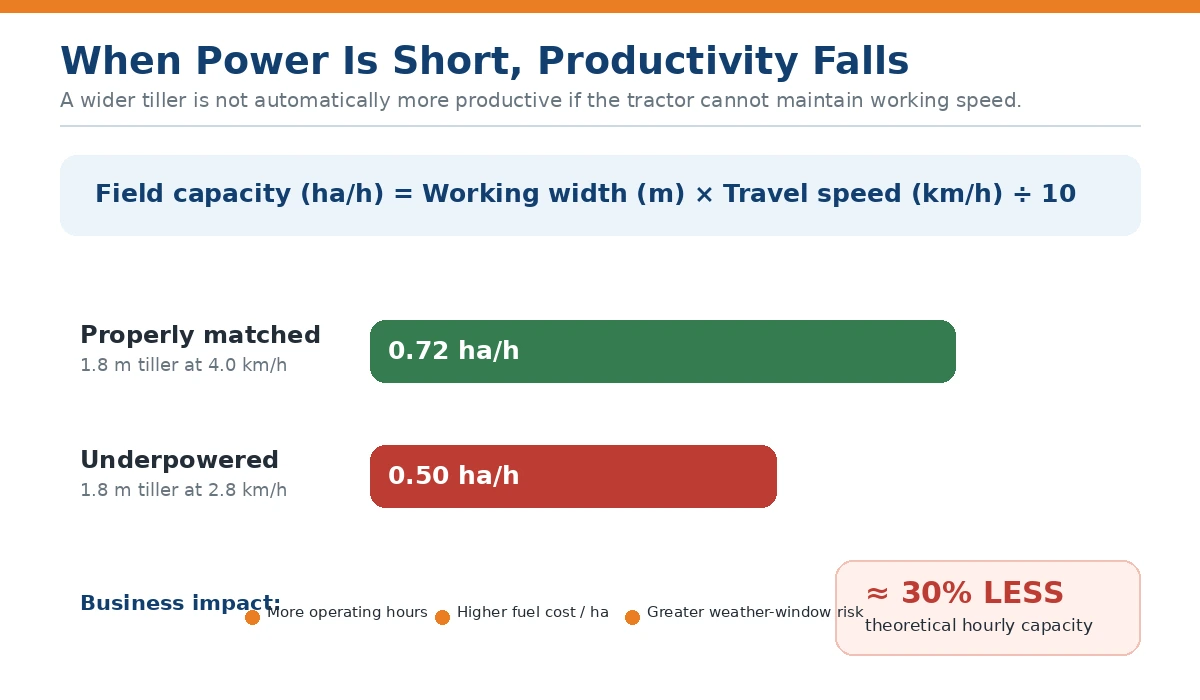
Illustrative field-capacity comparison based on the example used in this guide.
This is why a wider rotary tiller tractor combination is not automatically more productive. A slightly narrower tiller operated at the correct speed can outperform an oversized implement that keeps the tractor at the edge of its continuous capacity.
IV. Five Compatibility Checks Buyers Commonly Miss
Horsepower gets most of the attention, but many real-world tractor tiller problems come from mechanical compatibility rather than insufficient engine output.
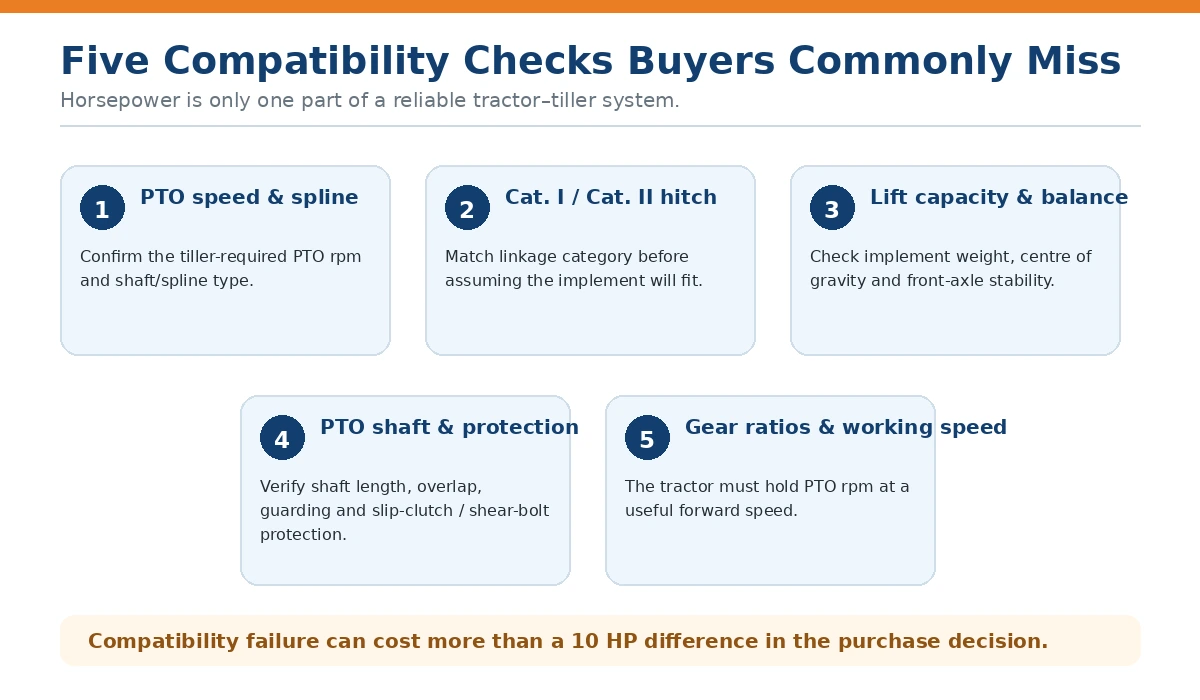
Five checks that should be completed before approving a tractor-rotary tiller combination.
1. PTO speed and spline
Many agricultural rotary tillers use 540 rpm PTO operation, but the implement manufacturer’s requirement must control the decision. The tractor’s shaft speed, spline type and the supplied configuration should be confirmed before ordering. A tractor offering more than one PTO speed does not mean every implement may be operated at the higher setting.
2. Category I versus Category II linkage
A buyer with existing implements should check hitch category before focusing on horsepower. Compact rotary tillers commonly use Category I geometry, while larger or heavier equipment may use Category II. Pin size, linkage geometry, implement width and tractor platform must all be compatible.
This is particularly important for European farms replacing an older tractor while keeping an existing implement fleet. A new tractor that forces the owner to replace otherwise serviceable attachments can change the total economics of the purchase.
3. Three-point lift capacity and implement weight
The tractor must be able to lift the tiller, but the check should not stop there. The implement’s centre of gravity and rear overhang influence how much load is transferred away from the front axle. A tractor can have enough power and enough hydraulic lift to raise an implement while still becoming poorly balanced during transport or headland manoeuvres.
Front ballast or a different tractor platform may therefore be required for stable steering and transport behaviour.
4. PTO shaft length and driveline protection
PTO shaft length must be checked through the linkage movement. A shaft that is too long can bottom out; one that is too short can lose safe engagement. Guarding, operating angle and the correct shear-bolt or slip-clutch protection should also be confirmed during commissioning.
5. Gear ratios and usable working speed
Rotary tillage requires the tractor to maintain PTO rpm while travelling slowly enough for the required soil finish. A transmission with suitable low working ratios can therefore matter as much as nominal horsepower. If the available gear is too fast, the tiller may not process soil adequately. If the next lower gear is unnecessarily slow, field productivity suffers.
V. The Hidden Cost of Choosing Too Little — or Too Much — Tractor
The cost of a poor tractor for tillage decision usually appears as a series of operating penalties rather than one immediate failure. A rotavator tractor that is badly matched can be expensive even when it never suffers a dramatic breakdown.
Undersizing: the visible and invisible penalties
- Lower forward speed and fewer hectares completed per day.
- Longer working hours near high engine load.
- More frequent downshifting and operator intervention.
- Greater risk of missing a narrow weather or planting window.
- Potentially higher fuel consumption per hectare even if hourly fuel use looks modest.
- More driveline stress if overload protection is repeatedly activated during normal work.
For a small property owner, slower progress may be acceptable. For a contractor or commercial farm, lost field capacity has a measurable value because the machine, operator and seasonal window all have an hourly cost.
Oversizing: capacity you may pay for but rarely use
- Higher purchase and financing cost.
- More machine mass and potentially more soil compaction.
- Larger turning envelope and reduced access in constrained areas.
- Potential incompatibility with lighter existing Category I implements.
- Higher ownership cost without a corresponding increase in annual utilisation.
This is why “buy one size bigger” should not be treated as a universal rule. The better rule is to buy enough reserve for the demanding recurring job while keeping the tractor platform compatible with the farm’s access, implements and annual workload.
Think in TCO, not only purchase price
Total cost of ownership for a rotary tillage system includes acquisition cost, fuel, maintenance, blade and driveline wear, labour hours, transport, implement replacement and the economic effect of completing—or failing to complete—work inside the available field window. A cheaper tractor that adds extra hours to every hectare can become the more expensive system over several seasons.
VI. Matching the Tractor Platform to Different Rotary Tillage Work
Once the soil, tiller and workload are defined, selecting a tractor for rotary tiller work becomes much more rational. This is also the point where an OXPLO model can be discussed without turning the article into a sales pitch.
The current OXPLO tractor range covers 25–70 HP and is divided between compact Category I platforms and larger Category II utility platforms. OXPLO also lists rotary tillers among its available tractor attachments and states that attachment compatibility can be checked against horsepower, PTO, linkage and hydraulic requirements before ordering.
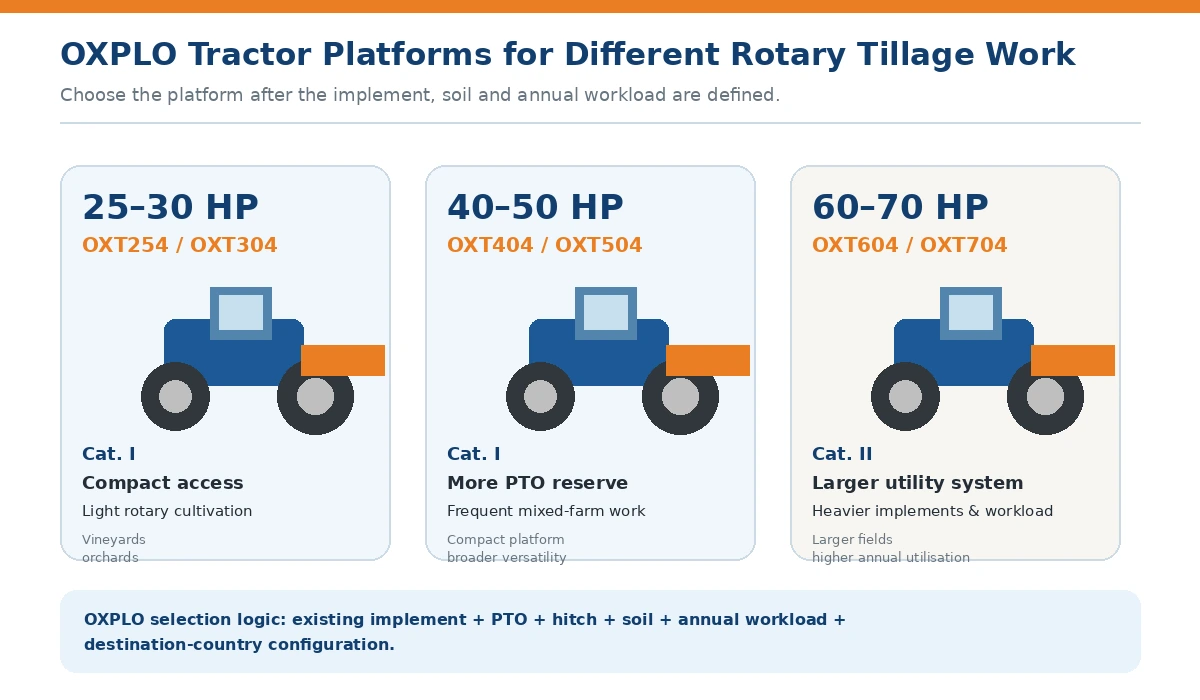
OXPLO platform selection should follow implement, hitch, soil and workload requirements.
Working Profile | Platform Logic | Typical Buyer Situation | Key Buying Check |
Light, access-sensitive work | Compact tractor platform | Vineyards, orchards, estates, previously cultivated soil, smaller implements | Avoid selecting only by HP; check row/gateway width, Cat. I compatibility, tiller PTO requirement and working depth. |
Frequent mixed-farm tillage | Compact platform with more power reserve | Mixed farms, recurring rotary tillage, mowing, transport and other PTO jobs | Prioritise PTO reserve and annual utilisation while retaining access and existing Cat. I implement compatibility. |
Higher recurring load / heavier implements | Larger utility platform | Larger fields, heavier soil preparation, contractors, broader implement fleet | Check Cat. II requirements, chassis size, transmission, implement weight and whether increased capacity is justified by annual workload. |
OXPLO 25–30 HP: compact access and light rotary cultivation
The OXPLO OXT254 and OXT304 sit at the compact end of the range with Category I rear linkage and 4WD. This class is relevant where narrow access, manoeuvrability and light recurring work matter more than maximum soil-working capacity.
For buyers considering this class, review the OXPLO OXT254 25 HP tractor and OXPLO OXT304 30 HP tractor product pages, then confirm the actual rotary tiller requirement before ordering.
The key limitation is not whether a small tiller can physically connect. The buyer should ask whether the intended soil, depth and annual hours remain within a comfortable operating envelope. Heavy clay, deep first-pass tillage or a wide implement can quickly turn a compact tractor into a slow system.
OXPLO 40–50 HP: more PTO reserve while retaining a compact Category I platform
The OXPLO OXT404 and OXT504 are particularly relevant to mixed farms that still depend on Category I implements but require more capacity for recurring cultivation and PTO-driven work. The OXT504 is especially useful as a decision point because it is the highest-powered model in OXPLO’s compact OXT chassis group.
See the OXPLO OXT404 40 HP tractor and OXPLO OXT504 50 HP tractor for current published specifications and application positioning.
For a European buyer with an existing Category I rotary tiller, mower or other rear implements, this compact platform can be attractive because it may increase power reserve without immediately forcing a move to a larger Category II tractor. The value is not simply “more HP”; it is the ability to retain compact access while supporting a more demanding annual workload.
OXPLO 60–70 HP: a larger Category II working system
The OXPLO OXT604 and OXT704 move into a larger utility platform with Category II linkage and 12F + 12R transmissions. This is a structural step up from the compact OXT254–OXT504 group, not merely a 10 or 20 HP increase.
Compare the OXPLO OXT604 60 HP utility tractor and OXPLO OXT704 70 HP tractor when the annual workload includes heavier implements, more intensive soil preparation, transport or other Category II applications.
For rotary tillage, the larger OXPLO platform becomes relevant when implement weight, hitch category, field size and recurring load justify the increase in chassis size and capacity. A customer who works mainly in narrow orchard rows with light tillage should not move to this platform simply because more horsepower is available. A contractor with heavier implements and longer working days may reach the opposite conclusion.
VII. How OXPLO Can Help Match an Existing Rotary Tiller Before You Order
For many B2B buyers, the best tractor recommendation starts with equipment they already own. Replacing a tractor does not necessarily mean replacing the rotary tiller, mower, trailer and every other implement on the farm.
OXPLO’s current tractor-selection process allows buyers to provide their application, implement and destination information so PTO, three-point linkage, hydraulic requirements and available configurations can be checked before production or shipment.
If you already own the rotary tiller, send these specifications
- Rotary tiller brand and model.
- Working width and approximate implement weight.
- Manufacturer’s minimum and recommended tractor or PTO horsepower.
- Required PTO speed and shaft/spline information.
- Three-point hitch category.
- Typical working depth.
- Soil type and whether the tiller is used for first-pass cultivation or finishing.
- Approximate annual hectares or working hours.
- Other implements that must work with the same tractor.
- Destination country and any relevant market configuration requirements.
OXPLO buyers can use the 25–70 HP Tractor & Attachment Selection page to compare application ranges and confirm PTO, linkage, attachment and destination-market requirements.
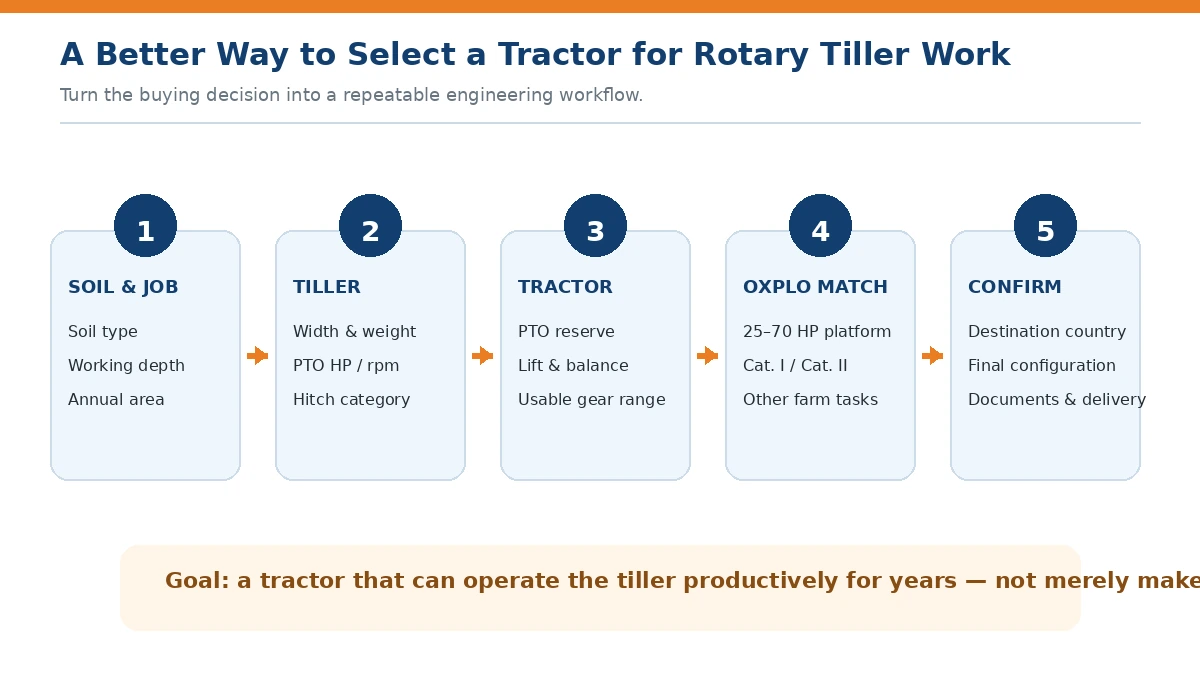
A practical workflow for matching an existing rotary tiller or planning a new tractor-implement system.
If you have not purchased the tiller yet, start from the job
Provide soil type, target working depth, field size, desired tiller width, annual workload and other planned tractor tasks. OXPLO can then help narrow the tractor platform before the customer finalises the implement. This sequence reduces the risk of buying a tiller that is too wide for the available power or a tractor that forces unnecessary changes to the rest of the implement fleet.
Why this matters for European buyers
European buyers frequently need one tractor to cover multiple jobs while fitting existing farm infrastructure and implement inventories. OXPLO’s 25–70 HP range allows the discussion to start from application rather than from a single fixed model. The compact Category I tractors suit one set of constraints; the larger Category II OXPLO utility platform suits another.
For current attachment availability and support information, visit OXPLO Parts & Attachments Support. For the full tractor line, see OXPLO Farm Tractors.
Final PTO speed, spline, engine configuration, tyres, lighting, guarding, operator station and available conformity documentation should be confirmed for the selected model and destination before ordering. This is more reliable than assuming one specification applies identically to every market.
VIII. A Practical Rotary Tiller Tractor Selection Checklist
Before approving a tractor for rotary tiller work, run the combination through three decision layers.
Layer 1 — Soil and work requirement
- What is the heaviest recurring soil condition?
- What working depth is actually required?
- Is the job first-pass cultivation, residue incorporation or seedbed finishing?
- How many hectares must be completed inside the normal working window?
- Are field access, orchard rows, gates or buildings limiting tractor dimensions?
Layer 2 — Rotary tiller requirement
- Working width and implement weight.
- Minimum/recommended engine or PTO horsepower.
- PTO speed and spline.
- Category I or Category II linkage.
- Maximum permitted tractor power.
- Driveline protection and PTO-shaft requirements.
Layer 3 — Tractor configuration
- Verified PTO compatibility and sufficient power reserve.
- Suitable low working gears for the required travel speed.
- Adequate three-point lift and safe front-to-rear balance.
- 4WD/traction appropriate for the soil and terrain.
- Dimensions that fit the property and working area.
- Compatibility with the farm’s other current and future implements.
- Configuration and documentation confirmed for the destination market.
Best-practice buying sequence: Soil → Job → Tiller → PTO Requirement → Hitch & Weight → Field Capacity → Tractor Platform → Market Configuration.
IX. Conclusion: Buy a Working System, Not a Horsepower Number
The right tractor for rotary tiller work is not the tractor with the highest horsepower and it is not necessarily the smallest tractor that can physically operate the implement. The best rotary tiller tractor is the one that keeps the whole working system inside a stable operating range.
A productive rotary tiller tractor must hold the required PTO speed, carry the implement safely, maintain a useful forward speed, preserve traction and remain compatible with the rest of the farm’s work. Soil condition, depth, tiller width, implement weight, hitch category and annual workload all influence that result.
For buyers comparing OXPLO tractors, the most useful distinction is the working platform. OXPLO OXT254–OXT504 models provide compact Category I options across 25–50 HP, while OXPLO OXT604 and OXT704 move into a larger Category II utility platform for broader implement and workload requirements. The correct choice depends on the complete system—not one headline number.
If you already own a rotary tiller, send OXPLO the implement specification, PTO requirement, hitch category, working width, weight, soil condition and destination country. If you are buying both tractor and tiller, start with the soil, required depth and annual work target. OXPLO can then help narrow the tractor platform and check the relevant attachment interfaces before an order is finalised.
Explore the OXPLO tractor range, review the application-based tractor selection guide, or visit the OXPLO homepage for more equipment information.
The objective is simple: buy a tractor that does not merely turn the rotavator on day one, but operates the complete tillage system productively across real field conditions for years.
X. Frequently Asked Questions
Q1. What tractor HP do I need for a rotary tiller?
Start with the rotary tiller manufacturer’s minimum and recommended power requirement, then adjust the tractor decision for soil resistance, tillage depth, travel speed and annual workload. There is no universal HP-per-metre rule that is accurate for every rotary tiller and soil condition.
Q2. Is a 25 HP tractor enough for a rotary tiller?
A 25 HP tractor can operate a compatible light-duty rotary tiller where the implement specification, soil condition and required depth are appropriate. It should not be assumed suitable for deep cultivation, heavy clay or a wide tiller simply because the hitch connects.
Q3. Is a 40–50 HP tractor a better choice for regular rotary tillage?
For many mixed farms, 40–50 HP can provide more useful reserve for recurring PTO work while still keeping the tractor relatively compact. The correct decision still depends on verified PTO requirement, Cat. I compatibility, implement weight and soil conditions. OXPLO’s OXT404 and OXT504 are relevant models to compare in this range.
Q4. When should I consider a 60–70 HP tractor for tillage?
Consider the larger class when the farm uses heavier or Category II implements, works larger areas, performs more demanding soil preparation, or needs one tractor for a broader professional workload. OXPLO’s OXT604 and OXT704 use the larger Category II utility platform.
Q5. Does 4WD help a tractor with a rotary tiller?
Yes. The tiller is PTO-driven, but the tractor still needs controlled forward motion. 4WD can improve traction and directional control on loose, damp or uneven ground, especially when soil conditions change across the field.
Q6. Is PTO speed important when choosing a rotavator tractor?
Yes. The implement must be operated at its specified PTO speed. Confirm the tractor’s PTO speed and spline against the tiller manufacturer’s requirement before ordering or connecting the implement.
Q7. Can I use my existing rotary tiller with an OXPLO tractor?
Potentially. OXPLO recommends confirming the implement’s horsepower requirement, PTO speed and spline, three-point linkage category, weight and any hydraulic requirements against the selected tractor configuration. Existing implement data should be supplied before the order is finalised.
Q8. Should I choose the widest rotary tiller my tractor can power?
Not automatically. A wider tiller can reduce productivity if the tractor cannot maintain adequate PTO speed and travel speed in real soil. Width should be balanced against field capacity, soil resistance, depth and available power reserve.
Q9. What information should I send OXPLO for a tractor recommendation?
Send the rotary tiller model or specification, working width, weight, PTO requirement, hitch category, soil type, working depth, annual workload, other implements and destination country. This gives OXPLO enough information to narrow the tractor platform and confirm the relevant interfaces.
OXPLO website references used in this guide: Tractor Range | Tractor & Attachment Selection | Support & Attachments