
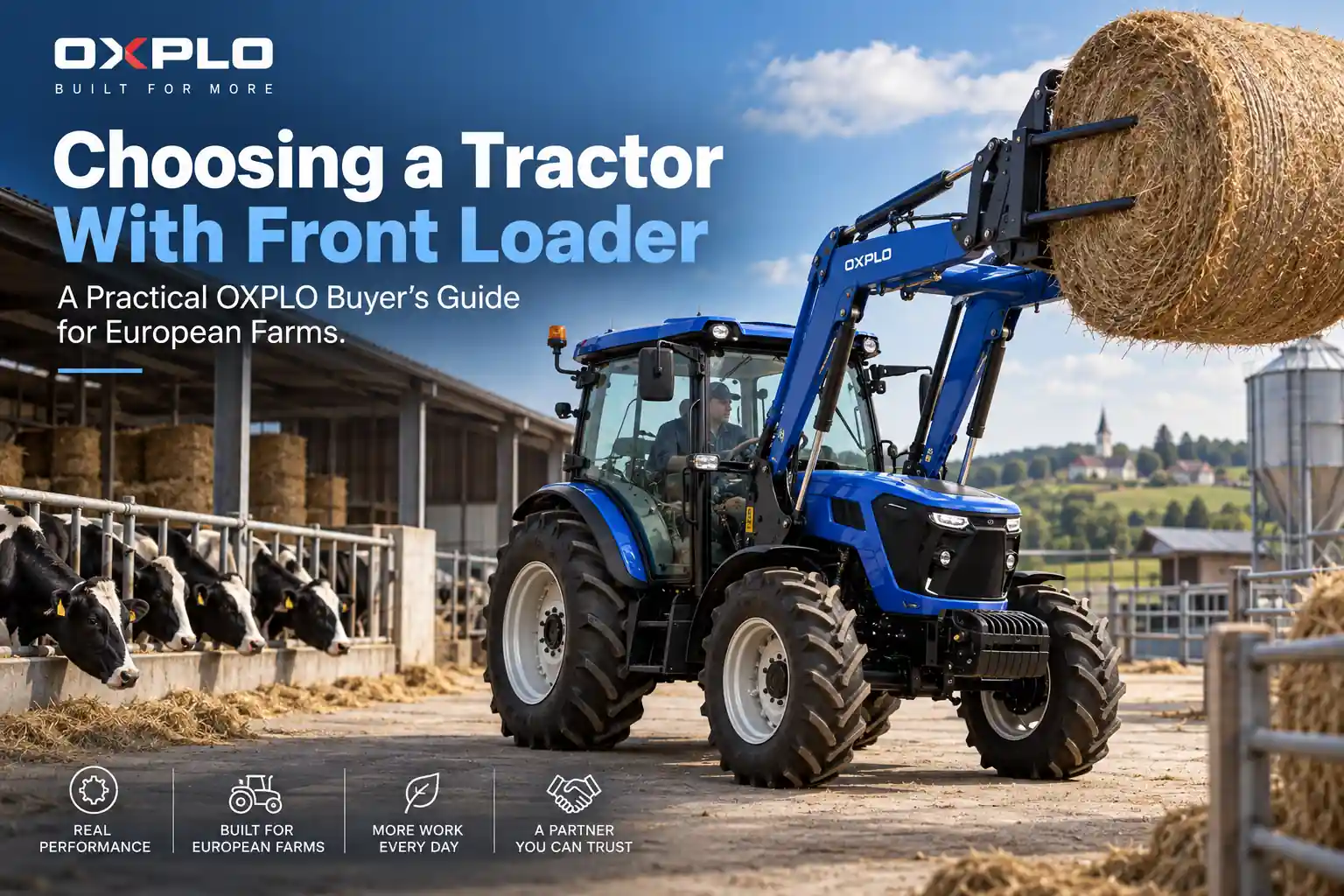
A practical engineering and procurement guide for European farms, dealers and agricultural equipment buyers
A tractor with front loader is often purchased as if it were a standard tractor plus one extra attachment. That is the first mistake. Once a loader is fitted, the tractor becomes a material-handling system in which chassis mass, front-axle loading, hydraulics, load centre, tyres, transmission, counterweight and working space all interact.
This matters especially in European farming. A machine may need to load feed in the morning, move round bales before lunch, tow a trailer in the afternoon and return to mowing or cultivation later in the week. At the same time, it may have to pass through an old barn entrance, work on wet grass or uneven farmyards, and satisfy destination-market documentation requirements.
The correct buying question is therefore not simply, “Which horsepower should I buy?” It is: “Which tractor-loader configuration can repeatedly handle my real loads, in my real working environment, without creating avoidable safety, productivity or total-cost problems?”
Buyer Rule |
I. Why European Farms Often Buy the Wrong Tractor With Front Loader
The loader changes the tractor’s physics
Front-loader work is not simply another use of engine horsepower. A front-mounted load creates a lever in front of the tractor. As the load moves forward and upward, more demand is placed on the front axle while the combined centre of gravity moves forward and, during lifting, upward.
This is why a tractor may have enough hydraulic force to raise a load but still be a poor machine for carrying that load repeatedly across an uneven yard. The question is not only whether the loader can lift. The complete system must also steer, brake, remain balanced and keep useful traction at the rear axle.
The practical consequence is simple: advertised loader capacity must never be evaluated without the attachment weight, load centre, counterweight, tyre capacity and tractor platform.
European farms add another constraint: access
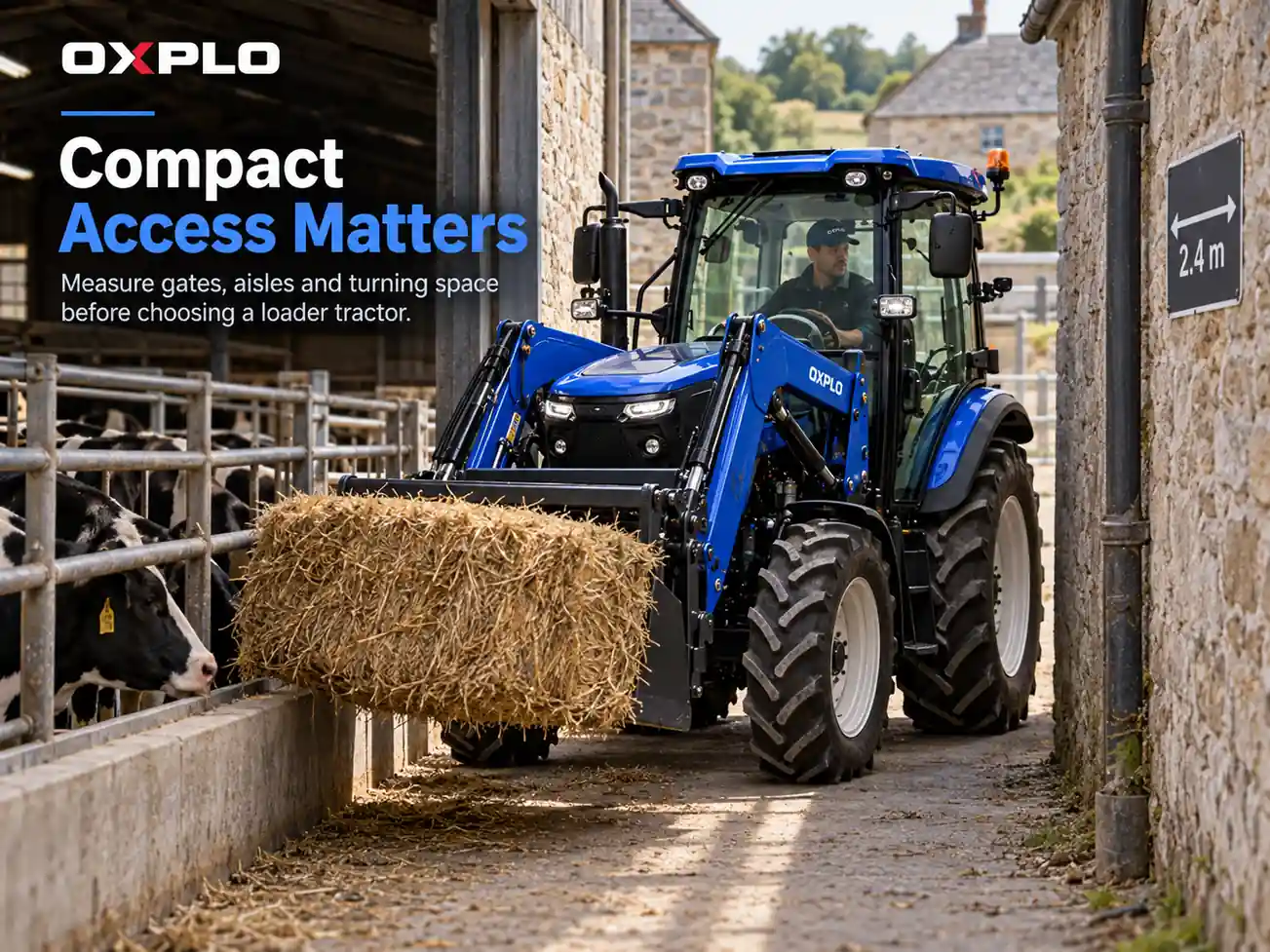
Compact access should be checked using the complete tractor-loader working envelope, not the bare tractor alone.
Many European buyers work around livestock buildings, older farmyards, orchard rows and gateways that were never designed around modern agricultural machinery. This creates a trade-off that is often missed during online comparison.
A larger tractor may provide a more substantial platform for regular loader work, but additional width, wheelbase and turning radius can reduce access. A compact tractor with loader may enter the building more easily, yet operate closer to its practical limit when handling dense material or heavy pallets.
Before comparing tractor models, measure the narrowest gate, barn doorway, aisle, turning area and overhead clearance. Then compare those figures with the tractor plus loader and attachment—not the bare tractor alone.
II. Start With the Job: What Are You Actually Loading?
Material type determines the engineering problem
A bucket full of dry feed, a bucket full of gravel and a pallet of fertiliser may occupy similar space but create very different loads. The buyer should therefore describe the task in kilograms, load centre and required lift height—not only in bucket volume.
Typical Task | What the Buyer Must Confirm | Main Risk if Ignored |
Feed / grain | Bulk density, bucket volume, daily cycle count | Oversized bucket slows cycles or overloads the front end |
Manure | Moisture, density, bucket or grapple type | Variable load mass and poor retention |
Soil / gravel | Material density, fill factor, ground condition | Dense material exceeds practical payload before bucket is full |
Round bales | Bale mass, diameter, spear/grab, stacking height | Unstable or unsecured load |
Pallets / fertiliser | Pallet mass, fork weight, load centre, lift height | Capacity falls as the load centre moves forward |
Logs / irregular material | Load shape, grapple requirement, hydraulic circuit | Poor load control and unexpected centre-of-gravity shift |
Load centre matters as much as load weight
One of the easiest ways to misread a loader specification is to compare only a headline lifting number. Capacity measured at the loader pivot is not the same as capacity available farther forward on pallet forks.
If the attachment moves the payload centre farther away from the loader pivot, leverage increases. This means the real question is: can the loader handle this load at this distance and at this height?
For B2B procurement, ask suppliers to state where lift capacity is measured. If two suppliers use different measurement points, their figures are not directly comparable.
Duty cycle changes the correct tractor class
A machine that lifts a heavy load twice per week has a different design requirement from a machine that performs 50 to 100 loader cycles every morning. Repetition changes the commercial calculation.
For occasional loader use, compact dimensions and lower purchase cost may dominate the decision. For frequent loader work, transmission usability, hydraulic response, front-axle reserve, tyres, operator fatigue and service life become more important.
III. The Engineering Behind a Stable and Productive Front Loader Tractor
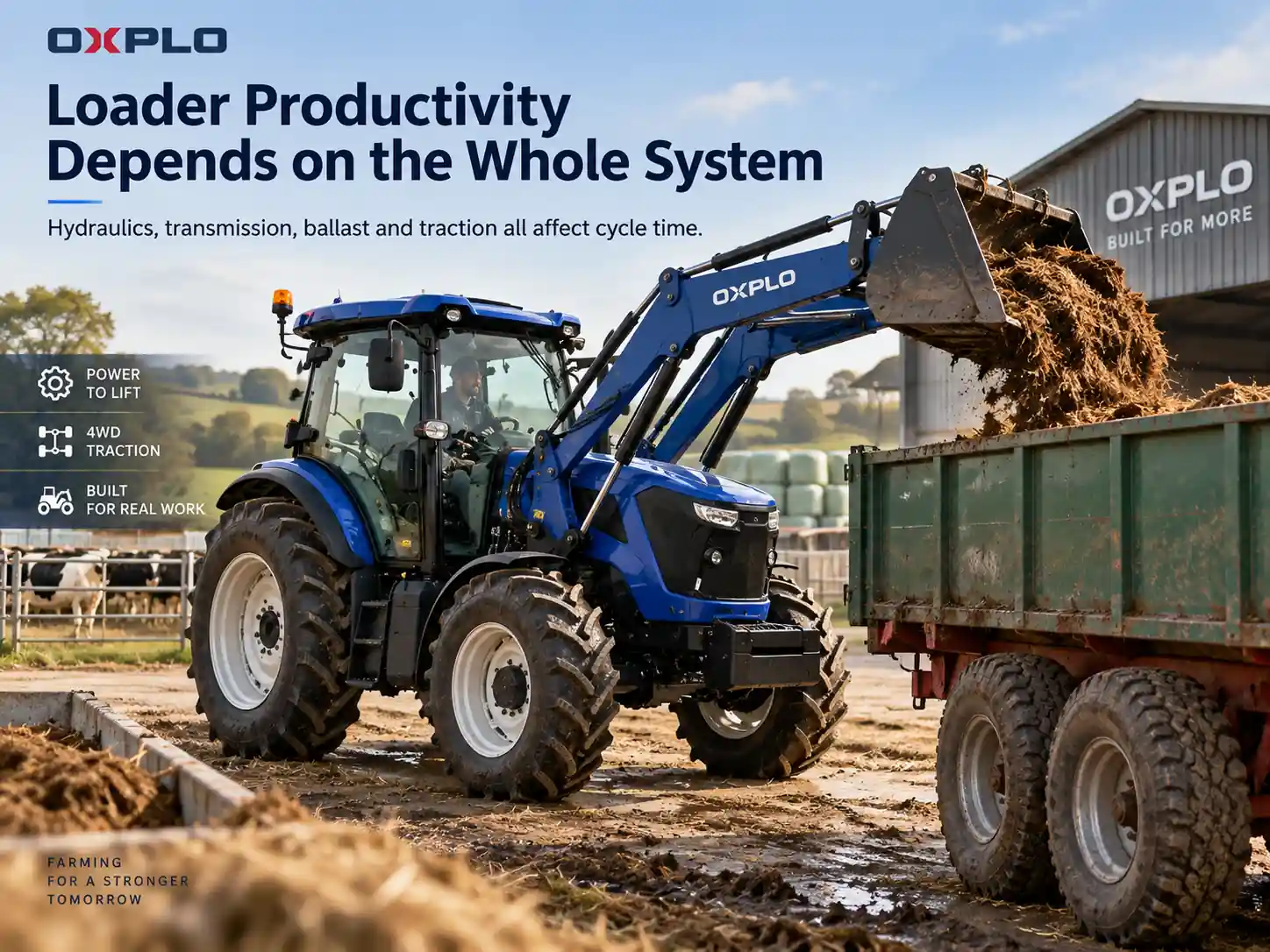
Loader productivity depends on the complete system: hydraulics, transmission, traction, tyres, ballast and operating workflow.
1. Tractor mass, wheelbase and counterweight
Tractor operating weight is not a guarantee of loader stability, but it defines part of the platform available for the loader system. Buyers should calculate the complete front-mounted mass: loader frame, attachment and payload.
Rear ballast is then used to help restore balance and useful rear-axle loading. The correct ballast arrangement must be matched to the tractor, loader and tyre limits. A random heavy implement on the three-point linkage is not a substitute for an approved counterweight strategy.
Wheelbase also creates a trade-off. A longer platform can be useful for regular utility work, but it increases the space required for turning. That is why loader selection should be made together with site measurements.
2. Hydraulic pressure and flow do different jobs
Hydraulic pressure contributes to available force. Hydraulic flow strongly affects how quickly the loader raises, dumps and rolls back. A loader that can technically lift the required load may still feel unproductive if every cycle is slow.
This is especially important in livestock and yard work where the same movement is repeated throughout the day. Buyers should ask for the loader’s hydraulic requirements, the tractor’s compatible hydraulic configuration, auxiliary circuits for powered attachments, and the expected behaviour when more than one function is used.
3. Transmission affects every loader cycle
Front-loader work involves constant direction changes. A typical cycle is approach, fill, reverse, turn, approach the trailer or stack, lift, dump, reverse and return.
In this type of work, usable low-speed forward and reverse ratios can matter more than a small difference in rated horsepower. The operator needs controlled approach speed and practical reverse choices without excessive clutch work or awkward gear selection.
4. 4WD, tyres and surface conditions
Four-wheel drive improves traction on grass, soil, gravel and changing farmyard surfaces. It does not, however, correct poor balance. Traction and stability are different engineering problems.
Tyre specification and inflation also matter because front-loader operation increases front tyre and axle demand. The final tyre choice should reflect the working surface, transport requirements and the loader configuration.
IV. Compact Tractor With Loader or Larger Utility Tractor?
When a compact tractor with loader is the right answer
Compact machines are valuable where access is the limiting factor. Narrow livestock alleys, vineyards, orchards, greenhouses, estate work and restricted farmyards can make a shorter, narrower tractor more productive than a larger machine.
A compact tractor with loader is also a rational choice when material-handling demand is light or intermittent and the tractor spends most of its time mowing, maintaining grounds, transporting light loads or using smaller Category I implements.
When compactness becomes expensive
The problem begins when the buyer chooses the smallest possible chassis and then asks it to perform near-limit loader work every day. The machine may still complete the task, but the operating margin becomes narrow.
The operator may need smaller bucket fills, slower travel, more counterweight, more trips and more careful positioning. Over hundreds of hours, those compromises can cost more than selecting a larger platform at the beginning.
Trade-off |
A practical starting matrix
Operating Profile | Typical Starting Point | Why |
Narrow access + occasional light handling | 25–40 HP compact class | Manoeuvrability and access dominate |
Livestock / mixed farm + regular light-to-medium handling | 40–50 HP compact-utility class | Balance between access, PTO work and loader use |
Frequent feed, bale, material and trailer work | 60 HP utility class | More substantial platform and broader transmission/linkage capability |
Higher annual workload + loader + field + transport | 70 HP utility class | More engine reserve while retaining multi-purpose use |
V. Hidden Costs: Why the Cheapest Loader Tractor Can Become the Most Expensive
Under-specification creates cost through repetition
A poorly matched farm tractor with loader often does not fail dramatically. Instead, it loses money a little at a time: smaller payloads, extra cycles, more reversing, more operator time, faster tyre wear and higher engine hours for the same amount of material moved.
That cost is easy to miss because it does not appear on the purchase invoice.
Oversizing has a cost too
Buying the largest machine available is not automatically safer or more economical. Oversizing can increase purchase price, transport cost, storage requirement, turning space and soil compaction while reducing access to older buildings or narrow rows.
The correct tractor with front loader is therefore the smallest system that can handle the required work with an adequate operating margin—not simply the smallest machine that can lift the load once.
Use throughput, not only lift capacity, to compare machines
For repetitive loading, a useful commercial measure is hourly material throughput:
Hourly throughput = average payload per cycle × completed cycles per hour.
A machine with a larger theoretical payload can still move less material per hour if hydraulic response, turning, gear selection or load control slows every cycle. Over 400 or 500 annual loader hours, a few seconds per cycle become a meaningful labour and fuel cost.
VI. What European Buyers Should Verify Before Ordering
Check the complete working envelope
European buyers should record gate width, barn entrance height, aisle width, turning space, orchard row width and any overhead obstructions. The comparison should include the loader and intended attachment.
If the machine must work both inside buildings and in fields, the procurement decision must balance access with loader duty rather than optimise only one side of the job.
Treat the loader as safety-related machinery, not a simple accessory
Front-loader safety requirements in Europe continue to receive technical attention. In July 2026, CEMA published technical guidance on tractor-mounted front loaders, addressing the risk of falling unit loads and the current standardisation discussion around protective solutions. For buyers, the practical lesson is to review the tractor, loader, attachment and intended use as one safety-related system rather than assuming that any loader that physically fits is acceptable.
Confirm the destination-market tractor configuration
Agricultural tractors in the EU sit within a specific approval framework. Regulation (EU) No 167/2013 covers type-approval and market-surveillance requirements for agricultural and forestry vehicles. In practice, buyers should confirm the supplied model, engine/emissions configuration, operator protection, lighting, braking, tyre options, loader documentation and destination-country requirements before shipment.
European Buyer Note |
VII. Matching OXPLO Tractors to Real Loader Work
This is where the earlier engineering logic becomes useful. OXPLO currently offers 25–70 HP 4WD tractors for European-oriented applications, but OXPLO does not need to treat every horsepower class as equally suitable for every loader job. The better approach is to match the OXPLO tractor platform to access, duty cycle, implement requirements and material-handling demand.
OXPLO OXT504: compact access with 50 HP output
The OXPLO OXT504 is the highest-powered model in OXPLO’s compact OXT chassis group. Its published specification includes 50 HP, 4WD, an 8F + 8R transmission, Category I linkage, a 1,800 mm wheelbase, approximately 2,200 kg listed weight and a 1,560 mm overall width.
For European customers, that compact width is a real advantage when gates, livestock buildings or storage areas limit access. The OXPLO OXT504 can therefore make sense where the buyer needs a farm tractor with loader capability but still values a compact footprint for mixed farming, grassland, feed support and general transport.
The boundary is frequency and load. If loader work becomes a major daily task, OXPLO buyers should compare the OXT504 with the larger OXT604 platform rather than selecting the 50 HP model only because it fits the horsepower target.
OXPLO OXT604: the stronger starting point for frequent loader work
The OXPLO OXT604 moves to OXPLO’s larger utility platform. Published data lists 60 HP, 4WD, a 12F + 12R transmission, Category II linkage, a 2,010 mm wheelbase, approximately 2,500 kg listed weight and larger 8.3-20 / 12.4-28 tyres.
Those figures matter because frequent loader work is not only about horsepower. The longer wheelbase, heavier listed platform, broader forward/reverse ratio range and Category II implement system create a more substantial starting point for a tractor that must combine material handling with field work.
For a livestock or mixed farm that moves feed, manure, bales or farm supplies regularly, the OXPLO OXT604 is a more logical model to evaluate when the loader, attachment, hydraulics, tyres and rear ballast are specified together.
The 12F + 12R transmission also directly answers a loader-work problem: repeated forward and reverse movements. Instead of presenting the gearbox as a catalogue number, OXPLO can explain it as finer speed selection for approach, loading, reversing and yard manoeuvring.
OXPLO OXT704: more power reserve for higher annual workload
The OXPLO OXT704 retains the same larger 2,010 mm wheelbase and approximately 2,500 kg listed platform while increasing rated output to 70 HP. OXPLO publishes 12F + 12R transmission, Category II linkage, 4WD and 540/760 rpm PTO for this model.
This makes the OXPLO OXT704 relevant to buyers who want more engine reserve for an annual workload that combines loader handling, trailer work, cultivation, grassland tasks and other Category II implement applications.
OXPLO also states that a compatible front-loader configuration can be discussed for the OXT704, with loader capacity, hydraulic connections, attachment type and counterweight requirements confirmed before ordering. That wording is important: OXPLO should sell the configuration, not an unverified lifting claim.
For wider-row orchards, estates and mixed farms, OXPLO buyers should still compare the 1,760 mm listed width and overall dimensions with gateways, buildings and canopy clearance before moving from the compact OXT504 platform.
Model | Published Platform | Best Loader-Related Buying Logic |
OXPLO OXT504 | 50 HP | 4WD | 8F+8R | Cat. I | 1,800 mm WB | ~2,200 kg | 1,560 mm width | Where compact access remains critical and loader work is light-to-regular |
OXPLO OXT604 | 60 HP | 4WD | 12F+12R | Cat. II | 2,010 mm WB | ~2,500 kg | Frequent mixed-farm / livestock loader work plus broader rear-implement needs |
OXPLO OXT704 | 70 HP | 4WD | 12F+12R | Cat. II | 2,010 mm WB | ~2,500 kg | Higher annual workload requiring additional engine reserve across loader, field and transport jobs |
VIII. How OXPLO Configures a Farm Tractor With Loader
Step 1: send the job, not only the horsepower
When requesting a quotation, an OXPLO buyer should provide:
- Destination country and market.
- Farm type: livestock, mixed farm, orchard, grassland, estate or contractor work.
- Material to be handled and maximum real load.
- Bucket, pallet fork, bale fork/spear, grapple or other attachment.
- Required dump or stacking height.
- Approximate loader hours per day or per year.
- Ground conditions: concrete, grass, mud, gravel, slopes or rough tracks.
- Narrowest gate, building entrance and working aisle.
- Other rear implements that the same tractor must operate.
Step 2: OXPLO checks the complete configuration
OXPLO’s tractor configuration page already follows this application-led logic. OXPLO asks customers to provide farm type, application, destination and attachment requirements before confirming horsepower, PTO, hydraulics, tyres and compatible attachments.
For a tractor with front loader, that process should extend to the exact loader model, loader measurement point, attachment weight, hydraulic connection requirements, tyre configuration and approved counterweight.
This is a stronger B2B value proposition than simply sending a tractor price. OXPLO is helping the buyer reduce the risk of purchasing a machine that is technically compatible on paper but inefficient in the customer’s actual farm workflow.
Step 3: confirm European documents before production or shipment
OXPLO’s Support section states that European-market configuration and CE-related documentation depend on the model, engine, destination country and intended application. OXPLO buyers should therefore request confirmation of the applicable documents for the exact supplied tractor-loader configuration rather than relying on generic paperwork.
This should include, as applicable, the confirmed specification sheet, engine/emissions information, manuals, labels, protective equipment, lighting/braking configuration, loader documentation and relevant conformity documents.
Step 4: plan parts and support before the machine arrives
For dealers and professional farms, after-sales planning is part of total cost of ownership. A buyer should know how filters, wearing parts, hydraulic components, loader pins/bushings and attachment parts will be identified and supplied.
OXPLO advises customers to retain machine model, serial number, part number, operating-hour records, photos and service history for faster parts and technical support. That process becomes more valuable when the tractor is operating daily rather than seasonally.
IX. Final Procurement Checklist for a Tractor With Front Loader
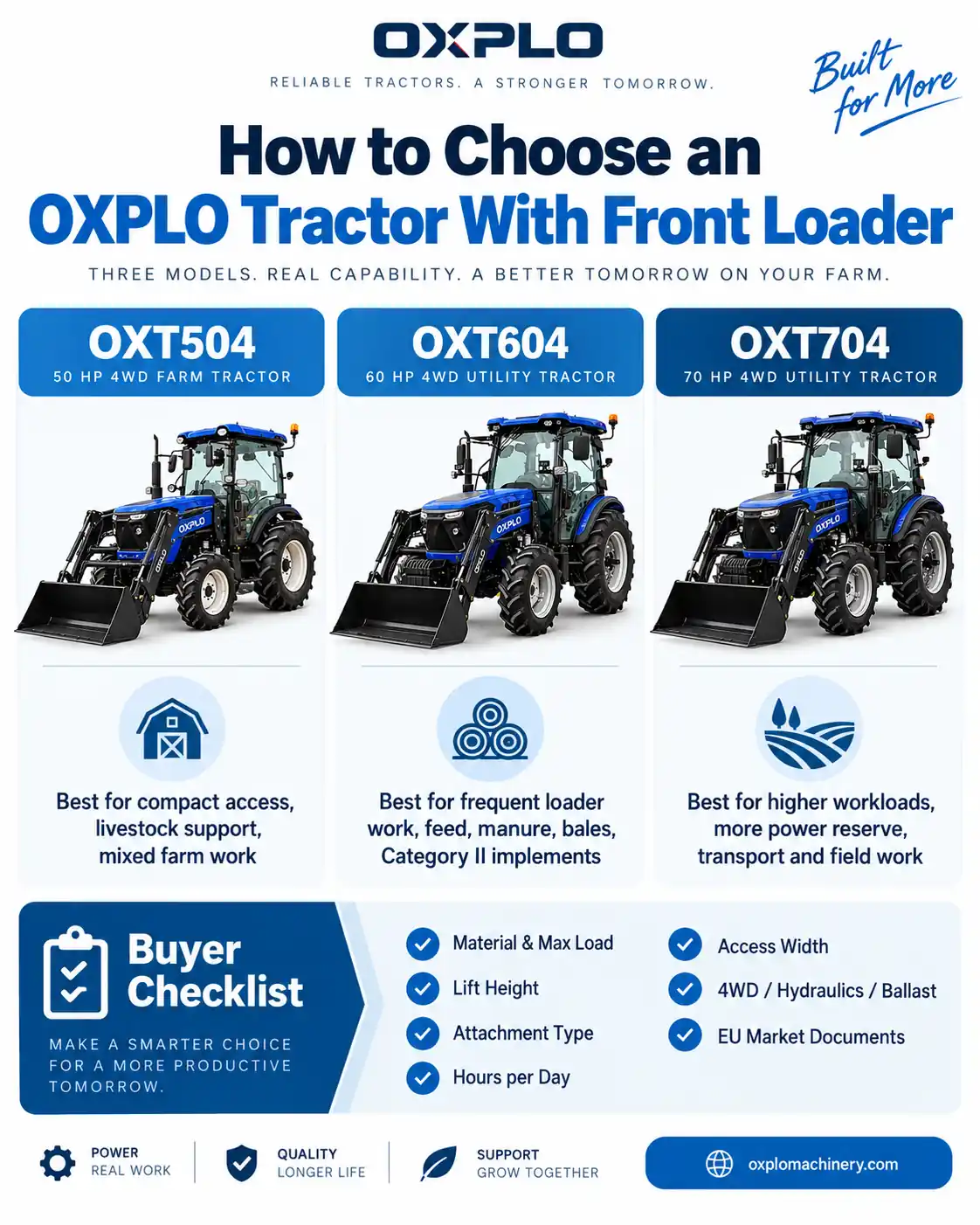
OXPLO model-selection overview and pre-order buyer checklist.
Before signing a purchase order, confirm the following points in writing:
- Exact tractor model, HP and 4WD configuration.
- Tractor dimensions, wheelbase, listed weight and tyre specification.
- Loader model and approved tractor compatibility.
- Loader lift-capacity measurement point and maximum lift height.
- Attachment type, attachment weight and required load centre.
- Hydraulic connections and auxiliary circuit requirements.
- Approved rear ballast / counterweight arrangement.
- Forward/reverse transmission suitability for expected loader duty.
- Gate, building and row clearances using the complete tractor-loader package.
- PTO speed and three-point-linkage compatibility for rear implements.
- Destination-market engine, operator protection, lighting and braking configuration.
- Applicable manuals, labels and conformity documentation.
- Spare-parts identification and technical-support process.
The most useful sentence to send a supplier |
Conclusion: Buy a Working System, Not a Tractor Plus a Bucket
Choosing a tractor with front loader is ultimately a system-engineering decision. Horsepower matters, but it does not tell you whether the tractor will remain well matched when the loader is raised, the pallet sits forward on forks, the yard becomes wet, or the operator repeats the same reversing cycle hundreds of times.
For compact European farms, a smaller front loader tractor can be the right answer when access is the dominant constraint. For livestock and mixed farms with frequent material handling, a larger utility platform often creates a better operating margin. For higher annual workloads, additional engine reserve becomes valuable—but only when the complete loader, hydraulic, tyre and ballast package is correctly matched.
OXPLO’s strongest role in this purchase process is therefore not to push the highest HP model. OXPLO can help buyers compare compact and larger utility platforms according to the real job, then confirm the tractor, attachments, hydraulics, tyres, loader requirements and destination-market documentation as one configuration.
If you are comparing an OXPLO farm tractor with loader for a European application, send OXPLO the material, maximum load, required lift height, access dimensions, operating hours, attachments and destination country. View OXPLO tractor configurations and request a model recommendation based on the work the machine must actually perform.