
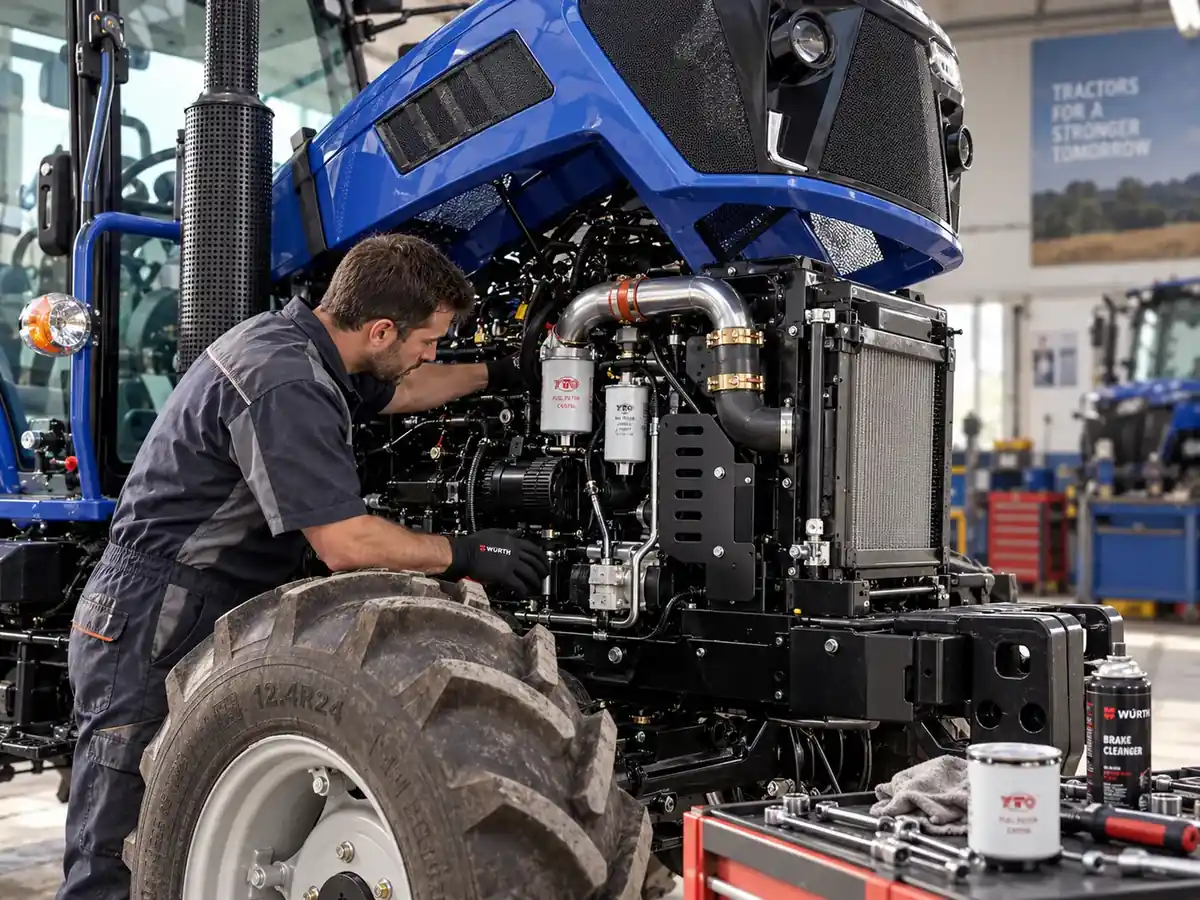
A practical reliability guide for European farmers, contractors, fleet managers and machinery buyers
For a European farm, the expensive part of a tractor failure is rarely the failed component alone. The real cost appears when a machine loses availability during a narrow spring cultivation window, grass harvest, vineyard maintenance cycle, livestock routine or contractor schedule. A hose that is inexpensive on a quiet winter day can become a major business problem if it fails when the tractor is booked for ten hours of work and the next weather front arrives tomorrow.
That is why effective tractor maintenance should be treated as uptime management rather than a list of oil changes. The objective is to detect small deviations – heat, contamination, leakage, vibration, tyre loading, slow hydraulic response or service-hour drift – before they develop into component damage and tractor downtime.
This guide explains seven maintenance mistakes that repeatedly create expensive downtime, then goes one step further: it shows how the maintenance priority changes by farm application, why some maintenance problems actually begin with the wrong tractor configuration, and what European buyers should confirm with a supplier before ordering a machine.
Key principle Good farm tractor maintenance does not start when a warning light appears. It starts with the correct machine-to-implement match, a model-specific service schedule and a habit of recording small changes before they become failures. |
I. Tractor Downtime Is Usually a Process Failure, Not a Sudden Breakdown
Most breakdowns look sudden only because the earlier signals were not recorded or acted on. A cooling system becomes marginal before the gauge reaches the red zone. A hydraulic hose sweats before it bursts. A PTO driveline develops play before vibration becomes obvious. A tyre runs under-inflated before the sidewall is damaged. The machine continues to work, so the operator assumes the problem can wait.
This is especially costly in European agriculture because production windows are compressed by weather and season. Mixed farms may move from cultivation to mowing to transport within the same week. Livestock farms depend on tractors for feeding, bale handling and yard work every day. Contractors must protect customer schedules. Vineyards and orchards often combine narrow access with repeated PTO and mowing work. These duty cycles make reliability a production issue, not only a workshop issue.
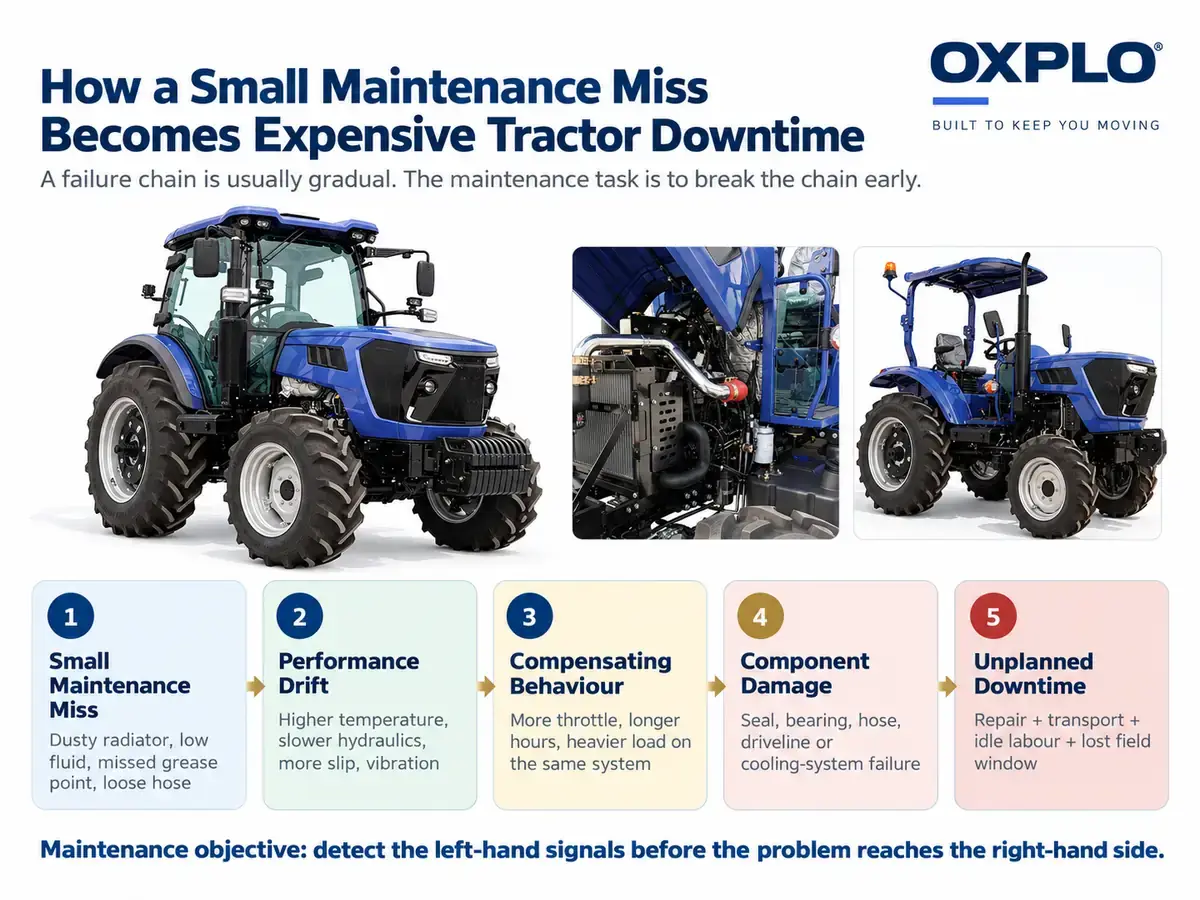
A typical maintenance failure chain: the earlier the signal is caught, the cheaper the intervention.
The business logic is simple: break the failure chain on the left. Once the issue reaches component damage, the farm starts paying for more than parts and labour. It may also pay for emergency transport, replacement machinery, idle employees, idle implements, missed field hours and delayed follow-on operations.
II. Three Engine-Side Maintenance Mistakes That Create Expensive Failures
Mistake 1: Servicing by Calendar Date Instead of Engine Hours and Duty Cycle
A tractor that works 250 hours a year on light mowing does not age in the same way as the same model working 800 hours with tillage, loader cycles, road transport and PTO loads. Yet many maintenance routines still use a simple rule such as “once a year.” That is convenient for administration but weak engineering.
Oil oxidation, filter loading, thermal cycles, dust ingestion and hydraulic use are driven by operating conditions. A practical tractor servicing plan therefore combines calendar time with recorded engine hours and the actual duty cycle. The operator should know the current hour reading, the last service hour, the next service point and whether severe conditions require more frequent inspection.
What to do instead Use the maintenance intervals in the exact operator or service manual supplied for the tractor configuration. Do not copy a generic 50-hour, 250-hour or 500-hour schedule from another engine or model. If dust, high load, frequent loader work or long operating days increase, shorten inspection frequency even when the formal service interval does not change. |
Mistake 2: Treating an Engine-Oil Change as the Whole Maintenance Programme
Changing engine oil matters, but it does not protect the engine from every failure mode. Diesel reliability also depends on clean intake air, clean fuel, correct fluid level, unrestricted cooling airflow and the condition of hoses and belts. In dusty tillage, mowing or harvest work, an air filter and radiator screen can deteriorate much faster than an office-style calendar schedule suggests.
The engineering risk is contamination. Once dirt, water or debris passes the intended barrier, the repair target is no longer the inexpensive filter. It can become the injection system, pump, cylinder surfaces, bearings or hydraulic components. The right question is not “Did we change the oil?” but “Did we control what enters the system?”
- Check the air-cleaning system and intake path, not only the replaceable element.
- Drain or inspect water-separation devices where fitted and investigate repeated water contamination.
- Use the fluid and filter specifications stated for the exact engine and hydraulic system.
- Record abnormal smoke, hard starting, unexplained fuel use or power loss instead of compensating with more throttle.
Mistake 3: Looking at Coolant Level but Ignoring Airflow Through the Cooling Pack
Many tractors overheat with a correct coolant level because heat cannot leave the machine efficiently. Seeds, chaff, dust, dried grass and mud accumulate across screens, radiator fins, oil coolers and condensers. The restriction is gradual, so the machine may appear normal in the morning and run hot only when ambient temperature, engine load and PTO demand rise together.
This is one of the most common examples of a symptom being mistaken for a root cause. When temperature rises, operators may add coolant or reduce speed, but the real problem may be airflow. Continued high-temperature operation then degrades oil, increases seal stress and reduces the safety margin of the entire power unit.
- Inspect the cooling pack from the air-entry side and between stacked heat exchangers where debris can hide.
- Clean with a method that does not fold radiator fins or force contamination deeper into the core.
- Check belt condition, hose condition and signs of coolant staining or repeated top-up.
- If overheating appears only under one implement or operating speed, investigate load matching as well as the cooling system.
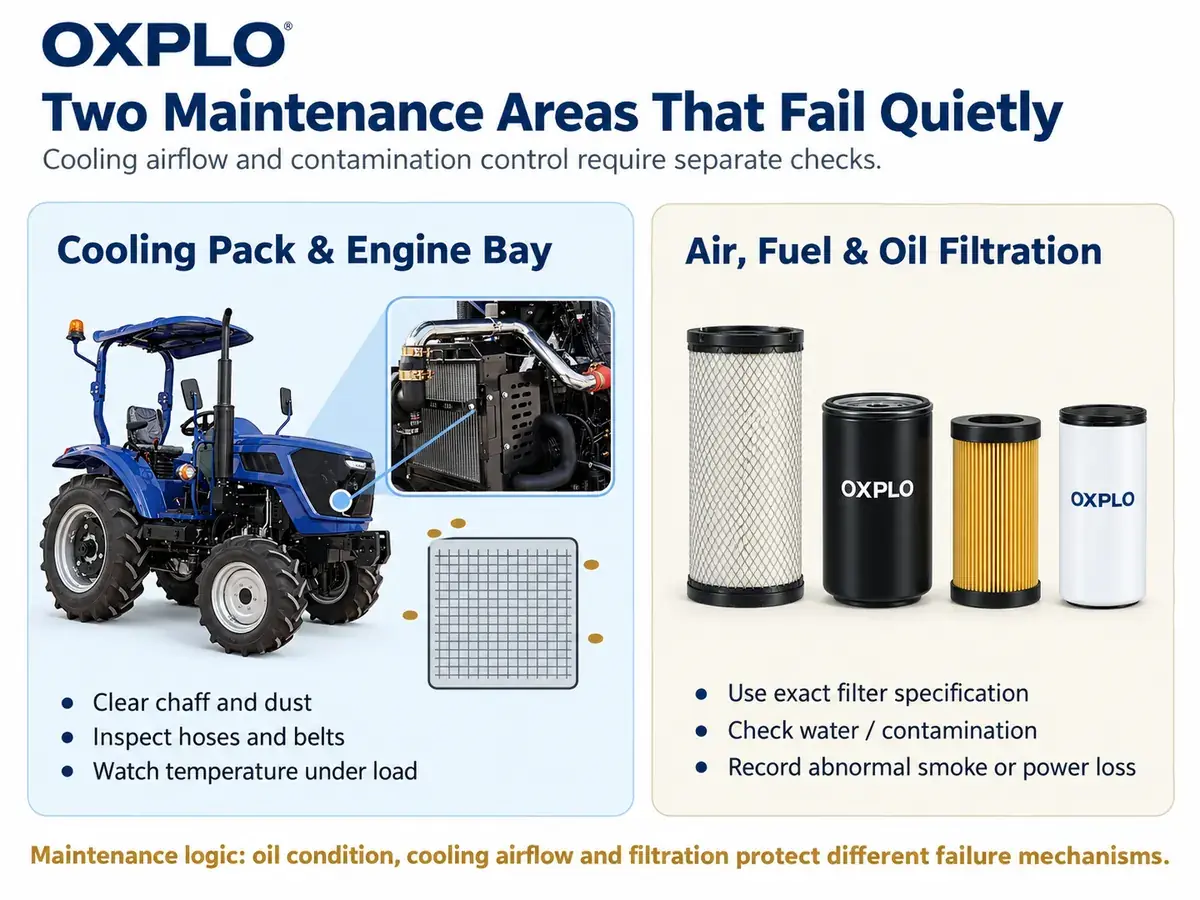
Generated maintenance illustration: cooling/engine inspection and contamination control are separate tasks, not extensions of a simple oil change.
III. Three Working-System Mistakes That Reduce Tractor Reliability
Mistake 4: Treating a Small Hydraulic Leak as Acceptable Because the Tractor Still Works
A slow hydraulic leak is easy to postpone because the loader still lifts, steering still works and the three-point linkage still raises. But the visible loss of oil is only one part of the problem. A leak can indicate hose abrasion, a deteriorating seal, a loose connection, damaged routing or abnormal heat. The same defect can also admit contamination or air when conditions change.
For loader-equipped tractors, the risk is magnified because hydraulic cycles are frequent and front-end components move through a wide range of positions. A hose that is safe at one steering angle may rub at another. A fitting that only sweats under light work may fail under higher pressure. The inspection therefore has to be dynamic: routing, clamps, bend radius and contact points matter as much as the final connection.
Safety point Never search for a high-pressure hydraulic pinhole with bare hands. High-pressure fluid injection injuries are medical emergencies. Suspected pressure-side leaks should be isolated and inspected using safe workshop procedures by qualified personnel. |
Mistake 5: Checking Whether the Tyre “Looks Flat” Instead of Managing Pressure, Load and Ballast
Agricultural tyres are part of the tractor’s powertrain because they convert torque into usable traction. Inflation pressure, axle load and ballast affect contact area, slip, ride, soil pressure and drivetrain loading. Visual inspection alone cannot tell whether a large agricultural tyre is at the correct operating pressure for the load.
The trade-off is important. Too much pressure can reduce the useful footprint in field work; too little pressure can increase carcass flex and heat, and may damage the tyre or bead. Loader work adds another variable because the front axle and front tyres see large load changes when the bucket is raised or loaded. Rear ballast may be necessary for stability and axle-load distribution, but excessive ballast also creates unnecessary rolling resistance and stress.
The correct target therefore comes from the tyre specification, actual axle load and work pattern. If the tractor spends part of the week in field work and part on road transport, one “set-and-forget” pressure may not be optimal. This is a maintenance decision with direct effects on fuel use, tyre life and productivity.
Mistake 6: Neglecting Grease Points, PTO Drivelines and Three-Point-Linkage Geometry
Pins, bushes, universal joints and splines often fail slowly. The first sign is usually not breakage; it is clearance, noise, uneven movement or vibration. Continued operation converts a cheap lubrication task into worn bores, damaged joints, driveline vibration and poor implement control.
PTO work adds a geometric problem. A tractor may have enough horsepower for an implement and still be poorly matched. PTO speed, spline type, driveline length, working angle, overlap, three-point category, implement weight and lift geometry all have to work together. A shaft that is too long can bottom as the linkage moves. A shaft that is too short may have inadequate overlap. Excessive joint angles increase vibration and wear.
This is why one of the most useful tractor maintenance tips is actually a purchasing rule: never approve an implement by horsepower alone. Horsepower is only one input to compatibility.
IV. Mistake 7: Running a Tractor Without Maintenance Records or a Spare-Parts Plan
The seventh mistake is managerial, but it amplifies every mechanical problem above. If service history lives in one operator’s memory, the farm cannot see recurring patterns. A hydraulic fitting that leaked at 620 hours, was tightened at 690 hours and leaked again at 750 hours looks like three unrelated incidents unless the events are recorded together.
A useful tractor maintenance checklist therefore has two jobs: it confirms the current inspection, and it creates a machine history. For each tractor, record the model and serial number, engine hours, inspection date, fluids and filters used, faults found, action taken, parts replaced and next service point. Add photos when a visual defect is likely to change over time.
The same logic applies to spare parts. A fleet does not need every component on the shelf. It needs the right service items and critical low-cost parts whose absence could immobilise the machine. Filters, belts, selected hoses, seals, fuses, lamps and common wear parts should be considered based on the exact configuration, local dealer capability and import lead time. The correct stock list is a risk decision, not a catalogue exercise.
Field | What to Record | Why It Matters |
Machine identity | Model, serial number, configuration | Prevents wrong parts and wrong technical advice |
Operating hours | Current hours + next service hour | Keeps servicing tied to machine use |
Inspection finding | Leak, heat, noise, vibration, wear, photo | Creates an early-warning history |
Action taken | Adjusted, cleaned, replaced, monitored | Shows whether the issue was solved or only delayed |
Parts / fluids | Part number, specification, quantity | Improves repeatability and future ordering |
Repeat fault | Date and hours of recurrence | Reveals root-cause problems that need deeper diagnosis |
V. Maintenance Priorities for Different European Farm Applications
A generic checklist is useful, but the highest-risk items change with the tractor’s actual job. This is where many maintenance programmes become too shallow: they treat every tractor as if it spends its life doing the same work. In practice, European farm applications create very different duty cycles.
A vineyard tractor may accumulate less drawbar load than a cultivation tractor but spend far more time in dusty mowing and repeated turning. A livestock tractor may do little tillage but run a loader through hundreds of hydraulic cycles. A contractor may operate the same tractor for long days with different operators and implements. Each pattern shifts the maintenance focus.
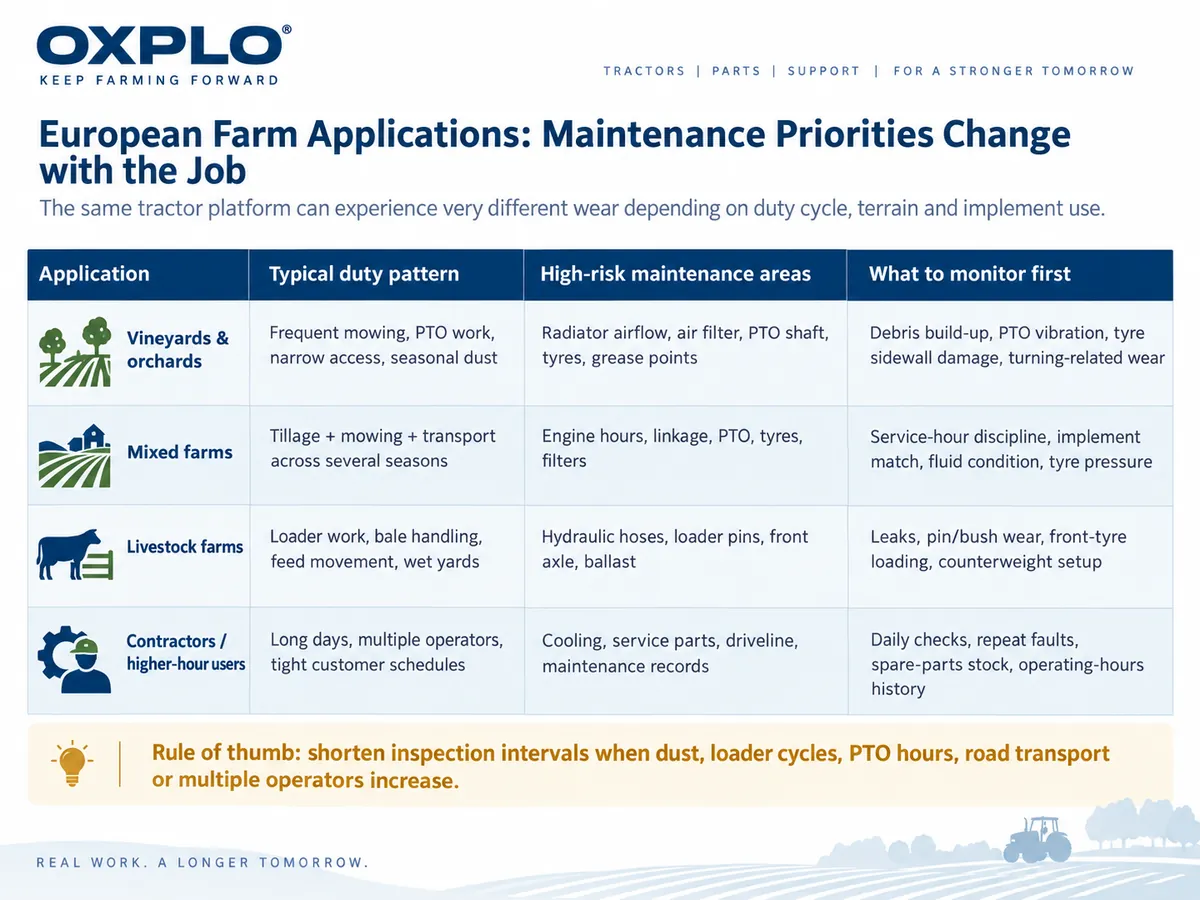
Maintenance priority should follow the application, not only the model name.
The operational lesson is straightforward: the maintenance plan should be built around the failure mechanisms created by the job. That means the tractor maintenance checklist used on a livestock farm should not be identical to the checklist used for vineyard floor care or higher-hour contracting.
VI. Some Tractor Maintenance Problems Actually Begin with the Wrong Tractor Configuration
By the time a machine reaches the workshop, it is easy to call every issue a maintenance problem. But some failures are the downstream result of a tractor spending its life in the wrong operating envelope. Too little power reserve, an incompatible PTO speed, an unsuitable linkage category, insufficient hydraulic capacity, poor ballast or an implement that is too heavy can create chronic heat, vibration, slip or component loading even when routine servicing is performed correctly.
This is where OXPLO’s 25-70 HP tractor range should be considered as three working platforms rather than six numbers on a horsepower list. The compact OXPLO models serve lower-to-medium duty work and Category I implements, while the OXPLO 60-70 HP models move into a larger Category II utility platform with more transmission ratios and larger working capacity. The engineering question is not “Which OXPLO tractor has the most HP?” but “Which platform keeps the intended job inside a sensible mechanical load range?”
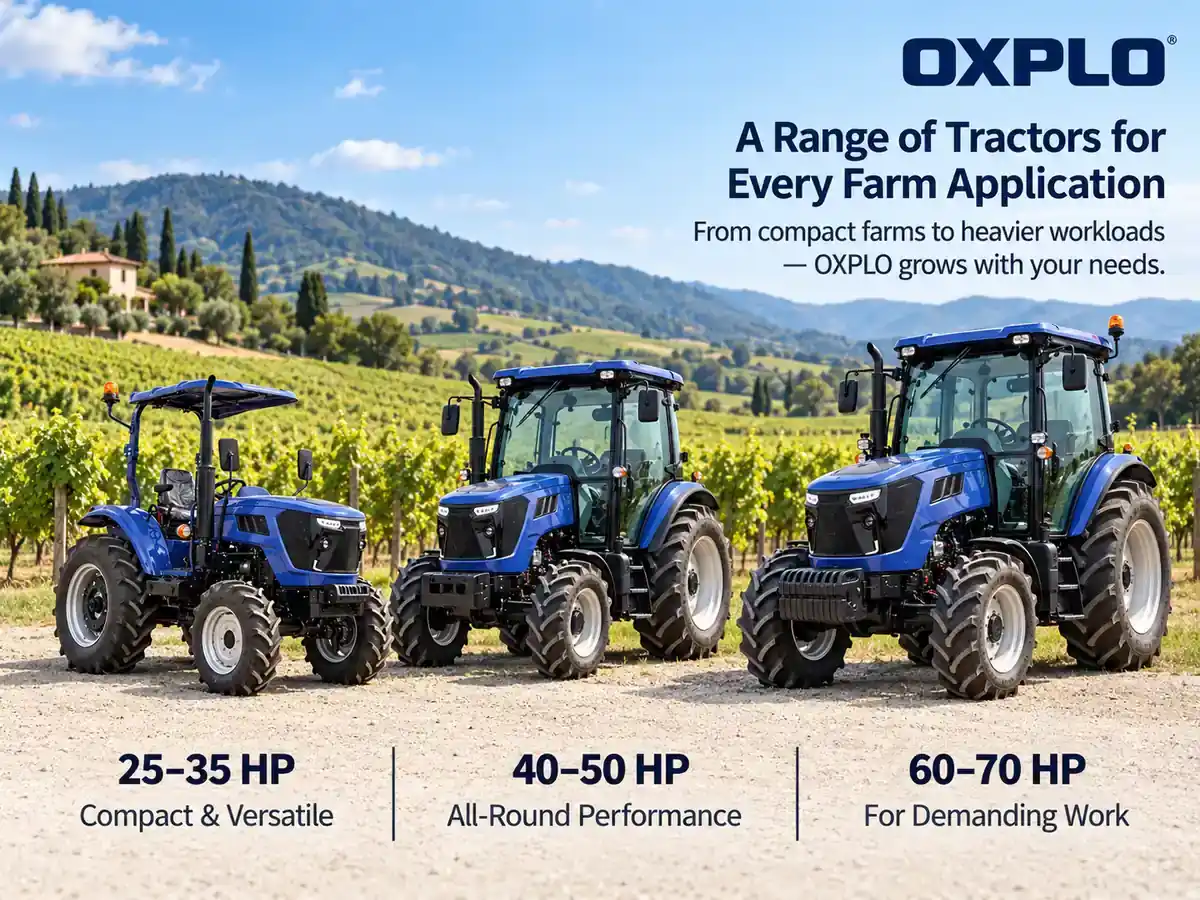
Generated OXPLO range illustration: compact 25-35 HP, all-round 40-50 HP and higher-demand 60-70 HP applications.
OXPLO range | Power | Platform | Typical work | Maintenance / load-management logic |
OXT254 / OXT304 | 25-30 HP | 4WD, Category I, compact platform | Vineyards, orchards, mowing, light transport | Avoid unnecessary size and mass where access and lighter implements dominate. |
OXT404 / OXT504 | 40-50 HP | 4WD, Category I, 8F+8R | Mixed farming, PTO work, transport, light loading | Adds useful power reserve without immediately moving to the larger Category II platform. |
OXT604 / OXT704 | 60-70 HP | 4WD, Category II, 12F+12R | Larger farms, loader work, heavier implements, demanding mixed-farm operations | More ratios and a larger implement interface help match ground speed and workload to heavier tasks. |
OXPLO product references: 25-70 HP tractor range | application-based tractor selection | OXT604 | OXT704
Why More Transmission Ratios Can Matter for Reliability
The OXPLO OXT604 and OXT704 use a 12F+12R transmission and Category II rear linkage, while the smaller OXPLO tractors use the compact Category I platform. More ratios do not “prevent maintenance,” but they give the operator more opportunity to match ground speed to engine load and implement demand. That can reduce the temptation to force an unsuitable gear through heavy work. The larger Category II platform also changes the implement class that can be matched safely.
Why PTO and Implement Matching Should Be Confirmed Before Purchase
OXPLO lists different PTO speed combinations across the tractor range, and the final configuration should be confirmed model by model. Before OXPLO approves an attachment combination, buyers should provide the intended implement, PTO requirement, linkage category, hydraulic demand, connection dimensions and working conditions. The OXPLO support page explicitly advises customers not to select attachments from appearance alone and notes that compatibility should be checked against horsepower, connection dimensions and hydraulic requirements.
This is one of the clearest ways OXPLO can reduce future tractor downtime: remove compatibility errors before the machine ships. A correctly matched mower, tiller, loader or trailer package is easier to operate within the tractor’s intended load envelope and easier to maintain predictably.
VII. How to Build a Tractor Maintenance Checklist That Operators Will Actually Use
A long checklist that no one completes is weaker than a short checklist that is used every day. The practical solution is to separate inspection by frequency and risk. Daily checks should be fast enough to perform during a walk-around. Hour-based tractor servicing should follow the model-specific manual. Seasonal checks should address storage, weather exposure and the next high-demand work period.
A. Before Each Working Day or Shift
- Engine oil, coolant and hydraulic-fluid level as specified for the machine.
- New oil, fuel or coolant marks under the tractor.
- Tyres: visible damage, inflation check as required, wheel fasteners and unusual wear.
- Radiator screens and cooling-air path, especially after mowing, dusty tillage or dry crop work.
- Hydraulic hoses and fittings, including rub points and loader-hose routing.
- PTO guard, driveline condition and three-point-linkage pins.
- Unusual noise, vibration, smell, smoke or slow hydraulic response during start-up.
B. Weekly or During High-Intensity Periods
- Grease high-cycle pivot points and driveline locations according to the manual.
- Inspect belt condition, battery terminals, linkage clearance and fasteners.
- Review tyre pressure against the current work: field, loader or transport.
- Look for repeat leaks or recurring debris build-up rather than treating each as a one-off event.
- Check the maintenance log: approaching service hours, unresolved defects and parts that need to be ordered.
C. Hour-Based Tractor Servicing
Use the exact OXPLO or engine-specific maintenance documentation supplied for the machine. Depending on model and configuration, hour-based work may include engine oil and filters, fuel filtration, hydraulic or transmission service, axle fluids, cooling-system service and other specified inspection points. The important discipline is to avoid inventing a universal interval across engines and tractors that do not share the same components.
D. Before Storage or the Off-Season
Clean the machine thoroughly, remove organic debris, address known leaks and damaged hoses, review fluid condition, protect exposed metal as appropriate, manage the battery and record every unresolved issue. Do not leave a known problem for “next season.” Months later, the symptom will be remembered but the location and circumstances may not be.
A practical farm rule If a defect can be recorded in under one minute, record it. If a service part can stop the machine for several days because of import lead time, decide before the season whether it should be stocked locally. |
VIII. What European Buyers Should Confirm Before Ordering a Tractor
For European buyers, long-term tractor maintenance is partly determined during procurement. The buyer should know what documentation is available, how parts are identified, how the supplier diagnoses a remote fault and which configuration is being supplied for the destination country. These questions matter even more when the tractor is purchased internationally.
1. Confirm the Exact Tractor, Engine and Destination-Market Configuration
European agricultural and forestry vehicle approval is governed by Regulation (EU) No 167/2013 and related delegated and implementing rules. Buyers should not assume that a generic CE reference answers every vehicle type-approval, emissions or national road-registration requirement. The exact model, engine, braking, lighting, protective equipment and documentation should be checked for the intended use and destination.
OXPLO states that eligible European-market configurations can be supplied with model-dependent CE-related documentation and that Stage V engine configurations may be available depending on the model and engine supplier. OXPLO also advises customers to confirm the exact documents before shipment. That is the correct procurement mindset: verify the supplied configuration, not the marketing category.
2. Ask for Model-Specific Maintenance Documentation Before the Busy Season
The buyer should have the operating and maintenance documentation, service intervals, fluid specifications, filter references and the procedure for identifying replacement components. OXPLO can supply maintenance parts and replacement components for supported models, but correct identification depends on model, serial number, part number and clear photos where needed.
3. Understand the Remote-Diagnosis Process
When a tractor is far from the factory, diagnosis becomes an information problem. OXPLO asks support customers to prepare the machine model, serial number, operating hours, issue description, photos, videos and fault-code information when available. Good maintenance records therefore do more than improve internal discipline; they also shorten technical communication and reduce the risk of ordering the wrong part.
4. Read the Warranty Terms as a Maintenance Document
Warranty coverage depends on the product, component and commercial agreement. Before ordering, confirm the period, covered components, exclusions, claim process and required maintenance evidence. OXPLO notes that maintenance records may be required when evaluating a warranty claim. This creates a direct commercial reason to keep a reliable tractor servicing history.
5. Ask These Seven Questions Before Requesting a Tractor Recommendation
- Which country will the tractor be used in?
- What is the farm type and approximate working area?
- Which implements must be used now – and which may be added later?
- What are the PTO speed, linkage and hydraulic requirements of those implements?
- How many operating hours are expected per year?
- Will a front loader, bale fork or other material-handling attachment be required?
- What local parts, workshop and road-use constraints must be considered?
With these inputs, OXPLO can narrow the selection between the compact 25-50 HP Category I tractors and the larger 60-70 HP Category II utility platform, while checking PTO, hydraulics, tyres, attachments and available destination-market documentation before the configuration is confirmed.
OXPLO support value The practical advantage is not a promise that a tractor will never need service. It is the ability to reduce avoidable uncertainty: confirm the configuration before purchase, identify compatible attachments, maintain a clear parts trail, and provide the information needed for remote technical support when a problem occurs. |
Useful OXPLO links: OXPLO Tractor Range | Tractor Applications & Configuration | Parts, Attachments & Technical Support | OXPLO Home
IX. Conclusion: Good Tractor Maintenance Begins Before the First Working Hour
The seven expensive maintenance mistakes are not isolated workshop errors. Together they reveal a broader reliability problem: machines fail when workload, configuration, inspection and information are treated as separate subjects.
- Do not service only by calendar date; use engine hours and real duty cycle.
- Do not reduce engine maintenance to oil changes; manage air, fuel, cooling and contamination.
- Do not wait for an overheat alarm to inspect cooling airflow.
- Do not ignore hydraulic leaks because the machine still moves.
- Do not treat tyre pressure and ballast as cosmetic settings.
- Do not approve PTO implements by horsepower alone; check geometry and interfaces.
- Do not run a tractor without a maintenance history and critical-parts plan.
For European farmers and contractors, the aim is not to eliminate every repair. That is unrealistic. The aim is to convert as much maintenance as possible from unplanned emergency work into controlled, scheduled work. That protects the field window, stabilises operating cost and makes the tractor easier to manage throughout its life.
OXPLO’s role fits at the front and back of that process. At the front, OXPLO can help match 25-70 HP tractors to farm type, implements, PTO, linkage, hydraulics, tyres and destination-market requirements. At the back, OXPLO provides parts enquiries, maintenance guidance, parts identification and remote technical assistance for supported equipment. The strongest result comes when those two stages are connected by good maintenance records.
If you are evaluating an OXPLO tractor, prepare your country, farm type, main implements, annual operating hours, loader requirement and current PTO/linkage specifications before requesting a quotation. That information allows the discussion to move beyond horsepower and price toward the real objective: a tractor configuration that can be maintained predictably and kept productive when the farm actually needs it.